
Dasharatha — Tragic King of Ayodhya, Father of Rama, and Oath-Bound King
Dasharatha — Tragic King of Ayodhya, Father of Rama, and Oath-Bound King
The doomed king of Ayodhya whose old promise to Kaikeyi sends Rama into exile and turns royal honour into a death sentence.
- Alias: Daśaratha, King of Kosala, Lord of Ayodhya, Scion of the Solar Line
- Gender: Male
- Race: Human
- Occupation: King, chariot-warrior, patriarch, keeper of dynastic vows
- Religion: Vedic royal rites, solar dynastic cult, sacrificial kingship
- Allies: Rama, Kausalya, Sumitra, Lakshmana, Shatrughna, Sumantra, Vashishta, loyal ministers, Ayodhyan veterans
- Complications: Kaikeyi, Manthara, Bharata’s absence, the two boons, the old curse, the pressure of succession
- Enemies: Rival courts, opportunistic border rulers, rakshasa powers watching Kosala weaken, his own past promises
- Abode / Base of Operations: Royal palace of Ayodhya
- Realm: Kosala
- Languages: Sanskrit, Kosalan court speech, regional diplomatic tongues
- Alignment: Lawful Good, with a tragic pull toward Lawful Neutral under oath-pressure
- Affiliations: Solar dynasty, royal house of Ayodhya, priestly court of Kosala
- Significant Others: Kausalya, Kaikeyi, Sumitra
- Children: Rama, Bharata, Lakshmana, Shatrughna; some traditions also include Shanta
- Primary Function in Play: Tragic king, royal patron, oath-bound judge, source of succession pressure, dying witness to the cost of dharma
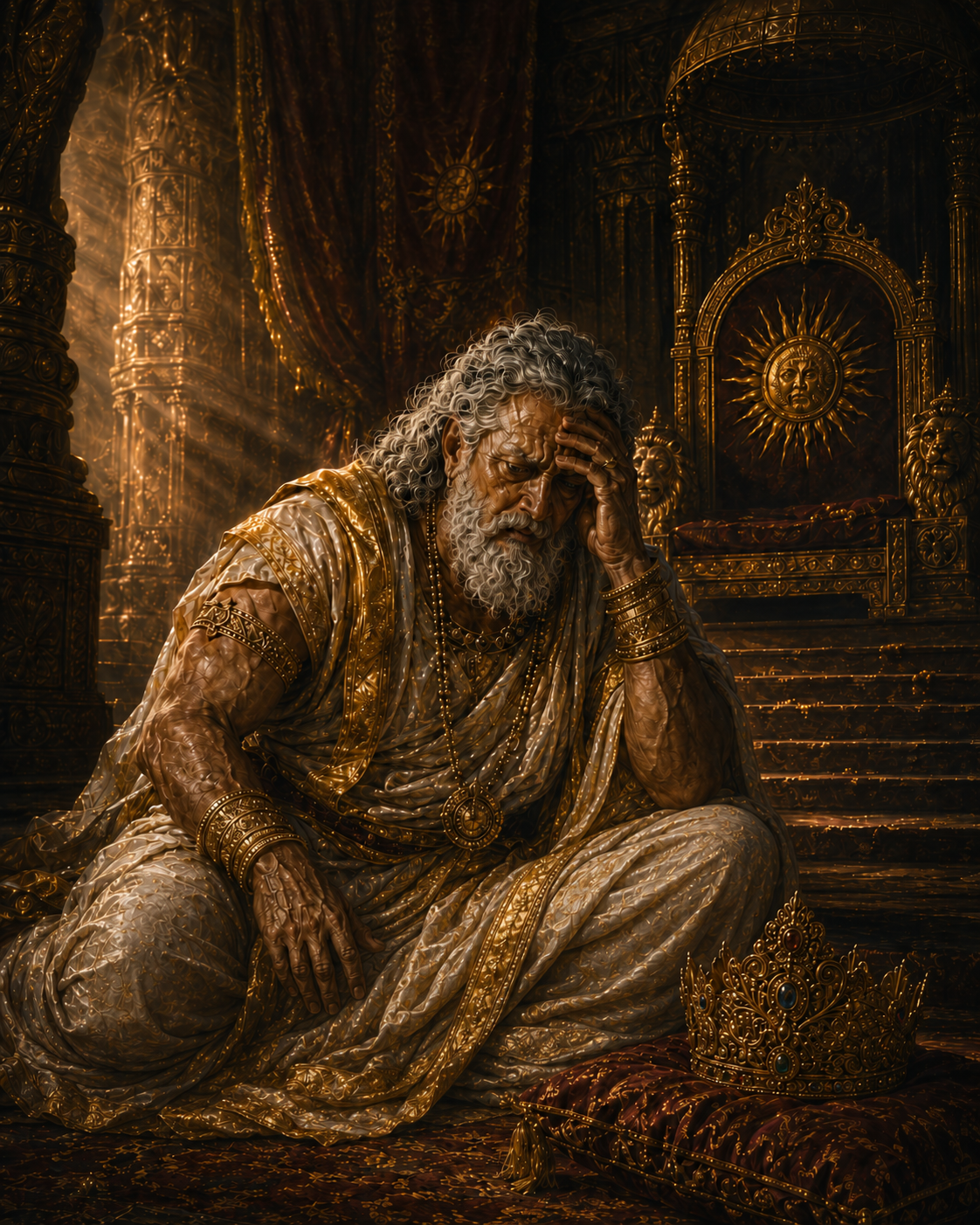
Dasharatha is the aged king of Kosala, ruler of Ayodhya, father of Rama, Bharata, Lakshmana, and Shatrughna, and one of the great tragic royal figures of the Ramayana. He is not a villain, a fool, or merely “Rama’s father.” He is a king whose virtues — devotion to oath, reverence for dharma, love of his son, and trust in royal speech — become the very forces that destroy him.
Dasharatha works best as a Named Major NPC: a tragic monarch, oath-bound patron, dynastic founder-figure, or dying king whose old decisions continue to govern the living after he is gone.
Overview
Dasharatha’s tragedy begins long before Rama’s exile. He is an old warrior-king without an heir, a ruler whose dynasty appears powerful but whose future is dangerously uncertain. The birth of his sons comes only after sacred rites, priestly intervention, and divine attention. Through the putrakameshti sacrifice, Dasharatha receives the sons who will secure his house — and, unknowingly, draw his household into the centre of divine history.
That matters for play. Dasharatha’s sons are not just children in a palace. They are the answer to a dynastic crisis, the fruit of sacrifice, and the centre of cosmic pressure. Rama’s exile is therefore not simply domestic betrayal. It is a rupture in succession, sacred kingship, royal law, and divine order.
Dasharatha should be played as a man who understands the seriousness of his own failure. He knows that Rama should inherit. He knows that Kaikeyi’s demand will ruin him. He knows that Ayodhya will grieve. Yet the boons he once granted Kaikeyi are not casual favours. They are royal speech. If the king’s own word can be broken when it wounds him, every treaty, oath, marriage settlement, land grant, and succession promise in the realm becomes weaker.
That is the cruelty of Dasharatha: he is most dangerous when he is trying to remain righteous.
Named Major NPC / Tragic Royal Patron
- Use Dasharatha when the campaign needs:
- A ruler whose command carries sacred and legal force.
- A succession crisis with no clean solution.
- A father whose love cannot save his son.
- A court where boons, oaths, queens, priests, servants, and old mistakes matter as much as armies.
- A dying king whose private grief becomes public disaster.
Appearance
Dasharatha is an old king who still carries the remains of a battlefield body. His shoulders are broad, his hands scarred by bow, rein, sword, and ritual gesture. Age has not made him small, but it has made him heavy. Every ornament on him looks inherited, earned, and burdensome.
In court, he wears gold, silk, jewels, sacred-thread regalia, and the signs of solar kingship. His crown does not look decorative. It looks like a weight pressing down through the spine. His voice still commands silence. Courtiers listen because they remember the king he was.
In private, after Kaikeyi’s demand, the same body becomes ruinous. He does not merely weep. He unravels. The old warrior who could face armies cannot bear the obedience of Rama.
Character
Dasharatha is affectionate, ceremonious, devout, proud, and deeply vulnerable to the obligations of speech. He believes that the king’s word participates in cosmic order. A promise is not a mood. A boon is not a courtly compliment. A vow does not expire because it becomes painful.
That belief makes him noble. It also makes him catastrophic.
He is not blind to court politics, but he underestimates the emotional damage caused by visible preference. Rama is his chosen heir, the beloved son, the obvious centre of public hope. Bharata is not unloved, but the court’s emotional weather has turned toward Rama. Kaikeyi’s fear, Manthara’s manipulation, and Bharata’s absence all exploit that imbalance. A weaker version of Dasharatha would be merely manipulated. The stronger version has helped create the conditions that trap him.
He is capable of judgment, ceremony, tenderness, and command. What he cannot do is turn back time.
Biography
Dasharatha’s early life belongs to chariots, campaigns, royal hunts, sacrificial fires, and frontier command. He is not a palace-bred weakling. His very name evokes the mastery of chariot warfare, and his memory should carry the thunder of wheels, horses, disciplined archery, and royal campaigns fought before the sons were born.
His reign over Kosala is prosperous but shadowed by one danger: he has no heir. This is not a private sorrow alone. A king without sons leaves ministers nervous, vassals calculating, queens politically exposed, and neighbouring rulers alert. Ayodhya may be rich, orderly, and sacred, but its future has a hollow place at the centre.
To answer that crisis, Dasharatha turns to sacrifice. The putrakameshti rite brings priestly order, divine notice, and the birth of the four princes. In myth-history terms, this is the moment when the royal household becomes the meeting point of dynastic need and divine intervention. The same ritual context that gives Dasharatha sons also places Rama within the larger answer to Ravana’s oppression of the worlds.
For years, the solution seems complete. Rama grows into the image of rightful kingship. Bharata, Lakshmana, and Shatrughna each take their places in the royal pattern. Dasharatha’s old fear of extinction gives way to a more dangerous confidence: the future appears secured.
Then he moves to crown Rama.
The decision is politically sensible. Rama is beloved, disciplined, and accepted. But it activates every buried tension in the palace: Kaikeyi’s insecurity, Manthara’s poison, Bharata’s absence, the hierarchy among queens, and the dangerous memory of old boons. Manthara pushes Kaikeyi to demand the two boons Dasharatha once promised: Bharata’s coronation and Rama’s fourteen-year exile. Dasharatha begs her to relent but admits he is bound by what he promised.
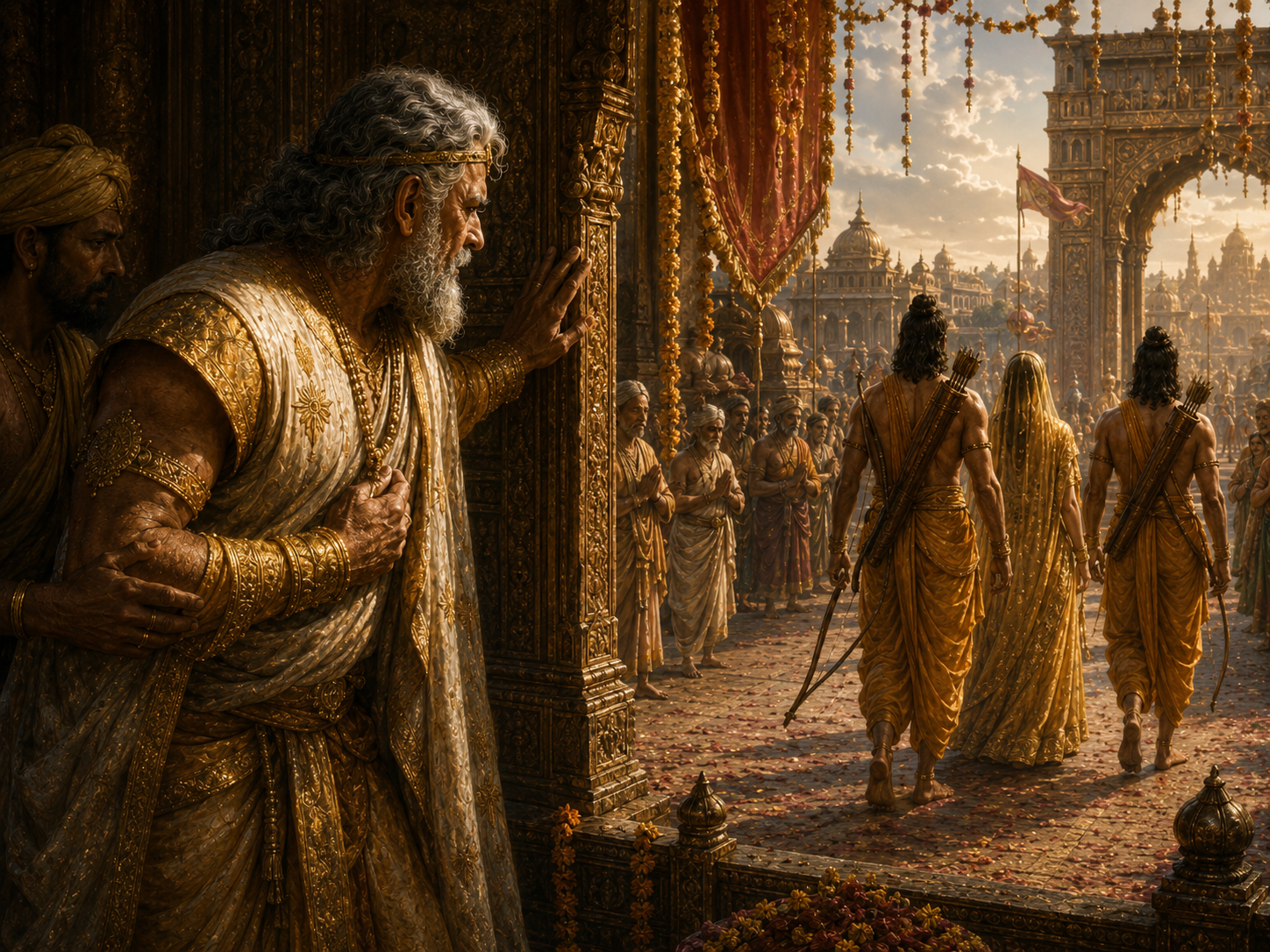
Rama’s response is what breaks him. Rama does not rebel, bargain, denounce Kaikeyi, or rescue his father from the oath. He accepts the exile because the king’s promise must be kept. The son becomes more obedient to the father’s word than the father can bear. Rama departs with Sita and Lakshmana, and the people of Ayodhya follow in grief before the exiles slip away at night.
After Rama leaves, Dasharatha collapses into grief. The strongest version of the story ties that grief to an earlier wound: the king remembers the killing of a boy, the son of blind parents, and understands his separation from Rama as the return of an old curse. Dasharatha lies delirious, repeats Rama’s name, and dies before Bharata and Shatrughna return from Kekaya.
His death does not end the crisis. It deepens it. Bharata returns to find the throne poisoned by legality, his father dead, Rama exiled, and his own name used in a scheme he did not desire. Dasharatha’s promise remains active even after death, because Rama continues to honour it. Bharata’s later regency under Rama’s sandals turns the empty throne into a visible accusation: the king is gone, the rightful heir is absent, and the dead king’s word still governs Ayodhya.
What Dasharatha Fears
- Dasharatha fears a kingdom without succession.
- He fears a king whose word is worthless.
- He fears that love has made him unjust.
- He fears that Bharata will be blamed for a crime he did not choose.
- He fears that Kaikeyi’s demand is lawful enough to obey and wicked enough to destroy him.
Most of all, he fears Rama’s obedience. A rebellious son could be opposed, negotiated with, punished, or forgiven. Rama’s perfect obedience leaves Dasharatha nowhere to hide.
What Dasharatha Wants
Dasharatha wants Rama crowned, Bharata honoured, the queens reconciled, the kingdom secure, and his old age completed under a son’s righteous rule.
After the crisis begins, his wants become smaller and more desperate. He wants Kaikeyi to withdraw the demand. He wants Rama to stay. He wants someone else to solve the contradiction between oath and love.
But Dasharatha is a king. His wants do not overrule his word.
Why He Does What He Does
Dasharatha acts from four pressures.
- Royal Speech: A king’s promise must mean something beyond convenience.
- Dynastic Fear: He has lived too long with the terror of no heir.
- Paternal Love: His attachment to Rama is real, visible, and politically consequential.
- Karmic Return: His final grief should feel like more than bad luck. The past comes back through the very kind of wound he once caused.
This makes him much more useful than a generic tragic father. Dasharatha is a campaign engine because his mistake is legally binding, morally unbearable, and spiritually meaningful.
The Court Crisis
Dasharatha’s court crisis should not be run as “evil queen tricks weak king.” That is too thin.
Run it as a locked room of lawful disaster.
The Pressure Points
- The Boons Are Real: Dasharatha did grant them. Denying this damages royal legitimacy.
- Kaikeyi Has Standing: She is not an outsider. She is a queen, Bharata’s mother, and a lawful claimant to the king’s promise.
- Manthara Weaponizes Fear: Manthara’s argument works because it speaks to real court hierarchy. Once Rama is king, Kausalya’s status rises.
- Bharata Is Absent: His absence makes the demand uglier. No one can ask whether he wants the throne.
- Rama Accepts: Rama’s obedience removes the easiest political solution. He will not become the excuse for rebellion.
- Dasharatha Is Dying in Public: His collapse turns every private decision into state crisis.
What the Players Can Actually Do
- Do not give the party a simple “stop the exile” button unless you want to break the mythic structure. Better options are:
- Recover the exact wording of the boons.
- Determine whether Kaikeyi can be ritually released from demanding them.
- Protect Rama on the first road into exile.
- Prevent rival factions from using Dasharatha’s collapse to seize power.
- Keep Bharata alive and politically clean until he returns.
- Expose Manthara’s manipulation without flattening Kaikeyi into a cartoon villain.
- Find the old curse or its witness and understand why Dasharatha believes the grief has come due.
- Secure the funeral rites before the succession crisis becomes supernatural unrest.
Court Factions
- Kausalya’s Household: Grief-stricken, loyal to Rama, tempted toward accusation.
- Kaikeyi’s Household: Defensive, legalistic, fearful of retaliation.
- Sumitra’s Household: Quieter, stabilizing, more concerned with Lakshmana and the survival of the royal house.
- The Priests: Divided between vow-law, ritual remedy, and fear of cosmic consequence.
- The Ministers: Terrified of civil disorder.
- The City: Loves Rama and may riot if grief finds a target.
- Foreign Eyes: Rival courts and hostile supernatural powers see opportunity in Ayodhya’s paralysis.
Court Crisis Table: 10 Escalating Complications
Use this table when Dasharatha’s court is already under pressure: Rama’s coronation is near, Kaikeyi has entered the anger-chamber, the two boons are being invoked, or Ayodhya has begun to understand that something is wrong.
| d10 | Escalating Complication |
|---|---|
| 1 | The Festival Starts Too Early. Musicians, garland-bearers, elephant-handlers, and temple servants begin the coronation procession before the palace has announced the crisis. Stopping them risks panic; allowing them to continue turns the city’s joy into public humiliation when the truth emerges. |
| 2 | The Exact Boon Is Disputed. A minister claims Dasharatha promised Kaikeyi “two honours,” not two unlimited demands. Kaikeyi’s household produces an elderly witness who remembers otherwise. The party must find records, witnesses, or ritual precedent before each faction declares the other false. |
| 3 | Manthara Vanishes. The servant whose counsel hardened Kaikeyi’s demand disappears into the women’s quarters, a temple storehouse, or a merchant convoy leaving Ayodhya. Kausalya’s allies want her seized and beaten; Kaikeyi’s allies call that an attack on the queen’s household. |
| 4 | Rama Refuses Rescue. Loyal guards, young nobles, or citizens quietly ask the party to help remove Rama from the palace and crown him by force. Rama learns of the plan and forbids it. The party must choose between political common sense and Rama’s obedience to his father’s word. |
| 5 | The City Finds a Villain. Rumours spread that Bharata plotted the exile from afar. Crowds gather near properties tied to Kaikeyi’s kin. Bharata is absent and cannot defend himself, making the accusation both useful and dangerous. |
| 6 | The Priests Divide. One priest argues that a king’s boon cannot be revoked; another argues that a boon used to wound dharma becomes ritually polluted. Their disagreement spills into public ritual, delaying coronation rites, funeral rites, or the formal exile declaration. |
| 7 | The Old Curse Returns. Dasharatha, delirious with grief, speaks of the youth he once killed by mistake and the blind parents who cursed him to die from separation from his son. The confession creates a new crisis: some call Rama’s exile karmic necessity, while others demand immediate rites to break the curse. |
| 8 | A Border Lord Mobilizes. News of Ayodhya’s paralysis reaches a rival ruler, forest chieftain, rakshasa agent, or ambitious vassal. Scouts report troops moving, tribute being withheld, or frontier shrines being profaned. The court must respond without a functioning king or crowned heir. |
| 9 | Bharata Returns Before the Court Is Ready. Bharata arrives unexpectedly from Kekaya and finds servants whispering, guards divided, his father dying or dead, and Rama gone. Every faction tries to reach him first. If the party fails to control the first hour, Bharata may be framed, attacked, crowned by force, or driven into public rage. |
| 10 | The Throne Rejects Easy Settlement. Omens gather around the empty throne: lamps gutter, royal elephants refuse their handlers, ancestral weapons fall from their stands, or the sandals of Rama become the only object before which the court grows still. The crisis cannot be solved by paperwork alone. Someone must publicly define who rules, in whose name, and at what spiritual cost. |
Using the Court Crisis Table
The table works best if each result narrows the players’ freedom rather than simply adding noise. The pressure should move from private palace problem to public succession crisis to sacred and political rupture.
For a strong sequence, use:
1–3 before the exile is formally announced.
4–6 once the court understands the boons.
7–8 as Dasharatha begins to fail.
9–10 after Rama leaves or as Bharata returns.
The strongest campaign version lets the players prevent riots, murders, forged documents, factional revenge, and foreign opportunism — but not easily erase the tragic heart of the story.
Scene Uses
The Coronation Prepared
Ayodhya is dressed for Rama’s coronation. Musicians rehearse, elephants are painted, garlands hang from gates, and the city expects joy. The party enters the palace as servants whisper that Kaikeyi has entered the anger-chamber.
The scene should feel like a festival already turning into a funeral.
The Anger-Chamber
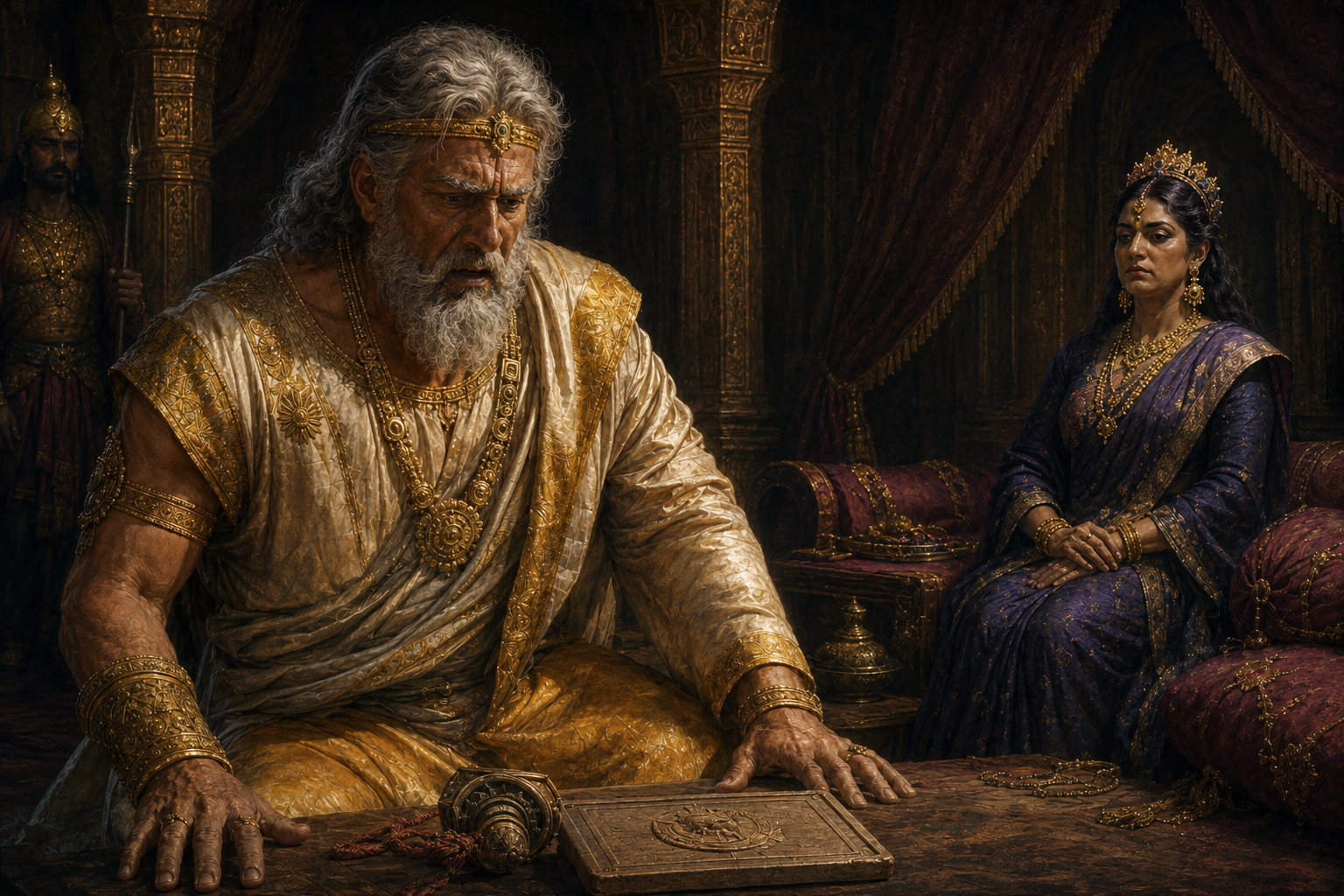
Kaikeyi lies on the floor stripped of ornaments or enthroned in cold stillness, depending on tone. Dasharatha enters expecting affection and meets a legal demand. The party may be present as guards, witnesses, priests, foreign envoys, or agents of a queen.
The important question is not “can they persuade her?” but “what price would release the king from his own word?”
The King Cannot Rise
After the demand, Dasharatha is alive but politically unusable. He cannot lead, cannot revoke, cannot bless, and cannot bear to see Rama. Ministers need decisions. The party may have to act under partial authority from a king who can no longer function.
The Exile Road
Rama, Sita, and Lakshmana leave the city. The people follow. The party’s job may be to protect the exiles without interfering, misdirect hostile agents, stop citizens from dying on the road, or prevent a faction from staging a “rescue” that Rama would reject.
The Deathbed
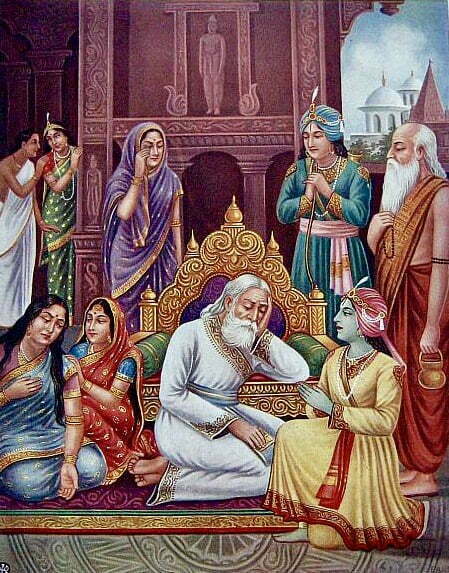
Dasharatha speaks in fragments: Rama’s name, Kaikeyi’s demand, the old killing, the blind parents’ curse, the sound of water mistaken for prey. This scene can reveal why his grief has supernatural weight.
Bharata Returns
Bharata returns from Kekaya and finds a throne prepared in his name, a father dead, and a brother exiled. This is a dangerous moment. If the party mishandles it, Bharata becomes a symbol for rebellion, guilt, or factional revenge. If they handle it well, he becomes the moral counterweight to the crisis.
Allies and Complications
Rama
Dasharatha’s beloved son and intended heir. Rama’s obedience is not passive. It is the force that preserves the king’s word after the king himself breaks under it.
Bharata
Bharata is the great complication. He benefits from the demand but did not make it. If treated as a villain, the story becomes weaker. His innocence makes the court crisis sharper.
Kaikeyi
Kaikeyi should be formidable. She is not simply “the wicked queen.” She invokes a real promise and uses lawful speech to achieve a terrible result. She is more dangerous if she believes she is defending Bharata’s future, correcting Kausalya’s rising status, or claiming what Dasharatha freely offered.
Manthara
Manthara is the spark in dry timber. She does not create every tension, but she knows where to press. She is ideal as a social antagonist: servant, whisperer, memory-keeper, and exploiter of household fear.
Kausalya
Kausalya embodies the cost paid by those who did not make the promise. She should not be reduced to grief alone. Her status, dignity, and maternal authority matter.
Sumitra
Sumitra is the stabilizer. She may understand most clearly that the dynasty must survive even when happiness cannot.
Sumantra
The charioteer and witness. Use him as the man who knows the road, hears what princes say when the court is gone, and carries unbearable messages back to the palace.
Vashishta
The priestly anchor of the court. He understands that the crisis is not merely emotional. It involves vow, ritual, kingship, and cosmic order.
Secrets
Choose only the ones that improve the campaign. Do not use all of them.
The Exact Boon Wording Is Narrower Than Kaikeyi Claims: The demand may be lawful, but its enforcement may be open to interpretation.
Dasharatha Rushed the Coronation: He feared age, omens, or political movement around Bharata’s absence.
The Curse Is Active: Dasharatha’s death is not simply grief. It is the return of the old wound caused when he killed the son of blind parents.
Kaikeyi Can Release Him, But Only Publicly: She must surrender honour before the court, not merely change her mind in private.
Bharata Was Deliberately Kept Away: Someone ensured he could not refuse the throne before the demand was made.
Rama Knows More Than He Says: Rama may understand that exile is necessary for a cosmic purpose, even while accepting it as obedience to his father.
Adventure Hooks
1. The Boon Ledger
A palm-leaf record or sealed witness statement preserves the exact promise Dasharatha made to Kaikeyi. Every faction wants it: Kaikeyi to prove her claim, Kausalya to test its limits, ministers to preserve order, and enemies to burn the court down.
2. The Anger-Chamber Witness
A servant heard the first version of Kaikeyi’s demand before Manthara refined it. That witness has vanished into the women’s quarters, temple kitchens, or a caravan leaving Ayodhya.
3. The Chariot After Midnight
Sumantra must drive Rama, Sita, and Lakshmana away from the grieving city. The party rides ahead to clear the road, silence assassins, and prevent loyal citizens from turning exile into riot.
4. The Curse by the River
Dasharatha’s delirium reveals the old killing. The party must find the river-place, perform rites for the dead youth and his blind parents, and determine whether the curse can be eased before the king dies.
5. The Unwanted King
Bharata returns. Court factions are ready to crown him, kill Manthara, imprison Kaikeyi, or declare Rama’s exile void. The party must keep Bharata alive long enough for him to refuse what was done in his name.
6. The Sandals on the Throne
If Rama will not return, Bharata needs a symbol strong enough to hold the realm together. The party must escort Rama’s sandals back to Ayodhya while enemies try to capture, counterfeit, or profane them.
Edition Tabs
Dasharatha, King of Ayodhya 5.5e / 2024
Dasharatha Pathfinder 1e
Dasharatha, King of Ayodhya 5.5e / 2024
Medium Humanoid, Lawful Good
Armor Class 17 ceremonial armor, royal guard discipline
Hit Points 126
Speed 30 ft.
| STR | DEX | CON | INT | WIS | CHA |
|---|---|---|---|---|---|
| 15 (+2) | 12 (+1) | 14 (+2) | 16 (+3) | 18 (+4) | 21 (+5) |
Saving Throws Wis +8, Cha +9
Skills History +7, Insight +8, Intimidation +9, Persuasion +9, Religion +7
Senses passive Perception 14
Languages Sanskrit, Kosalan court speech, regional diplomatic tongues
Challenge 9
Proficiency Bonus +4
Traits
King of the Solar Line. Dasharatha has advantage on Charisma checks made to command lawful subjects of Kosala, royal soldiers, ministers, envoys, and court officers who recognize his authority.
Oath-Bound Sovereign. Dasharatha has advantage on saving throws against any effect that would force him to break a sworn promise, royal decree, treaty, boon, or sacred obligation. If he willingly breaks such an oath, he loses King of the Solar Line for 7 days and cannot use Legendary Actions during that time.
Boon Once Granted. Once per day, when Dasharatha knowingly grants a boon, favour, pardon, or royal promise, the statement becomes spiritually weighty. Until fulfilled, any creature attempting to conceal, falsify, or obstruct the promise within Dasharatha’s court must succeed on a DC 17 Charisma saving throw or suffer disadvantage on Deception checks related to that promise for 24 hours.
Old Chariot-Lord. While mounted in a chariot or commanding one within 30 feet, Dasharatha and allied chariot-crews within 30 feet gain a +2 bonus to initiative and Wisdom saving throws against fear.
Loved by Ayodhya. In Ayodhya, Dasharatha can call ordinary aid from palace guards, priests, attendants, servants, or citizens unless the city is under coup, divine interdiction, mass panic, or open succession conflict.
Grief of the Son-Severed King. If Dasharatha is separated from Rama by exile, curse, or binding royal command, he has disadvantage on Constitution saving throws against exhaustion, disease, and magical grief effects. While under this grief, he cannot regain hit points above half his maximum unless ritually consoled, released from the oath, or reconciled to Rama’s departure.
Actions
Multiattack. Dasharatha makes two Royal Sword attacks or one Royal Sword attack and uses Command the Court.
Royal Sword. Melee Weapon Attack: +6 to hit, reach 5 ft., one target. Hit: 9 slashing damage.
Command the Court. Dasharatha targets up to three creatures within 60 feet that can hear and understand him. Each target must make a DC 17 Wisdom saving throw. On a failure, a hostile target cannot take reactions until the end of Dasharatha’s next turn. An allied target may instead move up to half its speed without provoking opportunity attacks.
Pronounce Royal Judgment. Dasharatha names one creature he can see within 60 feet. Until the start of his next turn, the first attack roll or Charisma check made by one of Dasharatha’s allies against that creature has advantage.
Invoke the Boon. Dasharatha names a sworn promise, boon, treaty, or obligation known to the target. One creature within 60 feet that can hear him must make a DC 17 Charisma saving throw. On a failure, the creature cannot knowingly deny the existence of that obligation for 1 minute, though it may still argue interpretation, legality, or consequence.
Bonus Actions
Royal Reassurance. One allied creature within 30 feet that can hear Dasharatha may immediately end the frightened condition on itself, provided the fear was not caused by a deity, avatar, major fiend, or cosmic curse.
Order the Chariot. One allied mount, chariot, or vehicle crew within 60 feet may move up to half its speed.
Reactions
The King Has Spoken. When a creature within 60 feet openly defies a lawful royal command, Dasharatha may force that creature to make a DC 17 Charisma saving throw. On a failure, the creature has disadvantage on its next attack roll, ability check, or saving throw before the end of its next turn.
A Promise Is Not Wind. When a creature Dasharatha can hear lies about a sworn promise, boon, succession claim, or royal decree, Dasharatha may impose disadvantage on that creature’s Deception check.
Legendary Actions
Dasharatha can take 2 legendary actions, choosing from the options below.
Measure the Hall. Dasharatha makes a Wisdom (Insight) check.
Command Movement. One allied creature within 30 feet may move up to half its speed without provoking opportunity attacks.
Name the Obligation Costs 2 Actions. One creature within 60 feet that can hear Dasharatha must succeed on a DC 17 Wisdom saving throw or be unable to speak against a known lawful obligation until the end of its next turn. This does not force agreement; it forces silence before acknowledged duty.
Dasharatha, King of Ayodhya
, Pathfinder 1e
Male venerable human aristocrat 10 / cavalier 5
LG Medium humanoid
Init +1; Senses Perception +16
AC 22, touch 11, flat-footed 21
hp 128
Fort +10, Ref +7, Will +16
Speed 30 ft.
Melee +2 ceremonial longsword +16/+11/+6
Special Attacks challenge 2/day, tactician, royal command, invoke boon
Str 14, Dex 12, Con 13, Int 16, Wis 18, Cha 22
Skills Diplomacy +27, Knowledge (history) +19, Knowledge (nobility) +22, Knowledge (religion) +19, Perception +16, Ride +14, Sense Motive +25
Feats Persuasive, Leadership, Skill Focus (Diplomacy), Iron Will, Mounted Combat, Noble Scion, Improved Initiative, Mounted Archery
Languages Sanskrit, Kosalan, regional court tongues
Special Abilities
Royal Command (Ex): Three times per day, Dasharatha may issue a formal royal command to allies within 60 feet. Affected allies gain a +2 morale bonus on attack rolls, saving throws against fear, and Diplomacy checks for 1 minute, provided the command upholds recognized law, succession, oath, or royal duty.
Invoke Boon (Su): Once per day, Dasharatha may call attention to a sworn boon, promise, treaty, or royal obligation. One creature within 60 feet that can hear him must succeed at a DC 20 Will save or be unable to knowingly deny the obligation for 1 minute. The creature may still dispute interpretation or consequence.
Oath-Bound Sovereign (Su): Dasharatha gains a +4 bonus on saving throws against effects that would force him to violate a sworn oath. If he willingly breaks a royal oath, he loses Royal Command and Invoke Boon for 7 days and takes a -4 penalty on Charisma-based checks against lawful subjects until ritually absolved.
Grief of Separation (Su): If Rama is exiled by Dasharatha’s command, Dasharatha takes a -4 penalty on saving throws against grief, despair, exhaustion, curse, and death effects until the exile is ended, ritually resolved, or accepted through divine intervention.
Equipment and Treasure
Dasharatha’s treasure should be royal, symbolic, and politically dangerous. He is not best used as a loot pile.
Personal Equipment: +2 ceremonial longsword, royal signet ring, solar dynastic regalia, gold-threaded court robes, sacred-thread ornaments, oath tablets, chariot fittings of ivory and gold, sealed royal decrees.
Royal Treasury Access: Dasharatha can grant gems, elephants, horses, land charters, priestly gifts, temple endowments, marriage settlements, military commissions, safe-conduct seals, and pardons.
Specific PC Reward Parcel: A party that serves Dasharatha well might receive:
2,000–5,000 gp in gems, worked gold, or courtly gifts.
A royal safe-conduct seal recognized across Kosala.
One trained warhorse or a share in a royal chariot team.
A land grant, tax privilege, or hereditary favour.
A sealed command that can open palace, temple, or military doors.
A minor blessing attached to oath-keeping.
A dangerous letter revealing what Dasharatha truly intended before Kaikeyi invoked the boons.
Use in Play
Dasharatha is strongest when the players cannot simply “fix” him.
He should create decisions like these:
Do you obey the king’s word when the king himself is destroyed by it?
Do you protect Rama’s exile, even if you believe the exile is unjust?
Do you expose Kaikeyi and risk civil disorder?
Do you preserve Bharata’s innocence when the city wants someone to blame?
Do you uphold oath-law knowing it can be weaponized?
Do you seek ritual release, legal loophole, political compromise, or divine judgment?
The wrong way to use Dasharatha is as a quest-giving monarch who dies off-screen. The right way is to make his court a place where every answer has a cost.
Source and Literary Context
Dasharatha is a central royal figure in the Ramayana, the Sanskrit epic traditionally attributed to Valmiki. He is the king of Ayodhya, father of Rama, and the monarch whose promise to Kaikeyi results in Rama’s fourteen-year exile. For general literary background, see Encyclopaedia Britannica’s article on the Ramayana.
The putrakameshti sacrifice, the two boons of Kaikeyi, Rama’s exile, Dasharatha’s grief, Bharata’s return, and the rule conducted in Rama’s name are the essential episodes to preserve when adapting him for game use. The best adaptation does not treat these events as decorative backstory; they are the machinery of the character.
Keep this reference growing
If this page helped with your reading or game, you can support its upkeep or explore the curated books.
Explore the Bookshop — epics, classics and stories behind imagined worlds.