
John Wilmot — The Wicked Earl
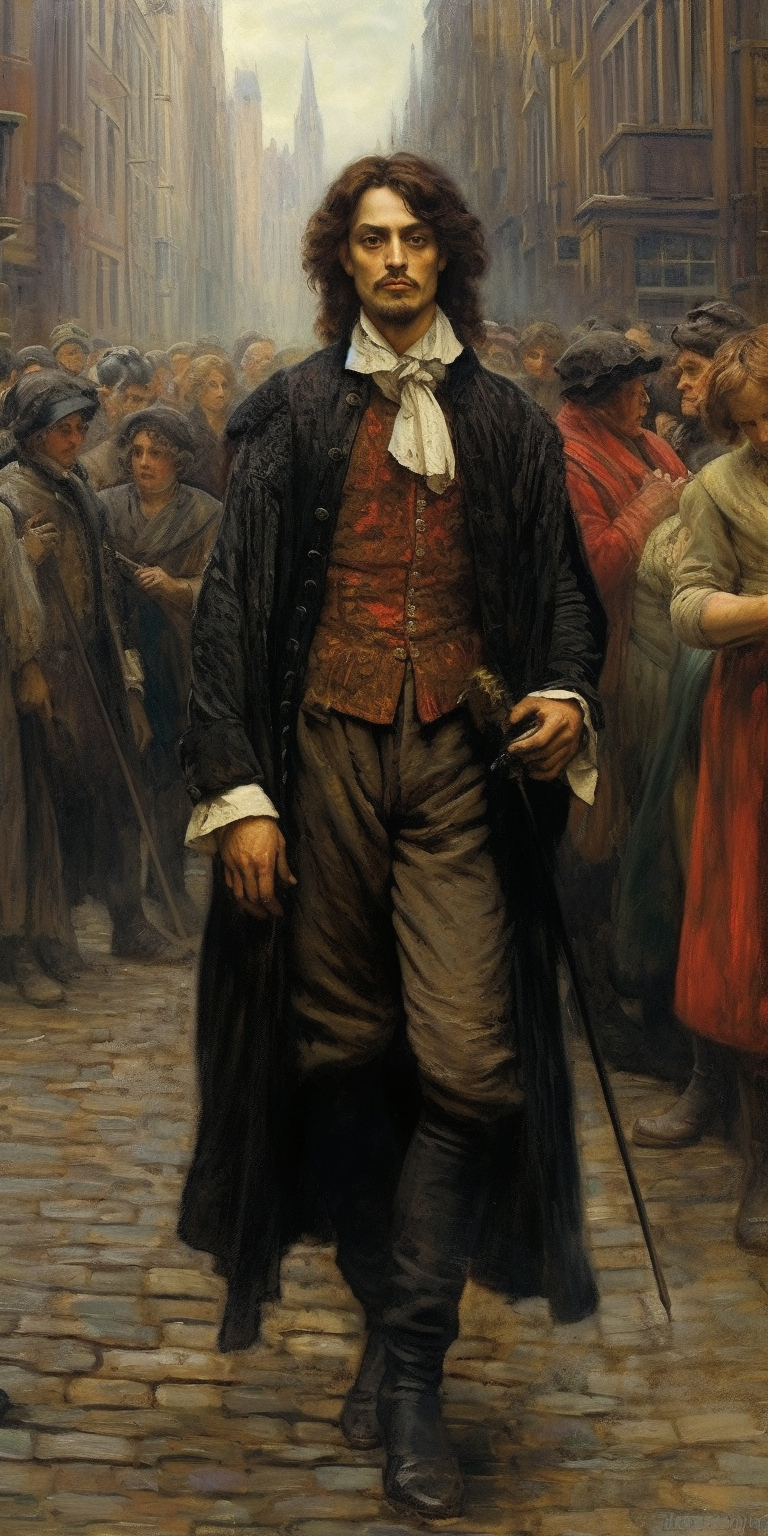
John Wilmot is dangerous because he can make cruelty sound clever and truth sound like a joke. A gifted poet, courtier and heir with enough rank to survive behaviour that would ruin poorer men, he uses performance to keep everyone guessing where amusement ends and judgement begins.
In the campaign’s London, Wilmot is a young earl whose verses travel through court faster than official proclamations. He can destroy a reputation with four lines, expose hypocrisy without naming anyone and then insist the entire room misunderstood him. Adventurers may need his access, his memory or his willingness to say what respectable people will not.
At a Glance
- Name: John Wilmot
- Known as: The Wicked Earl
- Species: Human
- Age: Late twenties
- Base: London and the English court
- Role: Earl, poet, courtier, satirist and scandal source
- Alignment: Chaotic Neutral
- Campaign status: Alive and active
- Campaign use: Unreliable patron, social weapon, court contact, satirist, witness or political complication
Game Statistics
5.5e / 2024
John Wilmot
Medium Humanoid (Human), Chaotic Neutral
Armor Class 15
Hit Points 62 (10d8 + 20)
Speed 30 ft.
| STR | DEX | CON | INT | WIS | CHA |
|---|---|---|---|---|---|
| 10 (+0) | 16 (+3) | 14 (+2) | 16 (+3) | 13 (+1) | 20 (+5) |
Saving Throws Dex +6, Cha +8
Skills Deception +11, History +6, Insight +4, Performance +11, Persuasion +8
Senses passive Perception 11
Languages English, French
Challenge 5 (1,800 XP; PB +3)
Traits
Courtly Mask. Wilmot has Advantage on Deception checks made to hide serious intent behind humour, flirtation or drunken-seeming behaviour.
Dangerous Memory. Wilmot has Advantage on checks to remember insults, rumours, private remarks and the exact wording of conversations heard during the previous month.
Cutting Satire. When a creature within 30 feet makes a Deception or Persuasion check, Wilmot can use his Reaction to subtract 1d6 from the roll if he can expose a hypocrisy, contradiction or embarrassing truth relevant to the attempt.
Actions
Rapier. Melee Attack Roll: +6, reach 5 ft. Hit: 7 (1d8 + 3) Piercing damage.
Dagger. Melee or Ranged Attack Roll: +6, reach 5 ft. or range 20/60 ft. Hit: 5 (1d4 + 3) Piercing damage.
Ruin the Moment (Recharge 5–6). One creature within 30 feet that can hear Wilmot must succeed on a DC 16 Charisma saving throw or lose its composure until the end of its next turn. It cannot take Reactions and has Disadvantage on Charisma checks.
John Wilmot — 5e / 2014
Medium humanoid (human), chaotic neutral
Armor Class 15; Hit Points 62; Speed 30 ft.; Challenge 1 (200 XP; proficiency bonus +2, personal combat only).
STR 10 (+0), DEX 16 (+3), CON 14 (+2), INT 16 (+3), WIS 13 (+1), CHA 20 (+5).
Saving Throws Dex +5, Cha +7; Skills Deception +9 (expertise), History +5, Insight +3, Performance +9 (expertise), Persuasion +7; Senses passive Perception 11; Languages English, French.
Traits
Courtly Mask. Wilmot has advantage on Charisma (Deception) checks to conceal serious intent beneath a joke, flirtation or apparently drunken behaviour.
Dangerous Memory. Wilmot has advantage on Intelligence checks to recall the wording of conversations and rumours he has heard in the previous month.
Actions
Rapier. Melee Weapon Attack: +5 to hit, reach 5 ft., one target. Hit: 7 (1d8 + 3) piercing damage.
Dagger. Melee or Ranged Weapon Attack: +5 to hit, reach 5 ft. or range 20/60 ft., one target. Hit: 5 (1d4 + 3) piercing damage.
Ruin the Moment (Recharge 5–6). One creature within 30 feet that can hear Wilmot makes a DC 15 Charisma saving throw. On a failure it cannot take reactions and has disadvantage on Charisma checks until the end of its next turn.
Reaction
Cutting Satire. When a creature within 30 feet that can hear him makes a Charisma (Deception) or Charisma (Persuasion) check, Wilmot can subtract 1d6 from the roll if he knows and can expose an actual contradiction, hypocrisy or embarrassing truth relevant to the claim.
Original 2014 adaptation of the campaign’s fictional 1454 courtier, not a claim that the seventeenth-century historical poet lived in this period. His greater influence is social rather than combat-based.
Pathfinder 1e
John Wilmot CR 5; human aristocrat 3/bard 4; CN Medium humanoid.
AC 17, touch 14, flat-footed 13; hp 45; Fort +4, Ref +7, Will +7.
Melee mwk rapier +8 (1d6/18–20); Bardic Performance 12 rounds/day.
Str 10, Dex 16, Con 13, Int 16, Wis 13, Cha 20. Feats Persuasive, Skill Focus (Perform [oratory]), Weapon Finesse. Skills Bluff +16, Diplomacy +15, Knowledge (nobility) +14, Perform (oratory) +18, Sense Motive +10.
D&D 3.5e
John Wilmot CR 5; human aristocrat 3/bard 4; CN Medium humanoid.
AC 16; hp 40; Fort +4, Ref +7, Will +7; Melee masterwork rapier +8 (1d6/18–20); bardic music 4/day.
Abilities Str 10, Dex 16, Con 13, Int 16, Wis 13, Cha 20. Feats Negotiator, Persuasive, Skill Focus (Perform), Weapon Finesse. Skills Bluff +16, Diplomacy +15, Gather Information +16, Knowledge (nobility and royalty) +14, Perform +18, Sense Motive +10.
What Is John Wilmot Doing Right Now?
Wilmot has written a vicious satire about a court faction that is suddenly circulating in several different versions. One version contains two lines he did not write. Those lines point toward a private meeting involving copied seals and a household officer linked to the forged-warrant crisis already troubling London.
Wilmot wants to know who altered his work, partly because the forgery is politically dangerous and partly because stealing his voice offends him personally.
Encounters
Wilmot performs even when no stage exists. He watches how people respond to insult, praise, flirtation and mockery, then chooses whichever makes them reveal the most. A serious question often receives a joke first and the real answer five minutes later.
He respects people who refuse to be dazzled by him. He is drawn to adventurers who have already survived public disgrace because they are harder to threaten with it.
Personality
Brilliant, restless, provocative and self-destructive, Wilmot is often most cruel when he feels sincerely exposed. He can recognise hypocrisy in others while remaining astonishingly tolerant of his own.
He values wit as proof of intelligence and sometimes mistakes cleverness for wisdom.
Relationships
Sir Charles Sedley: friend, rival and one of the few courtiers whose wit Wilmot cannot safely dismiss.
Fanny Murray: perceptive enough to know when his performance is hiding genuine fear.
George Selwyn: another observer who notices social ugliness instead of pretending not to see it.
Court rivals: numerous, amused in public and patient in revenge.
Equipment and Resources
- Rapier and dagger
- Fine court clothing
- Notebook of satires, fragments and private observations
- Letters and invitations
- Household servants and messengers
- Access to noble gatherings where direct questioning would be impossible
Adventure Hooks
- The Stolen Lines: two politically explosive lines are added to Wilmot’s poem. He wants the imitator found before the wrong faction retaliates.
- The Unwelcome Patron: someone offers to buy every copy of a satire before Wilmot has publicly admitted writing it.
- The Drunken Truth: Wilmot says something accurate at a feast while pretending to be far less sober than he is.
- The Ruined Name: an innocent courtier’s reputation collapses because a forged verse is attributed to Wilmot.
- Sedley’s Challenge: Sedley asks the party to keep Wilmot alive through a gathering where three offended men are carrying swords.
Connected Places and People
Mythical and Historical Context
Campaign chronology: John Wilmot, the historical second Earl of Rochester, lived from 1647 to 1680. The 1454 courtly satirist bearing his name is a fictional adaptation rather than his actual life, and the literary style is deliberately reimagined for the earlier court. For Wilmot’s original career and poetry, see the Poetry Foundation biography.
John Wilmot, Earl of Rochester, was a seventeenth-century English courtier and poet famed for satire, wit and scandal. This campaign version translates that reputation into the fifteenth-century English court.
Rules Notes
The game statistics and campaign relationships on this page are original adaptations designed for play in the stated rules editions.
Keep this reference growing
If this page helped with your reading or game, you can support its upkeep or explore the curated books.
Explore the Bookshop — epics, classics and stories behind imagined worlds.