
Thoosa — Sea Nymph, Mother of Polyphemus, and Daughter of Phorcys
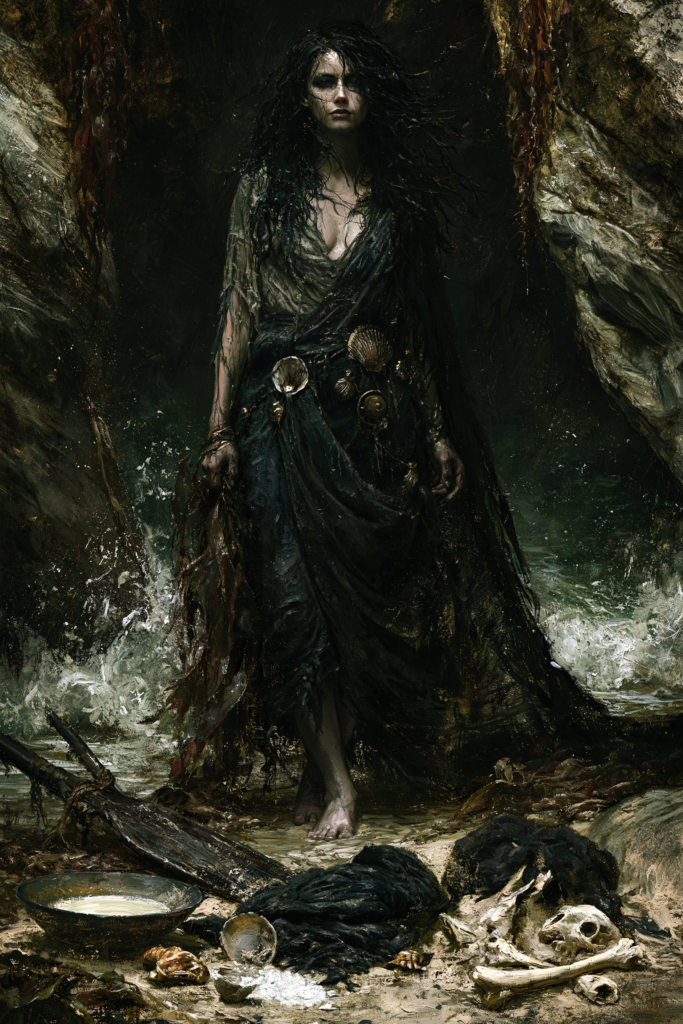
Thoosa is the sea-nymph mother of Polyphemus, the hidden maternal power that binds the Cyclops to Poseidon’s wrath and the older depths of Phorcys.
- Divine Name: Thoosa, also written Thoösa
- Divine Type: Sea nymph / minor marine divinity
- Lineage: Daughter of Phorcys
- Consort: Poseidon
- Known Child: Polyphemus
- Associated Powers: Swift currents, sea caves, cyclopean bloodlines, dangerous coastal waters, old marine ancestry
- Primary Mythic Function: Ancestral mother of Polyphemus and the link between the Cyclops, Poseidon, and the elder sea-powers of Phorcys
Overview
Thoosa is a sea nymph of Greek myth, remembered chiefly as the mother of Polyphemus. She is not a great public goddess or ruler of temples, but her lineage matters. Through her, the Cyclops belongs to the older marine world as well as to Poseidon’s storm-governed sea.
This makes Polyphemus more than a cave-dwelling brute. He is the child of a sea nymph descended from Phorcys and a sea-god whose anger can pursue a mortal across the world. When Odysseus blinds Polyphemus, the injury is not merely done to a monster. It strikes a being whose bloodline reaches into divine water, old caves, and the dangerous memory of the sea.
Thoosa’s campaign value is precise. She gives depth to Polyphemus, weight to Poseidon’s vengeance, and sacred meaning to cyclopean coasts, sea caves, and old island rites. She should feel less like a public goddess with priests and statues, and more like a name whispered where the tide enters stone.
Divine Nature
Thoosa is a marine nymph of dangerous ancestry: swift, hidden, and bound to the sea where it cuts into cliffs, floods caves, and erases tracks from the shore. Her divinity is not imperial or civic. It is ancestral, local, and difficult to separate from place.
Her power is best understood through blood and coast. A creature born from her line is not simply large, monstrous, or strange; it belongs to the old sea. Harm done to that bloodline can travel outward into storm, tide, omen, and divine resentment.
Mythic Role
Thoosa’s mythic role is genealogical and atmospheric. She gives Polyphemus a mother and places him within a specific divine ancestry. Through her, the Cyclops is tied to Phorcys, an elder marine power associated with the stranger and more hidden regions of the sea.
That role matters most after Polyphemus is blinded. His appeal to Poseidon is not the complaint of an ordinary defeated foe. It is the cry of a divine child whose injury calls the sea into judgement. Thoosa stands behind that moment as the maternal depth of the story: quiet, rarely named, but essential to the force of the curse that follows.
Sacred Geography
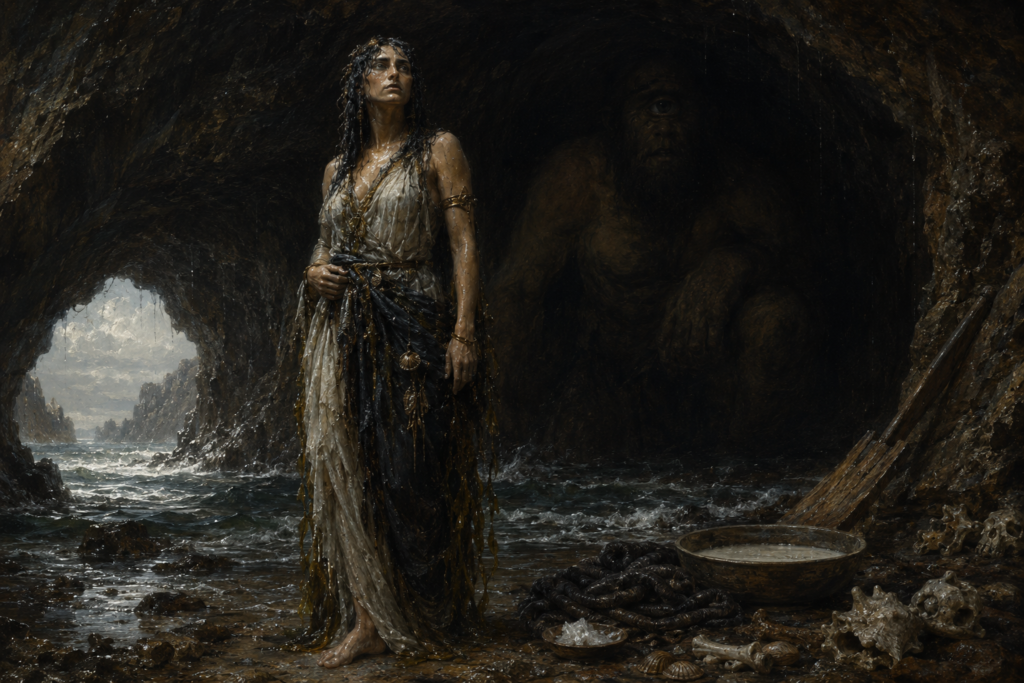
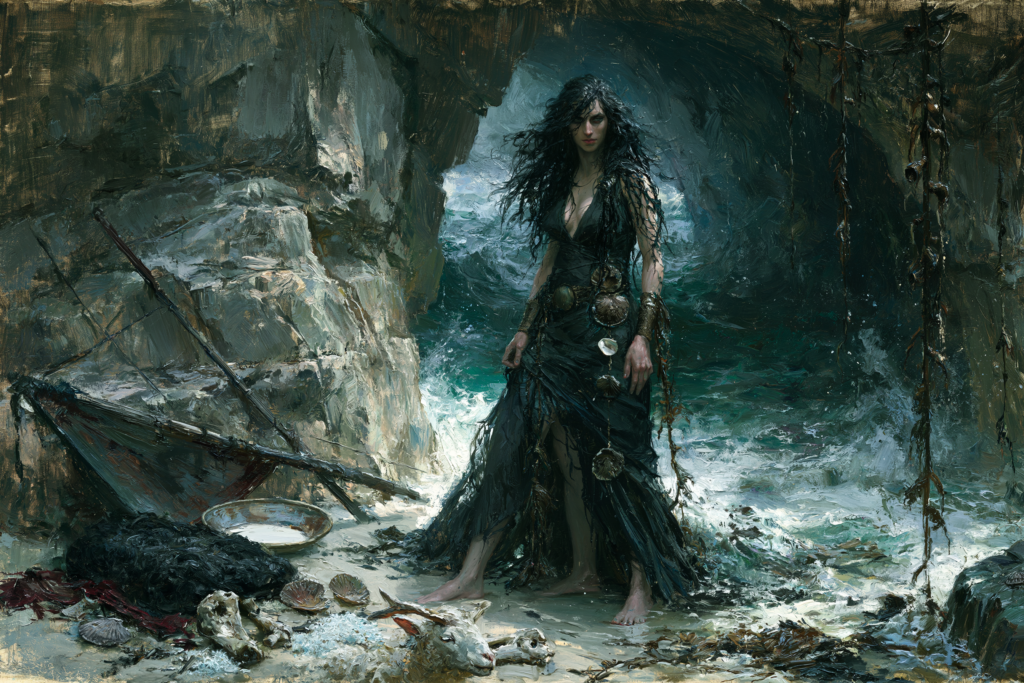
Thoosa belongs to difficult coastlines: sea caves, black reefs, hidden coves, storm-cut islands, drowned ledges, and places where the tide seems to enter stone with intention. She is not naturally associated with bright harbours or polished city temples. Her sacred places are older, wetter, and less comfortable.
In campaign use, her presence may be strongest near cyclopean shores, caves where giants once kept their flocks, or islands where offerings are left without formal priesthood. A traveller may never see her image carved in marble, but may find bowls of milk, black wool, shells, salt, or broken oars placed near a cave mouth before the tide comes in.
Worship, Rites, and Taboos
Thoosa is unlikely to have a large public cult. Her honour is local, secretive, and practical. Fishermen, island families, cave-herders, sailors, and those who live near cyclopean coasts may leave small offerings before dangerous voyages or before entering sea caves.
Appropriate offerings include milk poured into a tide pool, shells from deep water, salt, dark wool, a first catch, a broken oar from a survived wreck, or a small bowl left where the tide can claim it. These rites are not grand ceremonies. They are acts of caution made by people who know that the sea has mothers as well as kings.
Her central taboo is insult to sea-born blood. Those who mock, maim, blind, or desecrate a creature under the protection of old marine powers may not suffer immediate punishment, but the coast around them becomes less safe. Channels shift. Caves flood early. Safe winds die without warning. The sea does not need to hurry when it has already remembered the offence.
Omens and Divine Signs
- The tide enters a cave without sound.
- Milk left by the shore curdles into salt-white foam.
- Shells crack in a straight line before a storm.
- A one-eyed animal refuses to cross a beach.
- A blinded creature dreams of a woman beneath black water.
- A sailor hears giant weeping under the waves.
- A cave mouth appears wider from the sea than from the land.
Blessings, Curses, and Divine Pressure
Thoosa’s blessing is not glory, conquest, or civic authority. It is survival near hostile water. Those under her favour may find hidden coves, hear warnings in cave echoes, avoid treacherous reefs, or recognise when a tide pool is deeper than it appears. Her favour is especially appropriate for sailors, islanders, cave-herders, coastal seers, and descendants of cyclopean blood.
Her curse is coastal hostility. A ship may drift from a safe channel. A familiar cave may flood before its appointed tide. Salt water may ruin stored food. Wounds caused by blinding, oath-breaking, or cruelty near the sea may ache whenever surf is heard. The curse should not feel like random punishment. It should feel like the landscape turning against someone who has offended an old and specific power.
Servants, Children, and Associated Beings
- Polyphemus: Her most important child, the Cyclops whose blinding draws Poseidon’s wrath into the story of Odysseus.
- Poseidon: Her divine consort and the greater sea power behind Polyphemus’s vengeance.
- Phorcys: Her father, linking her to the older marine world of monsters, sea-nymphs, cave-haunting powers, and strange births.
- Cyclopean Shores: Coasts, caves, and islands where giant blood, old flocks, and sea-offerings remain part of local memory.
- Sea Nymphs and Deep-Water Spirits: Lesser marine beings may serve as signs of her presence, especially in places tied to Phorcys or Poseidon.
Relationship to Other Powers
Thoosa stands between Poseidon and Phorcys. Poseidon gives her line sovereign sea-force: storm, vengeance, earthquake, and punishment. Phorcys gives her older depth: the marine world of monsters, sea-nymphs, cave-haunting powers, and strange births.
Through Thoosa, Polyphemus belongs to both the Olympian sea and the pre-Olympian deep. That makes his injury more than a monster’s wound. It becomes a breach in a divine family, and the sea answers accordingly.
Using Thoosa in Your Game
Thoosa works best as a background divine pressure until the campaign requires her to manifest. Use her when a story touches Polyphemus, Poseidon’s vengeance, cyclopean ancestry, sea caves, old marine bloodlines, or the consequences of harming a being protected by divine lineage.
She can explain why a coast becomes dangerous after an offence, why a giant’s bloodline still matters, why a sea cave receives offerings from people who refuse to name the power inside it, or why Poseidon’s wrath feels older and more personal than ordinary divine anger. When she appears directly, she should usually manifest in a sea cave, reef, tide pool, storm-swept shore, or cyclopean island rather than in an ordinary courtly scene.
Adventure and Worldbuilding Hooks
- The Cave That Refuses the Tide: A sea cave sacred to Thoosa remains dry even during storms. Inside, offerings to Polyphemus have begun appearing again, though no living shepherd admits placing them there.
- The Blinding Debt: A coastal lord maims a one-eyed giant and declares it justice. Soon every harbour under his rule becomes unsafe, and sailors beg the party to discover which old sea power has been offended.
- Milk for the Deep Mother: Island families leave bowls of milk at a black tide pool before every voyage. When a foreign captain mocks the rite, his ship returns crewless, its hold filled with sheep bones and salt water.
Optional Shrine Effect
A character who leaves a sincere offering at a sea cave associated with Thoosa before entering dangerous coastal waters gains advantage on one Wisdom (Survival) or Intelligence (Nature) check made to navigate reefs, sea caves, hidden coves, or treacherous tides before the next dawn.
A character who desecrates the shrine has disadvantage on the next such check and cannot benefit from the shrine again until restitution is made. Restitution should require a meaningful offering, apology, or act of protection toward a sea-born creature, not a simple payment of coin.
Campaign Manifestation Stat Blocks
The following stat blocks represent Thoosa’s campaign-facing manifestation: the form in which she may appear at a sacred sea cave, hostile coast, cyclopean island, reef, tide pool, or place where Polyphemus’s bloodline has been offended. Defeating this manifestation should banish, appease, or disperse her local presence rather than destroy her full divine being.
Thoosa, Sea-Nymph of the Cyclopean Bloodline 5.5e / 2024
Thoosa, Sea-Nymph of the Cyclopean Bloodline Pathfinder 1e
Thoosa, Sea-Nymph of the Cyclopean Bloodline 5.5e / 2024
Medium Fey, Chaotic Neutral
Armor Class 18
Initiative +8
Hit Points 195 (23d8 + 92)
Speed 30 ft., swim 60 ft.
Proficiency Bonus +5
| STR | DEX | CON | INT | WIS | CHA |
|---|---|---|---|---|---|
| 16 (+3) | 20 (+5) | 18 (+4) | 16 (+3) | 19 (+4) | 22 (+6) |
Saving Throws Dex +10, Con +9, Wis +9, Cha +11
Skills Insight +9, Nature +8, Perception +9, Persuasion +11, Stealth +10, Survival +9
Damage Resistances cold; bludgeoning, piercing, and slashing from nonmagical attacks
Damage Immunities poison
Condition Immunities charmed, frightened, poisoned
Senses darkvision 120 ft., passive Perception 19
Languages Aquan, Giant, Greek, Primordial; telepathy 120 ft. while touching seawater
Challenge 13 (10,000 XP)
Traits
Amphibious. Thoosa can breathe air and water.
Daughter of Phorcys. Thoosa has advantage on saving throws against spells and magical effects while she is in seawater, a sea cave, or within 1 mile of a natural coast.
Mother of the Cyclopean Bloodline. Giants and cyclopean creatures friendly to Thoosa within 60 feet of her have advantage on saving throws against being charmed or frightened.
Sea-Cave Sovereignty. While Thoosa is in a sea cave, reef, tide pool, or coastal cavern, the area within 120 feet of her is difficult terrain for enemies of her choice. This effect does not hinder creatures with a swim speed.
Tide-Memory. If a creature has blinded, maimed, desecrated, or oath-broken against a sea-born creature under divine protection, Thoosa knows this when she can see that creature or when the creature stands in seawater within 120 feet of her.
Legendary Resistance (3/Day). If Thoosa fails a saving throw, she can choose to succeed instead.
Actions
Multiattack. Thoosa makes two Tide-Cutting Strike attacks, or one Tide-Cutting Strike attack and uses Salt-Water Curse.
Tide-Cutting Strike. Melee or Ranged Spell Attack: +11 to hit, reach 10 ft. or range 90 ft., one target. Hit: 24 (4d8 + 6) cold damage, and the target must succeed on a DC 19 Strength saving throw or be pushed up to 15 feet. If the target is in water or standing on wet stone, it is also knocked prone.
Salt-Water Curse. Thoosa chooses one creature she can see within 90 feet. The target must make a DC 19 Wisdom saving throw. On a failed save, the target is cursed for 1 minute. While cursed, the target cannot benefit from advantage on ability checks made to navigate, escape, or move safely through coastal terrain, caves, reefs, or storm waters. In addition, the first time on each of its turns that the target moves more than 10 feet, it takes 10 (3d6) cold damage as salt water tears against old wounds. The target can repeat the save at the end of each of its turns, ending the curse on a success.
Drowning Echo. Thoosa fills a 30-foot-radius sphere centred on a point she can see within 120 feet with the sound of deep water. Each enemy in that area must make a DC 19 Constitution saving throw. On a failed save, a creature takes 36 (8d8) thunder damage and is deafened until the end of its next turn. On a successful save, it takes half as much damage and is not deafened. Creatures underwater have disadvantage on this saving throw.
Call the Hidden Tide (Recharge 5–6). Thoosa summons a sudden surge of divine seawater in a 60-foot cone. Each creature of her choice in the area must make a DC 19 Dexterity saving throw. On a failed save, a creature takes 45 (10d8) cold damage and is pushed up to 30 feet away from Thoosa. On a successful save, it takes half as much damage and is not pushed. Unattended flames in the area are extinguished, and loose objects are swept away.
Bonus Actions
Slip Beneath the Surface. While touching water, mist, wet stone, or sea foam, Thoosa teleports up to 60 feet to an unoccupied space she can see that is also touching water, mist, wet stone, or sea foam.
Reactions
The Cave Answers. When a creature Thoosa can see hits her with an attack while she is in coastal terrain or a cavern, she can cause stone, tide, or sea-spray to answer the blow. The attacker must succeed on a DC 19 Dexterity saving throw or take 14 (4d6) bludgeoning damage and be pushed 10 feet.
Legendary Actions
Thoosa can take 3 legendary actions, choosing from the options below. Only one legendary action can be used at a time and only at the end of another creature’s turn.
Move Like Foam. Thoosa moves up to half her speed without provoking opportunity attacks.
Salt in the Wound. One creature cursed by Thoosa that she can see within 90 feet takes 10 (3d6) cold damage.
Command the Cave. Thoosa causes a surge of water, loose stone, or slick weed to erupt at a point she can see within 90 feet. One creature in that space must succeed on a DC 19 Dexterity saving throw or fall prone.
Mother’s Cry (Costs 2 Actions). Thoosa releases a grief-filled cry. Each enemy within 30 feet that can hear her must succeed on a DC 19 Wisdom saving throw or be frightened until the end of its next turn.
5.5e Encounter Use
Use Thoosa at CR 13 when the party has offended an old sea power, entered a sacred cave, become entangled in the bloodline of Polyphemus, or drawn Poseidon’s wrath into a local coastline. She should fight through terrain, tide, curse, displacement, and consequence rather than standing still as a simple spellcaster.
Thoosa, Sea-Nymph of the Cyclopean Bloodline Pathfinder 1e
CR 13
XP 25,600
Female divine sea nymph
CN Medium fey
Init +9; Senses darkvision 120 ft., low-light vision; Perception +24
Defense
AC 28, touch 22, flat-footed 22; +5 Dex, +1 dodge, +6 natural, +6 deflection
hp 152 (16d6+96)
Fort +13, Ref +17, Will +14
Defensive Abilities divine sea grace, tide-memory; DR 10/cold iron and magic; Immune poison; Resist cold 20
SR 24
Offense
Speed 30 ft., swim 60 ft.
Melee tide-cutting touch +16 touch (4d8+6 cold plus push)
Ranged tide-cutting wave +16 touch (4d8+6 cold, range 90 ft.)
Special Attacks call the hidden tide, drowning echo, salt-water curse
Spell-Like Abilities CL 13th; concentration +19
At will — control water, fog cloud, hydraulic push, obscuring mist, speak with animals only sea creatures
3/day — bestow curse, control winds, deep slumber, dominate animal only sea creatures, freedom of movement, water breathing
1/day — control weather coastal or sea areas only, greater dispel magic, summon nature’s ally VII only aquatic or coastal creatures
Statistics
Str 16, Dex 21, Con 22, Int 16, Wis 19, Cha 22
Base Atk +8; CMB +11; CMD 33
Feats Ability Focus (salt-water curse), Combat Casting, Dodge, Great Fortitude, Improved Initiative, Lightning Reflexes, Mobility, Weapon Finesse
Skills Bluff +25, Escape Artist +24, Knowledge (geography) +22, Knowledge (nature) +22, Knowledge (planes) +18, Perception +24, Perform (sing) +25, Sense Motive +23, Stealth +24, Survival +23, Swim +30
Languages Aquan, Giant, Greek, Sylvan; telepathy 120 ft. while touching seawater
SQ amphibious, sea-cave sovereignty, water step
Special Abilities
Amphibious (Ex). Thoosa can breathe air and water.
Divine Sea Grace (Su). Thoosa adds her Charisma bonus as a deflection bonus to AC while she is touching seawater, standing in a natural sea cave, or within 1 mile of a natural coast. This bonus is included in the statistics above.
Tide-Memory (Su). Thoosa automatically senses whether a creature within 120 feet has blinded, maimed, desecrated, or oath-broken against a sea-born creature under divine protection. This ability does not reveal every detail of the offence, but it tells her that the offence exists.
Sea-Cave Sovereignty (Su). In sea caves, reefs, tide pools, and natural coastal caverns, the area within 120 feet of Thoosa counts as difficult terrain for her enemies. This does not affect creatures with a swim speed.
Tide-Cutting Touch (Su). Thoosa’s touch or projected wave deals 4d8+6 points of cold damage. A creature hit by this attack must succeed at a DC 24 Reflex save or be pushed 15 feet. If the creature is in water or standing on wet stone, it is also knocked prone. The save DC is Charisma-based.
Salt-Water Curse (Su). As a standard action, Thoosa may curse one creature within 90 feet. The target must succeed at a DC 26 Will save or be cursed for 13 rounds. While cursed, the creature takes a –4 penalty on Survival checks, Profession (sailor) checks, Swim checks, and Knowledge (nature) checks made in coastal, reef, cave, island, or storm-water environments. The first time each round that the cursed creature moves more than 10 feet, it takes 3d6 points of cold damage as salt water tears at old injuries. This is a curse effect. The save DC is Charisma-based and includes Ability Focus.
Drowning Echo (Su). As a standard action, Thoosa may fill a 30-foot-radius spread within 120 feet with the sound of deep water. Enemies in the area take 8d8 points of sonic damage and are deafened for 1 round. A successful DC 24 Fortitude save halves the damage and negates the deafness. Creatures underwater take a –2 penalty on this save. The save DC is Charisma-based.
Call the Hidden Tide (Su). Once every 1d4 rounds, Thoosa may release a sudden surge of divine seawater in a 60-foot cone. Creatures of her choice in the area take 10d8 points of cold damage and are pushed 30 feet. A successful DC 24 Reflex save halves the damage and negates the push. Unattended mundane flames are extinguished, and unsecured objects are swept away. The save DC is Charisma-based.
Water Step (Su). While touching water, mist, wet stone, or sea foam, Thoosa may teleport up to 60 feet as a move action to another space she can see that is touching water, mist, wet stone, or sea foam. This is a teleportation effect.
Ecology
Environment temperate or warm coastlines, sea caves, reefs, islands, and cyclopean shores
Organization solitary, with sea nymphs, coastal spirits, or cyclopean descendants
Treasure standard; relic offerings, shells, black wool, salt vessels, ancient sea-cave votives, broken oars, and divine tokens rather than coin-heavy hoards
Pathfinder Encounter Use
This stat block represents Thoosa’s campaign-facing manifestation: the divine sea nymph as she may appear in a sacred cave, hostile coastline, cyclopean island, or place where Polyphemus’s bloodline has been offended. Defeating this form should banish, appease, or disperse her local presence rather than erase her from myth.
Her CR 13 rating makes her dangerous but correctly below major Olympian, Titan, demon-prince, or world-shaping divine powers. She is strongest in coastal terrain and weaker if forced away from water, caves, and sacred shorelines.
Source and Literary Context
Thoosa appears in Greek myth as a sea nymph, daughter of Phorcys and mother of Polyphemus by Poseidon. Her importance is chiefly genealogical: she connects the Cyclops encountered by Odysseus with both Poseidon and the older sea-divine lineage of Phorcys.
Her name is associated with swiftness, which fits her treatment here as a sea-cave and tide-bound divine manifestation rather than a public temple goddess. She is best understood as a mythic maternal sea power whose importance gathers around Polyphemus, Poseidon’s vengeance, and the older marine ancestry of Phorcys.
For a concise classical summary, see Theoi’s entry on Thoosa. For Polyphemus’s parentage and his role in the Odyssey, see Encyclopaedia Britannica’s article on Polyphemus.
Keep this reference growing
If this page helped with your reading or game, you can support its upkeep or explore the curated books.
Explore the Bookshop — epics, classics and stories behind imagined worlds.