
Polyphemus the Argonaut – Lapith Hero, Founder of Cius, and Hylas’ Last Witness
The old Argonaut who heard Hylas vanish and never stopped listening.
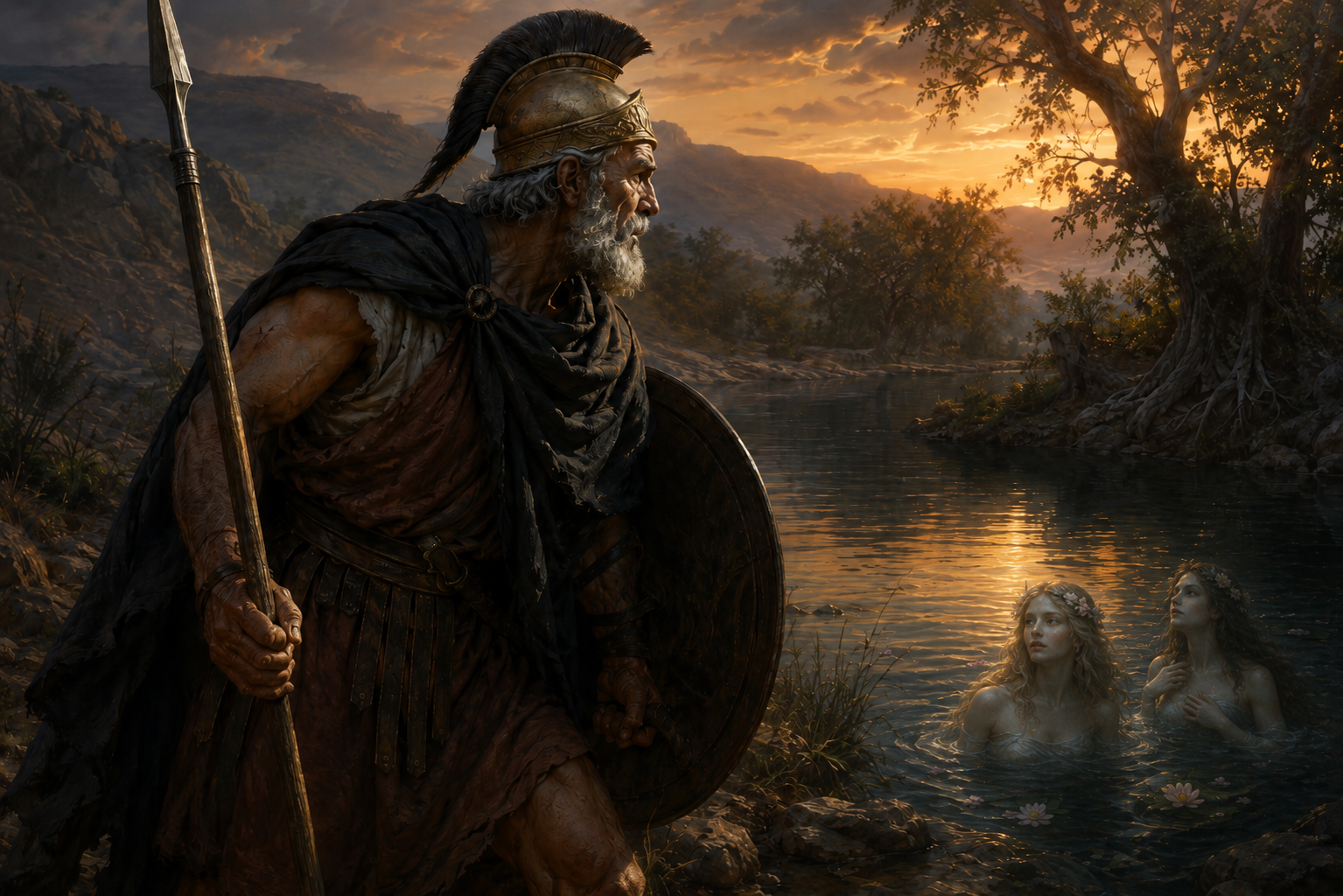
- Name: Polyphemus
- Common Titles: Last Spear of the Lapiths, Founder of Cius, the Old Argonaut, Hylas-Hearer
- Culture: Hellenic, Lapith
- Homeland: Larisa in Thessaly
- Current Seat: Cius in Mysia, or wherever the search for Hylas has drawn him
- Regional Reach: Thessaly, Mysia, Cius, the Propontis, and the Black Sea heroic routes
- Religion: Hellenic pantheon; especially bound by fate, Zeus’s judgement, Heracles’ heroic shadow, and the river-and-nymph powers of Mysia
- Languages: Greek, Mysian, and one Black Sea trade tongue
- Status: Living mythic founder-king, unless the Chalybes prophecy has already claimed him
- Role in the World: Elder hero, founder-king, monster-fighter, oath-bearing witness, and guardian of Cius
Polyphemus is not the Cyclops blinded by Odysseus. He is Polyphemus, son of Elatus, a Lapith hero from Larisa, an elder warrior of the Argonauts, and one of the last living men who fought in the old war against the Centaurs.
He heard Hylas cry out when the nymphs took him. He searched beside Heracles. The Argo sailed on without them. Heracles returned to his labours. Polyphemus remained in Mysia, where fate set him on the road to kingship, city-founding, and an old grief that no victory ever healed.
Overview
Polyphemus is an old man built like a ruined tower. His shoulders have settled, his beard is white, and his joints ache in the cold, but his hands still know how to close around a spear. He has the thick bones and battered face of a warrior who survived too many heroic generations: Centaur wars, sea voyages, oath-feasts, broken companies, foreign kings, river spirits, and the silence after a child’s cry.
He belongs to the generation before Jason’s fame hardened into legend. He does not speak like a courtier. He speaks like a man used to being obeyed in danger. When young warriors boast, he lets them. When they lie, he knows. When they pretend fear is strategy, he names it fear.
His tragedy is not weakness. His tragedy is that he remained faithful after the story moved on.
He built walls, commanded men, buried enemies, judged disputes, and ruled in Mysia, but part of him is still standing in the dark beside foreign water, turning his head toward a voice no one else can hear.
Appearance
Polyphemus is tall, broad, and visibly old. His back bends only slightly, but every movement carries the cost of old wounds. His left knee stiffens after rain. One shoulder sits higher than the other from an ancient Centaur’s club. His hands are scarred across the knuckles and palms. His face is weather-dark, with deep lines cut beside the mouth and eyes.
He wears practical heroic gear rather than ornamental armour: a bronze-faced helm, a heavy cloak pinned at the shoulder, a round shield darkened by age, and a long ash spear. His cuirass has been repaired many times. His sword is old enough to have a name, but he rarely uses the name aloud.
He carries a small river-stone from Mysia, wrapped in linen. It is not treasure. It is memory.
Character
Polyphemus is stern, protective, grieving, and difficult to impress. He has no patience for men who call every journey destiny. He has seen destiny abandon the innocent.
He admires courage, but he trusts endurance more. He respects those who go back for the lost, bury the unnamed, keep watch when others sleep, and do not mistake fame for honour.
His kindness is rough and practical. It appears most often around children, old soldiers, widows, sailors, wounded beasts, and anyone who has searched too long for someone they could not save.
He hates mockery of the lost.
He hates songs that make the voyage of the Argo sound clean.
Allies and Enemies
Jason: Polyphemus does not hate Jason simply, but he does not forgive the Argo’s departure. Jason represents command, necessity, and the cruelty of forward motion.
Heracles: A complicated bond. Heracles searched with him, and that matters. Yet Heracles could leave the search and return to his labours. Polyphemus could not.
Hylas: Not merely a lost youth, but a wound in the world. Any rumour of Hylas can move Polyphemus faster than gold, politics, or threats.
The Lapiths: His old people, his first war, and the measure by which he judges courage.
Centaurs: He does not treat Centaurs as tavern monsters. He remembers them as a people of terrifying force, appetite, pride, and old war.
Nymphs of Mysia: He does not dismiss them as pretty spirits. To him, they are powers with desire, secrecy, and guilt.
Kings of the Black Sea Routes: Some respect him as a founder. Others see an old king with heroic legitimacy they can exploit.
When Polyphemus Appears
Polyphemus works best as a patron, judge, witness, or dangerous ally when the party must decide whether speed is worth abandoning someone.
He may appear as a founder-king whose city is forgetting its sacred debts, an old warrior on the road guarding the dead from scavengers, a patron who pays for rumours instead of treasure, or the last living witness to a route, oath, monster, battlefield, or divine judgement from the Argonautic age.
He should enter play when the party is tempted to move on quickly, abandon a complication, leave hirelings exposed, ignore a missing child, treat a servant as disposable, or reduce old myth to loot.
He does not need to moralise constantly. One hard question from him is enough.
What Polyphemus Knows
Polyphemus can tell the party:
- Which Black Sea routes still remember the Argo.
- Which springs and river-mouths are sacred to dangerous nymph powers.
- Which heroic houses descend from oath-breakers.
- Where Centaur-war relics were buried or hidden.
- Which kings still use Jason’s name to justify betrayal.
- Why Cius must keep its river offerings.
- What Heracles did not say when the search for Hylas ended.
Secrets
The Cry Was Repeated: Polyphemus has heard Hylas’ cry more than once over the years, always near water, always when some oath is about to be broken.
Cius Is Built on a Bargain: The city’s foundation required an agreement with local river powers. Polyphemus has kept it. His heirs may not.
He Keeps Heracles’ Token: Polyphemus owns a battered clasp, broken bow-piece, or lion-hide thong once given by Heracles. He has never displayed it.
He Knows Jason Failed Someone Else: Polyphemus may know another ugly truth from the Argo’s voyage, one not preserved in heroic song.
He Is Marked by Fate: Old prophecy pulls him toward Cius, the Chalybes, and the iron road of his eventual end. In play, that fate can be a chain, a warning, or something the party tries to break.
Consequences
Polyphemus is not a wandering old sellsword. He is a founder, Argonaut, Lapith war-survivor, and oath-bearing heroic witness.
To aid him can open routes through Hellenic, Mysian, and Black Sea heroic networks. His friendship can bring shelter, military support, old heroic testimony, river access, and recognition among houses that still honour the Argonautic oaths.
To betray him can bring civic reprisal from Cius, curses from river powers, feud from heroic lineages, and the attention of those who remember what happened when heroes abandoned their own.
Harming him without cause is not merely an attack on an old man. It is an offence against a founder, a guest-right holder, a king, and one of the last witnesses of the heroic age.
Mechanics Tabs
The rules below are mechanics compatible for different game editions.
Polyphemus the Argonaut 5.5e / 2024
Polyphemus the Argonaut Pathfinder 1e
Polyphemus the Argonaut 5.5e / 2024
Medium Humanoid, Neutral
Armor Class 18
Initiative +2
Hit Points 178
Speed 30 ft.
Proficiency Bonus +5
| STR | DEX | CON | INT | WIS | CHA |
|---|---|---|---|---|---|
| 20 (+5) | 14 (+2) | 18 (+4) | 13 (+1) | 17 (+3) | 16 (+3) |
Saving Throws Str +10, Con +9, Wis +8
Skills Athletics +10, History +6, Insight +8, Intimidation +8, Perception +8, Survival +8
Senses passive Perception 18
Languages Greek, Mysian, one Black Sea trade tongue
Challenge 13
Traits
Argonautic Veteran. Polyphemus has Advantage on saving throws against being Frightened. Magical effects cannot force him to abandon an ally he can see unless he is Incapacitated.
Centaur-War Survivor. Polyphemus has Advantage on checks and saving throws made to resist being knocked Prone, shoved, Grappled, or trampled.
Old Wounds, Unbroken Spirit. When Polyphemus starts his turn below half his Hit Points, he gains 10 Temporary Hit Points if he can see an enemy or hear an ally.
Voice of the Lost. Polyphemus knows the direction of any real cry for help, dying call, or spoken plea within 300 feet, unless the voice is magically concealed.
Heroic Authority. Allies within 30 feet who can hear Polyphemus gain a +2 bonus to saving throws against being Charmed or Frightened.
Actions
Multiattack. Polyphemus makes three attacks: two with his Ash Spear and one with his Shield Bash or Short Sword.
Ash Spear. Melee or Ranged Weapon Attack: +10 to hit, reach 10 ft. or range 30/120 ft., one target. Hit: 14 piercing damage, or 16 piercing damage if wielded with two hands in melee.
Short Sword. Melee Weapon Attack: +10 to hit, reach 5 ft., one target. Hit: 9 piercing damage.
Shield Bash. Melee Weapon Attack: +10 to hit, reach 5 ft., one target. Hit: 10 bludgeoning damage, and the target must succeed on a DC 18 Strength saving throw or have the Prone condition.
Old Hero’s Command. Polyphemus chooses up to three allies within 60 feet who can hear him. Each chosen ally can immediately move up to half its Speed without provoking Opportunity Attacks. An ally that moves toward a fallen, Grappled, Restrained, or surrounded companion gains 10 Temporary Hit Points.
Bonus Actions
Stand Behind Me. Polyphemus moves up to 10 feet toward an ally he can see. Until the start of his next turn, the first attack roll made against that ally has Disadvantage if Polyphemus is within 5 feet of the ally.
Reactions
Not Left Behind. When an ally within 30 feet is reduced to 0 Hit Points, Grappled, Restrained, or forcibly moved away, Polyphemus moves up to his Speed toward that ally and makes one Ash Spear attack against a creature threatening or carrying them.
Shield the Vulnerable. When a creature within 5 feet of Polyphemus is hit by an attack, Polyphemus reduces the damage by 18. If the protected creature is a child, guide, hireling, wounded ally, prisoner, or noncombatant, reduce the damage by 28 instead.
Legendary Actions
Polyphemus can take 3 Legendary Actions, choosing from the options below. Only one Legendary Action can be used at a time and only at the end of another creature’s turn.
Move. Polyphemus moves up to half his Speed.
Spear Attack. Polyphemus makes one Ash Spear attack.
Name the Cowardice. One creature Polyphemus can see within 60 feet must succeed on a DC 16 Wisdom saving throw or have Disadvantage on its next attack roll or ability check before the end of its next turn. A creature that abandoned an ally, captive, servant, or wounded companion during the last minute has Disadvantage on this saving throw.
Call Them Back. One ally within 60 feet who can hear Polyphemus can immediately repeat a saving throw against being Charmed, Frightened, Stunned, or magically compelled to move away from an ally.
Notes
Polyphemus is not designed as a simple damage monster. His stat block is built around rescue, battlefield steadiness, heroic judgement, and refusal to abandon companions. In a fight, he protects vulnerable allies, punishes forced movement, and becomes most dangerous when enemies try to drag someone away.
Polyphemus the Argonaut Pathfinder 1e
Polyphemus the Argonaut CR 13
XP 25,600
Male human heroic warrior/aristocrat
N Medium humanoid
Init +2; Senses Perception +22
Defense
AC 28, touch 13, flat-footed 25
hp 184
Fort +16, Ref +10, Will +13
Defensive Abilities bravery, old wounds, shield ally; Immune fear effects from mundane intimidation
Offense
Speed 30 ft.
Melee heroic spear +24/+19/+14/+9 (1d8+10/×3) or short sword +22/+17/+12/+7 (1d6+7/19–20)
Ranged heroic spear +20 (1d8+7/×3)
Special Attacks centaur-war strike, old hero’s command, not left behind
Statistics
Str 24, Dex 14, Con 18, Int 13, Wis 17, Cha 16
Base Atk +16; CMB +23; CMD 36
Feats Combat Reflexes, Diehard, Endurance, Great Fortitude, Improved Bull Rush, Improved Shield Bash, Iron Will, Leadership, Power Attack, Toughness, Weapon Focus (spear)
Skills Climb +20, Diplomacy +16, Handle Animal +14, Intimidate +22, Knowledge (history) +14, Knowledge (nobility) +12, Perception +22, Sense Motive +20, Survival +20
Languages Greek, Mysian
Ecology
Environment any Hellenic, Mysian, coastal, hill, or frontier settlement
Organization solitary, with guards, with Argonautic companions, or with a city war-band
Treasure heroic spear, old shield, repaired bronze armour, founder’s cloak, river-stone relic, kingly but practical wealth
Special Abilities
Centaur-War Strike. Polyphemus gains a +2 bonus on attack and damage rolls against creatures using charge, trample, overrun, or mounted assault tactics.
Not Left Behind. Once per round as an immediate action, when an ally within 30 feet is reduced to 0 hit points, grappled, pinned, or forcibly moved, Polyphemus may move up to his speed toward that ally. This movement does not provoke attacks of opportunity from the creature threatening that ally.
Old Hero’s Command. Three times per day, Polyphemus may command up to three allies within 60 feet to move up to half their speed as an immediate action. Allies moving toward a fallen, captured, grappled, or surrounded companion gain a +2 morale bonus to AC and saving throws until the start of Polyphemus’ next turn.
Shield Ally. As an immediate action, Polyphemus may grant an adjacent ally a +4 shield bonus to AC against one attack. If the ally is a noncombatant, youth, servant, hireling, or wounded companion, the bonus increases to +6.
Voice of the Lost. Polyphemus gains a +10 circumstance bonus on Perception and Survival checks to locate a crying, calling, wounded, drowning, or abducted creature. This ability can function through storm, battle-noise, and running water unless the voice is magically hidden.
Notes
Use this version when Polyphemus is a major patron, temporary battlefield ally, or tragic heroic obstacle. He should not be thrown into a random fight without context. His mechanics are strongest when the encounter involves rescue, oath-breaking, forced movement, ambush, captives, or a party choice about whether to leave someone behind.
Equipment and Treasure
Heroic Ash Spear: A long, old spear with a darkened bronze head. It may function as a magical spear, but its greater value is symbolic: warriors, kings, and oath-keepers recognise it.
Bronze-Bound Shield: Scarred by Centaur weapons. A character carrying it may gain respect among Lapiths, Thessalian heroes, or old anti-Centaur lineages, but may also inherit old enemies.
Founder’s Cloak: A heavy cloak associated with Cius. It marks the wearer as someone under Polyphemus’ protection or judgement.
River-Stone of Mysia: A smooth stone wrapped in linen. It is cold near false oaths and damp near river spirits. It should not be treated as ordinary treasure unless the party is willing to insult the dead.
Old Argonautic Token: A clasp, oar-fragment, or bronze fitting from the Argo. It can open doors among heroic lineages, but it also draws attention from those who hate Jason’s company.
Adventure Hooks
The Cry Beneath the Spring
A child’s voice is heard beneath a Mysian spring, calling a name no living villager recognises. Polyphemus arrives before dawn, armed and silent. He does not ask the party to investigate. He asks whether they are coming with him or staying behind like cowards.
The City That Forgot Its Founder
Cius is prospering, but its new rulers want Polyphemus reduced to a statue, a festival, and a harmless founding tale. River offerings have stopped. Children vanish near the water. The old king knows exactly what kind of debt has gone unpaid.
Hylas Unchanged
A beautiful youth is seen beside a pool, unchanged by age. He knows Polyphemus’ name. He also knows the names of people who were not born when the Argo sailed.
Source and Literary Context
Polyphemus the Argonaut should not be confused with Polyphemus the Cyclops from the Odyssey. The Argonautic Polyphemus is a separate heroic figure: a Lapith from Larisa, son of Elatus or Eilatus, associated with the Centaur-war tradition, Jason’s expedition, Hylas’ disappearance, Mysia, and the foundation of Cius.
In Apollonius Rhodius’ Argonautica Book 1, Polyphemus appears among the Argonauts as an aged but still formidable warrior from the Lapith world. During the Mysian episode, he hears Hylas cry out after the youth is taken by the nymphs, and he joins Heracles in the search. The Argo departs without them, leaving Polyphemus’ later fate tied to Mysia and the city of Cius.
The ToposText entry for Polyphemus preserves the ancient-source outline: Polyphemus comes from Larisa, belongs to the Lapith heroic world, sails as one of the Argonauts, and later founds Cius in Mysia. His story is especially useful in play because it connects three powerful mythic themes: the heroic voyage, the abandoned companion, and the old warrior who survives long enough to become a founder.
For campaign use, Polyphemus is best treated as a living mythic figure rather than a dead literary reference. His strongest role is not simply that he sailed with Jason, but that he remained morally marked by the loss of Hylas. He embodies the cost of heroic speed: the people left behind when kings, demigods, and chosen captains continue toward glory.
Keep this reference growing
If this page helped with your reading or game, you can support its upkeep or explore the curated books.
Explore the Bookshop — epics, classics and stories behind imagined worlds.