
Ninon de l’Enclos — Parisian Salonnière and Social Intrigue
Ninon de l’Enclos — Parisian Salonnière and Social Intrigue
A brilliant Parisian salonnière whose beauty opens doors, whose wit keeps them open, and whose real power lies in making powerful people reveal themselves.
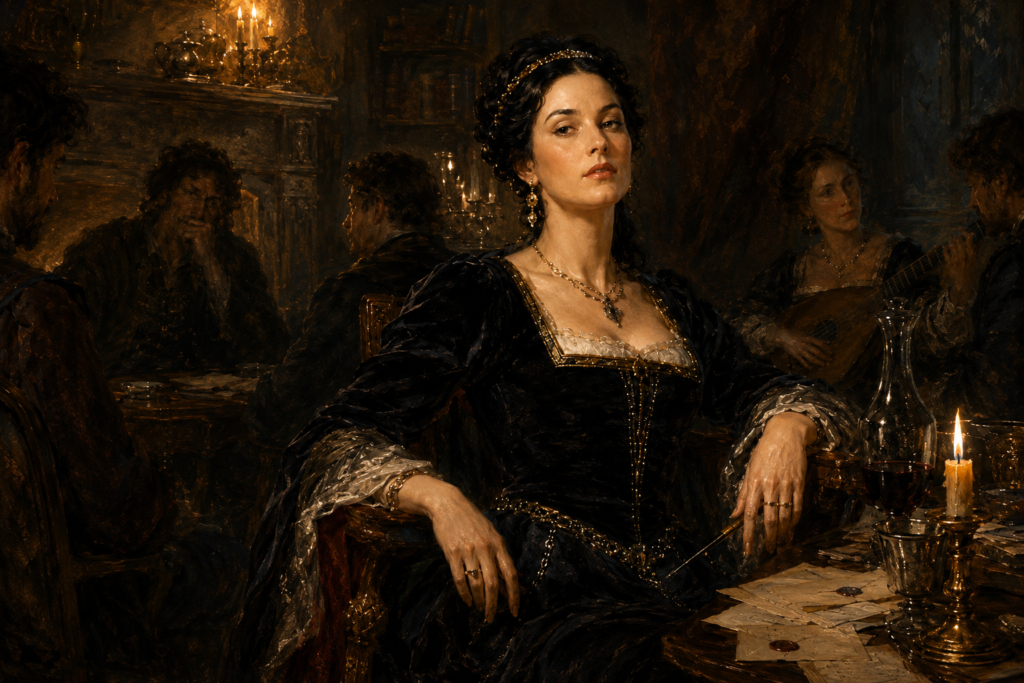
- Full Name: Anne “Ninon” de l’Enclos
- Common Name: Ninon de l’Enclos
- Alternative Spellings: Ninon de Lenclos, Ninon de Lanclos
- Gender: Female
- Race: Human
- Occupation: Salonnière, courtesan, patron of writers, social philosopher, political listener, private intelligence broker
- Nationality: French
- Region: Paris, especially noble houses, theatres, courtly gardens, academies, rented chambers, legal offices, and private salons
- Base of Operations: Her Paris salon, a cultivated house of music, letters, argument, wine, perfume, locked cabinets, and private rooms
- Languages: French, Latin, Italian, Spanish, coded salon phrases, courtly euphemism, poetic allusion
- Religion: Publicly observant of Parisian civic and household rites; privately sceptical of priestly authority, compulsory chastity, and doctrines that turn women into property
- Alignment: Neutral
- Affiliations: Parisian salons, poets, actors, musicians, noble patrons, ambitious younger courtiers, discreet lawyers, physicians, couriers, and women with nowhere else safe to speak
- Allies: Writers needing patronage, widows with money but little protection, young nobles she has educated, servants who hear everything, actresses, apothecaries, musicians, letter-carriers, and former lovers still grateful enough to be useful
- Rivals: Moral reformers, jealous spouses, court factions she refuses to serve, blackmailers, brittle aristocrats, and men who mistake admiration for possession
- Enemies: Anyone who tries to own her, silence her, expose her protected guests, or turn her salon into a hunting ground.
Ninon de l’Enclos is a dangerous answer to a simple question: what happens when a woman refuses to be bought, married, enclosed, or shamed into obedience?
Her salon is one of the quiet powers of Paris. It is not a tavern, brothel, court, academy, or chapel, though elements of all five pass through its doors. Music is played there. Arguments are sharpened there. Lovers are made and unmade there. Debts are revealed, reputations tested, marriages quietly redirected, and political futures measured by who laughs at the wrong remark.
Ninon does not rule by command. She rules by invitation. A nobleman enters believing he has come to be admired. A poet enters believing he has come to be understood. A magistrate enters believing he has come discreetly. By the time each leaves, he has usually given her something: a secret, a fear, a contradiction, a promise, a rumour, or a weakness.
Her power is not that she attracts powerful men. Her power is that she remembers what powerful people say when they believe themselves safe.
Use Ninon when the party needs Parisian access, dangerous discretion, or a room where the wrong sentence can ruin a noble house.
Ninon de l’Enclos, 5.5e / 2024-Compatible Stat Block
Ninon de l’Enclos, Pathfinder 1e-Compatible Stat Block
Ninon de l’Enclos
Medium Humanoid, Neutral
Armor Class: 15
Initiative: +4
Hit Points: 78 (12d8 + 24)
Speed: 30 ft.
Proficiency Bonus: +3
Saving Throws: Dex +7, Wis +6, Cha +9
Skills: Deception +12, History +7, Insight +9, Investigation +7, Performance +9, Persuasion +12
Senses: Passive Perception 16
Languages: French, Latin, Italian, Spanish, court cipher
Challenge: 6 (2,300 XP)
| STR | DEX | CON | INT | WIS | CHA |
|---|---|---|---|---|---|
| 9 (-1) | 18 (+4) | 14 (+2) | 18 (+4) | 16 (+3) | 21 (+5) |
Salon Authority. While Ninon is in a social setting where she is recognised as host, patron, guest of honour, or protected speaker, she has advantage on Charisma checks. Creatures hostile to her in that setting have disadvantage on Wisdom (Insight) checks made to determine her true intentions.
The Right Word. Ninon can use Charisma instead of Intelligence for checks related to courtly gossip, scandals, patronage, private correspondence, and noble social networks.
Unowned. Ninon has advantage on saving throws against being charmed or magically compelled by a creature that has attempted to threaten, coerce, possess, or claim her.
Protected by the Room. If Ninon is attacked in her own salon or in another socially controlled gathering, each neutral or friendly witness immediately becomes hostile to the attacker unless the attacker can justify the violence. This is not magical compulsion; it reflects the social consequences of drawing steel in the wrong room.
Actions
Dagger. Melee or Ranged Weapon Attack: +7 to hit, reach 5 ft. or range 20/60 ft., one target. Hit: 6 (1d4 + 4) piercing damage.
Cutting Observation. Ninon targets one creature within 60 feet that can hear and understand her. The target must succeed on a DC 17 Wisdom saving throw or take 18 (4d8) psychic damage and have disadvantage on the next attack roll, ability check, or saving throw it makes before the end of its next turn. On a success, the target takes half damage and suffers no disadvantage.
Expose Contradiction. Ninon chooses one creature within 60 feet that can hear her and has lied, concealed a motive, or contradicted itself during the scene. The target must make a DC 17 Charisma saving throw. On a failure, it is socially rattled for 1 minute. While rattled, it cannot benefit from advantage on Deception or Persuasion checks, and the first time each round it attempts to lie openly, it takes 9 (2d8) psychic damage. The target can repeat the saving throw at the end of each of its turns, ending the effect on a success.
Reactions
Not What I Said. When a creature Ninon can hear makes a Charisma check, Ninon can impose a −1d8 penalty on the roll if she can answer aloud with a correction, implication, or perfectly timed silence.
Social Escape. When a creature misses Ninon with an attack, she can move up to half her speed without provoking opportunity attacks, provided there is another creature, curtain, doorway, servant, guest, or substantial piece of furniture within 10 feet.
Social Lair Action
When Ninon is in her own salon, on initiative count 20, losing initiative ties, she may take one of the following social lair actions. These effects are not magical unless the campaign makes salon ritual, glamour, or oath-bound hospitality supernatural.
Change the Subject. Ninon redirects the room. One creature of her choice must succeed on a DC 17 Wisdom saving throw or lose advantage on its next Charisma check before the end of the round.
Call for Music. Musicians, servants, or guests create a brief screen of movement and sound. Ninon or one ally within 30 feet may move up to half their speed without provoking opportunity attacks.
Invite a Witness. Ninon draws attention to one creature. Until initiative count 20 on the next round, that creature has disadvantage on Dexterity (Sleight of Hand) checks and Charisma (Deception) checks while in the room.
Ninon de l’Enclos
Female human aristocrat 3 / bard 7
N Medium humanoid
Init +4; Senses Perception +13
Defense
AC 18, touch 15, flat-footed 13
hp 68 (10 HD)
Fort +5, Ref +11, Will +12
Offense
Speed 30 ft.
Melee masterwork dagger +10/+5 (1d4/19–20)
Ranged masterwork dagger +14 (1d4/19–20)
Special Attacks bardic performance 24 rounds/day, cutting remark, inspire competence, suggestion
Statistics
Str 8, Dex 18, Con 14, Int 18, Wis 16, Cha 22
Base Atk +7; CMB +6; CMD 20
Feats Alertness, Deceitful, Persuasive, Skill Focus (Diplomacy), Weapon Finesse
Skills Bluff +23, Diplomacy +27, Disguise +12, Knowledge (history) +16, Knowledge (local) +20, Knowledge (nobility) +20, Linguistics +11, Perform (oratory) +20, Perform (string) +16, Sense Motive +23, Sleight of Hand +11
Languages French, Latin, Italian, Spanish, court cipher
SQ bardic knowledge, versatile performance, well-connected
Special Abilities
Salon Authority (Ex): In a courtly, noble, artistic, or salon environment where Ninon is socially recognised, she gains a +4 circumstance bonus on Bluff, Diplomacy, Perform, and Sense Motive checks.
Cutting Remark (Su): As a standard action, Ninon may target one creature within 60 feet that can hear and understand her. The target must succeed at a DC 20 Will save or take 4d6 nonlethal damage and suffer a −2 penalty on attack rolls, skill checks, and saving throws for 1 round. This is a language-dependent, mind-affecting effect.
Well-Connected (Ex): Once per session, Ninon can reveal that she knows a useful contact in Paris, provided the contact plausibly belongs to noble, artistic, legal, theatrical, mercantile, medical, or domestic-service circles. Dangerous or highly specific contacts should require a successful Diplomacy or Knowledge check.
Social Terrain (Ex): In her own salon, Ninon may once per encounter force a creature that has just made a Bluff, Diplomacy, Intimidate, or Sense Motive check to reroll and take the worse result. She must be able to speak, and the target must be able to hear her. This represents interruption, redirected attention, and the pressure of witnesses rather than supernatural power.
Why Ninon Matters
Ninon changes Paris because she makes private desire politically useful.
In a city where lineage, office, guild, marriage, and household honour decide who may speak, she creates a room where rank can be rearranged for a few dangerous hours. A widow may speak beside a minister. A poet may embarrass a lord. A disgraced daughter may find protection before her family can bury the scandal. A young noble may learn that charm without intelligence is only expensive foolishness.
Her salon does not overthrow the city. It unsettles it. Men who would never fear a woman with a sword fear one who knows which servant carried which letter, which lord sold which office, and which public sermon was contradicted by a private visit after midnight. She does not need an army. She has memory, timing, and witnesses.
Because of Ninon, Paris contains a place where reputation is not fixed by birth alone. It can be revised, traded, rescued, wounded, or destroyed.
Appearance
Ninon’s beauty should be controlled rather than ornamental. She is not simply young, soft, or flawless; she is composed, intelligent, and difficult to read. Her expression often suggests that she has understood the conversation before everyone else has begun it.
She dresses in Parisian elegance: fine dark silk, restrained jewels, a girdle worked with silver thread, perfume used sparingly, and sleeves cut to show graceful hands accustomed to music, letters, and sealed paper. She wears wealth with precision, not display. Lesser courtiers use luxury to prove status. Ninon uses taste to make status feel negotiable.
Personality
Ninon is warm without being pliable, amused without being careless, and frank in a way that can feel like kindness or execution. She is not shocked by desire, ambition, vanity, cowardice, or appetite. She is shocked by people who pretend these things belong only to others.
She dislikes hypocrisy more than sin. She values wit, courage, elegance, self-knowledge, and the ability to keep one’s word after pleasure has passed. She has no patience for possessive sentiment disguised as love.
Private Truth
Ninon’s deepest fear is not disgrace. She has survived disgrace by making it interesting.
Her real fear is enclosure: being turned into someone else’s wife, trophy, penitent, scandal, cautionary tale, or political instrument. She knows that men are often forgiven for appetite while women are condemned for autonomy. Her independence is therefore not just indulgence. It is self-defence.
What She Wants
Ninon wants freedom, but not the shallow freedom to indulge every impulse. She wants the right to remain self-authored.
She wants Paris to contain rooms where wit, desire, art, and argument can trouble inherited power. She wants women to have choices not mediated entirely through fathers, husbands, confessors, patrons, or courts. She wants dull tyrants to fear laughter. She wants young minds to encounter books, music, forbidden arguments, and dangerous honesty before obedience hardens around them.
She also enjoys power. She would deny this only if denial served the room.
What She Knows
Ninon may know:
- Which noble houses are secretly bankrupt.
- Which marriage contract is being negotiated under false pretences.
- Which heir is illegitimate, bewitched, poisoned, or already promised elsewhere.
- Which magistrate sells verdicts through an intermediary.
- Which public moralist maintains a hidden vice.
- Which actress, poet, or musician carries messages between factions.
- Which noblewoman needs escape more urgently than reputation.
- Which court favourite is about to fall.
- Which lover has become a spy.
- Which secret is true, which is planted, and which is true but too dangerous to use.
Ninon’s Circle
Ninon is not powerful alone. Her salon is a living network. The following figures can be used as recurring contacts, witnesses, rivals, or complications.
The Widowed Patroness: A wealthy noblewoman who funds musicians, poets, and quiet legal work for women with dangerous husbands. She appears gentle, but she has survived three succession disputes and knows how inheritance really moves.
The Actress with Two Names: A brilliant performer who carries messages through theatres, noble houses, and rented rooms. She knows who applauds in public, who pays in private, and who cannot tell desire from ownership.
The Physician of Closed Doors: A discreet doctor who treats poisonings, pregnancies, exhaustion, venereal disease, panic, and wounds that respectable people cannot explain. He is loyal to Ninon because she once kept him from disgrace.
The Ruined Young Noble: A charming aristocrat whose debts should have destroyed him. Ninon keeps him close because he can enter rooms denied to merchants, servants, and women. He thinks he is her favourite. He is sometimes useful.
The Letter-Carrier: A quiet courier, possibly a servant or apprentice, who moves sealed notes through Paris. Everyone overlooks them. Ninon does not. Their knowledge of doorways, habits, and handwriting may be worth more than a knight’s ransom.
The Devout Accuser: A moral reformer who publicly condemns Ninon’s salon while privately circling it. He is dangerous because he understands that her room threatens his authority more than open vice would.
How She Uses Power
Ninon rarely threatens. Threats are crude and memorable. She prefers arrangements.
She places rivals at the same table under the protection of civility. She introduces a desperate poet to a patron who thinks he is buying flattery, then watches the poet become a witness. She lets a vain lord believe he has seduced her confidence while she measures how much he fears his wife, creditors, sovereign, or confessor.
When she attacks, the weapon is usually timing. A letter arrives too early. A rumour appears in three mouths at once. A patron withdraws. A mistress refuses a meeting. A fashionable joke becomes impossible to survive.
What Happens If the Party Crosses Her
Ninon does not usually retaliate with assassins. That would be wasteful, vulgar, and traceable.
If the characters insult, threaten, betray, or endanger her protected guests, Paris begins to close around them. Invitations disappear. Friendly witnesses become unavailable. A promised meeting is postponed until after the useful hour has passed. A lawyer suddenly remembers a procedural difficulty. A patron hears an unflattering version of events before the party can explain themselves.
If the offence is minor, Ninon may demand apology, restitution, or a favour performed without public credit. If the offence is serious, she does not need to destroy the party. She only needs to make every ambitious person in Paris wonder whether helping them is socially expensive.
If the offence is unforgivable, she releases truth rather than invention. A real secret reaches the right ears. A hidden debt surfaces. A witness remembers. A lover speaks. A servant repeats one sentence heard through a door.
Ninon’s vengeance is most frightening when it is accurate.
Role in the Campaign
Ninon works best as a patron, informant, social antagonist, protector of vulnerable NPCs, or gatekeeper to Parisian high society. She should not be used as a simple quest-giver handing out errands. Her scenes should involve bargaining, interpretation, discretion, and moral risk.
She can give the party access to rooms they could never enter by force. She can also make clear that access has a price: restraint, silence, a recovered letter, a public humiliation prevented, a witness protected, or a truth left unused.
Scene Uses
The Salon as Battlefield: The characters must obtain information during an evening of music, flirtation, masked insult, and coded conversation without causing open scandal.
The Protected Woman: A noblewoman, actress, widow, or servant has taken refuge under Ninon’s protection. The party needs her testimony, but Ninon will not surrender her to danger.
The Dangerous Letter: A letter in Ninon’s possession could topple a court faction. Several groups want it stolen, destroyed, copied, or publicly read.
The Young Genius: Ninon has discovered a brilliant young poet, actor, philosopher, or inventor. She asks the party to keep him alive long enough to become inconvenient.
The Hypocrite’s Fall: A public moralist attacks Ninon’s salon while privately exploiting women, debtors, apprentices, or penitents. Ninon does not ask the party to kill him. She asks them to make the truth undeniable.
Signature Encounter: The Supper of Seven Lies
Ninon invites the party to a private supper attended by seven guests. Each guest is lying, but not all are villains. The challenge is not to expose everyone. The challenge is to learn which lie matters tonight.
The supper takes place in Ninon’s salon during an evening of music, wine, controlled laughter, and apparently harmless debate. Open violence ruins the encounter. Public accusation may force a liar to flee, faint, challenge, confess falsely, or accuse someone else first. The party must listen, test, flatter, provoke, and decide what truth is worth using.
The Seven Guests
1. The Bankrupt Marquis: Claims his estates are secure. He is secretly selling family relics and may offer troops he cannot pay.
2. The Pious Reformer: Claims to be there only to observe corruption. He is searching for a protected woman who can expose him.
3. The Actress with Two Names: Claims she carries no message tonight. She has memorised one and hidden the written copy in a musical instrument.
4. The Young Heir: Claims to be free to marry. He is already bound by a secret contract that could start a feud.
5. The Physician of Closed Doors: Claims a nobleman died naturally. He knows the death was poison but does not know who ordered it.
6. The Foreign Envoy: Claims to know nothing of Parisian faction politics. He has already bought two servants in rival houses.
7. The Silent Widow: Claims she wants only peace. She has paid Ninon to discover who ruined her daughter.
Running the Encounter
Each round of conversation should revolve around one subject: marriage, debt, theatre, inheritance, foreign fashion, religious reform, or the duties of honour. During each subject, allow characters to make checks, offer remarks, read reactions, or privately move through the room.
Useful checks include Charisma (Persuasion), Charisma (Deception), Wisdom (Insight), Intelligence (Investigation), Intelligence (History), Dexterity (Sleight of Hand), or any relevant tool or background proficiency.
Suggested DCs:
DC 12: Notice discomfort, rivalry, attraction, or avoidance.
DC 15: Identify which guest is lying about the current subject.
DC 17: Understand what the lie protects.
DC 20: Learn how to use the truth without causing immediate scandal.
DC 23: Discover which two lies are connected.
Complications
On a failed check by 5 or more, the character becomes the subject of attention. Another guest asks a dangerous question, a rumour about the party is introduced, or Ninon quietly tests whether the character can recover gracefully.
If the party exposes the wrong lie too early, the real danger leaves the room. If they expose the right lie without restraint, they gain the truth but lose Ninon’s respect. If they protect someone vulnerable while still uncovering the central secret, Ninon becomes a powerful ally.
Salon Pressure Rules
When Ninon is encountered in her salon or another controlled social space, use these optional rules to make the room feel different from a normal encounter.
Reputation Is Armor: A creature cannot draw a weapon, cast an obvious hostile spell, or physically seize someone without immediately becoming the centre of the room. Unless it succeeds on a DC 17 Charisma check to justify the act, all neutral witnesses become socially hostile.
Every Sentence Has Witnesses: Any openly spoken accusation, confession, insult, or promise can be remembered and repeated. A character who speaks carelessly may create a future complication even if the scene seems successful.
Courtesy Costs Time: A character who ignores etiquette may act faster, but with disadvantage on the next Charisma check made in the room. A character who observes etiquette loses immediacy but gains advantage on one later Charisma or Wisdom (Insight) check.
The Host Controls the Floor: Once per scene, Ninon can redirect attention. She may interrupt an accusation, call for music, invite a toast, ask a guest to speak, or move the conversation to another room. This does not prevent action, but it changes who is watching and what kind of action is socially survivable.
Truth Is Not Always Victory: Revealing a secret may solve one problem while creating another. If the party exposes a protected victim, burns a useful witness, or humiliates someone Ninon intended to spare, they may win the information and lose the alliance.
Treasure and Possessions
Ninon’s wealth should not be treated as a heap of coins. Her real treasure is portable, social, and deniable.
Carried: Fine dagger, perfume vial, signet ring not her own, coded fan, wax tablets, small mirror, purse with 75 gp in mixed coin and small jewels.
In Her Salon: Locked correspondence chest, rare books, musical instruments, patronage ledgers, gowns worth 500–1,500 gp, wine, art objects, legal papers, and sealed letters more valuable than gold.
Adventure-Scale Reward: A party that wins Ninon’s favour may receive access to a patron, safehouse, forged invitation, cancelled debt, protected witness, confirmed rumour, or letter worth 1,000–5,000 gp to the right faction.
Using Ninon at the Table
Ninon should not be played as omniscient. She is powerful because people underestimate what they reveal around her, not because she knows everything by magic.
Give her excellent information in her own domain: Parisian society, lovers, debts, marriages, artists, patrons, scandals, and courtly hypocrisy. Outside that domain, she relies on letters, servants, guests, former lovers, paid observers, and clever inference.
Her scenes work best when the party must choose between truth and discretion. She rewards subtlety. She punishes bullying. If the characters threaten her in her own salon, the room should turn against them before swords leave sheaths.
Adventure Hooks
- The Dinner No One Survives Socially: Ninon invites the party to a private supper where every guest is lying about the same crime from a different angle. The challenge is not to solve the matter by force, but to leave with the truth without becoming the evening’s sacrifice.
- The Woman Who Refuses Rescue: A noble family insists that Ninon has corrupted their daughter and demands the party retrieve her. The daughter is not imprisoned; she is hiding from an arranged marriage, a forged dowry contract, and a family willing to call autonomy madness.
- The Book Bought for a Child: Ninon asks the characters to acquire a rare, suppressed book for a gifted child whose guardians want obedience, not education. Several factions know that whoever shapes the child’s mind may shape the next generation of Paris.
Source and Literary Context
Ninon de Lenclos, also written Ninon de l’Enclos or Ninon de Lanclos, was a celebrated 17th-century French courtesan, salonnière, writer, and freethinking figure associated with Parisian literary and aristocratic society. Encyclopaedia Britannica describes her as a celebrated French courtesan whose Paris salon attracted prominent literary and political figures, and notes her interest in Epicurean philosophy. For a concise overview, see Encyclopaedia Britannica’s entry on Ninon de Lenclos.
Her historical reputation centres on independence, wit, erotic freedom, patronage, scepticism toward conventional morality, and the ability to gather powerful intellectual and social circles around her. The Internet Encyclopedia of Philosophy presents her as a salonnière and libertine thinker whose ideas challenged ascetic morality and defended pleasure, naturalism, and women’s freedom within the constraints of her society. For a fuller philosophical treatment, see the Internet Encyclopedia of Philosophy’s article on Ninon de Lenclos.
The campaign version above deliberately shifts Ninon from a strict 17th-century French context into a late-medieval Parisian campaign frame. The adaptation preserves her strongest usable functions: the salon as private court, desire as political intelligence, wit as social weapon, patronage as protection, and female independence as a destabilising force among men who believe every person has a price.
Keep this reference growing
If this page helped with your reading or game, you can support its upkeep or explore the curated books.
Explore the Bookshop — epics, classics and stories behind imagined worlds.