
Spores of the Vrock Spell, Demonic Fungal Curse
Spores of the Vrock Spell, Demonic Fungal Curse
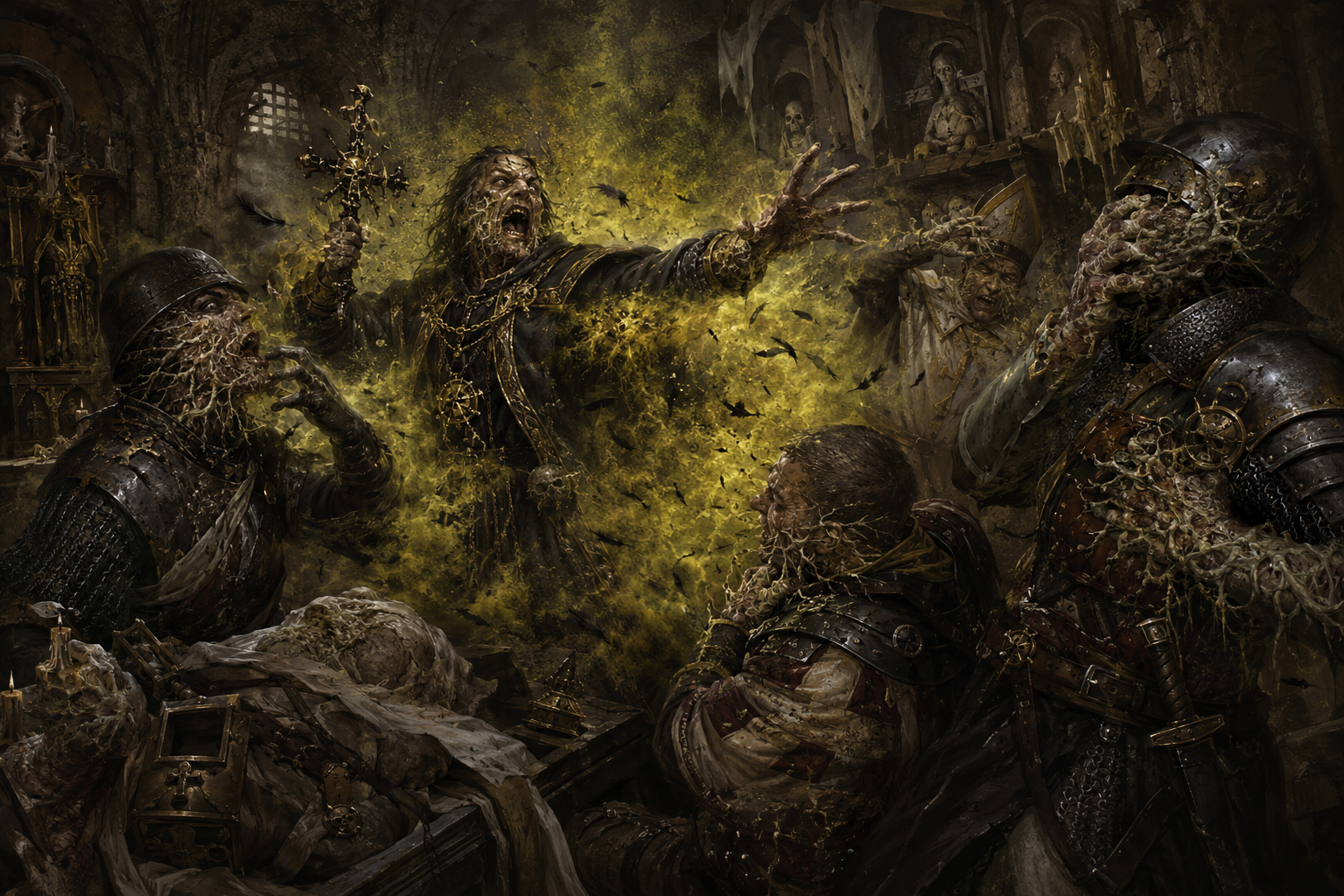
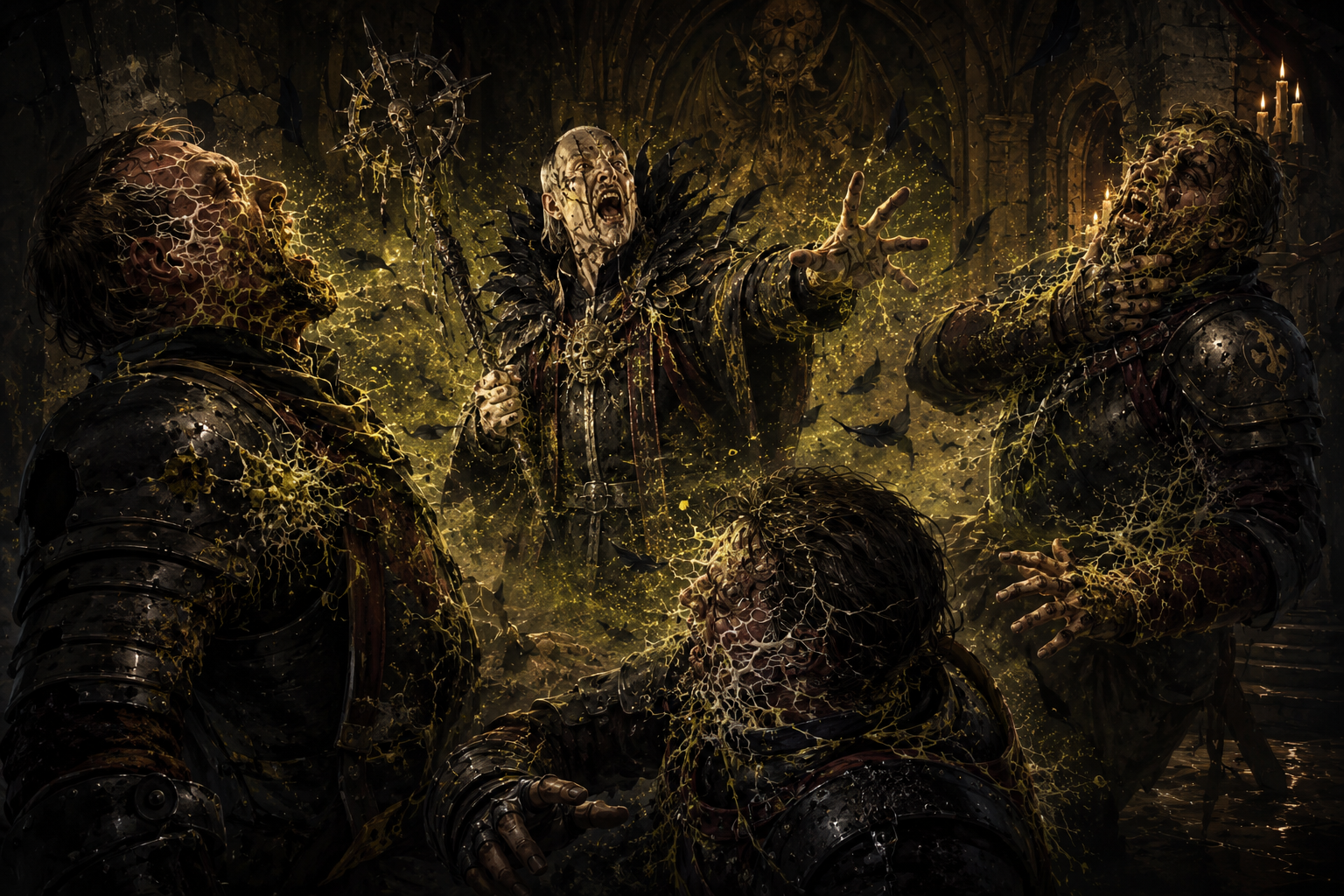
A burst of abyssal spores erupts from the caster, burrowing into nearby flesh and blooming into pale, fiendish growth.

Spores of the Vrock is a vile conjuration spell that erupts from the caster in a choking burst of abyssal spores. The magic wounds nearby creatures, drives living growth beneath the skin, and leaves the victim marked by pale, fibrous corruption.
This is not a battlefield cloud spell. It is intimate, ugly magic: a close-range punishment for enemies who crowd the caster, seize them, surround them, or press too near in a shrine, tunnel, prison cell, or plague-dark room.
Quick Rules Reference
Spell Name: Spores of the Vrock
School: Conjuration
Tags: Evil, fiendish, poison, spores, disease-like corruption
Typical Users: Evil clerics, demon cultists, abyssal war-priests, vrock-bound casters
Area: Creatures within 5 feet of the caster
Primary Effect: Initial poison damage followed by continuing spore damage
Counters: Holy water, blessing magic, poison delay, disease removal, poison neutralisation, restorative cleansing magic
Effects
When the caster completes the spell, a dense mass of abyssal spores bursts from their body, vestments, armour seams, holy symbol, mouth, or shadow. The spores fill the immediate space around the caster.
Creatures caught in the burst must resist the infection. On a failed save, the spores strike exposed flesh, enter wounds, cling to the eyes and mouth, and root beneath the skin. The victim suffers immediate damage, then takes continuing damage as the spores grow.
At the end of the growth period, the victim is covered in a tangle of pale, fibrous, vine-like growths. These growths are visible evidence of the spell’s corruption and may leave scars, lesions, or ritual marks even after the magic is cured.
The caster is never affected by their own Spores of the Vrock spell.
Mechanics
Spores of the Vrock 5.5e / 2024
Spores of the Vrock Pathfinder 1e / 3.5e
Spores of the Vrock 3.0e
Spores of the Vrock 5.5e / 2024
2nd-Level Conjuration
Casting Time: Action
Range: Self
Area: 5-foot Emanation
Components: V, S, M or Divine Focus
Material Component: A feather taken from an intelligent avian creature, fiendish bird, harpy, achaierai, vrock, or similar winged creature touched by malice or cunning
Duration: Instantaneous, then 1 minute
Available To: Cleric, Warlock
Suggested Traditions: Death Domain, Fiend Patron, demon-cult spell lists, vile divine magic traditions
Alternative Spell Name: Vrock Spores
A burst of abyssal spores erupts from you. Each creature within 5 feet of you, other than you, must make a Constitution saving throw.
On a failed save, a creature takes 1d8 Poison damage and becomes infected by the spores for 1 minute. While infected, the creature takes 1d2 Poison damage at the start of each of its turns.
On a successful save, the creature takes no damage and is not infected.
An infected creature can repeat the Constitution saving throw at the end of each of its turns, ending the infection on a success.
The infection also ends if the creature receives Lesser Restoration, Protection from Poison, Remove Curse, Dispel Evil and Good, Greater Restoration, or comparable magic that ends poison, disease, fiendish corruption, or supernatural infection.
A vial of holy water poured over the infected creature also ends the infection.
Because the original vile magic is vulnerable to consecration, a Bless spell cast on an infected creature ends the infection on that creature. If the spell targets multiple creatures, only infected targets are cleansed in this way; other targets receive the spell’s normal benefit.
At Higher Levels: When you cast this spell using a spell slot of 3rd level or higher, the initial damage increases by 1d8 for each slot level above 2nd. The continuing damage does not increase.
Notes
This spell affects all nearby creatures except the caster. It is not selective. Allies, captives, mounts, familiars, and bystanders are all at risk if they are too close.
The 5-foot area should remain tight. Increasing the area changes the spell’s role and makes it much stronger.
Creatures immune to Poison damage are not damaged by the spores, though visible harmless growths may still remain until removed by cleansing magic, holy water, or ordinary treatment after the encounter.
Spores of the Vrock Pathfinder 1e / 3.5e
Conjuration (Creation) [Evil]
Level: Cleric 2
Components: V, S, M/DF
Casting Time: 1 full round
Range: Personal
Area: 5-ft.-radius burst centred on the caster
Duration: Instantaneous, then 10 rounds
Saving Throw: Fortitude negates
Spell Resistance: Yes
The caster summons a burst of abyssal spores that fills the space around them. All creatures within 5 feet of the caster, except the caster, must attempt a Fortitude save.
A creature that fails its save takes 1d8 points of damage as the spores strike and penetrate its flesh. The spores then grow inside the victim, dealing 1d2 points of damage each round for 10 rounds.
At the end of the duration, the victim is covered in a tangle of fibrous, vine-like growths. These growths are the visible remains of the abyssal infection.
Delay poison suspends the continuing damage while its protection lasts. Bless, neutralize poison, remove disease, or a vial of holy water kills the spores and ends the effect.
Arcane Material Component: A feather from an intelligent avian creature, such as a harpy, achaierai, vrock, or similar creature.
Notes
This version preserves the older-edition rhythm: a short-range burst, Fortitude negation, spell resistance, and ten rounds of low but persistent damage.
The effect is not a mundane disease with an incubation period. It is a conjured abyssal infestation that behaves like poison, disease, and living corruption at once. Use the listed counters first.
Spores of the Vrock 3.0e
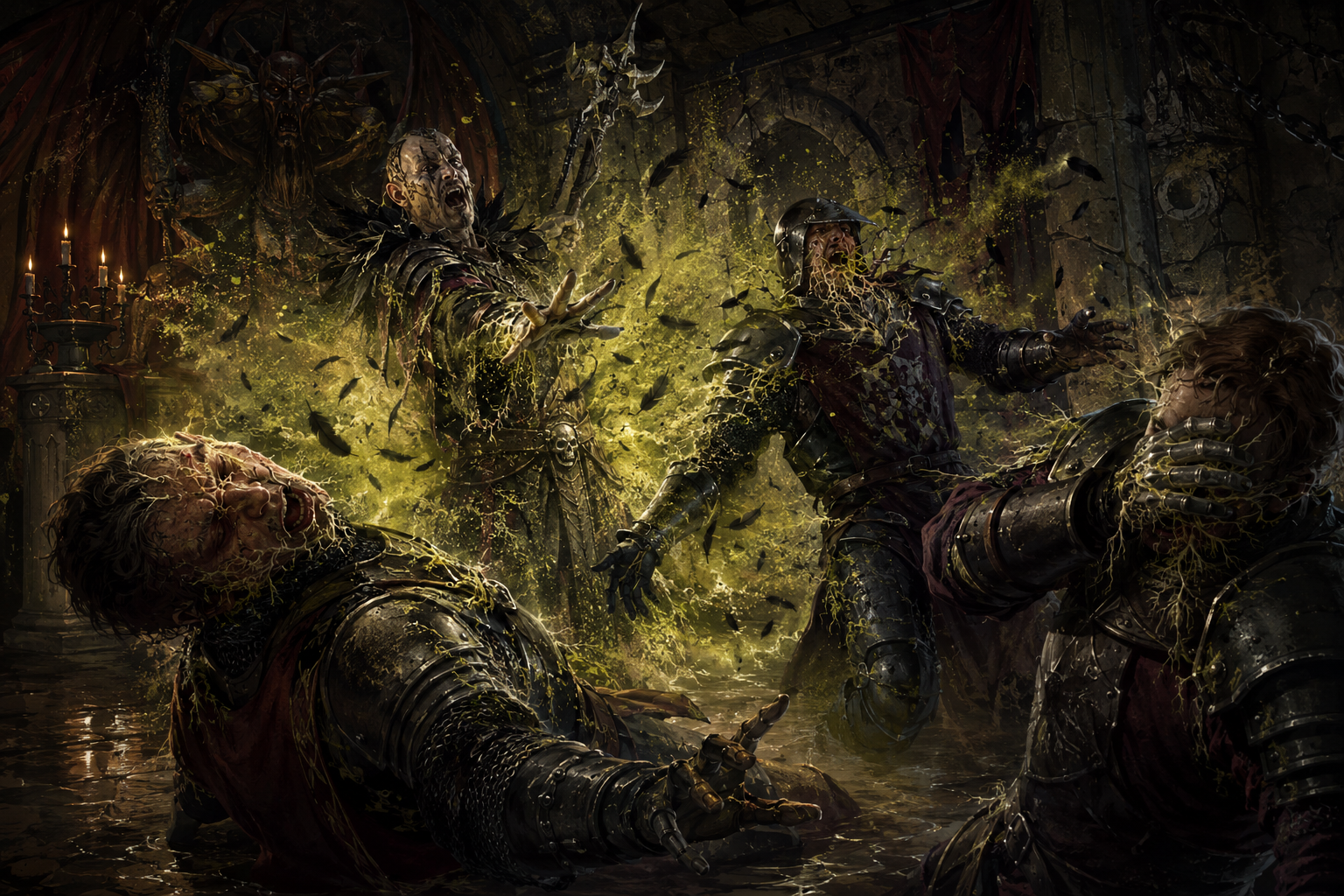
The caster summons a mass of spores that fill the area around him.
Book of Vile Darkness 3.5
By Monte Cook
Conjuration (Creation) [Evil]
Level: Cleric 2,
Components: V, S, M/DF
Casting Time: 1 full round
Area: 5-ft.-radius, centered on caster
Duration: Instantaneous
Saving Throw: Fortitude negates
Spell Resistance: Yes
The spores deal 1d8 points of damage to all creatures within 5 feet other than the caster. Then they penetrate the skin and grow, dealing an additional 1d2 points of damage each round for 10 rounds. At the end of this time, a tangle of viny growths covers each subject. A delay poison spell stops the spores’ growth for its duration. Bless, neutralize poison, or remove disease kills the spores, as does sprinkling the victim with a vial of holy water.
Arcane Material Component: The feathers of an avian creature with an Intelligence score of at least 3 (a harpy, achaierai, or similar creature).
Why This Spell Is Dangerous in the World
Spores of the Vrock is dangerous because it makes the caster’s immediate presence contagious. A cult priest does not need to dominate a battlefield; they only need enemies, guards, prisoners, or villagers to stand close enough.
The spell also leaves evidence. Victims do not merely fall wounded. Their skin flowers with pale fibres, mould-dark lesions, and root-like growths. Even after healing, the marks suggest demonic contact. In suspicious settlements, surviving the spell may still make a person look polluted, cursed, or secretly allied with abyssal powers.
Its evil nature matters. This is not ordinary poison. It is conjured fiendish growth. Temples, healers, druids, magistrates, and demon-hunters may treat its use as proof of vile practice.
Best Uses in Play
Use this spell when the caster expects enemies to close in.
It works best on a demon cultist trapped in melee, a vile cleric surrounded by guards, a war-priest fighting in a shrine chamber, or a villain who deliberately lets opponents crowd around them before releasing the spores.
It is also useful as evidence before combat begins. A corpse covered in pale vine-like growths tells the party that a nearby enemy has access to abyssal magic.
For player characters, the spell is tactically useful but socially dangerous. Casting it in a town, court, temple, military camp, or crowded street should have consequences.
Failure, Risk, and Misuse
The spell’s greatest weakness is positioning. It affects only creatures close to the caster. Enemies with reach, bows, thrown weapons, forced movement, silence, or counterspells can deny the caster the perfect moment.
It is also risky around allies. The caster is protected; companions are not.
The spell performs poorly against poison-immune creatures, distant enemies, and groups with ready access to cleansing magic. It performs well against lightly armoured melee attackers, restrained victims, mobs, and enemies who believe surrounding the caster is safe.
Investigation and Cleansing
The visible growths are the clearest sign of the spell. Victims may show pale threads beneath the skin, fungal lesions around wounds, black-green dust in clothing, or thin tendrils emerging from old scars, gums, ears, or eyes.
A healer, priest, herbalist, demonologist, or battlefield surgeon can identify the effect with Arcana, Religion, Medicine, Nature, Heal, or Knowledge checks as appropriate to the edition.
Holy water is the simplest field answer. Pouring it over the infected creature kills the spores and ends the effect. This gives prepared adventurers, priests, pilgrims, and monster-hunters a practical countermeasure without turning every cure into a high-level spell.
How the Spell Changes a Scene
This spell makes closeness frightening.
A prisoner may erupt in spores when a hidden cult brand activates. A dying priest may drag himself into the party before casting. A vrock-worshipping ascetic may allow enemies to stab him simply to bring them close enough for the spores to take root.
After the spell is cast, the scene should feel contaminated. Armour needs scraping. Wounds itch. The air smells of damp feathers, mould, and opened graves. Even when the magic ends, the victims may feel that something living tried to claim them.
Rules Clarifications and Edge Cases
Does the spell affect allies?
Yes. The caster is protected; everyone else nearby is at risk.
Is this poison, disease, or a curse?
It is a magical spore infestation. Use the listed counters. In 5.5e play, Poison damage and poison-cleansing magic are the cleanest default. Disease-cleansing and holy magic also work because the spell’s original logic allows them.
Does armour stop it?
No. The spores enter through seams, breath, exposed flesh, wounds, eyes, and supernatural contact.
Can the growths be cut away?
No, not while the spores remain alive inside the victim. Cutting or burning the surface growth may reduce the visible horror after the infection is cured, but it does not end the spell.
Can the spell spread from victim to victim?
No. The spell creates a single conjured burst. Victims do not infect one another unless a special villain, curse, or plague variant deliberately changes the spell.
Related Spells
These spells pair naturally with Spores of the Vrock because they involve poison, disease, cleansing, consecration, or corruption of the body.
Bless — This is the unusual consecrating counter named in the original spell. Its holy force kills the spores on infected victims, making it one of the simplest answers to the magic.
Delay Poison — This spell does not kill the spores, but it can hold their continuing harm in check while the victim retreats, receives aid, or reaches a proper healer.
Neutralize Poison — One of the cleanest answers to the spell. It treats the spores as a poisonous magical infestation and ends their continuing damage.
Remove Disease — This is appropriate when the spores are being treated as a demonic infection rather than simple venom. It kills the growth before it finishes spreading through the victim’s body.
Lesser Restoration — A practical low-level cleansing spell for ending the infection, especially where the spores are treated as poison, disease, or a supernatural bodily affliction.
Protection from Poison — Useful before entering a demon shrine, plague crypt, or vrock-haunted battlefield. It can also help a victim already suffering from the spores, depending on the rules version being used.
Contagion — A useful comparison spell rather than a direct counter. Both spells make corruption of the body part of the threat, but Contagion is slower and more disease-like, while Spores of the Vrock is immediate, close-range, and visibly abyssal.
Adventure and Worldbuilding Hooks
The Feather Reliquary
A ruined shrine contains a reliquary full of black feathers taken from intelligent winged creatures sacrificed by a demon cult. Local priests want it burned. A warlock wants it opened. The feathers are enough to supply years of vile spellcasting.
The Growth Beneath the Armour
A knight survives an ambush but refuses to remove his armour. When the party finally sees why, pale fibrous growths have threaded through the padding beneath his breastplate. He claims bandits attacked him. The infection pattern suggests a priest stood close enough to bless him.
The Choir with Mould in Their Throats
A temple choir begins coughing up black spores after singing at a noble funeral. The corpse was never infected. The spell was cast by someone standing among the mourners, close enough to harm the living while pretending to grieve.
Historical, Natural, and Mythic Context
Spores of the Vrock takes a natural horror and gives it an abyssal soul. Spores are small reproductive bodies that can travel invisibly, settle into hidden places, and become obvious only after growth has already begun. The spell turns that quiet natural process into an act of fiendish violence: the victim is not merely wounded, but made into soil for something hostile, invasive, and unclean. For natural background, see Britannica’s overview of spores and fungal reproductive processes.
The spell’s material component gives it a second layer of meaning. A feather from an intelligent avian creature connects the magic to winged omens, carrion birds, harpies, fiendish messengers, and the fear of predatory things descending from above. Harpies are especially fitting: in classical myth they are winged female spirits associated with snatching, punishment, storm-winds, and dreadful visitation. For mythic background, see Britannica’s entry on the Harpy.
In a late medieval campaign, this spell should feel like a stolen fragment of demonic biology rather than an ordinary poison. Vrocks are carrion-winged fiends, and their spores make proximity itself dangerous. A mortal caster using Spores of the Vrock borrows that same logic: the space around the caster becomes polluted, the victim’s body becomes a bed for hostile growth, and anyone standing too close learns that evil magic does not always arrive as flame, shadow, or command. Sometimes it blooms.
Keep this reference growing
If this page helped with your reading or game, you can support its upkeep or explore the curated books.
Explore the Bookshop — epics, classics and stories behind imagined worlds.