
Reforge Spell: Metal Reshaping Magic
Reforge Spell: Metal Reshaping Magic
Alternative Spell Name: Smith’s Command
Ruin a key, silence a bell, bend a chain, or turn metal into a crude practical shape.

Overview
The Reforge spell is a precise transmutation used when metal must be changed immediately rather than worked at a forge. It does not create metal, improve its quality, or turn poor iron into noble steel. It softens an existing metal object, lets the caster impose a new simple shape, and fixes the result once the magic ends.
Reforge is a spell of sabotage and salvage. It can deny function by deforming the metal object a situation depends on, or it can reshape available metal into a crude, practical form.
It is not a weapon spell, and it is not fabrication. It cannot produce masterwork tools, fitted armour, precision parts, or fine detail.
Effect
You reshape one nonmagical metal object within range.
The object must be a discrete object or accessible component, not an undefined portion of a larger structure. A sword, key, chain, hinge-pin, buckle, ring, fitting, bar, clasp, loose plate, tool, or vessel can be targeted. “The metal in the wall,” “the iron in the ship,” or “the rivets in a bridge” are not valid targets unless the chosen part is clearly separate and within the spell’s weight limit.
The object briefly softens as if heated in a forge, though it does not burn, drip, or radiate heat. To observers, the metal does not melt; it slackens, as if its shape has been forgotten. You reshape it into one simple, solid form that the available metal could reasonably make.
Reforge changes shape, not substance. It does not purify metal, remove rust, create alloy, restore lost mass, or increase value. Iron remains iron. Silver remains silver. Adamantine remains adamantine.
The object’s function changes with its form. A sword reshaped into a bar is no longer a weapon. A bell reshaped into a bowl no longer rings. A key reshaped into a lump no longer opens anything.
Reforge can also produce a crude, serviceable form from available metal: a hook, spike, ring, wedge, bar, or similar simple shape. The result is usable but unrefined.
Reforge cannot create precision objects or skilled workmanship. It cannot make locks, keys, springs, clockwork, fitted armour, inscriptions, coinage, or masterwork items.
Reforge does not affect magic items. A magic item can only be reshaped if it is broken, inert, or willingly submitted to a specific ritual designed for that purpose. This is not a normal use of the spell.
Edition Tabs
Reforge Spell, Reforge 5.5e / 2024
Reforge Spell, Pathfinder 1e / 3.5e
Reforge Spell 3.0
Reforge Spell, Reforge 5.5e / 2024

Alternative Spell Name: Smith’s Command
3rd-Level Transmutation Spell
Casting Time: Action
Range: 60 feet
Components: V, S, M (a scrap of iron from a forge)
Duration: Instantaneous
Available To: Wizard, Sorcerer, Artificer
Choose one nonmagical metal object you can see within range. The object must weigh no more than 10 pounds and must be a discrete object or accessible component.
If the object is worn or carried, the creature makes a Wisdom saving throw. On a success, the spell fails. On a failure, the object is reshaped.
You reshape the metal into a simple, solid form the material could reasonably make.
The spell changes shape, not substance. It cannot create precision objects, mechanisms, fitted items, or masterwork quality.
A reshaped weapon becomes an improvised weapon unless it clearly matches an existing weapon form.
At Higher Levels: The maximum weight increases by 10 pounds per slot level above 3rd.
Check: Intelligence (Arcana) or Dexterity using relevant tool proficiency, such as smith’s tools or thieves’ tools.
| Task | DC | Examples | Result |
|---|---|---|---|
| Crude form | — | Hook, spike, wedge, ring, bar, bowl | Works without a check. |
| Simple fit | 10 | Loose bracket, basic hinge plate, crude latch bar, simple tool head | Works normally, though visibly crude. |
| Close fit | 14 | Matching a clasp, reshaping a buckle, aligning a hinge-pin, replacing a simple catch | Works, but may be awkward, noisy, or short-lived. |
| Precision fit | 18 | Key for a mundane lock, tight latch part, fitted restraint component | Works once or briefly, at the DM’s discretion. |
| Exact duplication | — | Perfect key, masterwork fitting, coin die, seal matrix, clockwork part | Not possible with Reforge. |
Modifiers:
The caster has advantage if they can study the original object, matching socket, or receiving part for at least 1 round before casting. The caster has disadvantage if working from memory, a partial view, or a verbal description.
Hard Limits
A reshaped key is never a permanent reusable key. It may open a mundane lock once, stick in the lock, or fail after brief use.
Reforge does not bypass magical locks, wards, seals, or protections.
Reforge can approximate function, but it does not replace craft.
Reforge Spell, Pathfinder 1e / 3.5e
School: Transmutation
Level: Sorcerer/Wizard 3
Components: V, S, M
Casting Time: 1 standard action
Range: Close (25 ft. + 5 ft./2 levels)
Target: One nonmagical metal object up to 1 lb./level
Duration: Instantaneous
Saving Throw: Will negates, object
Spell Resistance: Yes, object
Material Component: A scrap of iron from a forge
You target a single nonmagical metal object. It softens briefly and can be reshaped into a simple form.
The metal remains the same material and retains its normal properties, but its function changes with its new shape.
Reforge changes shape, not substance. It cannot create precision work, complex mechanisms, fitted armour, or masterwork items.
The result is crude but usable.
Check: Spellcraft or an appropriate Craft skill, such as Craft (blacksmithing), Craft (weapons), Craft (armour), or Craft (locks).
| Task | DC | Examples | Result |
|---|---|---|---|
| Crude form | — | Hook, spike, wedge, ring, bar, bowl | Works without a check. |
| Simple fit | 10 | Loose bracket, basic hinge plate, crude latch bar, simple tool head | Works normally, though visibly crude. |
| Close fit | 15 | Matching a clasp, reshaping a buckle, aligning a hinge-pin, replacing a simple catch | Works, but may be awkward, noisy, or short-lived. |
| Precision fit | 20 | Key for a mundane lock, tight latch part, fitted restraint component | Works once or briefly, at the DM’s discretion. |
| Exact duplication | — | Perfect key, masterwork fitting, coin die, seal matrix, clockwork part | Not possible with Reforge. |
Modifiers:
Reduce the DC by 2 if the caster can study the original object, matching socket, or receiving part before casting. Increase the DC by 5 if the caster is working from memory, a partial view, or a verbal description.
Hard Limits
A reshaped key is never a permanent reusable key. It may open a mundane lock once, stick in the lock, or fail after brief use.
Reforge does not bypass magical locks, wards, seals, or protections.
Reforge can approximate function, but it does not replace craft.
Reforge Spell 3.0

You target a particular metal item with this spell. The item in question becomes soft, as if it were molten metal, and you can then reshape it into any desired form.
Relics & Rituals: Olympus
© 2004 White Wolf Publishing, Inc. Distributed for Sword and Sorcery Studios by White Wolf Publishing, Inc.
By W. Jason Peck, Aaron Rosenberg, Christina Stiles and Relics & Rituals: Olympus team
Transmutation
Level: Sorcerer/Wizard 3
Components: V, S, M
Casting Time: 1 standard action
Range: Close (25 feet + 5 ft./2 levels)
Effect: Up to 1 lb. weight of metal percaster level
Duration: Instantaneous
Saving Throw: Will negates (object)
Spell Resistance: Yes (object)
You do not need to touch the item to reshape it, but can simply imagine the desired form in your mind and order the metal to match it. Once it has taken its new form, the metal cools, and is now fixed in that shape. The item’s damage matches its new form, regardless of the old one – a sword that has been transformed into a metal urn does not do damage as a sword anymore. The metal itself remains the same, and retains the same hardness and hit points as before. Note, however, that this spell cannot produce artwork – filigree and etching and other intricated details are lost, and the new item is reasonably well crafted but not masterwork.
Material Component: A scrap of iron from a forge.
Why This Spell Matters
The Reforge Spell matters because it gives metal a second use after its first one has failed. Broken blades, bent fittings, damaged tools, ruined buckles, snapped chain, and scrap from the road can become something crude but useful before the party reaches a forge.
Its darker use is sabotage. A key can be made blank, a bell made dull, a chain made awkward, or a hinge-pin bent out of purpose. The spell is not subtle because it leaves no trace; it is subtle because the object is still there, and people may not understand what has changed until they try to use it.
Best Uses
The Reforge Spell is best used on small, definite pieces of metal: a key, chain, bell-clapper, buckle, hinge-pin, knife blade, loose plate, hook, ring, clasp, tool head, or similar object.
Use it in two ways:
Ruin a function: smooth a key, bend a clasp, spoil a hinge-pin, blunt a blade, close a chain link, or make a bell-clapper strike badly.
Make a crude form: turn available metal into a hook, wedge, spike, ring, bar, bowl, or simple tool head.
That is the spell at its cleanest: reshape one metal object so it does a different job, or can no longer do its old one.
Tactics
The Reforge Spell is the ability to change what a metal object is for. Its strength is not destruction, but alteration.
Use it when reshaping one object gives an immediate advantage: an obstacle becomes a tool, a tool becomes a restraint, a weapon becomes a different shape, or scrap becomes something usable. A chain might become a bar, a blade might become a hook, a broken plate might become a wedge, or a loose fitting might become a ring.
In combat, Reforge is worth the action only if the new form changes the situation. It does not stop an enemy from fighting, but it can change reach, leverage, access, restraint, escape, or the use of a particular item.
DM Notes
Keep the Reforge Spell focused on shape and function. It can make an object stop working, or turn existing metal into a crude usable form, but it should not replace smithing, locksmithing, siegecraft, or fabrication.
Do not allow the spell to create precise parts, hidden internal changes, fitted armour manipulation, working locks, perfect keys, complex mechanisms, or magic item alteration. Those uses turn a clear 3rd-level utility spell into something much broader than it should be.
The spell is strongest when the table thinks in objects. Ask what piece of metal matters, what job it performs, and what happens when that job fails.
Using This Spell in Your Game
Reforge should matter when the target object already matters. Use it on the key, not the idea of a locked door; the hinge-pin, not the whole gate; the bell-clapper, not the whole tower.
At the table, ask the player what object they are reshaping and what simple form they want it to take. If both answers are clear, the spell stays sharp and useful.
Good Combinations
- Mending: Useful after Reforge has produced a crude shape but left cracks, stress marks, or weak joins. It cannot turn the result into masterwork craft, but it can make a rough tool, hook, or fitting more dependable.
- Fabricate: Reforge handles the urgent field alteration; Fabricate handles proper construction later. Together, they separate emergency improvisation from finished workmanship.
- Knock: Knock opens what magic can open. Reforge changes the metal part that still matters: a bar, clasp, hinge-pin, hasp, chain, or fitting.
- Heat Metal: Heat Metal punishes contact with metal; Reforge changes what that metal is for. Used together, they can force panic, misdirection, or costly choices.
- Animate Objects: Reforge can turn scrap, bent weapons, or loose metal into simpler shapes before animation, making the animated objects easier to describe and use at the table.
Spellcasting Culture and Worldbuilding Hooks
The Reforge Spell has a poor reputation wherever locks, seals, bells, chains, and gates matter. Smith-guilds dislike it because it imitates a tiny part of their craft without training. Gaolers fear it because a key can become useless while still hanging from the belt. Magistrates distrust it because seals and signet rings can be made to lie by becoming blank.
Thieves value Reforge less as a way to open doors than as a way to confuse evidence. A lock is still present. A key is still present. A bell is still hanging. The failure looks like negligence, bad workmanship, or betrayal.
In forge temples, the spell is judged by intent. Used to salvage broken metal in hardship, it may be tolerated. Used to deform oath-weapons, shrine vessels, bells, or lawful seals, it is treated as desecration.
Adventure Hooks
The Bell Before the Raid: The watchman swears he pulled the rope, but the bronze bell gave only a dull scrape. By dawn, the raiders were gone. The bell was not cut down or cracked; its mouth has been subtly reshaped so it can no longer ring true.
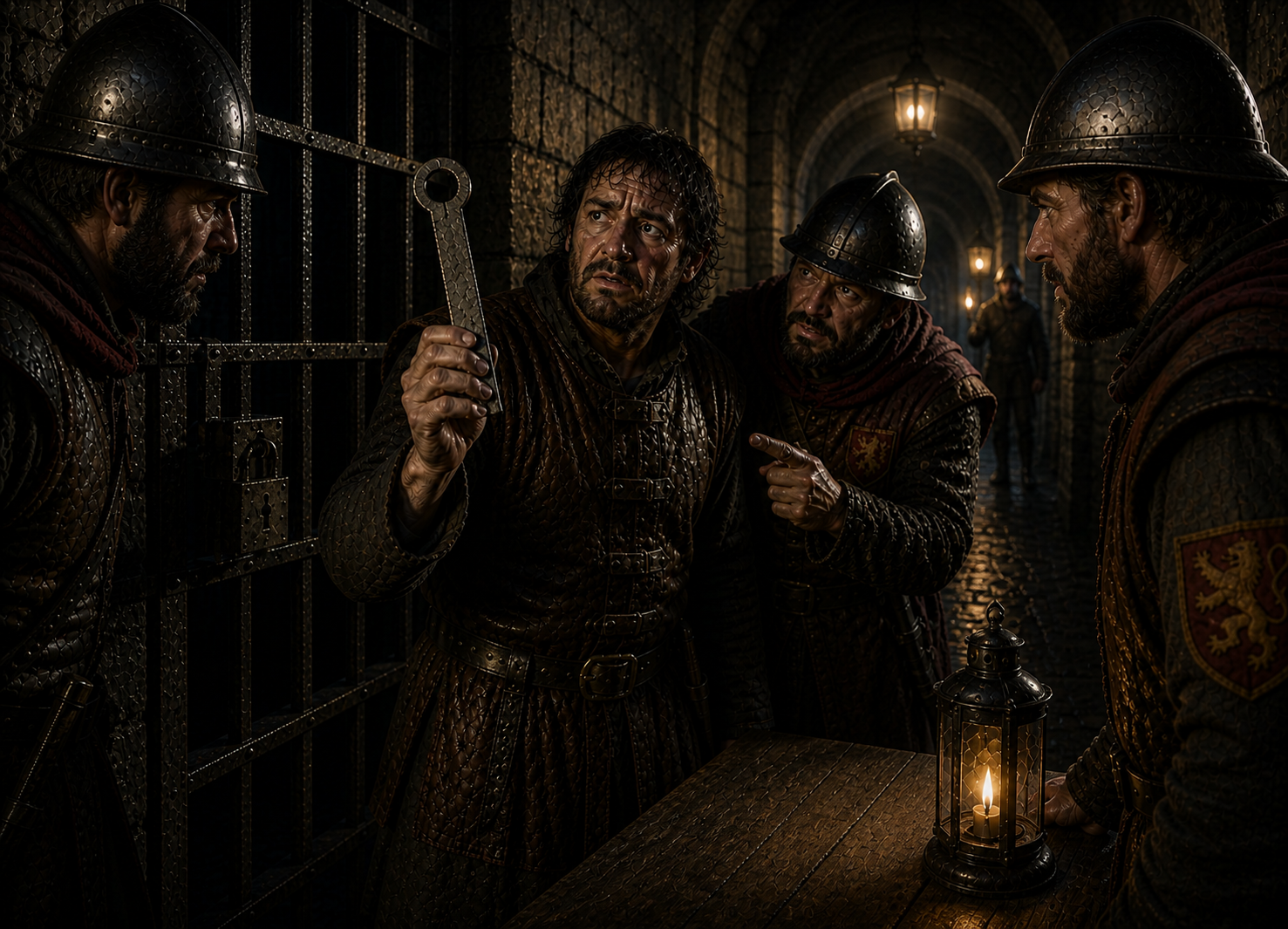
The Key That Condemned the Gaoler: A prisoner escaped from a locked cell, and the gaoler still has the key on his belt. Its teeth are now a smooth strip of iron. Either he helped the prisoner, or someone changed the key after the door was opened.
The Seal That Unmade the Treaty: A noble’s signet ring has become a plain band of gold. No gem was stolen, no finger was cut, and no chest was forced. Without the seal, every copy of the treaty can now be challenged.
The Hinge-Pin at the North Gate: The fortress did not fall because the gate was smashed. It fell because one hinge-pin had been reshaped days before the assault. The saboteur had to know the gate, the guard rotations, and exactly which piece of iron mattered.
Historical Context
Reforge reflects a simple reality of medieval life: small metal objects carried large responsibility. A single key controlled a cell. A hinge-pin held a gate. A bell gave warning. A clasp secured armour. When one of these failed, it mattered immediately.
This spell does not replace the smith or produce fine work. It reflects the moment before repair is possible, when a damaged or inconvenient piece of metal must be made useful again, or made to fail. In a world dependent on keys, fittings, chains, and simple mechanisms, the ability to alter one such object at the right time is enough to change an outcome.