
Ray of Exhaustion Spell
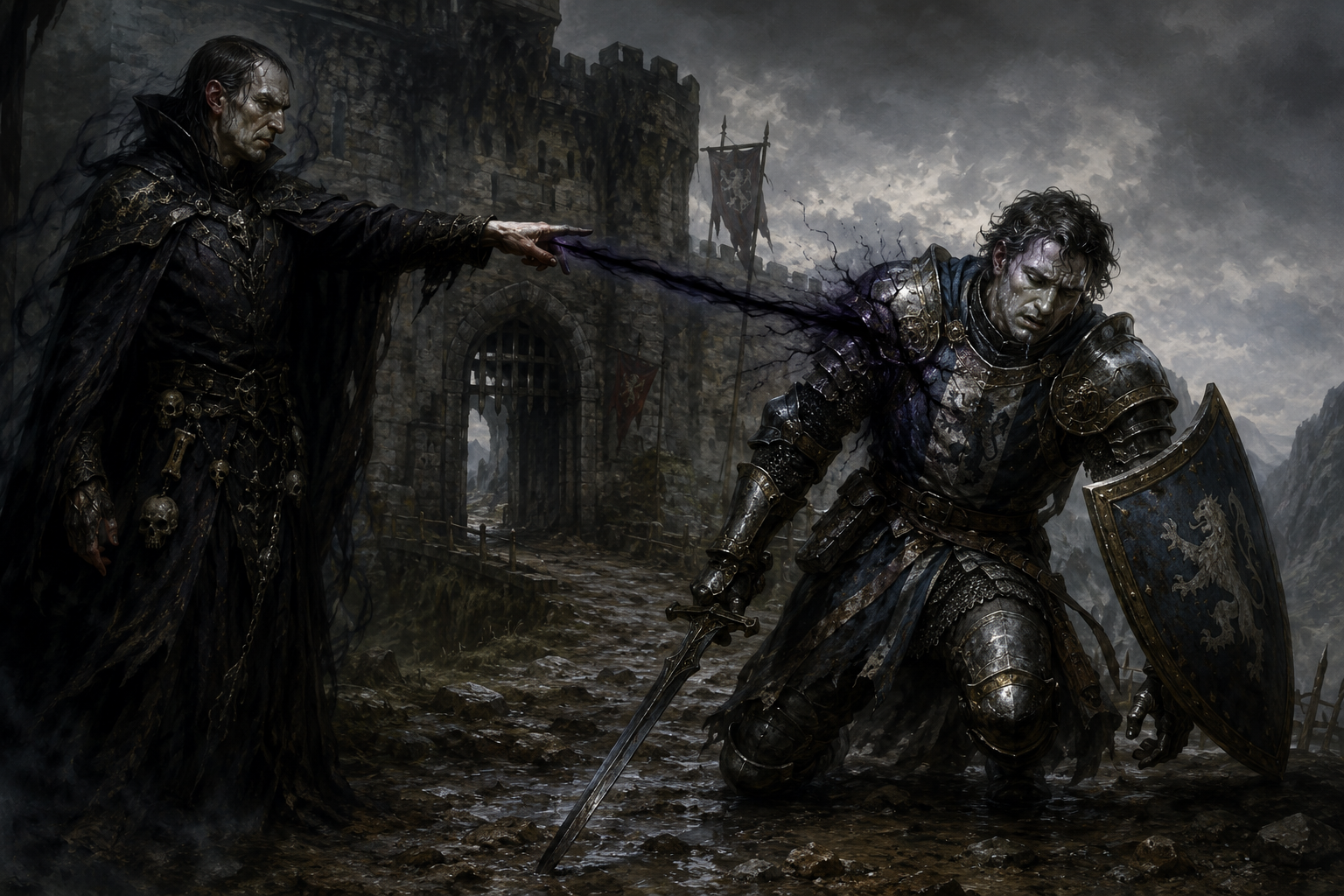
A black ray turns strength into fatigue and fatigue into magical exhaustion—but only in the legacy rules where the spell actually exists.
Ray of Exhaustion is a Pathfinder 1e and D&D 3.5e necromancy spell. There is no direct official D&D 5e / 2014 or D&D 5.5e / 2024 version. The previous modern conversion on this page created new “Minor Weariness” and “Severe Weariness” conditions that are not official rules and has therefore been removed.
The closest modern spell is Ray of Enfeeblement, but it is not the same spell. Modern Ray of Enfeeblement weakens attacks, Strength-based tests and damage; it does not recreate the classic fatigue-to-exhaustion progression.
Quick Rules Reference
- 5.5e / 2024: no direct official Ray of Exhaustion spell.
- 5e / 2014: no direct official Ray of Exhaustion spell.
- Closest modern spell: Ray of Enfeeblement, a different 2nd-level Necromancy debuff.
- Pathfinder 1e / D&D 3.5e: 3rd-level Necromancy, Sorcerer/Wizard, ranged touch attack, Fortitude partial, Spell Resistance yes.
- Failed save: target becomes exhausted for 1 minute per caster level.
- Successful save: target is fatigued instead.
- Already fatigued: the spell escalates fatigue to exhaustion.
- Already exhausted: the spell does not make the creature worse.
- Material component: a drop of sweat.
Rules
Ray of Exhaustion by Edition
5.5e / 2024 — No Direct Official Ray of Exhaustion
The 2024 spell list does not contain a direct Ray of Exhaustion. Do not use the previous homebrew “Minor Weariness / Severe Weariness” mechanics as though they were core rules.
Closest official spell: Ray of Enfeeblement
| Level | 2nd-level Necromancy |
|---|---|
| Range | 60 feet |
| Duration | Concentration, up to 1 minute |
| Save | Constitution |
On a failed save, Ray of Enfeeblement imposes Disadvantage on Strength-based D20 Tests and subtracts 1d8 from the target’s damage rolls for the duration, with repeat saves at the end of its turns. That is a different spell identity from legacy Ray of Exhaustion.
5e / 2014 — No Direct Official Ray of Exhaustion
Ray of Exhaustion was not carried into the 2014 core spell list as a direct spell. The 2014 game uses other debuffs—including its own version of Ray of Enfeeblement—rather than the old fatigue/exhaustion ray.
Rules boundary: do not map Pathfinder/3.5e fatigue and exhaustion directly into 2014 5e without an explicit house rule.
Ray of Exhaustion — Pathfinder 1e
| School | Necromancy |
|---|---|
| Level | Sorcerer/Wizard 3 |
| Casting Time | 1 standard action |
| Components | V, S, M (a drop of sweat) |
| Range | Close (25 ft. + 5 ft./2 levels) |
| Effect | Ray |
| Duration | 1 minute/level |
| Saving Throw | Fortitude partial |
| Spell Resistance | Yes |
Make a ranged touch attack. On a hit, the subject is immediately exhausted for the spell’s duration. A successful Fortitude save reduces this to fatigued.
A creature already fatigued becomes exhausted. A creature already exhausted is not worsened. Unlike ordinary fatigue or exhaustion, the condition created by this spell ends when the spell expires.
Ray of Exhaustion — D&D 3.5e
| School | Necromancy |
|---|---|
| Level | Sorcerer/Wizard 3 |
| Casting Time | 1 standard action |
| Components | V, S, M |
| Range | Close (25 ft. + 5 ft./2 levels) |
| Effect | Ray |
| Duration | 1 minute/level |
| Saving Throw | Fortitude partial |
| Spell Resistance | Yes |
A successful ranged touch attack subjects the target to magical exhaustion. On a failed Fortitude save the target is exhausted; on a successful save it is only fatigued.
An already fatigued creature becomes exhausted. An already exhausted creature is unaffected by further worsening from this spell. The magical condition ends when the spell’s duration expires.
Material component: a drop of sweat.
What Changed?
- There is no direct official Ray of Exhaustion in 5e/2014 or 5.5e/2024. The previous modern conversion has been removed.
- Modern Ray of Enfeeblement is only a thematic neighbour: it weakens Strength-related performance and damage but does not create legacy fatigue/exhaustion.
- Pathfinder 1e and D&D 3.5e use the same core procedure: ranged touch attack, then Fortitude partial.
- The spell escalates an already fatigued creature to exhausted but does not worsen a creature already exhausted.
- The legacy fatigue/exhaustion ends with the spell, unlike ordinary exhaustion from travel, starvation or other causes.
Legacy 3.0e Ray of Exhaustion
Necromancy
Level: Sorcerer/Wizard 3
Components: V, S, M
Casting Time: 1 standard action
Range: Close (25 ft. + 5 ft./2 levels)
Effect: Ray
Duration: 1 minute/level
Saving Throw: Fortitude partial
Spell Resistance: Yes
A ranged touch attack makes the target exhausted; a successful Fortitude save reduces the effect to fatigued. An already fatigued target becomes exhausted. The material component is a drop of sweat.
Why This Spell Is Dangerous in the World
Ray of Exhaustion is feared because it attacks trust in the body.
A knight struck by it may still have armour, training, courage, and command, but the body beneath the steel begins to fail. A messenger may still know the road but no longer have the legs to run it. A guard may still see the fleeing prisoner but lack the strength to give chase. A beast may still have teeth and claws but lose the killing momentum that makes it terrifying.
This makes the spell especially dangerous in courts, sieges, hunts, prisons, plague roads, forced marches, and battlefield retreats. It does not need to kill anyone to change who escapes, who is captured, who arrives too late, or who collapses before the gate is reached.
In darker hands, the spell becomes a tool of custody and coercion. A jailor can weaken prisoners without visible chains. A bounty hunter can take a dangerous quarry alive. A battlefield necromancer can break a shieldwall by making its strongest bodies falter before the charge lands.
Best Uses in Play
Stop a Pursuer:
Ray of Exhaustion is strongest when physical effort is about to decide the scene. It is especially effective before a chase begins, just before a brute reaches melee, while a guard holds a gate, while a messenger runs for help, or when a mounted hunter is about to overtake the party.
Break a Melee Brute:
Use Ray of Exhaustion against enemies whose threat comes from strength, speed, grappling, repeated attacks, or battlefield pressure. The spell does not remove them from the fight, but it makes them easier to survive.
Ruin a Physical Trial:
The spell is particularly strong in scenes involving pursuit, climbing, swimming, running, forced travel, battlefield withdrawal, rowing, carrying, or wilderness endurance.
Take Someone Alive:
A weakened target is easier to surround, disarm, bind, question, or transport. This makes the spell attractive to watch-captains, bounty hunters, prison mages, slave-takers, and battlefield officers who need prisoners rather than corpses.
Soften a Boss Without Ending the Encounter:
Ray of Exhaustion weakens a dangerous creature without stunning, banishing, charming, or locking it down completely. That makes it useful when the enemy should remain active but changed.
Failure, Risk, and Misuse
Ray of Exhaustion can miss, can be partly resisted, and is far less useful against enemies whose danger does not depend on physical effort. A necromancer, spirit, prophet, noble manipulator, trap-maker, or spellcaster may remain dangerous even while physically drained.
Do not use the spell as a vague “make the enemy weaker” button. It works best when exhaustion clearly matters: the quarry cannot keep running, the guard cannot hold the portcullis, the raider cannot climb the wall, the beast cannot keep pace with the horses, or the champion’s charge loses its force.
Signs of the Spell
A victim of Ray of Exhaustion may show sudden pallor, trembling hands, slack posture, shallow breath, cold sweat without heat, and the heavy movements of someone who has marched for days without rest.
Close inspection may reveal fading black veins around the point where the ray struck, a necromantic chill on the skin, or sweat beading on the brow despite cold weather. The victim’s breathing becomes rough and uneven, and their grip may loosen around weapons, reins, tools, or restraints.
Witnesses may describe the ray as a black thread, a smoky lance, a shadow from the caster’s finger, or a momentary darkening around the victim’s limbs.
Rules Clarifications and Edge Cases
Does the spell cause real long-term exhaustion?
No. The exhaustion, fatigue, or weariness caused by this spell is magical and temporary. It ends when the spell ends.
Can it worsen ordinary exhaustion?
Temporarily, yes. Ordinary exhaustion remains after the spell ends, but the spell’s added magical fatigue, exhaustion, or weariness does not.
Can it affect undead or constructs?
Usually no. The spell attacks living stamina. Creatures without living bodily fatigue are poor targets unless a specific stat block says otherwise.
Can repeated castings stack?
In Pathfinder 1e and D&D 3.5e, a creature that is already fatigued can become exhausted, but a creature already exhausted is not worsened by another Ray of Exhaustion. There is no direct official 5e/2014 or 5.5e/2024 Ray of Exhaustion to stack.
Is the target helpless?
No. The target is not asleep, paralysed, stunned, or unconscious. It can still think, speak, defend itself, cast spells, command allies, and make desperate choices. The spell changes what the target can physically afford to do next.
Does the target know it has been magically weakened?
Usually yes. The ray is visible, and the bodily collapse is sudden enough to feel unnatural.
Good Combinations
- Ray of Enfeeblement:: Weakens a physically dangerous enemy’s strength while Ray of Exhaustion attacks endurance.
- Bestow Curse: Turns a temporary weakening into a longer-term supernatural burden.
- Slow: Pairs well when movement, timing, and battlefield pressure all need to be hindered.
- Ghoul Touch: Offers a harsher disabling option with paralysis and corpse-stench imagery.
- Contagion: Suits campaigns where sickness, corruption, and necromancy overlap.
Adventure and Worldbuilding Hooks
The Tired Champion:
A famous duelist keeps losing bouts after a black-robed rival secretly strikes him before each public contest.
The Failed Messenger:
A courier carrying news of invasion is found alive but collapsed on the road, too exhausted to speak clearly. The black mark on his chest suggests magic, not hardship.
The Prison Without Chains:
A magistrate uses Ray of Exhaustion to keep prisoners weak without visible torture. The practice is legal, secret, and increasingly abused.
Historical, Medical, and Mythic Context
Ray of Exhaustion draws on an old and frightening idea: the body can fail before courage, duty, or will gives way. In a late medieval world, sudden weakness is not merely a physical symptom. It may be read as depletion, curse, wasting sickness, battlefield shock, stolen vigour, or the visible sign that a person’s vital heat has been driven out of balance.
Ancient and medieval medicine often understood illness through balance, depletion, heat, cold, moisture, dryness, and the movement of bodily fluids. The theory of the four humours treated blood, phlegm, yellow bile, and black bile as forces shaping both body and temperament. A spell that leaves a warrior pale, shaking, cold, and unable to endure would not look like a simple magical penalty. It would look like a violent disturbance of the body’s inner order.
The spell also belongs beside older fears of collapse through depletion. Fatigue is more than ordinary tiredness; it is the point at which effort becomes hateful and the body feels unable to continue. Ray of Exhaustion gives that failure a supernatural cause. The victim has not necessarily marched for days, starved, bled, or laboured in the fields, but the body behaves as if its reserves have already been spent.
In mythic terms, the spell belongs to stories where strength is stolen rather than defeated. Heroes are not always overcome by wounds. They may be undone by sleep, age, curse, poison, grief, enchantment, or the withdrawal of a god’s favour. Ray of Exhaustion turns that pattern into a visible act: a black ray touches the body, and the body’s courage is left without the strength to obey it.
In play, the spell should feel like more than a condition marker. Villagers may call it a wasting ray. Soldiers may fear it as coward’s necromancy. Physicians may look for chill skin, blackened veins, unnatural sweat, and a collapse of bodily balance. Priests and judges may argue over whether the victim’s vigour was stolen, suppressed, or judged. The spell is most memorable when it changes the fate of a body under pressure: the rider who cannot stay mounted, the champion who cannot lift his shield, the prisoner who cannot run, or the messenger who falls before delivering the warning.
Keep this reference growing
If this page helped with your reading or game, you can support its upkeep or explore the curated books.
Explore the Bookshop — epics, classics and stories behind imagined worlds.