
Planar Calling and Compulsion
Lesser Planar Binding
A dangerous rite for securing the service of a lesser planar creature—either by modern magical compulsion or by the older sequence of calling, containment and negotiated release.
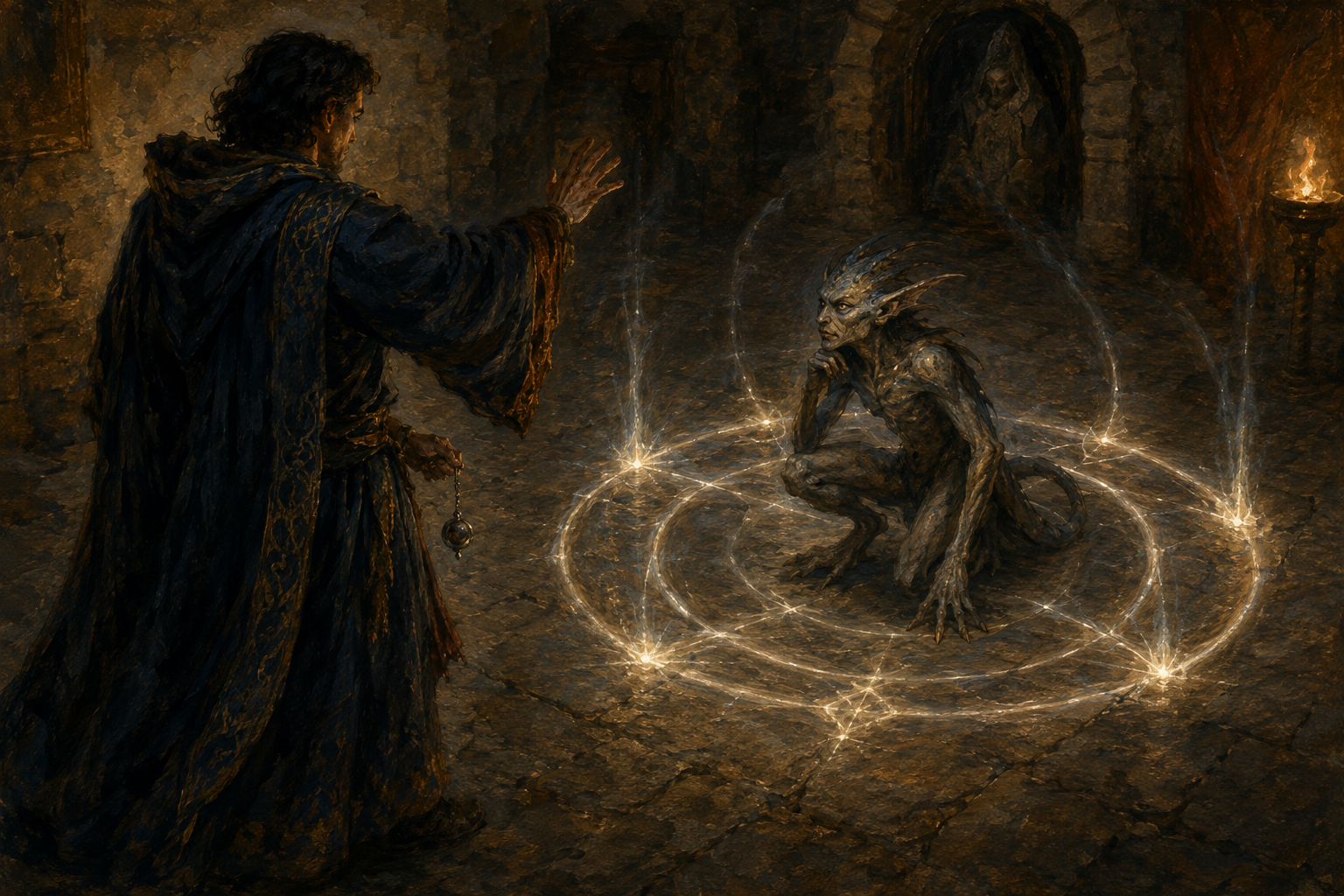
D&D 5.5e/2024 contains Planar Binding but no separate Lesser Planar Binding, so the first rules panel is an independent CR-limited conversion. Pathfinder 1e and D&D 3.5e preserve the original calling spell, in which an elemental or outsider is drawn into an inward-facing magic circle, allowed several routes of escape and bargained with for one service.
- Calling versus summoning
- Inward magic circles
- CR 6 or 6 Hit Dice
- Service and command
- Spell Resistance
- Escape and dispelling
I · Spell Overview
The call, the cage and the command
Bring or hold the creature
The modern conversion does not bring a creature from another plane. An eligible creature must already be present and remain within range throughout the casting. Pathfinder 1e and D&D 3.5e use the spell itself to call an elemental or outsider into a prepared trap.
Keep containment separate
Magic Circle against Evil and its corresponding variants provide confinement. The circle is a separate spell with its own direction, duration, boundary, Spell Resistance interactions and failure points.
Resolve resistance correctly
The D&D 5.5e/2024 conversion uses a Charisma saving throw and has no Spell Resistance procedure. Legacy rules use a Will save to resist the call, then allow specified daily escape methods after the creature appears.
Define service precisely
The modern effect compels obedience for a fixed duration. Legacy service begins only after an opposed Charisma negotiation succeeds and normally ends when the agreed task is completed. In every edition, hostile intelligence makes vague wording dangerous.
II · At the Table
Quick Rules Reference
Resolve the spell in this order, then use only the matching edition panel immediately below for the exact target limit, save, duration, Spell Resistance, concentration and service procedure.
- Choose the edition. Do not import Challenge Rating, Hit Dice, Charisma saves, Will saves or Spell Resistance from another ruleset.
- Prepare containment. Modern binding usually needs an inverted circle to hold an existing creature. Legacy binding requires an appropriate inward-facing magic circle.
- Check the target. The modern conversion permits one Celestial, Elemental, Fey or Fiend of CR 6 or lower. PF1e and 3.5e permit one elemental or outsider of 6 Hit Dice or fewer.
- Complete the casting. The modern caster takes the Magic action each turn and maintains Concentration for 10 minutes. Legacy casting takes 10 uninterrupted minutes under its own edition’s rules.
- Resolve arrival or binding. Modern: Charisma save at completion. Legacy: Will save to resist being called; Spell Resistance does not prevent the initial arrival.
- Resolve containment and escape. Modern: use the active circle or restraint. Legacy: track daily Spell Resistance, dimensional-travel and Charisma escape attempts.
- Resolve service. Modern failure compels service for the duration. Legacy service begins only after the caster wins the opposed Charisma check.
- Track every spell separately. Binding, magic circle, Dimensional Anchor and any summoning or creation spell have distinct durations and counterplay.
III · Edition-Separated Rules
Lesser Planar Binding Mechanics
The rules below are mechanics compatible for different game editions. Use only the panel matching the campaign’s ruleset. The D&D 5.5e/2024 panel is an independent conversion; the Pathfinder 1e and D&D 3.5e panels retain their own calling terminology, class lists, saving throws, Spell Resistance and negotiation rules.
Edition differences at a glance
| Rule element | D&D 5.5e / 2024 conversion | Pathfinder 1e | D&D 3.5e |
|---|---|---|---|
| What the spell does | Binds an eligible creature already present. | Calls a creature from another plane, then negotiates service. | Calls a creature from another plane, then negotiates service. |
| Target limit | One Celestial, Elemental, Fey or Fiend of CR 6 or lower. | One elemental or outsider of 6 HD or fewer. | One elemental or outsider of 6 HD or fewer. |
| Initial defence | Charisma save at completion. | Will save to resist the call. | Will save to resist the call. |
| Spell Resistance | Not used. | Does not stop arrival; later supports a daily escape attempt. | Does not stop arrival; later supports a daily escape attempt. |
| Service | Compelled for a fixed duration after a failed save. | Begins only after the caster wins an opposed Charisma check. | Begins only after the caster wins an opposed Charisma check. |
| Completed spell | Ongoing, dismissible and dispellable. | Calling is instantaneous; containment remains dispellable. | Calling is instantaneous; containment remains dispellable. |
| Proper name | Not required. | Required to call a specific individual. | Required to call a specific individual. |
| Return | No automatic dismissal at early completion. | Instant return after the agreed service is reported complete. | Instant return after the agreed service is reported complete. |
IV · Adjudication
Rules Clarifications and Edge Cases
Does Lesser Planar Binding itself create the creature?
Only in the legacy editions, and even there it calls rather than summons. Pathfinder 1e and D&D 3.5e transport the actual creature into the trap after a failed Will save. The modern conversion affects only an eligible creature already within range.
Is a Magic Circle mandatory?
Yes for the PF1e and D&D 3.5e calling procedure: the spell explicitly requires a prepared inward-facing circle. The modern conversion does not list a circle as a formal component, but an unwilling target must remain within 60 feet for the full 10 minutes. An inverted circle, secure chamber or other restraint is therefore normally essential.
What happens when the target is too large for the circle?
The circle’s rules control containment. A legacy creature too large to fit within the inward circle is not trapped by it. In modern play, use the actual 10-foot-radius, 20-foot-high Cylinder created by Magic Circle; Lesser Planar Binding does not enlarge the ward.
Can the prisoner attack through the circle?
An ordinary legacy inward circle is not a solid wall: ranged weapons, spells and magical abilities can cross, although the prisoner cannot reach across or attack the circle itself. A successful special diagram blocks the prisoner’s attacks and abilities. The modern Magic Circle imposes its listed attack and condition protections but does not grant total cover.
Does Dimensional Anchor stop every escape method?
No. In Pathfinder 1e and D&D 3.5e it closes the dimensional-travel route, but it does not stop the daily Spell Resistance test or Charisma escape check. In modern play, follow the independent Dimensional Anchor conversion; it limits magical travel rather than ordinary movement.
Can Dispel Magic send a legacy called creature home?
No. The legacy calling has instantaneous duration. Dispelling the circle removes containment, and dispelling Dimensional Anchor restores magical travel, but neither action reverses the completed call. A separate dismissal, banishment or negotiated release is needed.
Does a 2024 target’s Charmed immunity protect it?
No. The conversion does not impose the Charmed condition. The creature relies on its Charisma saving throw and any feature that applies to saving throws against spells or magical effects.
What if the modern target is invalid?
If the target has the wrong creature type or exceeds CR 6 when the casting completes, it is an invalid target. Under the 2024 invalid-target rule, the slot is still expended and the creature appears to have succeeded on its save when the spell would normally have no effect after a successful save.
Can a command force self-destruction?
The modern creature must follow commands to the best of its ability, but the spell does not let it perform an impossible act or understand undefined instructions. Legacy creatures never agree to impossible or unreasonable services. In every edition, adjudicate the exact words and the creature’s intelligence rather than inventing obedience beyond the spell.
What happens if the caster dies?
A completed modern binding requires no Concentration, so the caster’s death does not automatically end it. Legacy calling and an accepted service also continue according to their terms, while the circle and anchor continue only for their remaining durations. The death of the person who could clarify an ambiguous command may make the situation more dangerous.
Why does the circle say the calling spell must follow within 1 round when the spell takes 10 minutes?
The legacy texts create a timing conflict. The workable table ruling is that the caster must begin the 10-minute Planar Binding casting within 1 round of completing the inward circle. Requiring the spell to finish within that round would make the printed combination impossible.
V · Combinations and Counters
Build the trap, close the exits, protect the wording
Magic Circle against Evil
The defining partner. Modern play normally inverts the circle to hold an existing creature during the casting. Legacy play requires an appropriate inward circle as the receiving trap. Its boundary, duration and vulnerabilities remain independent of the binding.
Dimensional Anchor
The specialised answer to teleportation and planar escape. It does not stop Spell Resistance, Charisma escape, physical attacks or an outside creature from damaging a legacy diagram. The modern page presents it as an independent 2024-compatible conversion.
Dispel Magic
Against the modern conversion, target the ongoing binding and make the 2024 DC 15 check. Against PF1e or D&D 3.5e, dispel the ongoing circle or anchor; the instantaneous calling remains. Always use the matching edition’s dispel procedure.
Stronger binding tiers
Planar Binding and Greater Planar Binding extend the legacy family to more powerful creatures and larger Hit Dice totals. Do not increase this spell’s 6 HD cap merely because the caster level is high.
Practical counterplay
Interrupt the casting
In 2024 play, damage, incapacitation or another concentration-breaking event can end the 10-minute casting before the slot is spent. Moving the target beyond 60 feet or behind Total Cover before completion also defeats the attempt.
Break the boundary
Legacy circles depend on an intact physical line. A servant, familiar, infiltrator, falling object or environmental disturbance can release the prisoner even when the creature cannot touch the circle itself.
Attack the correct effect
A circle, anchor, summoning effect and completed modern binding can coexist. Identify which effect keeps the creature present, confined or obedient, then resolve Dispel Magic against that effect under the active edition.
Exploit language
A hostile planar intelligence does not become foolish. Ambiguous destinations, undefined deadlines, conflicting priorities and careless permissions can turn apparent obedience into sabotage.
VI · Campaign and World Consequences
Why lesser binding still changes a world
Proper names become strategic assets
In Pathfinder 1e and D&D 3.5e, a particular individual can be called only by its proper name. Archives, stolen catalogues, inherited grimoires and deliberately false names become matters of intelligence and counterintelligence.
Dedicated chambers become infrastructure
Reliable callers need undisturbed floors, measured circles, secure sight lines, vetted assistants and safeguards against ranged retaliation. A binding room is closer to a fortified laboratory than a casual spellcasting space.
Planar retaliation outlives the service
Neither a failed save nor a won Charisma check erases memory. Repeated coercion can create personal vendettas, hostile planar policy, rescue attempts and mortal agents seeking the caster’s diagrams or proper name.
Material cost limits modern practice
The modern conversion consumes a 500 GP jewel whenever the casting completes. Access to suitable gems limits routine use, encourages specialised trade and gives enemies a clear logistical point to disrupt.
Service is not loyalty
A compelled creature may obey while preserving its own goals. A legacy creature may accept because the reward is useful, because escape has failed or because the offered task advances a larger plan.
Ethics become visible
Binding an intelligent being by force is a political and moral act, even when the target is dangerous. Courts, guilds, cults and planar powers may judge the caster by whom they bind, why they do it and what service they demand.
VII · Adventure Design
Adventure Hooks
Each hook turns a specific rule—range, proper names, daily escape attempts, separate spell durations or twisted commands—into the centre of play.
The Sixth Hit Die
A supposedly legal target arrives with an unexpected advancement, template or hidden nature that places it above the spell’s limit. The circle holds something, but the thing inside may not be the creature the summoner named.
The Name in Two Hands
Two rival grimoires give different proper names for the same outsider. One is an alias; the other belongs to a far more dangerous relative who has been waiting to hear it spoken inside a prepared trap.
Ten Minutes of Silence
The characters must protect a modern caster through the full binding while enemies attack the chamber, the target bargains from inside the circle and every serious blow threatens Concentration.
The Daily Test
A legacy prisoner has failed every escape method for weeks. Tonight its Spell Resistance succeeds, and the only warning is a ward-keeper’s interrupted report from inside the supposedly secure complex.
The Completed Command
A bound creature reports that its task is finished, but the result is catastrophic. It obeyed every word and used the most destructive interpretation available. The party must prove whether the disaster was malice or exact compliance.
Dispel the Right Layer
A planar creature is present through one spell, trapped by a second, anchored by a third and commanded by a fourth. The characters have one Dispel Magic and seconds to identify which effect matters most.
VIII · Historical and Occult Development
From written binding to the conjurer’s circle
Historical magical practices did not operate as a single continuous system and do not demonstrate that fantasy planar calling was real. The spell instead combines recurring motifs: powerful names, written constraints, marked ritual space, spirit invocation and the danger of exact wording.
Late-antique magical handbooks
The Greek Magical Papyri preserve ritual instructions from Roman-period Egypt involving names, signs, material preparations, attraction, protection and binding. British Library Papyrus 121 is a fourth-century magical handbook containing rites for purposes ranging from healing to coercive attraction.
British Library: binding language and magical signs in the Greek Magical Papyri
Pentacles and spirit-calling manuals
Early-modern ritual manuscripts systematised circles, pentacles, powerful names, consecrated tools and procedures for calling spirits. Harley MS 2267, copied in 1600, contains sections on binding people or things, making pentacles and calling spirits.
The circle as a recognisable image
By the nineteenth century, the conjurer standing inside a marked circle while dangerous beings gather around it had become a familiar visual shorthand. An 1813 engraving after William Marshall Craig shows a wand-bearing conjurer, fire and demons arranged around a magic circle.
From invocation to game procedure
Fantasy roleplaying turns these motifs into a sequence that can be adjudicated: establish a boundary, identify the being, bring it into the prepared space, close exceptional escape routes and define the service. The danger comes from treating any one step as sufficient on its own.
IX · Mythological Parallels
Divine prisoners, chained powers and contained winds
These stories are thematic parallels rather than direct historical sources for the game spell. They share its central idea that a supernatural being or force can be confined, compelled or released through a particular boundary.
Ares in the bronze jar
In Greek myth, the Aloadae giants Otus and Ephialtes imprison Ares in a bronze vessel for thirteen months until Hermes rescues him. The episode closely parallels the spell’s warning that supernatural power does not guarantee freedom once a prison holds.
Prometheus bound
Prometheus is chained as punishment, while his intelligence and defiance survive physical confinement. The story offers a strong model for a prisoner who remains articulate, dangerous and politically significant despite secure bonds.
Aeolus and the bag of winds
Aeolus gives Odysseus a sealed bag containing the dangerous winds. When the seal is opened, the released powers overturn the voyage. The image resembles an elemental binding whose safety depends on an intact container and disciplined assistants.
The dangerous bargain
Stories of compelled supernatural service repeatedly turn on names, prohibitions, gifts and literal promises. Lesser Planar Binding makes that narrative structure mechanical: identity determines the target, the boundary creates leverage, and wording determines whether service becomes aid or revenge.
X · Sources and Compatibility
Rules basis and related spell references
The three rulesets remain separate throughout the page. The modern version is expressly identified as an independent conversion, while the two legacy panels preserve their own target limits, saves, Spell Resistance, calling diagrams, opposed Charisma checks and instantaneous calling.
Primary rules references
- D&D Beyond: Planar Binding (2024)
- D&D Beyond Basic Rules: spellcasting, longer casting times and combining spell effects
- Sage Advice Compendium: Planar Binding does not summon its target
- Archives of Nethys: Planar Binding family (Pathfinder 1e)
- Archives of Nethys: inward circle and calling diagram (Pathfinder 1e)
- d20 SRD: Planar Binding, Lesser (D&D 3.5e)
- d20 SRD: inward circle and calling diagram (D&D 3.5e)
Related spells and creature rules
Compatibility: D&D 5.5e/2024 mechanics are independently adapted from the official modern Planar Binding framework. Pathfinder 1e and D&D 3.5e rules are presented as edition-specific summaries of their respective open rules references.
Licensing: D&D 3.5e rules references derive from Open Game Content under the Open Game License v1.0a. Current D&D SRD material is available under Creative Commons Attribution 4.0. Pathfinder rules references are attributed to Paizo’s official Archives of Nethys resource. Product names and trademarks remain the property of their respective owners.