
Spell, Magickal Creation, “Thaumatogenesis”
Magickal Creation, “Thaumatogenesis”
A ninth-circle ritual of life-making that creates a new living being from magic alone, turning birth, bloodline, inheritance, prophecy, and divine law into matters of supernatural consequence.
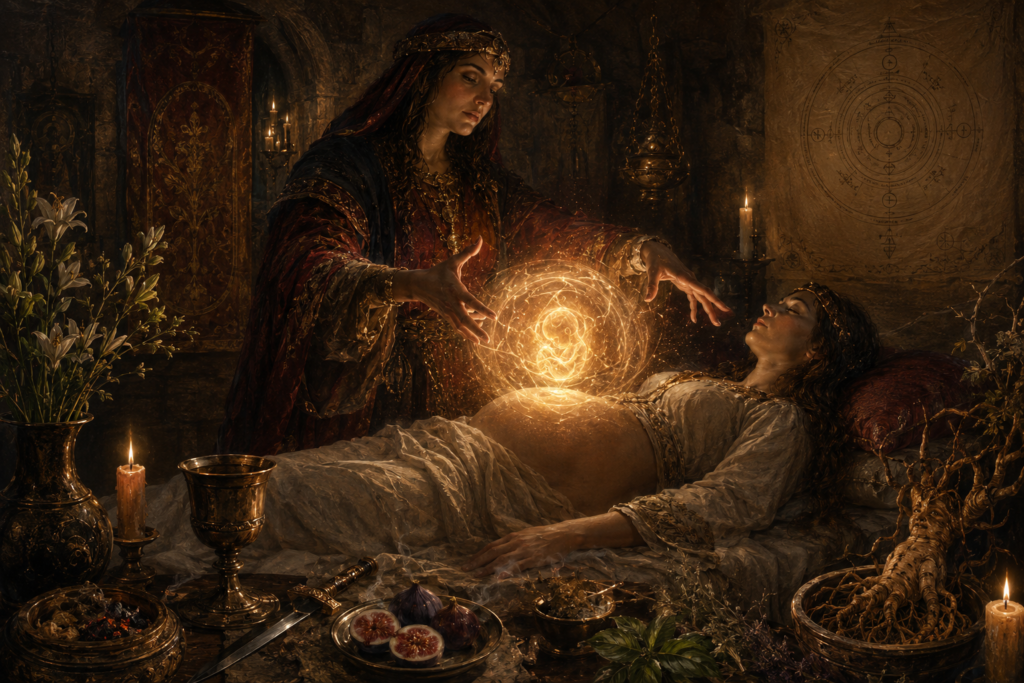
Magickal Creation, also called Thaumatogenesis, is one of the most dangerous forms of fertility magic because it does not bless an existing conception, restore ordinary fertility, or join two bloodlines in the natural way. It creates a new living being from magic alone.
The spell’s power is not merely biological. It is dynastic, sacred, legal, and cosmic. A child created by this ritual may have no ordinary parentage, no simple place in inheritance law, and no uncontested standing before temples, clans, courts, or ancestral powers. Some will call the child a miracle. Others will call them fraud, curse, political weapon, or evidence of forbidden sorcery.
This is not a convenient way to produce an heir or design a bloodline. It belongs to desperate rulers, dying families, fertility temples, witch covens, infernal bargains, celestial interventions, and prophecies that require a child who could not otherwise be born.
Used well, this spell does not create a plot device. It creates a life whose existence changes the world around it.
Edition Tabs
Magickal Creation, 5.5e / 2024
Magickal Creation, Pathfinder 1e / 3.5e
Magickal Creation, 3.0e
Magickal Creation, 5.5e / 2024
9th-Level Conjuration
Casting Time: 2 hours
Range: 60 feet, or special if cast through a clear scrying effect
Components: V, S, M, DF, costly life force
Material Components: Root agaric, basil, figs, and mandrake root harvested under the new moon, combined into a paste, dried, and burned during the casting. An athame and ritual cup are used as divine foci.
Duration: Permanent
Available To: Cleric, Witch, Fertility Domain or equivalent divine fertility tradition
Alternative Spell Name: Miracle of Unborn Fire
Effect
You perform a two-hour ritual that creates a new living being from pure magical force and places it within a willing living subject capable of carrying the created life. The subject must remain within range for the whole casting, or must be clearly visible to you through a stable scrying effect.
A willing subject requires no saving throw.
For most campaigns, the cleanest version of the spell is simple: Magickal Creation requires a willing subject. This keeps the spell focused on miracle, sacrifice, lineage, and consequence rather than violation.
If an unwilling version exists in the setting, it is infamous magic. An unwilling subject makes a Wisdom saving throw. On a success, the spell fails and the material components are consumed. On a failure, the spell takes hold, but the act is a grave magical crime and a violation of mortal, sacred, and possibly cosmic law.
If the spell succeeds, magical gestation begins. For most humanoids, the ordinary gestation period is compressed from months into hours. A human pregnancy created by this spell reaches birth in 9 hours. The minimum gestation time is 2 hours. The period may be longer for giant, draconic, monstrous, divine, or otherwise unusual creatures.
At the end of the gestation, the subject gives birth to a living child or equivalent newborn creature. Roll on the Thaumatogenesis Outcome table unless the caster successfully performs a controlled creation ritual.
Thaumatogenesis Outcome
| d100 | Outcome |
|---|---|
| 01–25 | The child is born with only the subject’s mortal traits. |
| 26–50 | The child bears traits of both the subject and the caster. |
| 51–60 | The child is born planetouched by infernal or abyssal influence, bearing traits of both the subject and the caster. |
| 61–70 | The child is born planetouched by infernal or abyssal influence, bearing only the subject’s mortal traits. |
| 71–80 | The child is born touched by celestial power, bearing traits of both the subject and the caster. |
| 81–90 | The child is born touched by celestial power, bearing only the subject’s mortal traits. |
| 91–95 | The child bears a strong fiendish inheritance. This may be represented as a tiefling of unusual potency, a half-fiend-equivalent creature, or a unique fiend-touched bloodline. |
| 96–100 | The child bears a strong celestial inheritance. This may be represented as an aasimar of unusual potency, a half-celestial-equivalent creature, or a unique heaven-touched bloodline. |
Controlled Creation
The caster may attempt to control the broad supernatural outcome instead of rolling.
At the end of the ritual, the caster makes a DC 20 spellcasting ability check. On a success, the caster chooses the broad outcome from the table. On a failure, roll normally, and the result is marked by instability. The child may carry an omen, visible sign, disputed soul-right, planar claim, ancestral curse, divine notice, or inherited enemy.
Controlled Creation determines the broad nature of the birth. It does not design a perfect heir, loyal servant, ideal bloodline, custom monster, or optimised future character. The spell may shape ancestry and supernatural inheritance, but it does not control the child’s mind, soul, morality, loyalty, personality, or destiny.
Life Force Cost in D&D 5.5e / 2024
The original spell costs 2,000 XP. In D&D 5.5e / 2024-style play, replace that cost with one of the following options.
Permanent Cost: The caster permanently loses one Hit Die. This loss can be restored only by Wish, divine intervention, or a major quest.
Exhausting Cost: The caster gains 5 levels of Exhaustion after the ritual, reduced by one level per Long Rest.
Rare Component Cost: The spell requires sacred or forbidden materials worth at least 25,000 gp, consumed during the casting.
Divine Debt: A deity, ancestor, celestial order, infernal court, fey power, fertility spirit, or cosmic law takes notice and gains a claim over the event.
For most campaigns, Divine Debt is the strongest version. It keeps the spell from becoming a transaction and makes the birth matter beyond the casting chamber.
Magickal Creation, Pathfinder 1e / 3.5e
School: Conjuration
Level: Witch 9, Cleric 9, Fertility 9
Components: V, S, M, DF, XP
Casting Time: 2 hours
Range: Close, or special through scrying
Target: One living creature
Duration: Permanent
Saving Throw: Will negates; see text
Spell Resistance: No
XP Cost: 2,000 XP
Effect
This spell creates a new living being from magical force and places it within the target.
A willing target receives no saving throw. An unwilling target who is aware of the spell may attempt a Will save to negate it. A target unaware of the spell receives a saving throw only if they become aware of the ritual before it is completed.
The caster must remain uninterrupted for the full two-hour casting time and must be able to see the target directly or through a stable scrying effect. If the caster is interrupted, the spell fails and the material components are consumed. The XP cost is paid only if the spell reaches completion.
If the spell succeeds, magical gestation begins. For most humanoids, the ordinary gestation period is compressed from months into hours. A human gestation therefore requires 9 hours. The minimum gestation period is 2 hours. The period may be longer for giant, draconic, monstrous, divine, or otherwise unusual creatures.
At the end of the gestation, the target gives birth to a living child or equivalent newborn creature. Roll on the Thaumatogenesis Outcome table unless the caster increases the casting DC to control the result.
Thaumatogenesis Outcome
| d100 | Outcome |
|---|---|
| 01–25 | The child is born with only the target’s mortal traits. |
| 26–50 | The child bears traits of both the target and the caster. |
| 51–60 | The child is born as a tiefling, bearing traits of both the target and the caster. |
| 61–70 | The child is born as a tiefling, bearing only the target’s mortal traits. |
| 71–80 | The child is born as an aasimar, bearing traits of both the target and the caster. |
| 81–90 | The child is born as an aasimar, bearing only the target’s mortal traits. |
| 91–95 | The child is born with the half-fiend template, bearing only the target’s mortal traits. |
| 96–100 | The child is born with the half-celestial template, bearing only the target’s mortal traits. |
Controlled Creation
By increasing the casting DC to 20, the caster may choose the broad result from the Thaumatogenesis Outcome table instead of rolling.
This control determines lineage and supernatural inheritance only. It does not determine the child’s alignment, loyalty, personality, soul, future class, abilities, or fate. A child created by this spell is a living creature, not a constructed servant or designed possession.
If the caster attempts controlled creation and fails the required casting check, roll normally on the Thaumatogenesis Outcome table. The result may also be marked by instability, omen, planar notice, ancestral dispute, or divine consequence.
Material Components and Divine Focus
The material components are root agaric, basil, figs, and mandrake root harvested under the new moon. These are combined into a paste, dried, and burned during the casting.
The divine focuses are an athame and a ritual cup, representing directed power, receptivity, union, and the shaping of life through sacred force.
XP Cost
The caster pays 2,000 XP when the spell is completed successfully.
If the casting is interrupted before completion, the material components are consumed, but the XP cost is not paid. If the spell is completed and the target successfully saves, the XP cost is still paid, because the life-force expenditure occurs at the spell’s final release.
Failure and Interruption
If the caster is interrupted during the two-hour casting time, the spell fails.
If the target leaves range, can no longer be perceived directly or through the scrying effect, or becomes protected by an effect that blocks the spell before completion, the spell fails.
If the spell fails, no life is created. However, at the referee’s discretion, a failed controlled creation may leave behind signs of disturbed life-magic: spoiled components, bloodline omens, hostile planar attention, a temple taboo, or a magical mark on the ritual space.
Magickal Creation, “Thaumatogenesis” 3.0e

By means of this spell a new life form can be created purely from magic. Unlike Magickal Conception, which takes exsiting life force and shapes into a new life, Magickal Creation uses only magic.
Liber Mysterium
The Netbook of Witches and Warlocks
By Timothy S. Brannan and The Netbook of Witches and Warlocks Team
Conjuration
Level: Witch 9, Cleric 9, Fertility,
Components: V S M DF XP
Casting Time: 2 hours
Range: Close
Target, Effect, Area: One creature
Duration: Permanent
Saving Throw: Will negates; see below
Spell Resistance: No
This spell maybe used to impregnate a female or even a male subject. Typically a female subject is used since is most cases (95% of the time) the impregnated male dies in the birth process.
The casting of this spell takes two hours, during which time the caster must be not interrupted. The casting witch must be able to see the target of the spell, either directly or by scrying. The target, if willing, gains no saving throw, but an unwilling target if aware of the spell can make a Will save. A target unaware of the casting must become aware of the situation before they can save. Many charlatans play on the paranoid nature of many and sell talismans that protect against this spell.
Since this is using the stuff of magic to produce a life the spell always works (given a passing DC of 10 plus or minus normal modifiers) and produces a living life form. What sort of life form produced is indicated by the table below.
| D% | Outcome of birth |
| 1-25 | The child is born with only the mother’s traits. |
| 26-50 | The child is born with both the traits of the mother and the caster |
| 51-60 | The child is born a Tiefling, with both the mothers and casters traits. |
| 61-70 | The child is born a Tiefling, with only the mothers traits. |
| 71-80 | The child is born an Aasimar, with both the mother and casters traits. |
| 81-90 | The child is born an Aasimar, with only the mothers traits. |
| 91-95 | The child is born with the half fiend template, with only the mothers traits. |
| 96-100 | The child is born with the half-celestial template, with only the mothers traits. |
By increasing the casting DC to 20 the caster then can control the outcome of the birth.
Gestation depends on the species of the mother, but time in months is often reduced to time in hours. So if the mother is human then nine months of pregnancy is reduced to nine hours. Then minimum time is two hours.
Material Components: Root Agaric, Basil, Figs and Mandrake root (harvested only by the new moon) are combined into a paste, dried and burned. An athame and a cup, symbolizing male and female powers to direct the spell are required as the divine focuses. The caster also pays 2,000 xp in life force for this spell.
Why This Spell Matters
Magickal Creation matters because it turns life into a deliberate magical act.
Most spells end when their duration expires. This one does not. Its result grows, speaks, inherits, chooses, loves, rebels, suffers, and changes history. A child created by Thaumatogenesis may become the last heir of a dying house, the answer to a temple’s prayer, the proof of a forbidden bargain, the restoration of a murdered bloodline, or the beginning of a war no one expected.
The spell stands at the edge of extinction, succession, prophecy, and sacred law. A kingdom without an heir may survive because of it. A family erased by murder may return through it. A celestial power may answer a desperate prayer through it. A devil may use it to place a lawful claimant inside a mortal dynasty. A coven may preserve a bloodline that kings tried to destroy.
Its danger is not that it creates a strange birth. Its danger is that it creates a person whom the world immediately tries to define.
Is the child legitimate? Are they a miracle? Are they an heir? Are they a crime? Are they free of the forces that made them? Can a soul created by magic belong wholly to itself?
Those questions are what make the spell worthy of ninth level.
Consent, Law, and Consequence
This spell touches birth, bodily autonomy, family, inheritance, and coercion. It needs more care than an ordinary combat spell.
For most campaigns, the best rule is that Magickal Creation requires a willing subject. This keeps the spell powerful and usable while still allowing miracle births, dynastic bargains, fertility rites, sacred covenants, and dangerous heroic sacrifices.
If the unwilling version exists, it should be rare, infamous, illegal, and treated as a major magical crime. It belongs to villain plots, curses, cult crimes, dynastic horror, infernal bargains, or temple scandals. It should not be used casually.
The first consequence of the spell is recognition. Someone will try to name what has happened. A court may call the child legitimate. A rival may call them fraud. A temple may call them sacred. A clan may call them kin. A devil may call them contracted. A celestial may call them protected. An inevitable may call them an unlawful disruption of succession, death, or inheritance.
The second consequence is claim. Bloodlines, temples, ancestors, gods, fiends, fey powers, royal courts, and enemies may all believe they have rights over the child or duties toward them.
The third consequence is choice. The child’s origin may shape their life, but it should not replace their will. The strongest stories from this spell come when the created person grows beyond the purpose others tried to impose on them.
Best Uses
Dynastic Crisis: A royal house is dying out, and civil war will begin unless an heir is produced. The ritual may save the kingdom, but only if the court accepts the child as lawful.
Miracle Birth: A fertility temple answers a desperate prayer. The child is born marked by divine or planar power, making the family both blessed and endangered.
Restored Bloodline: A murdered family’s last relic, ancestral oath, or preserved blood-sign is used in the ritual to restore a line thought extinct.
Forbidden Experiment: A powerful caster attempts to create the perfect vessel, oracle, saint, warlord, or bloodline founder. The spell works, but the created life is not property.
Planar Claim: A celestial, devil, daemon, fey power, ancestor, or cosmic agent argues that the child exists because of its influence and therefore falls under its protection, debt, law, or ownership.
Strategic Use
This is not a battlefield spell. Its power is dynastic, political, legal, sacred, and prophetic.
A villain uses Magickal Creation to manufacture heirs, bind bloodlines to infernal law, create scandal inside a noble house, or place a planar-touched claimant near a throne. A desperate ruler uses it to prevent civil war. A temple uses it to restore a sacred line. A witch coven uses it to call back a bloodline thought extinct. A devil cult uses it to put a lawful claimant inside a royal succession.
The spell works best as a hard choice. The important question is not “can a child be created?” The important question is “what law, god, family, prophecy, or enemy will now claim the child?”
Adjudicating the Spell
Do not treat the child as treasure, a summoned creature, a custom bloodline, or a designed servant. Magickal Creation creates a person, not a possession.
Decide the legal status early. Is the child legitimate, adopted, sacred, illegitimate, miraculous, cursed, or politically impossible? Different cultures, temples, courts, clans, and planar powers may disagree.
Use consequence, not punishment. The best follow-up is not arbitrary tragedy, but pressure: witnesses, claims, omens, rivals, divine notices, inheritance disputes, celestial protection, infernal contracts, and political fear.
Even when the child is planetouched, fiend-marked, celestial, or stranger, their origin should not replace their will.
Rules Clarifications and Edge Cases
Can the caster choose the child’s personality?
No. The spell may influence ancestry, appearance, and supernatural inheritance, but not the child’s soul, choices, morality, personality, or loyalty.
Can the caster create a clone of themselves?
Not by default. A result showing caster traits may create resemblance, inherited magical markers, or bloodline echoes, but it does not create a duplicate mind.
Can the spell create a monster?
Only if the setting allows it. The default spell creates a child or newborn creature appropriate to the subject and the ritual outcome. Creating dragons, giants, outsiders, undead, constructs, or unique creatures should require a separate epic ritual, divine intervention, or campaign-specific variant.
Can the spell create undead?
Not normally. This is life-creating conjuration, not necromancy. In a campaign involving the Red Death, a corrupted version might create a plague-marked birth, but that should be a major horror event, not the standard spell result.
Can a male subject carry the created life?
The original spell allows this but makes it extremely dangerous. For a cleaner publication ruling, the spell requires a subject physically, magically, or ritually capable of surviving the gestation. If the subject cannot survive the process, the spell fails unless additional powerful magic sustains them.
Can Dispel Magic end the pregnancy?
No. Once the spell has successfully created life, the result is permanent. Before birth, powerful magic such as Dispel Magic, Remove Curse, Greater Restoration, Wish, divine intervention, or a specialist fertility rite may reveal, protect, suppress, or alter the magical process at the referee’s discretion, but it should not erase the situation casually.
Good Combinations
- Divination: Used before the ritual to ask what power may answer, what bloodline will be affected, or what danger follows the child’s birth.
- Hallow: Protects the birthing chamber, temple, or ritual site from fiendish interference, hostile spirits, assassination, and oath-breaking.
- Speak with Dead: Allows a family or royal house to question an ancestor about succession, bloodline legitimacy, old curses, or whether a magically created heir should be recognised.
- Commune: Lets the caster seek divine judgement before using the spell, especially when a temple must decide whether the result is miracle, crime, or forbidden ambition.
- Legend Lore: Reveals whether the created child resembles an old prophecy, lost bloodline, celestial omen, infernal bargain, or ancestral scandal.
Adventure and Worldbuilding Hooks
The Impossible Heir: A dying royal house produces a child overnight, and the court declares the infant legitimate. Rivals insist the child is conjured fraud, a devil-marked claimant, or the first sign of a civil war engineered by witches.
The Child with Two Claims: A temple announces a miracle birth, but an infernal advocate arrives with documents proving the ritual drew on a debt owed generations ago. The child is now claimed by both the sanctuary and Hell’s bureaucracy.
The Stolen Line Restored: A murdered family’s last relic is used in a secret ritual to create a new heir. The child may restore justice, reopen a feud, invalidate a ruler, or awaken enemies who thought the bloodline extinct.
Campaign Use
Magickal Creation is strongest when birth and bloodline have immediate consequences: royal succession, temple law, monster ancestry, celestial intervention, infernal contracts, dynastic legitimacy, inheritance fraud, or prophecy.
In heroic campaigns, the spell can be a sacred answer to extinction, barrenness, oath, or bloodline murder. It should solve one crisis while opening another: the heir exists, but now the court, temple, clan, or planar power must decide what that means.
In darker campaigns, the spell becomes evidence of magical crime, cult manipulation, dynastic fraud, or political horror. A secret birth may be enough to topple a court, expose a devil’s contract, or bring an ancestral feud back to life.
The best use of the spell is not the birth itself, but what follows. Who recognises the child? Who denies them? Who protects them? Who fears what they might become?
Source and Literary Context
Magickal Creation, also called Thaumatogenesis, is adapted from Liber Mysterium: The Netbook of Witches and Warlocks by Timothy S. Brannan and The Netbook of Witches and Warlocks Team. The spell’s original identity is unusually potent: it creates new life from magic alone, rather than shaping existing life force or enabling ordinary conception. A source listing is available at RPGGeek: Liber Mysterium: The Netbook of Witches and Warlocks.
The spell belongs to the broader mythic territory of life made by divine, magical, or artistic force. One useful classical parallel is the story of Pygmalion, in which a crafted figure is brought to life through divine intervention. The comparison should be used carefully. Magickal Creation is not about romance or sculpture. It is about the terrifying sacred threshold between made thing and living person. For a concise reference, see Encyclopaedia Britannica: Pygmalion.