
Mage’s Private Sanctum Spell

A chamber can be made unseen, unheard, unscryable, and—under modern rules—closed to teleportation and planar travel.
Mage’s Private Sanctum is magic for councils, laboratories, treaties, confessions, vaults, and any room where secrecy matters more than physical defence. The spell does not make a wall harder to break or a door harder to open. It decides which kinds of observation and intrusion the ward will stop.
The spell changed significantly between modern D&D and the older d20 versions. D&D 5.5e / 2024 and D&D 5e / 2014 can block sight, sound, Divination, teleportation and planar travel. Pathfinder 1e and D&D 3.5e are 5th-level privacy wards instead: they block outside sight and sound, stop scrying, protect against detect thoughts, and explicitly allow creatures and objects to pass through the area.
Quick Rules Reference
- 2024 and 2014: 4th-level Abjuration, 120-foot range, 24-hour duration, 5-to-100-foot cube before upcasting.
- Modern protection choices: sound blocking, vision blocking, anti-Divination sensors, protection from Divination targeting, teleportation blocking, and planar-travel blocking.
- 2024 material component: a thin sheet of lead.
- 2014 material components: lead, opaque glass, cotton or cloth, and powdered chrysolite.
- Modern permanence: cast on the same spot every day for 365 days / one year.
- Pathfinder 1e and D&D 3.5e: 5th-level Abjuration, 30-foot cube per caster level, 24 hours, with permanence handled by permanency.
- Main limitation: privacy and dimensional warding are not physical security. A creature can still cross an unblocked doorway unless another effect stops it.
Effect
Private Sanctum creates a magical security zone. The exact protection depends on edition. Modern D&D lets the caster choose the protections needed for the chamber; the older Pathfinder and D&D 3.5e spell has a fixed package of privacy effects instead.
Rules
Mage’s Private Sanctum by Edition
Mordenkainen’s Private Sanctum — 5.5e / 2024

| Level | 4th-level Abjuration |
|---|---|
| Class | Wizard |
| Casting Time | 10 minutes |
| Range | 120 feet |
| Area | Cube from 5 feet to 100 feet on each side |
| Components | V, S, M (a thin sheet of lead) |
| Duration | 24 hours |
Choose any of the following protections when you cast the spell:
- Sound cannot pass through the barrier.
- The barrier appears dark and foggy and prevents vision, including Darkvision, through it.
- Divination sensors cannot appear inside the area or pass through its perimeter.
- Creatures inside cannot be targeted by Divination spells.
- Nothing can teleport into or out of the area.
- Planar travel is blocked within the area.
Permanent sanctum: casting the spell on the same spot every day for 365 days makes it last until dispelled.
Higher-level slot: increase the cube’s maximum size by 100 feet for each slot level above 4th.
Private Sanctum — 5e / 2014
| Level | 4th-level Abjuration |
|---|---|
| Class | Wizard |
| Casting Time | 10 minutes |
| Range | 120 feet |
| Area | Cube from 5 feet to 100 feet on each side |
| Components | V, S, M (lead, opaque glass, cotton or cloth, and powdered chrysolite) |
| Duration | 24 hours, or until dismissed as an action |
The caster chooses any or all of the same six protections used by the modern spell: sound blocking, visual obscurity, anti-Divination sensors, protection from Divination targeting, teleportation blocking, and planar-travel blocking.
Permanent sanctum: casting the spell on the same spot every day for one year makes the effect permanent.
At Higher Levels: increase the maximum cube size by 100 feet for each slot level above 4th.
Mage’s Private Sanctum — Pathfinder 1e
| School | Abjuration |
|---|---|
| Level | Sorcerer/Wizard 5 |
| Casting Time | 10 minutes |
| Range | Close (25 ft. + 5 ft./2 levels) |
| Area | 30-ft. cube/level (S) |
| Duration | 24 hours (D) |
| Saving Throw | None |
| Spell Resistance | No |
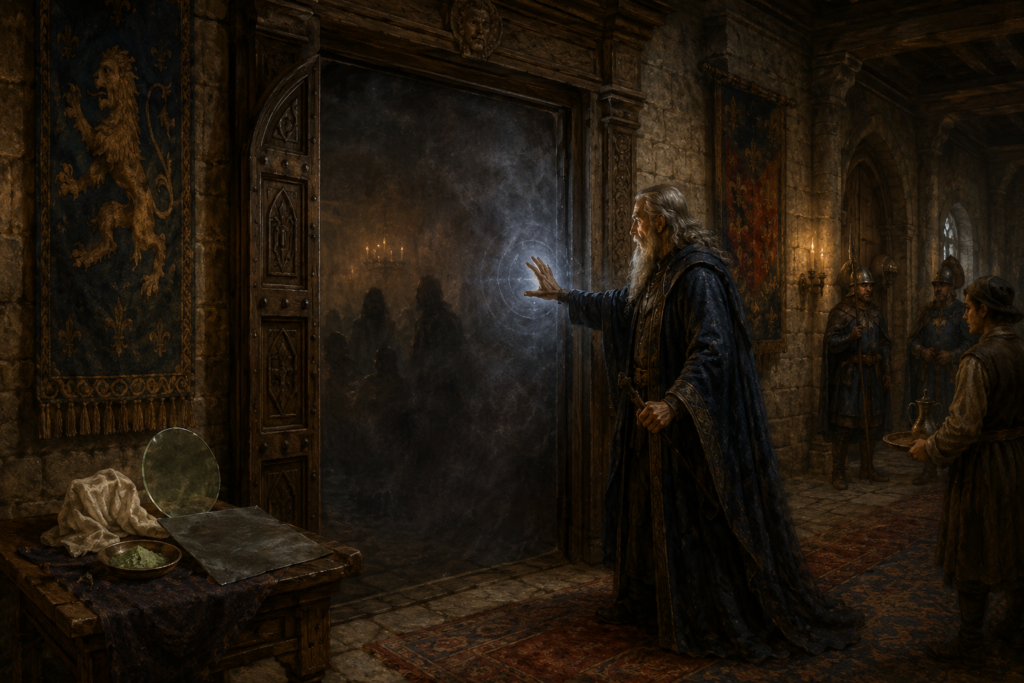
Anyone outside looking into the area sees only a dark, foggy mass, and Darkvision cannot penetrate it. No sound escapes the area. Those inside can see out normally.
Divination (scrying) spells cannot perceive anything inside, and creatures within are immune to detect thoughts. Ordinary speech cannot cross the boundary, but sending, message, and telepathic communication are explicitly permitted.
Creatures and objects can move into and out normally. This version does not include the modern teleportation or planar-travel lock.
Permanency: permanency can make the ward permanent; Pathfinder lists minimum caster level 13th and a 12,500 gp cost.
Mage’s Private Sanctum — D&D 3.5e
| School | Abjuration |
|---|---|
| Level | Sorcerer/Wizard 5 |
| Casting Time | 10 minutes |
| Range | Close (25 ft. + 5 ft./2 levels) |
| Area | 30-ft. cube/level (S) |
| Duration | 24 hours (D) |
| Saving Throw | None |
| Spell Resistance | No |
The ward creates the same legacy privacy package: outside viewers see foggy darkness, sound cannot escape, those inside see out, scrying cannot perceive inside, and creatures within are immune to detect thoughts.
Sending, message, and telepathic communication are explicitly unaffected. Creatures and objects can cross the boundary normally.
Permanency: permanency can make Mage’s Private Sanctum permanent at minimum caster level 13th; the 3.5e SRD lists a 2,500 XP cost.
What Changed?
- Modern D&D lowers the spell from 5th level to 4th and replaces caster-level area scaling with a fixed cube that can be enlarged by higher-level slots.
- Modern D&D adds dimensional security: teleportation and planar travel can be blocked. PF1e and 3.5e do not provide those protections.
- The visual ward changed: PF1e/3.5e explicitly let creatures inside see out; modern D&D says the foggy barrier prevents vision through it.
- The anti-divination wording changed: legacy rules explicitly block scrying and grant immunity to detect thoughts; modern D&D instead blocks Divination sensors and targeting by Divination spells.
- 2024 simplifies the material component to a thin sheet of lead and removes the 2014 action-dismissal sentence.
- Permanence changed completely: modern D&D uses repeated daily casting; PF1e/3.5e use permanency.
Legacy 3.0e Mage’s Private Sanctum
Abjuration
Level: Sorcerer/Wizard 5
Components: V, S, M
Casting Time: 10 minutes
Range: Close (25 ft. + 5 ft./2 levels)
Area: 30-ft. cube/level (S)
Duration: 24 hours (D)
Saving Throw: None
Spell Resistance: No
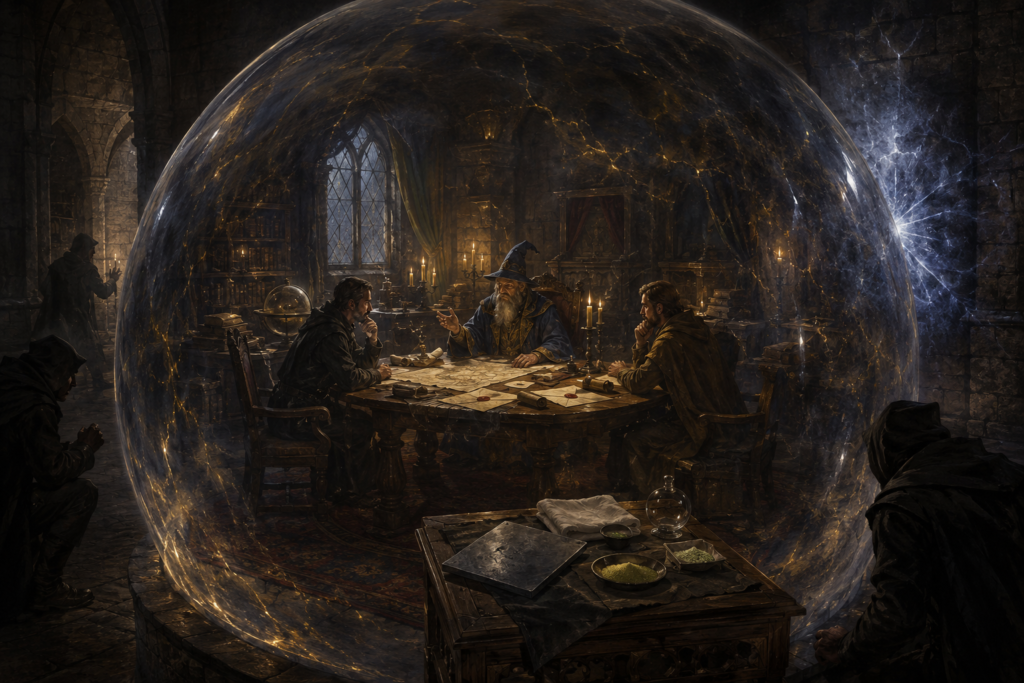
Outside viewers see a dark, foggy mass; sound cannot escape; those inside can see out; scrying cannot perceive inside; creatures within are protected from detect thoughts; other magical communication remains possible; and creatures and objects can cross the boundary. The spell can be made permanent with permanency.
Why This Spell Is Dangerous in the World
Mage’s Private Sanctum is dangerous because it creates rooms where power can act without witness.
A king can issue unlawful orders inside it. A guild can fix prices. A wizard can discuss forbidden arts. A priest can conceal scandal. A devil can negotiate an agreement without scrying eyes on the bargain. The spell does not force evil, but it makes secrecy easier, and secrecy changes law, trust, and proof.
It also changes how institutions behave. In a world where such magic exists, rulers without warded chambers are reckless. Councils held outside magical privacy are vulnerable. Testimony given inside a sanctum may be honest, coerced, or fabricated, and the lack of witness makes all three harder to untangle. The spell does not merely hide speech. It reshapes who can prove what happened.
Rules Clarifications and Edge Cases
- Can creatures walk through the ward? Yes, unless another spell or physical barrier stops them. Private Sanctum is not a wall.
- Does it block teleportation? In D&D 5.5e / 2024 and D&D 5e / 2014, yes if the caster chooses the teleportation-blocking property. Pathfinder 1e and D&D 3.5e do not block teleportation by themselves.
- Does it block planar travel? The modern D&D versions can block planar travel as one of their chosen protections. PF1e/3.5e do not.
- Can people inside see out? PF1e and D&D 3.5e explicitly say yes. The modern visual barrier prevents vision through it, so do not import the legacy one-way vision rule.
- Does it block sending? PF1e/3.5e explicitly allow sending. In modern D&D, if the anti-Divination-targeting property is chosen, a Divination spell that targets a creature inside can be blocked; resolve the current spell’s targeting rules rather than importing the legacy exception.
- Does it block message or telepathy? PF1e/3.5e explicitly allow them. Modern D&D does not give a blanket answer for every communication effect; use the chosen Sanctum properties and the communication effect’s own rules.
- Does it block all mental magic? No. Legacy rules specifically protect against detect thoughts; modern rules protect against Divination targeting. Neither statement means all charms, fear, domination or psychic effects automatically fail.
- Can outsiders tell the visual ward is present? If the visual-obscurity property is chosen, the boundary appears dark and foggy and is conspicuous.
- Can dispel magic end it? Yes, subject to the active edition’s dispelling rules. Even a ward made permanent by repeated modern casting remains “until dispelled.”
- Does it stop spies already inside? No. A hidden servant, disguised visitor, familiar or other intruder already inside is still a problem unless another defence exposes or stops them.
Good Combinations
- Alarm: Warns the caster if someone enters the warded area physically.
- Arcane Lock: Helps stop intruders from simply opening the door and walking into the sanctum.
- Glyph of Warding: Punishes trespass once an intruder crosses the threshold.
- Nondetection: Extends anti-divination protection to a person or object once it leaves the sanctum.
- Mages Faithful Hound: Guards the chamber against invisible or concealed intruders while the sanctum handles privacy.
Adventure Hooks
The Room That Was Too Quiet: A prince dies during a meeting held inside a permanent private sanctum. No outsider saw, heard, or scryed the event, and every witness inside has reason to lie.
The Fogged Chamber in the Inn: A travelling wizard rents the same upper chamber every new moon and wards it with Mage’s Private Sanctum before midnight visitors arrive. The locals fear blackmail, heresy, infernal business, or treason.
The King’s Missing Words: A treaty was negotiated inside a sanctum, but the written text now differs from what one ambassador swears was agreed. With no outside witness, the dispute may lead to war.
Historical and Mythic Context
Mage’s Private Sanctum belongs to the old magical idea of the protected chamber: a room where sight, sound, and knowledge are deliberately controlled. In courts, guildhalls, towers, and private houses, power often depends on who is allowed to hear a promise, witness a confession, read a document, or overhear a plan. The spell turns that social and political need into abjuration magic. It is the magical equivalent of a closed council, a sealed archive, and a guarded treaty chamber.
The material components also show the spell’s evolution. The 2024 version reduces the material to a thin sheet of lead. The 2014, Pathfinder 1e and D&D 3.5e versions use lead, opaque glass, cotton or cloth, and powdered chrysolite: materials that mirror the spell’s older emphasis on blocking sight, sound and magical observation.
Mythically, the spell also belongs to the power of silence. Ancient religious and initiatory traditions often treated silence not merely as the absence of speech, but as a sacred or dangerous condition: the silence of initiates, the silence of hidden rites, the silence of guarded names, and the silence demanded around secrets not meant for every ear. Harpocrates, the Greek form of the Egyptian child Horus later associated with silence, is a useful parallel for this theme rather than a direct source for the spell. See Theoi’s entry on Harpocrates.
In a campaign world, this context makes Mage’s Private Sanctum more than a wizard’s convenience. It is the spell behind secret councils, disputed treaties, sealed confessions, hidden laboratories, and private bargains no diviner can easily expose. Its danger is not that it harms the body, but that it removes witnesses. Once a chamber can be made unseen, unheard, and unreadable by magic, the question is no longer only what happened inside. The question is who has the authority to say what happened at all.
Keep this reference growing
If this page helped with your reading or game, you can support its upkeep or explore the curated books.
Explore the Bookshop — epics, classics and stories behind imagined worlds.