
Knock
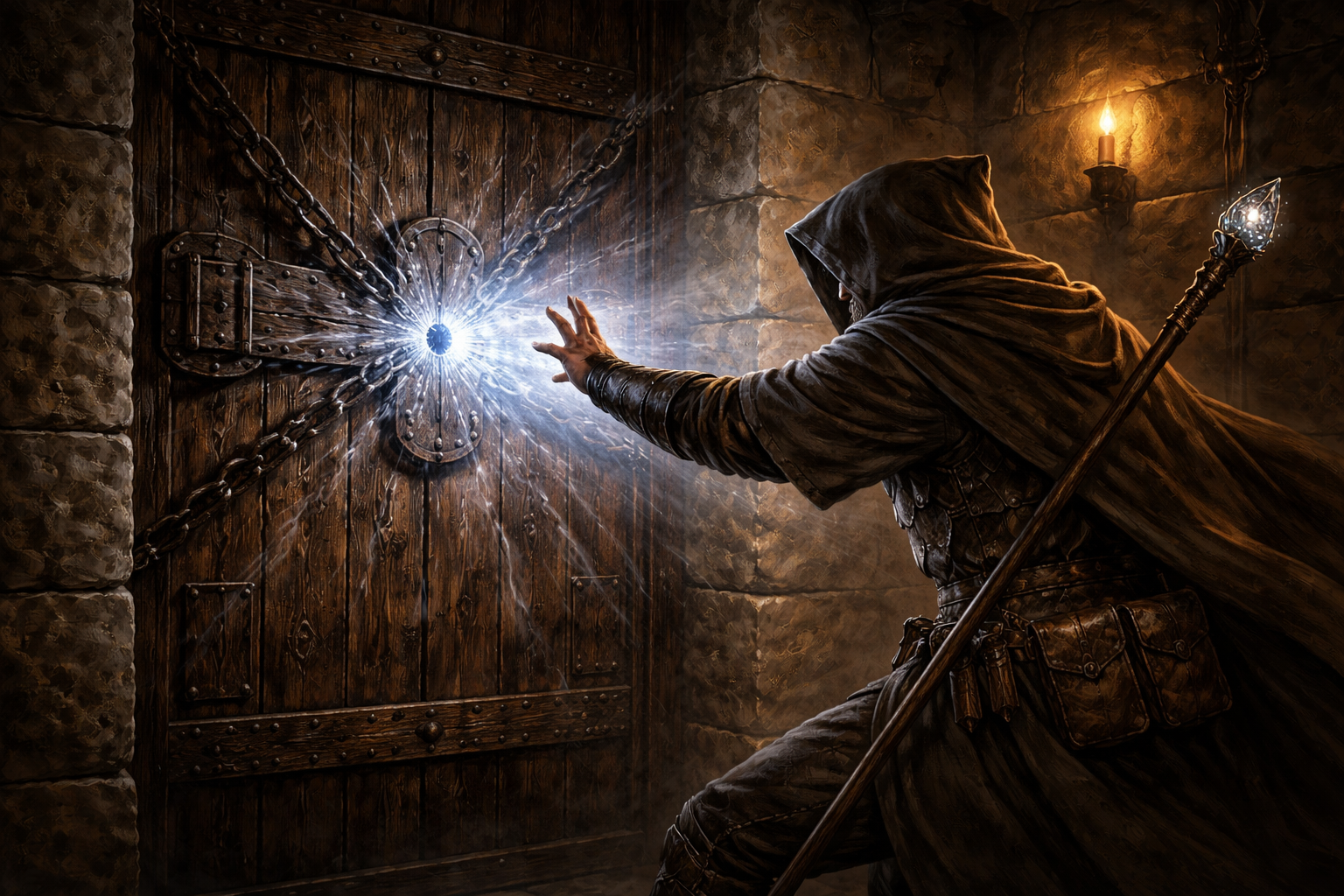
Knock is forced entry as a spell: fast, reliable and deliberately loud. It opens mundane closures and temporarily defeats Arcane Lock, trading stealth for certainty.
At a Glance
| Modern level | 2nd-level Transmutation |
|---|---|
| 2024 classes | Bard, Sorcerer, Wizard |
| 2014 classes | Bard, Sorcerer, Wizard |
| PF1e | Sorcerer/Wizard 2 |
| D&D 3.5e | Sorcerer/Wizard 2 |
| Signature drawback | The modern spell produces a knock audible up to 300 feet away |
Choose Your Edition
The fifth-edition versions are nearly identical. Pathfinder 1e and D&D 3.5e reach farther and can defeat up to two means of closure, but Pathfinder adds a caster-level check against the lock.
Knock — 5.5e / 2024
| Level | 2nd |
|---|---|
| School | Transmutation |
| Casting Time | Action |
| Range | 60 feet |
| Components | V |
| Duration | Instantaneous |
| Classes | Bard, Sorcerer, Wizard |
Choose a visible object within range that is secured against access: a door, chest, box, manacles, padlock or a similar object. A mundane lock opens; a stuck or barred target becomes unstuck or unbarred. If the object has several locks, the spell opens only one.
If Arcane Lock is holding the target shut, that spell is suppressed for 10 minutes, allowing the target to be opened and closed during that window.
Noise: the target emits a loud knock audible up to 300 feet away. The spell solves access, not secrecy.
Knock — 5e / 2014
| Level | 2nd |
|---|---|
| School | Transmutation |
| Casting Time | 1 action |
| Range | 60 feet |
| Components | V |
| Duration | Instantaneous |
| Classes | Bard, Sorcerer, Wizard |
The 2014 spell follows the same basic model as the current version: choose a visible secured object, open one mundane lock or remove a stuck/barred state, or suppress Arcane Lock for 10 minutes.
It also produces the same defining drawback: a loud knock from the target that can be heard from as far as 300 feet away.
Knock — Pathfinder 1e
| School | Transmutation |
|---|---|
| Level | Sorcerer/Wizard 2 |
| Casting Time | 1 standard action |
| Components | V |
| Range | Medium (100 ft. + 10 ft./level) |
| Target | One door, box or chest, up to 10 sq. ft./level |
| Duration | Instantaneous; see text |
| Saving Throw | None |
| Spell Resistance | No |
When the spell is completed, make a caster-level check against the lock’s DC with a +10 bonus. On success, Knock opens up to two means of closure. It can open secret doors, trick-opening containers, stuck or barred doors, and can loosen welds, shackles or chains used to hold something shut.
Arcane Lock is suppressed for 10 minutes rather than removed. The spell does not raise a barred gate or portcullis and does not affect ropes, vines or similar restraints that are not acting as closures.
Knock — D&D 3.5e
| School | Transmutation |
|---|---|
| Level | Sorcerer/Wizard 2 |
| Casting Time | 1 standard action |
| Components | V |
| Range | Medium (100 ft. + 10 ft./level) |
| Target | One door, box or chest, up to 10 sq. ft./level |
| Duration | Instantaneous; see text |
| Saving Throw | None |
| Spell Resistance | No |
The 3.5e spell opens stuck, barred, locked, held or Arcane Locked doors, plus secret doors and locked or trick-opening containers. It can loosen welds, shackles or chains that serve as closures, and one casting can undo up to two means of preventing access.
Unlike PF1e, the core 3.5e spell does not require a caster-level check against a mundane lock. Arcane Lock is suppressed for 10 minutes. Portcullises, barred gates, ropes and vines remain outside its normal effect.
What Changed?
- 2024 versus 2014: no major mechanical redesign; both use 60-foot range, one closure and the 300-foot audible knock.
- Pathfinder 1e: keeps the older long-range, two-closure model but adds a caster-level check with a +10 bonus against the lock DC.
- D&D 3.5e: the older spell automatically handles qualifying mundane closures and can undo up to two means of preventing access.
- Modern spell: explicitly includes objects such as manacles and padlocks and focuses the effect on one secured object.
Uses
Forced Entry
A locked door, barred hatch, chained coffer or sealed cell can become an immediate route forward. Knock is strongest when delay is more dangerous than discovery.
Breaking Magical Security
Knock is the natural counterpoint to Arcane Lock. It does not permanently destroy the ward; it creates a ten-minute window in which the protected object can be used normally.
Rescue and Escape
When a prisoner is chained, an ally is trapped, a route is sealed during pursuit, or a room is filling with fire or water, certainty can matter more than stealth.
Opening Under Pressure
Tools and careful skill remain better when time and silence are available. Knock earns its spell slot when the scene is already moving too quickly for patient work.
Tactics
For Players
Plan for the sound before casting the modern spell. Three hundred feet can include several rooms, a courtyard, a guard post or an entire small stronghold. Have the next move ready before the door opens.
Layered security still matters. In modern rules, an object with several locks loses only one lock per casting. In legacy d20 rules, a single casting can defeat up to two qualifying closures.
For Game Masters
Do not make every meaningful barrier immune to the spell. Let Knock solve the access problem it was prepared to solve, then let the consequences create the next problem: alerted guards, a triggered ward, a creature waiting beyond, or ten minutes of urgency before Arcane Lock resumes.
Opening something is not the same as making it safe. Traps, alarms, glyphs, creatures and environmental hazards remain separate from the lock itself unless their own rules say otherwise.
Good Combinations
- Arcane Lock — the classic defensive/offensive pairing.
- Alarm — entry may be guaranteed while detection remains a separate problem.
- Glyph of Warding — a lock can open without neutralising what protects the space beyond it.
- Silence — useful only with careful positioning and edition-specific adjudication, because Knock itself has a verbal component.
Why the Noise Matters
The loud report is not decorative flavour. It is the spell’s price. Knock converts a barrier into an announcement: the vault opens, but the household knows; the cell door yields, but the gaol is awake; the sealed chamber is accessible, but whatever is beyond it has warning.
That tradeoff keeps mundane expertise relevant. A skilled infiltrator can still be preferable when secrecy matters, while Knock remains the decisive answer when speed matters more.
Sources and Licensing
- D&D 2024 Basic Rules — Knock. SRD 5.2 material is available under CC BY 4.0.
- D&D 2014 Basic Rules — Knock. SRD 5.1 material is available under CC BY 4.0.
- Pathfinder 1e Core Rulebook — Knock. Open Game Content under OGL v1.0a.
- D&D 3.5 SRD — Knock. Open Game Content under OGL v1.0a.
Keep this reference growing
If this page helped with your reading or game, you can support its upkeep or explore the curated books.
Explore the Bookshop — epics, classics and stories behind imagined worlds.