
Irresistible Dance

Irresistible Dance turns bodily movement into a weapon. The victim remains recognisably themselves, but rhythm, balance and intention are seized by magic until even standing still becomes impossible.
Rules
Game Statistics
Choose the edition in use. Each tab is a standalone rules entry.
Irresistible Dance — D&D 5.5e / 2024
Level 6 Enchantment — Bard, Wizard
- Casting Time
- Action
- Range
- 30 feet
- Components
- V
- Duration
- Concentration, up to 1 minute
- Target
- One creature you can see within range
- Saving Throw
- Wisdom
Effect
The target makes a Wisdom saving throw. A successful initial save does not prevent the spell completely: the creature still dances until the end of its next turn and must spend all of its movement dancing in place during that time.
On a failed save, the creature has the Charmed condition for the duration. While affected, it must spend all of its movement dancing in place, has Disadvantage on Dexterity saving throws and attack rolls, and attacks against it have Advantage.
On each of its turns, the creature can spend its action trying to collect itself and repeat the Wisdom save. A success ends the spell on that creature.
Irresistible Dance — D&D 5e / 2014
6th-level Enchantment — Bard, Wizard
- Casting Time
- 1 action
- Range
- 30 feet
- Components
- V
- Duration
- Concentration, up to 1 minute
- Target
- One creature you can see within range
- Initial Saving Throw
- None
Effect
Choose one creature you can see within range. It immediately begins dancing in place for the duration. A creature that cannot be charmed is immune to the spell.
While dancing, the creature must use all its movement to dance without leaving its space, has Disadvantage on Dexterity saving throws and attack rolls, and other creatures have Advantage on attack rolls against it.
The creature can use its action to make a Wisdom saving throw to regain control of itself. On a success, the spell ends.
Irresistible Dance — Pathfinder 1e
Enchantment (Compulsion) [Mind-Affecting] — Bard 6, Sorcerer/Wizard 8
- Casting Time
- 1 standard action
- Components
- V
- Range
- Touch
- Target
- Living creature touched
- Duration
- 1d4+1 rounds
- Saving Throw
- Will partial
- Spell Resistance
- Yes
Effect
The creature is compelled to caper and dance in place and can do nothing else while the effect lasts. It takes a –4 penalty to Armor Class and a –10 penalty on Reflex saves, loses any Armor Class bonus from a shield it holds, and provokes attacks of opportunity each round on its turn.
A successful Will save does not negate the spell. It reduces the duration to 1 round.
Irresistible Dance — D&D 3.5e
Enchantment (Compulsion) [Mind-Affecting] — Bard 6, Sorcerer/Wizard 8
- Casting Time
- 1 standard action
- Components
- V
- Range
- Touch
- Target
- Living creature touched
- Duration
- 1d4+1 rounds
- Saving Throw
- None
- Spell Resistance
- Yes
Effect
The subject is forced to dance in place and cannot take other actions while the spell lasts. It takes a –4 penalty to Armor Class and a –10 penalty on Reflex saves, loses any shield bonus to Armor Class, and provokes attacks of opportunity each round on its turn.
Edition comparison
What Changed Between Editions?
| Rule | 5.5e / 2024 | 5e / 2014 | Pathfinder 1e | D&D 3.5e |
|---|---|---|---|---|
| Range | 30 feet; visible creature | 30 feet; visible creature | Touch | Touch |
| Initial resistance | Wisdom save; success still causes one turn of dancing | No initial save; eligible target begins dancing immediately | Will partial; success reduces duration to 1 round | No saving throw |
| Duration | Concentration, up to 1 minute | Concentration, up to 1 minute | 1d4+1 rounds | 1d4+1 rounds |
| Actions | Target can still act and may use its action to repeat the save | Target can still act and may use its action to make the save to end the spell | Target can do nothing except dance | Target can do nothing except dance |
| Combat penalty | Disadvantage on attacks and Dexterity saves; attacks against target have Advantage | Disadvantage on attacks and Dexterity saves; attacks against target have Advantage | –4 AC, –10 Reflex, no shield AC; provokes attacks of opportunity | –4 AC, –10 Reflex, no shield AC; provokes attacks of opportunity |
| Spell Resistance | No Spell Resistance mechanic | No Spell Resistance mechanic | Yes | Yes |
Tactics and rulings
Using Irresistible Dance in Play
It is strongest when movement matters
The spell is more than a joke at a target’s expense. Forcing a dangerous creature to spend its movement dancing can prevent a retreat, stop a charge, pin a defender away from an objective or keep a melee threat from closing the last few yards.
A successful modern save still matters
In 5.5e, the initial Wisdom save is not a clean miss. Even on a success, the target loses its movement to dancing until the end of its next turn. That makes the spell useful when one disrupted turn can change an encounter.
Do not import the earlier shutdown
Pathfinder 1e and D&D 3.5e make the victim effectively helpless to do anything except dance. The modern version does not. A failed 5.5e save imposes its listed movement and combat penalties and gives the creature an action-based repeat save, but it does not erase every other action, Bonus Action or Reaction unless another rule does so.
Concentration changes the counterplay
In 5.5e, hurting or disrupting the caster can be as important as attacking the dancer because the spell requires Concentration. In the earlier editions, the spell uses a fixed round duration instead.
Campaign use
Irresistible Dance in the World of 1454
In courts, guildhalls, universities and military households, this enchantment is feared because it is humiliating, unmistakable and physically coercive. A victim can remain fully aware while their body refuses ordinary discipline. That makes the spell useful for capture and disruption, but also for public disgrace.
Learned magicians treat it as a problem of magical natural philosophy: voice, attention, rhythm, balance and volition are being forced into a single supernatural pattern. A court scholar may describe the effect as enchantment; a physician may describe the victim’s exhaustion and loss of control; a magistrate cares about who cast it and what happened while the victim could not govern their own movement.
Because the spell is verbal, witnesses who understand magic may pay close attention to the caster’s speech immediately before the compulsion begins. That does not make every spoken charm identifiable, but it gives investigators a concrete event to reconstruct.
Rhine memories of involuntary dancing
Historical accounts place a major outbreak of involuntary dancing at Aachen in 1374, followed by reports elsewhere along the Rhine and into neighbouring regions. In SpiralWorlds, scholars can know those historical reports without assuming that every sufferer was the target of this spell. Disease, collective distress, supernatural contagion, fey interference and deliberate enchantment remain different possibilities until evidence separates them.
Watch
Irresistible Dance and Dancing Mania
Artistic context
Dance, Compulsion and the Uncanny
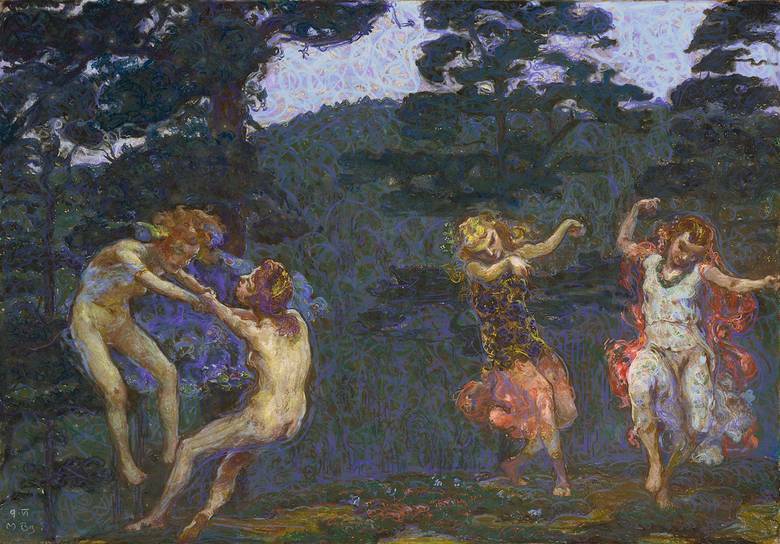
Martin Brandenburg’s Elfenreigen gives the spell a second visual register: dreamlike movement, collective rhythm and the unsettling loss of stillness that sits beneath the enchantment’s apparently comic surface.
Related magic and creatures
Useful SpiralWorlds Links
Rules questions
Irresistible Dance FAQ
Does a successful 5.5e save completely stop the spell?
No. The target still dances until the end of its next turn and must spend its movement dancing in place during that time.
Is a failed 5.5e target incapacitated?
No. Apply the Charmed condition and the movement, attack-roll and Dexterity-save effects stated by the spell. The earlier rule that the target can do nothing except dance belongs to Pathfinder 1e and D&D 3.5e, not the current version.
Can the 5.5e target try to escape?
Yes. On each of its turns it can use its action to repeat the Wisdom saving throw, ending the spell on itself on a success.
Does Pathfinder 1e allow a saving throw?
Yes. It is Will partial. Success reduces the duration to one round rather than negating the spell.
Does D&D 3.5e allow a saving throw?
No. The 3.5e entry lists no saving throw, although Spell Resistance applies.
Can the earlier target use a shield while dancing?
It can still be holding one, but the spell removes the shield’s Armor Class bonus while the effect lasts.
Is every historical case of dancing mania this spell?
No. The historical reports are context, not proof of a single magical cause. SpiralWorlds can contain genuine supernatural compulsions without rewriting every real outbreak as one spell effect.
Rules authority and licensing
Sources and Licensing
- D&D 5.5e / 2024: System Reference Document 5.2.1, Wizards of the Coast LLC, released under Creative Commons Attribution 4.0 International.
- D&D 5e / 2014: SRD 5.1 — Irresistible Dance. The 2014 SRD material is available under Creative Commons Attribution 4.0 and the Open Game License v1.0a.
- Pathfinder 1e: Pathfinder Reference Document — Irresistible Dance. Relevant Open Game Content is used under the Open Game License v1.0a.
- D&D 3.5e: Revised (v.3.5) System Reference Document — Irresistible Dance. Relevant Open Game Content is used under the Open Game License v1.0a.
- Historical context: Europeana — Saint John’s Dance, for the documented 1374 Aachen/Rhine dancing mania.
Dungeons & Dragons and related names are trademarks of Wizards of the Coast LLC. Pathfinder is a trademark of Paizo Inc. SpiralWorlds is not affiliated with or endorsed by either company.
Open Game License v1.0a — attribution block
Pathfinder 1e and D&D 3.5e Open Game Content on this page is used under the Open Game License v1.0a. See the Open Game License v1.0a.
Section 15 copyright notices: System Reference Document © 2000–2003 Wizards of the Coast, Inc.; Pathfinder Roleplaying Game Core Rulebook © 2009, Paizo Publishing, LLC; author Jason Bulmahn, based on material by Jonathan Tweet, Monte Cook and Skip Williams.
Keep this reference growing
If this page helped with your reading or game, you can support its upkeep or explore the curated books.
Explore the Bookshop — epics, classics and stories behind imagined worlds.