
Creeping Doom
The earth breaks open into a crawling sentence of death.

Overview
Creeping Doom is high druidic battlefield control: not a blast, not a curse, but a living occupation of space. The caster calls forth crawling masses of venomous centipedes that make ground unusable, break formations, and force enemies to move or be consumed.
Unlike spells such as Insect Plague, these swarms occupy and move across the ground, making them ideal for controlling movement, choking passages, and breaking fixed positions.
Effect
You summon multiple centipede swarms. Each swarm occupies an area, damages creatures caught within it, and can be commanded to move toward prey within your control range.
The spell’s purpose is area denial, formation-breaking, and battlefield panic.
Choose Your Edition
Creeping Doom at a Glance
| D&D 5.5e / 2024 | Original site house-rule adaptation, not an SRD 5.2.1 spell |
|---|---|
| D&D 5e / 2014 | No core spell by this name; see Insect Plague for a distinct effect |
| Pathfinder 1e | Druid 7; four enhanced swarms, standard-action casting, 1 round/level |
| D&D 3.5e | Druid 7; one swarm per two caster levels, 1-round casting, 1 minute/level |
Creeping Doom — Optional 2024 House Rules
Not official SRD: the following four-swarm, 4d8-damage, one-minute concentration version is a site-created conversion. Use only if the Games Master approves this homebrew spell; it must not be presented as the published 2024 rules.
7th-Level Conjuration
Available To: Druid
Casting Time: 1 action
Range: 100 feet
Components: V, S
Duration: Concentration, up to 1 minute
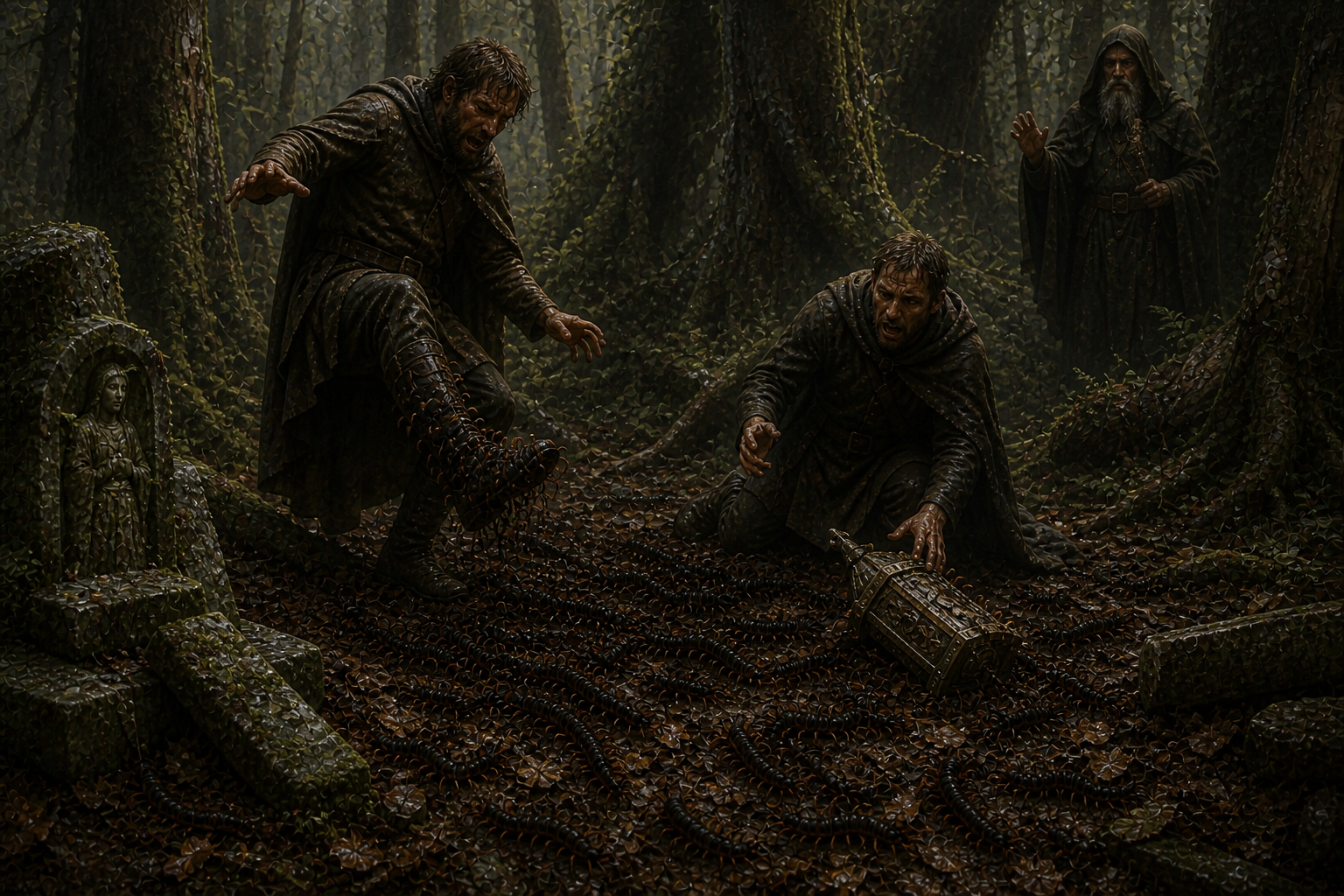
You summon four centipede swarms in spaces you can see within range. Each swarm occupies a 10-foot space. When a swarm appears, you may place it in a space occupied by one or more creatures.
Each swarm acts immediately after you in initiative. Swarms can move through spaces occupied by other creatures.
A creature takes 4d8 piercing damage when it enters a swarm’s space for the first time on a turn or starts its turn there. A creature can take this damage only once per turn from each swarm, and no creature can take damage from more than two swarms on the same turn.
As a Bonus Action, you may command any number of swarms to move up to 30 feet. A swarm must remain within 100 feet of you. If a swarm is ever more than 100 feet from you, it becomes stationary until you are within 100 feet of it again.
A swarm can be attacked and dispersed. Use the statistics of an appropriate insect or centipede swarm, or use the simplified swarm below.
Simplified Centipede Swarm
AC: 13
HP: 30
Speed: 30 ft., climb 30 ft.
Resistances: Bludgeoning, piercing, and slashing
Immunities: Charmed, frightened, grappled, prone, restrained
Vulnerability: Area damage
At Higher Levels
When you cast this spell using an 8th-level spell slot, you summon five swarms.
When you cast it using a 9th-level spell slot, you summon six swarms.
Creeping Doom — D&D 5e / 2014
Status: the 2014 core rules have no Creeping Doom spell of this name. Insect Plague is a distinct 2014 spell, not a mechanical conversion of the centipede swarms. The optional 2024-style treatment above is homebrew.
Creeping Doom — Pathfinder 1e
| School | Conjuration (Summoning) |
|---|---|
| Level | Druid 7 |
| Components | V, S |
| Casting Time | 1 standard action |
| Range | Close (25 ft. + 5 ft./2 levels) / 100 ft.; see text |
| Effect | Four enhanced insect swarms |
| Duration | 1 round/level |
| Saving Throw | Fortitude partial; see text |
| Spell Resistance | No |
Summon four swarms of insects, appearing adjacent initially but able to move independently. Treat each as a centipede swarm with 60 hit points and 4d6 swarm damage. The saving throw DC for its poison and distraction equals the spell’s DC; creatures caught in overlapping swarms take damage and make saves only once. A standard action commands any number of swarms toward targets within 100 feet; a swarm outside that command range stays stationary until the caster returns.
Source: Pathfinder Core Rulebook — Creeping Doom.
Earlier site wording (combined Pathfinder/3.5 treatment)
School: Conjuration (Summoning)
Level: Druid 7
Components: V, S
Casting Time: 1 round
Range: Close (25 ft. + 5 ft./2 levels) / 100 ft.; see text
Effect: One centipede swarm per two caster levels, maximum ten swarms at 20th level
Duration: 1 min./level
Saving Throw: None
Spell Resistance: No
You summon one centipede swarm per two caster levels, to a maximum of ten swarms at 20th level. The swarms need not appear adjacent to one another and may appear in spaces occupied by other creatures.
Each swarm acts on your initiative count.
The swarms remain stationary, attacking creatures in their areas, unless you command them to move. As a standard action, you may command any number of the swarms to move toward prey within 100 feet of you.
A swarm cannot be commanded to move more than 100 feet away from you. If you move more than 100 feet from a swarm, that swarm remains stationary and continues attacking creatures in its area. You may command it again once you move back within 100 feet.
Use the standard centipede swarm and swarm rules for the system being played.
Creeping Doom — D&D 3.5e
| School | Conjuration (Summoning) |
|---|---|
| Level | Druid 7; Witch 7 is preserved in the separate historical archive |
| Components | V, S |
| Casting Time | 1 round |
| Range | Close (25 ft. + 5 ft./2 levels) / 100 feet; see text |
| Effect | One centipede swarm per two caster levels; maximum ten swarms |
| Duration | 1 minute/level |
| Saving Throw | None |
| Spell Resistance | No |
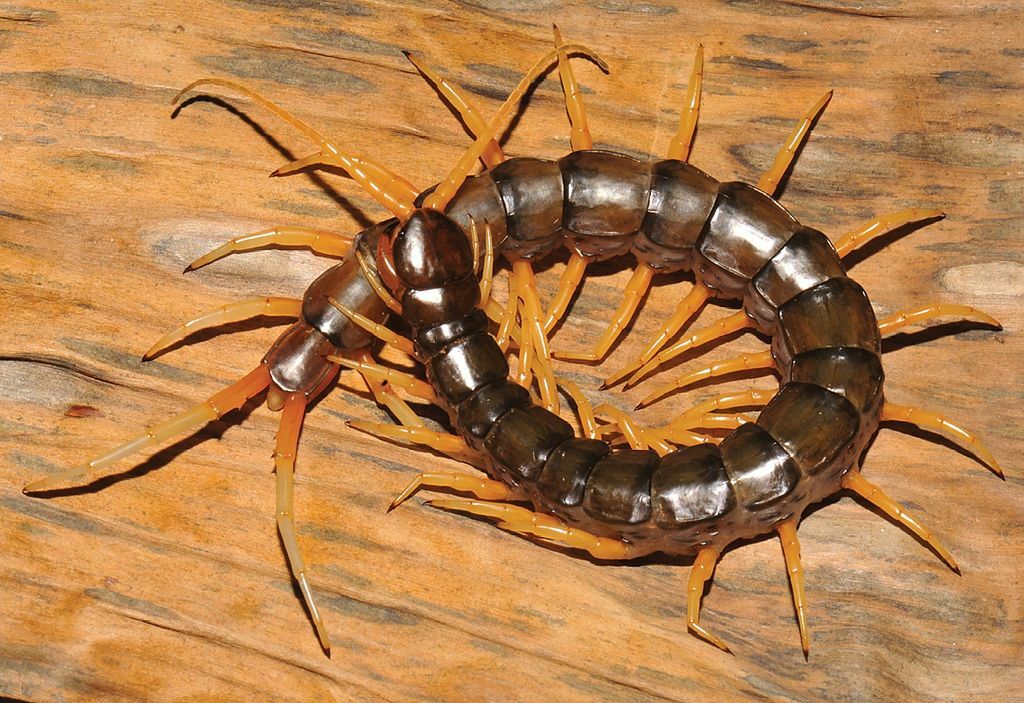
When you utter the spell of creeping doom, you call forth a mass of centipede swarms (one per two caster levels, to a maximum of ten swarms at 20th level), which need not appear adjacent to one another.
Conjuration (Summoning)
Level Druid 7
Components V, S
Casting Time 1 round
Range Close (25 ft. + 5 ft./2 levels)/ 100 ft.; see text
Effect One swarm of centipedes per two levels
Duration 1 min./level
Saving Throw None
Spell Resistance No
You may summon the centipede swarms so that they share the area of other creatures. The swarms remain stationary, attacking any creatures in their area, unless you command the creeping doom to move (a standard action). As a standard action, you can command any number of the swarms to move toward any prey within 100 feet of you. You cannot command any swarm to move more than 100 feet away from you, and if you move more than 100 feet from any swarm, that swarm remains stationary, attacking any creatures in its area (but it can be commanded again if you move within 100 feet).
This material is Open Game Content, and is licensed for public use under the terms of the Open Game License v1.0a.
Source: D&D 3.5 SRD — Creeping Doom.
Why This Spell Is Dangerous in the World
Creeping Doom turns living ground into a weapon. Armour, shields, and courage offer little protection against thousands of biting bodies underfoot, inside greaves, beneath robes, and across exposed skin.
Its true danger is not raw damage. It is collapse.
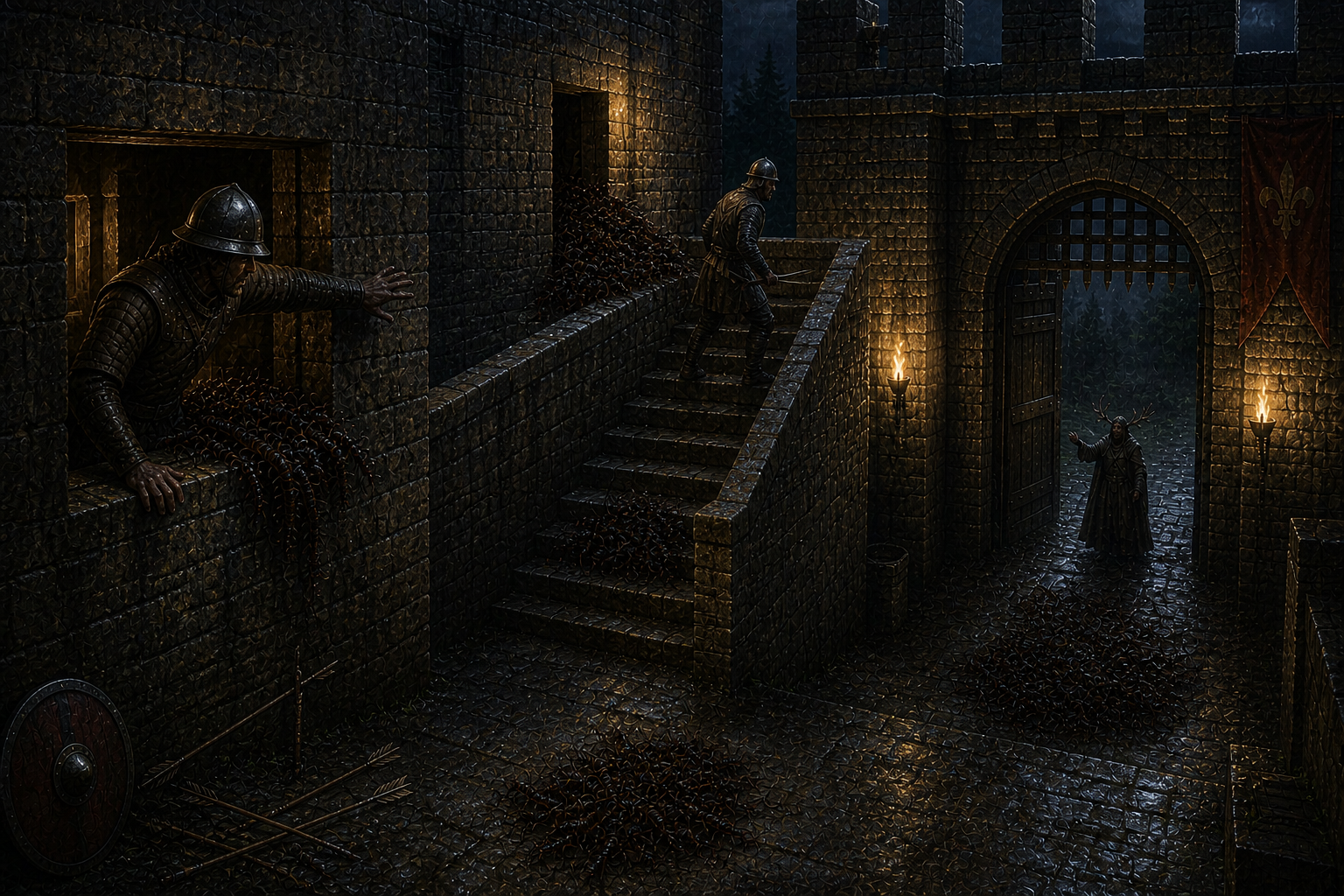
A disciplined line breaks when soldiers cannot stand still. Archers abandon position. Spellcasters lose concentration. Gate defenders leave the murder hole. A narrow bridge, stair, passage, or courtyard becomes a death trap.
This is why the spell is feared by armies and forbidden near many sacred groves, granaries, villages, and burial grounds. Where this spell is used carelessly, the ground is remembered as cursed long after the magic fades.
Best Uses
Use Creeping Doom to:
- Break shield walls and packed infantry
- Punish archers, casters, and guards holding fixed positions
- Block corridors, bridges, gates, and stairways
- Protect a ritual site, retreat, or wounded ally
- Force enemies into worse terrain
Tactics
Creeping Doom is strongest when the swarms are spread to control movement rather than stacked for damage.
Place swarms where enemies must go, not only where they are standing now. A swarm in a doorway may matter more than a swarm under one soldier.
The caster should stay close enough to command the swarms but far enough away to avoid being rushed. Losing position weakens the spell more than losing damage.
DM Notes
Do not run Creeping Doom as a simple damage spell. Run it as moving battlefield pressure.
Good counters include fire, area damage, flight, teleportation, elevation, sealed armour, or simply retreating before the swarms can close.
Track where each swarm is, what space it occupies, and whether it remains within command range.
For the 5.5e version, the cleanest ruling is that multiple swarms can overlap, but no creature can take damage from more than two swarms on the same turn.
Example: A creature forced to move through two swarm spaces in one turn takes damage from each swarm once, but does not take damage again when leaving those spaces.
Good Combinations
- Entangle: Holds enemies in place while the swarms close.
- Wall of Thorns: Narrows escape routes and forces bad movement choices.
- Spike Growth: Makes fleeing almost as dangerous as staying.
- Plant Growth: Slows pursuit and lets the swarms control a larger battlefield.
- Insect Plague: Turns the same battlefield into layered living pressure from above and below.
Using Creeping Doom in Your Game
This spell should feel like a threshold moment. When a druid casts Creeping Doom, the scene should change.
The sound comes first: dry clicking, leaf-rustle, armour tapping. Then the ground moves. Then the enemy realizes there is no clean place to stand.
Once this spell is cast, the question is no longer who wins the fight—but who can still stand their ground.
Spellcasting Culture and Worldbuilding Hooks
Some druid circles reserve Creeping Doom for war against oath-breakers, desecrators, and armies that burn sacred land.
Others forbid it near farms, wells, shrines, and burial places, fearing that the summoned hunger may leave a spiritual stain even after the creatures vanish.
Commanders who have survived the spell train soldiers to scatter, burn the ground, and climb anything solid. Veterans still fear the sound of insects beneath dry leaves.
Related Magic and Witch Spells
Browse Witch Spell Lists for the historical Witch 7 placement. Insect Plague and Entangle offer different forms of battlefield pressure; always use the rules for the edition being played.
Mythical Context
Greek stories could imagine entire peoples arising from the smallest creatures. In traditions surrounding Aeacus, Zeus changes the ants of Aegina into human Myrmidons; Ovid tells a variant after a plague ravages the island. Creeping Doom reverses the mood of this wonder, turning massed crawling life into an advancing terror. See the classical accounts of Aegina and the Myrmidons.
Historical Context
Creeping Doom is fantasy magic, but its horror is grounded in the real nature of centipedes: fast-moving, ground-dwelling predators armed with venomous claw-like limbs. Their habit of hiding beneath stones, bark, and leaf litter makes the spell’s image of dangerous ground especially fitting. For a concise natural-history reference, see Encyclopaedia Britannica’s entry on centipedes.
Keep this reference growing
If this page helped with your reading or game, you can support its upkeep or explore the curated books.
Explore the Bookshop — epics, classics and stories behind imagined worlds.