
Bleak Harvest Spell: Divine Crop Blight, Famine Curse, and Sacred Wrath
Bleak Harvest Spell: Divine Crop Blight, Famine Curse, and Sacred Wrath
A curse of dead grain, blackened fields, and divine punishment written into the soil.
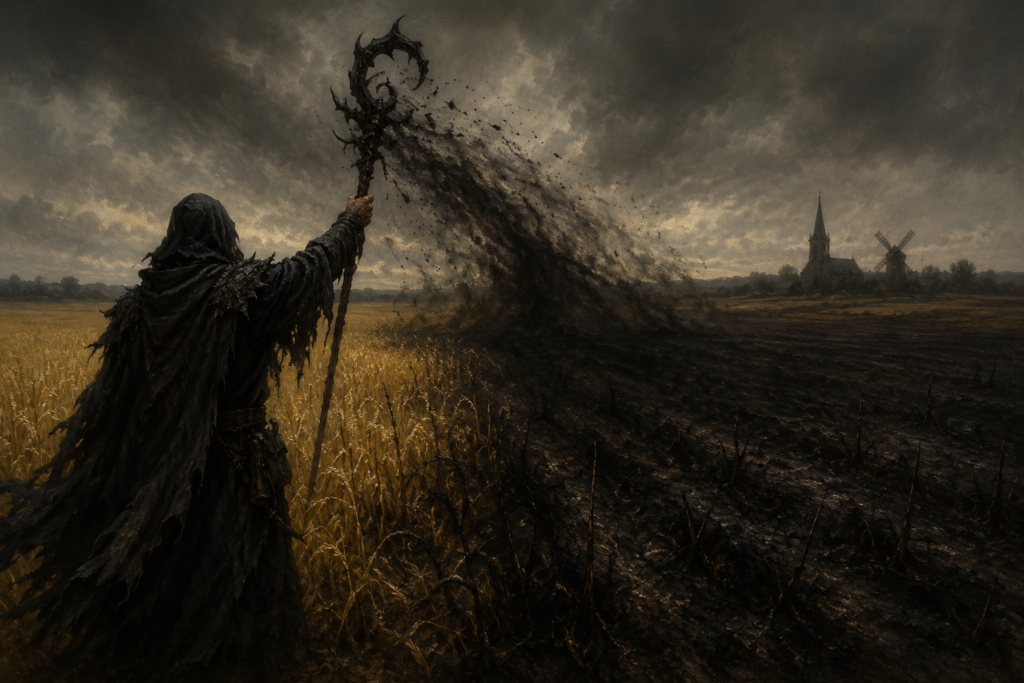
Bleak Harvest is a spell of judgment, revenge, siege, and sacred terror. A priest, druid, curse-speaker, or wrathful servant of the gods calls ruin into cultivated land, causing crops to blacken, shrivel, and fail. Where the spell settles, seed does not take, stalks rot before ripening, and the field becomes a visible sign that something has gone wrong between mortals, land, and the powers that watch over harvest.
This is not a battlefield spell. It is a spell of livelihood and consequence. A single casting can destroy a household’s food, break a tenant’s rent, punish a lord’s estate, weaken a village before winter, or mark a community as having offended a god. The visible damage is immediate, but the true harm unfolds through hunger, debt, accusation, migration, unrest, and desperate bargains.
Because Bleak Harvest affects land rather than creatures, it should carry consequences beyond ordinary combat. Those who cast it casually may find themselves pursued not only by guards, but by priests, reeves, druids, landholders, angry peasants, famine spirits, harvest gods, and the dead whose graves depended on a harvest that never came.
Quick Rules Reference
- Spell type: Divine or primal crop-blight curse.
- Primary effect: Ruins cultivated crops across a large area.
- Best use: Divine punishment, siege pressure, famine plots, cursed estates, and villainous leverage.
- Does not directly harm creatures: The spell destroys harvests, not bodies.
- Does not affect all plants: It targets cultivated food-producing land, not every forest, weed, or plant creature.
- Duration: The land remains barren for a long period unless the curse is ended.
- Campaign impact: The spell can create hunger, legal disputes, religious panic, and local unrest.
Effect
Bleak Harvest withers crops across a chosen area of cultivated land. Grain collapses, fruit blackens, vines dry, roots rot, and useful plants fail almost at once. The field does not merely suffer a poor yield. It becomes cursed against growth for the spell’s duration.
The spell affects crops, orchards, gardens, vineyards, and similar agricultural planting. It does not automatically kill ancient forests, wild meadows, sacred groves, ordinary roadside weeds, or non-crop plant monsters unless a specific rules version says otherwise. It is aimed at harvest, livelihood, and food supply.
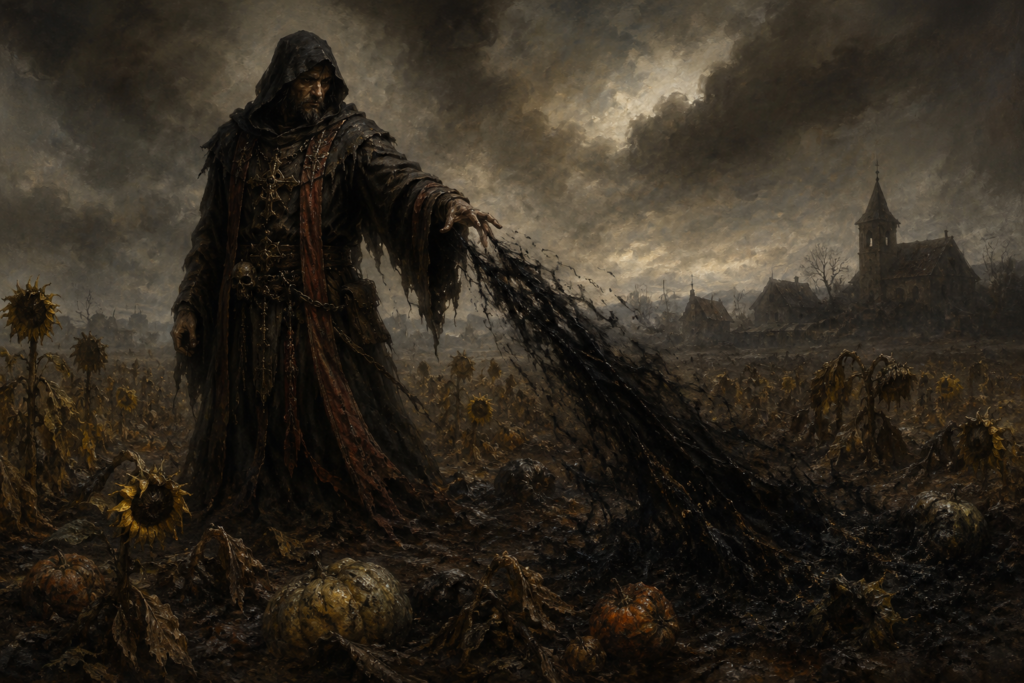
A field destroyed by Bleak Harvest should be visibly wrong. Birds avoid it. The soil smells sour. Stalks crumble into grey-black fibre. Fruit splits open with rot. In a pious village, people may not ask first who cast the spell. They may ask which god has been offended.
Mechanics Tabs
The rules below are mechanics tabs for different game systems.
Bleak Harvest 5.5e / 2024
Bleak Harvest, Pathfinder 1e / 3.5e
Bleak Harvest 3.0e
Bleak Harvest 5.5e / 2024-Compatible Version
2nd-Level Transmutation
Alternative Spell Name: Curse of the Withered Field
Casting Time: 1 minute
Range: 1,000 feet
Components: V, S, M/DF — a handful of spoiled grain, dead leaves, or ash from a burned field
Duration: 1 year
School: Transmutation
Classes: Cleric, Druid
Suggested Domains/Subclasses: Death, Nature, Tempest, War, Plague, Famine, Vengeance, and harvest-god cults when used as judgment magic.
You curse cultivated land that you can see within range. Choose up to 1 acre of crops, orchard, vineyard, garden, or similarly cultivated food-producing land. The chosen crops wither and become useless over the course of the casting, leaving the area barren and unable to produce ordinary crops for the spell’s duration.
For the duration, mundane planting in the cursed area fails. Seeds rot, shoots blacken, and grafts do not take. The curse does not harm creatures directly, does not damage buildings, and does not affect plant creatures unless the DM decides the target is rooted, cultivated, and functioning as part of the affected crop.
At Higher Levels. When you cast this spell using a spell slot of 3rd level or higher, the affected area increases by 1 acre for each slot level above 2nd.
Ending the Curse. The curse can be ended early by Remove Curse cast with a spell slot of 3rd level or higher. It can also be ended by Dispel Magic if the caster succeeds against your spell save DC. Greater Restoration, Hallow used as part of a ritual purification of the site, or similar divine or primal intervention may also end the curse at the DM’s discretion.
Notes
Bleak Harvest is deliberately not a direct combat spell. Its power lies in pressure, leverage, and consequence. A character who uses it against a village, estate, temple farm, occupied region, or dependent household is making a major social and moral act, not simply spending a 2nd-level spell slot.
The DM should decide whether the spell is legal punishment, sacrilege, terrorism, curse-work, druidic retaliation, temple judgment, or an act of famine-making depending on the target, witnesses, local law, and divine authority claimed by the caster.
Bleak Harvest, Pathfinder 1e / 3.5e-Compatible Version
Transmutation
Level: Cleric 2, Druid 2
Components: V, S, DF
Casting Time: 1 full-round action
Range: Long
Area: Up to 1 acre per caster level of cultivated crops
Duration: 1 year
Saving Throw: None
Spell Resistance: No
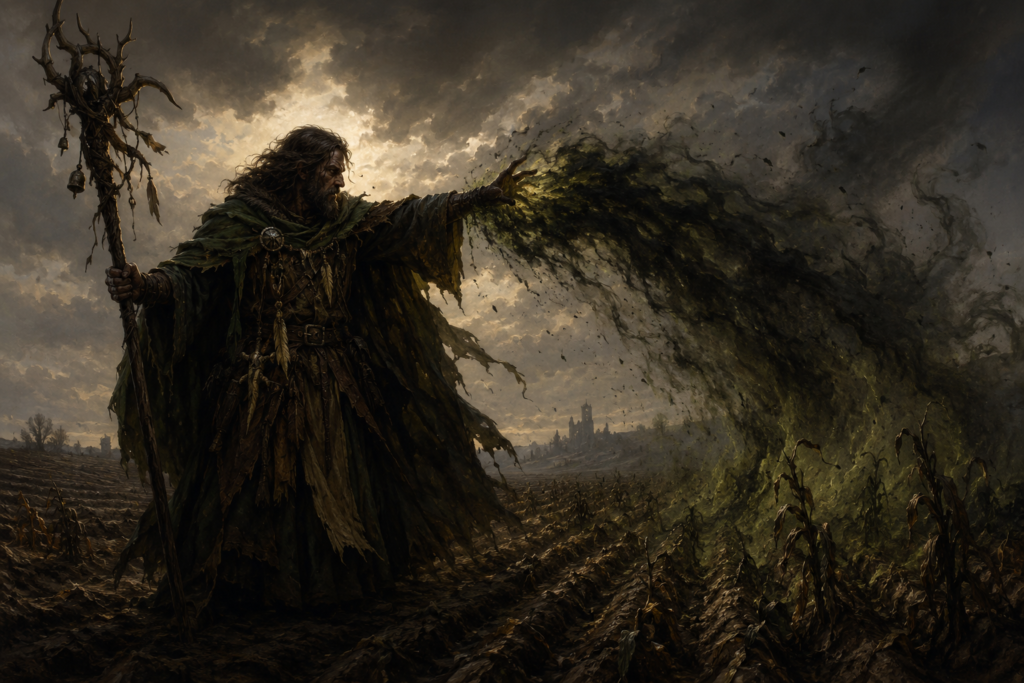
You curse cultivated land within range, causing crops in the affected area to wither, rot, and become useless almost immediately. The affected land cannot support normal crop growth for the duration. Seeds fail, shoots die, and planted crops become barren before they can produce a harvest.
This spell affects farmed crops, orchards, vineyards, gardens, and similar cultivated food-producing land. It does not normally destroy wild forests, natural grassland, plant creatures, magical plants, or sacred groves unless the GM rules that the target is being used as a cultivated harvest area.
Remove Curse, Dispel Magic, Break Enchantment, Hallow, Consecrate, Miracle, Wish, or equivalent divine or primal magic may end or suppress the curse, subject to caster-level checks where appropriate.
Pathfinder / 3.5e Notes
This version preserves the original spell’s campaign weight: a low-level divine caster can inflict serious economic and social damage without entering combat. The spell should be treated as an act with public consequences. Destroying a field may be a lawful temple punishment in one region, a capital crime in another, and a declaration of spiritual war in a third.
Bleak Harvest 3.0e
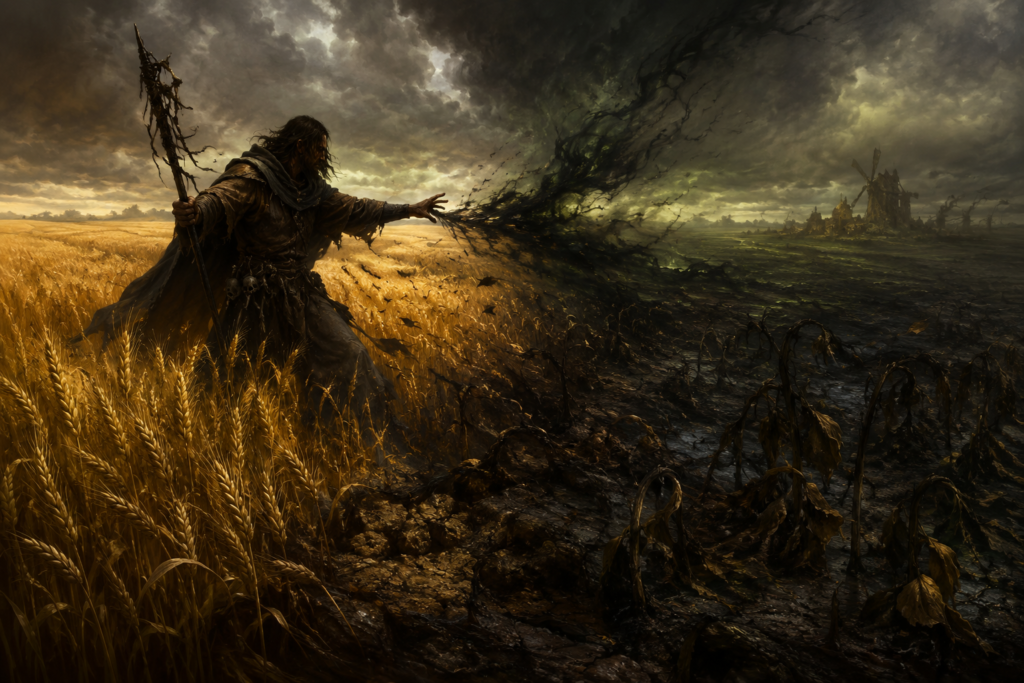
With this spell, you can demonstrate your gods’ wrath by visiting blight and destruction upon a farmer’s crops.
Relics & Rituals: Olympus
© 2004 White Wolf Publishing, Inc. Distributed for Sword and Sorcery Studios by White Wolf Publishing, Inc.
By W. Jason Peck, Aaron Rosenberg, Christina Stiles and Relics & Rituals: Olympus team
Transmutation
Level: Cleric 2, Druid 2
Components: V, S, DF
Casting Time: 1 full round action
Range: Long (400 ft. + 40 ft./level)
Area: 1 acre/level
Duration: 1 year
Saving Throw: None
Spell Resistance: No
The selected field withers and dies almost immediately, all of its crops turning shriveled and rotten. Nothing will grow here for the duration of the spell.
Why This Spell Is Dangerous in the World
Bleak Harvest is dangerous because it turns magic into famine.
A sword kills the person in front of it. This spell can starve people who never saw the caster. It strikes peasants, tenants, children, livestock, merchants, millers, bakers, brewers, tax collectors, soldiers, and lords through the same ruined field.
The spell also creates uncertainty. Was the land cursed by a god, poisoned by a rival, judged by druids, punished by a temple, or targeted by a hidden enemy? A single ruined field can trigger accusations against strangers, witches, rival families, foreign priests, local landlords, oath-breakers, or anyone already hated by the community.
In a late medieval campaign, crop failure is not background scenery. It is law, religion, economy, survival, and politics. Grain rent may go unpaid. Tithes may fail. A lord may demand food the village no longer has. A temple may claim the blight proves divine anger. A neighbouring estate may refuse aid. A desperate reeve may look for someone to hang.
This spell is especially frightening because it is low enough in level to be used by local religious authorities, hedge-priests, hostile druids, cult agents, and ambitious minor villains. It does not require a demon prince or archmage. One bitter servant of a harvest god may be enough.
Rules Clarifications and Edge Cases
- Does it affect stored food? No. It affects growing or planted crops, not grain already harvested and stored.
- Does it affect wild plants? Not normally. The spell is aimed at cultivated harvest land.
- Does it kill treants or plant monsters? No by default. A rooted plant creature disguised as a crop field may be a special DM ruling.
- Can it ruin an orchard? Yes, if the orchard is being cultivated as food-producing land. The trees may survive, but their harvest fails and growth is blighted for the duration.
- Can ordinary farming fix it? No. Replanting fails until the spell ends or the curse is lifted.
- Can the land recover afterward? Yes, unless other curses, salt, plague, infernal bargains, famine spirits, or mundane devastation have also affected the site.
- Can repeated castings devastate a region? Yes, but through repeated use, organisation, and time. One casting is local; many castings can become famine warfare.
Good Combinations
- Create or Destroy Water: Used by cruel priests to worsen drought conditions around already-blighted fields.
- Plant Growth: A direct thematic opposite, useful when breaking the curse or restoring devastated land.
- Hallow: Can ritually reclaim a cursed field when the blight is treated as divine contamination.
- Remove Curse: The cleanest adventuring answer when the spell is understood as a curse on the land.
- Dispel Magic: Useful when the party identifies the blight as an active magical effect rather than natural crop failure.
- Commune: Helps determine whether the blight came from a mortal caster, an offended god, or something pretending to speak for one.
Adventure Hooks
The Field That Confesses
A village field blackens overnight after the reeve executes an accused thief. The villagers believe the dead man was innocent and that the harvest god has judged them. The local lord insists the blight is enemy sabotage. The truth is worse: the spell was cast by the dead man’s sister, a novice priestess whose grief has attracted something older than her god.
Siege Without Fire
An army surrounds a walled town but does not attack. Instead, its priests curse the surrounding farms one by one. The defenders can survive the siege for now, but next winter is already being murdered in the soil.
The Saint of Rotten Grain
Pilgrims visit a ruined field where nothing has grown for years. They believe the blackened earth marks a holy punishment. Beneath the shrine, an old Bleak Harvest curse has become tangled with buried plague dead, turning the site into a place where famine, false piety, and undeath begin to meet.
Historical and Mythic Context
Bleak Harvest belongs to one of the oldest fears in settled life: the failure of the field. In agrarian societies, crop failure was not only an economic disaster. It could be read as divine anger, broken taboo, royal failure, ancestral displeasure, witchcraft, bad omens, drought, blight, or punishment from powers beneath the soil. A ruined harvest threatened law, family, trade, worship, and survival at the same time.
The spell also echoes the ancient idea that fertility is sacred. Greek myth often links harvest, famine, and divine emotion through figures such as Demeter, whose grief and wrath are tied to the barrenness of the earth. In a fantasy campaign, that mythic pattern becomes direct and dangerous: a god’s displeasure, or a priest claiming to act in that god’s name, can be written across the fields in rot and hunger.
Historically, famine has often followed war, taxation, siege, bad weather, and disease rather than simple scarcity alone. A spell such as Bleak Harvest gives that pressure a visible magical cause. It is the curse of the failed granary, the blackened barley field, the orchard that flowers but bears nothing, and the village that must decide whether to repent, rebel, flee, or accuse its neighbours.
For campaign use, the spell works best when it is treated as sacred violence against the land. It is not merely a way to destroy plants. It is a public act of judgment, spite, warfare, or famine-making, and the people who suffer from it will usually seek an answer in law, religion, vengeance, or desperate magic.
Keep this reference growing
If this page helped with your reading or game, you can support its upkeep or explore the curated books.
Explore the Bookshop — epics, classics and stories behind imagined worlds.