
Spell, Favorable Wind spell
Favorable Wind spell
A steady magical wind pours from the caster’s position, driving sails, clearing foul air, and forcing smaller creatures to struggle against the invisible pressure of the sky.

Favorable Wind is a spell of controlled force rather than destruction. It does not call lightning, tear roofs from houses, or summon a gale from the heavens. Instead, it produces a dependable stream of strong air that can be aimed, sustained, and used with precision.
At sea, the spell is prized because it can give a vessel movement when the natural wind fails or shifts against it. A spellcaster standing near the stern can send the wind forward into the sails, allowing a ship to continue under magical pressure while the crew trims canvas and holds course. Riverboats, coastal traders, warships, and desperate smugglers all value this kind of magic.
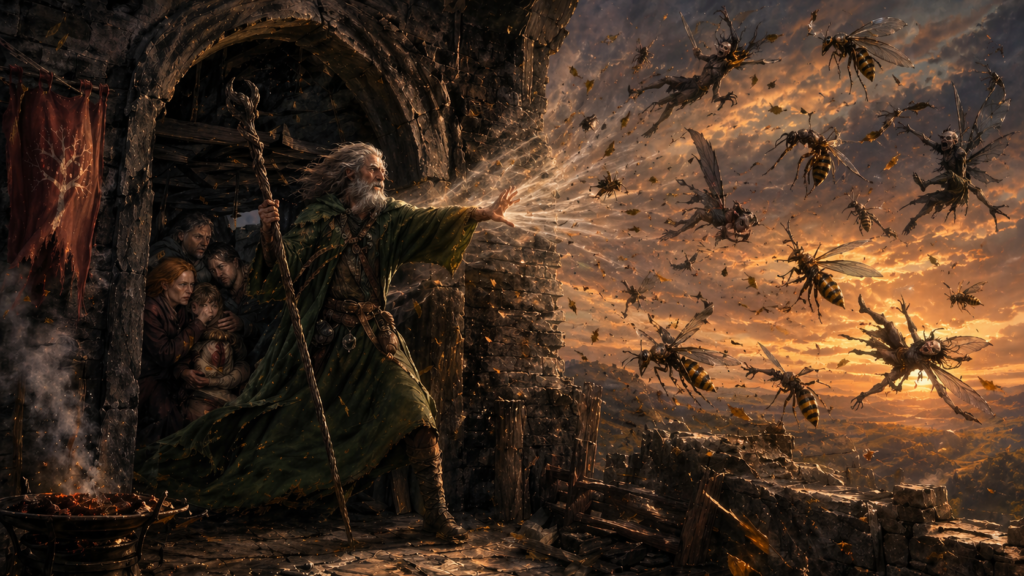
On land, Favorable Wind becomes a defensive and tactical tool. It clears smoke, poison clouds, and foul vapours from enclosed approaches. It snuffs exposed flames, spoils missile fire, drowns soft sounds, and makes it difficult for small creatures or flying pests to close the distance.
Its strength lies in reliability. It is not a spell for dramatic devastation; it is a spell for changing the conditions of a scene.
Effect
You create a strong magical wind that blows outward from you in a cone. The wind begins at your space and travels directly away from you. It can fill sails, scatter smoke and gases, extinguish exposed flames, hinder ranged attacks, and push back very small creatures.
The spell can perform any reasonable task that a strong natural wind could accomplish within its area, but it does not create a storm, change the weather, or move objects beyond what strong wind could plausibly affect.
Favorable Wind 5.5e / 2024
Favorable Wind Pathfinder 1e
Favorable Wind 3.5
Favorable Wind

3rd-Level Evocation
Casting Time: 1 action
Range: Self, 60-foot cone
Components: V, S
Duration: Concentration, up to 10 minutes
Available To: Druid, Sorcerer, Wizard
Alternative Spell Name: Sailwind
Effect
A strong magical wind blows from you in a 60-foot cone for the duration. The wind travels directly away from you and moves with you. As a Bonus Action on each of your turns, you may change the direction of the cone.
The wind creates the following effects within the cone.
Driven Sails. If you are aboard a sailing vessel and direct the wind into its sails from a suitable position, the vessel is treated as having favourable wind for movement. This does not replace the need for crew, rigging, steering, navigation, or seaworthiness. The spell cannot move a vessel faster than its hull, sails, and handling would normally allow under strong wind, and it cannot move a vessel if its sails cannot catch the wind.
Small Creatures. A Tiny or smaller creature that starts its turn in the cone or enters it for the first time on a turn must succeed on a Strength saving throw or be knocked Prone. If the creature is flying and fails the save, it is pushed up to 30 feet directly away from you instead of being knocked Prone.
A Small flying creature that starts its turn in the cone or enters it for the first time on a turn must succeed on a Strength saving throw or be pushed up to 15 feet directly away from you.
Checked Movement. A Small creature moving directly against the wind treats the cone as Difficult Terrain. A Small flying creature cannot willingly move closer to you through the cone unless it succeeds on a Strength saving throw at the start of its turn.
Larger Creatures. Medium or larger creatures can move normally through the cone, though they are still affected by the wind’s noise and missile disruption.
Missile Disruption. Ranged weapon attacks that pass through the cone, or are made by a creature inside the cone, are made with disadvantage if the projectile is light or wind-sensitive, such as an arrow, bolt, dart, sling stone, thrown dagger, or similar missile.
Noise and Air Pressure. Wisdom (Perception) checks that rely on hearing are made with disadvantage inside the cone.
Flames and Vapours. The wind extinguishes candles, torches, and similar unprotected flames. It disperses ordinary smoke, mist, gases, and vapours within the cone after 1 round of exposure, provided the material can be dispersed by strong natural wind.
Natural Wind Uses. The spell can fan a fire, scatter loose dust, drive rain sideways, stir waves, make handling small craft difficult, and perform other tasks that a strong natural wind could reasonably accomplish.
The spell cannot push a creature beyond the end of the cone.
Favorable Wind
School evocation [air]; Level druid 3, sorcerer/wizard 3
Casting Time 1 standard action
Components V, S
Range 60 ft.
Area cone-shaped emanation
Duration 10 minutes/level (D)
Saving Throw Fortitude negates; see text
Spell Resistance no
Effect
You produce a steady strong wind that begins at your position and blows directly away from you in a cone-shaped emanation. The wind moves with you. You may redirect the cone as a move action.
The wind is strong, roughly equivalent to a 30 mph natural wind. It can fill sails if you stand in a suitable position aboard a sailing vessel, such as astern of the mast, and direct the wind forward into the rigging. This does not remove the need for crew, steering, rigging, or proper handling.
Tiny or smaller creatures in the area must succeed at a Fortitude save or be knocked prone. Tiny or smaller flying creatures that fail this save are blown back 1d6 × 10 feet.
Small creatures are checked and cannot make progress directly against the wind. Small flying creatures that fail their Fortitude save are blown back 1d6 × 5 feet.
Medium or larger creatures can move normally through the area.
A creature cannot be pushed beyond the spell’s range by this effect.
All creatures in the area take a -2 penalty on ranged attack rolls and on Perception checks based on hearing. The wind automatically extinguishes candles, torches, and similar unprotected flames.
Favorable Wind disperses gases, vapours, smoke, and similar airborne effects to the limit of its range after 1 round, provided such effects can be dispersed by strong natural wind. It can also fan large fires, disturb loose objects, push small craft off course, and perform any other reasonable task a strong natural wind could accomplish.
Favorable Wind

This spell produces a stream of wind that can fill a ship’s sails, disperse vapors and gases, and keep flying creatures at bay.
(Stormwrack)
Originally posted on D&D tools
Evocation [Air]
Level: Druid 3, Sorcerer, Wizard 3,
Components: V, S,
Casting Time: 1 standard action
Range: 60 ft.
Area: Cone-shaped emanation
Duration: 10 min./level (D)
Saving Throw: Fortitude negates
Spell Resistance: No
The wind force is strong, with a speed of about 30 mph.
It begins where you stand and blows directly away from you; you can easily propel a sailing vessel by standing astern of the mast and directing the wind forward to fill the sails.
- Tiny or smaller creatures in the path of the wind are knocked prone, or if flying are blown back 1d6×10 feet.
- Small creatures are checked and cannot make headway against the wind.
- Small airborne creatures are instead blown back 1d6×5 feet.
- Medium and larger creatures can move normally within the effect.
A favorable wind can’t push a creature beyond the limit of its range.
Any creature, regardless of size, takes a -2 penalty on ranged attacks and on Listen checks in the area of a favorable wind.
The wind automatically extinguishes candles, torches, and similar unprotected flames.
In addition to the above-noted effects, favorable wind can do anything that a strong natural wind could do. It can fan a large fire, disperse gases and vapors to the limit of its range in 1 round, and make sailing difficult for small craft nearby.
Why This Spell Is Dangerous in the World
Favorable Wind is dangerous because it gives a spellcaster control over movement, visibility, fire, sound, and pursuit without needing to inflict damage.
A harbour priest with this spell can decide whether a ship leaves port. A naval mage can rescue a vessel from dead calm or help a small craft escape pursuit. A battlefield caster can clear poison gas from allies, ruin an ambush hidden in smoke, or make archers miss at the crucial moment.
In towns, the spell is feared around fire. Used carelessly, it can fan a blaze through timber streets. Used deliberately, it can scatter lamp-flames, carry sparks, and turn a controlled burn into disaster. Its power is not in raw violence but in changing what the air itself permits.
Best Uses
At Sea: Use Favorable Wind to move a ship during calm weather, improve manoeuvring during pursuit, or keep a vessel under control when the natural wind is unreliable.
Against Flying Creatures: The spell is especially useful against small airborne enemies such as stirges, bats, sprites, imps, familiars, and lesser flying scouts.
To Clear the Battlefield: It can disperse smoke, poison vapours, choking fumes, and other airborne hazards that strong wind can clear.
To Spoil Archery: The spell is useful against archers, crossbowmen, slingers, and thrown-weapon skirmishers.
To Control Fire and Light: It can snuff torches, candles, and exposed flames, or dangerously strengthen an existing blaze.
Tactics
Favorable Wind rewards positioning. The caster should stand where the cone can affect enemies without disrupting allies. On a ship, the caster’s position matters even more; the spell must be aimed into the sails, not merely cast somewhere on deck.
Against flying swarms or small winged creatures, cast the spell before they close. The wind is better at preventing approach than solving a melee already in progress.
In dungeons, the spell is excellent for clearing corridors, vents, smoke-filled rooms, and trapped chambers. It can also reveal hidden movement by blowing dust, ash, hanging cloth, cobwebs, or loose papers in the direction of the unseen airflow.
DM Notes
Favorable Wind should not replace a storm spell or a full weather-control effect. It creates a strong, directed wind in a limited area. It can help a ship move, but it does not rewrite naval travel speeds without regard for rigging, hull design, steering, sea conditions, or crew skill.
For the 5.5e version, Concentration keeps the spell balanced and prevents it from becoming a long-duration automatic solution to every sailing or battlefield problem. Ten minutes is still long enough to matter in chases, harbour scenes, naval encounters, dungeon hazards, and travel complications.
The Pathfinder 1e version can retain the longer duration because that system supports broader utility durations and more granular environmental spell handling.
Good Combinations
- Fog Cloud: Use Favorable Wind to shape, clear, or counter smoke and fog effects when visibility becomes more important than concealment.
- Gust of Wind: Combine both spells when a caster wants short explosive force and sustained directional pressure.
- Control Water: Excellent in naval encounters, allowing one caster to influence the water while another controls the air.
- Wall of Fire: Favorable Wind can make fire scenes more dangerous by fanning flames or driving smoke, though the exact interaction should remain under DM control.
- Call Lightning: A storm-themed caster can use Favorable Wind to establish battlefield atmosphere before calling down heavier weather magic.
Using This Spell in Your Game
Favorable Wind works best when the environment matters. It is strongest in scenes involving ships, smoke, lamps, arrows, fires, flying pests, poison vapours, and exposed terrain.
It also gives non-damaging spellcasters a way to matter in practical scenes. A druid can save a stranded vessel. A wizard can clear a laboratory accident. A sorcerer can extinguish a hall of torches before a duel. A storm-priest can stand at the stern of a warship and send the vessel cutting forward under a holy wind.
Spellcasting Culture and Worldbuilding Hooks
In coastal temples, Favorable Wind may be taught as a sacred duty. Priests who know it bless departures, rescue becalmed ships, and stand watch during dangerous crossings.
Among naval powers, the spell is strategic. A single caster can decide whether a messenger ship escapes, whether a smuggler reaches a hidden cove, or whether a warship can manoeuvre when the natural wind fails.
In inland regions, the spell has a different reputation. Farmers fear it near dry fields and thatched barns. Miners value it for clearing bad air. Alchemists pay well for casters who can disperse fumes without breaking sealed vessels. Adventurers learn quickly that sometimes the difference between death and survival is not firepower, but breathable air.
Keep this reference growing
If this page helped with your reading or game, you can support its upkeep or explore the curated books.
Explore the Bookshop — epics, classics and stories behind imagined worlds.