
Slaying Arrow – Magic Item
Slaying Arrow – Magic Item
A single arrow made for one death, one quarry, and one moment when mercy has already failed.
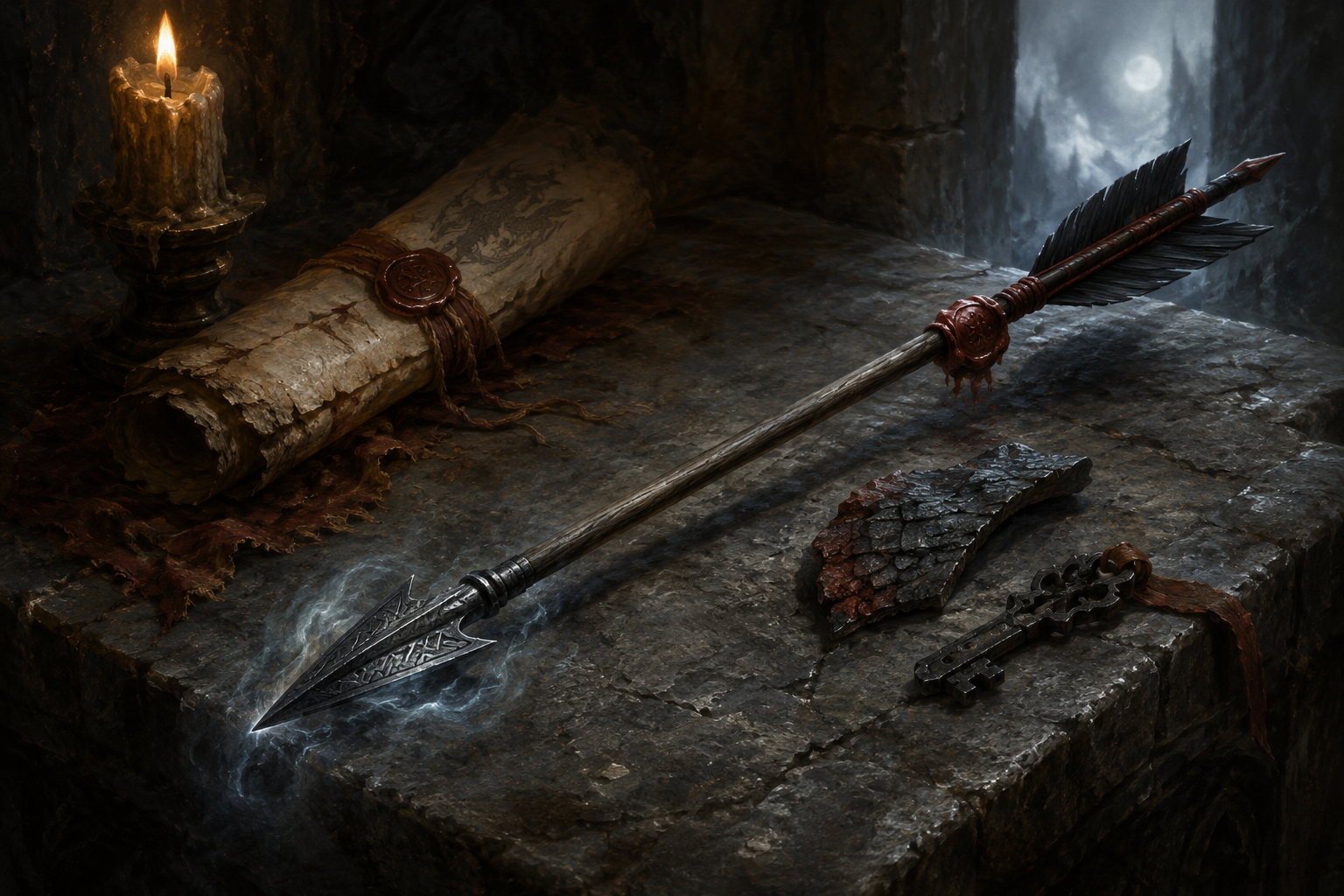
A Slaying Arrow is not simply enchanted ammunition. It is a killing sentence given physical form: shaft, head, fletching, binding, and death-rite all made to recognise one kind of being.
Some are forged for dragon-slayers, grave-knights, royal monster-hunters, and sworn wardens of dangerous roads. Others are commissioned in silence by princes, temple judges, frightened cities, oath-bound houses, or assassins who need one impossible target removed without a second chance.
Once fired, the arrow’s slaying magic is spent. Whether it strikes true, misses, shatters, or is deflected, the death bound into it has been released.
Physical Description
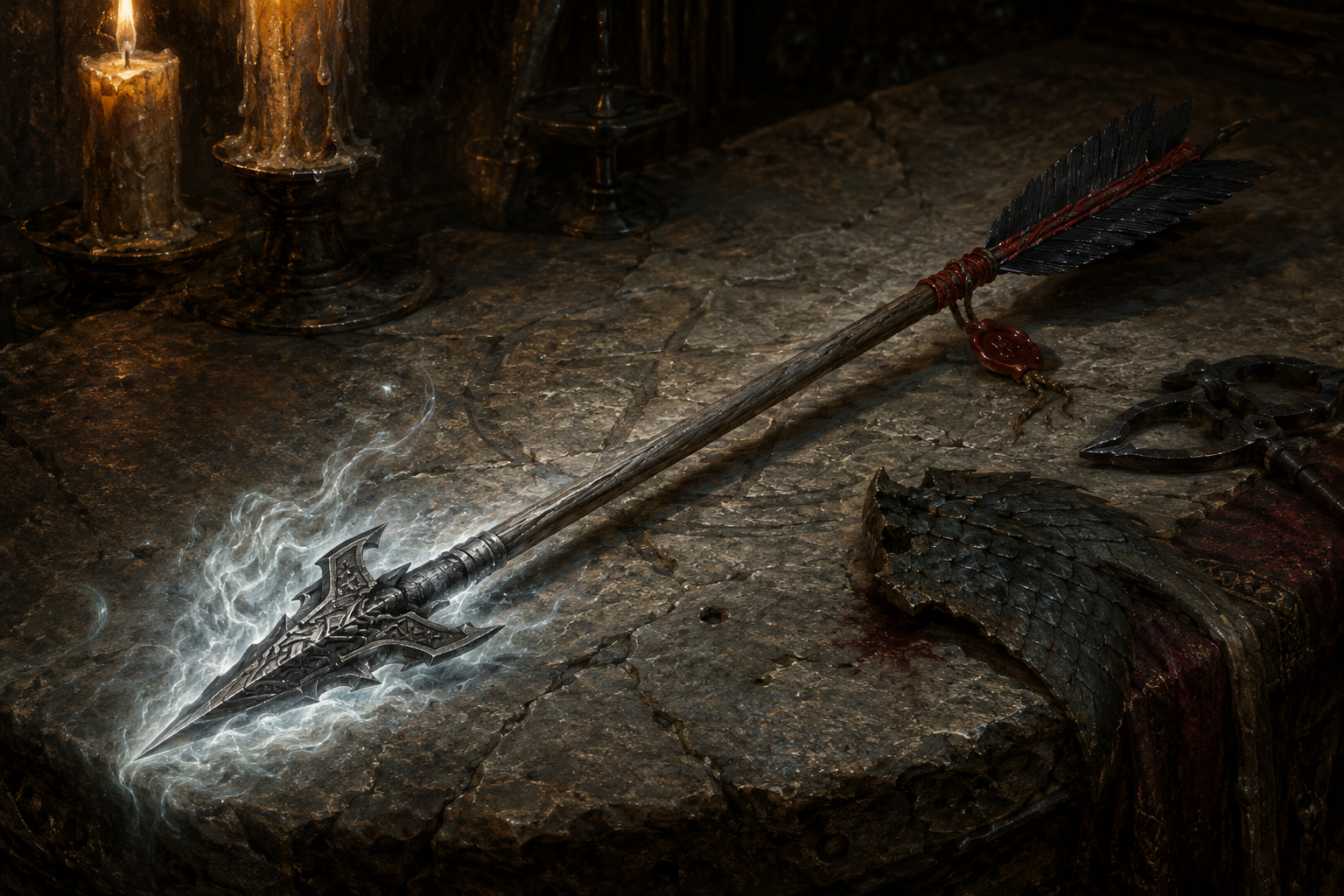
A slaying arrow rarely looks ordinary once examined closely. Its head may be blackened, silvered, barbed, glassy, bone-white, leaf-shaped, or worked with almost invisible runes. Its shaft is often made from wood cut under a specific moon, from a tree grown on a battlefield, or from timber taken from a grave boundary, sacred grove, execution hill, ruined watchtower, or monster-haunted pass.
Its fletching is usually chosen from a bird, beast, or omen associated with the intended quarry. A dragon-slaying arrow may smell faintly of storm-scorched iron. An undead-slaying arrow may remain cold under summer sun. A fey-slaying arrow may be wrapped in thorn, rowan, or old boundary thread. A human-slaying arrow may look terrifyingly plain.
The arrow is often stored alone rather than in a common quiver. It may rest in a narrow reliquary case, a sealed armoury drawer, a waxed leather sleeve, a priest’s casket, or a hunter’s oilcloth packet marked with the creature it was made to kill.
Why This Item Matters
A slaying arrow matters because it changes the shape of a confrontation before the first attack is made.
It gives weak hunters one chance against a stronger foe. It gives rulers a weapon they may deny owning. It gives temples a final instrument against the restless dead. It gives assassins a terrifying answer to a target that ordinary steel cannot reliably kill.
The item also creates immediate table pressure. It asks who should carry it, when it should be fired, whether the target truly deserves it, and what happens if the only shot is wasted.
Mechanics Tabs
The rules below are mechanics tabs for different game editions.
Slaying Arrow 5.5e / 2024
Slaying Arrow, Pathfinder 1e / D&D 3.5e
Slaying Arrow, 3.0e
Slaying Arrow 5.5e / 2024

Magic Ammunition, Very Rare
This arrow is keyed to one designated creature kind, chosen or rolled when the item is created, discovered, or identified.
You gain a +1 bonus to attack rolls and damage rolls made with this magic arrow.
When you hit a creature with this arrow, the slaying magic activates if the creature matches the arrow’s designated creature kind. The target must make a DC 20 Constitution saving throw.
On a failed save, the target takes 55 (10d10) necrotic damage. If this damage reduces the target to 0 Hit Points, the target dies or is destroyed instantly. On a successful save, the target takes half as much damage.
A creature that does not match the arrow’s designated creature kind is affected only by the arrow’s normal +1 magic.
A Greater Slaying Arrow uses the same rules, except the saving throw DC is 23 and the extra necrotic damage is 66 (12d10).
The slaying magic is expended after the arrow is fired, whether the attack hits or misses.
Designated Creature Kind
Choose or roll the arrow’s designated creature kind when the item is created, discovered, or identified.
| d100 | Designated Creature Kind |
|---|---|
| 01–05 | Aberrations |
| 06–09 | Beasts |
| 10–16 | Constructs |
| 17–22 | Dragons |
| 23–27 | Elementals |
| 28–32 | Fey |
| 33–39 | Giants |
| 40 | Aquatic humanoids |
| 41–42 | Dwarves |
| 43–44 | Elves |
| 45 | Gnolls |
| 46 | Gnomes |
| 47–49 | Goblinoids |
| 50–54 | Humans |
| 55–57 | Reptilian humanoids |
| 58–65 | Monstrosities |
| 66–70 | Monstrous or hybrid humanoid lineages |
| 71–72 | Oozes |
| 73 | Air-aligned extraplanar creatures |
| 74–76 | Chaotic extraplanar creatures |
| 77 | Earth-aligned extraplanar creatures |
| 78–80 | Fiends or evil extraplanar creatures |
| 81 | Fire-aligned extraplanar creatures |
| 82–84 | Celestials or good extraplanar creatures |
| 85–87 | Lawful extraplanar creatures |
| 88 | Water-aligned extraplanar creatures |
| 89–90 | Plants |
| 91–98 | Undead |
| 99–100 | Vermin, giant insects, arachnids, and similar swarms |
Notes
The D&D 5.5e / 2024-compatible version uses severe necrotic damage as its standard effect. This keeps the arrow deadly, especially against wounded or mid-tier targets, while preserving legendary monsters, major villains, and campaign-defining beings from being removed by a single unlucky save unless the DM wants that level of lethality in the campaign.
For a harsher old-school campaign, a matching creature that fails the saving throw dies or is destroyed instantly. Use that version when slaying arrows are meant to be rare weapons of fate rather than high-damage ammunition.
If the arrow was created for a named legendary creature, unique villain, sworn bloodline enemy, or prophesied target, the DM may rule that a failed saving throw kills or destroys that intended target outright. This should be used only when the arrow’s purpose has been established in the story, not for every randomly discovered slaying arrow.
The arrow must hit for the saving throw to occur. The slaying magic does not trigger on a miss.
Against undead and constructs, the extra necrotic damage represents destruction, severance, unmaking, collapse of animating force, or the breaking of the enchantment that sustains the body.
Slaying Arrow, Pathfinder 1e / D&D 3.5e
Aura: Strong necromancy
Caster Level: 13th
Slot: None
Weight: —
This +1 arrow is keyed to a particular type or subtype of creature, chosen or rolled when the item is created, discovered, or identified.
If the arrow strikes a creature of the designated type or subtype, the target must make a DC 20 Fortitude save or die instantly. In the case of unliving targets, the creature is destroyed instead.
A creature that does not match the arrow’s designated type or subtype is affected only by the arrow’s normal +1 magic.
Even creatures normally exempt from Fortitude saves, including undead and constructs, are subject to this attack.
When keyed to a living creature, the arrow’s killing power is a death effect. Effects such as death ward protect against it as normal.
A Greater Slaying Arrow functions as a normal slaying arrow, except the Fortitude save DC is 23.
The arrow’s slaying magic is expended when fired.
Designated Type or Subtype
| d% | Designated Type or Subtype |
| 01–05 | Aberrations |
| 06–09 | Animals |
| 10–16 | Constructs |
| 17–22 | Dragons |
| 23–27 | Elementals |
| 28–32 | Fey |
| 33–39 | Giants |
| 40 | Humanoids, aquatic |
| 41–42 | Humanoids, dwarf |
| 43–44 | Humanoids, elf |
| 45 | Humanoids, gnoll |
| 46 | Humanoids, gnome |
| 47–49 | Humanoids, goblinoid |
| 50–54 | Humanoids, human |
| 55–57 | Humanoids, reptilian |
| 58–65 | Magical beasts |
| 66–70 | Monstrous humanoids |
| 71–72 | Oozes |
| 73 | Outsiders, air |
| 74–76 | Outsiders, chaotic |
| 77 | Outsiders, earth |
| 78–80 | Outsiders, evil |
| 81 | Outsiders, fire |
| 82–84 | Outsiders, good |
| 85–87 | Outsiders, lawful |
| 88 | Outsiders, water |
| 89–90 | Plants |
| 91–98 | Undead |
| 99–100 | Vermin |
Construction Requirements: Craft Magic Arms and Armor, finger of death for a slaying arrow or heightened finger of death for a greater slaying arrow
Price: 2,282 gp for a slaying arrow; 4,057 gp for a greater slaying arrow
Cost: 1,144 gp 5 sp + 91 XP for a slaying arrow; 2,032 gp + 162 XP for a greater slaying arrow
Notes
For Pathfinder 1e tables that do not use XP costs for item creation, ignore the XP entry and use the campaign’s normal magic-item crafting rules.
The arrow’s target category should be clear before play. If the table is uncertain whether a creature qualifies, the DM should decide based on the creature’s printed type, subtype, tags, or strongest supernatural identity.
A slaying arrow is most satisfying when the players know what it is for before the fight begins. It works best as a tool of preparation, not as random treasure fired blindly into the next combat.
Slaying Arrow, 3.0e
This material is Open Game Content, and is licensed for public use under the terms of the Open Game License v1.0a.
This +1 arrow is keyed to a particular type or subtype of creature. If it strikes such a creature, the target must make a DC 20 Fortitude save or die (or, in the case of unliving targets, be destroyed) instantly. Note that even creatures normally exempt from Fortitude saves (undead and constructs) are subject to this attack. When keyed to a living creature, this is a death effect (and thus death ward protects a target). To determine the type or subtype of creature the arrow is keyed to, roll on the table below.
A greater slaying arrow functions just like a normal slaying arrow, but the DC to avoid the death effect is 23.
| d% | Designated Type or Subtype |
| 01-05 | Aberrations |
| 06-09 | Animals |
| 10-16 | Constructs |
| 17-22 | Dragons |
| 23-27 | Elementals |
| 28-32 | fey |
| 33-39 | Giants |
| 40 | Humanoids, aquatic |
| 41-42 | Humanoids, dwarf |
| 43-44 | Humanoids, elf |
| 45 | Humanoids, Gnoll |
| 46 | Humanoids, gnome |
| 47-49 | Humanoids, goblinoid |
| 50-54 | Humanoids, human |
| 55-57 | Humanoids, reptilian |
| 58-65 | magical beasts |
| 66-70 | monstrous humanoids |
| 71-72 | Oozes |
| 73 | outsiders, air |
| 74-76 | outsiders, chaotic |
| 77 | outsiders, earth |
| 78-80 | outsiders, evil |
| 81 | outsiders, fire |
| 82-84 | outsiders, good |
| 85-87 | outsiders, lawful |
| 88 | outsiders, water |
| 89-90 | Plants |
| 91-98 | undead |
| 99-100 | vermin |
Strong necromancy; CL 13th; Craft Magic Arms and Armor, finger of death (slaying arrow) or heightened finger of death (greater slaying arrow); Price 2,282 gp (slaying arrow) or 4,057 gp (greater slaying arrow); Cost 1,144 gp 5 sp + 91 XP (slaying arrow) or 2,032 gp + 162 XP (greater slaying arrow).
Identification
A slaying arrow should not be treated as a simple +1 arrow unless its deeper enchantment is deliberately hidden.
Common signs include fletching marked with the colour, feather, or omen of the intended quarry; a head shaped for a particular hide, scale, shell, bark, spirit, or corpse; a cold tightening sensation when the arrow is held near the intended creature kind; and inscriptions naming a creature type, bloodline, ancient enemy, holy ban, or royal quarry.
A successful identification check should reveal the arrow’s designated target kind. A partial success may reveal that the arrow is a slaying arrow without revealing exactly what it was made to kill.
Failure, Risk, and Misuse
A slaying arrow is easy to waste. It can be fired too early, used against the wrong creature, intercepted, stolen, broken, or spent on a lesser servant before the true target appears.
Its worst danger is political. A dragon-slaying arrow may be a royal weapon. An undead-slaying arrow may be a graveyard mercy or a temple relic. A human-slaying arrow is evidence of premeditated murder. An arrow keyed to elves, dwarves, fey, celestials, or recognised outsiders may be treated as preparation for war, sacrilege, treaty-breaking, or extermination.
The arrow creates pressure because it invites one hard question: who deserves the only shot?
Value in the World
Slaying arrows are too specific to function as common battlefield weapons and too dangerous to be treated as ordinary treasure. A lord does not keep a dozen of them loose in an armoury. A temple does not hand them out like blessed arrows. A hunter does not waste one on a creature that can be killed with courage and steel.
Their value lies in certainty, preparation, and fear. A city with a dragon-slaying arrow can negotiate differently with a wyrm. A baron with a human-slaying arrow has already crossed a moral line, even if the arrow remains unfired. A border fortress with a giant-slaying arrow may survive one siege that should have destroyed it.
Buying one openly is rare. Commissioning one is harder, because the maker must know what the arrow is meant to kill. That makes every slaying arrow a record of intent.
When a Slaying Arrow Appears
A slaying arrow should enter play with a purpose. It may be found in an old dragon-hunter’s chapel, locked inside a city armoury, sealed in a temple reliquary, carried by a frontier warden, buried with a failed hero, hidden in a noble assassin’s case, or granted by a ruler who does not want the order written down.
The item works best when the designated target matters. A random slaying arrow can be useful treasure, but a known dragon-slaying arrow found before the wyrm descends on the valley becomes a campaign object. An undead-slaying arrow placed in a plague chapel becomes a moral choice. A human-slaying arrow found in a diplomatic chamber becomes evidence.
Treasure
A slaying arrow should usually appear as deliberate treasure rather than as one more piece of ammunition. It belongs in a named cache, reliquary, sealed quiver, royal vault, old hunter’s grave, monster-killer’s chapel, military ledger, assassin’s case, or treaty chest.
A normal slaying arrow is appropriate as a major single-use reward when its target category is narrow, situational, or already connected to the campaign. A greater slaying arrow should be treated as a significant campaign asset, especially if keyed to dragons, undead, giants, constructs, fiends, celestials, humans, elves, dwarves, or another politically meaningful creature kind.
The best treasure placement gives the arrow a decision attached to it. The party should not only ask, “What is this worth?” They should ask, “Who was this made to kill?” and “Are we willing to be the ones who fire it?”
Adventure and Worldbuilding Hooks
The Last Arrow in the Chapel
A ruined mountain chapel contains one dragon-slaying arrow sealed behind the altar. The local duke wants it for war. A monastery wants it kept unused. A dragon’s envoy offers peace if the arrow is destroyed.
The Wrong Quarry
A captured assassin carries a human-slaying arrow, but the named victim is not the king. It is a child, witness, heir, plague survivor, oath-bearer, or prisoner whose death would quietly unravel a treaty.
The Arrow That Knows
A slaying arrow recovered from an old battlefield begins to hum near a trusted ally. Either the ally’s nature has been misunderstood, the arrow was made for a hidden bloodline, or something has changed inside them.
Historical and Mythic Context
The slaying arrow belongs to an old imaginative family of weapons in which the arrow is not simply a missile, but a carrier of judgement, plague, poison, prophecy, love, or divine will. In Greek myth, Apollo’s arrows bring sudden punishment, plague, purification, and distant death. This gives the enchanted arrow a role beyond battlefield archery: it is death sent from afar with a purpose. See Britannica on Apollo.
Heracles provides the clearest heroic model for the monster-killing arrow. After defeating the Lernaean Hydra, he dips his arrows in the creature’s poisonous blood or venom, giving them the power to inflict fatal wounds. One horror becomes the means of killing another. See Britannica on the Hydra.
The bow and arrows of Heracles later become central to the story of Philoctetes, where possession of the right weapon matters as much as courage, strength, or numbers. The Greeks cannot finish the war without the hero who bears Heracles’ bow. This is the right mythic territory for a slaying arrow: it should feel like a rare instrument of fate, not disposable ammunition. See Britannica on Philoctetes.
Mythic arrows do not always kill. Cupid and Eros show the same weapon-form carrying compulsion, desire, and supernatural change rather than physical force alone. Their arrows alter the victim’s state because they are made to do so. That tradition helps explain why a slaying arrow should feel like a precise magical sentence: the arrow does not merely wound the body, it declares what kind of being the target is and what fate has been prepared for it. See Britannica on Cupid and Britannica on Eros.
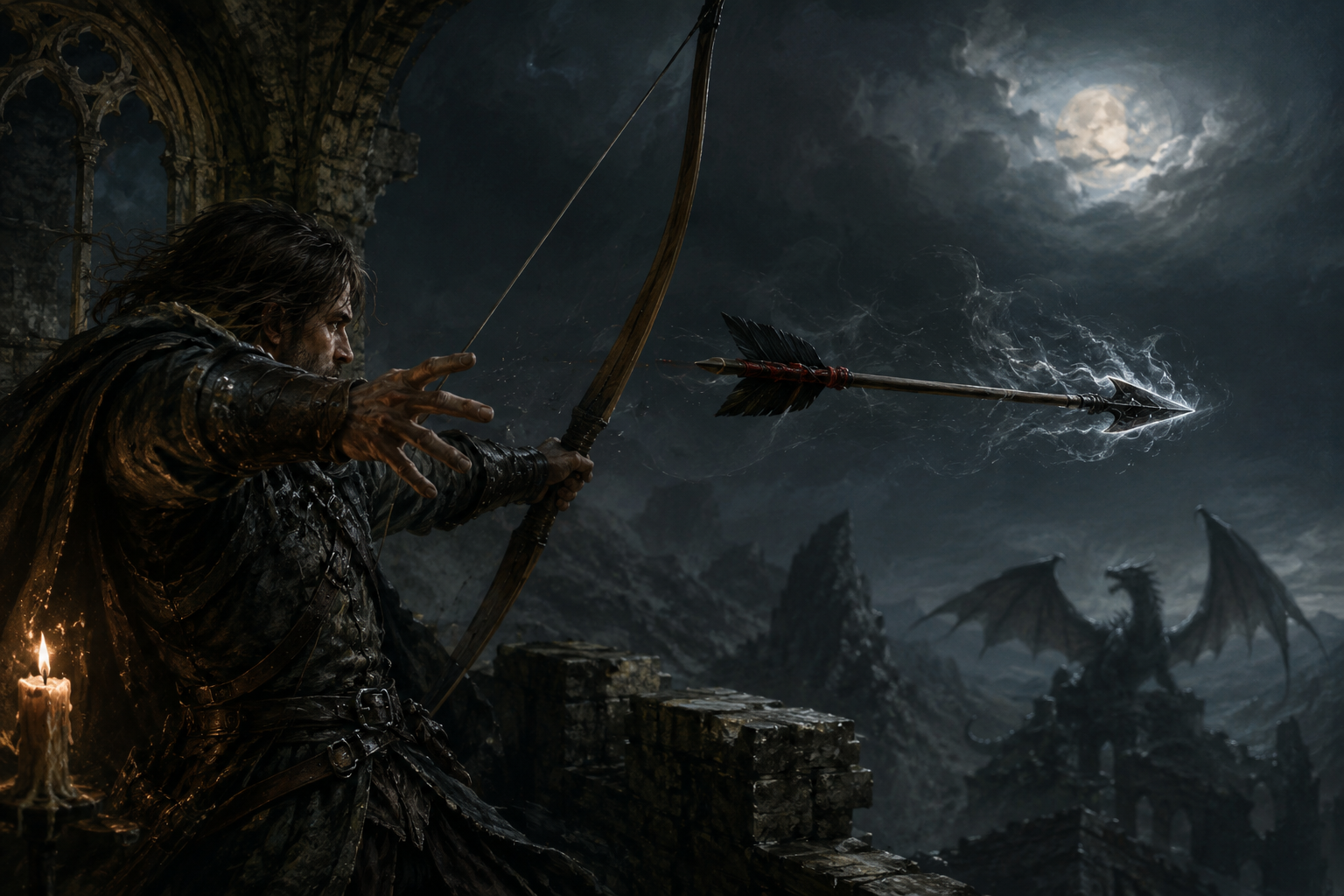
In a late medieval fantasy campaign, a slaying arrow is a rare weapon of judgement, monster-hunting, assassination, or sacred emergency. It does not make archers generally stronger. It makes one prepared shot matter. Someone has named a kind of victim, paid for its death, and placed that death in the hands of whoever draws the bow.