
Will Scarlet — Reckless Blade of Sherwood
Will Scarlet is Robin Hood’s handsome, reckless young blade: a proud Merry Man, elite swordsman, and gentleman fugitive whose violent past follows him into the greenwood.
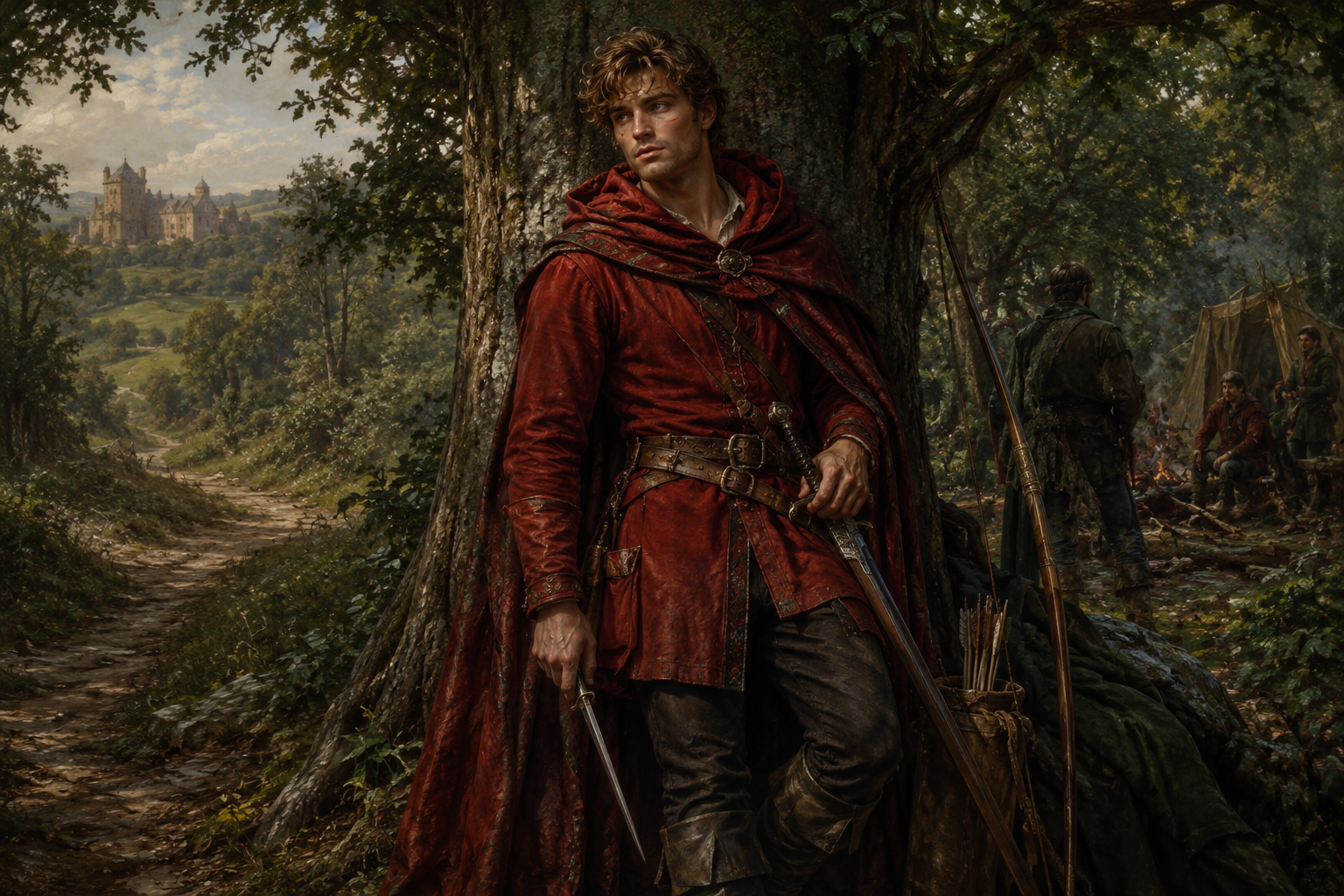
At a Glance
- Name: Will Scarlet
- Aliases: Will Scarlett, Will Scathlock, Will Scadlock, Will Scathelocke, Will Scarlock, Young Gamwell
- Gender: Male
- Race: Human
- Occupation: Merry Man, outlaw companion, elite swordsman, archer, forest scout, gentleman fugitive
- Religion: English household rites, greenwood oaths, and reverence for local spirits of hearth, tree, road, and sworn kinship
- Nationality: English
- Region: Nottinghamshire, Sherwood Forest, Barnsdale, and the roads between manor, market, and royal office
- Base of Operations: Robin Hood’s forest camps, deer-hides, charcoal burners’ huts, abandoned woodland shelters, and safehouses near the forest edge
- Languages: English, Norman French, thieves’ cant, hunting calls, courtly phrases learned from noble households
- Alignment: Chaotic Good, with dangerous Chaotic Neutral tendencies when pride, insult, or blood-feud is involved
- Affiliations: Robin Hood’s Merry Men; Little John; Friar Tuck; Much the Miller’s Son; Alan-a-Dale; sympathetic foresters, servants, millers, tenants, and household runaways
- Allies: Robin Hood, Little John, Friar Tuck, Much the Miller’s Son, Alan-a-Dale, trusted forest messengers
- Enemies: The Sheriff of Nottingham, corrupt foresters, abusive stewards, bounty men, informers, false outlaws, and noble households that hide violence behind law
- Significant Others: Varies by tradition; some stories connect him to the Gamwell family or give him gentler blood than most forest outlaws
- Challenge Role: Legendary skirmisher, elite duellist, social infiltrator, and volatile Merry Man
Will Scarlet is one of the enduring companions of Robin Hood and one of the sharpest figures among the Merry Men. He is not Robin’s equal as a commander, nor Little John’s equal in raw strength, nor Friar Tuck’s equal as a heavy sword-and-brawl fighter. His danger lies elsewhere. Will is quick, proud, socially dangerous, and marked by a violent past that his fine clothes cannot quite hide.
Where Robin Hood carries the cause, Will carries the wound. In the Young Gamwell tradition, he enters the greenwood after killing his father’s steward and seeking Robin Hood, who is named as his uncle. Other traditions preserve variant name-forms such as Scarlet, Scadlock, Scarlock, Scatheloke, and Scathelocke, showing how fluid the character’s identity became across ballads and later retellings.
At the table, Will Scarlet should not feel like “another Merry Man.” Robin’s band is not an average outlaw band. The Merry Men are the elite of the greenwood: legendary raiders, archers, scouts, ambushers, swordsmen, infiltrators, and folk-warriors whose names carry more force than a sheriff’s warrant. Will is the volatile young blade of that company: charming, proud, useful, dangerous, and always closer to violence than Robin would like.
Appearance
Will Scarlet is young in bearing even when not actually young: lean, graceful, bright-eyed, and too well-dressed for a fugitive. His clothes are patched and weather-stained, but their cut gives him away. Scarlet cloth, fine belt fittings, polished buckles, and boots that once belonged near tiled floors rather than deer tracks all suggest a man who has not entirely surrendered the world of halls and households.
He is not built like Little John, and he does not carry the heavier, more stubborn close-quarters presence of Friar Tuck. Will’s threat is speed, balance, timing, and nerve. He stands lightly, smiles before violence, and lets enemies underestimate him until they are bleeding. His sword is kept cleaner than his conscience. His clothing is not camouflage. It is defiance.
Character and Lore
Will Scarlet belongs to the part of the Robin Hood tradition where outlawry is not only hunger, but social rupture. Some tellings connect him with the name Gamwell and make him kin to Robin Hood. Other traditions preserve rougher name-forms such as Scadlock, Scarlock, Scatheloke, or Scathelocke. For campaign use, the strongest version is the one that gives him a broken connection to gentility, household violence, and a crime that made return impossible.
Will came from a household where manners hid violence. A steward, kinsman, officer, or lord’s favourite pushed too far. There was a quarrel. There was blood. The law made its decision before truth could speak. Will ran for the forest, and the forest kept him.
Robin Hood gave him shelter, but not peace. Will loves the Merry Men, yet he remains half-courtier, half-wolf. He knows which noble seal matters, which servant is frightened, which steward is lying, and which young lord has never been struck in the mouth. He is invaluable in raids on rich households because he understands how those households breathe. He is dangerous for exactly the same reason.
Name and Tradition
Will Scarlet’s name varies across the Robin Hood tradition. Forms such as Scarlet, Scarlett, Scarlock, Scadlock, Scatheloke, and Scathelocke appear in different sources and adaptations, and later writers sometimes separate these names into different characters. This entry treats them as related tradition-names rather than one fixed historical identity.
Some readings connect Scathlock or related forms with rougher outlaw associations, but that should remain a shadow of reputation rather than Will’s present role. In this version, Will is not a housebreaker by trade. He is a named Merry Man: a proud swordsman, scout, infiltrator, and volatile companion of Robin Hood.
Personality
Will Scarlet is charming when charm serves him, cutting when pride takes hold, and frightening when he believes someone deserves punishment. He is not naturally cruel to the helpless, but he can be merciless toward informers, abusive officers, false outlaws, and men who remind him of the life he fled.
His virtues are real. He is brave, loyal, quick-witted, generous with stolen wealth, and capable of sudden tenderness toward servants, children, widows, and disgraced young men. His flaws are just as real. He loves a dramatic gesture. He hears insult too quickly. He sometimes mistakes revenge for justice because revenge gives quicker answers.
Will is at his best when Robin Hood gives his anger a cause. He is at his worst when the cause becomes an excuse.
Motives and Fears
What He Wants:
Will wants to prove that outlawry has not made him lesser. He wants Robin’s respect, Little John’s recognition, Friar Tuck’s wary approval, and the fear of men who once thought themselves untouchable.
What He Fears:
He fears being remembered as a murderer rather than a wronged man. He fears that Robin’s mercy will one day fail. He fears returning to noble society and discovering that part of him still misses it.
What He Will Not Admit:
Will Scarlet needs Robin Hood. Without Robin’s larger cause, Will’s courage could harden into vanity and vengeance.
Will Scarlet in the Campaign World
In the 1454 campaign frame, Will Scarlet works best as a dangerous named Merry Man in an England of forest law, noble privilege, old household rites, local spirits, and greenwood oaths. He is not simply a peasant rebel, nor a polished noble hero. He is the man caught between hall and wood, too stained for one and too proud to disappear into the other.
He can pass as a retainer at a feast, identify a corrupt steward by his seal, recognise a forged writ, read a household’s power structure in a few minutes, and kill two armed men in the stable yard before the alarm bell sounds.
He should create complications even when he is on the party’s side. If Robin Hood asks for restraint, Will may press for public exposure. If the party negotiates, Will may force the hidden grievance into the open. If the sheriff offers pardon, Will may spit on it before anyone can test whether it was useful.
Using Will Scarlet in Play
Use Will Scarlet when the Robin Hood material needs heat. He belongs in scenes of honour, disguise, insult, desire, household secrets, class resentment, and revenge.
He can appear as:
At a Glance
- Robin Hood’s duellist and forward scout.
- A reckless ally who turns a clean rescue into a blood feud.
- A noble-born fugitive whose past threatens the Merry Men.
- A rival within the outlaw band who thinks Robin is too merciful.
- A charming infiltrator at court, feast, market, or manor.
- A witness to corruption who cannot testify without hanging himself.
Will should never be decorative. When he enters a scene, someone’s pride, secret, seal, household, or temper should be in danger.
Edition Stats
Game Statistics
5.5e / 2024
Will Scarlet, Reckless Merry Man
Medium Humanoid, Chaotic Good
Armor Class 16, or 17 while wielding a parrying dagger
Initiative +5
Hit Points 119 (17d8 + 34)
Speed 30 ft.
Proficiency Bonus +3
Saving Throws Dex +9, Wis +5, Cha +7
Skills Acrobatics +9, Deception +7, Insight +5, Perception +5, Persuasion +7, Sleight of Hand +9, Stealth +9, Survival +5
Senses passive Perception 15
Languages English, Norman French, thieves’ cant
Challenge 7 (2,900 XP)
| STR | DEX | CON | INT | WIS | CHA |
|---|---|---|---|---|---|
| 12 (+1) | 20 (+5) | 14 (+2) | 13 (+1) | 14 (+2) | 16 (+3) |
Traits
Duelist’s Finesse. Will uses Dexterity instead of Strength for attack and damage rolls with one-handed melee weapons he wields.
Household Eye. Will has Advantage on ability checks made to notice forged warrants, altered seals, hidden household tensions, frightened servants, concealed weapons, suspicious latches, or signs that a room has been searched. This reflects his knowledge of halls, households, and noble corruption, not a current life as a burglar.
Greenwood Footwork. Will ignores nonmagical difficult terrain caused by undergrowth, mud, roots, fallen branches, or forest debris.
Reckless Pride. If a creature insults, humiliates, or openly challenges Will, he can mark that creature until the end of his next turn. The first time Will hits the marked creature before the mark ends, the attack deals an extra 7 (2d6) damage. While the mark lasts, Will has Disadvantage on Wisdom saving throws against effects created by that creature.
Evasion. If Will is subjected to an effect that allows him to make a Dexterity saving throw to take only half damage, he instead takes no damage on a success and half damage on a failure.
Uncanny Dodge. When an attacker Will can see hits him with an attack, Will can use his Reaction to halve the attack’s damage against him.
Actions
Multiattack. Will makes two attacks, using Scarlet Blade, Parrying Dagger, Longbow, or a combination of them.
Scarlet Blade. Melee Weapon Attack: +9 to hit, reach 5 ft., one target. Hit: 10 (1d8 + 5) slashing damage, or 11 (1d10 + 5) slashing damage if used with two hands, plus 7 (2d6) damage if Will has Advantage on the attack roll or if the target is marked by Reckless Pride.
Parrying Dagger. Melee Weapon Attack: +9 to hit, reach 5 ft., one target. Hit: 8 (1d4 + 5) piercing damage. If Will hits a creature with this attack, the next melee attack that creature makes against him before the start of Will’s next turn has Disadvantage.
Longbow. Ranged Weapon Attack: +9 to hit, range 150/600 ft., one target. Hit: 9 (1d8 + 5) piercing damage, plus 7 (2d6) damage if Will has Advantage on the attack roll.
Cut the Purse, Cut the Belt. Will targets one creature within 5 feet that is wearing or carrying a visible object such as a purse, key ring, horn, scroll case, dagger, belt pouch, or sheathed light weapon. The target must succeed on a DC 17 Dexterity saving throw or Will snatches, cuts free, or disarms the object. This cannot remove armour, a worn shield, or an object gripped in two hands.
Bonus Actions
Cunning Action. Will takes the Dash, Disengage, or Hide action.
Flash Through the Gap. Will moves up to half his Speed without provoking Opportunity Attacks from one creature he has hit this turn.
Reactions
Scarlet Riposte. When a creature misses Will with a melee attack, Will makes one Scarlet Blade attack against that creature.
Mocking Turn 1/Day. When a creature Will can see within 30 feet misses him with an attack, Will forces that creature to make a DC 17 Wisdom saving throw. On a failed save, the creature has Disadvantage on the next attack roll it makes before the end of its next turn unless that attack targets Will.
Will Scarlet — 5e / 2014
Medium humanoid (human), chaotic good
Armor Class 16 (17 while using a parrying dagger); Hit Points 119 (17d8 + 34); Speed 30 ft.; Challenge 7 (2,900 XP; proficiency bonus +3)
STR 12 (+1), DEX 20 (+5), CON 14 (+2), INT 13 (+1), WIS 14 (+2), CHA 16 (+3)
Saving Throws Dex +8, Wis +5, Cha +6; Skills Acrobatics +9, Deception +7, Insight +5, Perception +5, Persuasion +7, Sleight of Hand +9, Stealth +9, Survival +5; Senses passive Perception 15; Languages English, French, thieves’ cant
Traits
Duelist’s Finesse. Will uses his Dexterity modifier for attacks and damage with his Scarlet Blade and parrying dagger.
Greenwood Footwork. Will ignores nonmagical difficult terrain from forest undergrowth.
Reckless Pride (1/Turn). If a creature openly insults or challenges Will, he may mark it until the end of his next turn. His first weapon attack that hits the marked creature deals 7 (2d6) extra damage, but Will has disadvantage on Wisdom saving throws against effects created by that creature while the mark lasts.
Evasion. When Will makes a Dexterity saving throw against an effect that deals half damage on a successful save, he instead takes no damage on a success or half on a failure.
Actions
Multiattack. Will makes two attacks with the Scarlet Blade, dagger or longbow in any combination.
Scarlet Blade. Melee Weapon Attack: +8 to hit, reach 5 ft., one target. Hit: 10 (1d8 + 5) slashing damage.
Parrying Dagger. Melee Weapon Attack: +8 to hit, reach 5 ft., one target. Hit: 7 (1d4 + 5) piercing damage. Until the start of Will’s next turn, the target has disadvantage on its next melee attack against him.
Longbow. Ranged Weapon Attack: +8 to hit, range 150/600 ft., one target. Hit: 9 (1d8 + 5) piercing damage.
Bonus Action
Cunning Action. Will takes the Dash, Disengage or Hide action.
Reaction
Uncanny Dodge. When an attacker Will can see hits him, he halves the attack’s damage against him.
Original 2014-edition NPC adaptation; weapon attacks use the 2014 proficiency calculation. The 2024 stat block remains unchanged.
Pathfinder 1e
Will Scarlet, Reckless Merry Man
CR 7
XP 3,200
Male human rogue 7 / fighter 2
CG Medium humanoid (human)
Init +5; Senses Perception +14
Defence
AC 21, touch 16, flat-footed 15; +5 armour, +5 Dex, +1 dodge
hp 83 (9 HD; 7d8 + 2d10 + 27)
Fort +8, Ref +13, Will +6
Defensive Abilities evasion, trap sense +2, uncanny dodge
Offence
Speed 30 ft.
Melee +1 short sword +14/+9 (1d6 + 3/19–20), dagger +13 (1d4 + 2/19–20)
Ranged mwk longbow +13/+8 (1d8/×3)
Special Attacks sneak attack +4d6
Statistics
Str 12, Dex 20, Con 14, Int 13, Wis 12, Cha 16
Base Atk +7; CMB +8; CMD 24
Feats Combat Expertise, Deceitful, Dodge, Improved Feint, Mobility, Two-Weapon Fighting, Weapon Finesse, Weapon Focus (short sword)
Skills Acrobatics +18, Bluff +18, Climb +11, Diplomacy +14, Disable Device +16, Disguise +14, Escape Artist +16, Intimidate +14, Knowledge (local) +12, Perception +14, Sense Motive +12, Sleight of Hand +18, Stealth +18, Survival +11
Languages English, Norman French, thieves’ cant
SQ rogue talents, trapfinding +3
Rogue Talents
Fast Stealth, Finesse Rogue, Stand Up, Combat Trick
Tactics
Before Combat Will studies the proudest or most richly dressed enemy, then uses mockery to draw that foe away from formation.
During Combat Will fights from movement, not position. He uses cover, feints, dirty tricks, and two-weapon pressure to create sneak attack openings. He avoids shield walls and heavy infantry unless fighting beside Little John, Friar Tuck, or another heavy ally.
Morale Will withdraws if Robin orders it, if an innocent is endangered, or if staying would expose the outlaw camp. If personally insulted, betrayed, or confronted by someone from his past, he may fight longer than wisdom allows.
Gear
+1 short sword, dagger, masterwork longbow, +1 leather armour, scarlet clothing, forest cloak, thieves’ tools, courtly belt, 20 arrows, 18 gp, signet ring, stolen warrant, and a pouch of coloured ribbons used as forest signals.
Will Scarlet — D&D 3.5e
CR 7; male human swashbuckler 4/rogue 4; CG Medium humanoid (human); Hit Dice 4d10+4d6+16 (62 hp); Initiative +5; Speed 30 ft.
Defence
Armour Class 20, touch 15, flat-footed 15 (+5 +1 mithral chain shirt, +5 Dex); Fort +4, Ref +10, Will +2; Defensive Abilities evasion, uncanny dodge; Special Qualities trapfinding, trap sense +1.
Offence
Base Attack/Grapple +7/+8; Attack masterwork rapier +13 melee (1d6+3/18–20), or longbow +12 ranged (1d8/×3); Full Attack masterwork rapier +13/+8 melee (1d6+3/18–20), or longbow +12/+7 ranged (1d8/×3); Space/Reach 5 ft./5 ft.; Special Attacks sneak attack +2d6, insightful strike +2 damage included against foes susceptible to critical hits.
Scarlet Feint (Ex; 1/Encounter). Once per encounter Will may feint in combat as a move action instead of a standard action, using the 3.5e Bluff and Sense Motive rules. This doesn’t deny Dexterity to all enemies; it affects only the named opponent.
Greenwood Footwork (Ex). Will gains a +4 circumstance bonus on Balance and Tumble checks through natural forest undergrowth.
Statistics
Abilities Str 12, Dex 20, Con 14, Int 14, Wis 11, Cha 16; Feats Combat Expertise, Dodge, Improved Feint, Two-Weapon Fighting; Class Bonus Feat Weapon Finesse.
Skills Balance +14, Bluff +14, Diplomacy +11, Escape Artist +14, Hide +16, Listen +8, Move Silently +16, Sense Motive +12, Sleight of Hand +16, Spot +8, Tumble +16; Languages English, French, thieves’ cant.
Equipment +1 mithral chain shirt, masterwork rapier, parrying dagger, longbow with 20 arrows, coloured cloak, disguise kit and folded court invitations.
Tactics
Before Combat Will studies an exit route and identifies the armed leader. During Combat He feints and manoeuvres to help allies escape, avoiding prolonged toe-to-toe combat. Morale He withdraws after wounded companions escape, and his pride can be used against him.
Original D&D 3.5e character-class conversion. The role of sneak attack, 3.5e feinting, skill ranks and iterative attacks is separate from Pathfinder 1e rules.
What Is Will Scarlet Doing Now?
Will is taking the jobs that require nerve and speed: slipping through guarded streets, provoking patrols away from a real target and meeting people too frightened to approach Robin directly. His appetite for risk makes him useful, but it also means Little John watches him closely when a plan depends on restraint.
Relationships
Robin Hood: captain, friend and the person whose approval Will most wants. Little John: older comrade who restrains Will’s worst impulses. Much: practical friend who often sees the consequences of Will’s bravado first.
Equipment
Fine but weather-stained scarlet clothing, short sword or arming sword, parrying dagger, longbow, 20 arrows, stolen noble belt, purse containing 18 gp and mixed household tokens, signet ring taken from a corrupt steward, waxed message packet, lockpicks, forest cloak, and a narrow silver brooch worth 25 gp.
Combat Role and Balance Notes
Will Scarlet is the Merry Men’s fast blade specialist. He is not Robin Hood’s equal as a commander or archer, Little John’s equal in raw strength, or Friar Tuck’s equal in heavy close-quarters fighting. His strength is speed, nerve, timing, and precision.
In combat, Will should not stand still and trade blows. He moves through cover, provokes mistakes, strikes exposed enemies, and uses ripostes or sudden movement to avoid being pinned down. He is most dangerous in broken terrain, crowded halls, forest paths, ambushes, and duels where pride can pull an enemy out of formation.
At CR 7, Will should badly outclass ordinary guards, foresters, bounty men, and road-cutters. A normal arrest party should need numbers, terrain, surprise, or leverage to bring him down. He should not outshine Robin Hood as the centre of the legend, but he should feel like a known Merry Man whose name makes sensible enemies cautious.
Social Encounters
Will Scarlet is dangerous in company because he is charming enough to be welcomed, proud enough to be baited, and wounded enough to notice every slight. He can pass among retainers, servants, young nobles, clerks, and household guards without looking like a forest brute. He knows how to bow, joke, flatter, listen, and make a room underestimate him.
He should not be reduced to a hothead. Will is socially useful because he understands both sides of the greenwood war. He notices who has rank, who only pretends to have it, who is frightened, who is lying, and who is using courtesy as a weapon. He can win a servant’s trust, prick a young noble’s vanity, recognise a rehearsed accusation, or turn a tense room toward laughter before violence begins.
His flaw is not simply temper. It is pride sharpened by shame. A clever enemy can bait him with accusations of murder, cowardice, low birth, broken kinship, false gentility, or betrayal of Robin Hood. Will may know he is being played and still feel the need to answer.
Will helps a scene by reading rooms, softening doors, and exposing false authority. He complicates a scene when charm gives way to pride, or when he refuses to let cruelty remain private just because secrecy would be convenient.
In a Scene, Will Might
At a Glance
- charm a servant, retainer, or clerk into speaking honestly;
- make a tense room laugh long enough for others to breathe;
- recognise someone from his old life and hide the pain badly;
- spot false courtesy, rehearsed testimony, or a staged accusation;
- notice which noble is truly powerful and which one is merely loud;
- provoke a vain enemy into revealing more than intended;
- cover shame with wit, style, or sudden boldness;
- accept Robin’s command to wait, then make everyone see how much it costs him.
Secrets
Choose one or more.
- The Steward’s Blood: Will killed his father’s steward before fleeing to the forest. Some say it was murder. Some say the steward had it coming. The truth is ugly enough for both sides to use.
- The Name in the Roll: One of Will’s older names appears in a legal record. If the sheriff connects the record to Will Scarlet, an old charge becomes useful again.
- The Kin Who Would Save Him: Will still has gentry kin who want him alive, but their mercy would mean obedience, silence, and leaving Robin Hood.
- The Witness Kept Quiet: Someone can prove Will’s first crime was provoked, but that witness is hidden, bought, imprisoned, or terrified.
- The False Scarlet: A killer is using Will’s name and colours to blacken the Merry Men before the shire.
Adventure Hooks
The Witness Kept Quiet
A servant who saw the steward’s death sends word that Will was not the villain the law claims. Before the party can reach the witness, the sheriff’s men move them under guard. Will wants to strike at once. Robin wants proof and a clean escape. The party must get the witness out before rescue becomes open war.
The Pardon with Teeth
A sealed pardon arrives for Will Scarlet, carried by a respectable clerk and witnessed by a noble household. It offers him restoration, but only if he leaves Robin Hood and testifies against the Merry Men. Will laughs at it in public. In private, he keeps reading it.
The False Scarlet
Someone wearing Will’s colours has raided a manor and murdered a household guard. The crime is designed to fit every ugly rumour about Will’s past. To clear him, the party must enter the world he escaped: old servants, hostile kin, sealed rooms, and people who still remember the night the steward died.
Treasure
Will’s treasure should be personal rather than heavy. He does not hoard like a bandit chief. He carries visible trophies because they annoy the powerful, remind him who he used to be, or prove that locked rooms are not as safe as their owners believe.
Possible treasure includes:
At a Glance
- fine scarlet clothing worth 50 gp, recognisable in Nottinghamshire;
- a noble belt set with silver mounts worth 75 gp;
- a stolen signet ring worth 25 gp but far more valuable as leverage;
- a folded warrant proving illegal seizure of tenant land;
- a purse of 18 gp, 34 sp, and mixed foreign coins;
- a polished dagger with a household crest filed almost smooth;
- a ribbon or sleeve-token from someone who should not be associated with him.
Why Will Scarlet Works
Will Scarlet gives the Merry Men internal heat. Robin Hood can become too clean if every companion simply admires him. Will complicates that. He is loyal but not obedient, charming but not safe, wounded but not helpless.
He brings class tension, youth, pride, beauty, old guilt, and violence into the greenwood. The variant-name tradition gives Will more weight than a simple colour-name, but his strongest form is not a burglar. He is a named Merry Man whose past still carries household violence, exile, and social shame.
He also gives the GM a way to make outlaw justice morally active. The question is not only whether the outlaws are right. With Will Scarlet present, the sharper question is this:
How far can righteous anger go before it becomes another kind of tyranny?
Source and Literary Context
Will Scarlet is one of the traditional companions of Robin Hood and appears across the wider Merry Men tradition under several related name-forms, including Will Scarlet, Will Scarlett, Scarlock, Scadlock, Scatheloke, and Scathelocke. These names are not always handled consistently across ballads, plays, and later retellings, and some later writers treat similar names as separate characters rather than one fixed figure.
One important origin tradition appears in Robin Hood and Will Scarlet, also known as Robin Hood Newly Revived. In that ballad, the young man identifies himself as Young Gamwell, says he has killed his father’s steward, and explains that he has come into the English wood to seek his uncle, Robin Hood. A readable edition is available through the University of Rochester’s Middle English Texts project: Robin Hood and Will Scarlet.
Joseph Ritson’s public-domain collection Robin Hood: A Collection of All the Ancient Poems, Songs, and Ballads remains a useful source for older Robin Hood material and variant traditions. For the text, see Project Gutenberg’s edition of Ritson’s Robin Hood collection.
This entry uses the variant-name tradition as character pressure rather than as a single settled etymology. Will is presented as a named Merry Man and elite swordsman whose past includes household violence, exile, and social rupture, not as a current housebreaker or common burglar.
Related Places and People
Mythical and Historical Context
Will Scarlet, sometimes called Will Scathlock, appears among Robin Hood’s followers in the medieval ballad tradition. The brilliant swordsman, courtly past and reckless temper given to him here are campaign characterisation, not a historically established 1454 identity. Early references name him without the detailed personal story that later romances and films supply. See the University of Rochester’s study of Will Scarlet and Scathlock and the English Broadside Ballad Archive.
Keep this reference growing
If this page helped with your reading or game, you can support its upkeep or explore the curated books.
Explore the Bookshop — epics, classics and stories behind imagined worlds.