
A’akuluujjusi: Inuit Creator Mother of Caribou and Walrus
At a Glance
- Pantheon: Inuit / North American Pantheon
- Divine Rank: Lesser Deity
- Primary Role: Creator mother of animal forms
- Mythic Sphere: Animal creation, caribou, walrus, corrected bodies, survival hunting, food animals, sacred restraint
- Sacred Animals: Caribou and walrus
- Divine Alignment: Neutral Good
- Planar Home: Beastlands
- Beastlands Region: Adlivun
- Divine Domain: The First Garment Tundra
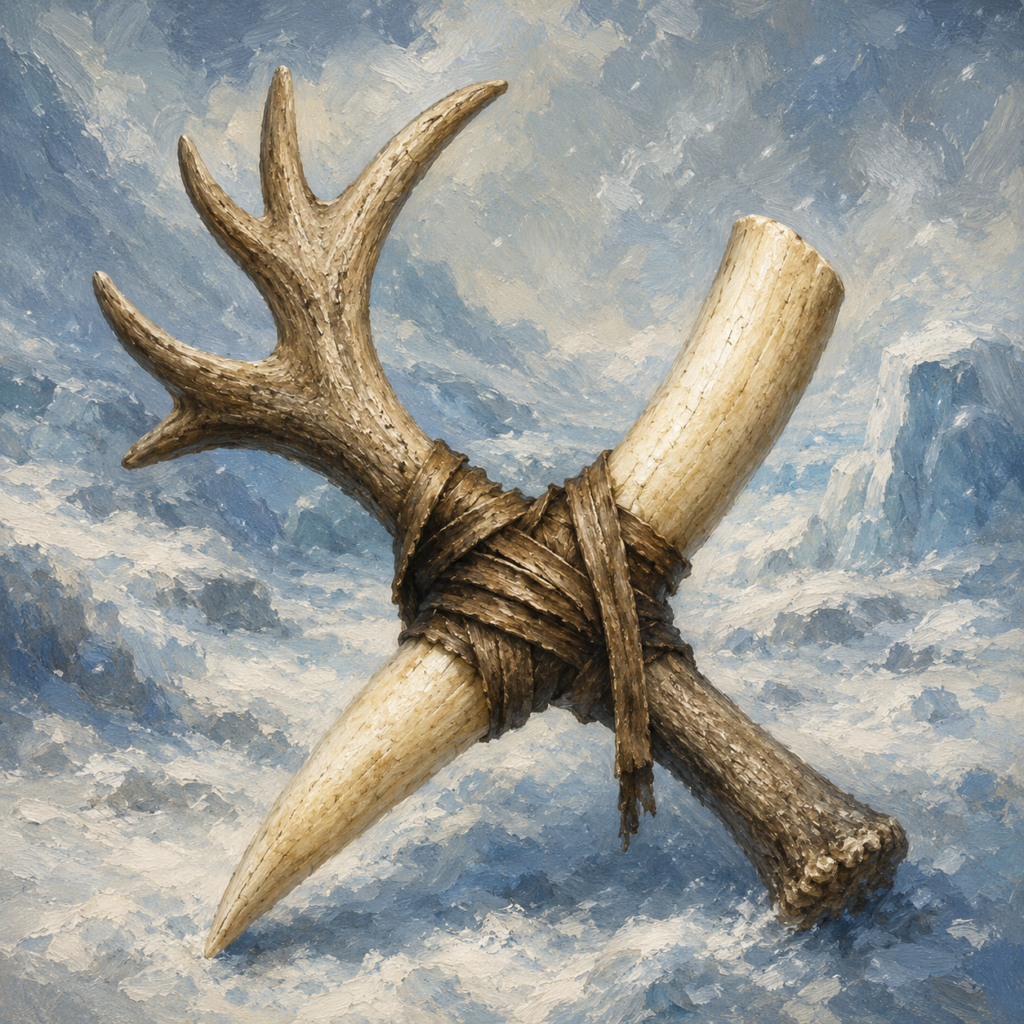
- Symbol: A caribou antler crossed with a walrus tusk, bound with hide
- Favoured Weapon: Harpoon, hunting spear, or bow
- Herald: The Wrong-First Beast
- Avatar CR: 24
- True Divine Form CR: 30
- Game Role: Animal-maker, patron of respectful hunters, corrector of malformed creation
The animal-maker shaped caribou and walrus, then corrected her creation so hunger, danger and survival could share the same world.
In the old northern animal-making story, a woman fashions the caribou and the walrus from clothing, then changes their bodies so that hunters and animals can live in a difficult balance. In this world, people call the animal-maker A’akuluujjusi. The earliest recorded versions do not securely name the woman; a similarly spelled Aakulujjuusi appears instead as a first human in a different Inuit origin story. The two figures are not presumed to be the same person. The animal-maker is not a giver of easy plenty: prey remains dangerous, people are not guaranteed food, and survival depends on skill and restraint.
Her best-known myth explains the caribou and the walrus. She makes the caribou from her trousers and gives it tusks. She makes the walrus from her jacket and gives it antlers. The first arrangement is wrong. The caribou is too dangerous for hunters, while the walrus bears a form that does not belong to it. A’akuluujjusi changes the world. The walrus receives the tusks. The caribou receives the antlers.
Even then, the caribou runs too swiftly to be taken. A’akuluujjusi turns the hair of its belly against the wind, slowing it just enough for the hunt to remain possible.
This is her divine law: animals are not helpless, people are not guaranteed food, and survival depends on respect, skill, restraint, and correct form.
Divine Identity
A’akuluujjusi is an ancient animal-maker whose law is written into living bodies. Tusk, antler, hide, hoof, flipper, fur, and belly hair are not decoration. They are divine decisions, each one carrying the memory of a world that had to be corrected before people could live in it.
She is not a harvest goddess carried into the Arctic. She is not a sea goddess replacing Sedna/Nuliajuk. She is not a universal fertility mother. Her power is more precise: she makes animals, repairs the first errors of creation, and preserves the difficult relationship between hunger and prey.
A’akuluujjusi dwells in the Beastlands, within Adlivun, the frozen Arctic reach of that plane. Her divine domain is the First Garment Tundra, a shore-ice and snowfield wilderness where old clothing gives birth to animal spirits and the first-made beasts still remember their wrong shapes.
She does not rule Sedna/Nuliajuk’s sea court and she is not subordinate to it. Sedna/Nuliajuk governs sea mammals, taboo, and the withholding or release of animals in many Inuit traditions. A’akuluujjusi governs the older mystery of animal form itself: why walrus bear tusks, why caribou bear antlers, and why prey remains dangerous but huntable.
Her alignment is Neutral Good. She preserves life, food-sharing, careful hunting, and corrected creation, but she is harsh toward waste, arrogance, and magic that turns living creatures into helpless meat.
Mythic Role
A’akuluujjusi is the corrector of creation.
She makes life.
She sees what is wrongly shaped.
She changes the body of the world until survival becomes possible.
Her myths give her a powerful role in play. She is the force behind animals whose bodies remember an older mistake. She is present in strange antlers, wrong tusks, wind-bent fur, impossible tracks, and prey that should not have been born in its current shape.
She is also a warning against careless magic. Wizards who breed tusked deer for war, nobles who twist herds for profit, hunters who make prey helpless by spellcraft, and rulers who waste what should feed a village all risk her judgement.
Appearance
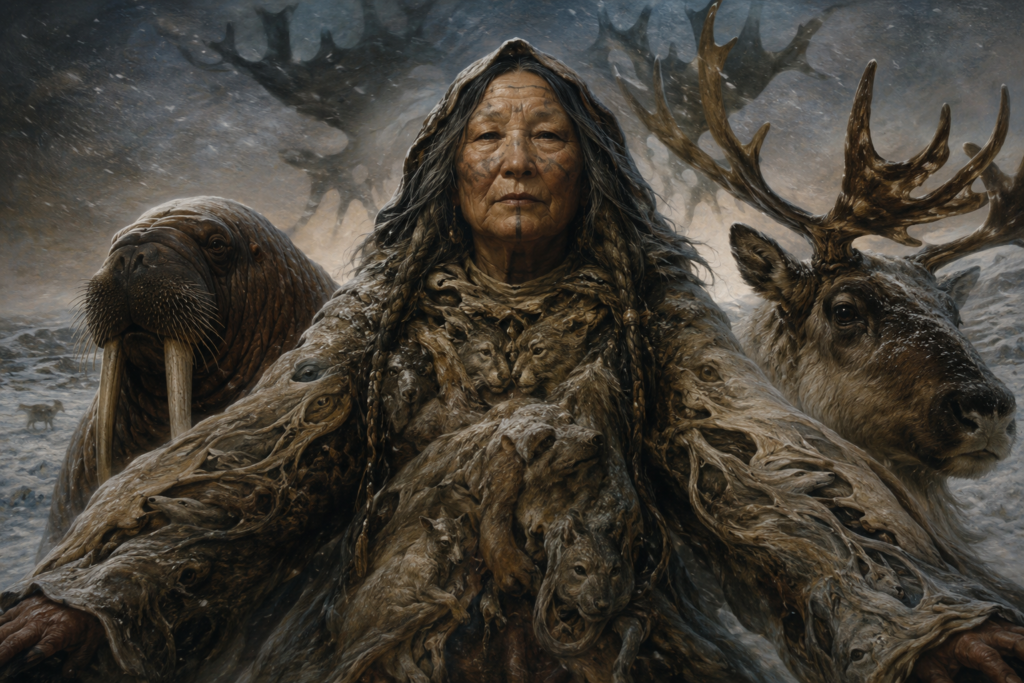
A’akuluujjusi appears as an Inuit creator mother of the first cold world, dressed in heavy hide garments. Her clothing is never still. A sleeve may stir with unborn animals. A folded trouser leg may twitch like a caribou calf. A thrown jacket may swell with the weight of a walrus.
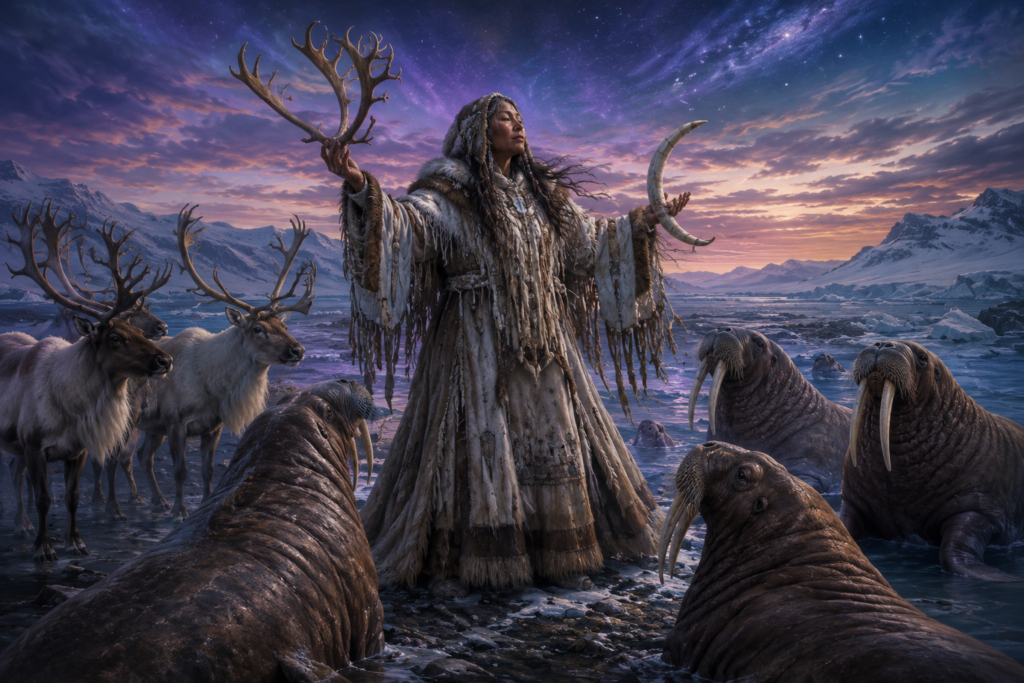
Her hands are broad and work-worn. One may hold an antler. The other may hold a tusk. Around her, snow remembers footprints made before the animals fully existed.
She is solemn rather than sentimental. Her face carries the knowledge that people must eat, animals must resist, and creation must be corrected without being made tame.
In the First Garment Tundra, she stands amid bone frames, old hides, antler shadows, and shore ice. Caribou cast tusked silhouettes in moonlight. Walruses sleep beside antler-shaped ice. Garments hung in the wind shift and breathe as though animals are pressing outward from within them.
Sacred Law, Offerings, and Taboos
A’akuluujjusi’s sacred law is the law of necessary taking.
Hunters honour her by using what they kill, dividing food properly, treating remains with respect, and remembering that prey is powerful before it is useful. A successful hunt is not proof that people own the world. It is proof that the old balance has held for one more day.
Offerings include clean hide, carved antler, worked walrus ivory, rendered fat, sinew thread, a portion of cooked meat, or a practical tool made from animal remains. The offering must come from necessity or rightful use, not vanity.
Her taboos are direct: do not waste meat, do not laugh at malformed animals, do not kill for sport alone, do not take more than the people can use, do not leave bones dishonoured, and do not use magic to make prey helpless without need.
The deepest taboo is contempt for created form. To mock tusk, antler, hoof, flipper, hide, or belly hair is to mock the correction that made survival possible.
Relationships
A’akuluujjusi has no secure divine family tree on this page. She is treated as a distinct Inuit animal-maker whose myth concerns the first shaping and correction of caribou and walrus.
She stands beside, but not beneath, the great Arctic powers of sea, hunting, weather, animals, and survival. Her nearest cosmological neighbours are Sedna/Nuliajuk and other Inuit powers connected to sea mammals, taboo, hunger, and the release or withholding of animals. A’akuluujjusi does not rule Sedna/Nuliajuk’s sea court, and she does not serve it. Her authority is older and more specific: the divine correction of animal bodies before the hunt can exist.
In the Beastlands, she shares the frozen reaches of Adlivun with sea-animal and underworld powers, but her own domain is separate. The First Garment Tundra is inland and shoreward rather than a drowned court or sea-death realm. It is the place of caribou, walrus, clothing, hide, tusk, antler, old garments, first-made animal spirits, and the law that makes prey dangerous but huntable.
Currently in the World
A’akuluujjusi is present wherever animal bodies still carry divine memory.
She is felt when a hunter runs a hand along caribou belly hair and sees how it catches the wind. She is present when walrus ivory cracks ice, when antlers lock in fog, when old clothes are repaired instead of discarded, and when a starving community must decide whether the next hunt is need or greed.
She does not require temples. Her shrines are hunting grounds, shore ice, cutting places, drying racks, antler piles, old garments, carved tools, and the stories told while meat is divided.
Her power stirs when animal forms are corrupted. A noble who breeds tusked deer for war, a wizard who turns walruses into siege beasts, a village that wastes a sacred herd, or a merchant who trades cursed ivory may all draw her attention.
Divine Scale and Defeat
A’akuluujjusi’s power is not measured only by body size. When she walks the snow in divine form, she appears as a vast hide-clad mother surrounded by caribou breath, walrus ivory, antler shadow, and living garments. Her deeper presence is the First Garment Tundra itself: the old law of tusk, antler, hide, hoof, flipper, hunger, and huntable prey.
Her avatar can be fought. Her true divine form can be challenged only in a mythic encounter, usually within Adlivun or a sacred hunting ground touched by her power.
Reducing one of her bodies to 0 hit points does not destroy her. A divine manifestation can be driven away, wounded, silenced, or forced to withdraw. Permanent defeat requires a mythic condition: stolen first-tusks, herds born into wrong forms, antlers torn from their sacred place in creation, famine caused by waste, or magic that makes prey either helpless or impossible to hunt.
Victory over her is rarely clean. If the balance breaks, famine follows. Herds vanish. Walruses overturn boats. Caribou are born with killing tusks. Clothing no longer keeps out the cold.
Divine Powers and Game Rules
A’akuluujjusi — D&D 2024
A’akuluujjusi, the Animal-Maker
Huge Celestial (Deity), Neutral Good · CR 24 (62,000 XP; PB +7)
Initiative +4 (14); AC 22 (divine hide); HP 345 (30d12 + 150); Speed 40 ft., Swim 40 ft.
| STR | DEX | CON | INT | WIS | CHA |
|---|---|---|---|---|---|
| 28 (+9) | 18 (+4) | 20 (+5) | 20 (+5) | 28 (+9) | 24 (+7) |
Saving Throws Str +16, Con +12, Wis +16, Cha +14; Skills Animal Handling +16, Insight +16, Nature +12, Perception +16, Survival +16; Resistances Cold; Bludgeoning, Piercing and Slashing from nonmagical attacks; Immunities Poison damage, Charmed and Poisoned conditions; Senses Truesight 120 ft., Passive Perception 26; Languages Inuit languages, Celestial, speech of beasts; Telepathy 120 ft.
Traits
Legendary Resistance (3/Day). If she fails a saving throw, she can choose to succeed instead.
Animal-Maker. Beasts and animal-bodied spirits must succeed on a DC 24 Wisdom save before attacking her. A success grants immunity to this trait for 24 hours.
Huntable, Not Helpless. Beasts of her choice within 1 mile have Advantage on saving throws against magic that Charms, Paralyzes or Incapacitates them solely to make slaughter effortless.
Actions
Multiattack. She makes three Antler-Tusk Staff attacks, or two attacks and uses Correct the Form.
Antler-Tusk Staff. Melee Attack Roll: +16 to hit, reach 15 ft., one creature. Hit: 27 (4d8 + 9) Bludgeoning plus 9 (2d8) Cold damage.
Correct the Form (Recharge 5–6). Constitution Saving Throw: DC 24, one creature within 90 ft. Failure: The target’s Speed is halved and it has Disadvantage on attacks with natural weapons for 1 minute, with a repeat save at the end of each of its turns. Success: No effect.
Bonus Actions
Garments of First Life (2/Day). She summons a friendly polar bear, giant elk or giant walrus spirit in an unoccupied space within 60 ft.; it acts immediately after her and vanishes after 1 minute.
Reactions
Undo the Wrong Shape. When she sees a creature within 60 ft. fail a save against a magical transformation, she allows it to reroll the save; it must use the new result.
Legendary Actions (3 per Round)
Track the Living. She moves up to half her Speed without provoking Opportunity Attacks. Turn the Belly Hair (Costs 2). One creature within 60 ft. must pass a DC 24 Strength save or have its Speed reduced to 10 ft. until the end of its next turn.
True Divine Form
Huge Celestial (Deity), Neutral Good · CR 30 (155,000 XP; PB +9)
Initiative +7 (17); AC 26 (divine form); HP 702 (36d12 + 468); Speed 50 ft., Swim 50 ft., Fly 50 ft. (hover)
| STR | DEX | CON | INT | WIS | CHA |
|---|---|---|---|---|---|
| 40 (+15) | 24 (+7) | 36 (+13) | 24 (+7) | 34 (+12) | 30 (+10) |
Saving Throws Str +24, Dex +16, Con +22, Wis +21, Cha +19; Skills Animal Handling +21, Nature +16, Perception +21, Survival +21; Resistances Acid, Fire, Lightning; Bludgeoning, Piercing and Slashing from nonartifact weapons; Immunities Cold, Poison, Charmed, Frightened, Paralyzed, Petrified and Poisoned; Senses Truesight 240 ft., Passive Perception 31; Languages Inuit languages, Celestial, all beasts; Telepathy 240 ft.
Traits
Legendary Resistance (5/Day). A failed save becomes a success. Divine Restoration. If reduced to 0 HP without the old law of correction being overturned, she reforms in the First Garment Tundra after 1d10 days.
Actions
Multiattack. Four Antler-Tusk Staff attacks. Antler-Tusk Staff. Melee Attack Roll: +24, reach 20 ft.; Hit: 37 (4d10 + 15) Bludgeoning plus 18 (4d8) Cold. Revision of the First Body (Recharge 5–6). Constitution Saving Throw: DC 29, up to three creatures within 120 ft.; on a failure each has one natural weapon suppressed or its Speed halved for 1 minute (repeat save ends).
Legendary Actions (4 per Round)
Cross the Snow. Move up to half Speed. First Correction (Costs 2). Force a DC 29 Constitution save against one effect of Revision of the First Body. Call the First-Made (Costs 3). Summon one CR 8-or-lower beast spirit for 1 minute.
Divine Domains and Spells
Domains: Life, Protection, Animal-Making (setting-specific). Domain spells: 1st Speak with Animals, 2nd Lesser Restoration, 3rd Conjure Animals, 4th Polymorph, 5th Greater Restoration, 6th Heal, 7th Regenerate, 8th Animal Shapes, 9th Shapechange. This is her divine spell repertoire, not a claim that a single cleric automatically prepares every spell.
Divine boons: A blessing allows a hunter to reroll one failed Survival check per Long Rest, or to protect an ally from a forced transformation once per Long Rest. Curse: Wasteful hunters see their tracks circle back and have Disadvantage on Survival checks until they make restitution.
Estate effect — First Garment Tundra: Hunters cannot disguise a wasteful kill from her; an animal correctly butchered provides enough for one additional hungry traveller. She may cause an icy wind to halve a hostile creature’s Speed for one round.
A’akuluujjusi — D&D 2014
A’akuluujjusi, Keeper of the First Shapes
Huge celestial, neutral good · Challenge 24 (62,000 XP)
Armor Class 22 (divine hide); Hit Points 345 (30d12 + 150); Speed 40 ft., swim 40 ft.
| STR | DEX | CON | INT | WIS | CHA |
|---|---|---|---|---|---|
| 28 (+9) | 18 (+4) | 20 (+5) | 20 (+5) | 28 (+9) | 24 (+7) |
Saving Throws Str +16, Con +12, Wis +16, Cha +14; Skills Animal Handling +16, Insight +16, Nature +12, Perception +16, Survival +16; Damage Resistances cold; bludgeoning, piercing and slashing from nonmagical attacks; Damage Immunities poison; Condition Immunities charmed, poisoned; Senses truesight 120 ft., passive Perception 26; Languages Inuit languages, Celestial, understands all beasts; telepathy 120 ft.
Traits
Legendary Resistance (3/Day). If she fails a saving throw, she can choose to succeed instead.
Voice of the First Hunt. Beasts within 60 feet of her have advantage on saving throws against being charmed, paralyzed or polymorphed against their will.
Actions
Multiattack. She makes three antler-tusk staff attacks.
Antler-Tusk Staff. Melee Weapon Attack: +16 to hit, reach 15 ft., one target. Hit: 27 (4d8 + 9) bludgeoning damage plus 9 (2d8) cold damage.
Revision of Flesh (Recharge 5–6). One creature within 90 feet makes a DC 24 Constitution saving throw. On a failure it has its speed halved and disadvantage on melee attacks using natural weapons for 1 minute; it repeats the save at the end of each turn.
Legendary Actions
She can take 3 legendary actions, only at the end of another creature’s turn: Move. Move up to half her speed. Turn the Belly Hair (Costs 2). One creature within 60 feet must pass a DC 24 Strength save or have speed 10 feet until the end of its next turn.
True Divine Form
Huge celestial, neutral good · Challenge 30 (155,000 XP)
Armor Class 26 (divine form); Hit Points 702 (36d12 + 468); Speed 50 ft., swim 50 ft., fly 50 ft. (hover)
| STR | DEX | CON | INT | WIS | CHA |
|---|---|---|---|---|---|
| 40 (+15) | 24 (+7) | 36 (+13) | 24 (+7) | 34 (+12) | 30 (+10) |
Saving Throws Str +24, Dex +16, Con +22, Wis +21, Cha +19; Skills Animal Handling +21, Nature +16, Perception +21, Survival +21; Damage Resistances acid, fire, lightning; bludgeoning, piercing and slashing from nonartifact weapons; Damage Immunities cold, poison; Condition Immunities charmed, frightened, paralyzed, petrified, poisoned; Senses truesight 240 ft., passive Perception 31; Languages Inuit languages, Celestial, all beasts; telepathy 240 ft.
Traits
Legendary Resistance (5/Day). A failed saving throw becomes a success. Undying Animal-Maker. A conventional defeat merely disperses her form; she reforms at the First Garment Tundra after 1d10 days unless a mythic condition has overturned the old law of correction.
Actions
Multiattack. Four Antler-Tusk Staff attacks. Antler-Tusk Staff. Melee Weapon Attack: +24 to hit, reach 20 ft., one target. Hit: 37 (4d10 + 15) bludgeoning damage plus 18 (4d8) cold damage. Revision of the First Body (Recharge 5–6). Up to three creatures within 120 ft. make a DC 29 Constitution saving throw or suffer a halved speed or suppressed natural weapon for 1 minute, repeating the save at the end of each turn.
Legendary Actions
A’akuluujjusi has 4 legendary actions per round: Cross the Snow. Move up to half her speed. First Correction (Costs 2). Force a DC 29 Constitution save against Revision of the First Body. Call the First-Made (Costs 3). Summon one CR 8-or-lower beast spirit for 1 minute.
Divine Domains and Granted Magic
Domains: Nature, Life, protection of hunted creatures. Domain spells: 1st Animal Friendship, 2nd Animal Messenger, 3rd Conjure Animals, 4th Polymorph, 5th Commune with Nature, 6th Heal, 7th Regenerate, 8th Animal Shapes, 9th Shapechange. These are deity-granted possibilities for worshippers whose class or covenant allows them.
Spellcasting. Wisdom is her spellcasting ability (spell save DC 24; +16 to hit); at will Speak with Animals, Animal Friendship; 3/day Polymorph, Control Weather; 1/day Animal Shapes, Shapechange.
Estate effect: A settlement that shares food fairly can never be led astray by a magical false trail within the First Garment Tundra. Wasteful hunters instead see antlered shadows and must repeat a successful Survival check once.
A’akuluujjusi — Pathfinder 1e
A’akuluujjusi (Avatar) CR 24
XP 1,228,800; NG Huge outsider (native, good); Init +8 (+4 Dex, +4 Improved Initiative); Senses darkvision 120 ft., low-light vision, scent, true seeing; Perception +38; Aura corrected hunt (60 ft.)
DEFENSE
AC 41, touch 12, flat-footed 37 (+4 Dex, +29 natural, –2 size); hp 406 (28d10 + 252); Fort +18, Ref +20, Will +26 (28 outsider Hit Dice; Fortitude poor, Reflex and Will good); DR 15/epic; Immune cold, poison; Resist acid 10, electricity 10, fire 10; SR 35.
OFFENSE
Speed 40 ft., swim 40 ft.; Melee +5 antler-tusk staff +44/+39/+34/+29 (3d8+23/19–20 plus 2d6 cold; staff treated as a quarterstaff for feats); Space 15 ft.; Reach 15 ft.; Special Attacks antler-tusk exchange, first correction, garments of first life.
Spell-Like Abilities (CL 24th; concentration +31): at will — calm animals, create food and water, endure elements, speak with animals; 3/day — animal growth, commune with nature, control weather, remove curse; 1/day — animal shapes, miracle, shapechange.
STATISTICS
Str 34, Dex 18, Con 28, Int 21, Wis 30, Cha 25; Base Atk +28; CMB +42; CMD 56; Feats (14) Blind-Fight, Combat Casting, Combat Reflexes, Endurance, Power Attack, Cleave, Great Cleave, Improved Bull Rush, Improved Overrun, Improved Sunder, Improved Critical (antler-tusk staff), Critical Focus, Weapon Focus (antler-tusk staff), Improved Initiative; Skills Handle Animal +41, Heal +38, Knowledge (nature) +38, Perception +38, Sense Motive +38, Survival +41, Swim +44; Languages Inuit languages, Celestial, Sylvan; speak with animals.
ECOLOGY
Environment First Garment Tundra (Beastlands); Organization solitary or with first-made animal spirits; Treasure none.
SPECIAL ABILITIES
Antler-Tusk Exchange (Su). Standard action: two creatures within 90 ft. each make a DC 29 Will save; on failure a natural weapon or movement mode is exchanged for 1 minute, never removing breathing or environmental survival. Turn the Belly Hair (Su). Standard action, 60-ft. burst; DC 29 Fortitude save or speed drops to 10 ft. for 1d4 rounds. First Correction (Su). Creatures struck by her staff make a DC 29 Fortitude save or one natural attack is suppressed for 1 minute.
True Divine Form — CR 30 / Mythic Rank 8
XP 9,830,400; NG Huge outsider (good, mythic); Init +11 (+7 Dex, +4 Improved Initiative); Senses darkvision 120 ft.
DEFENSE
AC 50, touch 19, flat-footed 43; hp 700 (divine vitality, original epic total); Fort +33, Ref +28, Will +32; DR 20/epic and artifact; Immune cold, disease, poison, petrification and unwilling polymorph; SR 40.
OFFENSE
Speed 50 ft., swim 50 ft.; Melee +5 antler-tusk staff +49/+44/+39/+34 (4d8+20/19–20 plus 4d6 cold; Weapon Focus and Improved Critical included); Space/Reach 15 ft./20 ft.; Special Attacks first correction (DC 35), call first-made animals, revision of flesh (DC 35).
Spell-Like Abilities (CL 30th; concentration +40): at will — speak with animals, greater dispel magic; 3/day — heal, greater restoration, control weather; 1/day — miracle, shapechange.
STATISTICS
Str 40, Dex 25, Con 36, Int 25, Wis 34, Cha 30; Base Atk +30; CMB +49; CMD 66; Feats (15) Blind-Fight, Combat Casting, Combat Reflexes, Endurance, Power Attack, Cleave, Great Cleave, Improved Bull Rush, Improved Overrun, Improved Sunder, Improved Critical (antler-tusk staff), Critical Focus, Weapon Focus (antler-tusk staff), Improved Initiative, Spell Penetration; Skills Handle Animal +43, Heal +45, Knowledge (nature) +40, Perception +45, Survival +45, Swim +53; Languages Inuit languages, Celestial, Sylvan; speak with animals.
ECOLOGY
Environment First Garment Tundra (Beastlands); Organization solitary or among first-made animal spirits; Treasure none.
SPECIAL ABILITIES
Divine Return (Su). She reforms at her Beastlands estate after 1d10 days unless the mythic victory condition is satisfied.
Domains, Domain Spells and Her Estate
Domains: Animal, Community, Good, Protection, Weather. Domain spells: 1st calm animals, 2nd hold animal, 3rd dominate animal, 4th summon nature’s ally IV, 5th animal growth, 6th antilife shell, 7th animal shapes, 8th summon nature’s ally VIII, 9th shapechange. Boons: huntable prey and the chance to undo a hostile body-changing spell. Curse: prey tracks vanish until restitution is made.
Estate effect: The first beast a creature slays for sport is reborn nearby with the predator’s scent; hunting creatures for food after careful rites causes no such omen.
A’akuluujjusi — D&D 3.5e
A’akuluujjusi, True Animal-Maker
Huge Outsider (Extraplanar, Good); Neutral Good; Divine Rank 8; Challenge Rating 30
Hit Dice 30d8+270 (510 hp; maximum divine Hit Dice); Initiative +9 (+5 Dex, +4 Improved Initiative); Speed 60 ft., swim 60 ft.; AC 51 (10 –2 size +5 Dex +21 natural +9 deflection +8 divine), touch 30, flat-footed 46; Base Attack/Grapple +30/+58; Attack +5 antler-tusk staff +54 melee (3d8+23 plus 2d6 cold); Full Attack +5 antler-tusk staff +54/+49/+44/+39 melee; Space/Reach 15 ft./15 ft.
Special Attacks First Correction, Antler-Tusk Exchange, spell-like abilities; Special Qualities immortal divine return, divine immunities, low-light vision, darkvision 120 ft., DR 20/epic, fire resistance 13, SR 40; Senses darkvision 120 ft., low-light vision; Saves Fort +36, Ref +32, Will +38 (including Great Fortitude, Lightning Reflexes and Iron Will); Abilities Str 34, Dex 20, Con 28, Int 24, Wis 32, Cha 28.
Skills Handle Animal +44, Heal +44, Knowledge (nature) +40, Listen +44, Spot +44, Survival +44, Swim +44; Feats Alertness, Combat Casting, Great Fortitude, Improved Initiative, Iron Will, Lightning Reflexes, Power Attack, Skill Focus (Survival), Track, Weapon Focus (quarterstaff), Endurance; Languages Inuit languages, Celestial, Sylvan; Environment First Garment Tundra (Beastlands); Organization Solitary or with first-made animal spirits; Treasure None; Advancement By divine rank; Level Adjustment —.
Special Abilities
Divine Rank 8. The rank bonus of +8 is included in attack rolls and saves, and divine rank grants immunity to energy drain, ability damage, disease, poison, cold, electricity, acid, mind-affecting effects and involuntary shape changes. Divine damage reduction is 20/epic and spell resistance is 32 + rank = 40. A natural 1 on attacks or saving throws is not automatically a failure.
First Correction (Su). On a staff hit, DC 29 Fortitude save or Speed halved or one natural weapon suppressed for 1 minute. Antler-Tusk Exchange (Su). Standard action, two creatures within 90 ft., DC 29 Will save; exchange one natural weapon or movement mode for 1 minute; cannot remove the ability to survive in the normal environment.
Divine Return (Su). Defeating her in battle does not destroy her estate or annul the old law. Unless the party changes the mythic law itself, she reforms in 1d10 days.
Domains and Domain Spells
Domains: Animal, Good, Protection, Weather (the Community domain is optional for this setting). Domain spells: 1st calm animals, 2nd hold animal, 3rd dominate animal, 4th summon nature’s ally IV, 5th animal growth, 6th antilife shell, 7th animal shapes, 8th summon nature’s ally VIII, 9th shapechange. Spell-like abilities: She can use granted domain spells at will at caster level 18; their save DC is 10 + spell level + Charisma modifier (+9) + divine rank (+8).
Estate and regional effects: Animal forms altered by curses reveal their old shapes in her snow; a hunting party that shares its catch finds safe passage through the high drifts. The effect ends at the boundary of her divine estate.
First-Made Animal Spirits
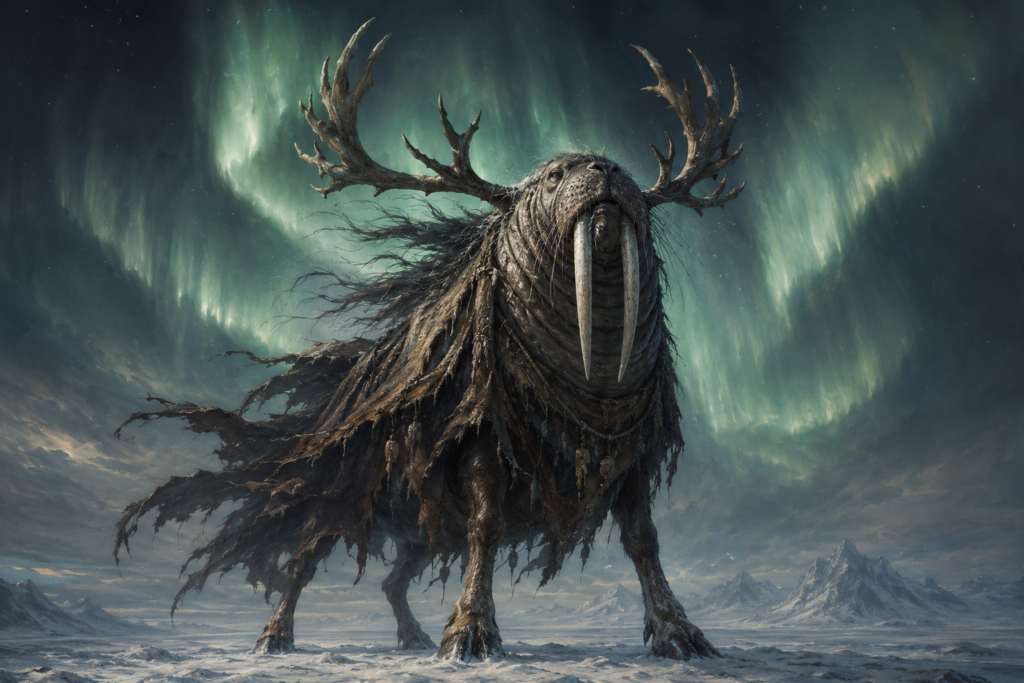
The Wrong-First Beast bears a caribou’s tusk-scars and a walrus’s antlered shadow. When it rises beside the sea ice, herds turn back rather than cross the hunters’ path. It may be placated by returning a stolen hide, sharing the season’s catch, or breaking the spell that has reshaped the animals.
Worshippers and Servants
A’akuluujjusi is honoured by hunters, hide-workers, carvers, elders, animal-speakers, survivalists, travelling families, and communities that live close to hunger.
Her servants are first-made animal spirits and corrected animal forms: caribou, walrus, hide-born beasts, antler-shadow messengers, tusk-bearing guardians, and old garments that stir with unborn animal life.
Her greatest servants are not angels or soldiers. They are signs that creation remembers its first correction: a caribou with tusk scars in its shadow, a walrus whose dreams grow antlers, a hide cloak that breathes in winter, or a herd that appears only to starving hunters.
Her herald is the Wrong-First Beast, the living memory of creation before it was repaired. It is a sacred warning, not a simple monster.
A priest, shaman, or spirit-worker devoted to her does not need a temple hierarchy. Their duty is practical sacred order: use the whole animal, divide food properly, repair old clothing, honour dangerous prey, and stop hunters or rulers who turn survival into waste.
Using This Deity in Your Game
Use A’akuluujjusi when the story concerns survival, food, hunting ethics, animal bodies, Arctic travel, famine, or magical tampering with nature.
She works especially well in tundra, coast, sea-ice, subarctic, and famine-threatened campaigns. She can also appear far from the north if someone has stolen sacred ivory, traded cursed antler, bred wrong-shaped animals, or used transmutation magic to create profitable but suffering livestock.
Her Beastlands home is the First Garment Tundra of Adlivun. A party may reach it through Arctic hunting grounds, old hide garments, caribou migrations, walrus-haunted shore ice, or planar crossings within Adlivun. There, hunting is not forbidden, but waste is punished immediately. Every beast is prey, spirit, witness, and old divine workmanship at once.
She should never be reduced to a food dispenser. Her stories have pressure. People need animals. Animals need defence. The divine compromise is fragile.
Adventure Hooks
The Tusked Caribou Return
A herd of caribou is born with walrus tusks and begins killing hunters. Elders call it the reversal of A’akuluujjusi’s correction. Someone has stolen sacred walrus tusks from an old offering place, and the herd grows less huntable each night.
The Garment That Gives Birth
An ancient parka begins producing living animal spirits. At first, they feed a starving village. Then stranger forms appear: antlered walruses, tusked deer, seal-hoofed dogs, and finally a creature that should never have been made. The garment is not evil. It is unfinished creation.
The Lord Who Bought the Herd
A southern noble purchases rights to a northern migration route and orders mass slaughter for ivory, antler, hide, and meat export. The first winter after the killings, his horses grow backward belly hair and refuse to run. His hounds birth flippered pups. His children dream of a woman turning garments inside out in the snow.
Relics and Signs
The First Tusk.
A walrus tusk marked with antler-shadow patterns. It restores a creature’s proper natural form or exposes a magical mutation.
The Wind-Turned Hide.
A strip of caribou belly hide that slows pursuit when tied around a spear, sled, doorway, or traveller’s pack.
The Wrong Antler.
An antler grown from an animal that should not have borne one. It is dangerous to keep but powerful in rites of correction.
The Empty Parka.
A sacred garment that moves as though something living is inside it. In famine, it leads its bearer toward food. In greed, it grows heavy as stone.
A’akuluujjusi’s Net.
A game-facing relic woven from sinew, hide cord, and carved ivory toggles. It does not dominate animals. It reveals whether a hunt is sustainable, prevents a necessary catch from being lost to bad weather, and tangles creatures that have been magically malformed.
Mythic and Historic Context

A’akuluujjusi is an Inuit creator figure associated most strongly with the making and correction of animals, especially the caribou and the walrus. Her best-known story explains why these two animals have the bodies they do. In the tale, she creates the caribou from her trousers and the walrus from her jacket. At first, the caribou has tusks and the walrus has antlers. When this proves wrong for the world of hunters and prey, A’akuluujjusi corrects creation: the walrus receives the tusks, the caribou receives the antlers, and the caribou is slowed by having the hair of its belly turned against the wind.
The story is an origin myth about animal form, survival, and the balance between people and the animals they depend upon. It does not present prey as helpless or hunting as casual. The caribou must be slowed enough for people to live, but it remains strong, swift, and difficult to take. The walrus receives the tusks that belong to its own way of life. The myth explains the visible features of animals while also expressing a moral world in which hunger, danger, and respect are bound together.
Modern summaries often identify A’akuluujjusi through this caribou-and-walrus creation story. The children’s book The Walrus and the Caribou, written by Maika Harper and illustrated by Marcus Cutler, is based on a traditional Inuit story from the South Baffin region of Nunavut. As with many orally transmitted traditions, details may vary by region, teller, family, and later publication.
The caribou-and-walrus story is well recorded, but the woman’s name is not securely preserved in its early tellings. Later summaries have associated the animal-maker with A’akuluujjusi, while a similarly written name belongs to the first-human tale. These are distinct narratives. Here the animal-maker is the patron of food animals, the corrector of dangerous forms and the power behind prey that remains huntable without ceasing to be wild.
The surviving material used here does not describe A’akuluujjusi as a giantess, assign her a fixed physical size, or give her a named court of servants. Those absences matter. Her importance comes from creation and correction, not from a measured body, royal genealogy, or formal divine household.
A related name, Aakulujjuusi, appears in the story of Uumarnituq and Aakulujjuusi, a separate Inuit tradition concerning first humans, gender, childbirth, death, and rebirth. This entry does not merge that figure with A’akuluujjusi the animal-maker. The similarity of names is treated as a source issue, not as a confirmed identity or relationship.
- Knud Rasmussen — account of Tuktut Ikviat, the Mother of the Caribou
- Franz Boas — the caribou-and-walrus origin account in a different Inuit tradition
- Later name attribution to A’akuluujjusi (compare the recorded accounts above)
- The Walrus and the Caribou — Werklund School of Education description
- The Walrus and the Caribou — Inhabit Media / Inhabit Books
- Bernard Saladin d’Anglure, Inuit Stories of Being and Rebirth — University of Manitoba Press
- Uumarnituq and Aakulujjuusi — related first-human and childbirth tradition
Keep this reference growing
If this page helped with your reading or game, you can support its upkeep or explore the curated books.
Explore the Bookshop — epics, classics and stories behind imagined worlds.