
The Æsir — High Gods of Asgard & the Divine Clan
Asgardian Pantheon • Divine Clan
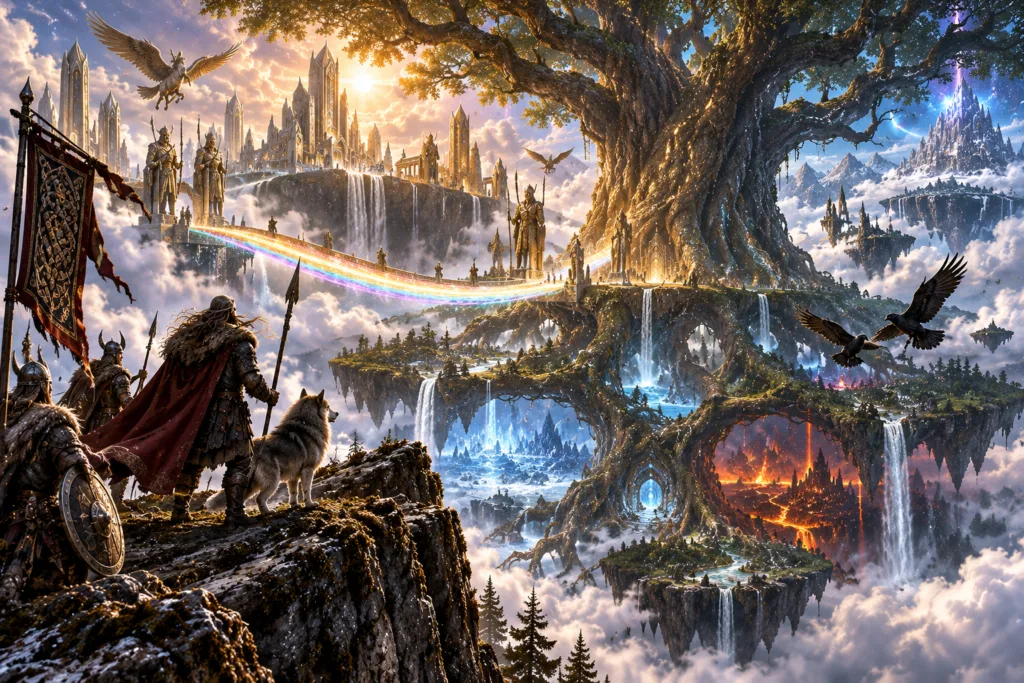
The Æsir are the great divine clan of Asgard: the household of Odin and Frigg, the kin of Thor and Baldr, the law-speakers, watchers, poets, protectors and war-powers whose feuds and oaths shape the northern worlds. They are not one god, one alignment or one simple portfolio. They are a divine society—bound by kinship, marriage, guest-right, rivalry, prophecy and the long memory of the war and peace made with the Vanir.
The Æsir at a Glance
| Nature | Divine clan and household of the northern gods |
|---|---|
| Primary realm | Asgard, the walled high realm within Ysgard |
| Leading figures | Odin and Frigg |
| Major powers | Thor, Baldr, Týr, Heimdall, Bragi, Iðunn and Forseti |
| Closely allied Vanir | Njörðr, Freyr and Freyja |
| Female collective | Ásynjur, a traditional term for the goddesses of the Æsir |
| Divine youth | Renewed through the apples guarded by Iðunn; the gods can still be slain |
| Foretold crisis | Ragnarök, still prophecy rather than a completed event |
| Worship | Usually directed to individual gods, households and local cults rather than to an undifferentiated “Æsir” deity |
Who Are the Æsir?
Æsir is a plural name for a class or clan of gods; it is not the name of a single divine being. The masculine singular is áss, while Ásynjur is commonly used for the goddesses associated with the clan. Surviving Norse sources sometimes use Æsir broadly for “the gods,” but they also distinguish the Æsir from the Vanir, another divine clan with its own ancestry and traditions.
The distinction is real, but it should not be reduced to “war gods versus fertility gods.” Thor is a protector and giant-slayer; Bragi is bound to poetry and eloquence; Iðunn guards renewal and youth; Forseti settles disputes; Frigg embodies queenship, family authority and foreknowledge. The Æsir are a household of very different powers whose unity comes from relationship and shared history rather than a single portfolio.
At the deepest level of the clan’s remembered ancestry stand Búri and Borr, followed by Odin and his brothers Vili and Vé. In the creation cycle, the brothers take part in the ordering of the world after the fall of Ymir. The later household grows through birth, marriage, alliance and incorporation, so divine family trees cross repeatedly into giant-born and Vanir lineages.
The Æsir and the Vanir
The old war between the Æsir and Vanir is one of the defining political memories of the northern divine world. It ends not in extermination but in settlement, exchange and a new divine order. Njörðr and Freyr become deeply embedded in the society of the Æsir, while Freyja stands among the most powerful northern goddesses without losing her Vanir identity.
The peace matters because it changes Asgard permanently. Vanir wealth, seiðr, fertility, sea-power and prosperity become part of the political world of the high gods, while Æsir ties of oath, kingship, war, law and divine household extend in the other direction. The result is an alliance of overlapping loyalties, not a merger that erases either clan.
Hœnir is especially important to this settlement tradition, while the extraordinarily wise Kvasir is remembered as a being created from the peace between the two divine houses.
The High Gods of Asgard
The Æsir are best understood through the individuals who make the divine household work. Their relationships are often more important than a modern list of portfolios.
- Odin — war-wisdom, poetry, sacrifice, kingship, magic and the chosen dead. His search for knowledge shapes much of Asgard’s long strategy against fate.
- Frigg — queenly authority, household sovereignty, foreknowledge, marriage and protected kinship. She knows more of fate than she chooses to reveal.
- Thor — thunder, strength and direct protection. He is the great defender of Midgard and the divine enemy most hostile giants fear to meet openly.
- Baldr — beloved and radiant, bound to one of the central doom-cycles surrounding the fate of the gods.
- Týr — courage, law, oath and costly sacrifice, remembered above all for the binding of Fenrir.
- Heimdall — watcher of Bifröst and divine sentinel, defined by vigilance, hearing, sight and the defence of thresholds.
- Bragi — poetry, eloquence and the power of the skald to preserve deeds in words.
- Iðunn — keeper of the apples through which the gods renew their youth.
- Forseti — judgement, arbitration and the settlement of disputes that would otherwise become feud.
Other members of the clan carry equally important roles: Víðarr and Váli embody vengeance and survival; Sif and Þrúðr belong to Thor’s household; Fulla, Gná and Hlín stand close to Frigg; and the older creation-linked generation of Vili and Vé reaches back toward the beginnings of the ordered world.
What Are the Æsir Doing Now?
Asgard is active, political and watchful. Ragnarök has not begun, but prophecy is not ignored. The gods know enough of the foretold catastrophe to build policy around it: prisons are guarded, oaths renewed, dangerous beings watched, chosen dead gathered and old alliances tested.
Odin continues to gather knowledge and worthy dead. Frigg protects the continuity of households and dynasties while withholding truths that could do more harm than good. Thor answers threats that break into the mortal world or cross the boundaries of the divine realms. Heimdall watches Bifröst. Týr weighs oaths whose cost may not be clear until years later. Iðunn’s charge remains strategically vital because the Æsir are mighty without being invulnerable.
The clan does not act with one mind. One god may favour intervention in Midgard while another counsels restraint; one may honour a giant envoy while another remembers an ancient feud. A mortal entering Asgard therefore enters a court of competing loyalties, not a room full of identical divine allies.
How the Æsir Behave
The Æsir value courage, reputation, hospitality, remembered obligation and the keeping of difficult promises, but each god expresses those values differently. Odin can be subtle, testing and ruthless in pursuit of knowledge. Thor is comparatively direct. Frigg protects through foresight and position. Týr accepts personal loss to uphold a binding agreement. Forseti seeks settlement before feud consumes both sides.
Alignment does not erase those differences. Membership in the Æsir does not force a deity into one moral or ethical category, and it does not make every enemy of one Æsir an enemy of them all. Kinship creates obligations; it does not remove personality, grievance or choice.
Hospitality is especially important in Asgard. A dangerous guest under recognised protection may have stronger standing than a friendly stranger who ignores the rules of the hall. Violence can be glorious in the right contest and disgraceful in the wrong place. An adventuring party that understands witnesses, guest-right, weregild, oath and reputation can survive encounters that raw combat power cannot solve.
Using the Æsir in Play
The Æsir should appear as a divine society of distinct personalities, not as a single pooled monster. When several gods assemble, each keeps their own divine rank, powers, loyalties and limits.
- Court audience: the characters need a ruling, safe-conduct or divine favour, but Odin, Frigg and Týr disagree over what obligation the request creates.
- Broken guest-right: blood is spilled inside an Asgardian hall while a rival or giant is under protection. The party must discover whether the killing was justified before feud becomes war.
- Prophecy under pressure: a new omen appears to contradict a known strand of Ragnarök. Odin wants knowledge, Frigg fears the cost of forcing fate, and another god wants immediate action.
- Vanir treaty: a dispute over trade, marriage, magic or sacred territory threatens the old peace. The party crosses between Asgard and Vanir interests without reducing either side to heroes or villains.
- Threat to Iðunn: theft, coercion or planar interference places the gods’ renewal at risk, turning a seemingly personal abduction into a crisis for the entire divine household.
Ragnarök and the Limits of Divine Power
The Æsir are gods, but they are not beyond fate. The surviving mythic tradition repeatedly treats the coming doom as a real future threat. Odin is foretold to fall to Fenrir; Thor is bound to his final struggle with Jörmungandr; Týr and Heimdall face their own terrible opponents; fire, battle and cosmic collapse surround the fate of the old order.
That vulnerability is one of the defining differences between the northern gods and truly untouchable abstractions. The Æsir can be wounded, deceived, bound by oath, deprived of vital resources and ultimately slain. Iðunn’s apples preserve youth, but they do not make prophecy meaningless.
Because Ragnarök remains unresolved, every attempt to delay it, prepare for it, exploit it or change one thread of it can become an adventure. The gods themselves have reasons to employ mortal agents precisely because divine power does not solve every problem cleanly.
Sources & Mythic Context
The central literary witnesses for the Æsir are the Poetic Edda and the Prose Edda. These sources preserve different poems, stories, genealogies and explanations, and they do not always produce one perfectly fixed list of gods or one modern system of portfolios.
That variation is useful rather than inconvenient. The Æsir are better understood as a network of remembered relationships—parents and children, spouses, oath-partners, rivals, guests, hostages, enemies and survivors—than as a single administrative pantheon with perfectly matching job descriptions.
Keep this reference growing
If this page helped with your reading or game, you can support its upkeep or explore the curated books.
Explore the Bookshop — epics, classics and stories behind imagined worlds.