
Mensfelden Lordship
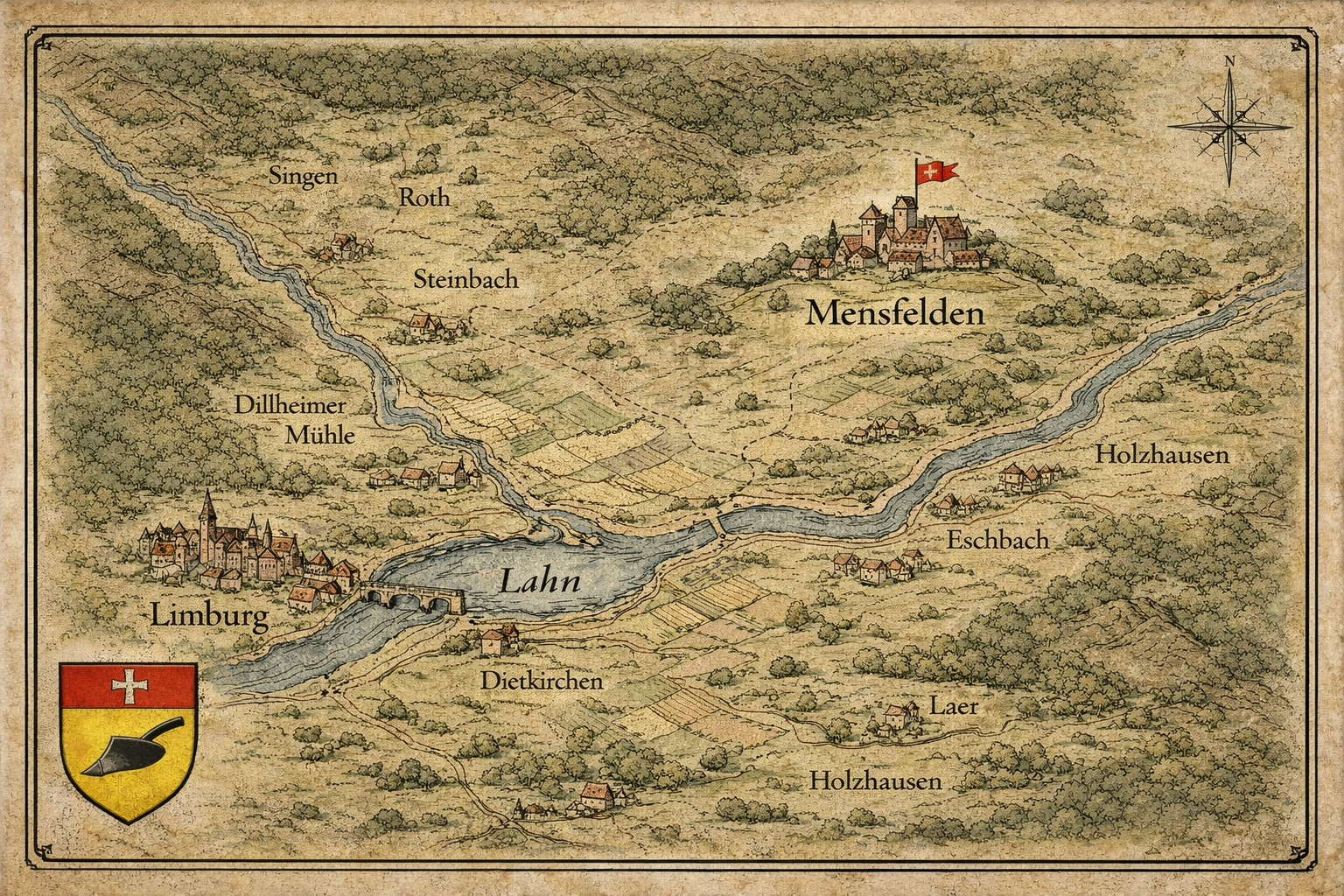
Small in name yet fiercely contested, the Lordship of Mensfelden sits astride the Lahn valley as a quiet fulcrum of power—where forgotten claims, shifting loyalties, and the weight of the land itself determine who truly rules.

The Lordship of Mensfelden lies along the Lahn valley within the Holy Roman Empire, set on gently rising ground north of the river near Limburg. The landscape is defined by fertile floodplains, low wooded hills, and routes that follow the river’s course. Narrow roads branch from the valley into farmland and upland clearings, creating a territory that is both connected and naturally divided.
Capital Settlement:
Mensfelden — a fortified village centered on a manor complex and parish site, serving as the administrative and symbolic heart of the lordship.
Other Settlements:
- Small farming hamlets along tributary streams
- Scattered hillside clearings used for pasture and timber
- Isolated mills positioned along flowing watercourses
Other Names:
- “The Mensfelden Holding”
- “The Upper Lahn Fields”
- Informally referred to as “the Lordship”
Description:
Mensfelden is a compact, land-driven territory shaped by use rather than design. Fields spread across the valley floor, divided by hedgerows and irrigation channels, while surrounding hills provide timber, grazing, and limited defensive ground. The climate is temperate, with productive growing seasons and occasional flooding that can disrupt movement and isolate outlying farms. The land feels worked, familiar, and closely observed—its boundaries understood through habit rather than fixed markers.
Real-World Inspirations:
Based on the medieval Lahn valley region of Hesse, reflecting minor feudal lordships where authority is local, layered, and influenced by nearby noble and ecclesiastical powers.
Heraldry and Symbols:
The lordship is represented by a simple heraldic shield in keeping with regional tradition, emphasizing landholding and continuity. Its design reflects status and function rather than grandeur.
National Motto and Ideals:
“By Land Held, By Right Proven.”
Authority rests on possession, recognition, and the ability to maintain control.
Moral and Philosophical Outlook:
Pragmatic and local. Loyalty is tied to land and obligation. Authority is respected when present and effective, and questioned when distant or uncertain.
Spiritual and Religious Landscape:
Religious practice is localised and land-bound, centered on:
- Sacred groves and boundary markers
- Springs and river sites
- Seasonal agricultural rites
Belief is practical, tied to continuity, fertility, and the maintenance of order within the land.
Government:
A feudal lordship governed by a local noble authority whose power depends on recognition by inhabitants and neighbouring powers. Control is direct but limited, requiring constant reinforcement.
Military:
- A small household retinue
- Levied peasants when required
- Defensive use of terrain and local knowledge
Forces are sufficient for maintaining order, not expansion.
Economy:
Primarily agricultural, supported by:
- Grain cultivation
- Livestock grazing
- Water-driven mills
- Modest river trade along the Lahn
Stability depends on reliable movement through the valley.
Technology Level:
Consistent with a mid-15th century rural Holy Roman Empire setting:
- Basic fortifications
- Established agricultural tools
- Functional but limited military equipment
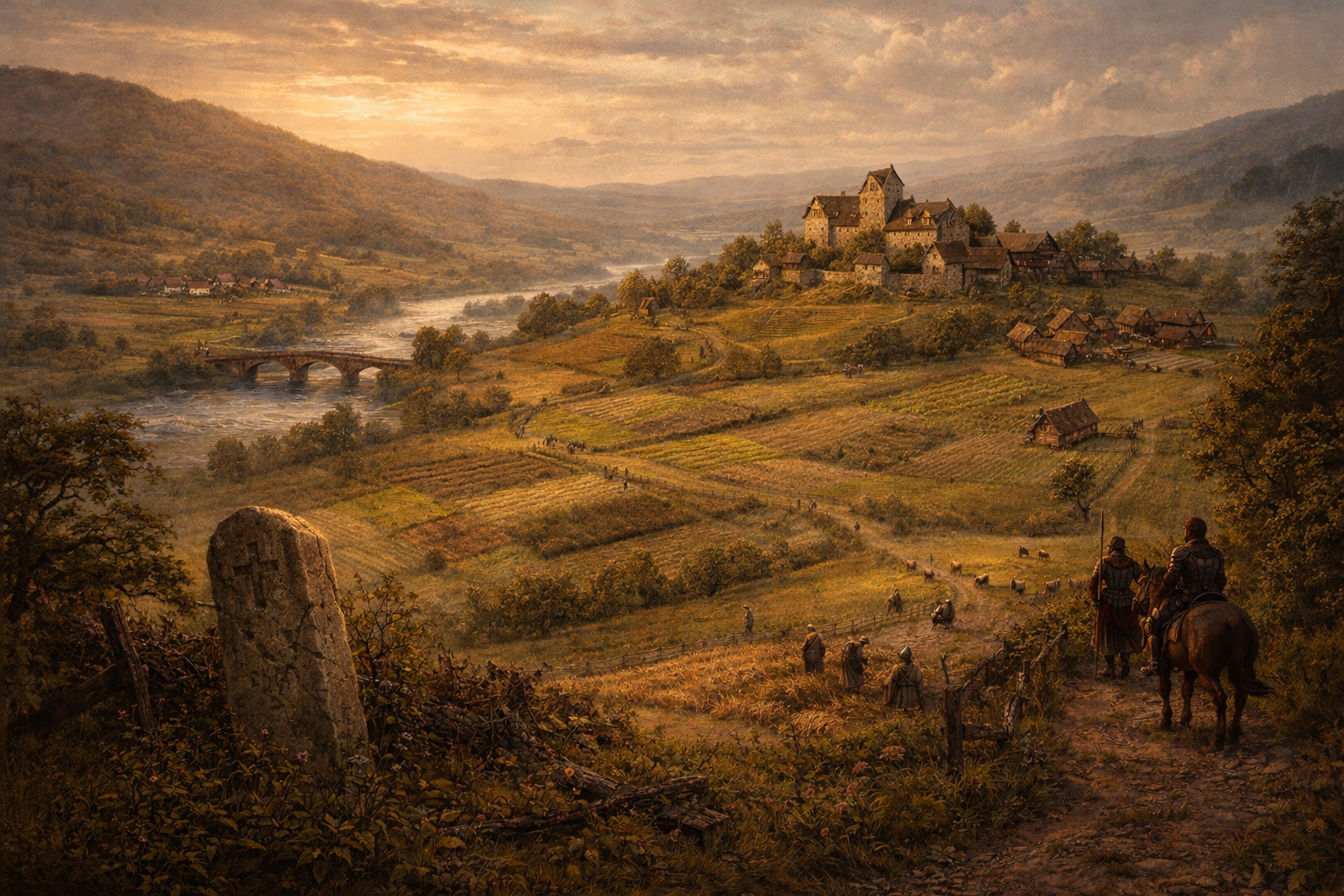
Mensfelden remains a minor, local lordship. Its authority is immediate and practical, not expansive or dominant.
Geographic Anchoring
- Roads follow the river and natural contours
- Settlements cluster around arable land and water access
- Authority is strongest where land is actively worked
Present-Day Threats and Challenges
- Disrupted Movement Along the Lahn Routes: Key paths become unreliable, with stretches of road falling quiet or avoided without clear cause
- Uncertain Control of Outlying Land: Boundaries once maintained through use are now contested or neglected
- External Pressure: Nearby authorities test influence through trade, legal claims, and quiet encroachment
- Growing Unease: Travellers and locals report areas where movement becomes difficult, misdirected, or resisted
Population and Society Composition
- Predominantly agrarian communities tied to seasonal cycles
- Small presence of craftsmen, millers, and traders near routes and water
- Minor nobility and retainers forming the governing layer
- Society is practical and local, with status defined by landholding and obligation
Structure of Authority
- Authority is localised and uneven, strongest near Mensfelden
- Outlying areas rely on custom, memory, and continued presence
- Control diminishes with distance from the manor and primary routes
Decision-Makers
- The lord and immediate household
- Retainers responsible for specific lands or routes
- Influential local landholders and elders
Ruling Power
A local lord whose authority depends on:
- visible presence
- consistent enforcement
- recognition by subjects and neighbouring powers
Power is sustained through continuity rather than force alone.
Notable Figures
The Lord of Mensfelden
Name: Heinrich von Diez
Status: Minor noble holding lands under the influence of the Counts of Diez within the Holy Roman Empire
Family
- Wife: Adelheid von Nassau
- From the House of Nassau, a rising regional power along the Lahn
- Marriage reflects local consolidation of influence, not expansion
- Children:
- Otto von Diez (heir, ~16) — raised to manage land and uphold family position
- Elisabeth von Diez (~13) — likely to be married into a nearby minor noble line
- Konrad von Diez (~9) — potential future in the Church, common for younger sons
Noteworthy Locations and Landmarks
- Mensfelden Manor and Parish Site — administrative core
- Lahn River Crossings — essential to movement and control
- Mill Sites — economic and logistical hubs
- Boundary Markers and Groves — traditional limits of land
- Upland Clearings — marginal but strategically useful
Power, Influence, and Reach
- Influence remains local and immediate
- Dependent on:
- control of movement
- recognition by neighbours
- continuity of land use
Alliances, Foes, and Diplomacy
- Maintains practical relationships with nearby powers
- Avoids open conflict but faces constant pressure
- Diplomacy is focused on preserving autonomy, not expansion
Inhabitants and Creatures
- Livestock and wildlife common to the region
- Increased activity of creatures in:
- woodland edges
- river crossings
- neglected or disputed land
Their presence reflects weakening control rather than random occurrence.
Terrain and Climate
- Temperate climate with stable seasonal patterns
- Fertile valley floor bordered by wooded hills
- Terrain supports agriculture but creates natural fragmentation
Weather Hazards
- Seasonal flooding along the Lahn
- Heavy rain affecting roads and crossings
- Fog reducing visibility in the valley
Notable Features
- Land defined by use rather than fixed borders
- Roads shaped by terrain, not imposed design
- Boundaries maintained through recognition and habit
Common Languages
- Local German dialects
- Trade language used along river routes
Cultural Practices
- Seasonal agricultural observances
- Local gatherings tied to planting and harvest
- Traditions grounded in continuity and land use
Local Laws and Customs
- Rights tied to land and obligation
- Boundaries enforced through memory and presence
- Authority respected when visible, tested when absent
ENCOUNTER TABLES
Low-Level Encounters (1–5)
Mid-Level Encounters (6–10)
High-Level Encounters (11+)
Low-Level Encounters (1–5)
- Bandits asserting control over a road section
- Wolves shadowing travellers along the tree line
- Displaced kobolds scouting new territory
- Broken cart blocking a narrow route
- Retainers questioning passage
- Giant spiders nesting near an abandoned structure
- Frightened traveller giving conflicting accounts
- Livestock panicked by unseen disturbance
- Flooded crossing forcing a detour
- Recently disturbed boundary marker
- Patrol escorting a detained individual
- Signs of nocturnal movement through fields
Mid-Level Encounters (6–10)
- Organised bandits controlling a route
- Kobold trap network in upland terrain
- Nix influencing a river crossing
- Wight with lesser undead in disturbed ground
- Large predator claiming territory
- Retainers enforcing disputed authority
- Isolated mill under threat or occupation
- Collapse of a road or embankment
- Escalating dispute over land use
- Unnatural silence across an active area
- Caravan refusing to proceed
- Coordinated disruption across multiple routes
High-Level Encounters (11+)
- Revenant tied to land ownership or broken claim
- Large territorial creature dominating uplands
- Multiple factions clashing over control
- River entity exerting wider influence
- Widespread undead disturbance
- Stronghold controlling passage
- Land resisting movement across multiple routes
- Collapse of recognised authority
- External powers applying coordinated pressure
- Ancient boundary force reasserting control
- Trade routes failing across the region
- Instability spreading to neighbouring lands
Scale Constraint
Mensfelden remains a minor lordship.
All threats and dynamics operate at a local or regional level, not beyond.
1. The Fractured Boundaries of Mensfelden
A Level 3–5 Adventure
Travel through the Lordship of Mensfelden is quietly breaking down.
Caravans fail to arrive. Farmers vanish between field and village. Roads once trusted without thought now lead astray, doubling back or carrying travellers to the wrong place entirely.
There is no sign of violence.
No bandits. No raiders. No war.
Yet movement itself has become unreliable.
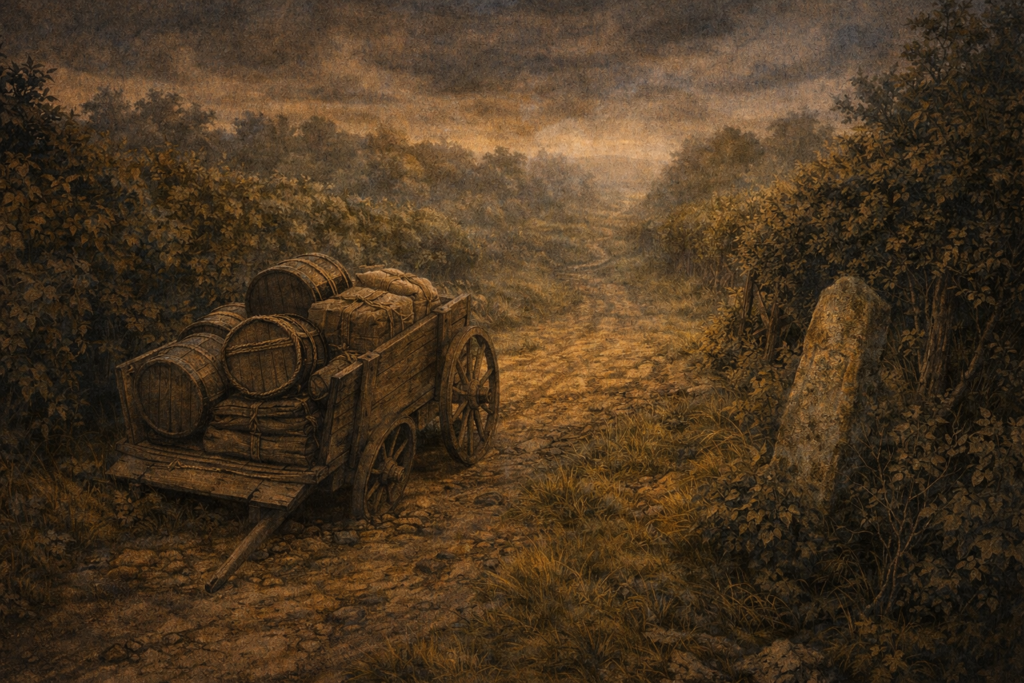
A wagon stands abandoned along the Lahn road—cargo untouched, horse gone, and no trace of its driver. Those who pass it speak of a growing unease:
- paths feel longer than they should
- landmarks appear where they should not
- animals balk at open ground for no visible reason
- the land itself seems reluctant to be crossed
At first, it is dismissed as rumour.
Then the roads begin to turn people back.
In Mensfelden, people have begun to say the same thing in different words:
the land decides who may pass.
This is not an enemy that can be tracked like a beast or crushed like a bandit gang. The deeper the players travel into Mensfelden, the clearer it becomes that the problem is not on the road.
It is in the land beneath it.
Something older is waking—
something that remembers where every boundary was once set,
what claims were sworn upon them,
and who had the right to cross.
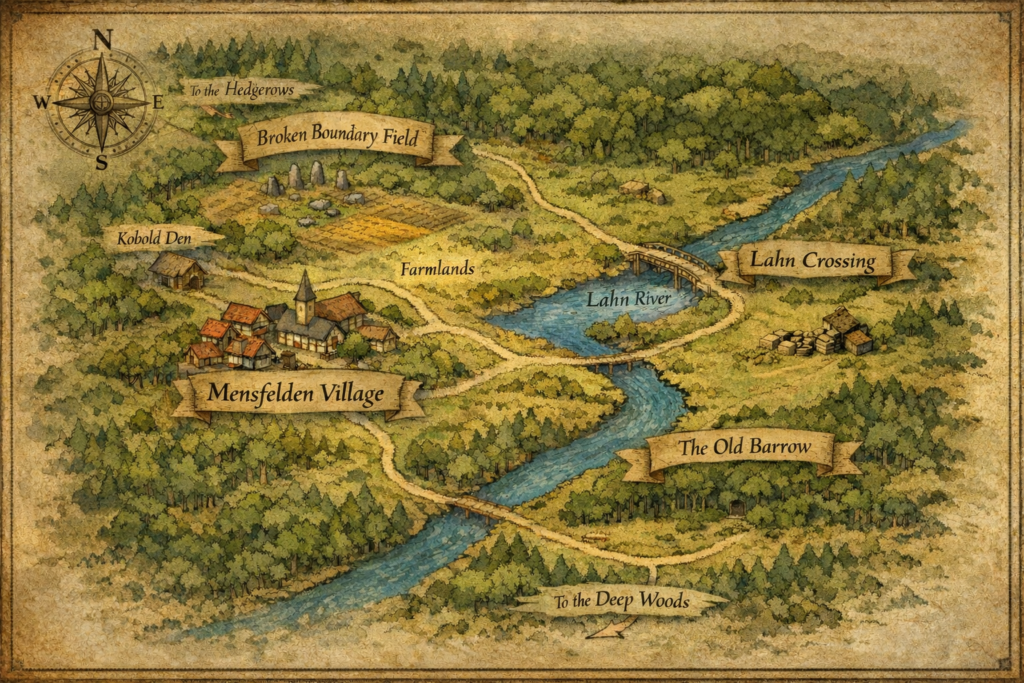
Major Adventure Locations (Mensfelden)
Where the Pattern Becomes Visible
These are the primary locations the adventure revolves around.
They do not replace encounters—they anchor them.
Encounters should be placed before, within, or between these locations so that the players experience the disturbance as a connected pattern rather than a series of unrelated incidents.
Mensfelden Village
The Center That Cannot Hold the Edges
Description
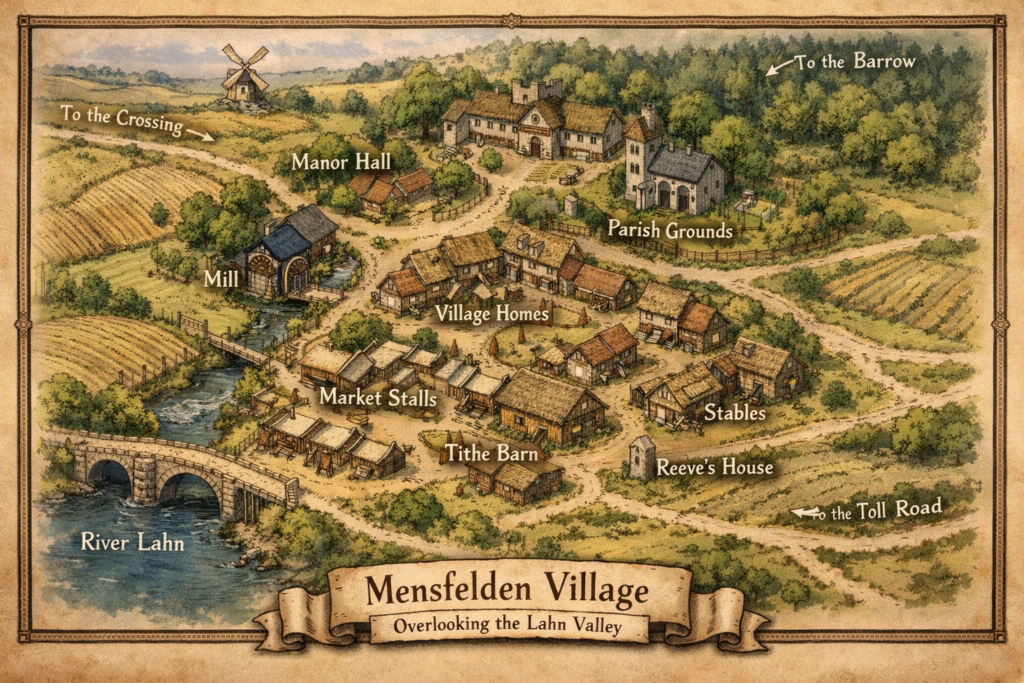
A compact manor-village overlooking the Lahn valley, centred on a modest hall, parish ground, enclosed yards, and clustered timber houses. Fields press close to the settlement, making any disruption to movement immediately felt.
Current Situation
The village still functions, but unease is spreading. Travel is unreliable, deliveries fail, and disputes over land use and access are becoming common.
Key Presence
- The lord’s steward or reeve
- Farmers, millers, and local elders
- Travellers unable to continue onward
- Retainers attempting to maintain order
Reveals
- The disruption is recent but rooted in older practices
- Memory of boundaries is inconsistent
- Passage works for some and fails for others
Encounter Placement
- 6. False Toll Keepers (best used on approach or as an active local problem)
- Aftermath of 2. Opening Scene — The Road That Doesn’t Lead
The Broken Boundary Field
Where Movement Begins to Fail
Description
A broad stretch of worked land divided by hedgerows, shallow ditches, and half-buried stones. It appears ordinary, but movement across it does not behave consistently.
Current Situation
Crossing certain lines causes delay, disorientation, or redirection. Animals resist entry, and activity no longer follows the visible layout of the land.
Key Presence
- Field workers (daytime)
- Displaced livestock
- Signs of nocturnal disturbance
Reveals
- The disturbance follows lines, not areas
- Older divisions still govern movement
- Crossing method affects outcome
Encounter Placement
- 3. Wolves in the Hedgerow (approach or perimeter)
- 4. Displaced Kobolds at the Broken Earth (within or beneath the field)
- 11. The Disturbed Boundary (primary discovery site)
The Lahn Crossing
Where Passage Becomes Conditional
Description
A narrow bridge, ford, or reinforced crossing along the Lahn. Functional, familiar, and widely used—until recently.
Current Situation
Crossing is inconsistent. Some pass without issue; others hesitate, turn back, or misstep without understanding why.
Key Presence
- Stranded travellers
- Drovers and local guides
- Abandoned goods near the banks
Reveals
- Passage is no longer neutral
- Effort does not guarantee success
- Water crossings follow the same rules as land
Encounter Placement
- 8. The Road That Fails (approach to or departure from the crossing)
- 10. The Nix at the Lahn Crossing (optional encounter)
The Old Barrow
Where the Land Remembers Authority
Description
A low burial mound marked by weathered stones and shallow earthworks, set just beyond active farmland but tied to older divisions of land.
Current Situation
The site has become active. The dead respond not to intrusion alone, but to broken claims and disturbed lines.
Key Presence
- A wight or lesser undead
- Signs of disturbance or excavation
- Burial markers tied to land boundaries
Reveals
- Authority here predates current rule
- Boundaries were once sworn and anchored into the land
- Disturbance has consequences beyond the living
Encounter Placement
- 11. The Disturbed Boundary (if used in a burial-bound context)
- Optional undead escalation encounter
The Boundary Nexus
Where the System Asserts Itself
Description
A hidden convergence of older divisions: a clearing, rise, or grove where stones, roots, and carved markers overlap in a pattern no longer understood.
Current Situation
This is the source of the disruption. The underlying system of land, claim, and passage is active again.
Key Presence
- The Boundary Keeper or equivalent force
- Disturbed and intersecting markers
- Strongest manifestation of the anomaly
Reveals
- The disruption is deliberate, not random
- It was triggered by broken or misaligned boundaries
- The land is enforcing a system current authority does not recognize
Encounter Placement
- 14. Core Truth / GM Brief
- 15. Resolution & Outcomes
- Escalated version of 8. The Road That Fails
Recommended Flow
A clean structure for play:
- The Fractured Boundaries of Mensfelden
- Opening Scene — The Road That Doesn’t Lead
- Wolves in the Hedgerow
- Displaced Kobolds at the Broken Earth
- Mensfelden Village
- False Toll Keepers
- The Broken Boundary Field
- The Road That Fails
- The Lahn Crossing
- The Nix at the Lahn Crossing
- The Disturbed Boundary
- The Old Barrow
- The Boundary Nexus
- Core Truth / GM Brief
- Resolution & Outcomes
Purpose
This structure ensures:
- encounters feel connected, not random
- locations carry meaning and progression
- players uncover the system step by step
- the final resolution feels earned
2. Opening Scene (Mensfelden)
The Road That Doesn’t Lead
The road into Mensfelden follows the Lahn—steady, familiar, and well-used.
It should be an easy approach.
It is not.
A wagon stands ahead, angled where the road dips toward a shallow ditch. One wheel has slipped, but not enough to overturn it. The load remains intact—sealed barrels, tied bundles, nothing disturbed.
The horse is gone.
There are no tracks leading away.
No sign of struggle.
The hedgerows press close here, dense and overgrown, limiting sight beyond a few paces. The air is still. No birds call. No distant voices carry.
For a moment, when the players look back the way they came, the road seems longer than it should be.
That impression passes quickly—but not completely.
What the Players Notice
At a glance, the scene reveals:
- The wagon shows no damage consistent with attack
- Goods remain intact and valuable
- No visible tracks lead away from the site
- The surrounding area is unnaturally quiet
A closer inspection reveals:
- The road surface is worn unevenly, as if travellers have turned back here again and again
- A nearby boundary stone sits slightly tilted, its carved face partly obscured by mud and roots
- The horse’s traces end abruptly near the road edge rather than continuing naturally away
At least one of these details should be obvious even without a successful check. The players should immediately understand that this is not an ordinary roadside abandonment.
Immediate Player Options
Players may:
- Examine the wagon and its contents
- Search for tracks or signs of the missing driver and horse
- Inspect the boundary stone
- Move into the surrounding fields or hedgerows
- Continue along the road toward Mensfelden
First Disturbance
If the players linger, investigate carelessly, or attempt to move on, the road begins to resist easy understanding.
Use one or two of the following signs:
- The road becomes less distinct underfoot, as though its edges are harder to follow
- Distances feel subtly inconsistent
- Sounds seem slightly displaced, as if carried from the wrong direction
- A landmark behind them appears farther away than it should
If they try to leave the area without understanding what is wrong, introduce one clear disruption:
- The road curves back unexpectedly, returning them near the wagon
- One character briefly loses their sense of direction
- Mounts or animals hesitate, refusing to move forward
Do not repeat the same effect more than once without adding a new clue.
First Clue
The boundary stone bears worn but deliberate markings.
It is not decorative.
It marks a division of land—one that has been disturbed, turned, or incorrectly set.
If the players miss this on inspection, reveal it through play: an animal balks beside it, a thrown object lands beyond it strangely, or retracing their steps brings them back to the stone from the wrong direction.
The scene should always communicate one essential truth:
the problem is tied to the land, not to a hidden attacker.
What This Scene Teaches
By the end of the opening scene, the players should understand:
- The wagon was not abandoned because of an ordinary attack
- The area itself is behaving incorrectly
- Movement is beginning to fail in a pattern, not at random
- Something about the boundary stone matters
Tone Anchor
Nothing attacks.
Nothing reveals itself openly.
And yet it becomes immediately clear:
The problem is not farther ahead on the road.
It is already here.
3. Wolves in the Hedgerow (Mensfelden)

First Reaction of the Land
Setup
This encounter occurs shortly after the players leave the wagon, either as they continue along the road or move into the bordering fields.
The hedgerows grow thicker here, pressing in on both sides and limiting visibility to only a few paces beyond the path.
This is the first living sign that the disturbance is already affecting the land around Mensfelden.
What the Players See
A shift in the hedgerow.
Branches move where there is no wind.
Something keeps pace with them, just out of sight.
Then a wolf steps into the road.
It does not snarl or crouch to spring. It simply stands and watches.
Another appears farther ahead.
A third steps from the growth behind them.
They do not rush in.
They hold position.
They follow.
At least one wolf should be visibly halted by something the players cannot yet see: it reaches a certain point at the edge of the road or field, then stops, paces, and refuses to cross.
That hesitation is the encounter’s unmissable clue.
Creatures
- 4 Wolves
- For stronger parties, replace 1–2 Wolves with Dire Wolves
Behaviour
The wolves do not behave like ordinary predators.
They:
- Shadow the party at a measured distance
- Circle gradually, testing position and cohesion
- Watch for separation, hesitation, or weakened targets
- Attack only if a clear opportunity presents itself
If met with strong resistance or obvious injury, they disengage quickly and vanish into the hedgerow.
If the players simply stand their ground and observe, the wolves remain tense but uncertain, as though restrained by something beyond fear.
Terrain
- Dense hedgerows provide concealment and restrict visibility
- The road is narrow, limiting formation
- Ground beyond the road is uneven, slowing movement
- The field edge contains at least one unseen line the wolves refuse to cross
Clue Layer
Careful observation reveals one or more of the following:
- The wolves refuse to cross a specific line in the adjacent field
- Tracks cluster unnaturally along certain routes while avoiding others entirely
- Food or thrown objects landing beyond that line are approached with visible hesitation—or ignored
- A wounded or enraged wolf still stops short at the same invisible boundary
One of these signs should be made clear even if the players do not investigate carefully.
The purpose of the encounter is not merely to threaten the party. It is to show, in plain view, that the land is already imposing rules.
If Combat Occurs
If the players attack immediately, the wolves do not fight to the death.
They:
- Strike only when advantage is obvious
- Break off quickly if injured
- Withdraw into the hedgerows rather than pressing a losing fight
Even in combat, the boundary clue should remain visible. A wolf should still refuse to cross the same line, even when pursuing prey.
Failure or aggression should still teach the players something.
What This Reveals
By the end of the encounter, the players should understand:
- The wolves are not behaving as natural predators
- Their movement is constrained by an unseen boundary
- The disturbance is affecting animals as well as travellers
- The land is already exerting influence in a visible, repeatable way
Purpose
This encounter:
- Introduces tension without requiring immediate combat
- Demonstrates the first clear and visible consequence of the disturbance
- Reinforces that the deeper threat lies in the land itself, not in a single enemy
- Teaches the players to watch for patterns rather than waiting for a direct attack
4. Displaced Kobolds at the Broken Earth
Mensfelden Lordship
Encounter Level: 3 (scalable 1–5)
Location: Embankment off the Lahn Road, Mensfelden
Encounter Summary
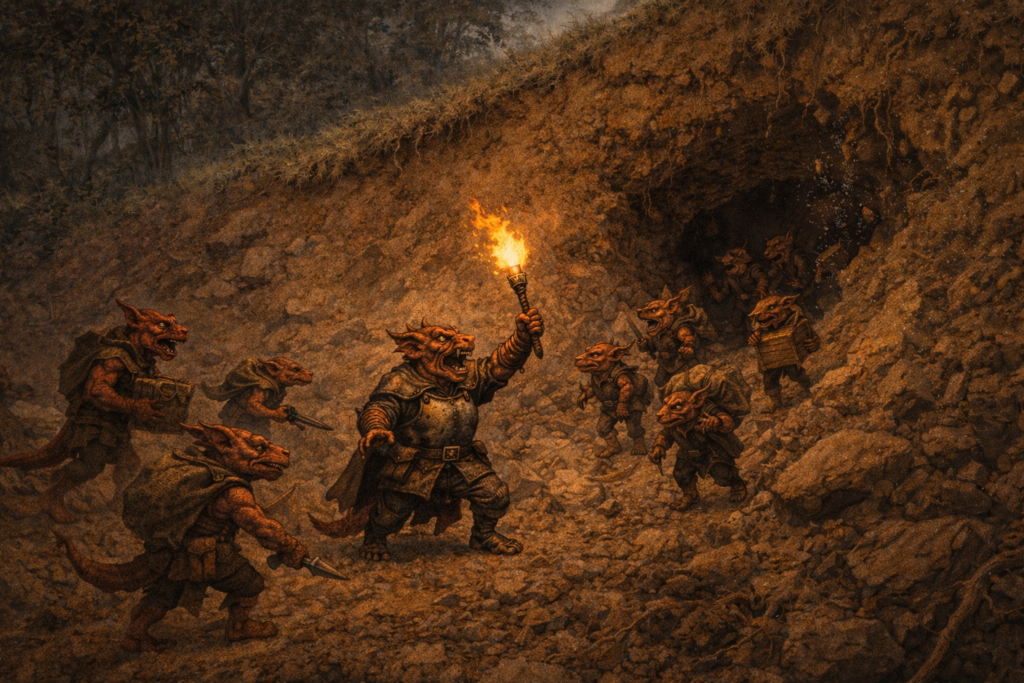
A section of ground has collapsed beside the road, exposing a crude kobold tunnel. The inhabitants are not defending it—they are abandoning it in haste.
The earth itself is unstable.
The kobolds are not the primary threat.
This encounter should make one thing clear: something deeper in the land is driving even entrenched creatures out of their own ground.
Setup
This encounter triggers when the party:
- Leaves the road to investigate disturbed ground
- Follows signs of movement from the wagon
- Tracks creatures avoiding a specific direction
It works best after the wolves, once the players are already beginning to suspect that movement and territory are behaving incorrectly.
Read-Aloud Text
The earth here has given way.
A section of the embankment has collapsed, spilling loose soil and broken roots into a shallow depression. Beneath it, a rough tunnel gapes open—its edges jagged and freshly broken.
Small figures scramble in and out, dragging tools, sacks, and fragments of timber.
They are not digging deeper.
They are leaving.
One pauses at the tunnel mouth, glances toward a particular stretch of ground beyond the collapse, and recoils as if from heat.
It chooses the longer way around.
What the Players Immediately See
At a glance, the scene reveals:
- The tunnel has collapsed recently
- The kobolds are evacuating, not preparing an ambush
- Their possessions are being dragged out hastily rather than organized for defense
- They are avoiding one particular direction even when it would be the easiest route out
That last detail should be obvious even without a successful roll. The players should be able to see that the kobolds fear something beyond the party.
Creatures
Displaced Kobold Work Group
- 1 Kobold Foreman
- 2–3 Kobold Sentries
- 3–6 Kobold Tunnelers / Carriers
These kobolds are not organized for battle. They are frightened, defensive, and trying to get away from a place they no longer trust.
Scene Purpose
This encounter should teach the players three things:
- The disturbance is spreading into the ground beneath the road
- Intelligent creatures are reacting to it rather than causing it
- The danger has direction: something about one line, one area, or one approach is wrong in a consistent way
GM Note
Do not present this as a standard kobold ambush.
The important question in the scene is not, “How do the players defeat the kobolds?” but:
“Why are the kobolds abandoning a defensible tunnel and refusing the easiest route?”
Even if the players attack immediately, the scene should still reveal that the kobolds were fleeing something tied to the land.
Kobold Stats 5.5e
Kobold Stats Pathfinder
Kobold Group (5.5e)
These kobolds are not organized for a stand-up fight. They are tunnel workers and lookouts caught in the middle of an evacuation.
Use them as a panicked, reactive work group, not as disciplined skirmishers.
Kobold Tunneler
Small humanoid (kobold), lawful evil
Armor Class 12 (natural armor)
Hit Points 9 (2d6 + 2)
Speed 30 ft., burrow 5 ft.
| STR | DEX | CON | INT | WIS | CHA |
|---|---|---|---|---|---|
| 7 (-2) | 15 (+2) | 12 (+1) | 8 (-1) | 9 (-1) | 8 (-1) |
Senses darkvision 60 ft., passive Perception 9
Languages Common, Draconic
Challenge 1/8 (25 XP)
Traits
Pack Tactics. The kobold has advantage on attack rolls against a creature if at least one of the kobold’s allies is within 5 feet of the creature and the ally isn’t incapacitated.
Sunlight Sensitivity. While in sunlight, the kobold has disadvantage on attack rolls and on Wisdom (Perception) checks that rely on sight.
Tunnel Instinct. The kobold has advantage on checks made to detect unstable ground, collapses, sinkholes, or structural weaknesses in earth or tunnel walls.
Actions
Dagger. Melee Weapon Attack: +4 to hit, reach 5 ft., one target.
Hit: 4 (1d4 + 2) piercing damage.
Improvised Pick. Melee Weapon Attack: +2 to hit, reach 5 ft., one target.
Hit: 3 (1d6) bludgeoning damage.
Kobold Sentry
Small humanoid (kobold), lawful evil
Armor Class 13
Hit Points 11 (2d6 + 4)
Speed 30 ft.
| STR | DEX | CON | INT | WIS | CHA |
|---|---|---|---|---|---|
| 7 (-2) | 15 (+2) | 14 (+2) | 8 (-1) | 9 (-1) | 8 (-1) |
Senses darkvision 60 ft., passive Perception 9
Languages Common, Draconic
Challenge 1/4 (50 XP)
Traits
Pack Tactics. The kobold has advantage on attack rolls against a creature if at least one of the kobold’s allies is within 5 feet of the creature and the ally isn’t incapacitated.
Sunlight Sensitivity. While in sunlight, the kobold has disadvantage on attack rolls and on Wisdom (Perception) checks that rely on sight.
Skirmisher. When a creature moves within 5 feet of the kobold, the kobold can move up to 10 feet without provoking opportunity attacks.
Actions
Spear. Melee Weapon Attack: +4 to hit, reach 5 ft., one target.
Hit: 5 (1d6 + 2) piercing damage.
Sling. Ranged Weapon Attack: +4 to hit, range 30/120 ft., one target.
Hit: 4 (1d4 + 2) bludgeoning damage.
Kobold Foreman
Small humanoid (kobold), lawful evil
Armor Class 13
Hit Points 18 (4d6 + 4)
Speed 30 ft.
| STR | DEX | CON | INT | WIS | CHA |
|---|---|---|---|---|---|
| 8 (-1) | 15 (+2) | 12 (+1) | 10 (+0) | 10 (+0) | 10 (+0) |
Senses darkvision 60 ft., passive Perception 10
Languages Common, Draconic
Challenge 1/4 (50 XP)
Traits
Pack Tactics. The kobold has advantage on attack rolls against a creature if at least one of the kobold’s allies is within 5 feet of the creature and the ally isn’t incapacitated.
Sunlight Sensitivity. While in sunlight, the kobold has disadvantage on attack rolls and on Wisdom (Perception) checks that rely on sight.
Command Panic (Recharge 5–6). The foreman barks a frantic order. Each allied kobold within 30 feet that can hear it can immediately use its reaction to move up to half its speed without provoking opportunity attacks.
This ability is usually used to scatter workers, pull sentries back, or escape collapsing terrain rather than to improve battlefield position.
Actions
Shortsword. Melee Weapon Attack: +4 to hit, reach 5 ft., one target.
Hit: 5 (1d6 + 2) piercing damage.
GM Use
These kobolds should read as:
- frightened rather than aggressive
- defensive rather than disciplined
- eager to escape rather than eager to kill
Even if combat begins, the group should behave like evacuating workers under pressure, not a normal dungeon patrol.
KOBOLD GROUP (PATHFINDER 1E)
4B. Kobold Group (Pathfinder 1e)
These kobolds are not organized for a stand-up fight. They are tunnel workers, lookouts, and a foreman trying to manage a panicked evacuation.
Run them as frightened, reactive creatures under pressure, not as disciplined defenders.
Kobold Tunneler
CR 1/4
XP 100
LE Small humanoid (reptilian)
Init +2; Senses darkvision 60 ft.; Perception +4
DEFENSE
AC 14, touch 13, flat-footed 12
(+2 Dex, +1 size, +1 natural)
hp 8 (2d8)
Fort +3, Ref +2, Will –1
OFFENSE
Speed 30 ft.
Melee
dagger +3 (1d3–2)
pick +1 (1d4–2)
STATISTICS
| STR | DEX | CON | INT | WIS | CHA |
|---|---|---|---|---|---|
| 7 (–2) | 15 (+2) | 10 (+0) | 8 (–1) | 9 (–1) | 8 (–1) |
Base Atk +1; CMB –3; CMD 9
Feats Skill Focus (Perception)
Skills Perception +4, Stealth +10
Languages Common, Draconic
SPECIAL ABILITIES
Tunnel Sense (Ex)
A kobold tunneler gains a +4 bonus on Perception checks made to detect unstable ground, collapses, sinkholes, or structural weaknesses in earth or tunnel walls.
Kobold Sentry
CR 1/3
XP 135
LE Small humanoid (reptilian)
Init +2; Senses darkvision 60 ft.; Perception +4
DEFENSE
AC 15, touch 13, flat-footed 13
(+2 Dex, +1 size, +2 natural)
hp 10 (2d8+2)
Fort +3, Ref +2, Will –1
OFFENSE
Speed 30 ft.
Melee
spear +3 (1d6–1)
Ranged
sling +4 (1d3)
STATISTICS
| STR | DEX | CON | INT | WIS | CHA |
|---|---|---|---|---|---|
| 7 (–2) | 15 (+2) | 12 (+1) | 8 (–1) | 9 (–1) | 8 (–1) |
Base Atk +1; CMB –3; CMD 10
Feats Dodge
Skills Perception +4, Stealth +10
Languages Common, Draconic
SPECIAL ABILITIES
Skirmish Step (Ex)
Once per round, when an enemy enters a square adjacent to the kobold, it may take a 5-foot step as an immediate action. This movement does not count against its movement on its next turn.
Kobold Foreman
CR 1
XP 400
LE Small humanoid (reptilian)
Init +2; Senses darkvision 60 ft.; Perception +5
DEFENSE
AC 15, touch 13, flat-footed 13
(+2 Dex, +1 size, +2 natural)
hp 18 (4d8)
Fort +4, Ref +3, Will +1
OFFENSE
Speed 30 ft.
Melee
shortsword +4 (1d4–1)
STATISTICS
| STR | DEX | CON | INT | WIS | CHA |
|---|---|---|---|---|---|
| 8 (–1) | 15 (+2) | 12 (+1) | 10 (+0) | 10 (+0) | 10 (+0) |
Base Atk +3; CMB –1; CMD 11
Feats Alertness, Skill Focus (Intimidate)
Skills Intimidate +7, Perception +5, Stealth +9
Languages Common, Draconic
SPECIAL ABILITIES
Command the Scattered (Ex)
Once per day, as a standard action, the kobold foreman shouts a frantic order. All allied kobolds within 30 feet that can hear it may immediately move up to their speed as an immediate action. This movement does not provoke attacks of opportunity.
This ability is normally used to pull workers out of danger, scatter sentries, or escape unstable terrain rather than to mount a coordinated attack.
GM Use
These kobolds are not organized for combat—they are evacuating.
They should behave as:
- startled and defensive
- quick to scatter
- unwilling to stand and die
- more concerned with escape than victory
If the players attack immediately, the encounter should still communicate that the kobolds were fleeing something tied to the land rather than preparing an ambush.
Kobold Encounter Tactics and Terrain
These kobolds are not organized for combat—they are evacuating.
Their behaviour should make that obvious.
Tactics
Initial Reaction: Defensive, startled
Primary Goal: Escape, not victory
Engagement
- Sentries delay threats and cover retreat
- Tunnelers and carriers scatter immediately if pressed
- The foreman tries to hold the group together long enough to withdraw
- Morale breaks after 1–2 casualties or any major collapse
The foreman does not fight to the death. If escape is possible, it takes it.
Even during combat, the kobolds should behave like frightened workers fleeing an unsafe site, not like a planned ambush.
Terrain Features
The terrain is as important as the kobolds.
The party should quickly realize that the ground itself is unstable and dangerous.
Unstable Ground
Loose soil shifts underfoot where the embankment has given way.
Detection:
DC 12 Perception or Survival
Trigger:
- Fast movement
- Multiple creatures crossing the same patch
- Sudden force, impact, or charging
Effect (5e):
DC 12 Dexterity saving throw or fall prone and have speed reduced to 0 until the start of the creature’s next turn.
If the save fails by 5 or more, the creature is restrained instead (escape DC 10 Strength check).
Effect (PF1e):
DC 12 Reflex save or fall prone.
Fail by 5 or more: the creature is entangled until freed or until it spends a move action regaining footing.
Collapsing Tunnel Edge
The exposed tunnel mouth and surrounding lip are structurally unsound.
Trigger:
- Heavy movement
- Significant combat impact
- Two or more creatures near the edge
- Deliberate tampering by kobolds or players
Effect (5e):
DC 13 Dexterity saving throw.
Failure: 2d6 bludgeoning damage and restrained beneath loose earth until freed.
Effect (PF1e):
DC 13 Reflex save.
Failure: 2d6 bludgeoning damage and pinned beneath loose earth until freed.
Burrow Pockets
Hidden voids and shallow undermined spaces lie beneath parts of the embankment.
Effect:
- Minor movement disruption
- Counts as difficult terrain or reduced movement for 1 round
- Useful for showing that the ground is compromised beyond the visible collapse
Kobold Advantage
The kobolds know this terrain better than the players, even in panic.
They:
- Ignore unstable ground penalties where practical
- Gain advantage in 5e or a +4 circumstance bonus in Pathfinder to detect or move around unstable sections
- Can trigger small collapses intentionally if cornered
This should reinforce that the site is dangerous because of the land first, not because of enemy strength.
Development
If the Players Attack Immediately
The kobolds panic.
- Tunnelers drop supplies and scatter
- Sentries delay briefly, then retreat
- The foreman shouts for withdrawal rather than counterattack
- The encounter becomes chaotic terrain combat, with instability posing as much danger as the kobolds
Even in this version, one thing must remain clear:
the kobolds are fleeing the site, not defending it.
If the Players Approach Carefully
The kobolds hesitate rather than charge.
The foreman may attempt crude communication through:
- Warning gestures
- Refusal to move in a specific direction
- Drawing a line in the dirt and shaking its head
- Pulling another kobold back from crossing a particular stretch of ground
This is the preferred path, but it should not be required for the players to learn what matters.
Clue Layer
Players can learn the following through observation, interaction, or even the aftermath of combat:
- The tunnel was abandoned suddenly
- There are no signs of predator attack
- Digging stopped in the middle of active work
- Supplies were left in disorder rather than packed properly
- Most importantly, the kobolds refuse to cross or flee in one particular direction
That final clue should be unmissable. At least one kobold should visibly avoid the same route, even when panicked.
The players should come away understanding that something deeper is driving the kobolds out.
Treasure
- Small sacks of ore or scrap metal (low value)
- Crude tools that can serve as improvised weapons
- Minor coin or trade goods
- Optional: a marked stone shard, broken survey token, or worked fragment hinting at older boundaries below the surface
Scaling
Level 1–2
- 3–5 kobolds total
- No foreman
- Collapse damage reduced or removed
Level 3–5 (Default)
- Full encounter as written
Level 6+
- Add traps or prepared retreat points
- Increase collapse damage
- Introduce a secondary threat deeper underground
- Let the terrain become the main pressure rather than simply adding more kobolds
Role in the Adventure
This encounter:
- Confirms that the disturbance extends below the road and into the earth
- Shows intelligent creatures reacting to the anomaly rather than causing it
- Reinforces environmental instability
- Points the players toward a specific direction or deeper source
GM Notes
Do not force combat.
Let the players choose whether this is a fight, a tense observation scene, or a broken attempt at communication.
Emphasize:
- instability
- urgency
- directionality of the threat
If the players miss subtle clues, make one visible:
- a kobold refusing a route
- a line scratched in dirt
- a panicked retreat around an apparently open patch of ground
Never let the encounter end without teaching that the danger is patterned.
Outcome
By the end of this encounter, the players should understand:
- The problem is not random
- It is spreading from a specific direction or line
- Even creatures that live underground no longer trust the land
- The land itself is becoming unreliable
5. Mensfelden Village
The Center That Cannot Hold the Edges
Role in the Adventure
Mensfelden Village is the first major social anchor of the adventure.
It is not an encounter in the usual sense, but a settlement section where the players can:
- gather information
- witness the human effects of the disturbance
- test early theories
- identify local authority, memory, and contradiction
- learn where to go next
This is the point where the adventure shifts from isolated incidents on the road to a broader understanding that the whole lordship is being affected.
Description
Mensfelden is a compact manor-village overlooking the Lahn valley, centred on a modest hall, parish ground, enclosed yards, and clustered timber houses. Fields press close to the settlement, so any disruption to movement is felt immediately in work, trade, and daily life.
The village is not abandoned or collapsing. It still functions.
But it no longer functions with confidence.
People move carefully. Deliveries arrive late or not at all. Conversations stop when strangers approach. Even ordinary tasks now carry uncertainty.
The place feels inhabited, strained, and watchful.
Current Situation
Travel in and out of Mensfelden has become unreliable.
- goods fail to arrive
- workers lose time or direction on familiar routes
- livestock resist crossing certain stretches of land
- arguments over access, use, and passage are becoming more common
- local authority is trying to hold order without understanding the cause
The reeve or steward may still insist the matter is temporary, but villagers no longer believe this is simple bad luck.
Some already say openly what others only imply:
the land decides who may pass.
What the Players See
When the party enters Mensfelden, they should immediately notice signs of strain:
- carts delayed or half-unloaded
- anxious drovers and field hands
- people arguing over whose track, gate, or path may still be trusted
- livestock penned more closely than usual
- travellers lingering because they are unwilling to attempt the road again before daylight
Nothing here is dramatic on its own.
Taken together, however, these signs make it clear that the problem is no longer private or local. It is changing how the village lives.
Key Presence
The players are likely to encounter some or all of the following:
- The Lord’s Steward or Reeve — attempting to preserve order, legitimacy, and routine
- Farmers and Millers — concerned with access, field boundaries, and lost labour
- Local Elders — bearers of fragmentary memory about older divisions and customs
- Stranded Travellers — frustrated, frightened, or unwilling to risk the road again
- Retainers or Household Men — trying to enforce authority they no longer fully understand
These people should not all agree with one another. The village is united in anxiety, not in interpretation.
What the Players Can Learn
By speaking to villagers, observing local behaviour, or comparing accounts, the players can uncover several important truths.
Common Reports
- some paths still work, but not for everyone
- the same road may fail one day and function the next
- animals often notice trouble before people do
- the problem seems worse where older field lines, stones, or crossings remain
- the disturbance has grown worse rather than fading with time
Older Memories
A local elder, labourer, or priest may remember fragments such as:
- boundary stones once mattered more than they do now
- certain crossings were acknowledged formally in older times
- some divisions of land were sworn, not merely marked
- burial grounds and field rights were once treated as connected matters
These recollections should be incomplete, contradictory, and valuable precisely because they are imperfect.
One Important Conclusion
By the end of this section, the players should be able to understand that:
- this is not a single cursed road
- this is not a matter of bandits, beasts, or weather
- the problem affects movement according to older patterns the villagers no longer fully understand
Social Tension
Mensfelden should feel socially unstable, but not lawless.
Pressure points include:
- disputes over who may cross which field or lane
- suspicion that outsiders make the problem worse
- frustration with the steward’s inability to restore normal passage
- opportunists exploiting routes that still work
- growing resentment between memory, custom, and present authority
The village should not erupt into chaos unless the GM wants escalation.
Instead, it should feel like a place trying to maintain ordinary life while ordinary life stops obeying familiar rules.
Possible Interactions
The players may:
- report what they saw at the wagon
- ask who last used the road safely
- inspect local maps, field boundaries, or tithe records
- question elders about old stones, burial lines, or customary rights
- ask which places people now avoid
- offer to investigate the roads, crossing, fields, or barrow
This is an excellent place for the GM to redirect stalled players without forcing them.
If the party is uncertain what to do next, the village should supply leads.
Useful Leads Forward
Mensfelden Village should point the players toward one or more of the following:
- False Toll Keepers — if local opportunists are controlling one of the few dependable routes
- The Broken Boundary Field — if farmers or drovers report specific failures in nearby land
- The Lahn Crossing — if travellers describe selective failure at the river
- The Old Barrow — if older villagers connect disturbance with burial lines or claimed ground
The village does not solve the mystery. It organizes it.
GM Guidance
Run Mensfelden as a place of strained normalcy.
The players should feel that:
- the disturbance is real and widespread
- people are adapting without understanding
- memory of older boundaries survives in fragments
- authority is weakening because movement can no longer be trusted
Do not turn this into a lore dump.
Let the players assemble the picture from overheard arguments, partial testimony, practical complaints, and conflicting explanations.
What This Section Reveals
By the end of this section, the players should understand:
- the disruption extends across the lordship, not just along one road
- ordinary people are already changing their behaviour around it
- memory of older land practices survives, but imperfectly
- the problem is beginning to undermine both daily life and local authority
This is the point where the adventure broadens from mystery to system.
Purpose
This section:
- gives the adventure a human center
- translates eerie anomaly into social consequence
- connects early encounters into a shared pattern
- prepares the players to investigate the field, crossing, and older boundaries with clearer purpose
Result
If run correctly, Mensfelden Village should:
- ground the adventure in lived consequences
- sharpen understanding without overexplaining
- provide direction without removing discovery
- make the wider lordship feel inhabited, strained, and worth helping or judging
6. False Toll Keepers (Mensfelden)
Authority Without Legitimacy
Setup
This encounter occurs farther along the road, where the terrain naturally narrows—a shallow rise, a bend between hedgerows, a narrow causeway, or a simple wooden crossing.
The place feels chosen, not built.
These men have not created control here. They are exploiting a place where movement still works.
That distinction matters.
What the Players See
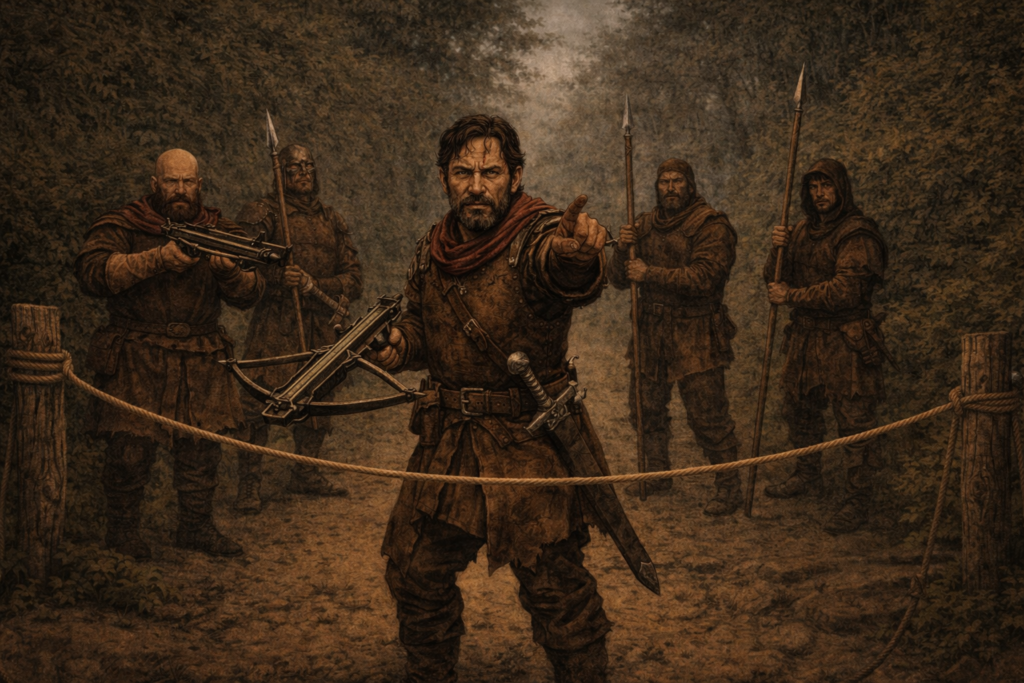
A rope or crude barrier stretches across the road.
A small group of armed men stands beyond it.
They are not uniformed. Their equipment is mixed—tools turned weapons, worn leathers, patched gear, and whatever arms they could keep close at hand.
One steps forward, trying for confidence.
The others hang back.
They watch the players—but they also keep glancing at the road, the hedgerows, and the ground around them, as if wary of something other than armed travellers.
That unease should be obvious. Even before anyone speaks, the players should sense that these men are not fully in control of the place they claim to hold.
Creatures / NPCs
Road Agents (Bandits)
- 5–7 Bandits
- 1 Bandit Leader
These are opportunists, not soldiers. They have found one stretch of road that still behaves reliably and are using it to extract coin, goods, or obedience from those who pass through.
What This Scene Should Communicate
At a glance, the players should understand:
- These men are trying to claim authority they do not truly possess
- They are taking advantage of a stable route, not creating the stability themselves
- They are frightened beneath the performance of control
This is the first clear human sign that control of movement now means control of power.
GM Note
Do not present them as confident professional brigands.
They should feel:
- uncertain
- reactive
- watchful
- slightly desperate
Their real strength is not discipline. It is that they happen to be standing on one of the few paths that still works.
Bandits 2024 5.5e
Bandits, (PATHFINDER 1E)
Road Agents (5.5e)
These bandits are not disciplined guards or hardened mercenaries. They are local opportunists exploiting a stretch of road that still behaves reliably.
Use them as tense, reactive road-takers rather than committed stand-up fighters.
Bandit (Road Agent)
Medium humanoid (any), any non-lawful alignment
Armor Class 12 (leather armor)
Hit Points 11 (2d8 + 2)
Speed 30 ft.
| STR | DEX | CON | INT | WIS | CHA |
|---|---|---|---|---|---|
| 11 (+0) | 12 (+1) | 12 (+1) | 10 (+0) | 10 (+0) | 10 (+0) |
Senses passive Perception 10
Languages Common
Challenge 1/8 (25 XP)
Traits
Opportunistic Fighters. The bandit has advantage on attack rolls against a creature that is prone, restrained, or isolated from its allies (no ally within 5 feet of it).
Actions
Spear. Melee Weapon Attack: +3 to hit, reach 5 ft., one target.
Hit: 4 (1d6 + 1) piercing damage, or 5 (1d8 + 1) piercing damage if used with two hands.
Light Crossbow. Ranged Weapon Attack: +3 to hit, range 80/320 ft., one target.
Hit: 5 (1d8 + 1) piercing damage.
Dagger. Melee or Ranged Weapon Attack: +3 to hit, reach 5 ft. or range 20/60 ft., one target.
Hit: 3 (1d4 + 1) piercing damage.
Bandit Leader (Road Captain)
Medium humanoid (any), any non-lawful alignment
Armor Class 13 (leather armor, shield)
Hit Points 45 (6d8 + 18)
Speed 30 ft.
| STR | DEX | CON | INT | WIS | CHA |
|---|---|---|---|---|---|
| 13 (+1) | 14 (+2) | 16 (+3) | 11 (+0) | 11 (+0) | 14 (+2) |
Senses passive Perception 10
Languages Common
Challenge 2 (450 XP)
Traits
Pack Coordination. Allied bandits within 10 feet of the leader gain a +1 bonus to attack rolls.
Actions
Multiattack. The leader makes two melee attacks.
Arming Sword. Melee Weapon Attack: +4 to hit, reach 5 ft., one target.
Hit: 6 (1d8 + 2) slashing damage.
Dagger (Thrown). Ranged Weapon Attack: +4 to hit, range 20/60 ft., one target.
Hit: 4 (1d4 + 2) piercing damage.
Bonus Action
Command (Recharge 5–6). One allied bandit within 30 feet that can hear the leader can immediately do one of the following:
- make one weapon attack, or
- move up to half its speed without provoking opportunity attacks
This is usually used to pull a wavering bandit back into position, reinforce a choke point, or cover a retreat.
GM Use
These road agents should feel:
- nervous rather than fearless
- opportunistic rather than disciplined
- quick to threaten, quick to lose heart under pressure
They want payment, compliance, and control of the road—not a fair fight.
If challenged hard, they hesitate. If blood is drawn, their confidence begins to fail.
Road Agents (Pathfinder 1e)
These bandits are not trained soldiers. They are locals, deserters, opportunists, and hangers-on exploiting one of the few stretches of road that still behaves reliably.
Run them as tense, reactive, and quick to break once their false authority is challenged.
Bandit (Road Agent)
CR 1/3
XP 135
CN Medium humanoid (human)
Init +1; Senses Perception +2
DEFENSE
AC 13, touch 11, flat-footed 12
(+1 Dex, +2 armor)
hp 10 (2d8+2)
Fort +3, Ref +1, Will +0
OFFENSE
Speed 30 ft.
Melee
spear +3 (1d6+1)
Ranged
light crossbow +3 (1d8)
STATISTICS
| STR | DEX | CON | INT | WIS | CHA |
|---|---|---|---|---|---|
| 11 (+0) | 12 (+1) | 12 (+1) | 10 (+0) | 10 (+0) | 10 (+0) |
Base Atk +1; CMB +1; CMD 12
Feats Weapon Focus (spear)
Skills Intimidate +4, Perception +2
Languages Common
Bandit Leader (Road Captain)
CR 2
XP 600
CN Medium humanoid (human)
Init +2; Senses Perception +4
DEFENSE
AC 15, touch 12, flat-footed 13
(+2 Dex, +3 armor)
hp 30 (4d10+8)
Fort +6, Ref +3, Will +2
OFFENSE
Speed 30 ft.
Melee
arming sword +6 (1d8+2)
Ranged
dagger +5 (1d4+2)
STATISTICS
| STR | DEX | CON | INT | WIS | CHA |
|---|---|---|---|---|---|
| 13 (+1) | 14 (+2) | 14 (+2) | 11 (+0) | 11 (+0) | 14 (+2) |
Base Atk +4; CMB +5; CMD 17
Feats Power Attack, Weapon Focus (longsword)
Skills Bluff +6, Intimidate +8, Perception +4
Languages Common
SPECIAL ABILITIES
Command the Road (Ex)
Once per day, as a standard action, the road captain rallies all allied bandits within 30 feet who can hear him. Until the start of the captain’s next turn, those bandits gain a +1 bonus on attack rolls and may immediately move up to 10 feet. This movement does not provoke attacks of opportunity.
This ability is usually used to pull wavering bandits into position, reinforce a chokepoint, or begin a retreat in better order.
GM Use
These road agents should feel:
- watchful rather than confident
- opportunistic rather than disciplined
- more interested in controlling passage than winning a prolonged fight
If pressed hard, they falter quickly. If injured, they begin looking for escape routes rather than pressing the attack.
Even in combat, they should read as men trying to hold onto a fragile advantage, not masters of the road.
Behaviour, Clues, and Outcome
Behaviour
The road agents attempt to halt the party and demand payment, identification, or proof of authority.
They speak with forced confidence, but the performance is strained.
They watch the players closely—but they also keep checking the road, the hedgerows, and the ground around them, as if afraid the place itself may stop behaving.
They are:
- uncertain
- reactive
- defensive beneath their posturing
- not fully in control of the situation they are exploiting
If Challenged
If the players question their authority, refuse payment, or push back verbally:
- the agents hesitate before escalating
- the leader tries to maintain the appearance of control
- individual bandits begin to look to one another for reassurance
- the group fractures quickly under pressure
This hesitation is important. It shows that their authority is assumed, not secure.
If Combat Begins
If violence breaks out:
- the bandits fight briefly and defensively
- they use the narrow road and hedgerows to hold position
- morale begins to fail as soon as they take visible losses
- they retreat quickly along routes they already know to be dependable
That final point should be visible in play. Their retreat is not random. They fall back along specific, familiar lines of movement.
Even if the players attack immediately, they should still be able to learn that these men know certain routes are safe and others are not.
Dialogue Clue
Under pressure, capture, or a failed show of authority, one of the road agents admits some version of the truth:
- “Road’s not right… hasn’t been for days.”
- “Some paths take you through. Some don’t.”
- “We just hold the ones that still work.”
This clue should not be completely missable. If the players do not parley, let it come out through shouted panic, a retreating curse, or overheard argument.
Terrain
- The narrow road limits easy flanking
- Hedgerows provide partial cover
- A shallow rise, bend, or crossing creates a natural chokepoint
- The chosen position reinforces that the bandits are using terrain that still behaves predictably
Clue / Outcome
By the end of the encounter, the players should be able to learn:
- the bandits did not cause the disruption
- they are exploiting stretches of road that remain stable
- movement is inconsistent, not blocked everywhere
- some routes still function normally, while others fail
Most importantly, the players should understand that there are now safe paths and failing paths.
That realization is the true reward of the scene.
What This Reveals
This encounter reveals that:
- authority in Mensfelden is already weakening
- control of movement now means control of power
- the disruption is selective, not random
- ordinary people are beginning to adapt to the anomaly in selfish, fearful ways
Purpose
This encounter:
- introduces the first strong human response to the instability
- adds social pressure with the possibility of brief combat
- reinforces that the anomaly is spreading beyond private fear into public opportunism
- teaches the players that the land is not uniformly broken—it is enforcing different results along different lines
GM Note
Do not let this become just another bandit fight.
The most important outcome is not defeating the road agents.
It is realizing that even opportunists have begun to map the difference between roads that still work and roads that no longer do.
7. The Broken Boundary Field
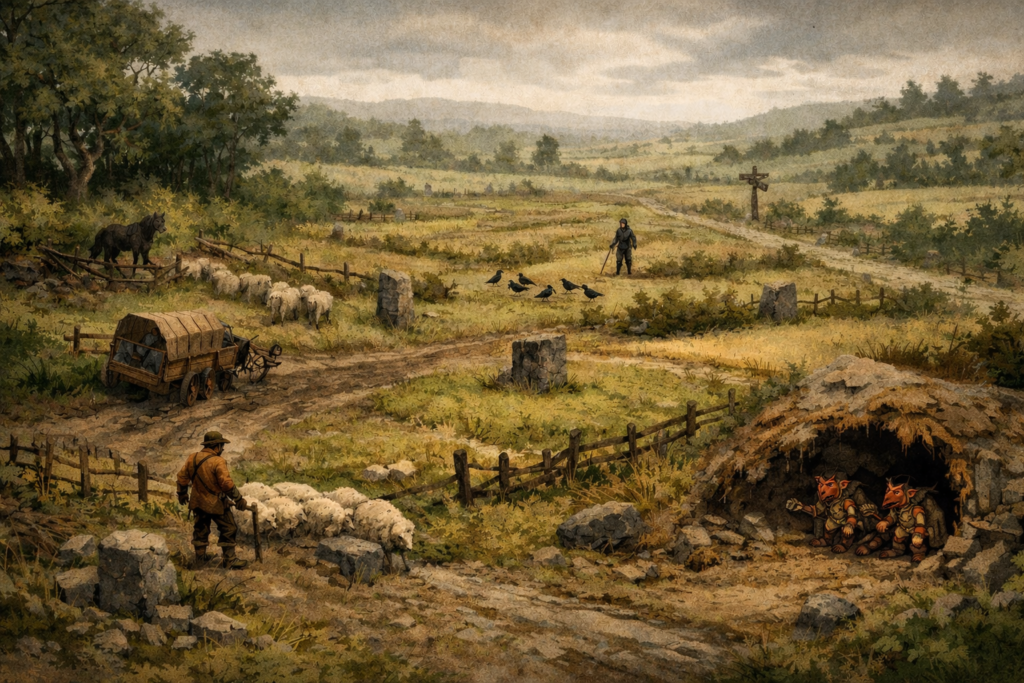
Where Movement Begins to Fail
Role in the Adventure
The Broken Boundary Field is the first major landscape section in which the players can see that the disturbance is not tied to a single road or isolated incident.
This is where the pattern becomes spatial.
The field allows the players to:
- observe that the anomaly follows lines rather than broad areas
- test movement, crossing, and route choice in open ground
- connect the wolves, kobolds, and disturbed markers into one larger structure
- recognize that older divisions still govern the land, even when no longer clearly visible
This section should move the adventure from suspicion into active experimentation.
Description
The Broken Boundary Field is a broad stretch of worked land divided by hedgerows, shallow ditches, half-buried stones, and faint changes in slope that once marked clear divisions of use and claim.
At first glance, it appears ordinary.
The crops are uneven, the ground is serviceable, and the old lines look no different from the remnants of any old field system left partly neglected over generations.
But movement across the field does not behave consistently.
What should be a simple walk from one side to the other becomes uncertain, delayed, or wrong.
Current Situation
The field is still being used, but badly.
- workers avoid certain routes without always knowing why
- livestock resist entering particular sections
- loads carried across the field arrive late or by a different path than intended
- familiar shortcuts no longer behave like shortcuts
- the visible layout of the land no longer matches the way passage actually works
This is one of the clearest places in Mensfelden where the old and present landscape no longer agree.
What the Players See
When the players enter or observe the field, they should notice signs that movement is being shaped by something invisible but consistent.
Possible signs include:
- a farmhand taking a visibly longer route to avoid an apparently open stretch of ground
- a cart track bending strangely around no visible obstacle
- livestock bunching at one edge of the field and refusing to cross
- birds landing freely where people and beasts hesitate
- old stones or ditch-lines that do not match the field’s current use
Nothing here should look dramatic in isolation.
Taken together, however, these signs should make the players understand that the field is governed by rules they cannot yet fully see.
Core Feature of the Field
The Broken Boundary Field is not dangerous because it is cursed ground.
It is dangerous because it still behaves as though older divisions of land are in force.
In this area:
- crossing points matter
- direction matters
- method matters
- visible terrain is not always the true guide to safe movement
This is where the players should begin to realize that the anomaly is selective, not random.
What the Players Can Do Here
This location is best run as a space for observation, trial, and inference.
The players may:
- cross the field directly
- follow the visible hedgerows or ditches
- watch animals or workers choose routes
- test the ground with poles, thrown objects, or markers
- compare present field use to older lines and stones
- attempt to identify where movement succeeds and where it fails
The field should reward care and experimentation, even if it does not immediately reveal the whole system.
Boundary Effects in the Field
When the players cross the field carelessly or choose a route that cuts across older divisions, use one or more of the following effects:
- they lose time without understanding where it went
- they emerge slightly off their intended line of travel
- they return nearer to a previous point than they should
- one character feels briefly turned around in open ground
- an animal or mount stops at a point that appears clear
Use these lightly. The field should feel resistant and patterned, not overtly magical.
Clear Clue Layer
This location should provide at least one obvious, visible clue that cannot be missed.
Use one or more of the following:
- a beast refuses to cross a line that is invisible to the players
- a worker warns the party away from a route that “never comes out right”
- tracks cluster along one line and avoid another
- a thrown object lands beyond an old marker, but retrieving it requires an unexpectedly indirect path
- one of the half-buried stones clearly aligns with another farther off, suggesting a boundary line rather than random field debris
At least one clue here should make it plain that the disturbance follows lines.
Connection to Earlier Encounters
The Broken Boundary Field is where earlier incidents begin to make sense.
It can connect directly to:
- 3. Wolves in the Hedgerow — the wolves’ refusal to cross now has a visible spatial context
- 4. Displaced Kobolds at the Broken Earth — the collapsing tunnel and one-way fear now point toward a larger structure beneath the land
- 6. False Toll Keepers — the idea of safe routes becomes materially understandable here
This section should make the earlier encounters feel like evidence, not isolated episodes.
Social and Practical Consequences
The field is not merely mysterious. It is disruptive.
Its instability affects:
- labour and planting
- herding and droving
- access between village and outlying work sites
- trust in familiar routes
- arguments over where people are “supposed” to cross
The field shows why the anomaly matters beyond atmosphere.
It damages ordinary life.
What the Players Can Learn
By exploring or observing the field, the players should be able to infer:
- the disturbance follows hidden divisions rather than broad zones
- some crossings still work if approached correctly
- older lines remain active even when present use ignores them
- movement is governed by relation to the land, not by modern convenience
This is an important midpoint in the adventure’s logic.
The players do not yet know everything, but they should now know enough to stop treating the problem like random supernatural interference.
Leads Forward
The Broken Boundary Field should direct the players naturally toward one or more of the following:
- 8. The Road That Fails — once they understand that route choice matters, the failing road becomes more legible
- 9. The Lahn Crossing — the same logic may apply to water and crossing points
- 11. The Disturbed Boundary — the field’s lines suggest that something has been moved, broken, or misaligned
- 12. The Old Barrow — if local memory or visible markers point toward older claims tied to burial ground
The field should not answer the mystery.
It should sharpen it.
GM Guidance
Run the Broken Boundary Field as a place of visible inconsistency.
Do not turn it into a puzzle with one hidden answer.
Instead, let the players build understanding through:
- repeated observation
- route testing
- animal behaviour
- relation between old markers and present use
The goal is not to trap the party in the field.
The goal is to teach them how the land is behaving.
If they miss subtle clues, make one concrete:
- a line of tracks
- a balking animal
- a visible route that fails
- a worker’s practical warning
What This Section Reveals
By the end of this section, the players should understand:
- the anomaly follows old divisions of land
- movement is shaped by crossing behavior, not just destination
- open terrain can be governed as strongly as roads or structures
- the problem is structural, not random
This is where the field itself becomes evidence.
Purpose
This section:
- makes the pattern visible in open ground
- turns suspicion into experimentation
- connects earlier encounters into a coherent landscape logic
- prepares the players for the road, crossing, and disturbed boundary ahead
Result
If run correctly, the Broken Boundary Field should:
- give the players a place to test ideas safely enough to learn
- reveal that the disturbance follows lines, not areas
- make the wider lordship feel governed by a hidden but consistent structure
- deepen the sense that the land is not breaking down, but enforcing something older
8. The Road That Fails (Mensfelden)
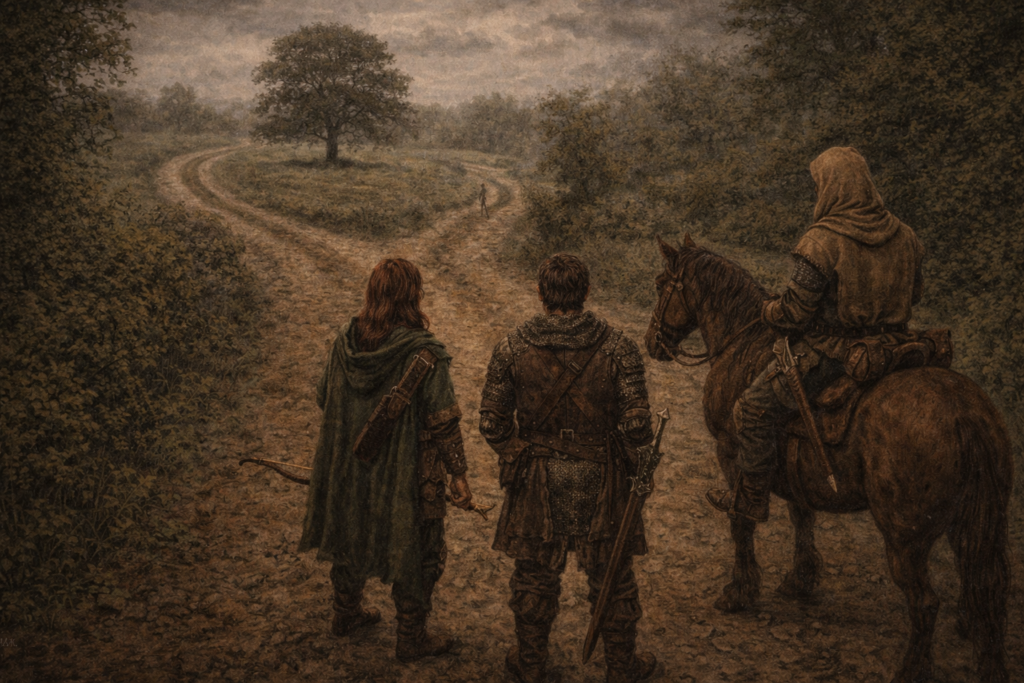
The Land Refuses Passage
Encounter Type
Environmental / exploration encounter
No primary creature
Escalation scene
Setup
This encounter begins once the players move beyond the bandit-held stretch of road or attempt to travel deeper into Mensfelden.
At first, nothing appears unusual.
That is the first sign that something is wrong.
This scene should mark the shift from “the road is troubled” to “movement itself is being governed.”
Read-Aloud Text
The road continues as before—packed earth worn by years of travel, bordered by hedgerow and field.
Nothing changes.
And yet, after a time, something begins to feel wrong.
A bend in the road seems familiar. A tree stands where you are certain you have already passed it. The ground beneath your feet feels no different, but the distance behind you stretches strangely in memory.
When you stop and look back, the road does not seem to match how far you have come.
What the Players Experience
As they travel, the players begin to notice that ordinary movement no longer guarantees ordinary progress.
Use one or more of the following signs:
- Landmarks appear repeated or subtly misplaced
- Travel takes longer than expected
- Tracks seem to double back without explanation
- Direction becomes uncertain
- A tree, ditch, or bend in the road appears twice when it should not
- The party returns to a place they recognize sooner than should be possible
At least one repeated landmark should be unmistakable. The encounter must provide one visible, concrete sign that the failure is patterned rather than arbitrary.
Core Effect
Movement no longer guarantees progress.
The players are not lost because they chose badly. They are being turned, delayed, or misdirected by the land itself.
Mechanics
Navigation Breakdown
5e
When travelling through this section, one character leading the way must make a DC 13 Wisdom (Survival) or Intelligence (Investigation) check.
Success:
The party progresses normally for this stretch.
Failure:
The party unknowingly loops, drifts off course, or returns toward a familiar location. After 10–15 minutes of travel, they realize they have not made the progress they expected.
A failed check should always reveal something useful as well as denying progress.
Pathfinder 1e
One character leading the way must make a DC 13 Survival check.
Success:
The party progresses normally for this stretch.
Failure:
The party becomes disoriented and travels in a circle, drifts off course, or returns near a familiar point without meaning to.
Again, failure should always teach something.
Failure Must Teach
Whenever the party fails to progress, add a clue.
Examples:
- The same marked tree appears again from the wrong direction
- The same wheel rut crosses the road twice
- A tossed stone lands normally on one side of the road but oddly on another
- An animal balks at the same point each time
- The party’s own tracks avoid one strip of ground and reappear elsewhere
Do not allow the encounter to produce empty repetition. Every failed attempt should teach the players more about the pattern.
Directional Instability
At the GM’s discretion, especially after repeated failures, add one escalation effect:
- One character briefly loses all sense of direction
- The party emerges slightly off course
- A familiar landmark appears in an impossible position
- The road seems to approach a known point from the wrong angle
Use these sparingly. One or two clear distortions are more effective than constant uncertainty.
Animal Resistance
Mounts and pack animals sense the problem before most people do.
They may:
- refuse to move forward
- rear, balk, or pull away
- become agitated near unseen lines in the road or field
5e
DC 12 Wisdom (Animal Handling)
Failure: the animal refuses to advance.
Pathfinder 1e
DC 12 Handle Animal
Failure: the animal refuses to advance.
Animal behavior should be one of the clearest clues in the encounter. Even if the players miss subtler signs, they should see that beasts react consistently to certain lines or places.
Clue Layer
Careful observation, repeated testing, or even failed travel attempts reveal that:
- the disturbance affects only certain stretches of land
- some paths still function normally
- others fail in a consistent pattern
- the anomaly follows lines the players cannot yet fully see
This is the point where the players should stop thinking of the road as broken and start thinking of the land as selective.
Key Discovery
A successful check, repeated testing, or cautious experimentation reveals one or more of the following truths:
- progress is possible only along certain routes
- those routes align with older divisions of land
- failing roads cross boundaries that are no longer being properly observed
- the “wrong” path is not always blocked, but it does not reliably permit passage
By the end of the scene, the players should understand that the problem is structured.
Escalation Options
Use one or two of these effects, not all at once.
Hard Loop
The party returns exactly to a place they know they already passed. Enough time has gone by to make this deeply unsettling.
Offset Arrival
The party reaches a point that should be ahead of them, but approaches it from the wrong direction.
Sensory Displacement
Sounds carry incorrectly. A voice seems to come from behind when no one is there. Running water is heard from the wrong side of the road.
Do not repeat a full loop more than twice without introducing a new clue or a new way forward.
Player Solutions
Players may try to overcome the road by:
- marking their route physically
- following animal tracks
- watching terrain contours rather than the road itself
- testing the ground with poles, rope, or thrown objects
- moving cautiously along suspected safe lines
- retracing the same route with different crossing behavior
These methods should not fully solve the problem, but they should provide:
- partial progress
- useful information
- bonuses on later checks
- stronger understanding of what the land is doing
Reward experimentation. The encounter should teach players how this adventure wants to be played.
What This Reveals
By the end of the encounter, the players should understand:
- the problem is not an ambush
- the problem is not a blocked road
- the problem is not even a creature
- the land itself is enforcing a rule
Core Realisation
In this place, movement requires more than intent.
It requires permission.
Purpose
This encounter should:
- shift the adventure from ordinary danger to deeper pattern
- create uncertainty without removing player agency
- reinforce the central themes of boundary, control, and right of passage
- teach the players that failure can still produce understanding
GM Notes
- Do not overuse loops; once or twice is enough
- Let the players identify the pattern through play
- Avoid turning confusion into frustration
- Every failed attempt should reveal a clue
- If the players become stuck, make the next sign clearer rather than more obscure
Result
This encounter should:
- feel distinct and memorable
- reinforce the core anomaly
- add mechanical depth without unnecessary complexity
- prepare the players for the disturbed boundary and the deeper truth behind the adventure
9. The Lahn Crossing
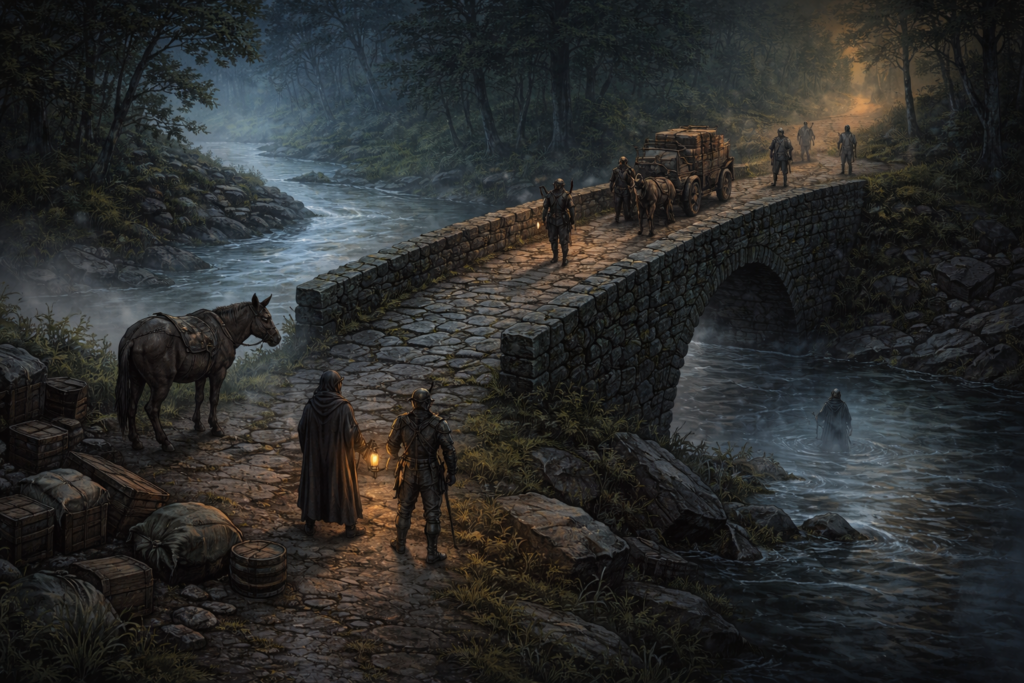
Where Passage Becomes Conditional
Role in the Adventure
The Lahn Crossing is the first place where the players can see that the disturbance governs not only roads and fields, but passage itself.
This section should make one thing unmistakable:
the problem is not tied to one surface, one path, or one kind of terrain.
The same hidden structure that shapes roads and field boundaries also governs water, crossings, and thresholds.
This location allows the players to:
- observe selective failure at a crossing point
- recognize that passage is no longer neutral
- test whether method, acknowledgment, or approach affects success
- connect the logic of land boundaries to river movement
- prepare for the interpretive shift introduced by the Nix
This is where the players should begin to understand that crossing is no longer a matter of effort alone.
Description
The Lahn Crossing is a narrow stone bridge spanning the river, familiar to traders, drovers, villagers, and travellers moving through the lordship.
It is not ruinous or blocked.
The bridge still stands. Its parapets remain sound, its stones are worn by long use, and the road approaches cleanly on both sides.
And yet the crossing no longer behaves as a crossing should.
Some who pass do so without issue.
Others stop midway, turn back, lose confidence, or emerge disoriented and unable to explain why.
The structure remains.
The certainty of passage does not.
Current Situation
The bridge is still in use, but uneasily.
- travellers hesitate before stepping onto it
- drovers and teamsters argue over whether to risk the far side
- animals sense the problem sooner than most people
- abandoned goods and broken routine collect near the bridgehead
- local guides no longer trust that the same approach will work twice
People speak of the crossing as though it has moods.
It does not.
It has conditions.
What the Players See
When the players arrive, they should notice signs that this place is not simply dangerous, but selective.
Possible signs include:
- a cart stopped short of the bridge while its driver argues with companions
- a mule or horse refusing to set hoof on the stonework
- cargo left near the bank because its owner would not cross again before daylight
- a traveller who insists the bridge “shifted” beneath him, though nothing visible has moved
- footprints, hoofprints, or wheel marks that suggest hesitation, doubling back, or repeated approaches
Nothing should indicate collapse, ambush, or obvious magical manifestation.
The place should feel usable and wrong at the same time.
Core Feature of the Crossing
The Lahn Crossing is where the players should learn that passage is no longer automatically granted.
At this location:
- the threshold matters more than the road leading to it
- hesitation and confidence can produce different outcomes
- beasts and people react differently, but consistently
- the river and bridge obey the same hidden structure as the surrounding land
The crossing should teach the players that the anomaly is not about roads failing.
It is about rights of passage being enforced.
What the Players Can Do Here
This location is best run as a place of observation, testing, and controlled risk.
The players may:
- attempt the crossing directly
- observe others trying to cross
- test different approaches to the bridgehead
- watch how animals respond to the threshold
- compare successful and unsuccessful attempts
- speak to stranded travellers, drovers, or guides
The crossing should reward careful attention.
It does not need to be immediately dangerous to be deeply unsettling.
Passage Effects at the Crossing
When the players or NPCs attempt the crossing carelessly, uncertainly, or in disregard of what the place is teaching, use one or more of the following effects:
- a character stops short without fully understanding why
- a mount or pack animal balks and refuses to advance
- someone reaches the far side but feels as though the crossing took longer than it should
- a traveller turns back midway with no clear cause
- a person emerges from the bridge disoriented, as though they approached from the wrong direction
Use these effects with restraint. The crossing should feel conditional, not chaotic.
Clear Clue Layer
This location should provide at least one obvious, visible clue that passage is being governed rather than randomly obstructed.
Use one or more of the following:
- an animal refuses to step onto a section of the bridge that appears completely safe
- one traveller crosses normally while another fails at nearly the same point moments later
- a local warns that “the bridge allows some and turns others back”
- wheel tracks or hoofprints show repeated failed approaches to the same threshold
- a character notices that a respectful or deliberate crossing meets less resistance than a hurried one
At least one clue here should make it clear that success is conditional.
Social and Practical Consequences
The crossing is not merely eerie. It is economically and socially disruptive.
Its instability affects:
- trade moving through the lordship
- droving and livestock movement
- communication between village, field, and road
- trust in local authority
- willingness to travel after dusk or alone
The Lahn Crossing shows that a failed crossing is not just a strange event.
It changes how a region functions.
What the Players Can Learn
By observing, testing, or speaking to those affected, the players should be able to infer:
- passage is no longer neutral
- the same bridge can succeed or fail under different conditions
- beasts sense the threshold before people do
- the hidden rules affecting roads and fields also govern crossings
- correct approach may matter as much as destination
This is a crucial interpretive step.
The players should begin to understand that passage itself has become conditional.
Connection to Other Sections
The Lahn Crossing connects naturally to:
- 8. The Road That Fails — the selective road logic continues here at a threshold
- 10. The Nix at the Lahn Crossing — the bridge provides the perfect setting for a witness to the old order
- 11. The Disturbed Boundary — once the players understand conditional passage, the meaning of disturbed markers becomes clearer
- 12. The Old Barrow — if the GM wants to deepen the connection between old rights, burial, and claim
This section should make the world feel more coherent, not more mysterious for its own sake.
Leads Forward
The crossing should point the players toward one or more of the following:
- The Nix — if the players hesitate, question, or seek meaning rather than merely trying to force passage
- The Disturbed Boundary — if they begin asking why crossing points are behaving differently
- The Old Barrow — if local memory links the bridge and river to older claims, sworn limits, or burial rights
- The Boundary Nexus — if the players now understand that the whole lordship is governed by one connected system
The crossing does not explain the mystery on its own.
It sharpens the players’ sense of what kind of mystery this is.
GM Guidance
Run the Lahn Crossing as a place of visible hesitation and conditional passage.
Do not make it feel like a puzzle bridge or a magical barrier.
Instead, let the players learn through:
- watching failed and successful attempts
- animal behaviour
- subtle threshold effects
- social testimony from stranded travellers
- changed behaviour in those who depend on the crossing
If the players miss quieter clues, make one practical and visible:
- a balking horse
- a stranded drover
- abandoned goods near the bridgehead
- one obvious failed crossing attempt
The goal is not to stop the party.
The goal is to teach them that passage has become something the land grants or denies.
What This Section Reveals
By the end of this section, the players should understand:
- passage is no longer automatic
- the anomaly affects crossings as well as roads and fields
- success and failure now follow conditions the players can begin to observe
- the problem is broader and more structured than it first appeared
This is where the logic of the adventure moves from route failure to conditional passage.
Purpose
This section:
- extends the anomaly from land into threshold spaces
- reinforces the idea that crossing is governed, not free
- prepares the players for the Nix encounter and deeper interpretation
- strengthens the sense that Mensfelden is held inside one connected system
Result
If run correctly, the Lahn Crossing should:
- make the players pause and test how passage now works
- show that water and thresholds obey the same hidden rules as land
- deepen the transition from eerie symptoms to intelligible structure
- prepare the players for the interpretive and revelatory scenes ahead
10. The Nix at the Lahn Crossing
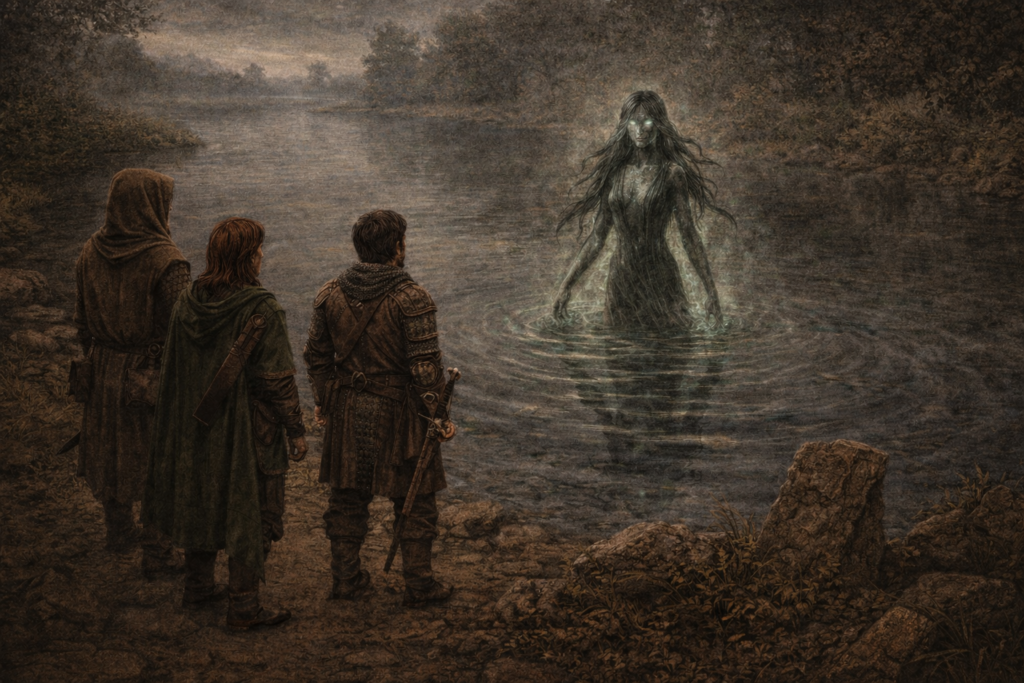
Optional Encounter — Social / Environmental
Role in the Adventure
This encounter introduces a speaking presence that reflects the boundary system.
It provides:
- indirect guidance toward understanding boundaries
- a supernatural witness tied to the river
- a tonal bridge between confusion and understanding
This encounter is optional and does not block progression, but it strongly improves player understanding before the later revelations of the adventure.
Placement
Use at:
9. The Lahn Crossing
Trigger when:
- players hesitate at the crossing
- a crossing attempt fails or feels inconsistent
- the group begins questioning movement, passage, or direction
The encounter works best once the players already suspect that the land is behaving according to hidden rules.
Description (Read Aloud)
The water of the Lahn moves slowly here, its surface smooth but not still.
Something disturbs the reflection—not a ripple, but a shape.
A figure stands beneath the surface, visible only where the light catches it wrong.
Tall. Slender. Not entirely aligned with the water that holds it.
It watches.
When it speaks, the sound comes from the current itself.
“You cross as though the land has forgotten you.”
The Nix
The Nix is a river spirit bound to the older rules of land, passage, and remembered boundaries.
It is:
- not immediately hostile
- unable or unwilling to fully leave the water
- partially submerged, distorted, or visible only through reflection and current
- part of the boundary system, not separate from it
The Nix should feel less like a monster and more like a witness to an older order.
Behavior
The Nix:
- observes before acting
- speaks in indirect, symbolic language
- responds by reframing player statements rather than answering directly
- reveals truth through implication, not explanation
It does not initiate combat.
If threatened, it withdraws rather than fighting openly.
Interaction
The Nix speaks in boundary logic expressed as folklore.
It does not explain the system outright. It reflects it.
This distinction matters. The Nix should clarify the tone and shape of the mystery, not solve it for the players.
Example Dialogue
Use or adapt the following:
- “The lines were set before your names were spoken.”
- “You step where no step was given.”
- “The river remembers who may pass.”
- “You do not cross. You are allowed.”
If the players ask blunt questions, the Nix should answer in ways that reveal principle rather than detail.
What the Nix Communicates
Through conversation, observation, or simple presence, the players may infer:
- movement requires recognition, not force
- boundaries are still in effect
- the disruption is not random
- the land follows rules that can be understood
The Nix does not identify the Nexus directly and does not provide a complete solution.
It should, however, make the players more confident that they are dealing with a system rather than a curse, ambush, or random haunting.
Mechanical Interaction
Use only if needed.
Sense Motive DC 12
The Nix is not hostile.
Knowledge (local or nature) DC 12
This is a river spirit tied to place, crossing, and passage.
Diplomacy DC 12–15
The Nix becomes less distant and slightly less cryptic.
These checks should support the scene, not dominate it.
Offerings (Optional)
If the players offer a token—coin, food, respect to the river, or a spoken acknowledgment of passage—the Nix responds more clearly.
Its tone becomes less distant.
Example response:
“You begin to remember. That is sufficient.”
This should feel like the players are participating in an older custom, even if they do not fully understand it.
Boon (Optional)
If the players engage meaningfully with the Nix, they gain a +2 circumstance bonus on the next check or saving throw made to interact with or cross a boundary.
This bonus applies once and must be used before leaving the Lahn Crossing area.
The boon is small, but it teaches the players that respectful interaction with the system matters.
If the Players Turn Violent
If attacked, the Nix does not remain to fight.
Instead:
- its form breaks apart beneath the surface
- the water distorts briefly, as though resisting intrusion
- the presence vanishes into the current
Do not run this as a full combat encounter.
Even if the players attack immediately, the encounter should still leave one clear impression behind: the water recoils, the crossing feels wrong, and the spirit’s final words or expression should reinforce that passage here is governed, not free.
This preserves the encounter’s narrative purpose even during blunt play.
Exit
The Nix departs when:
- it has been acknowledged or dismissed
- the conversation naturally concludes
- the players move away from the crossing
The scene should end cleanly and not overstay its welcome.
GM Notes
- Do not overplay the encounter
- Keep dialogue brief, reactive, and memorable
- Avoid giving direct answers
- Let the Nix reinforce the pattern without replacing discovery
If the players are insightful, the Nix can sharpen their understanding.
If they are impatient, it should still leave behind one strong idea:
crossing is permitted, not assumed.
Purpose
This encounter:
- humanizes the boundary system
- reinforces the rules through tone and interaction
- gives the players a speaking witness to the old order
- prepares them for the Boundary Nexus without spoiling it
Integration
This scene:
- strengthens 9. The Lahn Crossing
- supports player understanding before 13. The Boundary Nexus
- informs decision-making in 15. Resolution & Outcomes
Final Tone
The Nix is not a guide.
It is a witness to how things were—
and a presence that recognizes they are no longer so.
11. The Disturbed Boundary (Mensfelden)
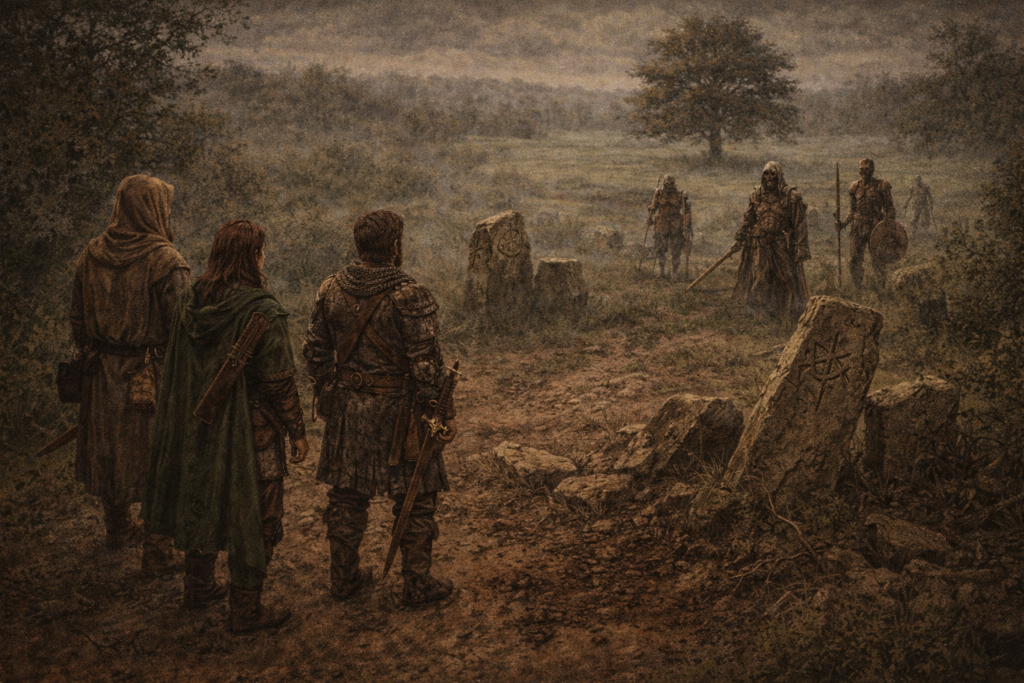
The First True Explanation
Encounter Type
Investigation / boundary encounter
Optional combat
Revelation scene
Setup
This encounter takes place where the failing road and the older divisions of land begin to converge.
The players reach a point where progress repeatedly falters: a field edge, a low rise, a grove margin, or an old line of stones now partly buried and overgrown.
Unlike the wagon or the failing road, this place does not merely feel wrong.
It feels claimed.
This is the first scene where the players should be able to understand, in practical terms, what the land is doing.
Read-Aloud Text
The ground rises slightly here, just enough to overlook the field beyond.
At first glance, the place is unremarkable: rough grass, exposed roots, a line of stone half-hidden by earth and moss.
Then the pattern becomes clear.
One stone stands tilted. Another has sunk. A third lies broken in the grass, its face turned inward. What remains of the line does not mark a road or fence, but something older and more deliberate.
The air feels heavier here.
Not colder. Not hostile.
Simply resistant.
As though this is a place where passage once had to be granted.
What the Players Notice
At a glance, the players should be able to tell:
- the stones form a boundary line, not a wall or a distance marker
- one or more stones have been shifted, dug up, or reset incorrectly
- the ground around them shows disturbance, but not ordinary farming use
- sound seems slightly dulled in the immediate area
With closer inspection, they can identify:
- worn carvings cut into the stone faces
- repeated symbols or marks indicating division, passage, or claim
- different ages of disturbance: some old, some very recent
At least one sign of recent tampering should be obvious without a roll. The players must not leave this scene thinking the anomaly is still random.
Core Discovery
This place governed movement.
Not symbolically, but practically.
These stones once marked where one set of rights ended and another began. Crossing here was never just a matter of walking through. It depended on recognition: of ownership, of obligation, of rightful passage.
Now those lines have been broken.
And the land is responding as though the rule still matters.
This is the first true explanation of the adventure’s central logic.
Optional Guardians
Use only if you want the scene to turn dangerous.
- 1 Wight or Barrow Wight
- 2–4 Skeletons
These undead do not begin as immediate attackers. They stir only if:
- the boundary is crossed carelessly
- the stones are disturbed further
- the players make false claims of ownership or right
- the site is treated as an obstacle rather than a place of rule
If used, the guardians should reinforce the site’s meaning, not distract from it.
Guardian Behaviour
If present, the dead are not simply hostile.
They are reactive.
They respond to:
- stepping across the line without caution
- attempting to move the stones without understanding
- claiming authority over the land without legitimacy
If the players pause, observe, or acknowledge the site carefully, the guardians may hesitate or remain still.
If combat begins, they hold the boundary rather than pursue far beyond it.
That behaviour should make clear that they are bound to the line, not merely present as wandering undead.
Terrain
- Uneven ground surrounds the boundary line
- Low stones, roots, and broken earth create difficult footing
- Visibility is clear enough for observation, but the site feels enclosed despite the open land
Optional Terrain Effect
Any character crossing the line hastily must succeed on a DC 12 Dexterity saving throw (5e) or DC 12 Reflex save (PF1e) or stumble, losing movement for the round as the ground seems to shift underfoot.
This should feel like resistance, not a trap.
Clue Layer
A careful search reveals one or more of the following:
- a stone was moved recently with tools, not weather
- a boundary mark has been turned to face the wrong direction
- a newer claim or usage line crosses the older one incorrectly
- old and recent disturbances overlap in the same place
- the disturbance is human in origin, even if the response is not
This is the first point at which the players should fully understand that someone broke a rule built into the land.
Do not let all of these clues remain optional. At least one should become clear through inspection, experimentation, or the behaviour of any guardians.
What This Reveals
By the end of this encounter, the players should understand:
- the failing roads are tied to disturbed boundaries
- the disruption follows older divisions of land and passage
- the problem is not merely supernatural
- it is legal, territorial, and spiritual at once
This is the scene where the mystery shifts from eerie symptom to understandable system.
Player Options
Players may attempt to:
- examine the stones and markings
- restore one stone to its proper position
- test whether respectful passage changes the effect
- search for signs of who moved the boundary
- confront any guardians that rise from the site
A partial restoration should not solve the whole problem, but it should provide something concrete:
- temporary safe passage
- proof that the system can be influenced
- a clear reduction in local instability
- stronger understanding of the rules involved
Success here should reward the correct mode of play.
Purpose
This encounter serves as the first real explanation of the adventure.
It changes the players’ understanding from:
something is wrong with the road
to:
the land is enforcing a broken system of passage and claim
GM Notes
- This scene should feel like discovery, not exposition
- Let the players infer as much as possible from the site itself
- If combat occurs, keep it short and purposeful
- The most important outcome is not victory, but understanding
- If the players miss the meaning, make the next clue more explicit rather than more mysterious
Result
This encounter should:
- give the first true explanation of the anomaly
- tie the disturbance directly to land, memory, and right of passage
- show that the system can be influenced, not merely endured
- provide a strong transition from early mystery into deeper investigation
12. The Old Barrow
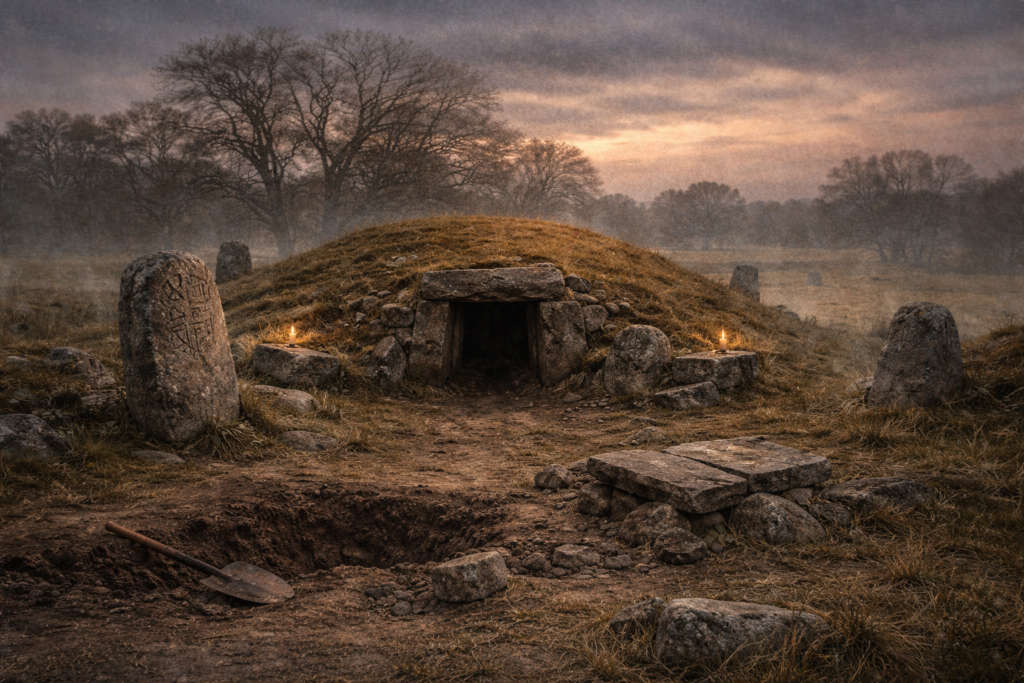
Where the Land Remembers Authority
Role in the Adventure
The Old Barrow is the point at which the players can see that the disturbance is not only practical or spatial, but ancestral.
This section deepens the adventure by showing that the system of land, claim, and passage reaches back beyond living memory.
It allows the players to:
- connect older boundary practice to burial and sworn authority
- see that the disturbance has consequences beyond the living
- understand that some claims were once witnessed and anchored in death as well as law
- encounter resistance that is not random hostility, but reactive enforcement
- strengthen the sense that the whole region is shaped by a forgotten order still capable of responding
The Old Barrow is optional in strict structure, but highly valuable if you want the adventure to gain weight, age, and solemnity before the Boundary Nexus.
Description
The Old Barrow is a low burial mound marked by weathered stones, shallow earthworks, and fragments of older carving half-sunk into the ground. It stands just beyond active farmland, far enough from regular labour to feel abandoned, but close enough to remain tied to the lived geography of Mensfelden.
At first glance, it appears to be only an old grave site—a place left behind as the village and its fields changed around it.
But the mound does not feel forgotten.
It feels withheld.
Even before anything stirs, the place carries the sense that the living are entering ground that still belongs to a prior order.
Current Situation
The barrow has become active.
This does not mean it seethes with open undead menace. Rather, it has begun to respond.
- the ground around the mound feels more structured than the surrounding land
- some travellers avoid the site without knowing why
- boundary stones and burial markers appear more significant here than elsewhere
- recent disturbance—digging, shifting, trespass, or careless passage—has made the place unstable
- the dead, if present, do not respond to intrusion alone, but to broken claim and misused ground
This is one of the clearest places where the players can understand that the old order bound land, lineage, and burial together.
What the Players See
When the players approach the barrow, they should notice signs that this place is tied to the same hidden structure affecting the wider lordship.
Possible signs include:
- a low mound ringed by worn stones or shallow earthwork lines
- old carved markers whose symbols resemble those on disturbed boundary stones elsewhere
- signs of recent intrusion: dug earth, shifted markers, broken turf, or tools left behind
- unnatural stillness around the mound compared to surrounding farmland
- a visible sense that routes around the barrow feel easier than crossing directly near it
The barrow should feel old, real, and embedded in the landscape.
It should not feel like a detached “dungeon site.”
Core Feature of the Barrow
The Old Barrow teaches that some boundaries were not merely practical.
They were sworn, witnessed, inherited, and anchored into the land through burial.
In this place:
- authority predates current ownership
- division of land has funerary and ancestral force
- crossing incorrectly is not just improper, but a violation of remembered order
- disturbance awakens response
The barrow should not merely add undead.
It should make the players understand that the land remembers legitimacy through the dead as well as the living.
What the Players Can Do Here
This location works best as a place of solemn investigation, cautious testing, and possible escalation.
The players may:
- inspect the mound, stones, and carvings
- compare markers here to those seen in fields or at disturbed boundaries
- search for signs of recent trespass or tampering
- test how movement around the mound differs from movement across it
- restore a shifted marker or reposition broken stone
- attempt respectful acknowledgment before crossing or examining the site
- confront any guardians that rise in response
The Old Barrow should reward restraint, observation, and respect.
It should become dangerous mainly when treated as inert ground.
Reactive Guardians (Optional)
If you want this location to turn dangerous, the barrow may be defended by one or more of the following:
- 1 Wight or Barrow Wight
- 2–4 Skeletons
These undead do not function as wandering monsters.
They respond to:
- crossing the site carelessly
- disturbing stones or burial markers
- claiming right or authority without legitimacy
- treating the mound as abandoned or meaningless
If used, these guardians should reinforce the meaning of the place, not turn it into a generic fight.
Guardian Behaviour
If undead are present, they should behave like enforcers of boundary and claim.
They:
- rise in response to trespass, false claim, or further disturbance
- hold ground rather than pursue far beyond the site
- hesitate if the players approach with visible caution or acknowledgment
- react more strongly to attempts to move markers than to mere proximity
This behaviour should make clear that they are not simply hostile dead.
They are part of the structure the players are uncovering.
Treasure
If the players search the Old Barrow carefully, they can recover the following items.
Oath-Ring of the Barrow Claim
A heavy silver ring, engraved on the inner band with worn symbols of division and witness. It is worth 45 gp as worked silver, though a local elder, steward, or antiquarian might value it more highly as proof of an older claim.
Broken Boundary Marker Shard
A carved fragment of dressed stone bearing the same marks found on disturbed boundary stones elsewhere in Mensfelden. It has little sale value, but it is strong physical evidence that the burial site and the wider boundary system are linked. Presenting it alongside other clues should grant the players advantage, a +2 bonus, or similar narrative leverage on later attempts to explain the situation to local authorities.
Ceremonial Grave Knife
This long, narrow blade was buried as a token of office rather than war. Its bronze fittings and age make it worth 25 gp to a collector, but its greater value is symbolic: it marks the dead as someone who once held recognized standing over land or passage.
Token of Recognized Passage
A palm-sized disc of bone and bronze, pierced for wearing on a cord. If carried openly and used with deliberate intent, it grants its bearer a one-time +2 bonus on a saving throw, skill check, or ability check made to cross, interpret, or resist a boundary effect in Mensfelden. Once used, the token becomes an ordinary antiquity worth 10 gp.
Boundary Effects at the Barrow
When the players cross the site carelessly or disturb it without understanding, use one or more of the following effects:
- a character stumbles or loses movement near a burial line
- the ground feels briefly resistant beneath a footstep
- sound seems dulled within the ring of stones
- an attempted route across the mound feels subtly wrong or misaligned
- an old marker seems more significant after crossing than before
Use these effects lightly. The barrow should feel resistant and watchful, not overtly trapped.
Clear Clue Layer
This location should provide at least one clear clue that connects burial, boundary, and legitimacy.
Use one or more of the following:
- a burial marker bearing symbols similar to those on boundary stones elsewhere
- a shifted or broken stone that was plainly moved by tools, not weather
- overlapping signs of old claim and recent disturbance in the same place
- a guardian that reacts only when a boundary is crossed or a claim is asserted falsely
- visible routes around the barrow feeling less resistant than those through its inner lines
At least one clue here should make it plain that the old order tied land and burial together.
What the Players Can Learn
By exploring, testing, or surviving the barrow’s response, the players should be able to infer:
- some boundaries were sworn into the land through the dead
- the anomaly is tied to older authority, not merely magical force
- recent disturbance has awakened consequences that current villagers do not understand
- the same structure affecting fields and crossings also governs burial ground
This is where the players should begin to grasp the full age and seriousness of the system.
Social and Historical Consequences
The Old Barrow is not important because it is spooky.
It is important because it reveals what kind of world once existed here.
It suggests that:
- land was once divided according to a more binding order
- burial and property were linked
- legitimacy was witnessed, remembered, and enforced beyond death
- current use of the land may rest on forgotten contradiction
The barrow gives depth to the problem.
It shows that the disturbance is not just inconvenience. It is inheritance returning to relevance.
Connection to Other Sections
The Old Barrow connects naturally to:
- 11. The Disturbed Boundary — both reveal that markers, claims, and old divisions have been physically altered
- 9. The Lahn Crossing — both show that passage depends on recognition, not effort
- 13. The Boundary Nexus — the barrow prepares the players to understand that the final site is not the origin of a curse, but the center of a system
- 14. Core Truth / GM Brief — the barrow foreshadows the full explanation before the GM-facing section makes it explicit
This section should make the wider structure feel older, more solemn, and more binding.
Leads Forward
The Old Barrow should direct the players toward one or more of the following:
- 11. The Disturbed Boundary — if they begin focusing on moved markers or broken lines
- 13. The Boundary Nexus — if they now understand that the disturbance belongs to one larger regulating structure
- 14. Core Truth / GM Brief — in publication order, this section helps prime the GM’s explanation through play evidence
- 15. Resolution & Outcomes — by showing that some consequences of restoration or severance will affect inherited order as well as present convenience
The barrow should not answer the mystery by itself.
It should deepen it and give it weight.
GM Guidance
Run the Old Barrow as a place of solemn resistance.
Do not make it feel like a random side quest or a detached undead encounter.
Instead, let the players learn through:
- visual continuity between burial and boundary markers
- signs of recent human disturbance
- cautious movement and response
- reactive undead behaviour, if used
- the sense that this place still belongs to a prior order
If the players miss subtle clues, make one visible:
- a moved marker
- a recognizable carved symbol
- a guardian that rises only at a false crossing
- a route that becomes easier when approached respectfully
The goal is not to frighten the party away from the site.
The goal is to show that the land remembers authority through the dead as well as the living.
What This Section Reveals
By the end of this section, the players should understand:
- authority here predates current rule
- burial, boundary, and legitimacy were once tightly linked
- recent disturbance has consequences beyond the living
- the anomaly is legal, territorial, and spiritual at once
This is where the adventure’s hidden structure gains historical and moral weight.
Purpose
This section:
- deepens the age and seriousness of the boundary system
- connects land division to burial and inherited authority
- adds solemnity before the final encounter
- prepares the players to understand the Nexus as the center of an older order, not a random supernatural outbreak
Result
If run correctly, the Old Barrow should:
- make the players feel they are dealing with inheritance, not just anomaly
- strengthen the link between boundary and legitimacy
- add depth and gravity to the investigation
- prepare the ground emotionally and intellectually for the Boundary Nexus
13. THE BOUNDARY NEXUS
Mensfelden — Final Encounter
Arrival (Read Aloud)
The trees thin into a low rise where the ground feels… arranged.
Stones stand at uneven intervals—some upright, some fallen—yet none seem misplaced. Thin lines of bare earth cut across the grass, half-hidden, as if something once marked them clearly.
Roots push up through the soil like veins, crossing and recrossing the space.
The air is still.
Not quiet—held.
As you step forward, there is a subtle resistance. Not enough to stop you.
Just enough to make you aware—
You are no longer certain where you are allowed to walk.
Encounter Summary
Type: Social / Environmental Encounter
Primary Challenge: Understanding and navigating boundary rules
Secondary Challenge: Interaction with the Boundary Keeper
Combat: Optional, triggered by player aggression
Scene Setup
The clearing is divided by invisible boundary lines.
- Movement across them is not automatic
- The space responds to how the characters move
- Careless movement causes displacement or denial
Do not explain this immediately. Let the players discover it through interaction.
Immediate Hook
Use one of the following as soon as the party enters:
- A villager is trapped, unable to leave
- A pack animal panics at unseen lines
- One character unknowingly returns to their starting point
- A boundary stone subtly shifts
This gives the scene immediate pressure and makes the hidden structure of the space tangible.
Running the Space
Core Rule
Only enforce boundary effects when characters cross, disturb, or test the lines.
The purpose of the scene is not to punish movement, but to reveal that movement here is governed.
Detecting Boundaries
Passive Perception 12+
The character notices irregular spacing, bare lines in the earth, or an unnatural pattern to the clearing.
Active Checks
- Wisdom (Perception) DC 12: locate a boundary line
- Intelligence (Nature or History) DC 12: recognize that the line marks an older division or claim
Crossing a Boundary
Careless Crossing
Use this when a character moves without pausing, observing, or acknowledging the space.
Wisdom save DC 13
On a failure, choose one:
- the character reappears where they started
- the character veers off course without realizing it
- the character briefly loses orientation
Describe the effect subtly. Do not present it like a trap or a failed puzzle answer.
Intentional Crossing
If a character pauses, acknowledges the line, and steps deliberately, allow the crossing with no roll required.
The encounter should reward understanding and care.
Encouraging Play
Reward characters who:
- test the ground
- mark lines or crossing points
- alter how they move
- ask questions about the space
- experiment with respectful passage
Any of these should grant clearer information, partial success, or reduced resistance.
Escalation Track
Increase pressure only if the players ignore what the clearing is teaching them.
Stage 1 — Subtle
- minor displacement
- slight confusion
- hesitation in movement
Stage 2 — Noticeable
- forced repositioning
- characters begin to separate
- visible mismatch between intended and actual path
Stage 3 — Active Resistance
- movement denied
- stronger interference
- the Keeper manifests, if it has not already done so
Do not let escalation become repetitive. Each stage should either increase pressure or make the pattern clearer.
The Boundary Keeper
Appearance Trigger
The Keeper manifests when the first of the following occurs:
- a boundary marker is disturbed
- a character repeatedly attempts to leave without adapting
- the party crosses three or more boundaries incorrectly
- the group spends several minutes resisting the rules of the clearing rather than learning them
Manifestation (Read or Paraphrase)
The ground aligns.
Stones tilt. Roots tighten. Soil gathers into form.
A figure stands where none stood before—tall, indistinct, shaped from earth and markers.
Its form never settles.
Where a face should be, there is only absence… and attention.
It does not walk.
It repositions.
And now it is aware of you.
Running the Keeper
Nature
The Keeper is not hostile by default.
It enforces rules, not emotions.
It speaks in terms of claim, boundary, and right.
Opening Challenge
Choose or improvise one of the following:
- “You cross without recognition. Why?”
- “Which claim permits your passage?”
- “Where do you stand?”
Interaction Rules
- Let the players answer freely
- Do not require specific wording
- Judge responses based on intent, confidence, and understanding
The Keeper should feel rigid, not arbitrary.
Keeper Reactions
- Observant, careful: allows experimentation
- Confused, inconsistent: increases pressure through movement effects
- Assertive, logical: engages directly
- Aggressive: escalates immediately
Environmental Effects
Use one effect at a time when needed:
- Deny Movement: the character cannot move forward this turn
- Push Back: move the character 10–15 feet away
- Disrupt Action: the character loses its action unless it succeeds on a DC 13 Wisdom save
- Silent Shift: the character is repositioned without noticing how
Use these sparingly. They are meant to create pressure, not overwhelm the scene.
If Combat Occurs
Only if the players initiate violence:
- the Keeper does not fight like a normal creature
- use environmental effects and battlefield control instead of straightforward attacks
- the terrain itself should become the primary threat
If the players reduce the scene to a standard slugging match, reintroduce the logic of the space through movement denial, repositioning, and boundary pressure.
Transition to Resolution
Move to 15. Resolution & Outcomes when the players do one or more of the following:
- ask how to fix, claim, or stop the situation
- interact intentionally with markers or lines
- engage meaningfully with the Keeper
- clearly choose a course of action
This scene is not the solution. It is the point at which the problem becomes fully legible.
Scene End State
This encounter ends when:
- the players understand the system well enough to act deliberately
- the players choose a resolution path
Do not resolve the entire problem here.
This scene reveals the full structure of the problem. The next section resolves it.
GM Intent
Run this as:
- a space with rules, not chaos
- a system to be understood, not merely survived
- a final encounter that rewards adaptation over force
Result
If run correctly, the players will:
- change how they move
- recognize patterns in the clearing
- engage with the Keeper as more than a monster
- realize that they must choose how the land is resolved
14. Core Truth & Boundary System
Mensfelden — GM Brief
This section explains what is actually happening beneath the adventure.
By the time the players reach the Boundary Nexus, they should have discovered most of this through play. What follows gives the GM the full structure behind the anomaly.
Core Truth
Mensfelden stands within an older system of land division in which boundaries were not merely marked—they were sworn, witnessed, and enforced.
These boundaries:
- defined ownership
- governed movement
- carried authority tied to land, lineage, and burial
They were never symbolic.
They were binding structures embedded into the land itself.
What Has Changed
Over generations, the visible landscape was altered.
- Hedgerows were moved or removed
- Stones were buried, reused, or forgotten
- Fields were merged or reworked
- Burial sites tied to older claims were disturbed
The land people see today no longer matches the land the system recognizes.
The Trigger
The current disruption began when a key contradiction was introduced into that older structure.
This may have taken the form of:
- a marker being displaced or destroyed
- a burial-linked claim being disturbed
- two incompatible land uses being forced to overlap
The result is a condition the system cannot reconcile.
What the Land Is Doing
The land is not corrupted, cursed, or broken.
It is attempting to resolve a contradiction according to its original terms.
To do this, it has begun enforcing the rules by which it once operated:
- movement is resisted when incorrect
- passage requires recognition
- boundaries assert themselves whether visible or not
- authority is determined by older claims, not current ownership
The Boundary System
Think of the land as operating according to a hidden but coherent structure.
- The area is divided into interlocking boundary lines
- Each line represents a claim, agreement, or remembered division
- Crossing them incorrectly produces resistance, delay, or redirection
- Aligning with them allows passage
This is not random.
It is consistent, learnable, and enforceable.
The Boundary Keeper
At the center of this structure is a regulating presence: the Boundary Keeper.
It is not a creature in the ordinary sense, but a manifestation of boundary logic given form.
It represents:
- claim
- division
- correctness
It does not act out of malice.
It exists to:
- identify contradictions
- test legitimacy
- enforce resolution
How the Keeper Thinks
The Keeper does not recognize:
- convenience
- modern ownership
- intent without acknowledgment
It recognizes only:
- valid claims
- proper crossings
- correct alignment
This is why it can seem alien, rigid, or unjust to those living under newer customs.
What the Players Are Really Solving
This adventure is not a monster hunt.
It is a system failure with multiple valid resolutions.
The players are not simply confronting a supernatural force. They are:
- identifying the contradiction
- deciding how the land should function
- choosing whether to restore, override, bargain with, or break the older order
GM Guidance
Run this as:
- a structured environment, not chaos
- a rule-based anomaly, not a puzzle with one answer
- a situation in which observation leads to understanding, and understanding leads to control
The adventure works best when players feel they are learning how the land behaves, rather than waiting for a single hidden explanation to be revealed to them.
Design Intent
By the time the players reach the Boundary Nexus, they should understand three things:
- the events across Mensfelden are connected
- the land is following rules
- their choices will determine how the disturbance ends
That understanding is what makes the final confrontation meaningful.
What the GM Should Understand
After reading this section, the GM should be clear on:
- what the boundary system is
- why it has become active again
- what the Boundary Keeper represents
- what kind of problem the adventure is actually presenting
This is the hidden logic beneath everything the players have encountered so far.
15. RESOLUTION & OUTCOMES
Mensfelden — Final Decision Layer
Resolution Overview
At the Boundary Nexus, the players must choose how to resolve the boundary system.
This is not a single-solution problem. The outcome is determined through action.
There are four primary resolution paths:
- Restoration
- Assertion
- Severance
- Bargain
Each path resolves the situation and leaves lasting consequences.
Resolution Structure
Each path follows the same structure:
- Goal — what is being attempted
- Steps — what must be done
- Checks — when rolls are required
- Outcome — what success accomplishes
- Cost — what changes as a result
1. Restoration — Repair the System
Goal
Re-align the original boundaries and restore the old order.
Steps
- Identify the disrupted boundary marker
- Physically correct its position
- Acknowledge the boundary through word, ritual, or deliberate intent
Checks (if required)
- Intelligence (Investigation) DC 12–14 to locate the correct marker
- Strength (Athletics) DC 10 to lift or reposition it
- Charisma (Persuasion) DC 12 to properly acknowledge the claim
Keeper Reaction
- Observes closely
- Intervenes only if the correction is incorrect
Outcome
- The ground settles and aligns
- Boundaries stabilize
- Movement returns to normal
- The Boundary Keeper withdraws
Cost
- Original land divisions are restored
- Some locals lose access, rights, or land use
2. Assertion — Override the System
Goal
Impose a new authority over the land.
Steps
- Declare a clear and explicit claim
- Establish a visible marker of authority
- Maintain position while the land resists
Challenge (Three Rounds)
Each round, one character must succeed on one of the following:
- Charisma (Persuasion or Intimidation) DC 13
- Wisdom saving throw DC 13
On a failure, the system pushes back with one of the following:
- forced movement
- disorientation
- loss of action
Outcome
- The system stabilizes under the new claim
- The Boundary Keeper yields
Cost
- The land remains tense and unstable
- Future complications are likely
3. Severance — Destroy the System
Goal
Break the boundary system entirely.
Steps
- Destroy two or three key boundary markers
- Continue despite active interference
Checks (if required)
- attack rolls against AC 12, or
- Strength (Athletics) DC 12 to break or dislodge markers
Each marker has approximately 10–15 hit points.
Keeper Response
- Immediately hostile
- Applies constant environmental pressure
Environmental Effects
Use one per round as needed:
- movement denied
- forced movement (10–15 feet)
- action disrupted (Wisdom saving throw DC 13 to act)
Outcome
- The Nexus collapses
- All boundary effects end
Cost
- The land becomes inert and diminished
- Long-term decline in fertility, structure, or cohesion follows
4. Bargain — Negotiate Terms
Goal
Reach an agreement with the Boundary Keeper.
Steps
- Engage the Keeper in direct interaction
- Offer one or more of the following:
- restoration of a boundary
- recognition of an existing claim
- agreement to respect limits or conditions
Checks (if required)
- Charisma (Persuasion) DC 12–14
Outcome
- Partial stabilization of the system
- Controlled or reduced anomalies
Cost
- An ongoing obligation remains
- The system persists in altered form
Failure and Escalation
If the players delay, fail repeatedly, or refuse to engage:
- boundaries become increasingly aggressive
- movement becomes unreliable or impossible
- NPCs may become trapped or lost
- the Boundary Keeper becomes fully hostile
If play stalls, introduce pressure by advancing events without the players’ control. A route may fail completely, an NPC may become trapped, or the Keeper may begin enforcing one outcome through force.
Ending the Adventure
Once a resolution path succeeds:
- the land stabilizes according to that outcome
- the boundary system is resolved, altered, or removed
- the effects across Mensfelden reflect the players’ decision
Outcome Integration
Mensfelden Village
Social order shifts according to the chosen resolution.
Broken Boundary Field
The field stabilizes, realigns, or becomes inert.
Lahn Crossing
Passage becomes reliable, restricted, or largely irrelevant.
Old Barrow
The site remains active, quiets, or loses significance.
Boundary Nexus
The nexus is stabilized, controlled, destroyed, or altered.
GM Guidance
Do not treat one outcome as correct.
Each path should:
- resolve the immediate problem
- change the world around Mensfelden
- produce meaningful consequences beyond the final scene
Final Result
This final phase ensures:
- player choice determines the outcome
- the system is resolved through action
- the adventure ends with clear and lasting consequences
Appendix A. Boundary Keeper — Full Manifestation (5.5e / Pathfinder 1e)
Not intended as a fair fight for Level 3–5.
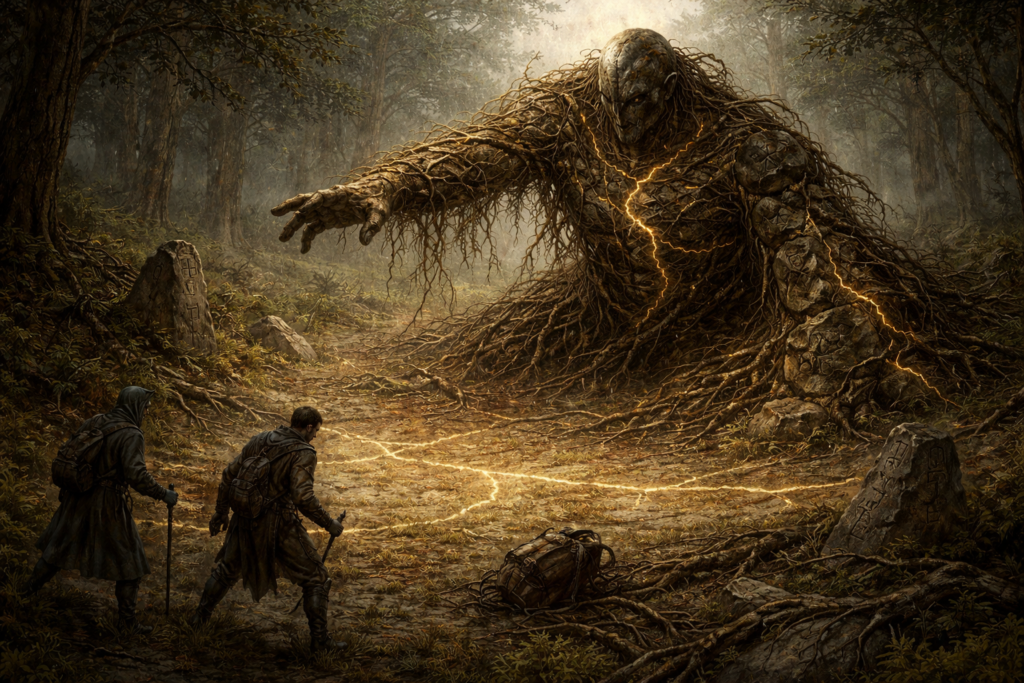
The following versions of the Boundary Keeper represent its full manifested form, not the default combat difficulty of the adventure.
These stat blocks are included as GM reserve material for tables that escalate the final confrontation into open violence, or for campaigns in which the Keeper is intended to function as an overwhelming force rather than a fair fight.
In a standard run of The Fractured Boundaries of Mensfelden, the Keeper is best used as:
- a manifestation of the boundary system
- a pressure engine during the final resolution
- a force that tests legitimacy, movement, and intent
- a presence that can be opposed, bargained with, acknowledged, or defied
It is not intended as a conventional boss encounter for a Level 3–5 party.
As written, the full Boundary Keeper is significantly more powerful than the stated adventure tier and should be used only if the GM wants the final scene to emphasize danger, escalation, or the consequences of attacking the system directly.
GM Use
Use the full manifestation only if one or more of the following are true:
- the party attempts to destroy or overpower the system through direct force
- the Keeper is meant to function as an overwhelming supernatural presence
- the final confrontation is intended to pressure retreat, negotiation, or a non-combat resolution
- the party is substantially stronger than the default adventure level
If you want the Boundary Keeper to serve as a winnable final combat encounter for a Level 3–5 group, use a reduced or limited manifestation instead.
Design Note
The Boundary Keeper is not a traditional monster.
It is a physical expression of claim, division, and enforced passage. Its role is to control space, deny careless movement, and make the logic of the land visible through pressure.
It should be run less like a brute and more like a living rule of the landscape.
BOUNDARY KEEPER 2024 5,5e
BOUNDARY KEEPER, Pathfinder
BOUNDARY KEEPER
Mensfelden — Avatar of Claim and Division
Large elemental (manifestation), neutral
Armor Class 17 (natural armor)
Hit Points 178 (17d10 + 85)
Speed 30 ft. (see Reposition)
| STR | DEX | CON | INT | WIS | CHA |
|---|---|---|---|---|---|
| 20 (+5) | 12 (+1) | 20 (+5) | 14 (+2) | 18 (+4) | 16 (+3) |
Saving Throws Wis +8, Cha +7, Con +9
Skills Insight +8, Perception +8
Damage Resistances bludgeoning, piercing, and slashing from nonmagical attacks
Damage Immunities poison, psychic
Condition Immunities charmed, frightened, prone
Senses tremorsense 60 ft., passive Perception 18
Languages understands all languages but speaks in fragments of claim and law
Challenge 11 (7,200 XP)
Traits
Boundary Form. The Boundary Keeper occupies and controls the ground within 60 feet of itself. This area is considered boundary terrain. The Keeper always knows the location of creatures touching the ground within this area.
Reposition. Instead of moving normally, the Boundary Keeper can teleport up to 30 feet to any point on the ground it can sense. This does not provoke opportunity attacks.
Enforced Division. When a creature moves more than 10 feet without stopping, the Keeper can force a DC 15 Wisdom saving throw. On a failure, the creature is moved back to where it started its movement or to another boundary point within 15 feet (Keeper’s choice).
Claim Recognition. A creature that uses its action to deliberately acknowledge a boundary (speaking intent, marking a line, or pausing to cross) has advantage on saving throws against the Keeper’s effects until the start of its next turn.
Immutable Logic. The Boundary Keeper has advantage on saving throws against spells and effects that would alter its form, movement, or position.
Actions
Multiattack. The Boundary Keeper uses Boundary Pulse and makes one Claim Strike.
Claim Strike. Melee Spell Attack: +8 to hit, reach 10 ft., one target. Hit: 21 (3d10 + 5) force damage, and the target must succeed on a DC 15 Strength saving throw or be pushed 10 feet along a boundary line.
Boundary Pulse (Recharge 5–6). The Keeper reinforces all boundaries within 30 feet.
Each creature in the area must make a DC 15 Wisdom saving throw.
On a failure, the creature:
- Cannot move on its next turn, and
- Has disadvantage on attack rolls until the end of that turn
On a success:
- Movement is halved until the end of the next turn
Mark of Division (Recharge 4–6). The Keeper designates a line within 30 feet.
Creatures crossing that line before the end of the Keeper’s next turn must succeed on a DC 15 Wisdom saving throw or:
- Take 13 (3d8) force damage
- Be repositioned up to 20 feet along the boundary
Bonus Actions
Shift the Line. The Keeper alters one boundary within 30 feet.
- A straight boundary line (up to 20 feet long) shifts position
- Creatures standing on it must succeed on a DC 15 Dexterity saving throw or fall prone
Reactions
Deny Passage. When a creature attempts to leave the boundary area, the Keeper forces a DC 15 Wisdom saving throw.
On a failure, the creature remains in place and loses the remainder of its movement.
Legendary Actions
The Boundary Keeper can take 3 legendary actions, choosing from the options below. Only one legendary action may be used at a time, and only at the end of another creature’s turn.
Reposition. The Keeper uses Reposition.
Displace Creature. One creature within 30 feet must succeed on a DC 15 Wisdom saving throw or be moved 10 feet in a direction of the Keeper’s choice.
Collapse Boundary (Costs 2 Actions). A boundary line collapses.
Creatures within 10 feet of the line must succeed on a DC 15 Dexterity saving throw or:
- Take 11 (2d10) force damage
- Fall prone
Lair Actions (Boundary Nexus Only)
On initiative count 20 (losing initiative ties), the Keeper can take one lair action:
- Realign Terrain. All creatures must succeed on a DC 14 Wisdom saving throw or be moved up to 10 feet.
- Suppress Movement. A 20-foot-radius area becomes difficult terrain until the next round.
- Anchor Claim. One boundary becomes stable; creatures standing on it have disadvantage on saving throws until the next round.
Regional Effects
The area within 1 mile of the Boundary Nexus is affected by the Keeper’s presence:
- Paths subtly shift; travel takes longer than expected
- Animals avoid crossing certain lines
- Travelers report returning to familiar locations unintentionally
If the Boundary Keeper is destroyed or the system resolved, these effects fade over 1d6 days.
Design Notes (GM Use)
- This creature is not meant to behave like a traditional monster
- It controls space, not just damage output
- It becomes hostile only if players attempt to break the system
Role in Play
- A boss encounter if players choose violence
- A pressure engine during resolution
- A physical manifestation of the system, not just an enemy
BOUNDARY KEEPER CR 11
XP 12,800
N Large outsider (earth, native)
DEFENSE
AC 25, touch 10, flat-footed 24 (+1 Dex, +15 natural, –1 size)
hp 161 (14d10+84)
Fort +13, Ref +5, Will +11
Defensive Abilities boundary form;
DR 10/magic; Immune poison; SR 22
OFFENSE
Init +5
Speed 30 ft. (see reposition)
Melee slam +19 (2d8+10 plus enforced division)
Space 10 ft.; Reach 10 ft.
Special Attacks boundary pulse, mark of division, enforced division
STATISTICS
Str 24, Dex 12, Con 22, Int 14, Wis 18, Cha 16
Base Atk +14; CMB +22; CMD 33
Feats Great Fortitude, Improved Initiative, Iron Will, Power Attack, Skill Focus (Perception), Toughness, Vital Strike
Skills Knowledge (nature) +19, Perception +21, Sense Motive +21
Languages understands all languages; communicates in fragmented phrases
SPECIAL ABILITIES
Save DCs are Charisma-based.
Boundary Form (Su)
The boundary keeper controls all ground within 60 feet. This area becomes boundary terrain. The keeper automatically senses all creatures in contact with the ground within this area (as tremorsense).
Reposition (Su)
As a move action, the boundary keeper teleports up to 30 feet to any point within its boundary terrain. This movement does not provoke attacks of opportunity.
Enforced Division (Su)
Whenever a creature moves more than 10 feet within boundary terrain, the keeper may force a DC 19 Will save.
On a failure, the keeper chooses one:
- The creature is moved back to its starting square, or
- The creature is repositioned up to 15 feet along a boundary line
This is a compulsion effect.
Claim Recognition (Ex)
A creature that spends a move or standard action to deliberately acknowledge a boundary (marking, pausing, or declaring intent) gains a +2 bonus on saving throws against the keeper’s abilities for 1 round.
Boundary Pulse (Su)
(usable every 1d4 rounds)
As a standard action, the keeper reinforces all boundaries within 30 feet.
All creatures in the area must succeed on a DC 19 Will save or:
- Be unable to move for 1 round, and
- Take a –2 penalty on attack rolls for 1 round
On a successful save, movement is reduced by half for 1 round.
Mark of Division (Su)
(usable every 1d4 rounds)
The keeper designates a boundary line within 30 feet.
Any creature crossing that line before the keeper’s next turn must succeed on a DC 19 Will save or:
- Take 4d6 points of damage (this damage is not reduced by damage reduction), and
- Be repositioned up to 20 feet along the boundary
Deny Passage (Su)
As an immediate action, when a creature attempts to leave boundary terrain, the keeper may force a DC 19 Will save.
On a failure, the creature’s movement immediately ends.
ECOLOGY
Environment temperate forests, boundary nexuses
Organization solitary
Treasure none
DESCRIPTION
A shifting figure of soil, roots, and ancient stone rises from the land itself, its form defined by lines that should not be visible. It does not walk—it repositions, as though the ground itself obeys it. Where it stands, the land remembers its divisions.
Appendix B. Boundary Keeper — Limited Manifestation (5.5e / Pathfinder 1e)
Appendix B. Boundary Keeper — Limited Manifestation
5.5e / Pathfinder 1e
The following versions of the Boundary Keeper represent a reduced manifestation suitable for the stated level of the adventure.
Use these stat blocks if the party turns the Boundary Nexus into a direct confrontation and you want that confrontation to be tense, thematic, and winnable for a Level 3–5 group.
These versions preserve the Keeper’s core identity:
- it controls space rather than simply dealing damage
- it punishes careless movement
- it rewards deliberate crossing and recognition
- it feels like a living expression of boundary law rather than a conventional brute
Unlike the Full Manifestation, this version is intended for actual play at the adventure’s default tier.
Boundary Keeper — Limited Manifestation (2024 5.5e)
Boundary Keeper — Limited Manifestation (Pathfinder 1e)
Boundary Keeper
Large elemental (manifestation), neutral
Armor Class 16 (natural armor)
Hit Points 95 (10d10 + 40)
Speed 30 ft. (see Reposition)
| STR | DEX | CON | INT | WIS | CHA |
|---|---|---|---|---|---|
| 18 (+4) | 12 (+1) | 18 (+4) | 12 (+1) | 16 (+3) | 14 (+2) |
Saving Throws Wis +6, Con +7
Skills Insight +6, Perception +6
Damage Resistances bludgeoning, piercing, and slashing from nonmagical attacks
Damage Immunities poison
Condition Immunities charmed, frightened, prone
Senses tremorsense 30 ft., passive Perception 16
Languages understands all languages but speaks only in broken phrases of claim and division
Challenge 6 (2,300 XP)
Proficiency Bonus +3
Traits
Boundary Form. The Boundary Keeper controls the ground within 30 feet of itself. This area is boundary terrain. While touching the ground, creatures within that area cannot be hidden from the Keeper.
Reposition. Instead of moving normally, the Boundary Keeper can teleport up to 20 feet to an unoccupied space on the ground that it can sense. This movement does not provoke opportunity attacks.
Enforced Division. Once per round, when a creature in boundary terrain moves more than 10 feet without stopping, the Keeper can force that creature to make a DC 14 Wisdom saving throw. On a failure, the Keeper chooses one of the following:
- the creature’s speed becomes 0 until the end of the turn, or
- the creature is moved up to 10 feet to another point on the ground the Keeper can sense
Claim Recognition. A creature that uses its action to deliberately acknowledge a boundary—by speaking intent, marking a line, or pausing before crossing—has advantage on saving throws against the Keeper’s abilities until the start of its next turn.
Actions
Multiattack. The Boundary Keeper makes two Claim Strike attacks.
Claim Strike. Melee Spell Attack: +6 to hit, reach 10 ft., one target.
Hit: 13 (2d8 + 4) force damage, and the target must succeed on a DC 14 Strength saving throw or be pushed 10 feet along the ground.
Boundary Pulse (Recharge 5–6). The Keeper reinforces all boundaries within 20 feet. Each creature of the Keeper’s choice in that area must make a DC 14 Wisdom saving throw.
On a failure, the creature’s speed is reduced to 0 until the start of its next turn.
On a success, the creature’s speed is halved until the start of its next turn.
Mark of Division (Recharge 4–6). The Keeper designates a line on the ground within 20 feet, up to 15 feet long. Until the start of the Keeper’s next turn, a creature that crosses that line must succeed on a DC 14 Wisdom saving throw or take 9 (2d8) force damage and be moved up to 10 feet along the line.
Reaction
Deny Passage. When a creature in boundary terrain attempts to leave the Keeper’s controlled area, the Keeper can force a DC 14 Wisdom saving throw. On a failure, the creature’s movement immediately ends.
Lair Action (Boundary Nexus Only)
On initiative count 20 (losing initiative ties), the Keeper can take one of the following lair actions:
- Realign Terrain. One creature touching the ground must succeed on a DC 13 Wisdom saving throw or be moved up to 10 feet.
- Suppress Movement. A 15-foot-radius area becomes difficult terrain until the next round.
- Anchor Claim. One visible boundary line becomes stable until the next round. Creatures acknowledging that line have advantage on their next saving throw against the Keeper before initiative count 20 on the next round.
GM Note
This version is intended to feel dangerous but manageable. The Keeper should pressure movement, split the party, and reward careful play, but it should not lock the group out of acting.
Boundary Keeper
CR 6
XP 2,400
N Large outsider (earth, native)
DEFENSE
AC 20, touch 10, flat-footed 19
(+1 Dex, +10 natural, –1 size)
hp 76 (8d10+32)
Fort +10, Ref +3, Will +8
Defensive Abilities boundary form;
DR 5/magic; Immune poison
OFFENSE
Init +5
Speed 30 ft. (see reposition)
Melee
slam +13 (2d6+6 plus enforced division)
Space 10 ft.; Reach 10 ft.
Special Attacks boundary pulse, enforced division, mark of division
STATISTICS
| STR | DEX | CON | INT | WIS | CHA |
|---|---|---|---|---|---|
| 22 | 12 | 18 | 12 | 16 | 14 |
Base Atk +8; CMB +15; CMD 26
Feats Improved Initiative, Iron Will, Power Attack, Skill Focus (Perception), Toughness
Skills Knowledge (nature) +12, Perception +17, Sense Motive +14
Languages understands all languages; communicates in fragmented phrases
ECOLOGY
Environment temperate forests, boundary nexuses
Organization solitary
Treasure none
SPECIAL ABILITIES
Save DCs are Charisma-based.
Boundary Form (Su)
The boundary keeper controls all ground within 30 feet. This area becomes boundary terrain. The keeper automatically senses all creatures in contact with the ground within this area, as tremorsense 30 feet.
Reposition (Su)
As a move action, the boundary keeper teleports up to 20 feet to any point within its boundary terrain. This movement does not provoke attacks of opportunity.
Enforced Division (Su)
Once per round, whenever a creature moves more than 10 feet within boundary terrain without stopping, the keeper may force a DC 15 Will save.
On a failure, the keeper chooses one:
- the creature’s movement immediately ends, or
- the creature is repositioned up to 10 feet along the ground
This is a compulsion effect.
Claim Recognition (Ex)
A creature that spends a move or standard action to deliberately acknowledge a boundary—marking it, pausing at it, or declaring intent to cross—gains a +2 bonus on saving throws against the keeper’s abilities for 1 round.
Boundary Pulse (Su)
Usable every 1d4 rounds.
As a standard action, the keeper reinforces all boundaries within 20 feet.
All creatures in the area must succeed on a DC 15 Will save or have their speed reduced to 0 for 1 round. On a successful save, their speed is halved for 1 round instead.
Mark of Division (Su)
Usable every 1d4 rounds.
The keeper designates a boundary line within 20 feet.
Any creature crossing that line before the keeper’s next turn must succeed on a DC 15 Will save or:
- take 2d6+3 points of damage, and
- be repositioned up to 10 feet along the line
Deny Passage (Su)
As an immediate action, when a creature attempts to leave boundary terrain, the keeper may force a DC 15 Will save. On a failure, the creature’s movement immediately ends.
DESCRIPTION
A shifting figure of earth, roots, and weathered stone rises from the land itself, its outline broken by lines that seem older than sight. It does not walk so much as relocate, as though the ground has already agreed where it belongs. In its presence, the land remembers division.
GM Use
Use the Limited Manifestation when:
- the party chooses violence at the Boundary Nexus
- you want a winnable final confrontation
- the Keeper needs to function as a spatial controller without overwhelming a low-level group
- you want the finale to remain thematic while still allowing a direct combat resolution
Use the Full Manifestation only when you want the Keeper to function as a superior force, a pressure engine, or an intentionally unfair escalation.
Keep this reference growing
If this page helped with your reading or game, you can support its upkeep or explore the curated books.
Explore the Bookshop — epics, classics and stories behind imagined worlds.