Earth Age 03 · c. 359–201 million years ago
Bugs, Amphibians and the Rise of Giants
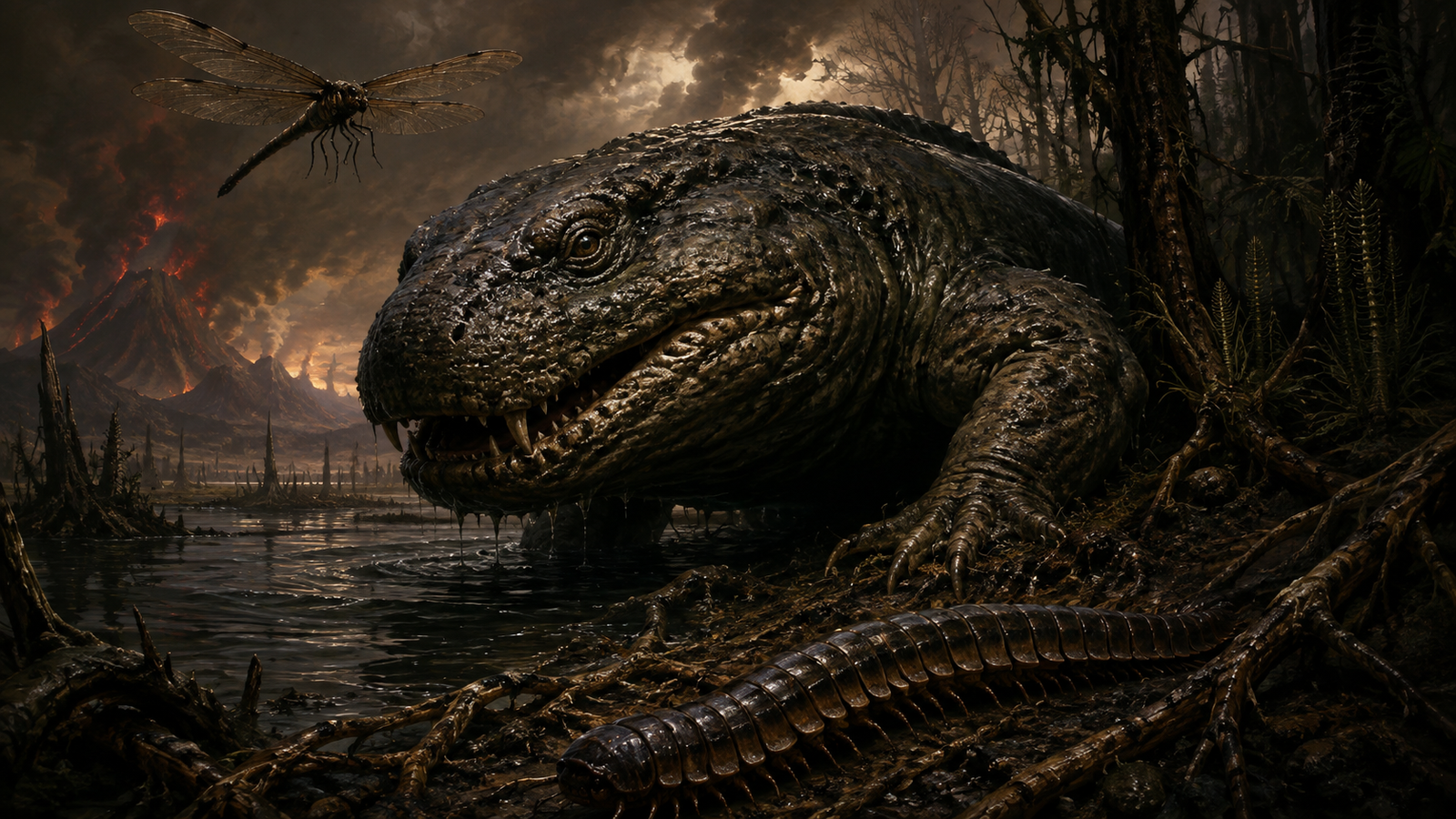
Forests swallow the lowlands. Armoured arthropods longer than a man cross the swamp floor. Black-water hunters wait beneath drowned branches. Serpent kingdoms rise on a world without humans. Then the greatest extinction Earth has yet endured tears the old order apart. From the ruins come stranger predators, the first dinosaurs, the first flying vertebrates and the creatures that will inherit the Jurassic.
Carboniferous · Permian · Triassic
You are here: Earth Age 03 · Bugs, Amphibians and the Rise of Giants
Life leaves the water behind
Earth Age 03 begins in steaming forests and ends beneath the feet of dinosaurs. Between those worlds lie giant arthropods, monstrous river hunters, synapsid predators, prehuman kingdoms and two planetary catastrophes.
The Carboniferous is a world beneath trees. Vast wetlands stretch through the tropics. Great jointed bodies push through the undergrowth. Huge winged insects hunt above the water. Tetrapods prowl pools and flooded channels where the forest floor disappears beneath black mud.
Some small vertebrates accomplish something far more important than becoming large: they begin to break the ancient dependence on open water for reproduction.
Their descendants spread into increasingly dry country. By the Permian, the world is divided between amphibious strongholds along rivers and lakes and a growing menagerie of synapsids and reptiles upon the open land.
This is also an inhabited world in the SpiralWorlds chronicle. Elder powers possess territories older than mountains. Serpent People build kingdoms across Pangaea. Cthulhu and his Star-Spawn are remembered in wars fought beneath skies no human being will ever see.
Then the world dies.
Around 252 million years ago, ecosystems collapse on a scale unmatched in later Earth history. Seas become hostile. Forests vanish. Ancient lineages disappear forever. Elder kingdoms fragment alongside the natural world that supported them.
The Triassic begins among survivors.
Armoured archosaurs, monstrous crocodile-line hunters, lingering amphibious giants, mammal-line creatures and the first dinosaurs compete across a scarred supercontinent. Pterosaurs claim the air. Ichthyosaurs become giants at sea. Shoggoths rise against their makers in the darkness below.
By the end of the age, the dinosaurs have survived one more extinction than many of their greatest rivals.
The Swamp Crown
“Beneath the coal forests, the crawling world becomes gigantic.”
The Carboniferous forest does not resemble any woodland of the campaign present.
There is no grass beneath the canopy. No flowers brighten the mud. No birds sing above it.
Instead, towering lycopsids, calamites, ferns and seed plants form dense green walls around flooded ground. Dead vegetation sinks into waterlogged earth. Over immense spans of time these buried forests become the coal seams opened by miners hundreds of millions of years later.
Arthropleura beneath the trees
The most imposing traveller on the forest floor is Arthropleura.
Its segmented armour moves between tree roots and fallen trunks in a long ripple of plates. The largest individuals are longer than a man is tall. Their broad tracks cross mudbanks, vanish beneath litter and emerge again beside black pools.
They are not the only giants.
Over the open water hunt enormous griffinflies, represented in the SpiralWorlds Bestiary by the Giant Dragonfly. Their wings cut through the heavy forest air as they pursue smaller insects above stagnant channels and drowned margins.
Something moves in the black water
The waterways are no safer than the forest floor.
Large tetrapods patrol pools, channels and drowned forest margins. Among them is Eogyrinus, a long-bodied ambush hunter at home in slow Carboniferous water.
A traveller might first notice only a wake beneath floating vegetation.
Then the broad skull rises.
These creatures are often called amphibians for convenience, but this is no kingdom of oversized modern frogs. The Carboniferous is filled with extinct forms unlike anything a later natural philosopher will see alive.
The creatures that leave the swamp
The decisive change begins quietly.
Some small tetrapods can reproduce without returning their eggs to open water. That freedom matters more than armour, teeth or size.
Their descendants push beyond wetland margins into woodland, uplands and seasonally dry country. From those pioneers will eventually come both the mammal-line beasts of the Permian and the reptilian dynasties of the Mesozoic.
The Father of Serpents watches
Much later, the oldest cults of Yig remember this expansion as the first great serpent-marking of the land.
The claim is not that Yig invents reptiles from nothing. Natural lineages are already diversifying across Earth.
Serpent tradition instead claims that the Father of Serpents recognises certain bloodlines, favours them, alters some and begins a relationship with scaled life that will outlast continents.
The wars no fossil records
Even these immense forests are young compared with some of the beings already present.
Elder chronicles place renewed activity by Cthulhu within this age.
His Star-Spawn contend with the ancient Elder Things in wars fought across coastlines and ocean basins that no longer exist.
The cyclopean city later remembered as R’lyeh belongs to these traditions: not a modern Pacific island somehow transported into deep time, but an elder territory on a planet whose geography will be remade again and again.
The green empire breaks
The great wet forests do not last forever.
Ice advances and retreats across southern Gondwana. Sea levels shift. Climate becomes more seasonal. Once-continuous forests fragment into separated refuges.
The giant arthropods remain. The river hunters remain.
But the world around them is becoming drier.
The swamp has begun to lose its crown.
The Drying World
“The rivers keep their monsters. Beyond them, new predators inherit the land.”
The Permian opens beneath a harsher sky.
Pangaea is becoming a single immense landmass. Far from the oceans, its interior grows seasonal and dry. Wetlands still follow rivers and lakes, but between them stretch open woodlands, floodplains and increasingly arid country.
For the creatures of the old swamp world, water becomes territory worth defending.
River monsters
Large temnospondyls wait in channels and lake margins, some with skulls broad enough to resemble living traps.
They are among the last great heirs of an age when amphibious tetrapods were the foremost vertebrate predators of the wetlands.
The rivers remain theirs.
The dry land does not.
The hunters beyond the water
Synapsids spread through country where dependence on permanent water would be a weakness.
The sail-backed Dimetrodon is one of the most famous, though it is no dinosaur.
Another formidable predator is Sphenacodon, a deep-skulled hunter built for power rather than spectacle.
Elsewhere, heavily built herbivores browse through dry vegetation while later therapsid predators pursue them across floodplains and scrub.
The distant ancestors of mammals are already here, though nothing in their world yet resembles the mammalian dominion of later ages.
The spiral-jawed hunter
At sea, strangeness takes another form.
Helicoprion hunts with a remarkable spiral whorl of teeth set within its lower jaw.
No curse shaped it. No wizard designed it.
The creature is simply one of the many forms natural life has tried and later abandoned.
In SpiralWorlds, the natural world is often strange enough to require no enchantment.
Valusia before mankind
Across the Permian land rise kingdoms whose ruins no human civilisation will ever see newly built.
The Serpent People preserve traditions of an ancient realm later remembered under the name Valusia.
Its cities stand upon a version of Earth almost beyond later recognition: Pangaea united, unfamiliar mountain chains, vanished seas and no human beings anywhere upon the world.
Serpent priests serve old gods. Dynasties map bloodlines across generations. Underground sanctuaries descend beneath territories already ancient by the standards of the Permian.
Later serpent realms reuse ancestral names and claims. Valusia is therefore not one unchanged political state persisting intact for hundreds of millions of years, but a name carried forward through successive serpent dynasties and traditions.
The heat comes
Toward the end of the Permian, the world begins to fail.
Volcanism spreads across what will one day become Siberia. Heat builds. Weather patterns become unstable. Oceans warm.
The first losses can still be mistaken for bad years.
Then whole ecosystems begin to disappear.
The Great Dying
Then Earth becomes a killing ground.
For generations, volcanic eruptions poison the stability of the planet. Temperatures climb. Drought strikes some regions while violent rainfall scars others. Forests retreat.
In the oceans, warmer water loses oxygen. Marine habitats collapse. Reefs die. Food webs unravel.
The destruction reaches from microscopic plankton to the largest predators.
Ancient lineages that survived earlier catastrophes finally vanish. The trilobites disappear forever. The strange Permian seas inhabited by hunters such as Helicoprion are broken beyond recovery.
On land, rivers shrink, forests fail and carcasses outnumber living animals across devastated regions.
Predators starve after their prey.
The Great Dying does not spare civilisation.
Serpent cities lose the rivers, forests and prey routes upon which they were built. Dynasties abandon surface capitals. Temples are sealed. Archives vanish into caverns.
Elder installations are buried beneath ash, desert and flooded coast.
Even beings capable of living for ages discover that immortality does not preserve an empire when the world supporting it has ceased to exist.
Life survives.
But survival is not victory.
For millions of years afterwards, Earth remains wounded.
The World After Ruin
“Survival comes first. Dominion comes later.”
The first Triassic landscapes are sparse.
There are places where a traveller can cross miles of harsh ground and see only a handful of common survivors.
The most famous is Lystrosaurus: a squat, tusked herbivore so successful in the devastated world that its bones dominate some Early Triassic landscapes.
Temnospondyls still haunt rivers. Cynodonts remain small but persistent. The surviving world is battered, repetitive and dangerous.
Then diversity begins to return.
The archosaur world
The Triassic becomes an age of strange experiments.
Armoured Stagonolepis cross the land in heavy coats of scutes.
Elsewhere, Postosuchus stalks the open country.
Despite the legacy directory path of its Bestiary page, Postosuchus is not a dinosaur. It is one of the great crocodile-line archosaurs: a powerful terrestrial predator living in the same world where the first dinosaurs are still only one group among many.
This matters because the early dinosaurs do not inherit an empty continent.
They must survive monsters already there.
The dinosaurs arrive
The first definite dinosaurs appear during the Triassic.
At first many are small, agile animals sharing the land with predators that can kill them, armoured herbivores they cannot easily attack and amphibious hunters still dominating the rivers.
Later forms begin to grow.
Plateosaurus walks the Late Triassic landscape as a substantial herbivore, its long neck and heavy body foreshadowing the far greater long-necked giants of the Jurassic.
The dinosaur age has begun.
It simply has not won yet.
Wings over Pangaea
Then a vertebrate leaves the ground under its own power.
Pterosaurs stretch membranous wings between elongated fingers and body. They are neither birds nor dinosaurs.
For the first time, the skies contain vertebrate flyers.
Below them, giant insects are no longer unmatched rulers of the air.
Giants beneath the sea
The recovering oceans produce monsters of their own.
Ichthyosaurs become fully marine hunters, some reaching enormous size.
Among them is Shonisaurus, a creature large enough to turn an encounter at sea into the sighting of a moving island.
The oceans have recovered enough to support giants once more.
The small creatures no one fears
In the shadows of all these reptiles, small cynodont descendants continue changing.
Some become early mammaliaforms.
They are not rulers. They are not giants. Most great predators barely notice them.
That obscurity becomes their defence.
Long after the great archosaurs have fallen, their descendants will still be here.
The rains return
The Triassic is often dry, but not always.
During the Carnian, rain returns on a vast scale. Rivers swell. Vegetation changes. Old communities are disrupted again.
Through the ecological upheaval, dinosaur lineages gain ground.
The strange survivor world is becoming a dinosaur world.
The servants rebel
Below the surface, another ancient order is failing.
The Elder Things once created Shoggoths as servants.
In the early Triassic, with Elder Thing power already weakened by planetary catastrophe, the servants rise against their makers.
The revolt spreads through hidden complexes and ancient colonies.
Some Shoggoths are destroyed.
Others escape.
Some are never found.
The rebellion is not the cause of the Great Dying. It is something more dangerous: an ancient war exploiting a world already broken.
The serpent realms retreat
The Serpent People survive as well.
But their old surface dominions do not simply recover.
Dynasties fracture. Cities are abandoned. Refuge kingdoms move below ground. Later serpent chronicles remember another great political collapse around 225 million years ago.
From this point onward, serpent civilisation increasingly becomes a civilisation of hidden survival, forbidden archives and repeated attempts to reclaim what was lost.
The second extinction
Near 201 million years ago, the Triassic ends in another planetary crisis.
Volcanism associated with the opening central Atlantic drives rapid environmental change.
Many of the great archosaur rivals of the dinosaurs disappear.
Large amphibious lineages are reduced.
Marine communities suffer again.
Dinosaurs survive.
Pterosaurs survive.
Crocodile-line archosaurs survive.
Mammal-line animals survive.
But the balance has shifted.
The greatest terrestrial competitors of the dinosaurs are gone.
The Jurassic waits on the other side.
The monsters of the age
Some are animals. Some are peoples. Some came from beyond Earth. All belong to the history of the world.
For the wider creature catalogue, continue to the World Bestiary.
| Creature | Age | Role in the world |
|---|---|---|
| Arthropleura | Carboniferous | Gigantic armoured walker of the coal forests. |
| Giant Dragonfly / griffinflies | Carboniferous | Large aerial predators above swamp and open water. |
| Eogyrinus | Carboniferous | Large ambush predator of black-water channels. |
| Temnospondyls | Carboniferous–Triassic | Great amphibious predators of rivers, lakes and wetlands. |
| Sphenacodon | Permian | Powerful terrestrial synapsid hunter. |
| Dimetrodon | Permian | Famous sail-backed synapsid predator; not a dinosaur. |
| Helicoprion | Permian | Marine predator armed with a spiral tooth whorl. |
| Serpent People | Permian–Triassic | Ancient terrestrial civilisation preserving Valusian traditions. |
| Lystrosaurus | Early Triassic | One of the signature survivors of the Great Dying. |
| Stagonolepis | Triassic | Armoured aetosaur of the archosaur radiation. |
| Postosuchus | Triassic | Great crocodile-line predator and rival of early dinosaurs. |
| Plateosaurus | Late Triassic | Large herbivorous dinosaur foreshadowing Jurassic giants. |
| Early Pterosaurs | Late Triassic | First vertebrate masters of powered flight. |
| Early Mammaliaforms | Late Triassic | Small survivors living beneath the great reptilian world. |
| Shonisaurus | Triassic | Gigantic ichthyosaur of the recovering seas. |
| Cthulhu | Hidden Carboniferous history | Great Old One associated with primordial wars and R’lyeh. |
| Star-Spawn of Cthulhu | Hidden Carboniferous history | Extraterrestrial powers associated with Cthulhu’s primordial forces. |
| Elder Things | Ancient survivor civilisation | Prehuman extraterrestrial civilisation weakened across successive catastrophes. |
| Shoggoths | Triassic hidden history | Created servants whose rebellion breaks Elder Thing control. |
From the coal forests to the first dinosaur world
The Swamp Crown begins
Wet forests spread and terrestrial ecosystems deepen.
Giants beneath the trees
Arthropleura and giant griffinflies become signature creatures of the forest world.
Black-water predators
Eogyrinus and other great tetrapods hunt drowned forests and rivers.
Life breaks free of the water
Early amniotes begin the conquest of increasingly dry land.
The forests fragment
Climate becomes more seasonal and the endless swamp world retreats.
The Permian begins
Pangaea becomes a world of great interiors, dry lands and river strongholds.
Synapsid hunters spread
Dimetrodon, Sphenacodon and later therapsids become major terrestrial powers.
Helicoprion hunts the sea
Helicoprion haunts the strange waters of the late Palaeozoic world.
The elder Valusian tradition
Serpent People maintain powerful kingdoms upon prehuman Pangaea.
The Great Dying
The mature Palaeozoic world collapses.
The survivor world
Lystrosaurus and other hardy survivors spread through devastated landscapes.
The Shoggoth rebellion
Shoggoths rise against their Elder Thing makers.
The archosaur experiment
Stagonolepis, Postosuchus and numerous other forms fill the recovering land.
The first dinosaur world
Dinosaurs become established and Plateosaurus herds cross Pangaean landscapes.
The sky is taken
Pterosaurs become the first vertebrates capable of powered flight.
Giants at sea
Shonisaurus and other ichthyosaurs patrol the recovering oceans.
Serpent realms fracture
Ancient dynasties retreat increasingly into hidden refuges.
The second extinction
Many dinosaur rivals disappear. The Jurassic opens.
Three hundred million years does not erase everything
The campaign present stands unimaginably far from Earth Age 03, but the old world still lies beneath every road, city and kingdom.
Coal Forests
Every deep coal seam is a compressed forest. Mines may expose fossil roots, giant arthropod tracks or sealed pockets where ancient ecosystems survived.
Arthropleura Roads
Fossilised trackways left by Arthropleura may continue through stone into caverns where the tracks become fresh.
Black-Water Refuges
Deep rivers can preserve creatures resembling Eogyrinus in ecosystems untouched by surface ages.
Synapsid Bone Fields
Ancient quarries contain predators and herbivores unlike both modern mammals and later dinosaurs.
The Spiral Tooth
A fossilised Helicoprion tooth whorl may be mistaken for an artefact until its biological origin is recognised.
The Death Layer
Some strata preserve an abrupt boundary between a living world and near-emptiness. Magic caught within such horizons may still carry the memory of planetary death.
Maps of Pangaea
Ancient Serpent People archives contain maps whose continents no longer resemble modern Earth.
Shoggoth Vaults
A sealed facility may hold evidence of the rebellion—or a Shoggoth that never returned to obedience.
Survivor Valleys
A true Triassic Lost World contains aetosaurs, temnospondyls, cynodonts and crocodile-line archosaurs alongside early dinosaurs.
The Inland Ocean
An isolated sea might still support Shonisaurus and other creatures thought extinct before the Jurassic began.
Adventures beneath impossible ages
Earth Age 03 works best when its depth of time matters. Characters should encounter more than isolated prehistoric beasts: they should find entire natural and political histories that ought to have vanished before humanity existed.
The Coal Road
Miners open a chamber filled with living Carboniferous vegetation. Fresh Arthropleura tracks cross the newly broken wall.
Black Water
Something shaped like Eogyrinus follows a boat through a subterranean river without once breaking the surface.
The Spiral Jaw
Fishermen recover a fresh Helicoprion tooth whorl from a sea in which the creature should have been extinct for hundreds of millions of years.
The First Valusia
A Serpentfolk noble produces a land treaty written when Pangaea was still one continent and demands that the agreement be honoured.
The Death Layer
A mine reaches the Permian–Triassic boundary. Every living thing carried across the exposed rock begins to suffocate.
The Survivor Plain
A road through ancient magic opens onto the Early Triassic. Lystrosaurus herds cover the barren horizon—and something larger follows them.
The Dinosaur That Isn’t
The party expects a dinosaur. Instead, Postosuchus emerges from the scrub.
The Herd Before Giants
A preserved Late Triassic valley contains Plateosaurus herds but none of the famous Jurassic dinosaurs.
The Inland Sea
A dark cavern ocean appears empty until a Shonisaurus surfaces alongside the party’s vessel.
The Disobedient Servant
An Elder Thing vault opens and releases a Shoggoth that still believes the ancient rebellion is underway.
Where the monsters stand in Earth history
The page above tells the age as lived history. This shorter section preserves the scientific foundation beneath it.
The Carboniferous spans roughly 359–299 million years ago and includes vast coal-forming forest systems, giant arthropods, diverse tetrapods and the early radiation of amniotes.
The Permian follows from roughly 299–252 million years ago. Synapsids become increasingly important on land while large amphibious tetrapods remain major freshwater predators. Pangaea creates enormous and often dry continental interiors.
The Permian ends with the Great Dying, associated principally with enormous Siberian volcanism, severe warming and catastrophic changes to marine and terrestrial ecosystems.
The Triassic is an age of recovery and experimentation. Archosaurs diversify into many forms, the first definite dinosaurs appear, pterosaurs take to the air, mammaliaforms emerge and ichthyosaurs become major marine animals.
The end-Triassic extinction removes many dinosaur competitors and prepares the ecological stage for the Jurassic Age of Giants.
Selected videos
Three supporting videos are retained as linked thumbnails rather than embedded players.
From the survivor world into the Age of Giants
The Triassic closes with extinction clearing many of the dinosaurs’ greatest rivals from the land. The next chapter begins as Jurassic ecosystems recover and true giant dinosaurian dominion takes shape.
Buy me a coffee