
Amphisbaena — The Two-Headed Venom Serpent
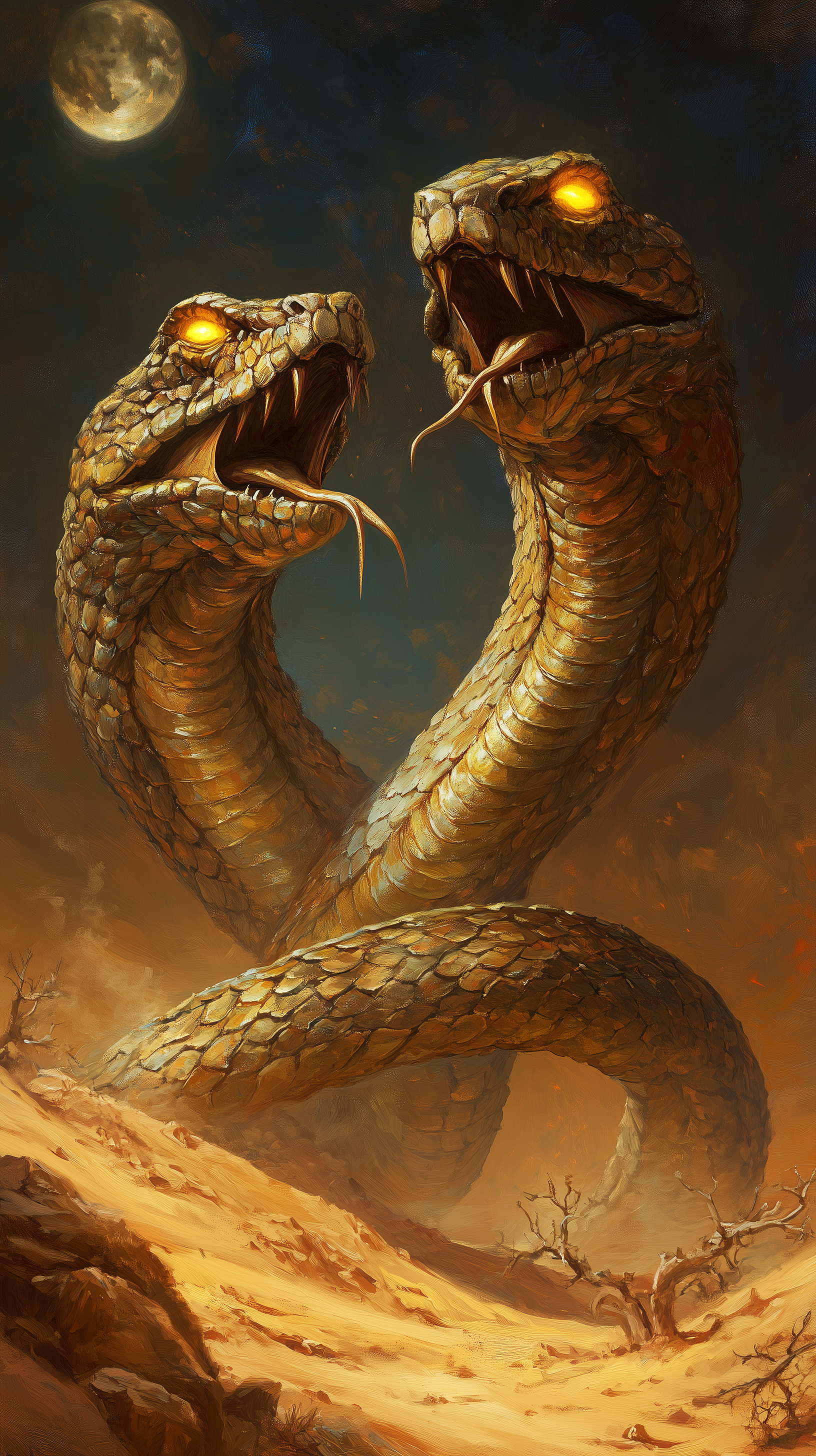
A venomous serpent with a head at each end, able to reverse direction instantly and keep watch on two approaches at once.
The amphisbaena is not a two-headed hydra and it is not a constrictor. It is a serpent whose tail ends in a second complete head. Ancient writers place it in Libya and emphasise its ability to travel with either end leading. Later monster traditions make that anatomy even more dangerous: both mouths carry venom, both heads remain alert, and severe slashing wounds can divide the creature into two living halves.
At a Glance
Rules by Edition
Amphisbaena
Large Monstrosity, Unaligned
AC 16; Initiative +3 (13)
HP 76 (9d10 + 27)
Speed 30 ft., Climb 20 ft., Swim 20 ft.
15 (+2)
16 (+3)
16 (+3)
2 (−4)
13 (+1)
5 (−3)
Skills Perception +5, Stealth +5
Resistances Cold
Immunities Petrified
Senses Darkvision 60 ft.; Passive Perception 15
Languages —
CR 4 (1,100 XP); PB +2
Traits
All-Around Vision. The amphisbaena has Advantage on Wisdom (Perception) checks that rely on sight and cannot be Surprised while conscious.
Split. If the amphisbaena takes Slashing damage from a Critical Hit and has at least 2 Hit Points afterward, it splits into two halves. Divide its current Hit Points as evenly as possible. Each half is Medium, has Speed 20 ft., Climb 20 ft., Swim 20 ft., retains the amphisbaena’s defenses and can make one Bite on its turn. A half cannot split again. If both halves survive and remain adjacent for 1 minute without taking damage, they rejoin and combine their Hit Points.
Actions
Multiattack. The amphisbaena makes two Bite attacks.
Bite. Melee Attack Roll: +5, reach 5 ft. Hit: 9 (1d10 + 4) Piercing damage plus 7 (2d6) Poison damage. The target must succeed on a DC 14 Constitution saving throw or have the Poisoned condition until the end of its next turn.
Amphisbaena
Large monstrosity, unaligned
Armor Class 16 (natural armor)
Hit Points 76 (9d10 + 27)
Speed 30 ft., climb 20 ft., swim 20 ft.
15 (+2)
16 (+3)
16 (+3)
2 (−4)
13 (+1)
5 (−3)
Skills Perception +5, Stealth +5
Damage Resistances cold
Condition Immunities petrified
Senses darkvision 60 ft., passive Perception 15
Languages —
Challenge 4 (1,100 XP)
Traits
All-Around Vision. The amphisbaena has advantage on Wisdom (Perception) checks that rely on sight and cannot be surprised while conscious.
Split. When a critical hit dealing slashing damage leaves the amphisbaena with at least 2 hit points, it splits into two Medium halves and divides its remaining hit points between them. Each half has speed 20 ft., climb 20 ft., swim 20 ft., retains the original defenses and can make one bite attack on its turn. A half cannot split again. Surviving halves rejoin after 1 minute adjacent to one another without taking damage.
Actions
Multiattack. The amphisbaena makes two bite attacks.
Bite. Melee Weapon Attack: +5 to hit, reach 5 ft., one target. Hit: 9 (1d10 + 4) piercing damage plus 7 (2d6) poison damage. The target must succeed on a DC 14 Constitution saving throw or be poisoned until the end of its next turn.
Amphisbaena CR 4
XP 1,200
N Large magical beast
Init +2; Senses all-around vision, darkvision 60 ft., low-light vision, scent; Perception +11
Defense
AC 19, touch 11, flat-footed 17 (+2 Dex, +8 natural, −1 size)
hp 45 (6d10+12)
Fort +6, Ref +7, Will +3
Defensive Abilities split; Immune petrification; Resist cold 10
Offense
Speed 20 ft., climb 20 ft., swim 20 ft.
Melee 2 bites +8 (1d8+2 plus poison)
Space 10 ft.; Reach 5 ft.
Statistics
Str 14, Dex 15, Con 13, Int 2, Wis 13, Cha 4
Base Atk +6; CMB +9; CMD 21 (can’t be tripped)
Feats Skill Focus (Stealth), Toughness, Weapon Focus (bite)
Skills Acrobatics +10, Climb +10, Perception +11, Stealth +11, Swim +10
Poison (Ex)
Bite—injury; save Fort DC 14; frequency 1/round for 6 rounds; effect 1d3 Con; cure 1 save.
Split (Su)
If a slashing critical hit cuts the amphisbaena in half, both portions continue as separate creatures with half the current hit points each after damage is applied. Neither half can split again. If both survive and are left together for 1 minute, they rejoin; a missing half regrows over 1d3 weeks.
Ecology
Environment temperate hills or underground
Organization solitary or pack (2–5)
Treasure incidental
Amphisbaena
Large Magical Beast
Hit Dice 6d10+12 (45 hp)
Initiative +2
Speed 20 ft. (4 squares), climb 20 ft., swim 20 ft.
Armor Class 19 (−1 size, +2 Dex, +8 natural), touch 11, flat-footed 17
Base Attack/Grapple +6/+12
Attack bite +8 melee (1d8+2 plus poison)
Full Attack 2 bites +8 melee (1d8+2 plus poison)
Space/Reach 10 ft./5 ft.
Special Attacks poison
Special Qualities all-around vision, darkvision 60 ft., low-light vision, scent, immunity to petrification, cold resistance 10, split
Saves Fort +6, Ref +7, Will +3
Abilities Str 14, Dex 15, Con 13, Int 2, Wis 13, Cha 4
Skills Balance +10, Climb +10, Hide +7, Listen +9, Spot +9, Swim +10
Feats Skill Focus (Hide), Toughness, Weapon Focus (bite)
Environment temperate hills or underground
Organization solitary or pack (2–5)
Challenge Rating 4
Treasure incidental
Poison (Ex)
Injury, bite; Fortitude DC 14; initial and secondary damage 1d3 Constitution. The save DC is Constitution-based.
Split (Su)
A slashing critical hit can divide the amphisbaena into two creatures, each with half its remaining hit points after damage. The halves cannot split again and can rejoin after 1 minute together. If one is destroyed, the survivor regrows the missing portion in 1d3 weeks.
Behaviour
Amphisbaenas patrol territory rather than constructing elaborate ambushes. One head can keep watch down a passage while the other studies the ground behind, making ordinary distraction tactics unreliable. The creature can reverse its direction without turning its whole body, so a retreating head becomes an attacking head almost instantly.
It does not wrap prey and crush it like a constrictor. Its danger comes from repeated venomous bites, rapid changes of direction and the difficulty of getting safely behind it.
Signs Before Initiative
- A broad serpentine trail doubles back without any sign that the animal turned around.
- Two sets of fang marks appear at opposite ends of the same struggle site.
- Small carcasses show venom damage but little evidence of constriction.
- Loose stones around a burrow are polished by scales moving in both directions.
- A shed skin appears to have a complete head-shape at both ends.
If Violence Starts
The amphisbaena tries to keep enemies within reach of both heads, biting two targets or concentrating both bites on a single vulnerable creature. It uses climbing and swimming routes to make pursuit awkward and does not expose a safe rear quarter. If a slashing critical hit splits it, the two halves immediately separate enough that one blast cannot easily catch both.
Homes, Range and Traditions
Greek and Roman writers place the amphisbaena in Libya, making North Africa its oldest geographical home. It also belongs naturally in the Hellenic Bestiary because Greek writers carried the creature into Mediterranean literature.
The story that amphisbaenas sprang from the blood of Medusa is a later legendary association and works well as an in-world explanation for their immunity to petrification. It also gives them a natural connection to Perseus stories without requiring every amphisbaena to be individually cursed.
Eggs, Handling and Capture
Legacy Pathfinder material values a viable amphisbaena egg at roughly 300–500 gp. Training is exceptionally difficult: attempts suffer a −8 penalty on Handle Animal checks. These figures are most useful in campaigns using the older fantasy economy. A captured specimen remains a venomous territorial predator even after conditioning.
Using an Amphisbaena in an Encounter
The impossible trail. Tracks enter and leave a sealed tomb through the same narrow crack, but nobody can find where the creature turned around.
The collector’s egg. A valuable black egg has hatched in transit, and the wagon now contains two sets of fangs facing opposite doors.
The split serpent. Hunters claim to have killed the monster by cutting it in half. Both halves are now hunting separately.
The petrifier’s pet. A medusa keeps an amphisbaena in the approach to her lair because its immunity lets it patrol where most living guards could not.
Classical and Rules Sources
Pliny and Aelian
Pliny describes a serpent with a second head at the tail; Aelian emphasises that it can move with either head leading. See the collected Amphisbaena sources at Theoi.
Pathfinder Bestiary 2
The PF1e creature’s all-around vision, venom, petrification immunity, cold resistance and split ability come from the open Bestiary 2 rules presentation.
Rules Sources and Licensing
The 5.5e/2024 and 5e/2014 stat blocks are original compatibility adaptations built from the creature’s classical anatomy and its open Pathfinder mechanics. The former CR 9 block, legendary actions, regeneration and broad weapon resistance were removed because they were not supported by the PF1e source or the creature’s established role.
The Pathfinder 1e statistics derive from Pathfinder Roleplaying Game Bestiary 2, © 2010 Paizo Publishing, LLC. The D&D 3.5e block is a page-specific compatibility conversion from that open material.
Keep this reference growing
If this page helped with your reading or game, you can support its upkeep or explore the curated books.
Explore the Bookshop — epics, classics and stories behind imagined worlds.