
Cat — Household Hunter and Night Watcher
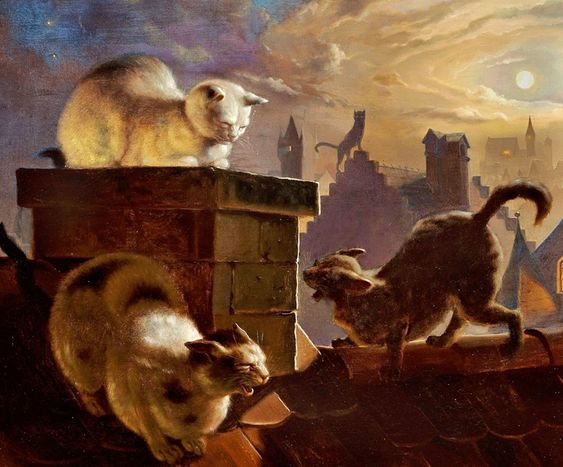
Something moves along the tiles above the silent courtyard. A cat pauses against the moonlight, listening to the scrape of a shutter. It may be hunting mice, returning to the household that feeds it, or watching an unfamiliar visitor enter the gate. Small animals can reveal a great deal about the lives around them.
At a Glance
- Identity: Domestic cat (Felis catus), a small carnivore associated with houses, farms and trading settlements
- Build: Small, flexible climber with sharp claws, forward-facing eyes and sensitive whiskers
- Behaviour: Stalks small prey, explores boundaries, rests in safe places and returns to familiar people or food
- Habitat: Villages, granaries, docks, farmyards, inns, warehouses and feral colonies around settlements
- Signs: Narrow pawprints, scratching, disturbed straw, prey remains and movement across roofs or garden walls
- Encounter role: Watchful household companion, rat hunter, missing pet, witness to disturbance or familiar where rules permit
- Threat: Scratches and bites when cornered; an ordinary cat normally escapes rather than battles adventurers
- Distinction: A living housecat is not inherently a supernatural Shadowbound Familiar or the Cheshire Cat
Cat — Game Statistics
The common cat is a published creature in each of these four systems. The following panels are independent, not a single universal stat block; some game rules, attacks and speeds differ between editions.
Cat — CR 0
Tiny Beast, Unaligned
Armor Class 12
Initiative +2 (12)
Hit Points 2 (1d4)
Speed 40 ft., Climb 40 ft.
| STR | DEX | CON | INT | WIS | CHA |
|---|---|---|---|---|---|
| 3 (−4) | 15 (+2) | 10 (+0) | 3 (−4) | 12 (+1) | 7 (−2) |
Saving Throws Dex +4
Skills Perception +3, Stealth +4
Senses Darkvision 60 ft.; Passive Perception 13
Languages None
Challenge 0 (10 XP; PB +2)
Traits
Jumper. The cat’s jump distance uses its Dexterity score rather than Strength.
Actions
Scratch. Melee Attack Roll: +4, reach 5 ft. Hit: 1 Slashing damage.
D&D 2024 System Reference Document 5.2.1, Cat (CC BY 4.0). The 2024 Cat has Jumper and Scratch, not the 2014 Claws attack or Keen Smell.
Cat — CR 0
Tiny beast, unaligned
Armor Class 12
Hit Points 2 (1d4)
Speed 40 ft., climb 30 ft.
| STR | DEX | CON | INT | WIS | CHA |
|---|---|---|---|---|---|
| 3 (−4) | 15 (+2) | 10 (+0) | 3 (−4) | 12 (+1) | 7 (−2) |
Skills Perception +3, Stealth +4
Senses passive Perception 13
Languages —
Challenge 0 (10 XP)
Traits
Keen Smell. The cat has advantage on Wisdom (Perception) checks that rely on smell.
Actions
Claws. Melee Weapon Attack: +0 to hit, reach 5 ft., one target. Hit: 1 slashing damage.
D&D 2014 SRD 5.1, Cat (CC BY 4.0). No automatic darkvision or Dexterity-based Jumper trait in this edition’s creature.
Cat — CR 1/4
XP 100 · N Tiny animal
Init +2; Senses low-light vision, scent; Perception +5
Defense
AC 14, touch 14, flat-footed 12 (+2 Dex, +2 size)
hp 3 (1d8 − 1)
Fort +1, Ref +4, Will +1
Offense
Speed 30 ft.
Melee 2 claws +4 (1d2 − 4), bite +4 (1d3 − 4)
Space/Reach 2½ ft./0 ft.
| STR | DEX | CON | INT | WIS | CHA |
|---|---|---|---|---|---|
| 3 | 15 | 8 | 2 | 12 | 7 |
Base Atk +0; CMB +0; CMD 6 (10 vs. trip)
Feat Weapon Finesse
Skills Climb +6, Perception +5, Stealth +14
Racial Modifiers +4 Climb, +4 Stealth
Ecology
Environment Temperate or hot plains and urban settlements
Organisation Solitary, pair or group (3–12)
Treasure None
Published Pathfinder Roleplaying Game Bestiary, Cat, p. 131, Paizo Publishing (OGL). The cat is an ordinary animal and does not gain abilities from a separate familiar automatically.
Cat — CR 1/4
Tiny Animal; Always neutral
Hit Dice ½d8 (2 hp)
Initiative +2
Speed 30 ft. (6 squares)
Armor Class 14 (+2 size, +2 Dex), touch 14, flat-footed 12
Base Attack/Grapple +0/−12
Attack claw +4 melee (1d2 − 4)
Full Attack 2 claws +4 melee (1d2 − 4) and bite −1 melee (1d3 − 4)
Space/Reach 2½ ft./0 ft.
Special Qualities low-light vision, scent
Saves Fort +2, Ref +4, Will +1
| STR | DEX | CON | INT | WIS | CHA |
|---|---|---|---|---|---|
| 3 | 15 | 10 | 2 | 12 | 7 |
Skills Balance +10, Climb +6, Hide +16*, Jump +10, Listen +3, Move Silently +8, Spot +3
Feats Stealthy, Weapon Finesse (bonus)
Environment Temperate plains
Organisation Domesticated or solitary
Treasure None
Combat and Skills
Cats stalk small prey and normally flee larger threats. They have +4 racial bonuses on Climb, Hide and Move Silently, +8 racial bonuses on Jump and Balance, and use Dexterity rather than Strength for Climb and Jump checks. *The extra Hide bonus increases in tall grass or dense undergrowth as specified in the official SRD.
D&D 3.5 System Reference Document, Cat (OGL 1.0a). These differ from the Pathfinder 1e Cat and should not be merged with it.
Cats in the Living World
A cat slips among sacks in a granary, watches sparrows from an inn windowsill, and finds a warm ledge above the baker’s oven. Housecats live beside people without sharing every human purpose. They hunt mice and small birds, guard favoured resting places, keep their own routes between buildings, and often recognise those who regularly feed or handle them. A familiar household cat is as likely to be part of an ordinary courtyard as a hawk above a hunt.
Cats are flexible climbers and patient short-range hunters. They stalk, pause and spring towards small prey rather than chasing it across miles of open country. Even a bold cat that has frightened a rat is vulnerable to a trained dog, a fall, a trap or rough handling. A colony living near a fish market may be fed by several households; a solitary farm cat may range between the barns and a stone wall. These are not identical creatures with identical histories.
People Who Live Alongside Cats
An innkeeper may welcome a cat that keeps mice from the storeroom, while a neighbour dislikes the animals coming through his garden. A ship’s cook values a hunter in the hold; a miller may know which cat has taken shelter above the flour sacks. Children can become attached to a kitten; an anxious keeper may search for an animal that has simply followed a trail across the rooftops. The cat’s choices need not be momentous, but the people who depend on or care about it give encounters consequences.
A genuine familiar has an additional magical bond where the chosen rules allow it. That bond should be described through the spellcaster and the selected edition, not given silently to every wild cat. A household cat does not automatically report secrets in human speech, know which person is guilty, or share the powers of the Cheshire Cat.
Signs Before the Animal Appears
Soft pawprints in flour or dusty earth, scratched wood, a disturbed basket, a displaced roof tile and the remains of a mouse can reveal where a cat has been. A sudden hiss warns that an animal feels threatened; a mew from behind a locked shutter may simply identify a trapped or hungry cat. Pay attention to the route through the building, because a cat may reach a place by window, beam or gap that a person cannot use.
Use Perception to notice a flicker of movement or a sound in the roof, and Survival for tracks on a lane or in a yard. If someone tries to climb after it, apply the relevant Climb rules for the character. A cat’s impressive agility does not make every old beam or roof safe for the pursuer.
Running a Cat
What It Wants
Food, a safe route, shelter, rest, curiosity satisfied, or the company of familiar people. A cat near a granary may be hunting pests, while one searching the same courtyard for hours may be looking for kittens. The animal is neither a moral witness nor a miniature soldier.
If Violence Starts
Cats ordinarily flee a larger opponent when there is an opening. An animal that is trapped, injured or defending young may scratch and bite, but should not fight armoured adventurers to the death. Use the chosen edition’s actual attacks and senses: the 2024 Cat has Scratch and Jumper, the 2014 Cat has Claws and Keen Smell, and Pathfinder and D&D 3.5e handle claws, bite and mobility under their separate systems. Never merge those traits into one exceptional creature.
Counterplay and Consequences
Leave an escape route open; find the animal’s keeper; use a familiar call or food; move fragile goods before retrieving a frightened cat from a crowded store. A child who gets a lost kitten back may tell the party about the place it was found. An innkeeper whose prized mouser is injured through carelessness might close the door to the same adventurers. Such reactions can carry a small incident into the wider sandbox.
Encounters and Adventure Hooks
The Granary at Dusk
Opening: Miller Rafe complains that sacks have been torn open at night, despite his cat sleeping inside the granary. He blames apprentices who have been asking for more flour. The cat keeps returning to the same wall and scratching at a blocked opening.
Choices: Watch the storeroom, follow the cat, inspect the wall or question the workers. Rats enter beneath the foundations, and one apprentice has been secretly feeding the cat rather than stealing grain. Repairing the hole earns the miller’s goodwill; accusing the wrong worker may cost an innocent person employment.
The Roof Above the Inn
Opening: Innkeeper Hesta hears a kitten calling from the roof after a storm. Tiles have shifted, and a guest’s travel papers are trapped beneath a broken shutter on the same ledge. The innkeeper wants the kitten saved; the guest wants the papers recovered before the courier departs.
Choices: Secure a ladder, use a rope, check the roof from an upper window or send a light-footed climber. Rushing risks a fall and further damage. The rescued kitten gives Hesta reason to trust the party, while the guest’s papers introduce a journey or NPC that can matter later.
The Watchman’s False Alarm
Opening: A town watchman claims someone passed into a closed warehouse because his lantern revealed two bright eyes in the rafters. He wants to break down the door before the morning market. A cat often hunts there, but an unfamiliar figure was also seen nearby.
Choices: Check tracks, question the watchman’s partner, find the cat’s usual entrance or watch the rear lane. The eyes belong to the cat, yet a smuggler has used the same loose shutter. The party can uncover the real route without destroying the merchant’s goods, or cause a dispute by forcing entry on uncertain evidence.
The Scholar’s Missing Companion
Opening: An itinerant scholar loses a beloved cat during an argument with a temple servant. The scholar claims the servant frightened the animal away, while the servant insists it wandered into the garden on its own. If the cat is a familiar, its special abilities depend on the selected edition’s rules.
Choices: Follow pawprints, ask the gardeners, inspect the courtyard wall or mediate the quarrel. The animal is trapped in a store shed where it followed a mouse. A calm rescue can end the disagreement and make the scholar available as a contact for later research.
Three Cats and a Closed Door
Opening: Several market cats gather every evening beside the same locked cellar. A street child says they follow a mysterious voice below, but the cellar owner denies anyone has entered for weeks. The smell of old fish clings to the steps.
Choices: Observe their feeding times, examine the lock, talk to the fishmongers or check whether the cellar has another entrance. Someone has been storing food and using a drainage passage as a hidden route. The cats reveal a pattern; they do not decide whether the person using the passage is a criminal or simply trying to survive.
Trade, Rumours and the Aftermath
A cat does not carry treasure. Its value lies in pest control, companionship, breeding or a special relationship with a household. A live, healthy mouser may be more useful than any price that could be obtained for it. The loss of a cat can affect ordinary people even when the adventurers face much larger dangers elsewhere.
The moonlit watcher: An animal appears on the same roof every night. Perhaps it has a regular hunting route; a genuinely magical watcher needs additional signs before the story becomes supernatural.
The cat that knows a thief: A cat follows a visitor through the market. It may recognise the smell of fish or a familiar person rather than guilt.
Sources and Rules Notices
The Cat stat blocks use the D&D SRD 5.2.1 and SRD 5.1 under Creative Commons Attribution 4.0, the Pathfinder Roleplaying Game Bestiary (Paizo Publishing, p. 131, under its applicable Open Game Licence), and the D&D 3.5e SRD Cat under OGL 1.0a. Each edition has different statistics and attack text. The original 3.5e reference used on this page has been placed inside its own mechanics panel.
The Fedor Flinzer cat painting is retained from the page. The five encounters and named NPCs above are original campaign material.
Earlier embedded cat video references
The original page embedded three video clips. They are retained as optional external links rather than large automatic embeds: First clip, Second clip, Third clip.
Keep this reference growing
If this page helped with your reading or game, you can support its upkeep or explore the curated books.
Explore the Bookshop — epics, classics and stories behind imagined worlds.