
Yithian — Archivist of the Great Race
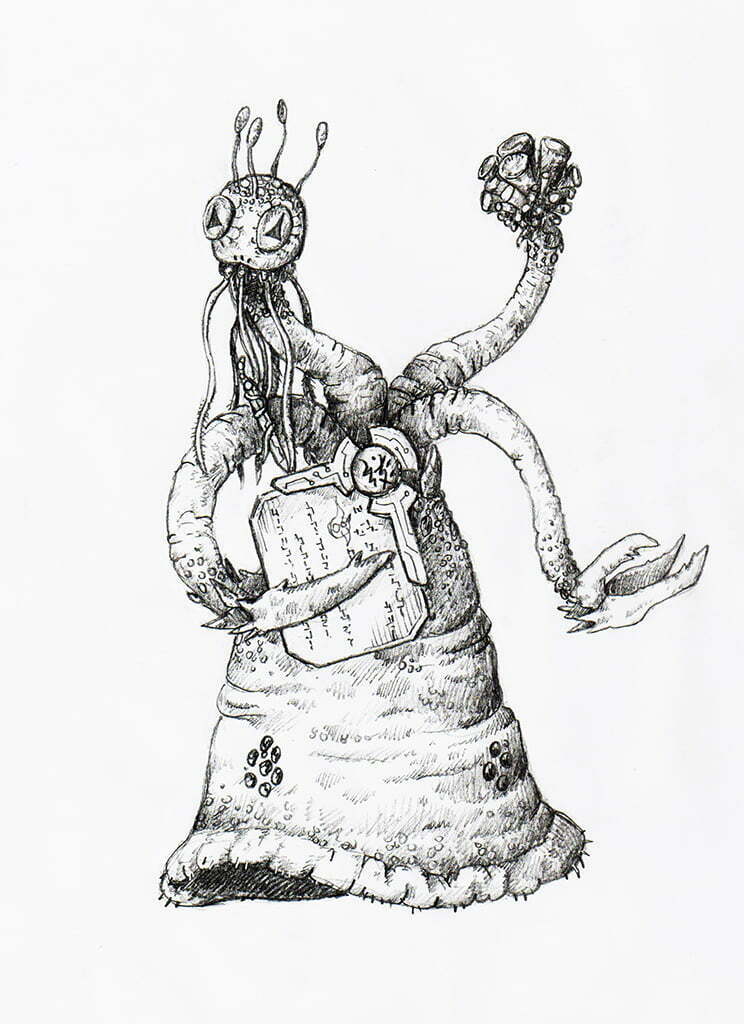
A Yithian is a towering, cone-bodied scholar that can exchange minds with beings living in other ages. Its ridged ten-foot frame moves on a muscular base; two long arms end in strong pincers, while its other appendages carry sensory trumpets and a many-eyed head. It would rather obtain a forgotten history than kill anyone who knows it—but a Yithian may borrow a person’s body, study the surrounding world, and return that person with only broken memories of what happened.
At a Glance
Yithian Statistics
Yithian
Large Aberration, Lawful Neutral
AC 17 (natural armour); Initiative +1 (11)
HP 136 (16d10 + 48)
Speed 20 ft., Climb 10 ft.
22 (+6)
13 (+1)
17 (+3)
24 (+7)
19 (+4)
18 (+4)
Saving Throws Int +11, Wis +8, Cha +8
Skills Arcana +11, History +11, Insight +8, Investigation +11, Perception +8
Resistances Acid, Cold, Fire
Senses Blindsight 60 ft., Darkvision 60 ft.; Passive Perception 18
Languages Aklo, Common, Yithian, several ancient languages; Telepathy 100 ft.
CR 9 (5,000 XP); PB +4
Traits
All-Around Vision. The Yithian has Advantage on Wisdom (Perception) checks relying on sight and can’t be surprised while conscious.
Ancient Scholar. The Yithian has Advantage on Intelligence checks to interpret old records, ancient languages and celestial instruments.
Actions
Multiattack. The Yithian makes two Pincer attacks.
Pincer. Melee Attack Roll: +10, reach 10 ft. Hit: 19 (3d8 + 6) Piercing damage.
Thought Probe. Wisdom Saving Throw: DC 16, one creature within 60 feet that can receive the Yithian’s telepathy. Failure: 27 (6d8) Psychic damage, and the Yithian knows the creature’s surface thoughts until the start of its next turn. Success: Half damage only.
Mind Exchange (Recharge 6). Charisma Saving Throw: DC 16, one living creature within 60 feet that can receive the Yithian’s telepathy. Failure: Their minds exchange bodies for up to 1 minute. Each mind retains its own Intelligence, Wisdom, Charisma, memories and proficiencies, but uses its host body’s Strength, Dexterity, Constitution, Hit Points, movement and physical traits. The affected creature repeats the saving throw at the end of each of its turns, ending the exchange on a success. The Yithian can end the exchange without an action; it also ends if either body dies. Success: The exchange fails and the target is immune to that Yithian’s Mind Exchange for 24 hours.
Erase Memory (1/Day). Wisdom Saving Throw: DC 16, one creature within 60 feet that can receive the Yithian’s telepathy. Failure: The creature forgets one continuous hour from the last 24 hours. The memory returns after 24 hours or when Greater Restoration is cast on it. Success: No effect.
Yithian
Large aberration, lawful neutral
Armor Class 17 (natural armor)
Hit Points 136 (16d10 + 48)
Speed 20 ft., climb 10 ft.
22 (+6)
13 (+1)
17 (+3)
24 (+7)
19 (+4)
18 (+4)
Saving Throws Int +11, Wis +8, Cha +8
Skills Arcana +11, History +11, Insight +8, Investigation +11, Perception +8
Damage Resistances acid, cold, fire
Senses blindsight 60 ft., darkvision 60 ft., passive Perception 18
Languages Aklo, Common, Yithian, several ancient languages, telepathy 100 ft.
Challenge 9 (5,000 XP)
Traits
All-Around Vision. The yithian has advantage on Wisdom (Perception) checks relying on sight and can’t be surprised while conscious.
Scholar. The yithian has advantage on Intelligence checks involving old records, ancient languages and celestial instruments.
Actions
Multiattack. The yithian makes two pincer attacks.
Pincer. Melee Weapon Attack: +10 to hit, reach 10 ft., one target. Hit: 19 (3d8 + 6) piercing damage.
Thought Probe. One creature within 60 feet that can receive the yithian’s telepathy must make a DC 16 Wisdom saving throw, taking 27 (6d8) psychic damage on a failed save, or half on a successful one. On a failure, the yithian learns the creature’s surface thoughts until the start of its next turn.
Mind Swap (Recharge 6). One living creature within 60 feet that can receive the yithian’s telepathy must make a DC 16 Charisma saving throw or exchange minds with the yithian for 1 minute. Each mind retains its own Intelligence, Wisdom, Charisma, memories and proficiencies but uses the other body’s physical scores, hit points, movement and traits. The creature repeats the save at the end of each of its turns, ending the exchange on a success. The yithian can end it at will, and it ends if either body dies. On a successful initial save, the target is immune to that yithian’s Mind Swap for 24 hours.
Amnesia (1/Day). A creature within 60 feet that can receive the yithian’s telepathy must succeed on a DC 16 Wisdom saving throw or forget one continuous hour from the last day for 24 hours. Greater restoration ends the effect.
Yithian — CR 9
| Yithian CR 9 |
| XP 6,400 LN Large aberration Init +1; Senses all-around vision, Blindsense 60 ft., Darkvision 60 ft.; Perception +25 |
| DEFENSE |
| AC 23, touch 10, flat-footed 22 (+1 Dexterity, +13 natural, -1 size) hp 105 (14d8+42); fast healing 5 Fort +9, Ref +5, Will +15 DR 10/magic; Resist acid 10, cold 10, fire 10 |
| OFFENSE |
| Speed 20 ft., Climb 10 ft. Melee 2 pincers +15 (2d8+9/x3) Space 10 ft.; Reach 10 ft. Special Attacks amnesia, deadly pincers, mind swap Spell-Like Abilities (CL 15th; Concentration +19) At will-astral projection (self only), detect thoughts (DC 16), hold monster (DC 19), modify memory (DC 18) |
| STATISTICS |
| Strength 22, Dexterity 13, Constitution 17, Intelligence 24, Wisdom 19, Charisma 18 Base Atk +10; CMB +17; CMD 28 Feats Alertness, Combat Expertise, Great Fortitude, Improved Great Fortitude, Improved Iron Will, Iron Will, Vital Strike Skills Climb +14, Diplomacy +18, Heal +18, Knowledge (Arcana, engineering, geography, history, planes) +24, Linguistics +24, Perception +25, Sense Motive +22, Use Magic Device +18 Languages Aklo, Common, Yithian, 20 other languages; telepathy 100 ft. SQ scholar |
| SPECIAL ABILITIES |
| Amnesia (Su) Once per day as a standard action, a yithian can attempt to inflict amnesia on a targetit is able to communicate telepathically with. A target can resist this attack with a DC 21 Will save. If the target fails its save, it takes a permanent -4 penalty on Will saving throws and all skill checks, and loses all memories save for those the yithian chooses to leave intact. This effect can be cured by heal or greater restoration. This is a mind-affecting insanity effect. The save DC is Charisma-based. Deadly Pincers (Ex) A yithian always applies 1-1/2 times its Strength modifier to damage dealt by its pincer attacks, and deals triple damage on a critical hit. Pincers are primary attacks for yithians. Mind Swap (Su) As a full-round action, a yithian can trade minds with another living creature it is able to communicate telepathically with. This functions as magic jar, except the two minds trade bodies. An unwilling target can resist the mind swap with a DC 21 Will save, after which that particular yithian cannot attempt to swap minds with that creature again for 24 hours. The yithian can end the effect of this mind swap at any time and over any distance as a full-round action, instantly returning both minds to the proper bodies-if the yithian wishes, it may attempt to use its amnesia power on the other mind as a free action when it ends the mind swap in this way. This is a mind-affecting effect. The save DC is Charisma-based. Scholar (Ex) Yithians treat all knowledge skills as class skills. |
| ECOLOGY |
| Environment Any Organization solitary, pair, band (3-9), or enclave (10-100) Treasure standard |
Yithian
Large Aberration
Hit Dice: 14d8+42 (105 hp)
Initiative: +1
Speed: 20 ft. (4 squares), climb 10 ft.
Armor Class: 23 (–1 size, +1 Dex, +13 natural), touch 10, flat-footed 22
Base Attack/Grapple: +10/+20
Attack: Pincer +15 melee (2d8+9/×3)
Full Attack: 2 pincers +15 melee (2d8+9/×3)
Space/Reach: 10 ft./10 ft.
Special Attacks: Amnesia, mind swap, spell-like abilities
Special Qualities: All-around vision, blindsense 60 ft., darkvision 60 ft., DR 10/magic, fast healing 5, resistance to acid 10, cold 10 and fire 10, scholar, telepathy 100 ft.
Saves: Fort +9, Ref +5, Will +15
Abilities: Str 22, Dex 13, Con 17, Int 24, Wis 19, Cha 18
Skills: Climb +14, Diplomacy +18, Heal +18, Knowledge (arcana, architecture and engineering, geography, history, the planes) +24, Listen +25, Search +24, Sense Motive +22, Spot +25, Use Magic Device +18
Feats: Alertness, Blind-Fight, Combat Expertise, Great Fortitude, Iron Will
Environment: Any
Organization: Solitary, pair, band (3–9) or enclave (10–100)
Challenge Rating: 9
Treasure: Standard
Alignment: Usually lawful neutral
Advancement: By Hit Dice or character class
Level Adjustment: —
Special Abilities
Amnesia (Su): Once per day, as a standard action, the Yithian targets a creature within telepathy range. DC 21 Will negates. Failure erases memories chosen by the Yithian and imposes a –4 penalty on Will saves and skill checks until cured by heal or greater restoration. Mind-affecting; the save DC is Charisma-based.
Mind Swap (Su): As a full-round action, the Yithian exchanges minds with a living creature within telepathy range, functioning as magic jar except both minds trade bodies. DC 21 Will negates; a successful save grants immunity to that Yithian’s swap for 24 hours. The Yithian may end the exchange at any distance as a full-round action, and may use amnesia on the returned mind as a free action. Mind-affecting; the save DC is Charisma-based.
Spell-Like Abilities: Caster level 15th. At will—astral projection (self only), detect thoughts (DC 16), hold monster (DC 19), modify memory (DC 18).
Scholar (Ex): All Knowledge skills are class skills.
What Is a Yithian?
The creature is unmistakable when seen in its own body. A Yithian stands roughly ten feet tall on a broad, tapering cone of ridged, leathery flesh. Its base travels by contracting and extending a thick muscular underside, carrying its immense weight with an unsettling, deliberate glide. Four flexible limbs rise from the cone’s narrow summit, each able to stretch several feet. Two end in tremendous black pincers that can lift tools, turn pages, seize an intruder or cut through flesh. The remaining limbs support a cluster of trumpet-shaped sensory organs and a rounded head bearing three large eyes, small stalks and dangling feelers.
It does not have a human face or human gestures. When a Yithian turns its head, its eyes survey different parts of a chamber while its pincers continue sorting instruments. The creature can speak with the rasp and click of its claws, but it often prefers telepathy when dealing with visitors whose language its body cannot reproduce. Its movements are slow and precise. The impression is less of an animal stalking prey than of a towering scholar interrupted at work.
A Yithian can crush an opponent with its pincers, but such violence is usually a means of protecting a much more important asset: knowledge. It wants a lost text, an accurate map of a vanished coast, a witness’s memories or the position of a star at an otherwise inaccessible moment in history.
The Great Race and Its Civilisation
The Great Race of Yith is not a herd of solitary monsters. It is a civilisation of historians, engineers, astronomers, linguists and custodians whose archives preserve accounts from worlds and centuries inaccessible to ordinary travellers. Its scholars assemble records from eyewitness testimony, mechanical instruments and expeditions through the minds of beings who lived in other ages. They keep immense collections of stone tablets, inscribed metal leaves, diagrams and carefully indexed histories, and debate which facts can be trusted when a witness has seen only a fragment of a possible future.
Their ancestors escaped a dying world by projecting their consciousnesses into a different race of bodies. That history is fundamental to their identity: the Great Race is a continuity of minds and stored learning, not a single unchanging biological species. Physical Yithian strongholds belong to remote epochs and inaccessible places, while an investigator in the present can meet a Yithian consciousness wearing a human, animal or other suitable living body.
Their society is organised around long research projects. A keeper of languages may catalogue the speech of an extinct people; a temporal observer may spend years comparing conflicting prophecies; a security custodian may seal an archive against creatures that would destroy its records. Cooperation and discipline make such projects possible, but Yithian scholars disagree sharply over the right to use another creature’s body without consent. Some offer a bargain and take a volunteer. Others regard temporary captivity and memory removal as a regrettable but acceptable cost of preserving history.
They are not automatically servants of the other monsters of the world, and an encounter need not begin with combat. A Yithian might provide a truthful warning, conceal a decisive fact, exchange information or arrange a dangerous rescue if the party can demonstrate that its records will survive.
Mind Exchange: What Actually Happens?
A Yithian sends its mind into another living creature, while the displaced mind occupies the Yithian’s body. This is an exchange, not the creation of a duplicate and not a physical journey through a portal. During a visit, the Yithian directs its borrowed body, studies its surroundings and can use the host’s voice to ask questions. The other person is somewhere else, confronted by alien senses and a civilisation that may belong to a distant age.
Those displaced are not necessarily tortured or destroyed. In the archives they may be protected, taught a language and questioned as valuable witnesses. But protection does not make the exchange consensual. When the minds return, the Great Race may erase or suppress memories of its own world. The returning host notices missing days, changed handwriting, unfamiliar skills or dreams of endless corridors lined with books. A particularly determined witness may reconstruct parts of that forgotten experience.
The time spent away from a familiar body can feel like a moment or stretch across a long captivity. Whatever its length, the exchange leaves traces: a gap in a traveller’s life, a displaced witness, and a second mind that may return with knowledge the Yithian did not expect it to keep. A missing month is a mystery that changes relationships as well as memories; it is not merely an hour erased from a diary.
The difference between a Yithian and a simple mind controller matters: in an exchange, both people are somewhere, and both may have learned something. Recovering the host’s testimony can be more valuable than killing the alien historian.
Where Yithians Are Found
In their own immense bodies, Yithians belong among the archives, observatories, machinery halls and ruined monumental cities of remote ages. A working installation has space for their ten-foot conical frames, broad passageways for their bases, shelves reachable by flexible limbs and devices designed for a mind interested in measurement rather than human comfort. Lower chambers may contain sealed records too dangerous to show a visiting historian. Abandoned facilities can survive beneath younger settlements or at the edge of a forgotten landscape, but finding one is an exceptional discovery rather than a routine visit to a village.
In 1454, encounters are more commonly indirect. A scholar returns from a journey remembering the future; a monk’s careful script suddenly contains astronomical terminology he does not know; a court astrologer borrows an unfamiliar map and then cannot explain where the copy went. An investigator may follow these signs to a temporary human host without ever seeing a Yithian’s true shape. The Space Atlas covers physical worlds and routes; a Yithian mind journey does not require one of those voyages.
Signs of a Yithian Investigation
- A witness remembers an immense library in dreams but cannot recall the missing period in which the dreams began.
- A familiar person speaks accurately about a dead civilisation while making surprising mistakes about friends and household routines.
- Pages are removed from an otherwise ordinary chronicle, leaving only records of one particular eclipse, language or voyage.
- An ancient sealed vault contains a table, lever or writing instrument shaped for a huge pincer rather than a human hand.
Meeting a Yithian
First contact. The Yithian observes the visitors before speaking. It asks precise questions, checks the answers against records and offers a useful fact in return for an equally specific concession. It need not tell the party everything it knows. If approached peacefully, it may accept a promise to preserve a tablet, retrieve an object without breaking its seals or allow a willing character to recount a forgotten event.
If threatened. It moves to defend its texts and instruments, uses its extraordinary perception to watch several approaches, probes surface thoughts to detect deception and tries to separate the most dangerous intruder from the archive. Its pincers are effective at close quarters, but it favours a controlled exchange of minds or a retreat over a fight that risks destroying irreplaceable evidence. A Yithian prepared for trouble may also have allies, guarded chambers or powerful tools; such equipment should be established in the encounter instead of silently added to the printed stat block.
What stops it? The party can refuse access, remove the coveted record, break line of communication or exploit the limits and saving throws of the relevant mind-affecting power. Telepathy does not mean the alien knows every thought or can ignore the distances, actions and immunities specified in its chosen rules panel. If a victim has lost memories, the party can investigate memory-altering magic and seek a healer capable of restoring what was taken.
The Archivist’s Bargain
A Yithian will reveal the true date of an approaching disaster if the party protects an old record from destruction. The record, however, also contains names of living people whom the archivist has already visited without consent. Returning the evidence may save a city but leave the victims ignorant of who used them.
The Scholar’s Missing Week
A surveyor in Prague returns with a precise celestial coordinate and no memory of writing it. A second record kept in a monastery identifies that coordinate as the position of a sealed chamber beneath an older observatory. The Yithian visitor wants the surviving inscription before a rival collector burns it; the surveyor’s family wants the truth about his absence. The party must recover the record, find a way to hear the displaced person’s account and decide how much of the archivist’s explanation to believe.
The Door Made for Pincers
Workmen uncover a bronze mechanism inside a collapsed vault. Its grips are wider than a human hand, and its inner walls are covered in diagrams of a sky no living astronomer recognises. A Yithian custodian arrives in the body of a local scholar and offers to open it. The mechanism is a warning seal: opening it without the custodian’s knowledge will damage the only record identifying the creature imprisoned below.
Yithian Roles and Variants
Temporal observer: A scholar whose principal work is collecting testimonies from borrowed bodies. It seeks information and prefers to flee a confrontation. Use the same Yithian statistics unless a campaign deliberately changes its combat capabilities.
Archive custodian: Responsible for living witnesses and irreplaceable machines. It may oppose an archivist who erased a captive’s memories without permission, creating a conflict within the Great Race rather than a battle against an entire species.
Exiled historian: A researcher who possesses records its own society wants suppressed. It has a reason to cooperate with mortals, although its account may be partial or self-serving.
An observer, a custodian and an exile may share the same physical abilities but differ dramatically in what they will risk, whom they trust and which records they are prepared to sacrifice.
Sources and Licensing
Creature and literary origins: the Great Race of Yith and its cone-bodied, time-crossing archivists appear in H. P. Lovecraft’s The Shadow out of Time, first published in June 1936. The description of the body, its scholarly culture and exchanges between displaced minds follows that literary origin. The 1454 encounters, custodians, negotiations and plot details are original setting material.
Pathfinder 1e: the complete CR 9 statistics are based on the published Yithian from Pathfinder Roleplaying Game Bestiary 3 (2011), Paizo Publishing, LLC. The complete Section 15 notice is retained below. D&D 2024, D&D 2014 and D&D 3.5e: independent original campaign conversions, not official Wizards of the Coast stat blocks. Their mechanical conventions follow the D&D 5e SRD documents (CC BY 4.0) and the 3.5e SRD (OGL 1.0a), respectively. In particular, the short-duration mind-exchange rules in the fifth-edition panels do not create unrestricted historical time travel during combat.
Related pages: Aberrations, Space Atlas, Magic Jar and Modify Memory.
Section 15: Copyright Notice – Pathfinder Roleplaying Game Bestiary 3
Pathfinder Roleplaying Game Bestiary 3, © 2011, Paizo Publishing, LLC; Authors Jesse Benner, Jason Bulmahn, Adam Daigle, James Jacobs, Michael Kenway, Rob McCreary, Patrick Renie, Chris Sims, F. Wesley Schneider, James L. Sutter, and Russ Taylor, based on material by Jonathan Tweet, Monte Cook, and Skip Williams.
Keep this reference growing
If this page helped with your reading or game, you can support its upkeep or explore the curated books.
Explore the Bookshop — epics, classics and stories behind imagined worlds.