
Mimic
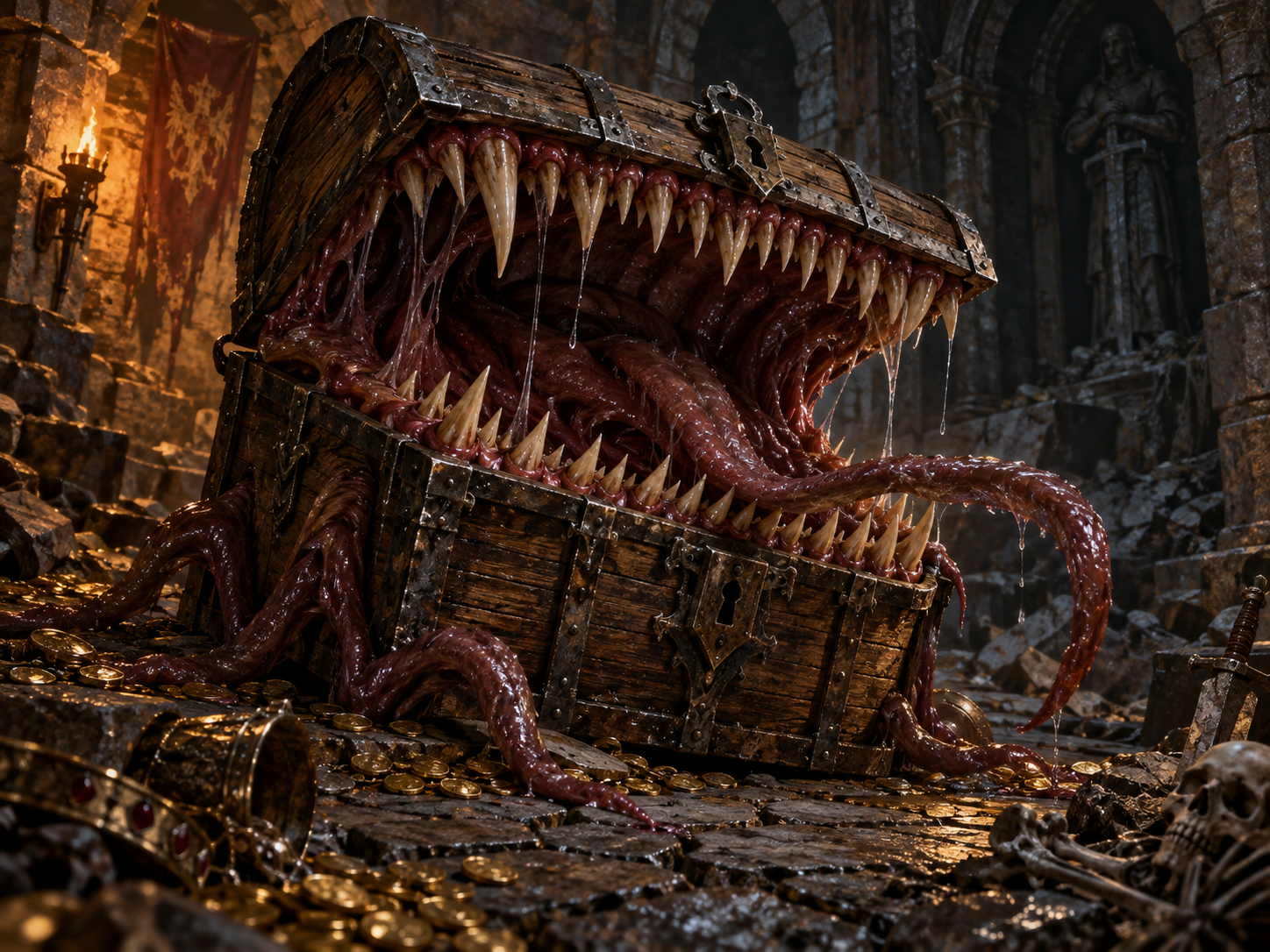
A mimic is a shapeshifting ambush predator that becomes a door, chest, bed, altar, crate or other ordinary object, waits for someone to touch it, then traps prey with adhesive flesh and tears into the victim before companions can react. Neutral by nature and patient by instinct, it turns routine exploration into a threat.
Reference Card
GM Quick Use
- Place it where interaction is natural. A mimic works best as a door that must be opened, a chest beside genuine loot, a bed in a deserted room or a crate in a busy storehouse.
- Foreshadow the scene, not the answer. Give observant characters evidence of predation around the lair without making the disguised object automatically obvious.
- Open on the isolated character. The first round matters most: grab the creature that touches it, then force the rest of the party to choose between rescue, damage and positioning.
- Use the edition’s actual escape rules. Do not import Pathfinder adhesive counters into 5.5e, or 2014 traits into the 2024 stat block.
- Let survival matter. A mimic that loses its ambush advantage can withdraw, bargain or remain motionless for another chance when its edition and intelligence support that behaviour.
Encounter Builder
Mimic — D&D 5.5e / 2024
Medium Monstrosity, Neutral
AC 12
Initiative +3 (13)
HP 58 (9d8 + 18)
Speed 20 ft.
| STR | DEX | CON | INT | WIS | CHA |
|---|---|---|---|---|---|
| 17 (+3) | 12 (+1) | 15 (+2) | 5 (−3) | 13 (+1) | 8 (−1) |
| Save +3 | Save +1 | Save +2 | Save −3 | Save +1 | Save −1 |
Skills Stealth +5
Immunities Acid damage; Prone condition
Senses Darkvision 60 ft.; Passive Perception 11
Languages None
CR 2 (XP 450; PB +2)
Traits
Adhesive (Object Form Only). Anything touching the mimic can stick to it. A Huge or smaller creature that becomes adhered is Grappled (escape DC 13), and ability checks made to escape that grapple have Disadvantage.
Actions
Bite. Melee Attack Roll: +5, reach 5 ft. The attack has Advantage against a creature Grappled by the mimic. Hit: 7 (1d8 + 3) Piercing damage, or 12 (2d8 + 3) Piercing damage if the target is Grappled by the mimic, plus 4 (1d8) Acid damage.
Pseudopod. Melee Attack Roll: +5, reach 5 ft. Hit: 7 (1d8 + 3) Bludgeoning damage plus 4 (1d8) Acid damage. A Large or smaller target is Grappled (escape DC 13), and ability checks to escape have Disadvantage.
Bonus Actions
Shape-Shift. The mimic changes into the appearance of a Medium or Small object without changing its game statistics, or returns to its true blob-like form. Equipment it carries does not transform with it.
Running the 2024 mimic: establish the grapple with Pseudopod or contact while in object form, then Bite the trapped target. For the older False Appearance and Grappler mechanics, use the dedicated D&D 5e / 2014 tab.
Mimic — D&D 5e / 2014
Medium monstrosity (shapechanger), neutral
Armor Class 12 (natural armor)
Hit Points 58 (9d8 + 18)
Speed 15 ft.
Skills Stealth +5
Damage Immunities acid
Condition Immunities prone
Senses darkvision 60 ft., passive Perception 11
Languages —
Challenge 2 (450 XP)
Traits
Shapechanger. The mimic can use its action to polymorph into an object or back into its true, amorphous form. Its statistics are the same in each form. Equipment it carries is not transformed. It reverts to its true form if it dies.
Adhesive (Object Form Only). The mimic adheres to anything that touches it. A Huge or smaller creature adhered to the mimic is also Grappled by it (escape DC 13). Ability checks made to escape this grapple have disadvantage.
False Appearance (Object Form Only). While the mimic remains motionless, it is indistinguishable from an ordinary object.
Grappler. The mimic has advantage on attack rolls against any creature Grappled by it.
Actions
Pseudopod. Melee Weapon Attack: +5 to hit, reach 5 ft., one target. Hit: 7 (1d8 + 3) bludgeoning damage. If the mimic is in object form, the target is subjected to its Adhesive trait.
Bite. Melee Weapon Attack: +5 to hit, reach 5 ft., one target. Hit: 7 (1d8 + 3) piercing damage plus 4 (1d8) acid damage.
2014 tactics: remain motionless in object form until prey makes contact, use Adhesive to trap the first victim, then exploit Grappler to attack that target with advantage.
Mimic — Pathfinder 1e
CR 4 XP 1,200
N Medium Aberration (shapechanger)
Init +5; Senses darkvision 60 ft.; Perception +14
Defense
AC 16, touch 11, flat-footed 15 (+1 Dex, +5 natural)
hp 52 (7d8 + 21)
Fort +5, Ref +5, Will +6; Immune acid
Offense
Speed 10 ft.
Melee slam +10 (1d8 + 6 plus adhesive)
Special Attacks constrict (slam, 1d8 + 6)
Statistics
Str 19, Dex 12, Con 17, Int 10, Wis 13, Cha 10
Base Atk +5; CMB +9; CMD 20 (can’t be tripped)
Feats Improved Initiative, Lightning Reflexes, Skill Focus (Perception), Weapon Focus (slam)
Skills Climb +14, Disguise +10 (+30 when mimicking objects), Knowledge (dungeoneering) +10, Perception +14
Racial Modifiers +20 Disguise when mimicking objects; Languages Common; SQ mimic object
Special Abilities
Adhesive (Ex). The mimic’s slime holds fast creatures and objects that touch it. A creature hit by its adhesive-covered slam is automatically grappled. A weapon striking the mimic sticks unless its wielder succeeds on a DC 17 Reflex save; freeing a stuck weapon requires a DC 17 Strength check. Strong alcohol or universal solvent dissolves the adhesive. The mimic can release its own adhesive at will, and the substance loses its grip 5 rounds after the mimic dies. The DC is Strength-based.
Mimic Object (Ex). The mimic assumes the general form of a Medium object such as a chest, bed or door without substantially changing size. Its surface remains hard and rough. It gains a +20 racial bonus on Disguise checks made to imitate an object, and Disguise is always a class skill for it.
Ecology
Environment any; Organization solitary; Treasure incidental
Pathfinder 1e Mimic Mutations
These optional mutations create unusual mimics. Apply the listed CR adjustment only to this Pathfinder 1e version and reassess the encounter after combining several mutations.
Aberrant Biology (Ex), CR +1. The mimic has a 50% chance to ignore extra damage from critical hits and sneak attacks.
Adaptive Resistance (Ex), CR +1. The mimic has resistance 20 against fire, cold, electricity or sonic damage, choosing one type at a time. It can change the chosen resistance as a move action.
Bioluminescence (Ex), CR +0. The mimic can make any part of its body glow from candle brightness to torch brightness, in one or several colours, and can start or stop the light as a free action.
Corrosive Glue (Ex), CR +1. A successful slam attack or grapple check deals an extra 2d6 acid damage.
Gillfoot (Ex), CR +0. The mimic gains climb 5 ft. and swim 5 ft., can breathe water as easily as air, and can still take a 5-foot step while climbing, swimming or moving through terrain that would normally prevent it.
Glide (Ex), CR +0. The mimic gains a fly speed of 40 ft. with clumsy maneuverability.
Hardy Protoplasm (Ex), CR +1. The mimic gains fast healing 5.
Hypersenses (Ex), CR +0. The mimic gains blindsense 30 ft. and cannot be flanked.
Mutable Strikes (Ex), CR +0. Its slam deals bludgeoning, piercing and slashing damage, and the slam’s damage die increases by one step.
Otherworldly Resilience (Ex), CR +1. The mimic gains DR 5/adamantine.
Supple Shifter (Ex), CR +1. The mimic can squeeze into a space one-quarter of its normal base size, its reach increases by 5 ft., and it gains Combat Reflexes as a bonus feat.
Toxic (Ex), CR +1. The mimic’s flesh becomes a contact poison: Fortitude DC 10 + half its Hit Dice + its Constitution modifier; frequency 1/round for 4 rounds; effect 1d2 Constitution damage; cure 1 save. Creatures hit by its natural attacks, or striking it with unarmed attacks or natural weapons, are exposed.
Mimic — D&D 3.5e
Large Aberration (Shapechanger), Usually Neutral
Hit Dice 7d8 + 21 (52 hp)
Initiative +1
Speed 10 ft. (2 squares)
Armor Class 15 (−1 size, +1 Dex, +5 natural), touch 10, flat-footed 15
Base Attack/Grapple +5/+13
Attack slam +9 melee (1d8 + 4)
Full Attack 2 slams +9 melee (1d8 + 4)
Space/Reach 10 ft./10 ft.
Special Attacks adhesive, crush
Special Qualities darkvision 60 ft., immunity to acid, mimic shape
Saves Fort +5, Ref +5, Will +6
Abilities Str 19, Dex 12, Con 17, Int 10, Wis 13, Cha 10
Skills Climb +9, Disguise +13, Listen +8, Spot +8
Feats Alertness, Lightning Reflexes, Weapon Focus (slam)
Environment underground; Organization solitary; Challenge Rating 4
Treasure 1/10 coins; 50% goods; 50% items; Alignment usually neutral; Advancement 8–10 HD (Large), 11–21 HD (Huge); Languages Common
Special Abilities
Adhesive (Ex). A mimic’s natural adhesive makes creatures and weapons stick to it. A mimic automatically grapples a creature hit by a slam. A weapon that strikes it sticks unless the wielder succeeds on a DC 16 Reflex save; a DC 16 Strength check frees a stuck weapon. Strong alcohol dissolves the adhesive. The mimic can suppress its adhesive at will, and the substance breaks down 5 rounds after death.
Crush (Ex). A mimic deals 1d8 + 4 damage after making a successful grapple check.
Mimic Shape (Ex). A mimic can reshape itself to fill roughly 150 cubic feet and imitate an object of comparable size. Close examination is resolved with Spot opposed by the mimic’s Disguise check. Its ability to imitate objects grants a +8 racial bonus on Disguise checks.
What Is a Mimic?
A mimic is a living shapeshifter whose hunting strategy depends on looking like something worth approaching. The classic disguise is a treasure chest, but a chest is only one possibility. Doors, tables, beds, barrels, statues, coffers, lecterns, crates and architectural fittings all turn ordinary dungeon decisions into dangerous contact.
Its classification changes between rules editions: the current 5.5e creature is a Monstrosity, while Pathfinder 1e and D&D 3.5e treat it as an Aberration. Its behaviour is more consistent than its taxonomy. It waits, lets prey commit to touching or moving it, then uses adhesion and brute force to keep a victim from simply stepping away.
Appearance and False Forms
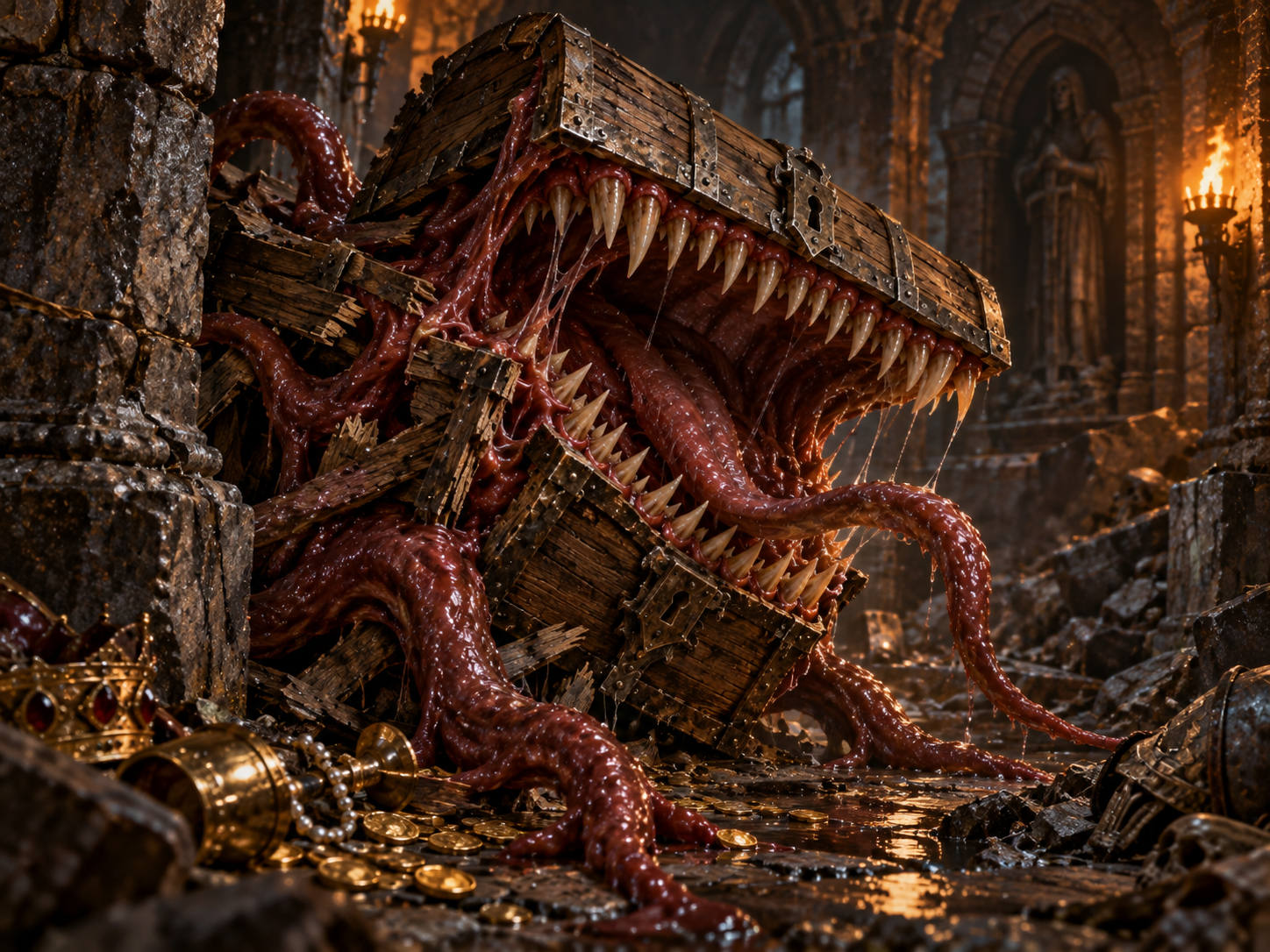
Outside a disguise, a mimic is an amorphous mass of tough flesh capable of extruding pseudopods, opening a tooth-lined maw and changing its surface to resemble worked material. When it settles into a false form, its greatest advantage is not perfect artistry but context: a chest belongs in a treasury, a barrel belongs in a cellar, and a door belongs in a wall.
Older rules describe a typical mimic as occupying roughly 150 cubic feet, while the current 5.5e version specifically imitates Medium or Small objects. Treat each edition’s limits as part of that edition’s stat block rather than assuming that every mimic can become a house, ship or room.
Habitat, Signs and Hunting Grounds
Mimics favour places where people approach objects without prolonged scrutiny: crypts, castle undercrofts, abandoned monasteries, smugglers’ caves, warehouses, toll houses, cellars, ship holds, ruined workshops and treasure chambers. A successful mimic does not need constant traffic. It needs occasional isolated prey and enough quiet to reset its disguise.
In 1454, reports cluster around abandoned fortifications, plague-emptied buildings, siege-damaged quarters, river warehouses and old religious sites where scavengers, soldiers, thieves and explorers repeatedly search unattended rooms.
Useful warning signs exist around a lair even when the false object itself passes inspection: vermin vanish from a room, bones accumulate behind furniture, drag marks stop at an apparently harmless object, nearby dust has been disturbed, or scraps of leather and cloth remain stuck to stone where a previous victim struggled free.
Fair-play clue: foreshadow the predator through its environment. Do not invent a universal seam, smell, heartbeat or detection DC that automatically defeats a successful disguise when the edition’s rules do not provide one.
Behaviour and Intelligence
A mimic is an energy-efficient hunter. Remaining still costs less than chasing prey, and a convincing false object can make food approach voluntarily. A hungry mimic therefore chooses position before it chooses shape: near a doorway, beside genuine valuables, at the end of a passage, inside a storehouse or anywhere an explorer is likely to reach before thinking.
The rules editions portray mimic intelligence differently. The current 5.5e mimic has Intelligence 5 and no languages, making it much more bestial by default. Pathfinder 1e and D&D 3.5e give mimics Intelligence 10 and Common, supporting negotiation, deception, surrender and bargains. Use the behaviour that belongs to the stat block in play.
Combat and Tactics
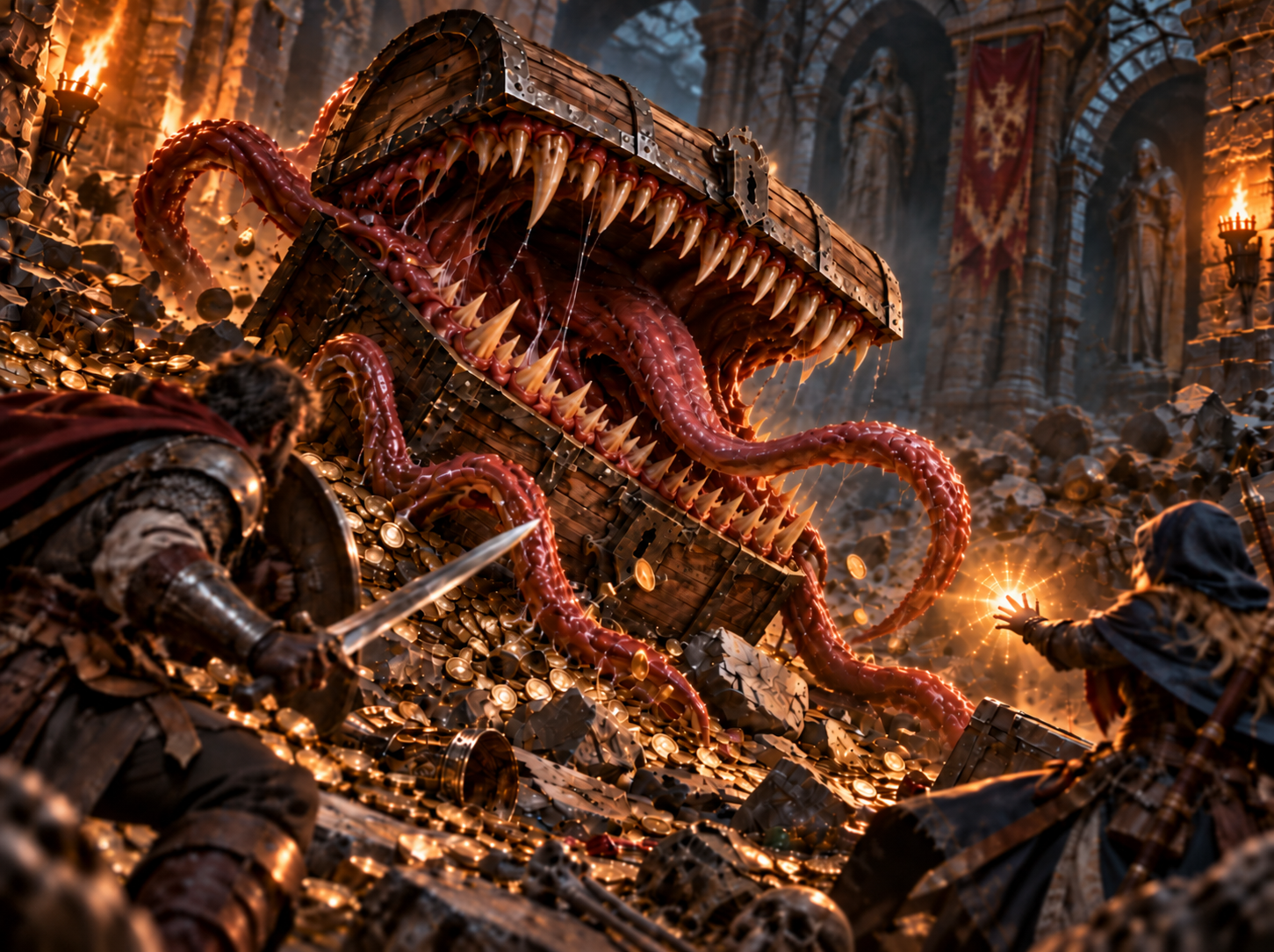
The mimic’s first target should usually be the creature that has already committed to touching, opening or moving it. Once contact is made, the creature uses adhesion or a pseudopod to prevent easy withdrawal, then concentrates attacks on the trapped victim while the room itself becomes part of the fight.
A mimic has little reason to trade attacks with an entire prepared party in open ground. It benefits from corners, narrow spaces, clutter and doorways that delay rescuers. In editions where it can negotiate, a badly injured mimic may offer information, access to hidden treasure or safe passage rather than fight to destruction.
Against inexperienced parties, avoid turning the encounter into a pure “you touched the chest, therefore you lose” trick. The danger is stronger when players can recognise clues, choose how to approach and then deal with the consequences of a wrong or risky decision.
Treasure and Salvage
Mimic treasure is usually accidental: coins, weapons, jewellery, tools and packs abandoned by creatures it killed. Intelligent mimics may deliberately arrange valuables as bait, while more bestial specimens simply remain near places where treasure already attracts prey.
Pathfinder 1e and D&D 3.5e explicitly state that the natural adhesive breaks down 5 rounds after the mimic dies, so it is not a permanent crafting substance without some separate preservation method. Strong alcohol and universal solvent are counters in the Pathfinder rules; they should not be treated as automatic 5.5e counters unless the GM adds that rule.
Ecology and Local Impact
A single mimic can change how an entire building is used. Servants stop entering one storeroom alone. Rats disappear. Guards refuse to touch abandoned crates. A toll station loses travellers without obvious bloodshed. Once rumours spread, every chest and door becomes suspect long after the actual predator has moved on.
This makes mimics useful beyond a single combat. A merchant may pay to clear a warehouse, thieves may deliberately feed one to protect a cache, or a castle garrison may abandon a passage because nobody can agree which object is dangerous. The creature’s ecological footprint is fear, missing animals and disrupted human routines as much as bones.
Rumours and What They Mean
| Rumour | Use at the Table |
|---|---|
| “Never trust a chest with iron hinges.” | False. A mimic can imitate many kinds of object; hinge style is not a reliable test. |
| “The rats vanished before the porter did.” | Useful clue. A stationary predator can thin out small animals around its hiding place. |
| “Strong spirits will free a stuck sword.” | Edition-dependent. This is a real counter in Pathfinder 1e and D&D 3.5e, not a universal rule. |
| “Some of them can talk.” | Edition-dependent. Pathfinder 1e and 3.5e mimics speak Common; the current 5.5e mimic has no language. |
Adventure Hooks
The Toll Chest
Merchants have stopped using a bridge after three toll collectors vanished. The coin chest is still in the booth, apparently untouched, and the local lord wants the road reopened before the next market day.
The Empty Wine Cellar
A monastery’s wine vanishes barrel by barrel, followed by the cellarer. One barrel is a mimic that learned the safest disguise in the room; another contains the only clue to who brought it there.
The Ship That Eats Cargo
Crates disappear during a coastal voyage, yet the hold remains locked from the outside. A mimic has been moving only when the ship’s bell and waves cover the sound.
The Door No Mason Built
A newly uncovered crypt has one more door than the monastery plans record. Behind the false “door” is a genuine sealed chamber that the mimic has inadvertently protected for decades.
Set-Piece: The Wrong Treasury
The party enters a looted treasury containing one intact coffer, a broken strongbox, scattered silver and a corpse whose sword is missing. The intact coffer is the mimic. The broken strongbox contains genuine valuables. The missing sword is stuck to the mimic’s underside, and the corpse’s position gives attentive characters a clue before anyone reaches for the apparent prize.
The encounter becomes more interesting if another threat arrives after the mimic reveals itself: guards, rival thieves, flooding or a closing portcullis. The mimic then controls space while the second problem creates urgency.
RPG History and Rules Sources
The mimic is a tabletop roleplaying-game monster rather than a direct adaptation of one specific historical folklore creature. Its recognisable object-disguise identity reaches back to the original Advanced Dungeons & Dragons Monster Manual published in 1977.
Rules references: official SRD 5.2.1 Mimic; Pathfinder 1e Mimic; D&D 3.5e SRD Mimic.
Rules and Licensing
D&D 5.5e / 2024
This work includes material from the System Reference Document 5.2.1 (“SRD 5.2.1”) by Wizards of the Coast LLC, available at https://www.dndbeyond.com/srd. The SRD 5.2.1 is licensed under the Creative Commons Attribution 4.0 International License, available at https://creativecommons.org/licenses/by/4.0/legalcode.
D&D 5e / 2014
This work includes material taken from the System Reference Document 5.1 (“SRD 5.1”) by Wizards of the Coast LLC and available at https://dnd.wizards.com/resources/systems-reference-document. The SRD 5.1 is licensed under the Creative Commons Attribution 4.0 International License available at https://creativecommons.org/licenses/by/4.0/legalcode. The legacy mimic is presented in the dedicated 2014 edition tab; its action economy is not the same as SRD 5.2.1.
Official 2014 source: SRD 5.1 PDF. Official 2024 source: SRD 5.2.1 PDF.
Pathfinder 1e and D&D 3.5e
The Pathfinder 1e and D&D 3.5e rules use and adapt Open Game Content under the Open Game License Version 1.0a. The Pathfinder base creature derives from the Pathfinder RPG Bestiary; the Pathfinder mimic mutations derive from Dungeon Denizens Revisited.
Open Game License Version 1.0a
OPEN GAME LICENSE Version 1.0a
The following text is the property of Wizards of the Coast, Inc. and is Copyright 2000 Wizards of the Coast, Inc (“Wizards”). All Rights Reserved.
1. Definitions: (a) “Contributors” means the copyright and/or trademark owners who have contributed Open Game Content; (b) “Derivative Material” means copyrighted material including derivative works and translations (including into other computer languages), potation, modification, correction, addition, extension, upgrade, improvement, compilation, abridgment or other form in which an existing work may be recast, transformed or adapted; (c) “Distribute” means to reproduce, license, rent, lease, sell, broadcast, publicly display, transmit or otherwise distribute; (d) “Open Game Content” means the game mechanic and includes the methods, procedures, processes and routines to the extent such content does not embody the Product Identity and is an enhancement over the prior art and any additional content clearly identified as Open Game Content by the Contributor, and means any work covered by this License, including translations and derivative works under copyright law, but specifically excludes Product Identity. (e) “Product Identity” means product and product line names, logos and identifying marks including trade dress; artifacts; creatures characters; stories, storylines, plots, thematic elements, dialogue, incidents, language, artwork, symbols, designs, depictions, likenesses, formats, poses, concepts, themes and graphic, photographic and other visual or audio representations; names and descriptions of characters, spells, enchantments, personalities, teams, personas, likenesses and special abilities; places, locations, environments, creatures, equipment, magical or supernatural abilities or effects, logos, symbols, or graphic designs; and any other trademark or registered trademark clearly identified as Product identity by the owner of the Product Identity, and which specifically excludes Open Game Content; (f) “Trademark” means the logos, names, mark, sign, motto, designs that are used by a Contributor to identify itself or its products or the associated products contributed to the Open Game License by the Contributor; (g) “Use”, “Used” or “Using” means to use, Distribute, copy, edit, format, modify, translate and otherwise create Derivative Material of Open Game Content; (h) “You” or “Your” means the licensee in terms of this agreement.
2. The License: This License applies to any Open Game Content that contains a notice indicating that the Open Game Content may only be Used under and in terms of this License. You must affix such a notice to any Open Game Content that you Use. No terms may be added to or subtracted from this License except as described by the License itself. No other terms or conditions may be applied to any Open Game Content distributed using this License.
3. Offer and Acceptance: By Using the Open Game Content You indicate Your acceptance of the terms of this License.
4. Grant and Consideration: In consideration for agreeing to use this License, the Contributors grant You a perpetual, worldwide, royalty-free, non-exclusive license with the exact terms of this License to Use, the Open Game Content.
5. Representation of Authority to Contribute: If You are contributing original material as Open Game Content, You represent that Your Contributions are Your original creation and/or You have sufficient rights to grant the rights conveyed by this License.
6. Notice of License Copyright: You must update the COPYRIGHT NOTICE portion of this License to include the exact text of the COPYRIGHT NOTICE of any Open Game Content You are copying, modifying or distributing, and You must add the title, the copyright date, and the copyright holder’s name to the COPYRIGHT NOTICE of any original Open Game Content you Distribute.
7. Use of Product Identity: You agree not to Use any Product Identity, including as an indication as to compatibility, except as expressly licensed in another, independent Agreement with the owner of each element of that Product Identity. You agree not to indicate compatibility or co-adaptability with any Trademark or Registered Trademark in conjunction with a work containing Open Game Content except as expressly licensed in another, independent Agreement with the owner of such Trademark or Registered Trademark. The use of any Product Identity in Open Game Content does not constitute a challenge to the ownership of that Product Identity. The owner of any Product Identity used in Open Game Content shall retain all rights, title and interest in and to that Product Identity.
8. Identification: If you distribute Open Game Content You must clearly indicate which portions of the work that you are distributing are Open Game Content.
9. Updating the License: Wizards or its designated Agents may publish updated versions of this License. You may use any authorized version of this License to copy, modify and distribute any Open Game Content originally distributed under any version of this License.
10. Copy of this License: You MUST include a copy of this License with every copy of the Open Game Content You Distribute.
11. Use of Contributor Credits: You may not market or advertise the Open Game Content using the name of any Contributor unless You have written permission from the Contributor to do so.
12. Inability to Comply: If it is impossible for You to comply with any of the terms of this License with respect to some or all of the Open Game Content due to statute, judicial order, or governmental regulation then You may not Use any Open Game Material so affected.
13. Termination: This License will terminate automatically if You fail to comply with all terms herein and fail to cure such breach within 30 days of becoming aware of the breach. All sublicenses shall survive the termination of this License.
14. Reformation: If any provision of this License is held to be unenforceable, such provision shall be reformed only to the extent necessary to make it enforceable.
15. COPYRIGHT NOTICE
Open Game License v 1.0a Copyright 2000, Wizards of the Coast, Inc.
System Reference Document Copyright 2000–2003, Wizards of the Coast, Inc.; Authors Jonathan Tweet, Monte Cook, Skip Williams, Rich Baker, Andy Collins, David Noonan, Rich Redman, Bruce R. Cordell, John D. Rateliff, Thomas Reid, James Wyatt, based on original material by E. Gary Gygax and Dave Arneson.
Pathfinder Roleplaying Game Core Rulebook Copyright 2009, Paizo Publishing, LLC; Author: Jason Bulmahn, based on material by Jonathan Tweet, Monte Cook, and Skip Williams.
Pathfinder RPG Bestiary. Copyright 2009, Paizo Publishing, LLC; Author: Jason Bulmahn, based on material by Jonathan Tweet, Monte Cook, and Skip Williams.
Pathfinder Roleplaying Game Reference Document. © 2011, Paizo Publishing, LLC; Author: Paizo Publishing, LLC.
Dungeon Denizens Revisited. Copyright 2009, Paizo Publishing, LLC; Authors Clinton Boomer, Jason Bulmahn, Joshua J. Frost, Nicolas Logue, Robert McCreary, Jason Nelson, Richard Pett, Sean K Reynolds, James L. Sutter, and Greg A. Vaughan.
Mimic Pathfinder 1e and D&D 3.5e rules adaptations. Copyright 2026 SpiralWorlds.
Mimic FAQ
Can a mimic become any object?
No. The limits depend on edition. The current 5.5e mimic resembles a Medium or Small object; Pathfinder 1e specifies the general shape of a Medium object; D&D 3.5e uses its own volume-based Mimic Shape rules.
Can a mimic talk?
The current 5.5e mimic has no languages. Pathfinder 1e and D&D 3.5e mimics speak Common and have Intelligence 10, so those versions can negotiate or deceive creatures directly.
Does alcohol dissolve mimic adhesive?
In Pathfinder 1e and D&D 3.5e, strong alcohol is an explicit counter to the adhesive. The current 5.5e stat block does not include that rule.
Keep this reference growing
If this page helped with your reading or game, you can support its upkeep or explore the curated books.
Explore the Bookshop — epics, classics and stories behind imagined worlds.