
Creating New Witch Traditions: 7 Powerful Ways to Build Better Covens
Creating New Witch Traditions: 7 Powerful Ways to Build Better Covens
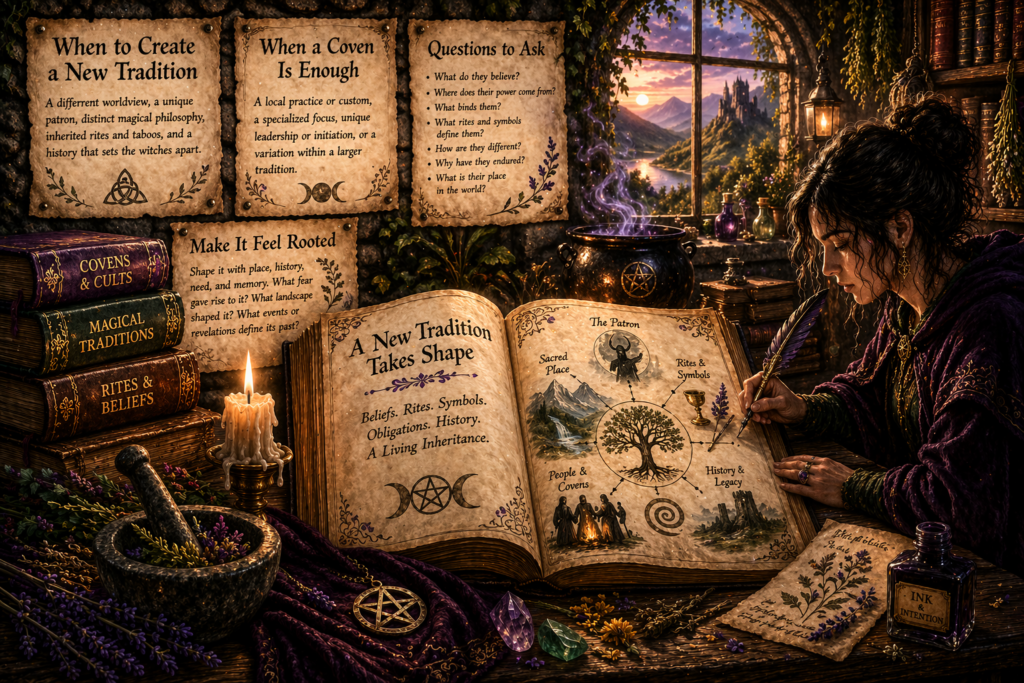
Creating New Witch Traditions allows a Game Master to shape witchcraft so it belongs naturally to the campaign world instead of borrowing assumptions from somewhere else. The traditions presented elsewhere may draw on older historical and occult models, but another world may understand witches, patrons, covens, and the craft in very different ways.
A new tradition should not be created lightly. A tradition is not just a list of powers, a costume, or a small circle of unusual practitioners. It is a larger inheritance: a body of belief, magical practice, ritual custom, sacred obligation, and shared identity strong enough to endure across generations, regions, or multiple covens. A true tradition carries history with it.
What a Tradition Really Is
A witch tradition is usually shaped by geography, philosophy, theology, patronage, ritual structure, inherited lore, and a particular understanding of magic. It is broad enough that different covens, teachers, or lineages can still be recognized as belonging to the same greater whole. Members may disagree on details, but they share a common way of interpreting the craft.
This matters in worldbuilding because a tradition tells players not only what witches can do, but how they think, what they fear, what they owe, and what gives their magic meaning.
When to Build a Separate Tradition
Create a new tradition when witches in the setting possess a genuinely different worldview, source of authority, magical philosophy, ritual inheritance, or spiritual obligation. A separate tradition is appropriate when the difference is large enough to reshape how witches learn, practice, organize themselves, and understand their place in the world.
A tradition may deserve to stand on its own if it answers core questions differently from every existing model. Does it serve a different class of Patron? Does it treat magic as bargain, revelation, bloodright, discipline, or theft? Does it preserve unique rites, taboos, sacred tools, seasonal obligations, or doctrines about fate, the dead, the body, or the soul? If so, the tradition may be broad enough to justify separate treatment.
When a Coven Is Enough
Game Masters should be cautious about inventing a wholly separate tradition when a new coven would serve the same purpose more cleanly. A coven is often the better tool for representing a local practice, a patron-specific branch, a distinctive magical emphasis, an unusual initiation, or a community with its own customs and leadership.
If the witches in question still share the same larger beliefs, magical foundations, and inherited understanding of the craft, then they probably belong to an existing tradition and differ only at the coven level. In many campaigns, this distinction prevents needless fragmentation and helps witchcraft feel older, broader, and more believable.
Questions Worth Answering First
A well-made tradition should feel like a living inheritance rather than a bundle of mechanics. Ask the following before giving it a place in the setting:
- What does this tradition believe about magic?
- Where does it claim its authority comes from?
- What obligations, taboos, or oaths bind its members?
- What rites, symbols, and sacred practices define it?
- How does it differ from older or rival traditions?
- Why has it endured instead of vanishing?
- What place does it hold in the wider world?
If those questions cannot be answered clearly, then the idea may not yet be a full tradition. It may be a coven, a temporary sect, a patron cult, or a local variation within a larger body of practice.
Making It Feel Rooted in the World
The best traditions feel shaped by history, place, and necessity. They should grow from the setting rather than float above it. A marshland tradition will not look, pray, or work magic in the same way as a mountain tradition. A witch-lineage formed under a stern death goddess will not resemble one raised by household spirits, moon powers, or devouring forest patrons.
Think in terms of inheritance rather than invention. What old fear gave rise to this tradition? What landscape shaped it? What enemies hardened it? What miracles, bargains, disasters, or revelations define its memory? Details like these give a tradition weight and make it feel as though it belongs to a world with a past.
Why This Matters for Play
A strong tradition does more than grant powers. It gives a player a way to understand a witch as part of something larger: an order, lineage, secret religion, or living magical culture. It provides obligations as well as advantages, and identity as well as mechanics.
A well-built tradition also gives the Game Master tools for allies, rivals, initiations, betrayals, sacred duties, inherited enemies, and old unresolved obligations that can shape stories for years. For related guidance, see Knowledge (Witchcraft).
Final Guidance
In most cases, it is better to create fewer traditions and make them stronger than to create many traditions that differ only in surface detail. Large traditions should feel broad, durable, and culturally real. Covens can then provide the local variety, internal tension, and specialized expression that keep witchcraft alive at the table.
Handled well, Creating New Witch Traditions does more than expand player options. It deepens the setting, strengthens the place of witches in the world, and makes the craft feel ancient, rooted, and consequential.
For a broader discussion of how tradition shapes magical identity in folklore and historical belief, see Encyclopaedia Britannica’s overview of witchcraft.