
Skill Knowledge (Witchcraft)
Knowledge (Witchcraft)
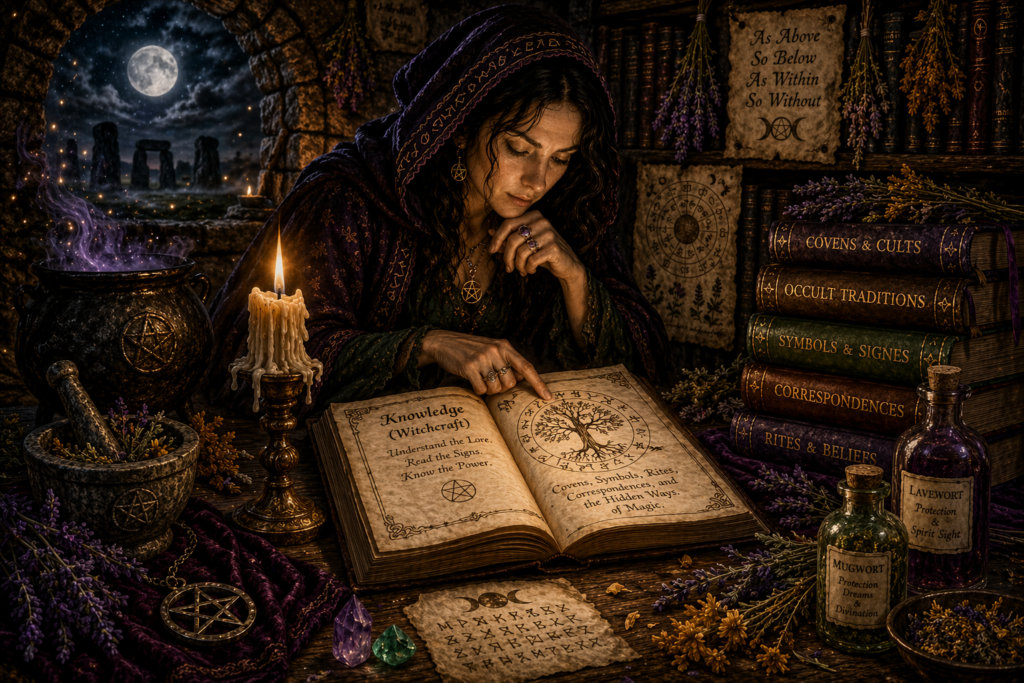
Knowledge (Witchcraft) (Intelligence; Trained Only)
Knowledge (Witchcraft) is a trained Intelligence-based subskill of the Knowledge category. It covers the history, beliefs, rites, symbols, covens, cults, occult traditions, magical correspondences, and spiritual practices associated with witches and related supernatural paths.
Where Knowledge (Arcana) addresses magic in its broader and more formal sense, Knowledge (Witchcraft) is concerned with the hidden logic of witchcraft itself: the bonds between stars and seasons, stones and bodies, colors and omens, spirits and places, signs and fate. It is the lore of magical custom, sacred taboo, inherited practice, and the symbolic understanding by which witches interpret and reshape the world.
A character trained in Knowledge (Witchcraft) can identify covens, interpret witch-signs, recognize occult traditions, classify ritual practices, recall supernatural weaknesses, and understand the beliefs that lie behind a witch’s magic. In campaigns where witchcraft is a real and distinct force, this skill is more than a narrow specialty. It is the key to understanding an entire supernatural culture.
Check
A successful Knowledge (Witchcraft) check allows a character to recall useful information about witches, covens, occult traditions, magical beliefs, supernatural practices, ritual symbols, sacred sites, magical hot spots, and related supernatural beings. This skill may be used to identify traditions, classify covens, interpret magical practices, recognize symbols, understand occult theories, and recall the known strengths or weaknesses of certain supernatural foes.
As a general rule, easy questions have DCs of 10 to 11, standard questions have DCs of 15 to 16, and difficult questions have DCs of 20 or higher. Particularly obscure, regional, or esoteric subjects may increase the DC by 1 or 2, or more at the Game Master’s discretion.
Knowledge (Witchcraft) DCs
| Task | DC |
|---|---|
| Identify major occult practices such as witchcraft, voodoo, or Hermetic magic. | 10 |
| Identify major occult theories or beliefs such as reincarnation, ley lines, or correspondences. | 11 |
| Identify the common magical practices of a particular tradition or sub-tradition. | 12 |
| Identify common weaknesses or strengths of common supernatural monsters such as undead, fey, or warlocks. | 12 |
| Identify common occult hot spots and their significance, such as the Great Pyramids, Stonehenge, or Atlantis. | 13 |
| Identify or classify major branches of witchcraft traditions or occult schools of thought, such as Celtic practice, Santeria, Gnostic teachings, or Hermetic philosophy. | 15 |
| Identify common weaknesses or strengths of rarer supernatural monsters such as outsiders or demons. Increase the DC for especially uncommon creatures or traits. | 16 |
| Identify rarer occult hot spots and their significance, such as the Nazca Lines, Tihanco, or Xanadu. | 17 |
| Identify or classify minor branches of occult practice or lesser-known witchcraft traditions, such as Rosicrucianism, the Golden Dawn, Pictish practice, or Bocur traditions. | 18 |
| Identify major covens by name or by distinctive practices. | 19 |
| Identify major occult figures or personages by name or reputation, such as King Solomon or Aleister Crowley. | 20 |
| Identify lesser occult figures or personages by name or reputation, such as Madame Blavatsky. | 22 |
| Identify more esoteric occult practices such as Taoist witchcraft or ancient mystery traditions. | 24 |
| Identify lesser covens by name or by distinctive practices. | 26 |
What Knowledge (Witchcraft) Covers
Knowledge (Witchcraft) includes an understanding of correspondences and hidden relationships: the belief that stars, planets, gemstones, herbs, colors, body parts, omens, and life events are bound together by invisible patterns. Those trained in this skill know how witches read such signs, how they draw meaning from them, and how they may use occult knowledge for healing, divination, cursing, protection, and spiritual work.
This skill also covers the basic tenets of witch religion, the nature of covens and cults, the symbolic language of witchcraft, and the distinctive magical worldview that sets witches apart from more formal arcane traditions. It is as much a knowledge of meaning as it is of magic.
Retry
No. A check represents what the character already knows. Thinking about it longer does not ordinarily produce a different answer, though the Game Master may allow a new check if the character gains access to new evidence, forgotten texts, a witness, or further instruction.
Special
A witch trained in Knowledge (Witchcraft) is especially well equipped to identify covens, recognize witch-symbols, interpret ritual patterns, and understand the magical nature of other witches. At the Game Master’s discretion, witches or similarly initiated characters may receive a circumstance bonus on checks involving their own traditions, allied covens, or familiar supernatural practices.
In campaigns where witches are rare, poorly defined, or not meaningfully distinct from other arcane casters, Knowledge (Witchcraft) may have limited value. As an optional rule, the Game Master may fold its function into Knowledge (Arcana).
In campaigns where witches, covens, magical religion, occult traditions, and supernatural customs are culturally important and clearly distinct, Knowledge (Witchcraft) should remain separate. In such games, the Game Master may also allow classes such as clerics and wizards to treat Knowledge (Witchcraft) as a class skill.
Learning Witch Spells
An arcane spellcaster must have at least 1 rank in Knowledge (Witchcraft) to learn spells from a witch’s spellbook.
The base penalty to learn a witch spell is –5, with an additional –1 penalty per spell level. Thus, learning a 6th-level witch spell carries a total penalty of –11. Each rank in Knowledge (Witchcraft) reduces this penalty by 1.
Witches likewise need this skill if they wish to learn arcane spells from the scrolls or spellbooks of wizards, using the same penalties.
At the Game Master’s discretion, some spells may remain beyond the witch’s tradition to understand or beyond the wizard’s ability to grasp, regardless of skill ranks, if the spell belongs too deeply to a different magical discipline, sacred lineage, or occult worldview.
Knowledge (Witchcraft) and Knowledge (Arcana)
Like Knowledge (Arcana), Knowledge (Witchcraft) deals with the supernatural. The difference lies in emphasis.
Knowledge (Arcana) concerns magical theory, spell structure, magical creatures, formal lore, and the operation of arcane effects. Knowledge (Witchcraft) concerns the history, religion, customs, rites, symbols, correspondences, and magical practices of witches. Where arcana explains how magic works, witchcraft more often explains what it means, how it is learned, who guards it, and why it is feared.
In a setting where witches are spiritually, culturally, and ritually distinct, that difference matters. Knowledge (Witchcraft) is not merely arcana with a narrower title. It is the lore of an older, stranger, and more intimate way of understanding power.
Using Knowledge (Witchcraft) in a Campaign
Knowledge (Witchcraft) is most useful in campaigns that treat witchcraft as a real tradition rather than a cosmetic label. It supports investigations into covens, magical accusations, strange rites, cursed places, supernatural customs, folk healing, village fears, occult inheritances, spirit bargains, and hidden religious practices. It also helps distinguish witches from wizards, priests, and other spellcasters in a way that gives the setting more depth.
When witchcraft is prominent, this skill helps the world feel older, more rooted, and more dangerous. It reminds players that magic is not only power. It is memory, taboo, inheritance, belief, and consequence.
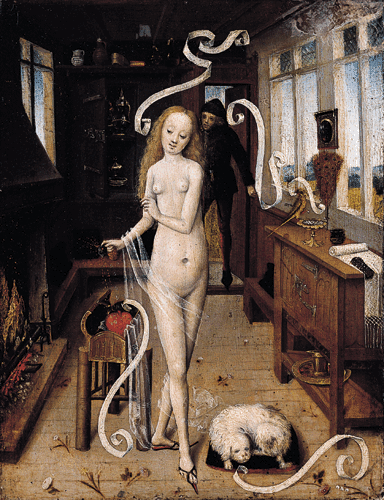
For broader real-world background on the history of witchcraft beliefs, see Encyclopaedia Britannica’s overview of witchcraft and the Wikimedia Commons source for the historical witchcraft image.
Keep this reference growing
If this page helped with your reading or game, you can support its upkeep or explore the curated books.
Explore the Bookshop — epics, classics and stories behind imagined worlds.