
Teucer, Exiled Archer of Salamis | Greek Mythology
The archer whose glory was won behind Ajax’s shield, and whose life has never escaped the brother he survived.
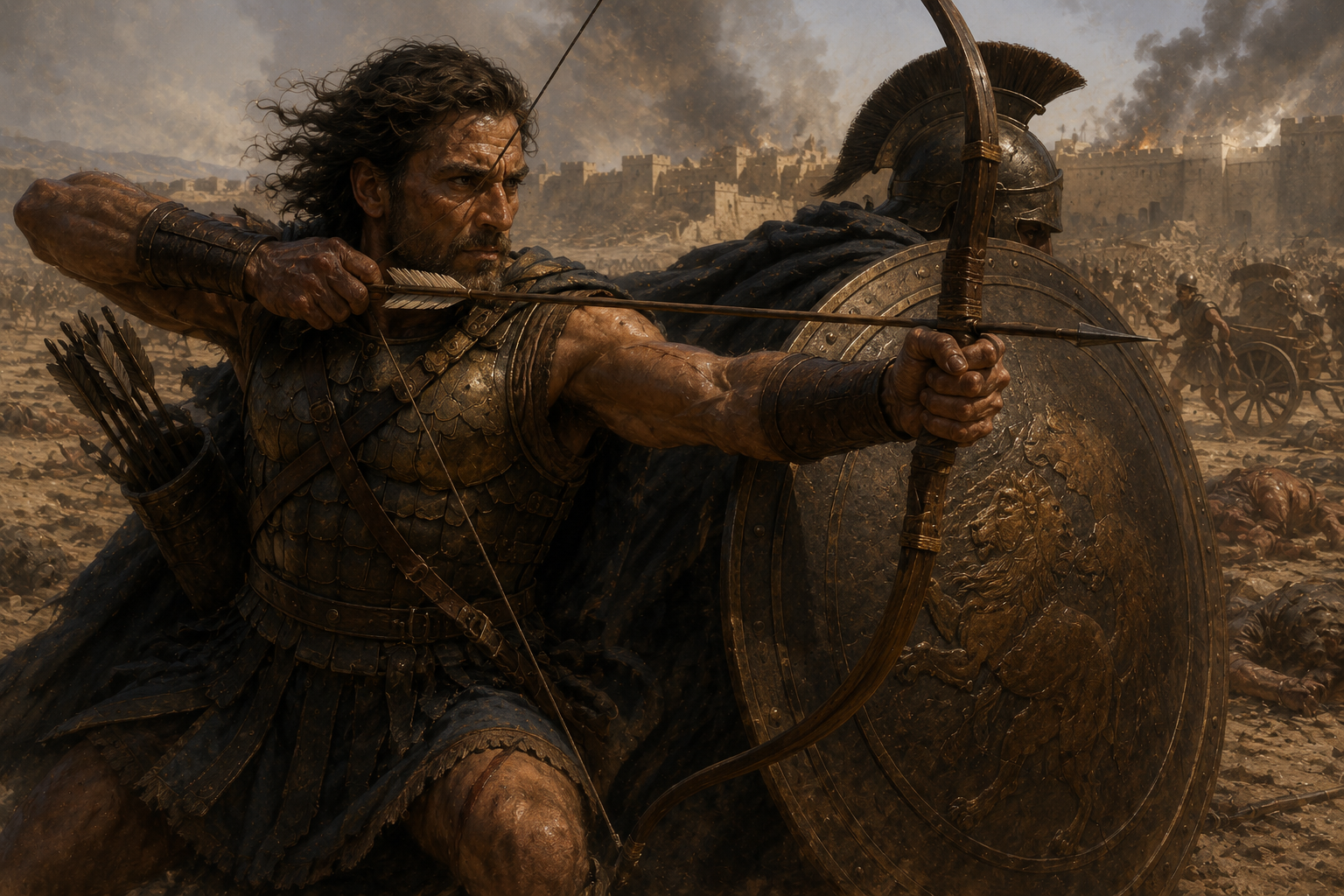
- Name: Teucer
- Greek Form: Teukros / Teucros
- Title: The Exiled Archer of Salamis
- Kind: Living mythic human hero
- Culture: Achaean Greek, Salaminian, Trojan-blooded through Hesione
- Original Homeland: Salamis
- Later Realm: Salamis in Cyprus
- Religion: Hellenic pantheon; especially Apollo, Athena, Zeus, and the heroic dead
- Role: Exiled prince, master archer, founder-king, war-leader, survivor of Ajax
- Campaign Status: Living and active
- Best Used As: Patron, rival, military mentor, disputed king, tragic ally, legal claimant, shrine-haunted founder
- Core Theme: Survival under judgement
Teucer is a hero of the Trojan War: prince of Salamis, son of Telamon and Hesione, half-brother of Ajax the Great, master archer of the Achaean host, and founder-king of a second Salamis in Cyprus. His story is not simply one of skill with a bow. It is a story of protection, survival, accusation, exile, and the terrible burden of living after a greater brother has fallen.
In the campaign world, Teucer is not a dead name in an old poem. He is a mythic survivor whose presence can unsettle courts, shrines, armies, bloodlines, and cities.
What does a survivor owe the dead?
Overview
Teucer’s fame begins in one of the clearest battle-images of the Trojan War: Ajax advancing beneath his great shield while Teucer shoots from behind him.
Ajax was the wall. Teucer was the arrow-line. One brother absorbed the danger; the other answered it. Together, they became a single engine of protection and death.
That image made Teucer famous, but it also wounded him forever. He survived the war through the very bond that made him glorious. Ajax stood before him. Ajax died. Teucer lived.
After Troy, survival did not bring peace. Teucer returned without Ajax, and Telamon, his father, rejected him. Whether that rejection was grief, law, pride, politics, or sacred judgement depends on the teller, but the result is the same: Teucer was cast out from Salamis and forced to build a second life elsewhere.
That second life became Salamis in Cyprus.
This makes Teucer more than a legendary archer. He is a founder whose throne was born from exile, a Greek hero with Trojan blood through his mother Hesione, a war-leader whose finest memories are inseparable from the dead, and a man whose legitimacy can still be attacked through a single accusation:
You lived because Ajax stood in front of you.
Who Teucer Is
Teucer is a king because he was denied the right to remain only a son.
He carries three identities that never fully reconcile.
He is Ajax’s archer, remembered for the shield-bond that made him deadly.
He is Telamon’s rejected son, cast out under the shadow of a brother’s death.
He is the founder of Cypriot Salamis, a ruler forced to prove that a city born from exile can be more than a copy of the home that refused him.
Each identity creates enemies. Greek rivals question his Trojan blood. Trojan survivors name him kin-killer. Priests ask whether Ajax accepts his offerings. Kings wonder whether his new Salamis is lawful, cursed, or dangerous. Veterans watch him to see whether he honours the dead or uses them.
His bow is famous, but his real force is the unresolved judgement surrounding Ajax.
Appearance
Teucer looks like a man preserved by legend but worn by command.
He is strong, lean, and weathered rather than youthful. His shoulders and arms carry the shape of a lifetime spent drawing heavy bows. His right hand is hard with old callus. Several fingers are slightly crooked from war, salt air, and string pressure. He moves with exact economy, as if every room is a battlefield with distances already measured.
He dresses as a founder-king who still expects war: good wool beneath worn leather, bronze fittings kept clean, a cloak pinned with the sign of Salamis, a knife placed for real use, and a bow never far from reach.
A small bronze shield-charm hangs at his belt or throat. It is not Ajax’s shield. It is worse than that: a reminder small enough to carry everywhere.
Voice and Manner
Teucer is controlled, formal, and difficult to flatter.
He does not enjoy songs about his archery when they forget Ajax. Praise that separates him from his brother lands poorly. Mockery of Ajax lands worse. When insulted, Teucer does not usually shout. He becomes colder, more courteous, and more precise.
He speaks like a commander rather than a court performer. He asks where a person stood, who they protected, who they abandoned, who buried the dead, who signed the order, and who profited when the blood dried.
He respects courage, but he has no patience for theatrical courage. He has seen young men die beautifully and uselessly. What impresses him is endurance, discipline, loyalty, restraint, and the hard mercy of standing between danger and someone weaker.
What Teucer Wants
Teucer wants vindication, but he is too proud to beg for it.
He wants Telamon’s judgement answered. Not erased. Answered. If his father condemned him justly, Teucer must know. If the judgement was grief, manipulation, or politics, then dynasties, shrines, and heroic memory have been poisoned by a lie.
He wants Cypriot Salamis to endure as a true city, not a consolation prize. Every treaty, marriage alliance, harbour claim, military oath, and temple dedication is part of that struggle.
He wants Ajax honoured without Ajax’s name being used forever as a weapon against the living.
He wants one clean shot, one final moment in which skill, truth, and fate agree.
He does not expect to receive it.
Secrets and Pressures
The Trojan Blood Problem
Teucer’s mother, Hesione, ties him to Troy. Greek rivals can call him compromised. Trojan survivors can call him kin-killer. Cypriot factions can question whether divided blood can found an undivided realm.
This affects guest-right, treaties, hostage claims, marriage negotiations, shrine acceptance, and the legitimacy of his descendants.
The Ajax Question
Teucer survived the formation that made him famous. Ajax stood before him. Ajax died. Teucer lived.
That fact does not prove guilt, but it creates a wound others can reopen. Teucer is drawn to bodyguards, shield-bearers, younger siblings, loyal retainers, and anyone accused of surviving someone else’s sacrifice.
The Father’s Sentence
Telamon’s rejection still has force. In a mythic world, a father’s condemnation, a king’s public refusal, and a house’s judgement are not private emotions. They can stain succession, temple access, marriage claims, heroic cult, and the right to rule.
The Apollo Wound
Teucer understands that a perfect shot can fail because a god has chosen otherwise. He respects divine power, especially Apollo’s, but he does not confuse divine intervention with justice.
The Founder’s Fear
Teucer fears that his city will always be called the lesser Salamis. He can become severe when Cypriot Salamis is treated as an exile’s copy rather than a true foundation.
Using Teucer in Your Campaign
Use Teucer when his arrival changes what the scene is about.
If he enters a court, the issue becomes legitimacy.
If he enters a shrine, the issue becomes judgement.
If he enters a battlefield, the issue becomes protection.
If he enters a family dispute, the issue becomes inheritance, guilt, and the rights of the rejected.
If he enters a city, the issue becomes whether founded places can escape the wounds that made them.
Use him as a patron when the characters must recover a body, protect a witness, carry an oath, investigate a forged judgement, or defend a city whose legitimacy is under attack.
Use him as a rival when the characters serve old Salaminian interests, Trojan claimants, anti-Cypriot factions, or priests who claim Ajax has spoken against him.
Use him as a judge when the characters have survived a disaster and must answer for who they saved, who they abandoned, and what they did afterward.
Use him as an ally when the party needs a commander who understands formation, morale, discipline, and the terrible cost of holding a line.
Adventure and Worldbuilding Hooks
The Shield That Will Not Admit Him
A shrine of Ajax refuses Teucer’s offerings. Sacrificial smoke bends away from the altar, bronze rings without touch, and the priests declare that Ajax has rejected his brother.
The Second Salamis
A rival faction claims that Cypriot Salamis has no lawful future because its founder was disowned. The dispute begins with documents, sacrifices, and heralds, but soon threatens to become civil war.
The Arrow Meant for Hector
Teucer possesses a black-fletched arrow he never loosed. Some say it was made for Hector before Apollo denied the shot. Now a warlord, revenant, divinely protected tyrant, or Trojan ghost seeks it.
Telamon’s Last Sentence
A tablet, witness, curse, or sealed judgement from Telamon’s court resurfaces. It may prove Teucer’s exile lawful, prove it was engineered by rivals, or reveal that Telamon’s words were altered after his death.
The Trojan Cousin
A Trojan-blooded envoy arrives under guest-right and asks Teucer for protection. Greek allies demand the envoy’s surrender. Trojan survivors call Teucer a coward if he refuses.
The Shield-Bearer’s Dream
A young warrior begins dreaming Ajax’s battles and waking with bruises shaped like spear-strikes. Teucer recognises the pattern and fears Ajax’s doom is repeating through a new mortal vessel.
Social Encounter Engine: The Accusation of Ajax
Use this framework when Teucer appears in a court, shrine, heroic assembly, inheritance hearing, diplomatic crisis, or public confrontation where Ajax’s death is used against him.
Start the scene at 0.
| Score | State of the Accusation |
|---|---|
| -3 | Condemned. Teucer is treated as oath-breaker, failed brother, or false founder. |
| -2 | Hostile. His enemies control the room. |
| -1 | Suspicious. Listeners doubt him but have not fully judged. |
| 0 | Unsettled. The wound is known, but the room has not chosen a truth. |
| +1 | Listening. Teucer’s honour is being reconsidered. |
| +2 | Divided. Accusers risk backlash if they press too hard. |
| +3 | Vindicated. The court, shrine, or assembly accepts that Teucer’s guilt is not proven. |
Raising the Score
Move the score +1 if the characters produce credible evidence that Teucer defended Ajax’s body, protected Ajax’s honour, preserved burial rites, or was scapegoated.
Move the score +1 if a shield-bearer, veteran, priest of the heroic dead, Trojan witness, or surviving dependent speaks for Teucer at personal risk.
Move the score +1 if the characters frame the issue correctly: not “Teucer did nothing wrong,” but “survival is not proof of betrayal.”
Move the score +1 if Teucer accepts a painful truth without trying to make himself look clean.
Lowering the Score
Move the score –1 if the accusers show that Teucer benefited politically from Ajax’s death.
Move the score –1 if the characters dismiss Ajax’s death as old history, insult heroic burial, mock shield-bonds, or treat the accusation as court gossip.
Move the score –1 if Teucer appears to put his new kingship above his brother’s memory.
Move the score –1 if a divine sign, forged or real, seems to reject his offering.
Consequences
At +2 or higher, public action against Teucer becomes dangerous. His enemies may still scheme, but open condemnation risks political, sacred, or military backlash.
At +3, Teucer gains recognised standing in the scene. A shrine may accept his offering, a court may recognise his claim, or a heroic assembly may silence the accusation.
At –2 or lower, Teucer becomes isolated. Allies hesitate. Rivals advance claims. Priests deny him ritual certainty.
At –3, violence, confiscation, renewed exile, ritual rejection, or dynastic crisis becomes imminent unless the characters intervene.
Mechanics
Teucer, Exiled Archer-King 5.5e / 2024
Teucer, Exiled Archer-King Pathfinder 1e / 3.5e
Teucer, Exiled Archer-King 5.5e / 2024

Medium Humanoid, Neutral Good or Lawful Neutral
Armor Class: 18
Initiative: +7
Hit Points: 187 (22d8 + 88)
Speed: 30 ft.
Proficiency Bonus: +5
Saving Throws: Dex +12, Con +9, Wis +9, Cha +8
Skills: Acrobatics +12, Athletics +9, History +8, Insight +14, Perception +14, Persuasion +8, Stealth +12, Survival +9
Senses: passive Perception 24
Languages: Greek, Trojan, Cypriot dialects, plus two campaign-appropriate trade languages
Challenge: 15
| STR | DEX | CON | INT | WIS | CHA |
|---|---|---|---|---|---|
| 16 (+3) | 24 (+7) | 18 (+4) | 16 (+3) | 18 (+4) | 16 (+3) |
Traits
Legendary Archer. Teucer ignores disadvantage on ranged weapon attacks caused by long range. His ranged weapon attacks ignore half cover and three-quarters cover unless the cover is a sealed barrier with no exposed angle, slit, gap, shadow-line, movement, or visible body part.
Behind the Shield. While Teucer is within 5 feet of an allied creature using a shield, he gains half cover. If that ally is Large or larger, or is using a tower-shield-style defence, Teucer gains three-quarters cover instead.
Trojan War Veteran. Teucer has advantage on saving throws against being frightened. He also has advantage on Wisdom (Insight) checks made to read soldiers, guards, duelists, commanders, shield-bearers, and oath-sworn retainers.
Ajax’s Absence. When an allied creature within 30 feet of Teucer is reduced to 0 hit points, Teucer may immediately move up to half his speed without provoking Opportunity Attacks and make one Longbow attack against the creature that caused the ally to fall. Once Teucer uses this trait, he cannot use it again until the start of his next turn.
Founder’s Command. Allied creatures of Teucer’s choice within 30 feet who can hear him gain a +2 bonus to saving throws against being frightened or charmed.
Actions
Multiattack. Teucer makes three Longbow attacks.
Longbow of the Second Salamis. Ranged Weapon Attack: +12 to hit, range 200/800 ft., one target. Hit: 16 (2d8 + 7) piercing damage. If Teucer had advantage on the attack roll, the target takes an extra 7 (2d6) piercing damage.
Close Knife. Melee Weapon Attack: +12 to hit, reach 5 ft., one target. Hit: 12 (1d10 + 7) piercing damage.
Arrow Through the Command Voice. Teucer makes one Longbow attack against a creature he can see that has issued a command, cast a spell with a verbal component, or used a leadership feature since the end of Teucer’s last turn. On a hit, the attack deals normal damage, and the target must succeed on a DC 20 Constitution saving throw or lose the command, spell, or leadership effect if it has not yet resolved. If the effect has already resolved, the target instead cannot issue commands, cast spells with verbal components, or use command-based features until the end of its next turn. This is a martial interruption, not a silence effect.
Rain Behind the Shield. Teucer chooses up to three creatures he can see within range of his longbow. He makes one Longbow attack against each target. If Teucer is benefiting from Behind the Shield, these attacks have advantage. Teucer cannot use this action again until he rolls initiative in a new combat or finishes a Short or Long Rest.
Bonus Actions
Find the Exposed Angle. Teucer chooses one creature he can see. Until the end of this turn, his next ranged attack against that creature ignores disadvantage caused by the target being prone, partially obscured, or engaged in melee.
Order the Shield-Line. One allied creature within 30 feet who can hear Teucer may move up to half its speed without provoking Opportunity Attacks, provided it ends that movement closer to Teucer or between Teucer and a hostile creature.
Reactions
Not Again. When a creature Teucer can see hits an ally within 30 feet, Teucer may make one Longbow attack against the attacker. On a hit, the attacker has disadvantage on the next attack roll it makes before the end of its turn.
Arrow Against the Hand. When a creature Teucer can see makes a weapon attack within his longbow’s normal range, Teucer may make one Longbow attack against that creature. On a hit, the triggering attack roll is reduced by 1d8. If this causes the attack to miss, the target’s weapon arm is checked, deflected, pinned, or bloodied.
Legendary Actions
Teucer can take 3 Legendary Actions, choosing from the options below. Only one Legendary Action can be used at a time, and only at the end of another creature’s turn. Teucer regains spent Legendary Actions at the start of his turn.
Shift Position. Teucer moves up to half his speed without provoking Opportunity Attacks.
Measured Shot. Teucer makes one Longbow attack.
Call the Old Formation. One allied creature within 30 feet who can hear Teucer may use its Reaction to move up to half its speed or take the Dodge action.
The Shot That Should Have Struck Hector. Costs 2 Actions. Teucer makes one Longbow attack. If the attack hits, it deals an extra 14 (4d6) piercing damage. If the target is protected by a divine, legendary, or fate-based feature that would turn the hit into a miss, reduce the target’s next saving throw before the end of Teucer’s next turn by 1d6 instead. Teucer knows when this happens.
Running Teucer in D&D 5.5e / 2024 Play
Teucer is a tactical archer-commander.
His signature pattern is:
- Place a shield-bearing ally, champion, guard, or loyal retainer near him.
- Let Teucer fire from behind that protection.
- Use his reactions to interrupt decisive enemy blows.
- Use his command abilities to keep allies in protective positions.
- Make Ajax’s absence matter whenever someone falls defending another.
He is most dangerous in open courts, broken walls, siege lines, ships, harbour stairs, temple approaches, and battlefield ridges where sightlines matter. He is less dominant in cramped tunnels, magical darkness, smoke-filled interiors, and chaotic melee where enemies can surround him.
Teucer, Exiled Archer-King Pathfinder 1e / 3.5e
CR 15
XP 51,200
Male unique human hero
NG or LN Medium humanoid human
Init +11; Senses Perception +27
Defence
AC 31, touch 18, flat-footed 25
(+8 armor, +5 Dex, +3 deflection, +2 natural armor, +3 shield-line awareness)
hp 214 (20d10 + 100)
Fort +17, Ref +18, Will +13
+4 vs. fear effects; +2 vs. charm and compulsion effects caused by battlefield command, supernatural awe, heroic reputation, or oath-pressure
Defensive Abilities bravery, evasion, uncanny battlefield sense
Offence
Speed 30 ft.
Melee short sword +25/+20/+15/+10 (1d6+7/19–20)
Ranged +5 adaptive composite longbow +34/+29/+24/+19 (1d8+12/×3)
With Rapid Shot and Deadly Aim: +26/+26/+21/+16/+11 (1d8+24/×3)
Within 30 feet, Teucer gains the normal benefit of Point-Blank Shot. He also adds +1d6 precision damage if the target is denied its Dexterity bonus, flanked by Teucer’s allies, or exposed by one of Teucer’s tactical abilities.
Special Attacks arrow against the hand, behind the shield, founder’s command, rain behind the shield, shot that should have struck Hector
Statistics
Str 16, Dex 24, Con 20, Int 16, Wis 18, Cha 16
Base Atk +20; CMB +23; CMD 43
Feats Clustered Shots, Deadly Aim, Far Shot, Greater Weapon Focus (longbow), Greater Weapon Specialization (longbow), Improved Critical (longbow), Improved Initiative, Improved Precise Shot, Improved Snap Shot, Manyshot, Point-Blank Shot, Precise Shot, Rapid Shot, Shot on the Run, Snap Shot, Weapon Focus (longbow), Weapon Specialization (longbow)
Skills Acrobatics +25, Climb +18, Diplomacy +21, Intimidate +21, Knowledge (history) +23, Knowledge (nobility) +23, Perception +27, Profession (sailor) +18, Sense Motive +27, Stealth +25, Survival +24
Languages Greek, Trojan, Cypriot, plus two campaign-appropriate trade tongues
SQ battlefield tactician, heroic survivor, Trojan-blooded exile
Special Abilities
Behind the Shield (Ex). If Teucer is adjacent to an ally using a shield, he gains a +2 shield-line bonus to AC against ranged attacks and a +2 bonus on Reflex saves. If the ally uses a tower shield or is Large or larger and physically interposes itself, these bonuses increase to +4. Teucer may still make ranged attacks while benefiting from this ability if he has line of effect from around, over, or beside the shield.
Arrow Against the Hand (Ex). As an immediate action, when a creature within 100 feet makes a weapon attack, Teucer may make a ranged attack against that creature. If he hits, the triggering attack takes a –4 penalty. If this causes the attack to miss, the attacker’s blow is deflected, spoiled, pinned, or forced wide. Teucer can use this ability 5 times per day.
Rain Behind the Shield (Ex). As a full-round action, if Teucer is benefiting from Behind the Shield, he may make one ranged attack at his highest attack bonus against up to four different targets within range. These attacks do not provoke attacks of opportunity from creatures other than the targets. Teucer can use this ability 3 times per day.
Founder’s Command (Ex). Allies within 30 feet who can hear Teucer gain a +2 morale bonus on saving throws against fear and charm effects. Once per round as a swift action, Teucer may allow one such ally to move 10 feet as a free action. This movement does not provoke attacks of opportunity if the ally ends adjacent to Teucer, adjacent to another ally, or in a position that blocks a clear path to Teucer.
The Shot That Should Have Struck Hector (Su). Three times per day, Teucer may declare a single ranged attack as the shot that should have landed. If the attack hits, it deals an additional 6d6 points of damage. If the attack misses because of a divine, mythic, luck, fate, or supernatural protection effect, Teucer immediately recognises that the shot was turned aside by more than skill or armour. The protected target takes a –2 penalty on saving throws against Teucer’s allies until the end of Teucer’s next turn.
Heroic Survivor (Ex). When an ally within 30 feet is reduced to 0 or fewer hit points, Teucer gains a +2 morale bonus on attack rolls and damage rolls against the creature that dropped that ally for 1 round. This bonus increases to +4 if the fallen ally was using a shield, defending another creature, or acting as a bodyguard.
Trojan-Blooded Exile (Ex). Teucer gains a +4 bonus on Diplomacy and Sense Motive checks involving Greeks, Trojans, Cypriots, exiles, hostages, royal captives, and disputed heirs. He takes a –4 penalty on Diplomacy checks against creatures who accuse him directly of kin-slaying, cowardice, or abandoning Ajax unless he first answers the accusation through roleplay, evidence, oath, or deed.
Tactics
Before Combat: Teucer studies the ground, wind, doors, shield-lines, command figures, and escape routes. If possible, he positions shield-bearing allies between himself and direct attack without hiding from responsibility.
During Combat: Teucer targets commanders, exposed spellcasters, standard-bearers, monster handlers, siege engineers, and enemies attacking his allies. He uses Arrow Against the Hand to spoil decisive attacks and Rain Behind the Shield when enemy formations press forward.
Morale: Teucer does not flee while sworn allies are still standing. If civilians, oath-guests, wounded comrades, or shield-bearers are threatened, he withdraws only to reposition around their defence. If Ajax’s name is invoked as an accusation, Teucer may become reckless for one round, prioritising the accuser over the tactically correct target.
Pathfinder / 3.5e Balance Note
Teucer’s printed full-attack damage is dangerous but not his true threat. His real strength is action denial, positioning, morale pressure, and battlefield interruption. He should play like a CR 15 heroic commander when he has allies and sightlines. If encountered alone in cramped terrain, he is easier to contain.
Do not treat the word “mythic” in Teucer’s lore as automatic use of the Pathfinder mythic subsystem. The default Pathfinder / 3.5e-compatible version is intentionally non-mythic, so it remains easier to use in ordinary high-level campaigns.
Optional Pathfinder Mythic Variant
Use this option only if your campaign already uses Pathfinder mythic rules.
Mythic Rank: MR 3
Suggested Mythic Path: Champion, with Marshal-flavoured command choices
Mythic Power: 9/day
Surge: +1d6
Recommended Use: Major patron, campaign-defining rival, heroic battlefield ally, shrine-judged founder, or climactic opponent
Suggested Mythic Adjustments
Legendary Item. Treat the Bow of the Second Salamis as a legendary item. Its abilities should support precision, range, fate-marked shots, and shield-line warfare rather than raw elemental damage.
Mythic Shot That Should Have Struck Hector. When Teucer uses The Shot That Should Have Struck Hector, he may spend one use of mythic power before rolling. If the attack hits, increase the bonus damage from 6d6 to 8d6. If the attack is negated by divine, mythic, luck, fate, or supernatural protection, the protected target takes a –4 penalty instead of –2 on saving throws against Teucer’s allies until the end of Teucer’s next turn.
Marshal-Flavoured Command. Teucer may spend one use of mythic power to let an ally within 30 feet move, brace, take cover, or hold formation at a decisive moment.
Mythic Variant Balance Note
The mythic version should not replace Teucer’s identity with spectacle. His mythic force should remain specific: impossible archery, battlefield timing, shield-line command, survivor’s guilt, divine frustration, founder’s authority, and the old wound of Ajax.
Treasure and Signature Gear
Bow of the Second Salamis
A dark heroic bow made of horn, yew, sinew, and bronze fittings. It is not decorated like a court object. It has the grave polish of a weapon maintained by a man who remembers every battle in which it was used.
Ajax’s Shield-Charm
A small bronze charm shaped like a shield, worn at the belt or throat. It is not Ajax’s shield, nor even a fragment of it unless the campaign chooses that version. Its power is symbolic, legal, and sacred: a portable wound.
The Unloosed Arrow
One black-fletched arrow kept apart from the rest. Teucer will not waste it, sell it, or use it for display. It was made for a target that fate once denied him.
Seal of Cypriot Salamis
A founder’s seal used for letters, military orders, treaties, and dynastic recognition. Forging it, stealing it, or breaking it publicly can start a war.
Campaign Treasure Note
Teucer’s possessions should not be treated as ordinary loot unless his defeat truly matters to the campaign. His bow, charm, arrow, and seal are political objects as much as magical ones. Taking them creates consequences from Salamis, heroic shrines, veterans, claimants, and the dead.
Relationships
Ajax the Great
Brother, shield, wound, accusation, and sacred absence. Ajax defines Teucer even when Teucer tries to live beyond him.
Telamon
Father and judge. Telamon’s rejection is the sentence Teucer has never fully answered.
Hesione
Mother and Trojan bloodline. Through Hesione, Teucer’s war against Troy becomes a war against part of his own kin.
Apollo
The god of the bow is both patron and wound. Teucer respects Apollo, but he knows divine favour does not always follow justice.
Trojan Survivors
To some Trojan survivors, Teucer is a Greek killer. To others, he is kin through Hesione. To the most bitter, he is the worst of both: a man who had Trojan blood and still drew against Troy.
Historical, Mythic, and Literary Context
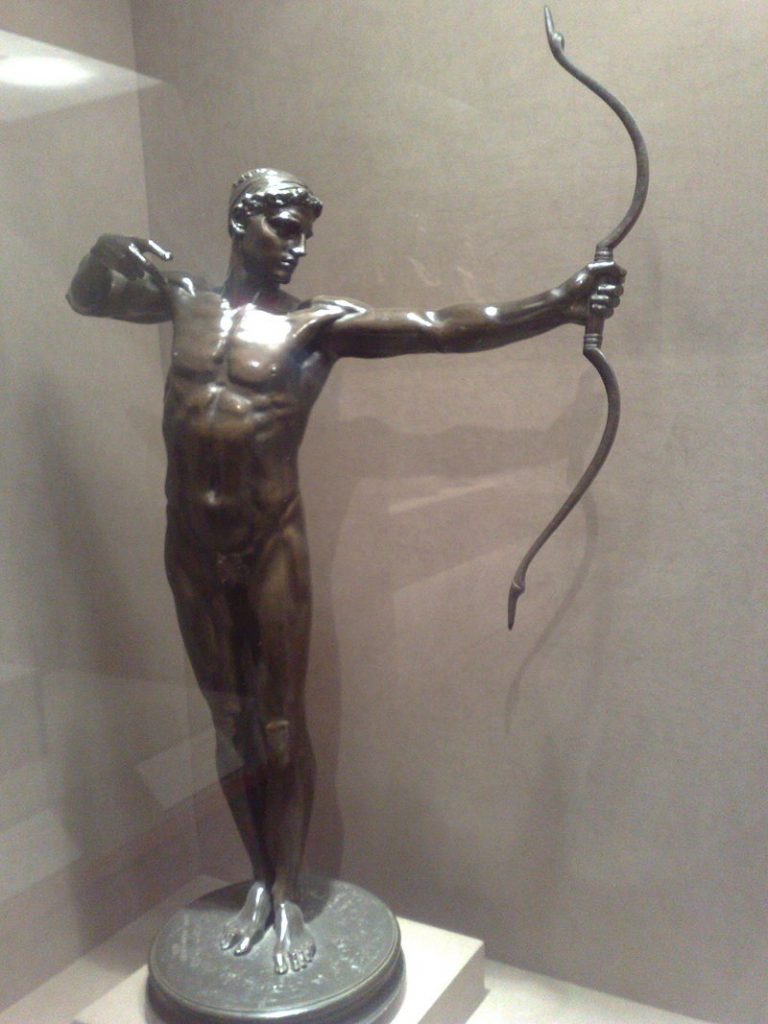
Teucer belongs to the heroic tradition of the Trojan War. He is usually described as the son of Telamon of Salamis and Hesione, and as the half-brother of Ajax the Great. His most memorable battlefield role is as an archer fighting from behind Ajax’s great shield, creating one of Greek myth’s strongest paired images of protection and precision.
His story is also a story of aftermath. Teucer survives Troy, but survival does not restore him to his father’s house. Later tradition connects him with exile and with the foundation of Salamis in Cyprus, turning him from battlefield hero into founder-king. That shift is what makes him especially useful in mythic campaign play: he is not only a warrior from the war, but a ruler made by the consequences of the war.
For concise reference points, see the British Museum’s collection entry for Teucer, the Municipality of Salamina’s overview of Teucer and Salamis, and Encyclopaedia Britannica’s entry on Ajax the Greater.
Teucer’s strongest campaign value lies in the way his legend binds archery, shield-brotherhood, exile, mixed Greek and Trojan blood, foundation myth, and the ethics of survival. He belongs in stories where victory leaves legal, familial, sacred, and political wounds behind it.