
Sawney Bean, the Red King of the Tidal Cave
A coastal cannibal patriarch whose hidden clan turns lonely roads, drowned caves, and missing travellers into a private kingdom of hunger.
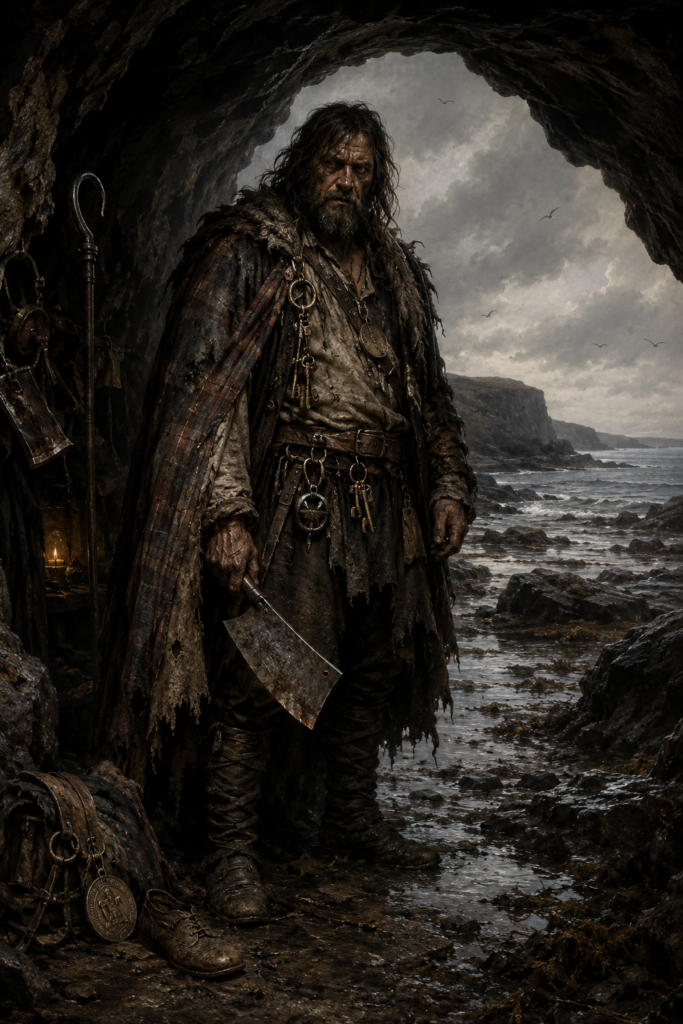
Image created with ChatGPT.
- Name: Alexander Bean
- Common Name: Sawney Bean
- Aliases: Sawney Beane, Sandy Bane, the Red King of the Cave, the Father Under the Tide
- Gender: Male
- Race: Human
- Occupation: Outlaw patriarch, murderer, ambush leader, cave-lord
- Nationality: Scottish
- Region: South-western Scotland, especially the coast between Girvan and Ballantrae
- Base of Operations: A sea cave hidden by tide, rock, stink, and fear
- Languages: Scots, Gaelic, some English learned from victims, traders, soldiers, and stolen letters
- Alignment: Chaotic Evil
- Affiliations: The Bean Clan; coastal cutthroats; corpse-strippers; desperate informants; smugglers who pretend not to know
- Allies: Agnes “Black” Douglas; his sons and daughters; frightened road-watchers; a few bribed or terrified outsiders
- Enemies: Royal officers, local lairds, fisherfolk whose kin vanished, ruined innkeepers, surviving witnesses, and any family stubborn enough to keep asking questions
- Significant Other: Agnes “Black” Douglas
- Suggested Role: Major villain, horror patriarch, regional threat, hidden cause behind disappearances
- Suggested Challenge: CR 10 as an individual; CR 13–15 when faced in his tidal cave with clan support, lair actions, traps, hostages, and rising water
Sawney Bean is what happens when the road loses its law.
He rules from a sea cave that the tide itself conceals. At low water, the entrance opens like a wound in the coast. At high water, the sea closes over the path, washing away tracks, blood, hoofprints, and certainty. Inside, stolen saddles hang from stone hooks. Blades rust beside butchered wagons. Coin, jewellery, noble seals, wedding rings, shrine tokens, children’s shoes, and half-rotted packs are sorted by use: what can be spent, melted, traded, worn, forged, sold, or used as bait.
Sawney is the patriarch of a hidden clan. Some are his children, some grandchildren, some half-feral dependants drawn into the cave’s protection, and some prisoners broken into obedience. His household is not a bandit camp but a diseased little court. He gives orders. He apportions meat, plunder, mates, punishments, silence, and survival.
His greatest shield is disbelief. No sheriff wants to admit that dozens of disappearances may have one cause. No laird wants merchants to abandon his road. No coastal town wants its name tied to cannibals. So the respectable world invents easier answers: wolves, raiders, debt, elopement, bad weather, smugglers, curses, or drink.
Sawney survives because people prefer a plausible lie to an unbearable truth.
Appearance
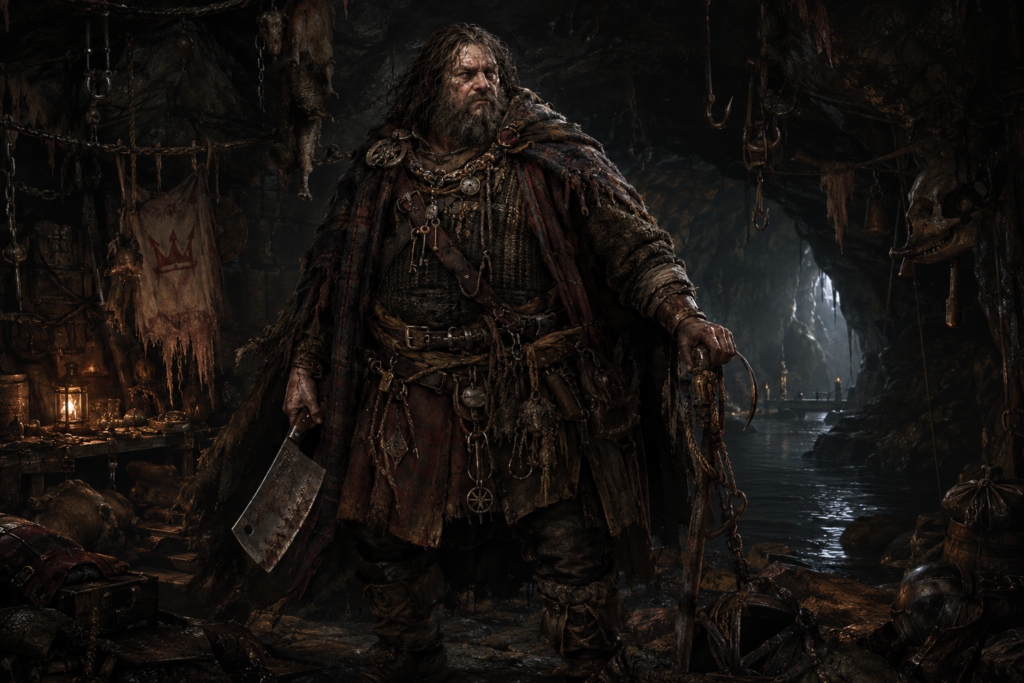
Sawney Bean is broad-shouldered, filthy, and weather-gnarled, with the heavy build of a man who has lived more like a badger than a citizen. His hair and beard are tangled with salt, grease, ash, and shell grit. His skin is pale where the cave has kept him from sun, but wind-burnt and scarred across the face, hands, and neck.
His eyes are watchful rather than mad. That is the worst part. Sawney is not a raving beast, but a practical butcher with a king’s certainty inside his own foul kingdom.
He dresses in stolen layers: a nobleman’s torn cloak over fisherman’s wool, a dead soldier’s belt, a woman’s brooch used to fasten a hide mantle, mismatched boots cut from victims who no longer need them. Around his neck he may wear trophies, not as decoration but as accounting: rings, teeth, carved charms, keys, and tokens taken from those whose names he remembers only when useful.
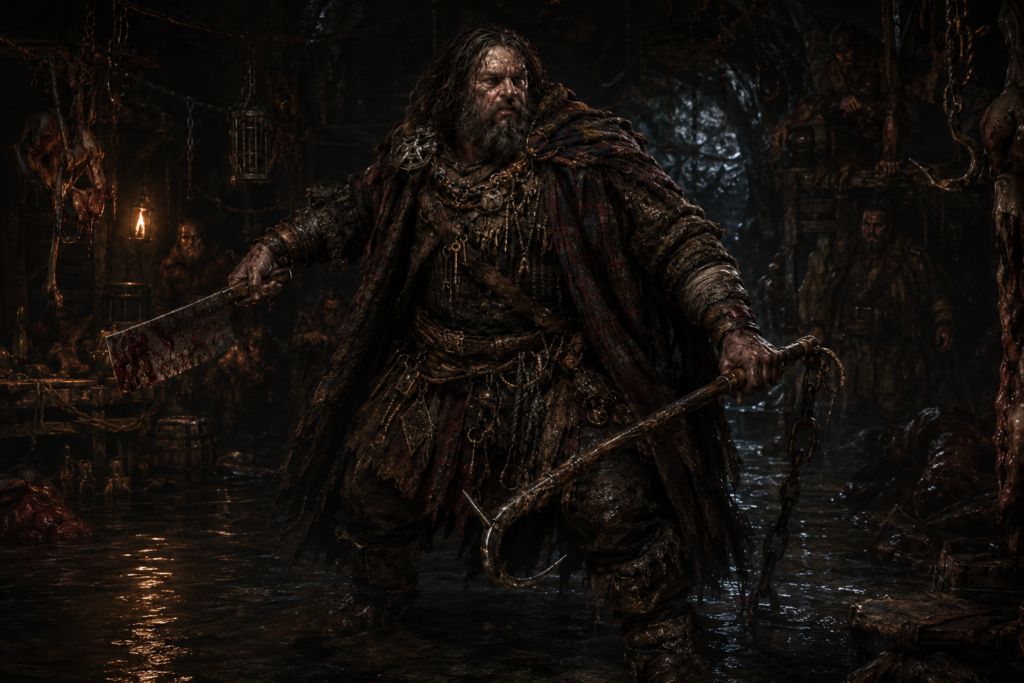
His weapons are simple and ugly: a cleaver, a gutting knife, a cudgel, a short axe, and a hooked pole for dragging bodies over wet stone.
Character
Sawney is patient, suspicious, and frighteningly disciplined when hunger or greed requires it. He understands fear as a tool. He does not raid every traveller. He studies patterns. He waits for fog, rain, market traffic, war levies, seasonal travel, drunkenness, inheritance disputes, or lonely stretches of road where screams carry poorly.
He prefers victims whose disappearance can be explained by the world: debtors, runaways, messengers, peddlers, pilgrims, soldiers, servants, strangers, lovers, and men travelling alone after drink.
He does not think of himself as a monster. To Sawney, settled society is hypocrisy. Lords take rents. Kings take sons. Merchants cheat the poor. War feeds on villages and calls itself honour. Sawney merely takes what he can reach and calls it honesty.
His tenderness exists only inside the clan, and even there it is poisoned. He can be affectionate with children, instructive with sons, amused by cleverness, and proud of a successful ambush. But his love is ownership. No one leaves the cave without permission. No one speaks against him twice. No one wastes food. No one brings danger home.
What Sawney Wants
Sawney wants secrecy, bloodline, and control.
He wants the cave to remain a world apart from law. He wants his clan to multiply until every nearby road belongs to him. He wants the towns above the tide-line to remain divided, frightened, and confused.
He does not dream of conquest like a warlord. He dreams of a coast where no wagon passes without his knowledge, no child strays without risk, and no authority can prove what everyone fears.
If cornered, he does not seek martyrdom. He wants escape, revenge, and continuation. He will sacrifice half the clan if one branch survives inland.
What Sawney Fears
Sawney fears fire in the cave more than blades on the road.
He also fears names. A missing traveller is meat. A named victim with family, witnesses, route, time, horse, cargo, and last known inn is danger. He fears records being compared across jurisdictions. He fears a survivor with a clear memory. He fears dogs that can track through tide-wrack. He fears local fisherfolk who know caves better than soldiers.
Most of all, he fears one of his own choosing daylight.
Edition Tabs
Sawney Bean, Red King of the Tidal Cave D&D 5.5e / 2024
Sawney Bean Pathfinder 1e
Sawney Bean, Red King of the Tidal Cave D&D 5.5e / 2024
Medium Humanoid, Chaotic Evil
Armor Class: 17, or 18 in his cave
Initiative: +4
Hit Points: 168
Speed: 30 ft., climb 20 ft. on rough stone
Proficiency Bonus: +4
Saving Throws: Str +9, Dex +8, Con +8, Wis +7
Skills: Athletics +9, Deception +6, Insight +7, Intimidation +10, Perception +11, Stealth +8, Survival +11
Senses: darkvision 60 ft. while in his cave or coastal lair; passive Perception 21
Languages: Scots, Gaelic, English
Challenge: 10
| STR | DEX | CON | INT | WIS | CHA |
|---|---|---|---|---|---|
| 20 (+5) | 17 (+3) | 18 (+4) | 14 (+2) | 17 (+3) | 15 (+2) |
Traits
Cave-King’s Territory. Sawney has advantage on Wisdom (Perception), Wisdom (Survival), and Dexterity (Stealth) checks made in sea caves, rocky coasts, gullies, ruins, storm drains, or similar broken terrain.
Butcher’s Nerve. Sawney has advantage on saving throws against being frightened. When a creature he can see drops to 0 hit points within 30 feet of him, Sawney gains 10 temporary hit points.
Tide-Taught Ambusher. During the first round of combat, Sawney has advantage on attack rolls against any creature that has not yet taken a turn.
Filthy Resilience. Sawney has advantage on saving throws against poison and disease.
Patriarch of the Clan. Allied Bean clan members within 60 feet who can hear Sawney have advantage on saving throws against being frightened and gain a +2 bonus to damage rolls against creatures Sawney has hit since the start of his last turn.
No Clean Duel. Sawney does not provoke opportunity attacks from creatures that are prone, grappled, restrained, frightened, or blinded.
Actions
Multiattack. Sawney makes three attacks: two with his Cleaver and one with his Gutting Knife. He may replace one Cleaver attack with Drag Down or Call the Clan.
Cleaver. Melee Weapon Attack: +9 to hit, reach 5 ft., one target. Hit: 14 slashing damage. If the target is below its hit point maximum, it takes an extra 7 slashing damage.
Gutting Knife. Melee Weapon Attack: +9 to hit, reach 5 ft., one target. Hit: 10 piercing damage, or 19 piercing damage if Sawney has advantage on the attack roll or if the target is prone, grappled, restrained, or frightened.
Cudgel. Melee Weapon Attack: +9 to hit, reach 5 ft., one target. Hit: 12 bludgeoning damage. If the target is Medium or smaller, it must succeed on a DC 17 Strength saving throw or be knocked prone.
Drag Down. Sawney targets one prone, grappled, restrained, frightened, or surprised creature within 5 feet. The target must succeed on a DC 17 Strength saving throw or be dragged up to 15 feet to an unoccupied space Sawney can reach. If the movement crosses jagged stone, broken shells, hooks, submerged rocks, or similar hazards, the target takes 10 slashing damage.
Call the Clan. Sawney bellows an order. Up to three allied Bean clan members within 60 feet who can hear him may each move up to half their speed without provoking opportunity attacks. One of them may make one weapon attack as part of this movement.
Bonus Actions
Into the Dark. Sawney takes the Hide action if he is in dim light, darkness, heavy rain, fog, smoke, or broken rocky terrain.
Kick the Knee. Sawney targets one creature within 5 feet. The target must succeed on a DC 17 Dexterity saving throw or its speed is reduced by 10 feet until the end of its next turn. If the target fails the save by 5 or more, it also falls prone.
Reactions
Meat Shield. When Sawney is hit by an attack while an allied clan member or grappled creature is within 5 feet of him, he may impose disadvantage on the attack roll. If the attack misses, the chosen creature takes 10 damage of the attack’s type.
No One Leaves. When a creature Sawney can see within 10 feet moves away from him, Sawney may make one Cleaver attack against it.
Legendary Actions
Sawney can take 3 legendary actions, choosing from the options below. Only one legendary action can be used at a time and only at the end of another creature’s turn.
Move Through the Rocks. Sawney moves up to half his speed without provoking opportunity attacks if he ends the movement in broken terrain, dim light, darkness, smoke, or cover.
Knife from Below. Sawney makes one Gutting Knife attack against a prone, grappled, restrained, frightened, or surprised creature.
Order the Hook. One allied clan member Sawney can see within 60 feet may attempt to grapple, shove, or drag a creature.
Lair Actions: The Tidal Cave
On initiative count 20, Sawney may use one of the following lair actions while inside his cave. He cannot use the same lair action two rounds in a row.
The Tide Rises. Seawater surges through a passage. Creatures in a 20-foot line chosen by Sawney must succeed on a DC 15 Strength saving throw or be knocked prone and pushed 15 feet. A creature pushed into a wall, hook, pit, or rock shelf takes 7 bludgeoning damage.
The Cave Goes Black. A lamp is kicked over, smoke thickens, or a hidden passage is blocked. One 30-foot area becomes heavily obscured until initiative count 20 on the next round.
Hooks and Ropes. Hidden hooks, nets, and weighted ropes drop in one 15-foot square. Creatures in the area must succeed on a DC 15 Dexterity saving throw or be restrained until they use an action to escape with a successful DC 15 Strength or Dexterity check.
The Wrong Passage Floods. Sawney chooses one visible tunnel, chamber edge, or side passage. Until initiative count 20 on the next round, that area is difficult terrain. A creature that starts its turn there must succeed on a DC 15 Strength saving throw or fall prone.
Sawney Bean CR 10
XP 9,600
Male human rogue 6/barbarian 4
CE Medium humanoid
Init +4; Senses Perception +18
Defense
AC 20, touch 14, flat-footed 16; armour scraps, hardened leather, Dex
AC in his tidal cave 22, touch 16, flat-footed 18
hp 118
Fort +10, Ref +10, Will +6
Defensive Abilities evasion, uncanny dodge, improved uncanny dodge, trap sense +2; DR 1/— while raging
Offense
Speed 30 ft.
Melee cleaver +15/+10 (1d6+6/19–20), gutting knife +14 (1d4+6/19–20)
Melee while raging cleaver +17/+12 (1d6+9/19–20), gutting knife +16 (1d4+8/19–20)
Special Attacks rage 14 rounds/day, sneak attack +3d6, drag down, clan command
Tactics
Before Combat Sawney observes prey, separates travellers, blocks retreat routes, and sends weaker clan members to create noise, panic, or false movement.
During Combat He attacks from concealment, targets isolated or prone enemies, and orders clan members to grapple, flank, and drag victims toward hazards.
Morale Sawney does not fight honourably. If reduced below 40 hit points outside the cave, he retreats. If cornered in the cave, he sacrifices clan members, hostages, or prisoners to escape.
Statistics
Str 22, Dex 18, Con 18, Int 14, Wis 16, Cha 14
Base Atk +8; CMB +14; CMD 28
Feats Combat Reflexes, Intimidating Prowess, Power Attack, Stealthy, Toughness, Weapon Focus (cleaver)
Skills Acrobatics +15, Climb +18, Disable Device +15, Disguise +11, Escape Artist +15, Intimidate +20, Knowledge (local) +12, Perception +18, Sense Motive +14, Stealth +19, Survival +17, Swim +15
Languages Scots, Gaelic, English
SQ rogue talents: fast stealth, surprise attack, terrain mastery cave/coast
Special Abilities
Drag Down (Ex). As a standard action, Sawney may attempt a combat maneuver check against a prone, grappled, or flat-footed adjacent creature. If successful, he moves the target 10 feet into an adjacent legal space, plus 5 feet for every 5 by which his check exceeds the target’s CMD. If the path crosses jagged stone, hooks, broken shell, submerged rock, or similar hazards, the target takes 1d6 slashing or bludgeoning damage.
Clan Command (Ex). As a move action, Sawney can direct one allied clan member within 60 feet who can hear him. That ally may move up to half its speed or make a single melee attack. This is a language-dependent effect.
Cave-King (Ex). In sea caves, rocky coasts, gullies, and similar terrain, Sawney gains a +2 circumstance bonus on Stealth, Perception, Survival, and initiative checks. This bonus increases to +4 inside his own tidal cave. The increased cave bonus is already reflected in his tidal cave AC.
No Clean Duel (Ex). Sawney gains a +2 bonus on attack rolls against prone, grappled, frightened, flat-footed, or restrained targets.
Gear
Cleaver, gutting knife, cudgel, hardened leather and hide scraps, stolen rings worth 180 gp, keys from at least six victims, pouch of bone counters, crude map of coastal roads, signal whistle, 3 doses of foul cave poison, and a stolen cloak clasp bearing the mark of a missing noble house.
Treasure
Sawney’s treasure should feel accumulated, incriminating, and disgusting rather than heroic.
A typical cave hoard might include:
- 340 gp, 920 sp, and 1,800 cp in mixed coinage from several regions
- Jewellery, brooches, buckles, rings, and chains worth 1,200 gp if cleaned and identified
- Damp trade goods: cloth, salt, knives, pewter, wax, spices, and tools worth 300 gp
- Noble or merchant seals worth more as evidence than as treasure
- 1d4 minor magic items taken from victims, preferably practical items such as a cloak, ring, knife, charm, or travelling tool
- A ledger, bundle of letters, or marked road-token proving that some disappearances were not random
- Personal effects that create moral complications: wedding rings, child tokens, clan badges, shrine charms, signet rings, and letters never delivered
Do not make the treasure too clean. The party should have to decide what can be sold, what must be returned, what proves murder, and what implicates people still alive.
Evidence Found in the Cave
Use these details when players search the lair:
- A wall scratched with tally marks grouped by road, season, or moon phase.
- Saddles cut apart for leather, but with makers’ marks intact.
- Rings sorted by metal rather than owner.
- A noble seal used to forge letters delaying search parties.
- Child-sized footprints in ash near a narrow crawlspace.
- A half-burned message naming an outside informant.
- A prisoner who has survived too long and no longer knows whether rescue is possible.
- A tide chart scratched into stone with unnerving accuracy.
- A pile of keys, most of which no longer open anything that matters.
- Fresh footprints leading deeper than the known cave map allows.
Running Sawney at the Table
Sawney should not stand in the open trading blows like a battlefield champion. He is a lair predator.
Use darkness, tide, slippery stone, height changes, narrow passages, echoing voices, false exits, moving water, frightened captives, and bad footing. Give the party fair clues before danger triggers: rope marks, hooks in the ceiling, scrape marks on stone, sudden silence from hidden watchers, a rush of cold air from a side tunnel, or the tide-smell growing stronger.
His combat style is built around isolation. He knocks characters prone, separates them with water or darkness, drags them into hazards, then uses clan members to pile on. He should punish recklessness, not negate good planning.
If the players bring dogs, maps, local guides, oil, rope, lanterns, tide knowledge, disciplined formations, or clever methods of marking passages, reward them. Sawney is dangerous because the cave favours him, not because the adventure ignores player preparation.
Boundaries and Horror Tone
Sawney Bean is a cannibal-horror figure. Use implication more than indulgence.
The strongest version is not a gore spectacle. It is the horror of systems failing: roads unsafe, officials dismissive, poor victims ignored, families unheard, and an entire cave-world surviving because respectable people prefer denial.
Show aftermath, evidence, fear, smell, silence, and moral consequence. Do not linger on cruelty for its own sake.
The Bean Clan
The Bean Clan should not be played as a crowd of identical cannibal extras. Its horror is stronger when it has structure.
A believable campaign version might include Sawney, Agnes, 6–10 adult killers, 6–12 younger or weaker clan members, 2–5 prisoners, and 1–3 outside informants.
Agnes “Black” Douglas
Sawney’s partner, keeper of grudges, poisoner, cave-mother, and second ruler of the clan. Agnes may be more practical than Sawney, more superstitious, or more dangerous because she knows when to abandon him.
The Road-Sons
Adult ambushers who know how to pull riders from saddles, cut throats in rain, and make murder look like weather, wolves, robbery, or disappearance.
The Cave-Daughters
Watchers, bait-setters, corpse-sorters, spies, and sometimes the clan’s most dangerous negotiators. They may know the nearby towns better than the men do.
The Tide-Children
Half-starved younger clan members who crawl through rock passages no armoured adult can enter. Some are vicious. Some are terrified. Some do not understand that another life is possible.
The Broken Guests
Captives kept alive for labour, ransom, forged letters, bait, or information. A rescued prisoner may be grateful, treacherous, half-mad, or too ashamed to tell the whole truth.
The Outside Eyes
Inn servants, smugglers, shepherds, debtors, or frightened locals who do not belong to the clan but warn it when armed men are coming.
The clan should create decisions, not just targets: rescue the child who may be bait, trust the prisoner who may be broken, spare the daughter who may later murder witnesses, or burn the cave knowing captives may still be inside.
Bean Clan Encounter Roster
The Bean Clan works best as a living lair rather than a single boss fight. Sawney is the patriarch, Agnes is the cave’s keeper and poisoner, and the lesser clan members create pressure through ambush, deception, sabotage, fear, and rescue complications. Use the following stat blocks as modular pieces rather than as one mandatory encounter.
Gang Member Tabs
Agnes “Black” Douglas
Bean Clan Road-Son
Bean Clan Cave-Daughter
Bean Clan Tide-Child
Broken Guests
Agnes “Black” Douglas, Cave-Mother of the Bean Clan
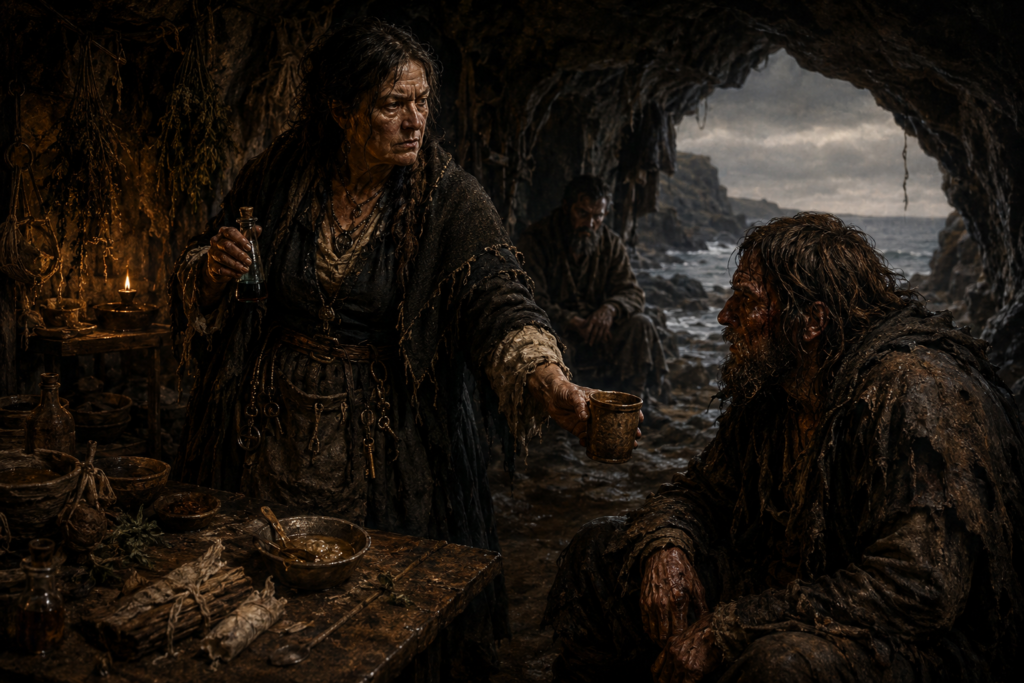
Image created with ChatGPT.
Agnes “Black” Douglas is not merely Sawney’s consort. She is the cave’s keeper, poisoner, judge, and second ruler; where Sawney breaks bodies, Agnes decides who is silenced, used, spared, or fed to the dark.
Medium Humanoid, Chaotic Evil
Armor Class: 16, or 17 in the tidal cave
Initiative: +4
Hit Points: 143
Speed: 30 ft., climb 20 ft. on rough stone
Proficiency Bonus: +4
Saving Throws: Dex +8, Con +7, Wis +8, Cha +7
Skills: Deception +11, Insight +8, Intimidation +7, Medicine +8, Perception +8, Sleight of Hand +8, Stealth +8, Survival +8
Tools: Poisoner’s kit +11
Senses: passive Perception 18
Languages: Scots, Gaelic, English
Challenge: 9
| STR | DEX | CON | INT | WIS | CHA |
|---|---|---|---|---|---|
| 13 (+1) | 18 (+4) | 16 (+3) | 16 (+3) | 17 (+3) | 16 (+3) |
Traits
Cave-Mother’s Authority. Allied Bean clan members within 60 feet of Agnes who can hear her have advantage on saving throws against being charmed or frightened. If Sawney Bean is also present, those allies also gain a +2 bonus to Wisdom saving throws while within 60 feet of both Sawney and Agnes.
Black Douglas Poisoncraft. Agnes has advantage on ability checks made with poisoner’s kit. A creature that fails a saving throw against one of Agnes’s poisons cannot benefit from advantage on its next saving throw against poison before the end of Agnes’s next turn.
No Witness Leaves Clean. Once per turn, when Agnes hits a creature that is poisoned, frightened, grappled, restrained, prone, or below its hit point maximum, the attack deals an extra 7 poison damage.
Tide-Cave Familiarity. Agnes has advantage on Dexterity (Stealth), Wisdom (Perception), and Wisdom (Survival) checks made in sea caves, rocky coasts, gullies, ruined cellars, storm drains, and similar broken or enclosed terrain.
Poisoned Hospitality. Agnes can prepare food, drink, salves, bandages, smoke, bedding, blade edges, door latches, or handled objects with subtle poison. A creature exposed to a prepared source for at least 10 minutes, or a creature that eats or drinks something Agnes has prepared, must succeed on a DC 17 Constitution saving throw or be poisoned for 1 hour. While poisoned in this way, the creature has disadvantage on Wisdom (Perception) checks and saving throws against being frightened. A creature that succeeds on the save is immune to Agnes’s Poisoned Hospitality for 24 hours.
Actions
Multiattack. Agnes makes three attacks: two with her Long Knife and one with her Bone Needle. She may replace one attack with Mother’s Command.
Long Knife. Melee Weapon Attack: +8 to hit, reach 5 ft., one target. Hit: 9 piercing damage plus 7 poison damage.
Bone Needle. Melee Weapon Attack: +8 to hit, reach 5 ft., one target. Hit: 6 piercing damage. The target must succeed on a DC 17 Constitution saving throw or be poisoned until the end of its next turn. While poisoned in this way, the target cannot take reactions.
Thrown Knife. Ranged Weapon Attack: +8 to hit, range 20/60 ft., one target. Hit: 8 piercing damage plus 7 poison damage.
Black Draught. Agnes targets one creature within 30 feet that has eaten, drunk, inhaled smoke, touched a prepared object, been treated with a prepared salve or bandage, or been wounded by one of her poisoned weapons since the start of the encounter. The target must make a DC 17 Constitution saving throw. On a failure, it takes 21 poison damage and is poisoned for 1 minute. While poisoned in this way, the creature cannot take reactions. On a success, the target takes half as much damage and is not poisoned. A poisoned creature may repeat the saving throw at the end of each of its turns, ending the effect on a success.
Mother’s Command. Agnes chooses up to two allied Bean clan members within 60 feet who can hear her. Each chosen ally may immediately move up to half its speed without provoking opportunity attacks. One chosen ally may also attempt to grapple, shove, or drag a creature.
Quiet the Prisoner. Agnes targets one grappled, restrained, frightened, poisoned, or prone creature within 5 feet. The target must succeed on a DC 17 Wisdom saving throw or be unable to speak above a whisper until the end of its next turn. While affected, it cannot cast spells with verbal components or call for help clearly.
Bonus Actions
Slip Behind the Stronger Body. Agnes takes the Hide or Disengage action if she is within 5 feet of an allied Bean clan member, captive, corpse, heavy furniture, cave wall, smoke, darkness, or other cover.
Show Them the Knife. Agnes targets one creature within 30 feet that can see her and can also see a captive, helpless creature, or allied clan member. The target must succeed on a DC 17 Wisdom saving throw or be frightened of Agnes until the end of its next turn. A creature that succeeds is immune to this bonus action for 24 hours.
Reactions
Not Her Blood. When Agnes is hit by an attack while an allied clan member, captive, or grappled creature is within 5 feet of her, she may halve the damage she takes. The chosen nearby creature takes the other half. A willing creature may be chosen automatically; an unwilling creature must fail a DC 17 Dexterity saving throw to be used in this way.
Poison the Opening. When a creature Agnes can see within 5 feet misses her with a melee attack, Agnes may make one Bone Needle attack against that creature.
Legendary Actions
Agnes can take 2 legendary actions, choosing from the options below. Only one legendary action can be used at a time and only at the end of another creature’s turn.
Vanish into the Cave. Agnes moves up to half her speed without provoking opportunity attacks if she ends the movement in dim light, darkness, cover, smoke, fog, or broken terrain.
Needle-Prick. Agnes makes one Bone Needle attack.
Whispered Order. One allied Bean clan member within 60 feet who can hear Agnes may move up to half its speed or take the Hide action.
Black Douglas Draught
This poison does not look theatrical. It appears as bitter dark liquid, treated fat, spoiled broth, smoke residue, salve, or residue on a needle.
Ingested, inhaled, contact, or injury poison. A creature exposed to the draught must make a DC 17 Constitution saving throw. On a failure, it takes 21 poison damage and is poisoned for 1 minute. While poisoned in this way, the creature has disadvantage on Wisdom (Perception) checks and cannot take reactions. On a success, the creature takes half damage and is not poisoned. A poisoned creature repeats the saving throw at the end of each of its turns, ending the effect on a success.
Agnes and Sawney Together
Agnes should not simply add more damage to a Sawney encounter. Her purpose is to make the fight nastier, less certain, and more morally dangerous.
When Agnes and Sawney are encountered together:
- Sawney isolates and drags victims into danger.
- Agnes poisons, silences, redirects, and uses captives as shields.
- Sawney commands through terror.
- Agnes commands through control, secrets, and family dependence.
- Sawney is the cave’s butcher-king.
- Agnes is the cave’s keeper, poisoner, and judge.
A fight against both of them in the tidal cave should usually be treated as at least a CR 14–15 encounter, depending on how many clan members, prisoners, traps, and tide hazards are present.
Running Agnes at the Table
Agnes works best when she changes the shape of the encounter rather than standing still and trading attacks. She should begin behind other bodies: a frightened captive, a younger clan member, a curtain of smoke, a narrow passage, a table of spoiled food, or a cave wall slick with tide-water.
She should poison before combat if possible. Her most dangerous scenes happen when the party has already drunk from a prepared cup, accepted false medical help, breathed cave-smoke, touched a marked door, or rescued a prisoner whose bandages have been treated with her mixtures.
Agnes should rarely look surprised. She has lived too long among screams, storms, hunger, and men with knives. She does not panic when the party enters the cave. She starts deciding who can be killed, who can be blamed, who can be used, and who might be worth keeping alive.
Suggested Equipment
Agnes may carry or keep nearby:
- Long knife with a darkened blade
- Bone needle or awl
- Pouch of powdered shell, dried fungus, bitter herbs, and rendered fat
- Poisoner’s kit hidden in a sewing roll
- Three prepared doses of Black Douglas draught
- Stolen rings and hair tokens used to identify victims
- Keys to prisoner chains
- Waxed packet of forged letters
- Child’s whistle used to signal through cave passages
- Small bronze charm from an older Scottish shrine, worn more as habit than piety
Challenge Note
Agnes is best set at CR 9. She is slightly less directly lethal than Sawney Bean, but her poison, silence effects, hostage use, clan command, and pre-combat preparation make her more dangerous than a normal assassin-style NPC. In the cave, with prepared poison and minions, she can feel like a CR 10 threat without needing to be physically stronger than Sawney.
Bean Clan Road-Son
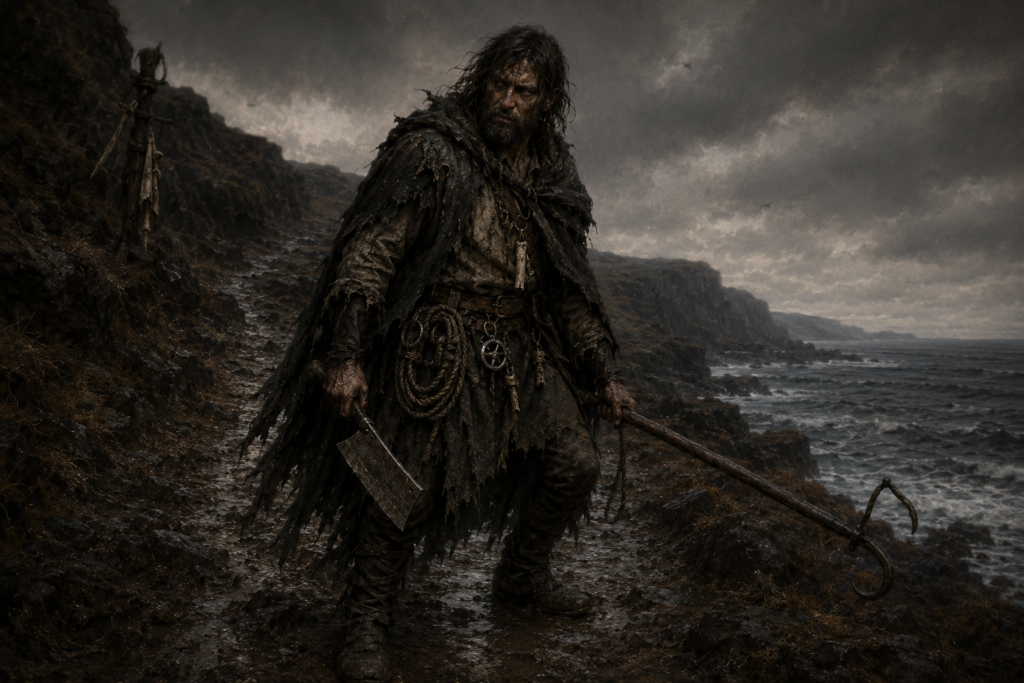
Image created with ChatGPT.
Medium Humanoid, Chaotic Evil
Armor Class: 15
Initiative: +3
Hit Points: 52
Speed: 30 ft., climb 20 ft. on rough stone
Proficiency Bonus: +2
Saving Throws: Str +6, Dex +5
Skills: Athletics +6, Intimidation +4, Perception +4, Stealth +5, Survival +4
Senses: passive Perception 14
Languages: Scots, Gaelic
Challenge: 3
| STR | DEX | CON | INT | WIS | CHA |
|---|---|---|---|---|---|
| 17 (+3) | 16 (+3) | 15 (+2) | 10 (+0) | 14 (+2) | 11 (+0) |
Traits
Road Ambusher. During the first round of combat, the Road-Son has advantage on attack rolls against any creature that has not yet taken a turn.
Drag to the Dark. The Road-Son has advantage on Strength (Athletics) checks made to grapple or shove a creature while in dim light, darkness, fog, heavy rain, broken terrain, roadside brush, gullies, or the tidal cave.
Road Gang. Once per turn, the Road-Son deals an extra 3 damage to a creature if at least one allied Bean clan member is within 5 feet of that creature and the ally is not incapacitated.
Cave-Bred Footing. The Road-Son ignores difficult terrain caused by wet stone, loose rock, shallow tidewater, broken shells, refuse, cave debris, roadside mud, or scree.
Actions
Multiattack. The Road-Son makes two attacks, using Cleaver, Hooked Pole, Shortbow, or Hamstring in any combination.
Cleaver. Melee Weapon Attack: +6 to hit, reach 5 ft., one target. Hit: 9 slashing damage.
Hooked Pole. Melee Weapon Attack: +6 to hit, reach 10 ft., one target. Hit: 7 piercing damage. If the target is Medium or smaller, it must succeed on a DC 14 Strength saving throw or be pulled up to 10 feet toward the Road-Son.
Shortbow. Ranged Weapon Attack: +5 to hit, range 80/320 ft., one target. Hit: 6 piercing damage.
Hamstring. Melee Weapon Attack: +6 to hit, reach 5 ft., one creature. Hit: 7 slashing damage, and the target must succeed on a DC 14 Dexterity saving throw or its speed is reduced by 10 feet until the end of its next turn. If the target is already prone, grappled, restrained, or frightened, it falls prone on a failed save.
Seize the Traveller. The Road-Son attempts to grapple one Medium or smaller creature within 5 feet. If the grapple succeeds, the Road-Son may move up to 10 feet without provoking opportunity attacks from the grappled creature, dragging the target with him.
Bonus Actions
Into the Weather. The Road-Son takes the Hide action if he is in fog, heavy rain, dim light, darkness, smoke, roadside brush, broken rocks, gullies, or cave terrain.
Kick Down. The Road-Son targets one grappled creature within 5 feet. The target must succeed on a DC 14 Strength saving throw or fall prone.
Reaction
Hold Him Still. When a creature grappled by the Road-Son makes an attack against a creature other than the Road-Son, the Road-Son may impose disadvantage on the attack roll.
Road-Sons in the Encounter
Road-Sons are not duelists. They are road predators trained by hunger, bad weather, and Sawney’s command. Their job is to separate travellers, pull riders down, drag targets into gullies or cave-mouths, and keep victims prone long enough for Sawney or Agnes to finish the work.
Use 2–4 Road-Sons for a serious ambush. Use 6 or more only if the party is meant to feel overwhelmed or if the encounter includes a rescue objective, bad footing, darkness, or tide pressure.
A Road-Son is most dangerous when paired with:
- Sawney Bean, who benefits from prone, grappled, restrained, or frightened targets.
- Agnes “Black” Douglas, who poisons and silences victims while the Road-Sons hold them still.
- Cave-Daughters, who bait, flank, distract, or cut off escape routes.
- Tide-Children, who harry isolated characters through crawlspaces and side passages.
Typical Equipment
A Road-Son usually carries:
- Cleaver, short axe, or heavy knife
- Hooked pole or drag-hook
- Shortbow with 12–20 arrows
- Coil of rope
- Bone whistle or shell signal
- Stolen cloak or roadside disguise
- 2d10 sp and 1d6 gp in mixed stolen coin
- One personal trophy from a previous victim
Variant: Road-Son Heavy
For a larger adult killer or Sawney’s favoured enforcer, make these changes:
- Challenge: 4
- Hit Points: 75
- Armor Class: 16
- Strength: 19 (+4)
- Cleaver: +7 to hit, 11 slashing damage
- Hooked Pole: +7 to hit, 9 piercing damage; DC 15 Strength save
- Seize the Traveller: Can grapple Large or smaller creatures
Bean Clan Cave-Daughter

Medium Humanoid, Chaotic Evil
Armor Class: 15
Initiative: +4
Hit Points: 45
Speed: 30 ft., climb 20 ft. on rough stone
Proficiency Bonus: +2
Saving Throws: Dex +6, Wis +4
Skills: Deception +5, Insight +4, Perception +4, Sleight of Hand +6, Stealth +6, Survival +4
Tools: Disguise kit +5, poisoner’s kit +5
Senses: passive Perception 14
Languages: Scots, Gaelic, some English
Challenge: 3
| STR | DEX | CON | INT | WIS | CHA |
|---|---|---|---|---|---|
| 12 (+1) | 18 (+4) | 14 (+2) | 12 (+1) | 14 (+2) | 14 (+2) |
Traits
Baited Mercy. The Cave-Daughter has advantage on Charisma (Deception) checks made to appear frightened, injured, lost, helpless, repentant, or willing to betray the Bean Clan.
Cave-Quiet Step. The Cave-Daughter has advantage on Dexterity (Stealth) checks made in dim light, darkness, smoke, fog, heavy rain, rocky terrain, refuse, narrow passages, or the tidal cave.
Cut the Escape. Once per turn, when the Cave-Daughter hits a creature that has no conscious allies within 5 feet of it, the attack deals an extra 5 damage.
Poisoned Pin. Once per turn, when the Cave-Daughter hits a creature with a dagger or hairpin, the target must succeed on a DC 13 Constitution saving throw or be poisoned until the end of its next turn.
Cave-Bred Footing. The Cave-Daughter ignores difficult terrain caused by wet stone, loose rock, shallow tidewater, broken shells, refuse, cave debris, roadside mud, or scree.
Actions
Multiattack. The Cave-Daughter makes two attacks, using Dagger, Hairpin, Sling, or Close the Wound in any combination.
Dagger. Melee or Ranged Weapon Attack: +6 to hit, reach 5 ft. or range 20/60 ft., one target. Hit: 7 piercing damage.
Hairpin. Melee Weapon Attack: +6 to hit, reach 5 ft., one target. Hit: 5 piercing damage. If the target is poisoned, frightened, grappled, restrained, or surprised, it cannot take reactions until the start of its next turn.
Sling. Ranged Weapon Attack: +6 to hit, range 30/120 ft., one target. Hit: 6 bludgeoning damage.
Close the Wound. Melee Weapon Attack: +6 to hit, reach 5 ft., one prone, grappled, restrained, frightened, poisoned, or surprised creature. Hit: 10 slashing damage. If the target is below its hit point maximum, it takes an extra 5 slashing damage.
False Surrender. The Cave-Daughter drops prone, raises her hands, offers information, points toward a false danger, or otherwise pretends to yield. One creature within 30 feet that can see or hear her must succeed on a DC 13 Wisdom saving throw or have disadvantage on the next attack roll or ability check it makes against her before the end of its next turn. A creature that succeeds on this save is immune to that Cave-Daughter’s False Surrender for 24 hours.
Bonus Actions
Slip Aside. The Cave-Daughter takes the Disengage or Hide action if she is in dim light, darkness, smoke, fog, heavy rain, broken terrain, or within 5 feet of a captive, corpse, allied clan member, cave wall, heavy furniture, or other cover.
Signal the Others. One allied Bean clan member within 60 feet who can see or hear the Cave-Daughter may move up to 10 feet without provoking opportunity attacks.
Reaction
Knife from the Blind Side. When a creature within 5 feet of the Cave-Daughter attacks another creature, the Cave-Daughter may make one Hairpin attack against it.
Cave-Daughters in the Encounter
Cave-Daughters are watchers, bait-setters, knife-fighters, poison-handlers, and prisoner-keepers. They are not weaker Road-Sons. They fight by misdirection, positioning, and timing.
Use them to:
- Draw characters toward false rescue scenes.
- Lure protectors away from the group.
- Cut off escape routes.
- Poison or silence isolated victims.
- Pretend to be prisoners, guides, servants, or frightened locals.
- Punish characters who rush ahead alone.
- Keep pressure on spellcasters and archers.
- Signal hidden Road-Sons, Tide-Children, or Agnes.
A Cave-Daughter should rarely begin a fight in a clean battle line. She is most effective when first seen as a victim, guide, witness, prisoner, or frightened clan member who might be redeemable.
Typical Equipment
A Cave-Daughter usually carries:
- Two daggers
- Concealed hairpin, awl, or bodkin
- Sling and 10 stones
- Small pouch of bitter poison
- Waxed thread, bone needle, or crude sewing kit
- Stolen shawl, cloak, or roadside disguise
- Bone whistle or shell signal
- 1d10 sp and 1d4 gp in mixed stolen coin
- One personal keepsake taken from a victim
Variant: Cave-Daughter Whisperer
For an older, more trusted, or Agnes-trained Cave-Daughter, make these changes:
- Challenge: 4
- Hit Points: 66
- Charisma: 16 (+3)
- Deception: +7
- Stealth: +8
- Poisoned Pin: DC 14
- False Surrender: DC 14
Add the following trait:
Agnes’s Lessons. Once per turn, when the Cave-Daughter Whisperer poisons a creature or hits a poisoned creature, one allied Bean clan member within 30 feet may move up to 10 feet without provoking opportunity attacks.
Use one Cave-Daughter Whisperer as Agnes’s favoured spy, prisoner-handler, or bait-maker.
Bean Clan Tide-Child

Small Humanoid, Chaotic Evil
Armor Class: 14
Initiative: +3
Hit Points: 22
Speed: 30 ft., climb 20 ft., swim 20 ft.
Proficiency Bonus: +2
Saving Throws: Dex +5
Skills: Acrobatics +5, Perception +3, Sleight of Hand +5, Stealth +7, Survival +3
Senses: passive Perception 13
Languages: Scots, Gaelic
Challenge: 1
| STR | DEX | CON | INT | WIS | CHA |
|---|---|---|---|---|---|
| 8 (-1) | 16 (+3) | 12 (+1) | 9 (-1) | 12 (+1) | 9 (-1) |
Traits
Crawlspace Born. The Tide-Child can move through spaces wide enough for a Tiny creature without squeezing, provided it is not wearing armour or carrying bulky gear. It has advantage on Dexterity (Stealth) checks made in crawlspaces, cracks, refuse heaps, narrow cave passages, wreckage, or broken stone.
Tide-Skitter. The Tide-Child ignores difficult terrain caused by shallow tidewater, slick stone, mud, broken shells, seaweed, cave refuse, and loose rock.
Small Hands, Bad Work. The Tide-Child has advantage on Dexterity (Sleight of Hand) checks made to steal small objects, loosen knots, steal keys, cut straps, pull pins, spill lamps, open simple latches, or disturb unattended gear.
Too Quick to Pin. Opportunity attacks against the Tide-Child are made with disadvantage while it is in cave terrain, dim light, darkness, fog, smoke, heavy rain, or shallow water.
Actions
Bone Knife. Melee Weapon Attack: +5 to hit, reach 5 ft., one target. Hit: 5 piercing damage.
Sling. Ranged Weapon Attack: +5 to hit, range 30/120 ft., one target. Hit: 5 bludgeoning damage.
Cut the Strap. The Tide-Child targets one creature within 5 feet. The target must succeed on a DC 13 Dexterity saving throw or one nonmagical object visibly worn or carried by the target is loosened, dropped, fouled, or made awkward. Examples include a backpack strap, belt pouch, lantern hook, waterskin, quiver tie, shield strap, scabbard, rope knot, or component pouch flap. The object is not destroyed. A creature can use an action to secure the item again.
Shriek from the Crack. The Tide-Child lets out a piercing cave-shriek. One allied Bean clan member within 60 feet who can hear it may move up to half its speed without provoking opportunity attacks. If no allied Bean clan member is present, the shriek can instead alert nearby clan members or reveal the Tide-Child’s position.
Throw Filth. Ranged Weapon Attack: +5 to hit, range 10/30 ft., one creature. Hit: The target has disadvantage on the next attack roll or Wisdom (Perception) check it makes before the end of its next turn. This attack deals no damage.
Bonus Actions
Scuttle Away. The Tide-Child takes the Disengage or Hide action if it is in dim light, darkness, cave terrain, fog, smoke, heavy rain, shallow water, refuse, or within 5 feet of a corpse, captive, clan member, wall, tunnel, or other cover.
Through the Crack. The Tide-Child moves up to 10 feet without provoking opportunity attacks, provided it ends this movement in a space that is narrow, obscured, covered, flooded, cluttered, or difficult terrain for Medium creatures.
Reaction
Bite the Hand. When a creature within 5 feet of the Tide-Child tries to grapple it, restrain it, pick it up, or search it, the Tide-Child may make one Bone Knife attack against that creature.
Tide-Children in the Encounter
Tide-Children should not be used as simple child soldiers or ordinary melee enemies. They are scouts, watchers, alarm-raisers, bait, saboteurs, crawlspace attackers, witnesses, and lair hazards with faces.
Use them primarily as hazards, scouts, witnesses, and rescue complications. Avoid making combat with them the emotional centre of the encounter unless your table has clearly accepted that tone.
Use them to:
- Warn Sawney or Agnes that intruders have entered the cave.
- Steal keys, spell components, knives, maps, food, or lanterns.
- Cut saddle straps, rope lines, packs, bowstrings, or waterskins.
- Lead characters into narrow passages where adults cannot easily follow.
- Throw filth, ash, sand, shell grit, or spoiled matter into eyes and mouths.
- Trigger hidden nets, drop stones, pull ropes, or spill lamps.
- Crawl through cracks to flank the party.
- Make rescue decisions morally harder.
A Tide-Child should be frightening because of what the cave has made of them, not because they are individually powerful.
Typical Equipment
A Tide-Child usually carries:
- Bone knife, sharpened shell, awl, or stolen eating knife
- Sling and 6–10 stones
- Coil of dirty string or thin rope
- Broken fishhook
- Stolen key, button, ring, or charm
- Ragged cloak or sackcloth wrap
- Small pouch of ash, sand, shell grit, or filth
- 1d6 cp or one small stolen trinket
Variant: Tide-Child Tunnel Rat
For a quicker, older, or more vicious Tide-Child, make these changes:
- Challenge: 2
- Hit Points: 36
- Dexterity: 18 (+4)
- Stealth: +8
- Bone Knife: +6 to hit, 6 piercing damage
- Sling: +6 to hit, 6 bludgeoning damage
- Cut the Strap: DC 14
- Throw Filth: DC 14
Add the following trait:
Crack Ambusher. During the first round of combat, the Tide-Child Tunnel Rat has advantage on attack rolls against any creature that has not yet seen it or heard it.
Use one or two Tunnel Rats as cave scouts, alarm-runners, or passage-keepers. Do not use large numbers unless the encounter is meant to feel chaotic, claustrophobic, and morally ugly.
Broken Guests
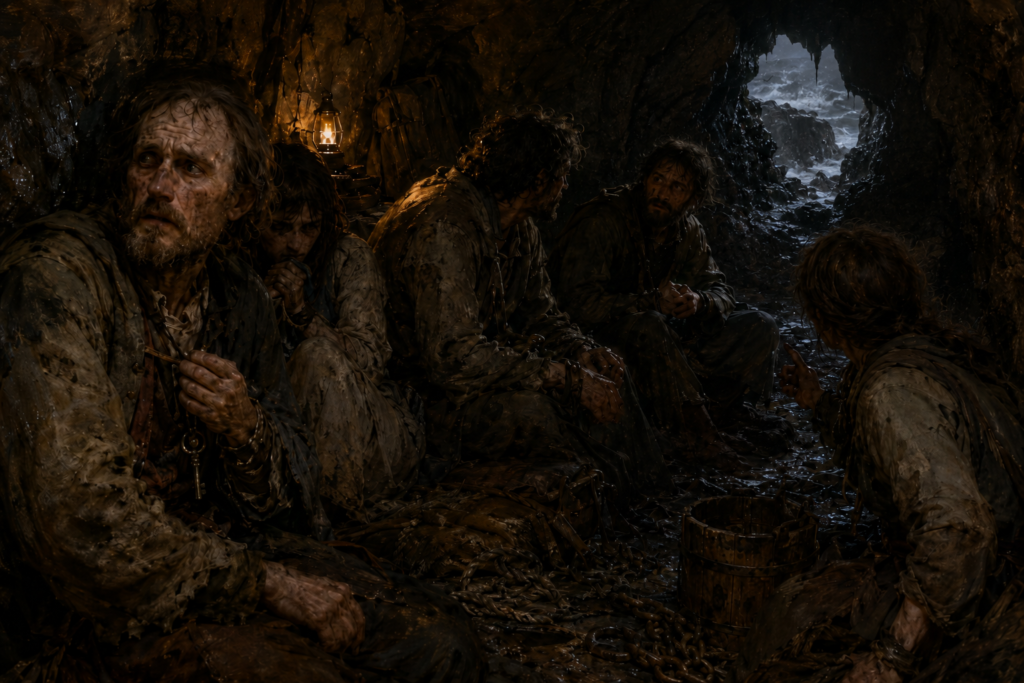
Image created with ChatGPT.
The Broken Guests are not a normal enemy type. They are captives, coerced servants, bait, witnesses, damaged survivors, false guides, and moral complications inside the Bean Clan’s cave.
Use them to make the lair harder to navigate, not to add another group of combatants. A Broken Guest may help the party, mislead them, scream at the wrong moment, hide a key, beg for mercy, obey a trained command, or freeze when escape is finally possible.
Broken Guest
Small or Medium Humanoid, Any Alignment
Armor Class: 11
Initiative: +1
Hit Points: 9
Speed: 25 ft.
Proficiency Bonus: +2
Saving Throws: Wis +2
Skills: Deception +2, Insight +2, Perception +2, Stealth +3, Survival +2
Senses: passive Perception 12
Languages: Any one language they knew before capture; some may understand Scots or Gaelic
Challenge: 1/8
| STR | DEX | CON | INT | WIS | CHA |
|---|---|---|---|---|---|
| 9 (-1) | 12 (+1) | 10 (+0) | 10 (+0) | 11 (+0) | 10 (+0) |
Traits
Broken by the Cave. The Broken Guest has disadvantage on saving throws against being frightened while it can see Sawney Bean, Agnes “Black” Douglas, or two or more Bean clan members.
Knows the Wrong Way. The Broken Guest has advantage on Wisdom (Survival) checks made to navigate part of the tidal cave, but only if it has been held there for at least a week. On a failed check, it may still remember one useful clue, such as a tide mark, hidden rope, crawlspace, prisoner hook, false passage, or place where the clan refuses to step.
Coerced Obedience. If Sawney or Agnes gives the Broken Guest a direct order within 60 feet, the Broken Guest must succeed on a DC 13 Wisdom saving throw or obey in the simplest possible way until the end of its next turn. This is not magical control. It is terror, conditioning, and immediate coercion. The order cannot force the Broken Guest to directly kill itself or deliberately kill another captive, but it may cause the Guest to lie, block a passage, drop a key, shout a warning, extinguish a light, point the wrong way, or delay a rescuer.
Break the Pressure. A creature can use an action to speak firmly, show proof of safety, name the Broken Guest’s home or kin, offer food, cut a binding, shield the Guest from the clan, or otherwise break the immediate pressure of the cave. The Broken Guest then makes a DC 13 Wisdom saving throw. On a success, it is no longer affected by Coerced Obedience for 10 minutes. On a failure, it remains frightened or confused, but does not become hostile unless threatened.
Actions
Desperate Strike. Melee Weapon Attack: +3 to hit, reach 5 ft., one target. Hit: 3 bludgeoning, piercing, or slashing damage, depending on the object used.
Cry Out. The Broken Guest screams, calls for help, repeats a trained warning, or panics. One Bean clan member within 60 feet who can hear the cry may move up to 10 feet without provoking opportunity attacks. If no clan member is nearby, this instead reveals the Broken Guest’s location.
Mislead. The Broken Guest points, lies, gives a partial truth, or repeats what the clan trained them to say. One creature within 30 feet that can hear and understand the Broken Guest must succeed on a DC 12 Wisdom (Insight) check or have disadvantage on the next Wisdom (Perception), Wisdom (Survival), or Intelligence (Investigation) check it makes before the end of its next turn.
Bonus Action
Cower. The Broken Guest drops prone, takes cover, or moves up to 10 feet away from the nearest visible threat without provoking opportunity attacks.
Reaction
Panic in the Way. When a creature within 5 feet of the Broken Guest makes an attack roll, the Broken Guest may panic, stumble, or flinch into the line of movement. The attacker must succeed on a DC 12 Dexterity saving throw or make the attack roll with disadvantage. A Broken Guest cannot use this reaction if incapacitated or restrained.
Using Broken Guests in the Encounter
Broken Guests should create rescue pressure, uncertainty, and consequence. They are not there to be harvested for shock value, nor should they be treated as ordinary enemies unless the situation clearly warrants it.
Use them as:
- captives who know part of the cave;
- bait placed in visible distress;
- frightened witnesses who give incomplete truths;
- coerced servants forced to warn the clan;
- false prisoners planted by Agnes;
- survivors too broken to trust rescuers quickly;
- people who may help if treated carefully;
- moral obstacles during fire, flooding, darkness, or retreat.
A Broken Guest may beg for rescue while also obeying Agnes’s trained commands. They may tell the party not to go left because they genuinely believe left is death, or because the clan beat that warning into them for weeks. They may hide a key because they were told another prisoner would be killed if they surrendered it.
The strongest version is not “the prisoner attacks you.” The strongest version is: the prisoner makes every decision cost time, trust, noise, or risk.
Broken Guest Complications
Use one or more of these during play:
- The False Guide: The Guest knows a path, but it leads through a clan killing ground unless the party notices the warning signs.
- The Hidden Key: The Guest has a key sewn into clothing or hair, but is terrified of admitting it.
- The Trained Cry: If touched suddenly, the Guest screams a signal phrase that alerts a Road-Son.
- The Half-Truth: The Guest accurately describes one chamber but lies about the next.
- The Marked Prisoner: Agnes has poisoned the Guest’s bandage, clothing, or skin with a contact draught.
- The Lost Name: The Guest no longer answers to their true name until someone speaks of home, family, craft, or oath.
- The Bargain: The Guest will help only if the party promises to rescue another captive deeper in the cave.
- The Spy by Terror: The Guest is not loyal to the clan, but believes the clan will know if they help.
Variant: Broken Guest Plant
Use this for a prisoner who is actually working for the Bean Clan, whether by fear, corruption, dependence, blood relation, or Agnes’s deliberate placement.
Make these changes:
- Challenge: 1/2
- Hit Points: 18
- Deception: +5
- Stealth: +5
- Remove: Coerced Obedience and Break the Pressure
Add the following trait:
Knife Under the Rags. Once per turn, when the Broken Guest Plant hits a creature that trusts it, is surprised by it, or has not attacked it since the start of the encounter, the attack deals an extra 7 piercing damage.
Add this action:
Hidden Knife. Melee Weapon Attack: +5 to hit, reach 5 ft., one target. Hit: 5 piercing damage.
Variant: Broken Guest Survivor
Use this for a prisoner who is not strong enough to fight but has enough will left to help.
Make these changes:
- Hit Points: 14
- Wisdom: 13 (+1)
- Survival: +4
Add the following trait:
One Clear Memory. Once per encounter, the Broken Guest Survivor can give one useful clue about the cave: the direction of the tide, the location of a hidden passage, the sound of a trap mechanism, the routine of a guard, the smell of Agnes’s poison, or the place where Sawney keeps keys.
Tone and Table Use Note
Broken Guests are human consequences of the cave. They should make the Sawney Bean lair feel morally dangerous, not merely gruesome.
Use them to create hard choices: whether to trust, whether to slow down, whether to split the party, whether to risk noise, whether to spend time freeing captives while the tide rises, and whether to believe a person whose survival has depended on pleasing monsters.
Role in the Campaign
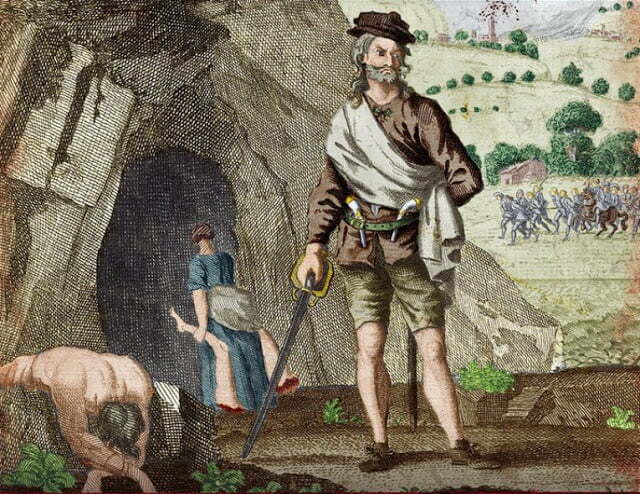
Sawney works best as the hidden source of a regional wound.
At first, the party should not meet him. They find empty carts, abandoned shoes, a horse walking riderless through rain, a purse still full of coins, bones misidentified as animal remains, or a family who insists their son did not run away. Inns grow quiet. Merchants begin travelling in armed groups. Local lairds blame rival clans, smugglers, raiders, curses, or bad roads.
Sawney becomes more frightening when the party realise the disappearances are organised. Someone studies the roads. Someone knows when witnesses are few. Someone removes traces. Someone plants false evidence. Someone lets rumours spread in the wrong direction.
In a 1454 campaign, Sawney should be treated as a legendary or semi-legendary horror adapted into the living world, not as a cleanly documented historical criminal. He may be a living outlaw patriarch, the heir to an older cannibal line, a title passed from cave-king to cave-king, or a bogeyman whose legend conceals a real clan.
By the time Sawney appears, the players should feel they have entered a private kingdom that has been operating beneath everyone’s feet.
Adventure Hooks
1. The Road That Eats Names
Travellers vanish along a coastal route, but only those unlikely to be pursued: peddlers, servants, fostered children, messengers, and poor pilgrims to older shrines. A noble finally cares when his illegitimate son disappears while carrying a sealed letter.
The party must investigate a road where every innkeeper has a theory, every shepherd has seen something, and every official wants the answer to be ordinary banditry. The first real clue is not a body, but a forged message sent after the victim was already dead.
2. The Daughter in the Town
A young woman living in a coastal town is accused of being kin to the cave clan after a survivor recognises a lullaby she sings. She may be innocent, escaped, complicit, or trying to protect a child still inside the cave.
The town wants a hanging before the truth is known. Sawney wants her silenced before she remembers enough to guide enemies to the cave. The party must decide whether she is witness, bait, victim, murderer, or all four.
3. The Cave Under High Water
The party finds the entrance to Sawney’s cave only as the tide begins to turn. Inside are captives, plunder, hidden passages, clan members, false exits, and Sawney retreating deeper into black stone.
The players must decide whether to push inward, withdraw before the sea seals them in, or split the group to save prisoners while Sawney prepares an ambush. The cave is not a dungeon waiting to be cleared. It is a living lair that knows the tide better than the heroes do.
Source and Literary Context
Sawney Bean, usually given as Alexander “Sawney” Bean, is a legendary Scottish cannibal patriarch said to have led a hidden cave-dwelling clan that murdered and ate travellers. The familiar version places the clan in a sea cave near Ballantrae or Bennane Head on the Ayrshire coast and describes their eventual capture and execution under a Scottish king. The tale is strongly associated with sensational crime literature such as The Newgate Calendar, which presents Sawney Bean as a monstrous cave-dwelling murderer and cannibal. For a public-domain presentation of the traditional crime-literature version, see The Newgate Calendar account of Sawney Bean.
The story’s historical reliability is highly doubtful. Modern folklore scholarship generally treats Sawney Bean as a famous Scottish legend rather than a securely documented historical person. A key scholarly discussion is Sandy Hobbs and David Cornwell’s article “Sawney Bean, the Scottish Cannibal,” published in Folklore, which addresses the legendary status and historical uncertainty surrounding the tale. See “Sawney Bean, the Scottish Cannibal” via JSTOR.
For campaign use, Sawney Bean is strongest as a legend with teeth: not a cleanly documented historical NPC, but a horror figure rooted in coastal fear, outlaw violence, cannibal folklore, sensational crime writing, and the anxiety that law does not reach every road.