
Madame Rachel — The Woman Who Sells Eternal Beauty
Madame Rachel — The Woman Who Sells Eternal Beauty
A cosmetic-mistress, alchemical fraudster, blackmailer, and keeper of aristocratic shame, Madame Rachel offers beauty that works just long enough to make the price unbearable.
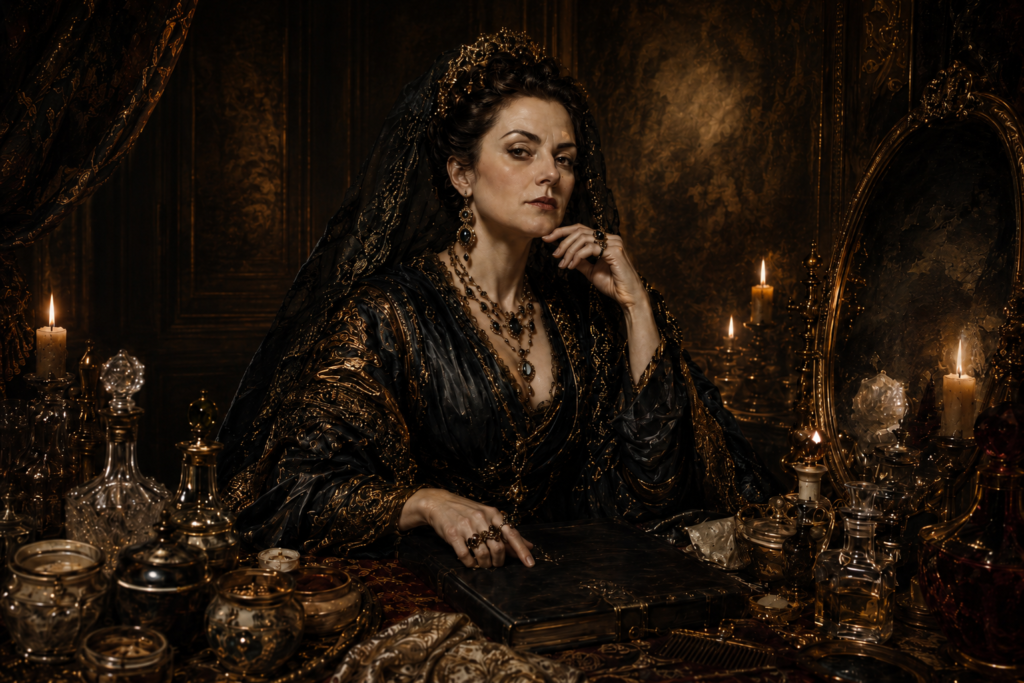
- Full Name: Sarah Rachel Russell
- Common Name: Madame Rachel
- Aliases: The Woman Who Sells Forever, Mistress of the Painted Rooms, Rachel of the Bond Street House, the Alabaster Widow
- Gender: Female
- Race: Human
- Occupation: Cosmetic-seller, alchemical beautician, fraudster, blackmailer, salon-keeper, broker of secrets
- Nationality: English
- Region: London, especially wealthy shopping streets, noble households, theatres, apothecary lanes, debt courts, and private lodging houses
- Base of Operations: A fashionable cosmetic house with painted reception rooms, curtained bathing chambers, hidden ledgers, locked cabinets, and a discreet back stair
- Languages: English, thieves’ cant, merchant French, cosmetic and apothecary jargon, scraps of Italian, Arabic, Greek, and Latin used mainly for mystique
- Religion: Publicly respectful of London’s civic rites and household customs; privately attentive to old oaths, thresholds, graves, women’s charms, protective household spirits, and certain infernal courtesies she refuses to call worship
- Alignment: Neutral Evil
- Affiliations: Apothecaries, pawnbrokers, corrupt beadles, debt collectors, theatre people, false physicians, servants in noble houses, discreet brothel-keepers, minor court officials, and lesser infernal intermediaries of contract, debt, vanity, and silence
- Allies: Paid maids, frightened clients, fashionable widows, dishonest physicians, cosmetic apprentices, letter-carriers, jewellers willing not to ask questions, and fiendish go-betweens who trade in clauses rather than open damnation
- Rivals: Honest apothecaries, exposed former clients, moral crusaders, ruined husbands, competing charm-sellers, physicians who resent her trade, and infernal agents who believe she has grown too proud
- Enemies: Women she is destroying, families she is blackmailing, investigators with patience, nobles whose scandals she holds too closely, and any fiend that decides she has stopped being profitable
Madame Rachel is a London beauty-seller whose chambers are more dangerous than a thieves’ den because no one respectable wishes to admit they go there. She sells smooth skin in alabaster pots, youth in painted jars, hair-darkening washes, perfumes, powders, baths, charms, and “secret Eastern preparations” with names more valuable than their ingredients.
Her true trade is not cosmetics. It is fear.
A noblewoman comes because age has become a political danger. A widow comes because she must remarry before creditors strip her household bare. A courtier comes because a scar, rash, pregnancy, stain, or rumour threatens everything. Madame Rachel listens, flatters, diagnoses, promises, records, and extends credit. Once the client owes too much, she introduces the second price: jewels, letters, silence, introductions, false testimony, access to households, or betrayal of rivals.
She is not merely a fraud. Some of her treatments genuinely work, but never cleanly. A cream hides pox scars for one evening. A wash darkens grey hair until dawn. A bath makes old skin luminous while leaving the bather feverish, dependent, or marked by alchemical residue. She thrives because the lie, the craft, and the hidden bargain mix together, and no victim can easily say where the fraud ends.
Madame Rachel does not openly serve fiends. She buys from them, bargains with them, learns from them, and tells herself that trade is not worship. The distinction matters to her far more than it matters to the things behind the mirror.
Personality
Madame Rachel is generous in the first meeting, theatrical in the second, and merciless by the third. She understands shame better than most priests, physicians, or magistrates. She never begins with threats. She begins with relief.
She praises what the client fears losing. She names a flaw softly enough that the victim feels seen rather than judged. She offers credit as kindness. She offers secrecy as friendship. She offers beauty as salvation.
Her cruelty is practical. She does not ruin clients for pleasure unless profit, protection, or revenge follows. She prefers a living debtor to a dead enemy. When pressed, however, she destroys a reputation with a letter, a pawn ticket, a stained garment, or the testimony of a servant who has already been paid.
With fiends, she is careful, proud, and dangerously self-deceiving. She believes she is too clever to be owned because she never kneels, never chants, and never calls them masters. Her bargains are written in the language of supply, debt, exclusivity, formula rights, and witness clauses. That makes them more dangerous, not less.
Private Truth
Madame Rachel does not believe beauty is trivial. She believes society makes it into a weapon long before she learns to sell it.
She despises nobles who condemn cosmetics while buying them, husbands who demand youth while ageing freely, courts that mock women for vanity after forcing their value into appearance, and physicians who call her dishonest while selling dangerous cures under cleaner names.
That bitterness does not redeem her. It explains why she never feels guilty for taking money from those who have more than she ever had. Her moral failure is not that she sees the hypocrisy. Her moral failure is that she turns every wounded person into stock.
Her infernal dealings sharpen this failure. Devils and other fiends do not need to corrupt her with grand temptations. They merely encourage what she already believes: that every fear can be priced, every secret collateralised, and every wounded person converted into leverage.
How She Operates
Madame Rachel’s business has three visible layers.
The public shop sells powders, perfumes, soaps, hair washes, scented gloves, skin tonics, tooth preparations, oils, and small vanities. This layer is expensive but not openly criminal.
The private chambers offer baths, masked facials, scar-softening preparations, complexion restoratives, anti-ageing draughts, alchemical vapours, and body wraps. These require privacy, undress, trust, and servants who can be bribed.
The hidden trade is the black ledger. This records debts, jewels, marks, birthmarks, scars, affairs, pregnancies, disguises, letters, aliases, and anything said by a frightened client who thinks the room is sealed.
Beneath even the ledger lies a quieter trade. Madame Rachel sometimes buys rare cosmetic formulae, mirror-charms, debt clauses, glamour ingredients, and contract wording from infernal intermediaries. She does not call this worship. She calls it supply.
The ledger is more valuable than the shop.
Signature Schemes
The Eternal Beauty Contract: Madame Rachel sells a sequence of treatments that must be completed or the client’s skin will “reject the process.” The price rises each time.
The False Suitor: She convinces a widow or heiress that a powerful admirer intends marriage, but only if the client becomes more presentable, discreet, and obedient.
The Jewel Deposit: A client leaves jewels as temporary security. Madame Rachel pawns them, replaces them with imitations, or claims they are always payment.
The Poisoned Improvement: A preparation works beautifully once, then causes dependency, rash, swelling, or visible decline unless countered by a second treatment.
The Servant’s Whisper: She pays household servants for knowledge, then sells that knowledge back as “intuition.”
The Shame Mirror: A room of angled mirrors and flattering lamps lets the client see exactly what she fears. Madame Rachel then sells the cure.
The Witnessed Clause: A client signs a treatment agreement believing it to be a receipt, credit note, or privacy guarantee. The wording is not overtly supernatural, but an infernal witness marks the debt. Missed payment brings nightmares, social accidents, sudden exposure, or a fiendish collector disguised as a clerk.
Why She Matters
Madame Rachel turns private insecurity into public danger. One visit to her rooms can compromise a noble marriage, expose an illegitimate heir, bankrupt a widow, blackmail a magistrate, or reveal which court faction is trying to preserve a dying lord’s appearance long enough to pass a decree.
She is strongest as a social villain rather than a simple combat encounter. The party may first meet her as a merchant, witness, patron, suspect, informant, or criminal fixer. Only later do they realise half the city’s respectable women, courtiers, actors, physicians, and servants orbit her in fear.
Her fiendish dealings remain commercial, deniable, and practical. She is not a robed cultist chanting in a cellar. She is more dangerous than that: a respectable supplier of shame, contract, vanity, and debt, whose infernal contacts prefer ledgers to altars.
Edition Tabs
Madame Rachel, 5.5e / 2024-Compatible Stat Block
Madame Rachel, Pathfinder 1e-Compatible Stat Block
Madame Rachel, 5.5e / 2024
Medium Humanoid, Neutral Evil
Armor Class 15
Initiative +3
Hit Points 84 (13d8 + 26)
Speed 30 ft.
Proficiency Bonus +3
Saving Throws Dex +6, Wis +6, Cha +8
Skills Deception +11, Insight +9, Investigation +7, Medicine +6, Persuasion +8, Sleight of Hand +6
Tools Alchemist’s Supplies +10, Disguise Kit +10, Forgery Kit +7, Poisoner’s Kit +10
Damage Resistances poison
Senses passive Perception 16
Languages English, thieves’ cant, merchant French, cosmetic and apothecary jargon
Challenge 8 (3,900 XP)
| STR | DEX | CON | INT | WIS | CHA |
|---|---|---|---|---|---|
| 8 (-1) | 16 (+3) | 14 (+2) | 18 (+4) | 17 (+3) | 20 (+5) |
Traits
Beautiful for Ever. Madame Rachel has advantage on Charisma checks made against a creature that has willingly accepted a treatment, cosmetic, gift, loan, or private consultation from her within the last 30 days.
Black Ledger. If Madame Rachel spends at least 10 minutes privately questioning, treating, or observing a creature, she may attempt to learn one useful secret about it. The target makes a DC 16 Charisma saving throw. On a failure, she learns one socially dangerous fact, hidden fear, debt, disguise, relationship, or vulnerability. This is not mind reading; it represents expert questioning, observation, and inference.
Infernal Witness. Truths written in Madame Rachel’s black ledger darken overnight; deliberate lies fade by dawn. A creature named in the ledger has disadvantage on the first Charisma saving throw it makes against Madame Rachel each day, provided she has written a true secret, debt, or compromising fact about that creature.
Cosmetic Alchemy. Madame Rachel carries prepared powders, fumes, draughts, and skin applications. A creature that drinks, inhales, or accepts one of her treatments must succeed on the listed saving throw or suffer the effect. She can prepare up to six such doses per day.
Respectable Mask. While in a wealthy district, courtly house, salon, theatre, or official chamber, Madame Rachel has advantage on ability checks made to avoid immediate arrest, delay questioning, or make accusations against her seem socially inconvenient.
Social Predator. Madame Rachel has advantage on Wisdom (Insight) checks made to identify shame, fear, vanity, debt, romantic desperation, or fear of scandal.
Actions
Multiattack. Madame Rachel makes two Dagger or Caustic Powder attacks, or she makes one attack and uses Honeyed Threat.
Dagger. Melee or Ranged Weapon Attack: +6 to hit, reach 5 ft. or range 20/60 ft., one target. Hit: 5 (1d4 + 3) piercing damage plus 7 (2d6) poison damage.
Caustic Powder. Ranged Weapon Attack: +6 to hit, range 15 ft., one creature. Hit: 10 (2d6 + 3) poison damage, and the target must succeed on a DC 16 Constitution saving throw or be blinded until the end of its next turn.
Honeyed Threat. One creature within 30 feet that can hear and understand Madame Rachel must make a DC 16 Wisdom saving throw. On a failure, the creature is charmed or frightened by her, Madame Rachel’s choice, until the end of her next turn. If Madame Rachel possesses an exposed secret, unpaid debt, or known scandal involving the creature, it has disadvantage on the save.
The Second Price. Madame Rachel names a secret, debt, or compromising fact about one creature she can see within 60 feet. The target must succeed on a DC 16 Charisma saving throw or take 17 (5d6) psychic damage and be unable to willingly move closer to Madame Rachel until the end of its next turn. On a success, the target takes half damage and suffers no movement restriction.
Alchemical Treatment. Madame Rachel administers or throws one prepared treatment. Choose one effect:
False Bloom: The target must succeed on a DC 16 Constitution saving throw or be poisoned for 1 minute. While poisoned this way, the target’s face becomes flushed, luminous, and unnaturally smooth. The target can repeat the save at the end of each of its turns.
Sleep of Soft Skin: The target must succeed on a DC 16 Constitution saving throw or fall unconscious for 1 minute. The effect ends if the target takes damage or another creature uses an action to shake it awake.
Burning Unguent: The target takes 14 (4d6) acid damage, or half as much damage on a successful DC 16 Dexterity saving throw.
Mirror Draught: The target must succeed on a DC 16 Wisdom saving throw or become incapacitated by self-disgust, vanity, or panic until the end of its next turn.
Bonus Actions
Slip Behind the Curtain. Madame Rachel takes the Hide or Disengage action. She can use this bonus action only while within 5 feet of a curtain, screen, doorway, crowd, mirror, cabinet, or heavy furniture.
Servant, Now. One allied servant, apprentice, guard, or bribed bystander within 30 feet may move up to half its speed and take the Help action.
Reactions
I Have Your Letter. When a creature Madame Rachel can see targets her with an attack, spell, or hostile social accusation, she may reveal or imply damaging leverage. The creature must succeed on a DC 16 Wisdom saving throw or choose a different target or lose the action. A creature immune to being charmed is immune to this effect.
Powder in the Eyes. When a creature hits Madame Rachel with a melee attack, she imposes disadvantage on the next attack roll that creature makes before the end of its next turn.
Encounter Use
Madame Rachel should rarely fight alone. Her proper battlefield is a salon with servants, screens, boiling cosmetic vessels, locked cabinets, braziers, scented smoke, slippery bathing floors, false walls, and clients who do not want the authorities called.
Use her as a CR 8 social-criminal villain. In direct combat she is dangerous, but she is not built to stand in a fair duel. Her real power is preparation, leverage, escape routes, bribed witnesses, infernal fine print, and victims who hesitate because exposure may ruin them too.
Madame Rachel, Pathfinder 1e
Female human expert 7 / rogue 5 / alchemist 3
NE Medium humanoid
Init +4; Senses Perception +17
DEFENSE
AC 20, touch 15, flat-footed 15; +4 Dex, +1 dodge, +5 armour and protective garments
hp 98
Fort +8, Ref +13, Will +12
Defensive Abilities evasion, trap sense +1, uncanny dodge; Resist +4 on saves against poison
OFFENSE
Speed 30 ft.
Melee poisoned dagger +12/+7 (1d4+1 plus poison)
Ranged caustic cosmetic powder +13 touch (3d6 acid plus blindness risk)
Special Attacks sneak attack +3d6, bombs 5/day, blackmail leverage, infernal witness
TACTICS
Before Combat Madame Rachel delays arrest, divides accusers, summons servants, invokes debt, and tries to move the confrontation into a room prepared with fumes, screens, mirrors, and exits.
During Combat She blinds enemies, uses poison and acid preparations, exposes secrets to disrupt attackers, and lets hired guards or desperate servants engage directly.
Morale Madame Rachel flees if reduced below 30 hit points unless escape means losing her ledger.
STATISTICS
Str 8, Dex 18, Con 14, Int 18, Wis 16, Cha 20
Base Atk +10; CMB +9; CMD 24
Feats Deceitful, Dodge, Persuasive, Skill Focus (Bluff), Skill Focus (Profession [cosmetician]), Weapon Finesse
Skills Appraise +18, Bluff +27, Craft (alchemy) +22, Diplomacy +22, Disguise +22, Heal +16, Intimidate +19, Knowledge (local) +18, Knowledge (planes) +12, Perception +17, Profession (cosmetician) +24, Sense Motive +22, Sleight of Hand +18, Stealth +18, Use Magic Device +17
Languages English, French, thieves’ cant, cosmetic and apothecary trade jargon
SQ alchemy, poison use, trapfinding, salon network, social contacts
Special Abilities
Blackmail Leverage (Ex): If Madame Rachel has spent at least 10 minutes privately treating, interviewing, or observing a creature, she may attempt a Bluff check opposed by the target’s Sense Motive. On a success, she identifies a usable fear, debt, vanity, or secret. Once per day per target, she may invoke this knowledge to impose a –4 penalty on that target’s attack roll, saving throw, Diplomacy check, or testimony against her.
Infernal Witness (Su): Truths written in Madame Rachel’s black ledger darken overnight; deliberate lies fade by dawn. Once per day, when Madame Rachel invokes a true secret written in the ledger, the named target takes a –2 penalty on one saving throw or opposed check against her blackmail leverage, fear, charm, or social coercion.
Caustic Cosmetic Powder (Ex): As a standard action, Madame Rachel may throw a prepared powder as a ranged touch attack within 15 feet. On a hit, the target takes 3d6 acid damage and must succeed on a DC 18 Fortitude save or be blinded for 1 round.
False Bloom Draught (Ex): A creature that drinks or inhales this preparation must succeed on a DC 18 Fortitude save or be sickened for 1d6 minutes. For the first hour after use, the creature appears healthier and more attractive, gaining a +2 circumstance bonus on Disguise checks made to appear youthful, healthy, or uninjured.
Respectable Mask (Ex): In wealthy, courtly, or official environments, Madame Rachel gains a +4 circumstance bonus on Bluff and Diplomacy checks made to delay investigation, redirect blame, or make accusations against her seem socially dangerous.
Equipment and Treasure
Madame Rachel’s wealth is portable, deniable, and incriminating.
Carried Gear: poisoned dagger, rings worth 250 gp, scent bottles, cosmetic knives, small mirror, sealed powders, three false keys, coded appointment book, silk purse containing 80 gp, vial of sleep draught, vial of caustic whitening fluid.
Salon Treasure: 2,500–6,000 gp in jewellery, pawn tickets, client deposits, silver jars, rare perfumes, alchemical ingredients, blackmail letters, false contracts, forged marriage promises, debt notes, and a locked ledger.
The Black Ledger: This is her real treasure. Destroying it may free victims. Stealing it may make the party powerful. Returning it to the wrong noble may start a private war. If the infernal witness bound to the ledger is active, truths written in it darken overnight and lies fade by dawn. A fiend may not own Madame Rachel outright, but something is certainly reading over her shoulder.
Using Madame Rachel in Your Game
Madame Rachel works best when the party does not initially know whether she is villain, victim, merchant, informant, or necessary evil.
She can provide access to noble households, identify disguises, expose poisoning, prepare a false appearance, remove scars, conceal someone wanted by law, or sell a treatment that lets a dying ruler appear healthy for one final audience.
Her price is never only coin. She wants letters, introductions, names, silence, favours, and leverage.
Do not make every cosmetic treatment fake. That weakens her. Her most frightening quality is that some of her work is real enough to make people return after they already know she is dangerous.
At the table, she can have one infernal supplier, one mirror-bound witness, one devilish clerk, or one old formula whose cost she refuses to understand. Keep the fiends behind the contract, not standing in the shop.
Adventure Hooks
The Widow’s Face: A wealthy widow hires the party after Madame Rachel threatens to expose her visits to the painted rooms. The widow claims she only buys cosmetics, but the ledger suggests a false marriage plot, missing jewels, and a nobleman who may never intend to marry her.
Beautiful for One Night: A dying princess appears at court suddenly restored, radiant, and politically decisive. Madame Rachel’s treatment buys the princess one public evening of apparent health, but the cost accelerates her death. The party must decide whether to expose the deception before a succession decree is sealed.
The Ledger in the Bath-House: A servant steals Madame Rachel’s black ledger and begs the party for protection. Half of London wants the book destroyed; the other half wants it weaponised. Madame Rachel wants the servant alive long enough to learn who has read it.
Powder for the Queen: A royal household quietly asks the party to investigate a cosmetic preparation being delivered to a queen, duchess, or high noblewoman. The powder improves complexion but contains a slow poison that only becomes obvious after the user stops taking it.
The Woman Who Pays in Pearls: A client vanishes after leaving a pearl necklace as security. Madame Rachel insists the woman leaves willingly. The pawn tickets, bath stains, and witness statements all contradict one another.
The Clause That Breathes: A client’s treatment contract begins altering itself after sunset, adding new obligations in a cramped legal hand. Madame Rachel insists this is impossible, but the ink smells faintly of smoke, perfume, and hot metal.
Roleplaying Madame Rachel
Use warmth before threat. She should sound like someone who understands the client’s pain better than anyone else in the room.
“Beauty is never vanity, my dear. Vanity is what ugly people call survival when it belongs to someone else.”
“I do not sell miracles. Miracles are cheap. I sell continuance.”
“You come to me because the honest world has already judged you.”
“Pay me in coin if you can. Pay me in truth if you must.”
“Careful. That letter ruins you more thoroughly than it enriches me.”
“No, my dear. I worship nothing with horns. I merely know where certain useful things may be purchased.”
Source and Literary Context
Sarah Rachel Russell, better known as Madame Rachel, was a Victorian London cosmetician, businesswoman, fraudster, and blackmailer associated with the promise “Beautiful for Ever.” Historical accounts connect her with expensive beauty preparations, fashionable clients, fraud trials in 1868 and 1878, and her death in Woking Prison in 1880. For a concise biographical summary, see Willesden Jewish Cemetery’s Madame Rachel life story.
The campaign version above deliberately shifts her out of a strictly Victorian setting and into a late-medieval London frame. The adaptation preserves her strongest historical functions: beauty as commerce, cosmetics as social anxiety, secrecy as leverage, and the salon as a place where respectable society becomes vulnerable. For a fuller narrative account of her career and trials, see Helen Rappaport’s article, The True Story of Madame Rachel.
Madame Rachel is most useful in play when treated neither as a simple quack nor as a grand sorceress. Her power lies in the mixture: some fraud, some genuine cosmetic craft, some alchemy, some social insight, a great deal of blackmail, and carefully deniable dealings with infernal intermediaries. That balance keeps her believable while making her more dangerous than an ordinary swindler.