
Prince Valiant of Thule — The Singing Sword
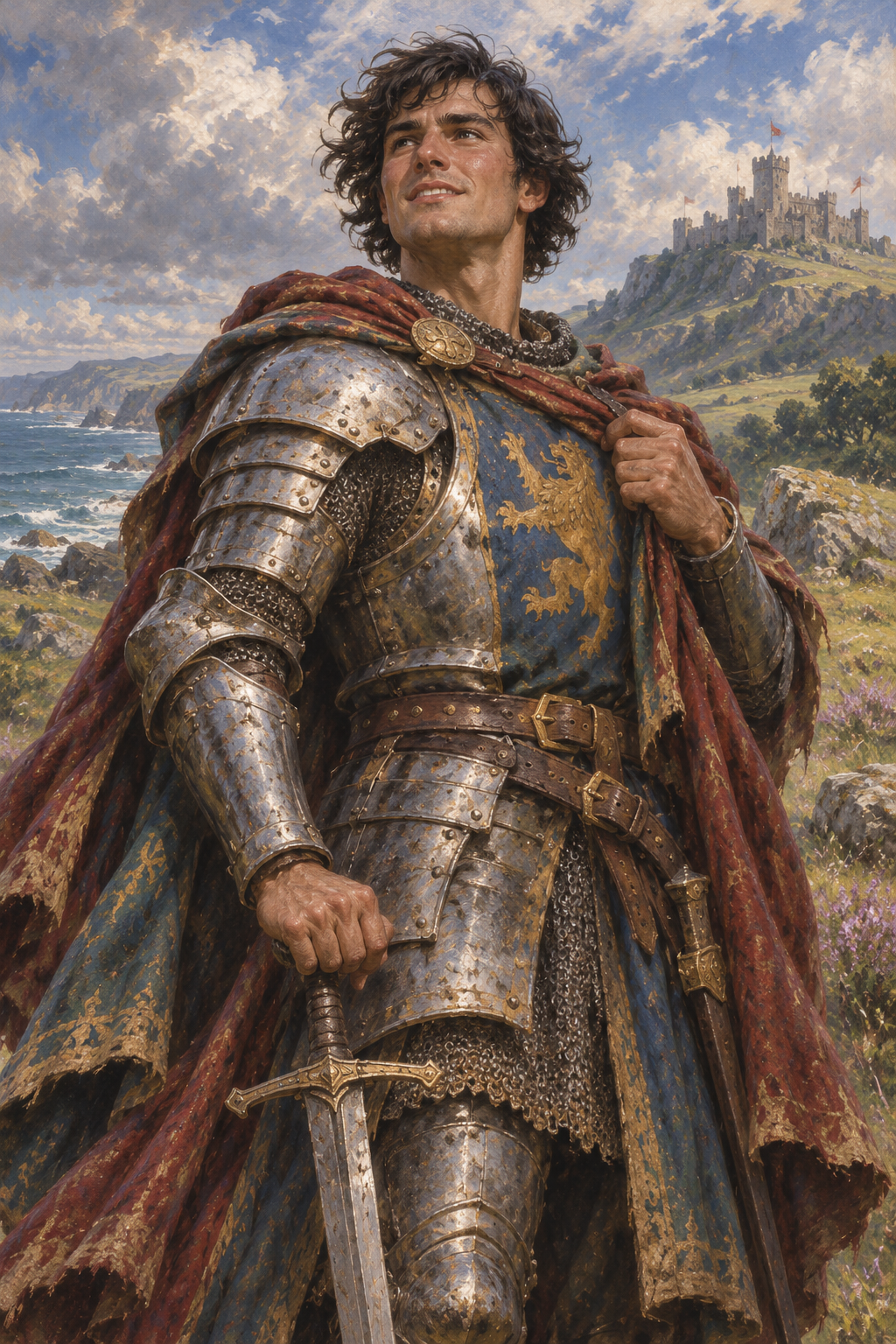
At a Glance
| Name | Prince Valiant of Thule; Val; the knight of the Singing Sword |
|---|---|
| Nature | Human, mortal; prince, traveller, knight and war leader |
| Alignment | Lawful Good — loyalty tempered by an unwillingness to obey unjust commands |
| Home and allegiance | Thule, Arthur’s court, and the Misty Isles through Queen Aleta |
| Family | Son of King Aguar; husband and political partner of Queen Aleta; father of Arn and other children |
| Allies | Gawain, Tristan, Merlin and loyal companions from his voyages |
| Adversaries | Warlords, raiders, tyrants and rulers who mistake royal descent for a licence to harm the weak |
| Languages | Thulian (a North Germanic tongue), Brythonic and courtly Latin; interpreters used beyond those lands |
| Equipment | The Singing Sword (Flamberge), plate and shield, cavalry lance, travel cloak and a trained warhorse |
| Where encountered | Arthur’s age, before Camlann; in 1454, only by a crossing into an earlier time or through a surviving account of his deeds |
| Rules profile | D&D 2024 CR 12; D&D 2014 CR 12; Pathfinder 1e CR 12; D&D 3.5e CR 13 |
The ferryman claims that an armed stranger has crossed the flooded estuary without asking his price. At dawn the stranger returns, leading a chestnut horse and carrying a bundle wrapped in sailcloth: the stolen tax rolls that would have condemned three villages to famine. He is Prince Valiant, and his soldiers will not arrive before the king’s collectors.
He needs witnesses, shelter and a way to protect the families without beginning a war between two courts. He can defeat the tax captain easily enough. The harder question is whether his companions will trust him when he insists that the captain deserves a fair hearing.
Game Statistics
D&D 2024 — Prince Valiant
Medium Humanoid (Human), Lawful Good
AC 20 (plate armour, shield); Initiative +2 (12); HP 190 (20d8 + 100); Speed 30 ft.
| Ability | Score | Modifier | Save |
|---|---|---|---|
| STR | 22 | +6 | +10 |
| DEX | 14 | +2 | +2 |
| CON | 20 | +5 | +9 |
| INT | 14 | +2 | +2 |
| WIS | 16 | +3 | +7 |
| CHA | 18 | +4 | +8 |
Skills Athletics +10, History +6, Insight +7, Perception +7, Persuasion +8, Survival +7. Senses Passive Perception 17. Languages Thulian, Brythonic, Latin. CR 12 (8,400 XP; PB +4).
Traits
Indomitable (2/Day). When Valiant fails a saving throw, he can reroll it and must use the new roll.
Steadfast Company. Valiant and allies within 15 feet of him have a +2 bonus to saving throws against the Frightened condition while he is conscious. This bonus does not stack with another instance of Steadfast Company.
Mounted Knight. While riding a trained mount, he has Advantage on saving throws and checks to avoid being dismounted. The mount has its own speed and actions; Valiant does not acquire its speed as his own.
Flamberge, the Singing Sword. The +2 longsword is a magic weapon. The first time on each of Valiant’s turns that it hits a creature, the blade deals an extra 9 (2d8) Thunder damage to that creature. The note it makes is audible within 30 feet; it does not deafen, charm or compel by itself.
Actions
Multiattack. Valiant makes three Singing Sword attacks or three dagger attacks. While mounted, he can replace one of these attacks with a Cavalry Lance attack.
Singing Sword. Melee Attack Roll: +12, reach 5 ft., one target. Hit: 12 (1d8 + 8) Slashing damage; the first hit on his own turn also triggers Flamberge’s Thunder effect.
Cavalry Lance (While Mounted). Melee Attack Roll: +10, reach 10 ft., one target. Hit: 12 (1d12 + 6) Piercing damage. If his mount moved at least 20 feet straight towards the target immediately before this hit, the target takes an extra 7 (2d6) Piercing damage and, if Large or smaller, must succeed on a DC 18 Strength saving throw or have the Prone condition. This extra damage and saving throw can occur only once per turn.
Dagger. Melee or Ranged Attack Roll: +10, reach 5 ft. or range 20/60 ft., one target. Hit: 8 (1d4 + 6) Piercing damage.
Bonus Actions
Command the Line (Recharge 5–6). Up to two allies within 60 feet who can hear Valiant can each use their Reaction immediately to move up to half their Speed without provoking Opportunity Attacks. Neither ally gains an additional action or attack.
Second Wind (1/Day). Valiant regains 25 Hit Points.
Reactions
Parry. When a melee attack would hit Valiant and he can see the attacker, he increases his AC by 3 against that attack, potentially causing it to miss.
Legendary Actions
Valiant can take two Legendary Actions per round, choosing from the options below. He takes only one option at the end of another creature’s turn and regains spent actions at the start of his turn.
Measured Strike (Costs 1). Valiant makes one Singing Sword attack without applying Flamberge’s once-per-turn Thunder effect.
Orderly Withdrawal (Costs 1). Valiant or one ally within 30 feet who can hear him moves up to half their Speed without provoking Opportunity Attacks.
Hold Fast (Costs 2). Up to two allies who can hear him within 30 feet each gain 10 Temporary Hit Points and can immediately repeat a saving throw against the Frightened condition, ending it on a success.
Trained Warhorse
Large Beast, Unaligned. AC 16 (barding); HP 45 (6d10 + 12); Speed 60 ft.; STR 18 (+4), DEX 12 (+1), CON 14 (+2), INT 2 (−4), WIS 12 (+1), CHA 7 (−2). Hooves: +6 to hit, reach 5 ft., 11 (2d6 + 4) Bludgeoning damage. Trampling Charge: If the horse moves at least 20 feet straight toward a creature and hits it with Hooves on the same turn, that target must succeed on a DC 14 Strength save or fall Prone. The mount is a separate creature and has no special damage immunities.
Encounter use. Valiant shields civilians and engages the strongest aggressor. If he believes the fight can end without killing, he offers surrender after the first decisive exchange. He retreats rather than abandon a dependent ally.
D&D 2014 — Prince Valiant
Medium humanoid (human), lawful good. Armor Class 20 (plate, shield); Hit Points 190 (20d8 + 100); Speed 30 ft.
| STR | DEX | CON | INT | WIS | CHA |
|---|---|---|---|---|---|
| 22 (+6) | 14 (+2) | 20 (+5) | 14 (+2) | 16 (+3) | 18 (+4) |
Saving Throws Str +10, Con +9, Wis +7, Cha +8. Skills Athletics +10, History +6, Insight +7, Perception +7, Persuasion +8, Survival +7. Senses passive Perception 17. Languages Thulian, Brythonic, Latin. Challenge 12 (8,400 XP; proficiency bonus +4).
Traits
Indomitable (2/Day). Valiant can reroll a failed saving throw and must use the new result.
Steadfast Company. Valiant and friendly creatures within 15 feet of him gain a +2 bonus on saving throws against being frightened while he is conscious. Multiple instances of this feature do not stack.
Experienced Rider. Valiant has advantage on saving throws to avoid falling off his trained warhorse. He and the horse take separate turns or act under the controlled-mount rules.
The Singing Sword. Flamberge is a +2 magic longsword. On the first hit of Valiant’s own turn, it deals an extra 9 (2d8) thunder damage. Its ringing is audible within 30 feet, with no automatic deafening effect.
Actions
Multiattack. Valiant makes three sword or three dagger attacks. When mounted, he can replace one sword attack with a lance attack.
Singing Sword. Melee Weapon Attack: +12 to hit, reach 5 ft., one target. Hit: 12 (1d8 + 8) slashing damage; the first sword hit of his turn also deals 9 (2d8) thunder damage.
Cavalry Lance (Mounted Only). Melee Weapon Attack: +10 to hit, reach 10 ft., one target. Hit: 12 (1d12 + 6) piercing damage. After 20 feet of movement directly toward the target by his mount, the attack also deals 7 (2d6) piercing damage and a creature of Large size or smaller must succeed on a DC 18 Strength saving throw or fall prone (once per turn). The lance has disadvantage against targets within 5 feet, as normal.
Dagger. Melee or Ranged Weapon Attack: +10 to hit, reach 5 ft. or range 20/60 ft., one target. Hit: 8 (1d4 + 6) piercing damage.
Bonus Actions
Battle Orders (Recharge 5–6). Up to two creatures allied with Valiant within 60 feet that can hear him can each use their reaction to move up to half their speed without provoking opportunity attacks.
Second Wind (1/Day). Valiant regains 25 hit points.
Reactions
Parry. Valiant adds 3 to his AC against one melee attack that would hit him, if he can see the attacker.
Legendary Actions
Valiant can take two legendary actions, regaining spent actions at the start of his turn. He can use only one legendary action option at the end of another creature’s turn.
Measured Strike (Costs 1). Valiant makes one Singing Sword attack. The extra thunder damage applies only on his own turn.
Directed Retreat (Costs 1). Valiant or one ally within 30 feet who can hear him moves up to half its speed without provoking opportunity attacks.
Stand Firm (Costs 2). Up to two allies within 30 feet who can hear Valiant each gain 10 temporary hit points and can immediately repeat a saving throw against being frightened, ending that effect on a success.
Trained Warhorse
Large beast, unaligned. AC 16 (barding); hp 45 (6d10 + 12); speed 60 ft.; STR 18 (+4), DEX 12 (+1), CON 14 (+2), INT 2 (−4), WIS 12 (+1), CHA 7 (−2). Hooves: melee weapon attack +6 to hit, reach 5 ft., hit 11 (2d6 + 4) bludgeoning. Trampling Charge: after moving at least 20 feet straight toward a creature before hitting with Hooves on the same turn, that creature must make a DC 14 Strength save or fall prone. The mount has no special resistance or immunity.
Tactics. When civilians are threatened, Valiant interposes his shield and leads by example; when betrayed, he first seeks the authority behind the order, not the nearest soldier to punish.
Pathfinder 1e — Prince Valiant
Prince Valiant CR 12; XP 19,200. LG Medium humanoid (human), fighter 13. Init +6; Senses Perception +15.
Defense
AC 29, touch 13, flat-footed 27 (+11 armour, +4 shield, +2 Dex, +1 natural, +1 deflection); hp 137 (13d10 + 52 plus 13 Toughness); Fort +12, Ref +6, Will +8 (+11 against fear through bravery +3).
Offense
Speed 30 ft. (armour training; his warhorse moves separately). Melee +2 Singing Sword +26/+21/+16 (1d8+15/17–20), or with Power Attack +22/+17/+12 (1d8+23/17–20); +1 lance +22/+17/+12 (1d8+9/×3, reach, mounted use). Space 5 ft.; Reach 5 ft. with sword, 10 ft. with lance.
Mounted Charge. On a mounted charge, his lance attack is +24 and its damage is tripled by Spirited Charge, to 3d8+27 on a successful hit. Use the normal charge restrictions and single attack; do not add the double-charge multiplier again.
Statistics
Str 22, Dex 14, Con 18, Int 12, Wis 14, Cha 16. Base Atk +13; CMB +19; CMD 32. Feats Combat Reflexes, Critical Focus, Greater Weapon Focus (longsword), Greater Weapon Specialization (longsword), Improved Critical (longsword), Improved Initiative, Iron Will, Mounted Combat, Power Attack, Ride-By Attack, Shield Focus, Spirited Charge, Toughness, Weapon Focus (longsword), Weapon Specialization (longsword).
Skills Climb +10, Diplomacy +16, Intimidate +10, Knowledge (nobility) +5, Perception +15, Ride +14 (armour and shield check penalties included). Languages Thulian, Brythonic, Latin. Traits bravery +3, armour training 3, weapon training (heavy blades +3, spears +2, axes +1).
Special Abilities
The Singing Sword (Su, Original Magic Item). This +2 longsword can be commanded three times per day as a free action immediately after it strikes a creature, adding 1d6 sonic damage to that hit. It is not a continuous sonic-damage enchantment. The weapon hums audibly but confers no other automatic condition.
Rally the Guard (Ex, 1/day). As a standard action Valiant gives up to three willing allies within 30 feet who can hear him a +2 morale bonus on Will saves against fear for 3 rounds. This bonus does not stack with an existing morale bonus to those saves.
Weapon Training (Ex). Bonuses from heavy blades and spears are included in the attack and damage totals. The sword’s attack bonuses also include Weapon Focus and Greater Weapon Focus; its damage includes both Weapon Specialization feats.
Equipment and Warhorse
+2 full plate, +1 heavy steel shield, +2 Singing Sword, +1 lance, amulet of natural armour +1, ring of protection +1, dagger, royal travel cloak and customary coin and seals. His combat-trained heavy horse is a separate Large animal: AC 16 (chain barding), hp 30 (4d8+12), speed 35 ft. in barding, 2 hooves +6 (1d6+4) and bite +1 (1d4+2); Str 18, Dex 13, Con 17, Int 2, Wis 13, Cha 6. Valiant uses Ride +14 with Mounted Combat and Ride-By Attack. The horse receives no legendary abilities.
Tactics
Before combat, he scouts the route and chooses where his horse can turn. In combat, he employs the lance only when he has the distance and space for a real charge, then closes with Flamberge. His legal feats and equipment support a dangerous charge, but he has no invented knight class, smite ability or fear immunity.
D&D 3.5e — Prince Valiant
Prince Valiant; male human Fighter 13; LG Medium Humanoid (human); CR 13.
| Hit Dice | 13d10+52 (124 hp) |
|---|---|
| Initiative | +6 (+2 Dex, +4 Improved Initiative) |
| Speed | 20 ft. in full plate (base 30 ft.); mount acts separately |
| Armor Class | 26 (+10 armour, +3 shield, +1 Dex, +1 natural, +1 deflection), touch 12, flat-footed 25 |
| Base Attack/Grapple | +13/+8/+3; +19 |
| Attack | +2 Singing Sword +23 melee (1d8+12/17–20) or +1 lance +20 melee (1d8+7/×3) |
| Full Attack | +2 Singing Sword +23/+18/+13 melee (1d8+12/17–20); or +1 lance +20/+15/+10 melee (1d8+7/×3) |
| Space/Reach | 5 ft./5 ft. (lance reaches 10 ft. but cannot strike adjacent creatures) |
| Special Attacks | Spirited Charge, Power Attack, command of the Singing Sword |
| Special Qualities | Disciplined war leader, no supernatural immunities |
| Saves | Fort +12, Ref +6, Will +8 |
| Abilities | Str 22, Dex 14, Con 18, Int 12, Wis 14, Cha 16 |
| Skills | Diplomacy +9, Handle Animal +16, Intimidate +14, Listen +5, Ride +12 (armour/shield penalties included), Spot +5 |
| Feats | Cleave, Combat Reflexes, Greater Weapon Focus (longsword), Greater Weapon Specialization (longsword), Improved Critical (longsword), Improved Initiative, Iron Will, Mounted Combat, Power Attack, Ride-By Attack, Spirited Charge, Weapon Focus (longsword), Weapon Specialization (longsword) |
| Environment | Thule, Camelot, the Misty Isles and their roads |
| Organization | Solitary, with a trained horse, or with a company of 2–12 retainers |
| Treasure | Heroic NPC equipment, royal seals and the Singing Sword |
| Alignment | Lawful Good |
Special Abilities
The Singing Sword (Su, Original Magic Item). This +2 longsword can be commanded three times per day as a free action after a hit to deal an extra 1d6 sonic damage. No additional attacks are granted. The audible ringing has no automatic confusion or deafening effect.
Rally the Guard (Ex, 1/day). As a standard action, Valiant grants up to three allies within 30 feet who can hear him a +2 morale bonus on Will saves against fear for 3 rounds. This bonus does not stack with other morale bonuses to the same saves.
Mounted Assault. Mounted Combat, Ride-By Attack and Spirited Charge follow their normal feat rules. When charging with the lance, damage is tripled to 3d8+21. A charge provides the normal +2 attack bonus, giving him +22 with his +1 lance; charge is a single attack, not a full attack.
Possessions and Mount
+2 full plate, +1 heavy steel shield, +2 Singing Sword, +1 lance, amulet of natural armour +1, ring of protection +1, dagger and travel equipment. Heavy warhorse: Large Animal, AC 19 in chain barding, hp 30 (4d8+12), speed 35 ft. in barding, 2 hooves +6 melee (1d6+4), bite +1 melee (1d4+2), Fort +7, Ref +5, Will +2, Str 18, Dex 13, Con 17, Int 2, Wis 13, Cha 6. The horse is separately targetable and normally acts as Valiant’s mount.
Tactics. Valiant prefers roads wide enough for his mount. He challenges an armed leader, protects prisoners and retreats if holding the field would sacrifice innocents. If unhorsed, he changes to sword-and-shield fighting rather than claiming the abilities of a mounted charger on foot.
What Is Happening Right Now?
A crown’s wax seal has been impressed upon an order for confiscation. The order bears a true signature and a false date. Valiant knows because he met the messenger while the scribe named in the order was still alive. He could denounce the document publicly, but the governor controls the harbour and holds the families of two witnesses. He asks the characters to smuggle those witnesses onto a fishing boat while he occupies the governor’s guards at the gate.
There is a danger he has not recognised. One of the witnesses wants revenge rather than safety. If the characters let that man into the castle with a weapon, the governor’s crimes may be exposed only after an execution has made the whole province an enemy. Valiant will listen to a better plan, particularly one that spares the guards who have done nothing worse than obey an order they did not understand.
The Prince from the Northern Fens
Valiant’s father, King Aguar of Thule, lost his throne, and the boy grew to manhood amid marshes, windswept coasts and the uncertainty of exile. Hunger taught him to travel lightly. His father’s pride taught him what a crown could cost its bearers. He learned to endure cold journeys before he learned to accept the ceremony of a royal hall.
At Arthur’s court, he was the foreign prince who found a place through deeds rather than seniority. Gawain valued his courage and appetite for danger; Tristan understood the burden that a beloved ruler can place upon friends. Merlin was less easily impressed, reminding the prince that the right battle is often the one not fought.
The northern wars eventually led him back towards Thule and the struggle against the usurper Sligon. Other journeys carried him across seas and into foreign courts where an oath translated badly could lead to bloodshed. His gift was not that he understood every people at once; it was that he recognised when he did not, and sought a trustworthy speaker before drawing conclusions.
Queen Aleta, Prince Arn and the Cost of Duty
Aleta, queen of the Misty Isles, is neither prize nor dependent in his life. She has her own court, advisers, fleets and obligations, and will oppose Valiant when his instinct to ride towards a danger jeopardises the people she governs. Their marriage depends on the ability to speak sharply, disagree and return to the same table.
Their eldest son Arn has heard every version of his father’s victories and is less impressed by stories than by whether Valiant will make time for him when ships are departing. A courtier can exploit that resentment. An honest conversation may be a greater victory than the defeat of another tyrant.
Flamberge, the Singing Sword
Flamberge is a blade that seems to sing as it leaves its sheath. Some say it was shaped by the same hand responsible for Excalibur; others deny any such pedigree. What is certain to those who have faced it is that its wielder is skilled, disciplined and reluctant to use a killing stroke against a helpless foe. The sword does not choose Valiant’s causes for him.
In the hands of a thief it remains a valuable weapon, not a crown or a guarantee of noble conduct. If the characters retrieve it after an ambush, Valiant will ask first whether anyone was injured during its recovery. He will not demand that a friend become an outlaw to protect his reputation.
Allies, Enemies and Allegiances
Arthur values the prince’s courage but expects obedience in the field. Gawain will answer a summons to ride beside him. Tristan may be a sympathetic but unreliable ally when his own honour is in conflict. Merlin knows how political victories can unravel under old spells.
Valiant has no fixed hatred for any people. He judges a hostile commander by what that commander has done and what terms the commander will accept. A robber who surrenders a child hostage may receive mercy; a noble who commands the slaughter of captives will find little comfort in his title. His Lawful Good alignment is expressed by promises honoured, lawful authority held accountable, and protection for those with no powerful patron.
How to Play Prince Valiant
He speaks plainly and asks direct questions. He does not praise a player character for killing an enemy that could have been taken alive, yet he will not abandon someone who fought bravely for the wrong employer. A compliment from Valiant means he has noticed a particular act: a gate held, an oath kept or a frightened prisoner given water.
At the table, Valiant is an excellent patron or temporary companion but a poor solution to every problem. Keep the critical choice in the characters’ hands. He may hold a bridge so that they can carry evidence through the forest, or offer his authority as a guarantee while they negotiate. Do not have him solve the mystery and win the battle alone.
He is an imposing mortal, not a demigod or a planar outsider. He needs sleep, can be deceived, can be wounded and can make a disastrous judgment. A party capable of facing him can force surrender or defeat him without requiring invented immortality.
Rumours and Adventures
The King’s False Seal. A royal decree orders villages emptied before winter. Valiant has proof of forgery but needs the characters to bring the original seal-maker to safety. The seal-maker has reasons to fear both the governor and the prince.
The Singing Sword at the Ford. Flamberge has been hidden by a river cult that fears its sound. The cult’s old leader seeks a bargain; a younger faction intends to drown the blade and its bearer together.
Arn’s Unfinished Letter. The prince’s son asks the characters to deliver a letter to Aleta rather than to his father. It contains a plan to sail without permission, and the ship’s captain is already being bribed by a rival court.
The Price of Thule. A ship bearing news of Sligon’s supporters reaches the harbour. Some exiles want their land restored; others want vengeance upon families whose children have never heard of the old rebellion.
Travel, Time and the Courts of Britain
Valiant belongs to the generations of Arthurian Britain, before the fall of Camelot. By 1454 he is a figure of later record, art and disputed oral history, not a man riding across ordinary contemporary Britain. An encounter with him in person requires the characters to travel to his age, or a rare crossing through the Fey border that opens on an earlier day. Such a crossing should be treated as a genuine change of time and place, not evidence that the prince has remained alive for nine centuries.
Thule is a northern realm of sea roads and weather-bound strongholds, while Camelot’s roads turn south towards courts divided by uncertain loyalties. The Misty Isles form a separate royal responsibility. A journey between them is a political expedition as much as a ride on a map: safe passage depends upon local rulers, guards, ferrymen and hostages whose names a knight must remember.
Sources and Licensing
Prince Valiant in the Days of King Arthur is a twentieth-century comic-strip creation of Hal Foster (first published 1937), not a character from the medieval Arthurian source corpus. This reference distinguishes that later fictional tradition from the older Matter of Britain. Thule, Aguar, Aleta, Arn and the Singing Sword (Flamberge) follow the comic’s named characters and artefacts; the scenes, roleplaying interpretation, encounter material and statistics on this page are newly written game adaptations.
Primary creator/source context: King Features’ retrospective; Fantagraphics’ Prince Valiant editions. Rules background: D&D 2024 SRD, D&D 2014 SRD, Pathfinder Roleplaying Game Fighter, and the D&D 3.5 System Reference Document. The four character statistics are original conversions and are not official statistics from any of those publishers. The full version-appropriate open-content notices and licences apply wherever that open-content material is reproduced.
Art: original painted Prince Valiant portrait prepared for this article. The underlying comic character and its original published illustrations remain the property of their respective rights holders; no original comic-strip panel is reproduced in this replacement.
Keep this reference growing
If this page helped with your reading or game, you can support its upkeep or explore the curated books.
Explore the Bookshop — epics, classics and stories behind imagined worlds.