
Dragon Turtle — Sovereign of the Deep
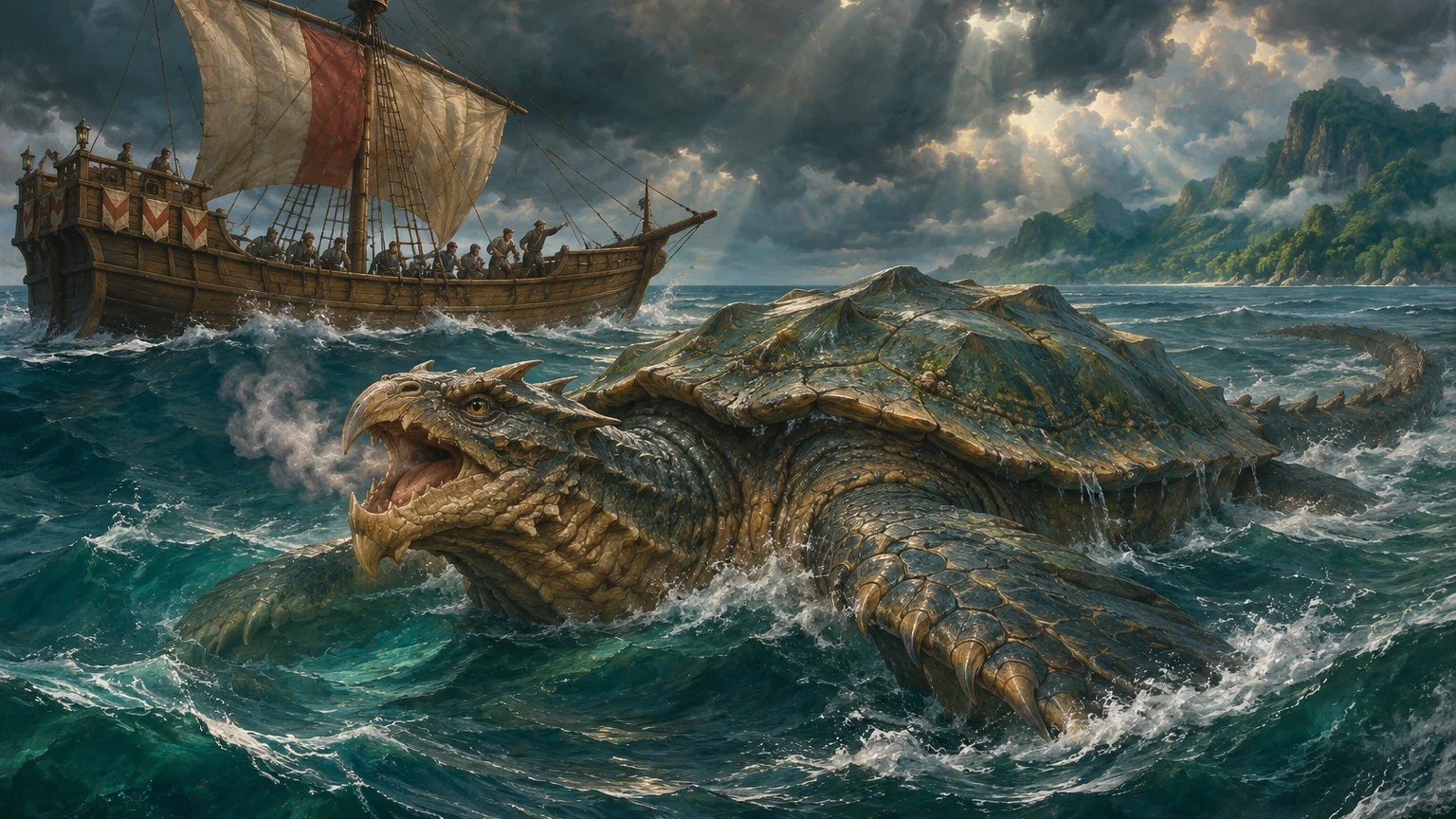
A merchant ship enters a narrow passage. An armoured back breaks the swell beside its hull, and scalding mist drifts from a dragon’s jaws. The dragon turtle neither charges nor retreats. It waits for the captain to pay the toll owed for safe passage.
At a Glance
- Nature
- Intelligent, shell-backed aquatic dragon and powerful sovereign of a stretch of sea
- Size
- Gargantuan in D&D 2024 and 2014; Huge in Pathfinder 1e and D&D 3.5e
- Challenge ratings
- D&D 2024: 17 · D&D 2014: 17 · Pathfinder 1e: 9 · D&D 3.5e: 9
- Build
- An enormous, broad-shelled aquatic dragon; large enough to dwarf a ship’s boat, but not a living island
- Alignment
- Usually Neutral; individual dragons may become fair-minded guardians, ruthless extortionists, or cruel tyrants
- Habitat
- Deep coastal waters, ocean approaches, broad straits, drowned caves and warm offshore currents
- Social structure
- Usually solitary, with a territory maintained by remembered bargains and reprisals
- Chief danger
- Scalding steam, crushing jaws, submerged attacks and the destruction of vessels
- What it wants
- Safe possession of its waters, recognition of its authority, and treasure worth keeping
- Parley
- Speak clearly, keep weapons lowered, and offer something of value before it grows impatient
Game Statistics
Dragon Turtle — D&D 2024
Gargantuan Dragon, Neutral
AC 20 HP 356 (23d20 + 115) Speed 20 ft.; Swim 50 ft. Initiative +6 (16)
| STR | DEX | CON | INT | WIS | CHA |
|---|---|---|---|---|---|
| 25 (+7) | 10 (+0) | 20 (+5) | 10 (+0) | 12 (+1) | 12 (+1) |
Saves Con +11, Wis +7
Resistance Fire
Senses Darkvision 120 ft.; Passive Perception 11
Languages Draconic, Primordial (Aquan)
CR 17 (18,000 XP); PB +6
Traits
Amphibious. Breathes freely in air and in water.
Actions
Multiattack. Makes three Bite attacks, with the option to replace one Bite with a Tail attack.
Bite. Melee attack +13, reach 15 ft.; on a hit, 23 (3d10 + 7) piercing plus 7 (2d6) fire. Water alone does not reduce the fire damage.
Tail. Melee attack +13, reach 15 ft.; on a hit, 18 (2d10 + 7) bludgeoning. A Huge or smaller creature struck becomes Prone.
Steam Breath (Recharge 5–6). Superheated vapour fills a 60-foot cone. Creatures in the cone make a DC 19 Constitution save, taking 56 (16d6) fire damage on a failure, or half on success. Being underwater provides no resistance to this fire damage.
At sea. Use the rules for attacks on objects or vessels to resolve damage to a ship. The ordinary 2024 dragon turtle does not have a separate printed Capsize action or legendary actions.
Dragon Turtle — D&D 2014
Gargantuan dragon, neutral
AC 20 (natural armour) HP 341 (22d20 + 110) Speed 20 ft., swim 40 ft.
| STR | DEX | CON | INT | WIS | CHA |
|---|---|---|---|---|---|
| 25 (+7) | 10 (+0) | 20 (+5) | 10 (+0) | 12 (+1) | 12 (+1) |
Saving Throws Dex +6, Con +11, Wis +7
Damage Resistance fire
Senses darkvision 120 ft.; passive Perception 11
Languages Aquan, Draconic
Challenge 17 (18,000 XP)
Traits
Amphibious. Can breathe in air or underwater.
Actions
Multiattack. Makes one Bite and two Claw attacks; may replace the two Claw attacks with one Tail attack.
Bite. Melee weapon attack +13 to hit, reach 15 ft.; hit 26 (3d12 + 7) piercing.
Claw. Melee weapon attack +13 to hit, reach 10 ft.; hit 16 (2d8 + 7) slashing.
Tail. Melee weapon attack +13 to hit, reach 15 ft.; hit 26 (3d12 + 7) bludgeoning. A creature struck must pass a DC 20 Strength save or be pushed up to 10 feet and knocked Prone.
Steam Breath (Recharge 5–6). A 60-foot cone of steam forces a DC 18 Constitution save; failure deals 52 (15d6) fire damage, success half. Underwater targets do not gain resistance merely for being submerged.
At sea. Resolve attacks against the vessel with the campaign’s ship and object rules; do not import the D&D 3.5e percentage-based capsize ability.
Dragon Turtle — Pathfinder 1e
CR 9; XP 6,400; N Huge dragon (aquatic)
Initiative +4; Senses darkvision 60 ft., low-light vision, scent; Perception +16
Defence
AC 23, touch 8, flat-footed 23 (+15 natural, −2 size)
hp 126 (12d12 + 48)
Fort +12, Ref +8, Will +9
Immune fire, sleep, paralysis
Offence
Speed 20 ft., swim 30 ft.
Melee bite +18 (3d6 + 8), 2 claws +18 (2d6 + 8)
Space 15 ft.; Reach 10 ft.
Special Attacks breath weapon, capsize
Statistics
Str 27, Dex 10, Con 19, Int 12, Wis 13, Cha 12
Base Atk +12; CMB +22; CMD 32 (36 vs. trip)
Feats Awesome Blow, Blind-Fight, Cleave, Improved Bull Rush, Improved Initiative, Power Attack
Skills Diplomacy +16, Intimidate +16, Perception +16, Sense Motive +16, Stealth +7 (+15 in water), Survival +16, Swim +31
Languages Aquan, Common, Draconic
Special Abilities
Breath Weapon (Su). Once every 1d4 rounds, blasts a cloud of steam 50 feet long, 25 feet wide and 20 feet high, dealing 12d6 fire damage (Reflex DC 20 half). Effective at the surface and underwater.
Capsize (Ex). During a charge, the dragon turtle may ram a vessel and attempt a combat manoeuvre check against DC 25 or the captain’s Profession (sailor) result, whichever is greater. Apply a cumulative −10 penalty to the dragon turtle’s CMB for every size category by which the vessel exceeds the turtle.
Ecology
Environment temperate aquatic; Organisation solitary; Treasure double
Dragon Turtle — D&D 3.5e
Huge dragon (aquatic); CR 9; usually neutral
| Hit Dice | 12d12 + 60 (138 hp) |
|---|---|
| Initiative | +0 |
| Speed | 20 ft.; swim 30 ft. |
| Armor Class | 25 (−2 size, +17 natural), touch 8, flat-footed 25 |
| Base Attack/Grapple | +12/+28 |
| Attack | Bite +18 melee (4d6 + 8) |
| Full Attack | Bite +18 melee (4d6 + 8) and two claws +13 melee (2d8 + 4) |
| Space/Reach | 15 ft./10 ft. |
| Special Attacks | Breath weapon, capsize |
| Special Qualities | Darkvision 60 ft., low-light vision, scent; immunity to fire, sleep and paralysis |
| Saves | Fort +13, Ref +8, Will +9 |
| Abilities | Str 27, Dex 10, Con 21, Int 12, Wis 13, Cha 12 |
| Skills | Diplomacy +3, Hide +7 (additional +8 submerged), Intimidate +16, Listen +16, Search +16, Sense Motive +16, Spot +16, Survival +16 (+18 tracking), Swim +21 |
| Feats | Blind-Fight, Cleave, Improved Bull Rush, Power Attack, Snatch |
| Environment | Temperate aquatic |
| Organisation | Solitary |
| Treasure | Triple standard |
| Languages | Aquan, Draconic, Common |
| Advancement | 13–24 HD (Huge); 25–36 HD (Gargantuan) |
Combat
Breath Weapon (Su). A superheated cloud 50 feet long, 25 feet wide and 20 feet high, usable once every 1d4 rounds; 12d6 fire damage, Reflex DC 21 half. The steam works underwater.
Capsize (Ex). When submerged beneath a vessel, the dragon turtle can rise against its hull. A vessel shorter than 20 feet overturns on a 95% chance; a vessel 20–60 feet long on 50%; and one over 60 feet on 20%. This is the D&D 3.5e rule, not a general property of all editions.
Swimming. +8 racial bonus to relevant Swim checks, can take 10 even under threat, and can use the run action while swimming in a straight line. It gains +8 racial bonus on Hide checks while submerged.
What Is Happening Right Now?
Three merchant captains have begun paying their tolls with clipped coins rather than full weight. The dragon turtle has noticed. It has not yet attacked their ships: instead, it has dragged an abandoned anchor into the harbour mouth and left it standing upright on the seabed, chain hanging like a warning. The next vessel to cheat it will be stopped. The honest captains now want the false weights exposed before the sea closes against everyone.
The Sovereign Beneath the Keel
A dragon turtle is not a mindless sea monster that attacks every sail on the horizon. It is an old, watchful dragon whose wealth arrives on the tide. A fishing boat might cross its hunting ground unchallenged for years, while a treasure-laden vessel that refuses the customary toll may find the sea beneath its keel abruptly alive. The turtle learns the flags, routes and habits of local captains. It knows which crews keep their word and which throw stones at the reef and call themselves brave.
Its shell resembles a submerged reef when seen from above: steep plates of slate green or tarnished bronze, pale barnacles along the seams, and ridges that briefly catch the sun before sinking again. The head has the hooked jaws and old, measuring gaze of a dragon; broad limbs and a muscular tail propel it through breakers and strong currents. The largest individuals dwarf a ship’s boat, although an ordinary dragon turtle is not an island-sized creature. Sailors who claim to have landed on the back of a living island may have met an aspidochelone instead.
Appearance and Natural History
Young dragon turtles spend years hunting fish around steep reefs and coastal shelves, learning the sounds of oars and the tremor of hulls. Adults claim deeper approaches, submerged caverns and passages between islands. They eat fish, great squid, sharks and whatever large prey the season offers; seaweed and other vegetation sometimes supplement their diet. Few squander a dependable food supply by sinking every ship in sight.
Most lairs open beneath a rocky overhang or into a drowned volcanic chamber. The entrance must admit the dragon and remain defensible against other great sea beasts. Inside lie ballast stones, ornate anchors, carved figureheads, ceramic cargo, old coins, gems and sometimes the intact stern of a wreck brought there as a trophy. A dragon turtle values recognition as much as gold: the bell of a defeated warship or a treaty scratched into copper may matter more to it than an uncounted chest of silver.
Temperament, Law and Bargains
Neutral dragon turtles judge deeds chiefly by their effect on territory, prosperity and pride. Some follow a strict law: one toll per vessel, an oath of safe passage, and death for breaking either side’s bargain. Others change the price whenever hunger or greed suits them. An evil turtle may drown a town for defying it; a good-hearted one may defend its fishing fleets against pirates yet demand a ceremony of thanks at the turning of each season. Alignment is a guide to conduct, not a command that every individual behave alike.
Whether lawful, neutral or chaotic, a turtle judges interference with its holdings according to its own values. Good and evil describe what the creature is willing to inflict on others, not whether it charges a toll. A demand for treasure is not always a prelude to battle. Couriers can bargain for a season’s protection, mariners may ransom survivors from a wreck, and the turtle may ask adventurers to retrieve a stolen relic rather than pay coin. Threats delivered from a fragile deck are rarely persuasive. A promise given before witnesses, especially one remembered by the turtle for decades, can be more valuable than a rich but dishonest offering.
Sea Neighbours and Rivalries
Dragon turtles compete with coral drakes for reef caves, but a great turtle generally leaves the smaller dragon alone if its brood and food supply remain undisturbed. Sea drakes range more freely through storm waters; their raids can provoke a turtle into defending a valuable sea lane. Sea serpents and deep sea serpents are hunters rather than tribute collectors. A serpent’s arrival may drive frightened prey into the turtle’s waters, or force two great predators into a brief, violent contest.
Merfolk and other sea peoples remember the bounds of each turtle’s claim. Some negotiate openly; others resent the tolls and recruit adventurers to break them. Sahuagin warbands may raid a dragon turtle’s stores, bargain for the right to pass, or attempt to lure it against a rival undersea settlement. Siyokoy search wrecks for curiosities, often risking the turtle’s anger by taking objects it regards as its own. Such relationships are local political arrangements, not proof that the dragon commands all aquatic creatures.
Where Dragon Turtles Are Encountered
Along the South Asian maritime trade routes, in island channels and in the Coral Sea, sailors speak of long-established toll passages marked by isolated rocks and old wrecks. Merchant convoys, local pilots and coastal rulers may all pay different prices for the same passage; the treaty accepted by one captain need not bind the next. A dragon turtle may also rule a temperate strait or a wide freshwater basin if food and refuge permit. It belongs to the living seas of Midgard; an individual drawn into the Elemental Plane of Water is a traveller, invader or captive of that world, not automatically a native elemental.
Hoard, Salvage and Spoils
The creature’s wealth consists as much of obligations as objects. An heirloom bell marks the surrender of a royal ship; a copper plate records thirty years of safe passage; a chest of pearls was paid to spare a fishing settlement. Adventurers who recover a relic from its grotto may inherit the quarrel attached to it. A dragon turtle’s shell is not a conveniently renewable armour mine, and extracting it means killing or maiming a creature intelligent enough to remember a bargain.
A wreck may still contain trapped air, fresh survivors, a sealed message, or competing claimants. When a ship goes down in turtle-held waters, it does not follow that its original owners have abandoned the cargo. Treasure recovery can lead to diplomatic judgement, salvage law, a stealth expedition or open war with a power that can close a strait without owning a single ship.
Encounters at Sea
The Toll of Pearl Sound. A coastal town has paid the same dragon turtle for a century. This year’s payment was stolen by a rival captain, and the guardian now threatens to close the channel. The thieves have the treasure, but the town has the written promise proving what is owed.
Two Flags on One Wreck. A vessel lost with rival royal envoys aboard has been added to the turtle’s hoard. Both courts demand its dispatch chest. The turtle will return it only if someone establishes who ordered the crew to sail into forbidden water.
The Unhatched Bargain. A coral drake has hidden its brood in the entrance of a turtle’s winter lair. The turtle has decided that the drake’s reef now belongs to it. Evacuating the brood peacefully may prevent a fight that would shatter the whole reef.
The Wrong Monster. Survivors swear that a living island swallowed their companions. Their stories attract hunters seeking a dragon turtle’s hoard, but the evidence points toward an aspidochelone. A reckless assault on the local turtle would start a second, entirely avoidable disaster.
Running the Dragon Turtle
Let the creature show intelligence before violence. A looming shell under a boat, a steaming patch of water, or a returned tribute chest with one missing coin can establish its presence without a fight. In battle it uses its breath against clustered foes, strikes from the water, and breaks contact when an attack would cost more than the prize. When angered, it approaches from beneath the stern to deny the captain an easy turn. On a ship, the danger is broader than hit-point loss: torn rigging, lost steerage, boats swamped by the wake, and an exhausted crew exposed to the sea.
A ship’s vulnerability depends on its hull, size, and captain’s decisions. Ask for the route and the price of passage before initiative is rolled; a wrecked ship and a drowned crew are consequences even when the dragon itself survives the fight.
Related Creatures and Deeper Reading
The Dragon Bestiary places dragon turtles among the sea’s draconic powers. A dragon whale and the cetus threaten sailors on a very different scale, while the dragon eel competes for submerged hunting passages. At the coast, reefclaws can make the shallow escape route deadlier than the turtle’s deep water.
To run an ocean passage, draw on the Vehicles collection for the crew’s vessels and South Asia for the political and commercial stakes of Indian Ocean trade. The Elemental Plane of Water offers an exceptional planar detour rather than the creature’s usual home.
Rules Sources and Attribution
This work includes material from the System Reference Document 5.2.1 (“SRD 5.2.1”) by Wizards of the Coast LLC, available at https://www.dndbeyond.com/srd. The SRD 5.2.1 is licensed under the Creative Commons Attribution 4.0 International License. Game statistics have been reformatted and explanatory prose adapted.
This work includes material taken from the System Reference Document 5.1 (“SRD 5.1”) by Wizards of the Coast LLC and available at https://dnd.wizards.com/resources/systems-reference-document. The SRD 5.1 is licensed under the Creative Commons Attribution 4.0 International License. Game statistics have been reformatted and explanatory prose adapted.
Additional edition references: Pathfinder 1e dragon turtle and D&D 3.5e dragon turtle. Preserve the site’s applicable Open Game License and Section 15 notices when publishing OGL-derived mechanics.
Keep this reference growing
If this page helped with your reading or game, you can support its upkeep or explore the curated books.
Explore the Bookshop — epics, classics and stories behind imagined worlds.