
Crom Cruach, The Hidden One, The Bloody God
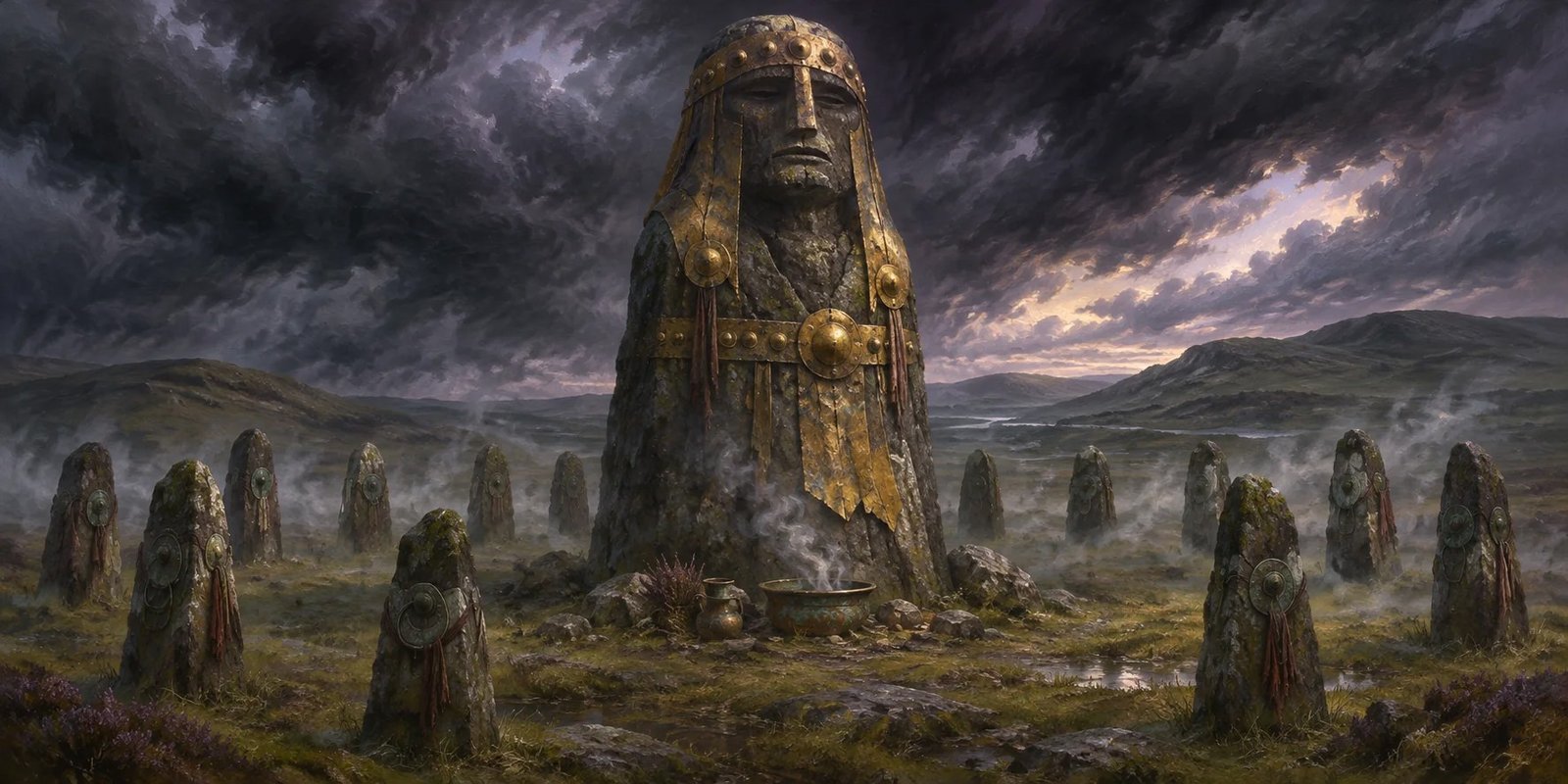
At Mag Slecht, the ancient gilded idol stands among twelve lesser stones. The fields are abundant and the cattle give milk through bitter weather, yet families vanish when the priests demand their due. Crom Cruach promises prosperity to those who obey. Those who break the bargain hear grinding stone beneath the hill.
At a Glance
- Pantheon: Celtic pantheon
- Deity Title: Crom Cruach, The Hidden One, The Bloody God
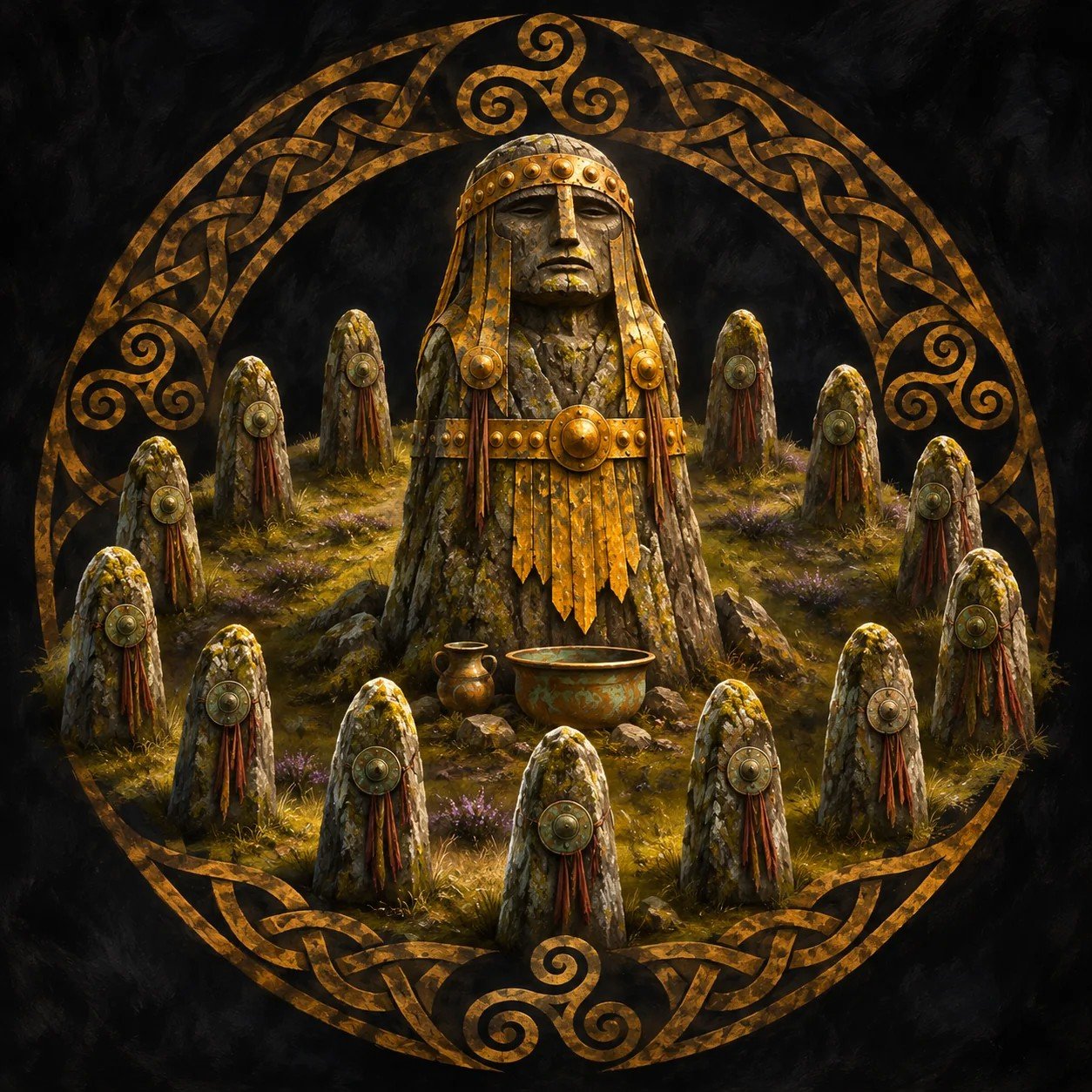
- Divine sign: A gilded central standing stone surrounded by twelve lesser stones; an emblem used by his present cult, not an independently attested ancient symbol.
- Home Plane: The Otherworld, specifically the realm of the dead
- Deity Level: Intermediate
- Alignment: Chaotic Evil
- Names and related traditions: Cenn Cruaich and Crom Cróich are recorded name forms; Crom Dubh is sometimes connected in later folklore, but the identification is uncertain. The Morrígan is a distinct goddess.
- Superior: None
- Traditional Allies: Other Chaotic Evil deities or monstrous races
- Traditional Foes: Other deities of the Celtic pantheon, lawful or good-aligned deities
- Divine Artifact: Unknown, possibly a sacred stone or artifact related to blood sacrifice
- Servants: Druids, witches, or other spellcasters who follow his teachings
- Servitor Creatures: Giant serpents, Giant worms, monstrous insects, or undead creatures
- Sacred Animal: Serpent or snake
- Manifestations: Storms, thunder, blood or gore, serpents or snakes, death and decay
- Signs of Favor: Unnatural storms, plagues, mysterious disappearances, and sudden deaths
- Worshipers: Barbarians, warlocks, and other chaotic evil or monstrous humanoids
- Cleric Alignments : Chaotic Evil
- Specialty Priests: Druids or witches who specialize in blood magic and animal sacrifice
- Holy Days: Samhain (Celtic festival of the dead), Beltane (festival of fertility and new life), and Lughnasadh (festival of the harvest)
- Portfolio: Fertility, death, war, and blood sacrifice
- Domains: Death, Destruction, War
- Favored Weapon: Greatsword or scythe
- Favored Class: Barbarian
- Favored Race: Fomorians, and other monstrous humanoids
- Duties of the Priesthood: To perform blood sacrifices and other rituals to appease Crom Cruach, to spread fear and chaos throughout the land, to serve as advisors to barbarian warlords and other chaotic leaders
- Principal sacred site: Mag Slecht in Ireland, where medieval place-lore remembers Crom Cruach’s central idol and twelve surrounding images. Hidden modern cults gather at ruined or imitated circles.
- Benefits: Clerics and followers of Crom Cruach gain the ability to channel negative energy and summon undead creatures. They are also able to perform blood sacrifices to gain power or favor from their deity.
Crom Cruach is remembered in medieval Irish place-lore as the powerful idol of Mag Slecht. Stories describe a gold-clad central image surrounded by twelve lesser figures, and offerings made in hope of milk, grain and prosperity. The horrifying accounts of human sacrifice survive in medieval narratives; their details are not independent archaeological proof of ancient rites. His original divine appearance is not securely recorded. In the present world, the power behind the old idol demands tribute again, and those who seek his favour discover how dearly abundance can be bought.
Crom Cruach’s present-day cult bargains over survival. His priests promise fertile fields and healthy cattle, then demand hostages, tribute and blood in return. Some followers present these demands as sacred necessity; others use the fear of the old idol to establish ruthless control. Crom Cruach rewards obedience and turns on those who break an oath, making his gifts dangerous even when the harvest truly improves.
At Mag Slecht, the surviving legend places a great gilded image among twelve lesser stones. Those who gather there in 1454 are not united in purpose: hungry farmers seek relief, frightened families seek to recover missing kin, and cult-keepers demand that no one question the price of the god’s favour. The old accusations of sacrifice hang over every bargain, but the adventurers must establish what is happening now.
Crom Cruach can take a vast, many-headed serpentine form when he enters battle, coils around a sacrificial court or pursues those who have broken sworn tribute. This Worm King guise belongs to the present supernatural world and is not an ancient historical depiction: the surviving written tradition describes an idol and its cult landscape rather than the deity’s living body.
Despite the horrific nature of his worship, Crom Cruach was seen as a powerful and influential deity, with many believing that he held sway over the land and its fertility. While his reign of terror eventually came to an end his legacy lives on in the stories and legends that have been passed down through the generations.
Crom Cruach, The Worm King

Huge fiend (divine manifestation), chaotic evil
Armor Class: 30 (natural armor)
Hit Points: 625 (50d12 + 300)
Speed: 50 ft., climb 50 ft.
| STR | DEX | CON | INT | WIS | CHA |
|---|---|---|---|---|---|
| 30 (+10) | 16 (+3) | 22 (+6) | 24 (+7) | 22 (+6) | 30 (+10) |
Saving Throws: Con +16, Int +17, Wis +16, Cha +20
Skills: Insight +16, Intimidation +20, Perception +16
Damage Resistances: cold, fire, lightning; bludgeoning, piercing, and slashing from nonmagical attacks
Damage Immunities: poison
Condition Immunities: poisoned
Senses: truesight 120 ft., passive Perception 26
Languages: all, telepathy 120 ft.
Challenge Rating: 32 (epic encounter challenge; no standard 2014 XP award)
Legendary Resistance (5/Day): If Crom Cruach fails a saving throw, he can choose to succeed instead.
Magic Resistance: Crom Cruach has advantage on saving throws against spells and other magical effects.
Multi-Headed: Crom Cruach has 5 heads. While he has more than one head, he has advantage on saving throws against being blinded, charmed, deafened, frightened, stunned, and knocked unconscious.
Innate Spellcasting: Crom Cruach’s spellcasting ability is Charisma (spell save DC 28). He can innately cast the following spells, requiring no material components:
- At will: detect magic, detect thoughts, dispel magic, dominate monster, flame strike, invisibility, plane shift, suggestion
- 3/day each: chain lightning, earthquake, fire storm, meteor swarm, power word stun, wall of fire
- 1/day each: armageddon, divine word, power word kill, time stop
Regeneration: Crom Cruach regains 50 hit points at the start of his turn if he has at least one head.
Actions:
Multiattack: Crom Cruach can use his Frightful Presence. He then makes 5 bite attacks.
- Bite: Melee Weapon Attack: +22 to hit, reach 15 ft., one target. Hit: 49 (6d12 + 10) piercing damage.
- Frightful Presence: Each creature of Crom Cruach’s choice within 120 feet of him and aware of him must succeed on a DC 28 Wisdom saving throw or become frightened for 1 minute. A creature can repeat the saving throw at the end of each of its turns, ending the effect on itself on a success. If a creature’s saving throw is successful or the effect ends for it, the creature is immune to Crom Cruach’s Frightful Presence for the next 24 hours.
- Tail: Melee Weapon Attack: +22 to hit, reach 25 ft., one target. Hit: 43 (6d10 + 10) bludgeoning damage.
Legendary Actions:
Crom Cruach can take 3 legendary actions, choosing from the options below. Only one legendary action option can be used at a time and only at the end of another creature’s turn. Crom Cruach regains spent legendary actions at the start of his turn.
- Bite: Crom Cruach makes one bite attack.
- Tail Attack: Crom Cruach makes one tail attack.
- Cataclysmic Roar (Costs 2 Actions): Each creature within 120 feet of Crom Cruach must make a DC 28 Constitution saving throw, taking 55 (10d10) thunder damage on a failed save, or half as much damage on a successful one. Additionally, any creature that fails its saving throw is stunned until the end of its next turn.
Lair Actions:
On initiative count 20 (losing initiative ties), Crom Cruach takes a lair action to cause one of the following effects:
- Cataclysmic Earthquake: Crom Cruach causes a massive earthquake within a 1-mile radius centered on himself. All creatures in the area must make a DC 28 Dexterity saving throw, taking 55 (10d10) bludgeoning damage and being knocked prone on a failed save, or half as much damage and not being knocked prone on a successful one.
- Summon Demons: Crom Cruach summons 2d6 fiends (CR 10 or lower), which appear in unoccupied spaces within 60 feet of him. These demons are under Crom Cruach’s control and act immediately after him in the initiative order.
Regional Effects:
The region containing Crom Cruach’s lair is warped by his magic, which creates one or more of the following effects:
- Blackened Skies: The sky above the region is always dark and cloudy, and heavy rain and thunderstorms are frequent.
- Corrupted Ground: The ground within 1 mile of Crom Cruach’s lair is twisted and corrupted by demonic magic, causing it to become difficult terrain. Additionally, any creature that starts its turn within the area must make a DC 28 Wisdom saving throw or become frightened of Crom Cruach for 1 minute.
- Demonic Frenzy: Fiends within 1 mile of Crom Cruach have advantage on attack rolls, saving throws, and ability checks.
Crom Cruach in 1454
In 1454 the old idol at Mag Slecht answers prayers again. A hungry district has found an extraordinary abundance of milk and grain, but its priest-keepers demand a terrible tithe before they will share it. Some families secretly shelter those named for tribute. Others fear that refusing the bargain will starve everyone when winter comes. Crom Cruach’s return is not an indiscriminate rampage: he builds power through dependence, fear and oaths that rulers are willing to enforce.
The Thirteenth Stone. A new standing stone appears at Mag Slecht, beyond the twelve stones that surround the old gilded idol. Each dawn its surface shows the name of a villager marked to vanish at sunset. The characters can expose a mortal hand behind the selection, break the new stone’s spell or negotiate with the god’s priesthood before the final name appears.
Milk of the Black Cattle. A settlement’s animals give rich milk even in a failing season. The cattle refuse to cross the boundary of a nearby abandoned field, where a stone altar has been covered with fresh offerings. The adventurers must decide whether to destroy the source of the unnatural abundance, protect the villagers from a cult that claims ownership of the herd, or find another way to feed the district.
The Gold That Will Not Melt. A goldsmith is ordered to fashion a fresh mask for the idol, but none of the metal will melt. Its owner offers a fortune to recover the missing ritual fire from a ruined hill shrine. The party can investigate the fire’s guardian, uncover who benefits from the commission and choose whether allowing the mask to be completed is worth the promised reward.
Crom Cruach demands submission more than conquest. His shrine prospers when mortals convince themselves that the only way to protect their neighbours is to surrender someone else. The god’s priests reward loyalty, punish broken tribute-oaths and deliberately make ordinary survival depend upon their favour. The characters can oppose the cult by breaking this dependence, saving those condemned by its bargains and confronting the Worm King if he manifests.
Myth and Sources
Medieval Irish place-lore remembers Crom Cruach at Mag Slecht as a great gilded idol surrounded by twelve smaller images. Its accounts of offerings and human sacrifice belong to surviving medieval narratives and should not be mistaken for direct archaeological proof of every detail. The bargaining priests, renewed cult, Worm King manifestation, and battles presented here are part of the living campaign world.
Further reading: Alexandra Bergholm, “The Idols of the Pagan Irish in the Medieval Literary Imagination”, in Myth and History in Celtic and Scandinavian Traditions. The painted idol and its cult emblem on this page are original interpretations for the campaign, not surviving historical depictions.
Keep this reference growing
If this page helped with your reading or game, you can support its upkeep or explore the curated books.
Explore the Bookshop — epics, classics and stories behind imagined worlds.