
Ereshkigal — Queen of Irkalla & Lady of the Great Earth
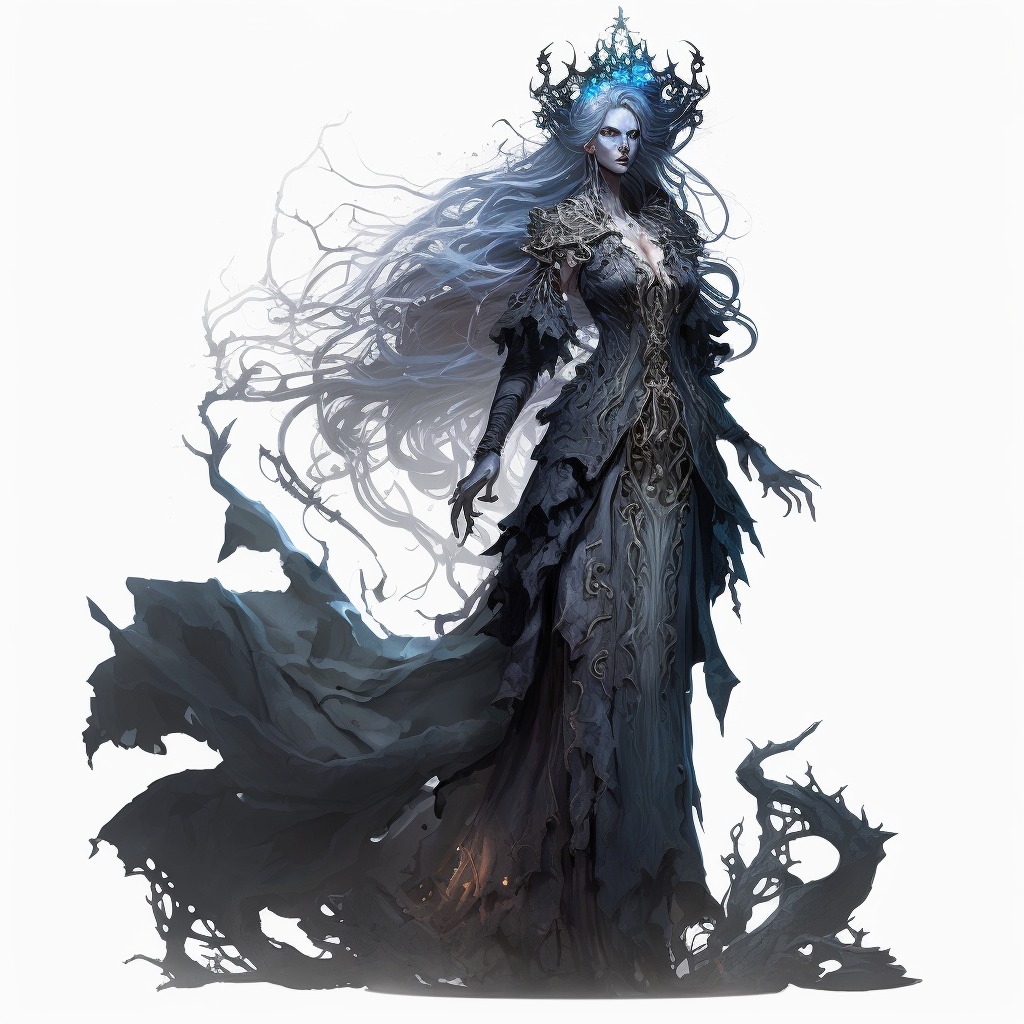
Ereshkigal is the Lady of the Great Earth and sovereign of the Mesopotamian underworld. She is not a demon queen, nor an imported embodiment of evil. She is the ruler of a necessary kingdom whose laws bind gods and mortals alike once they cross the gates of the Great Below.
At a Glance
Mesopotamian
Greater Deity
Lawful Neutral
Lady of the Great Earth; Queen of the Great Below; Sovereign of Irkalla
Underworld sovereignty, death, funerary law, boundaries, judgement, irreversible passage and the authority of the dead
Irkalla — the Great Below
Game Mechanics
The following statistics are campaign adaptations for direct divine manifestations, not official rules material.
5.5e / 2024 — Direct Divine Manifestation
Large Celestial (Greater Deity), Lawful Neutral. AC 30; HP 940; Speed 40 ft.; CR 37; PB +11. STR 28, DEX 24, CON 36, INT 34, WIS 40, CHA 38. Saving Throws Con +24, Int +23, Wis +26, Cha +25. Damage Resistances cold, force, psychic; Damage Immunities necrotic, poison, radiant. Condition Immunities charmed, exhaustion, frightened, paralyzed, poisoned, stunned. Truesight 240 ft.; tremorsense 120 ft.; telepathy 1 mile.
Greater Divine Nature. Ereshkigal requires no food, drink, air or sleep. Legendary Resistance (5/Day). Magic Resistance.
Sovereign of Irkalla. Undead within 120 feet cannot act against Ereshkigal unless protected by equal or greater divine power. Teleportation and planar travel within 120 feet fail unless she permits them.
Law of the Seven Gates. When a hostile creature enters within 120 feet of Ereshkigal for the first time in an encounter, she chooses one benefit or defence it possesses—flight, invisibility, one resistance, one active spell effect, one magic item bonus or one class feature granting temporary immunity. That benefit is suppressed until the creature leaves her presence or succeeds on a DC 31 Charisma save at the end of its turn.
No One Leaves Uncounted. Ereshkigal always knows the number and identity of living, dead and undead creatures within 1 mile of her while in an underworld, tomb complex or funerary precinct.
Actions — Sceptre of the Great Earth. +21 to hit, reach 15 ft.; 4d10+9 bludgeoning plus 6d8 necrotic. Sentence of the Dead (Recharge 5–6). One creature within 120 feet makes DC 31 Wisdom save; on failure it takes 72 necrotic damage, cannot regain hit points until the end of its next turn and is Restrained by spectral hands. Close the Gate (Recharge 5–6). One portal, teleportation effect or extradimensional opening within 240 feet is suppressed for 1 minute. Queen’s Recall (1/Day). Up to six dead or undead creatures within 300 feet are transported to empty spaces before Ereshkigal; unwilling creatures make DC 31 Charisma saves to resist.
Legendary Actions (5/round). Grave Step; Sceptre Strike; Name the Dead (1), learning one creature’s true condition, remaining hit points and whether it has died before; Strip the Gate (2), suppressing one additional defence under Law of the Seven Gates; Namtar’s Message (3), forcing one creature to make DC 31 Constitution save or become Incapacitated until end of its next turn.
Lair Actions in Irkalla. On initiative count 20 Ereshkigal may close all unattended doors and portals; extinguish non-divine light in a 120-foot area; summon underworld dust that turns the area into difficult terrain; or force one creature that broke a funerary oath to save against Frightened until the next round.
Cleric themes. Grave, Death and Order fit different parts of Ereshkigal’s role. A campaign Underworld Domain might use false life, sanctuary; gentle repose, silence; speak with dead, bestow curse; death ward, divination; geas, raise dead.
Pathfinder 1e — Campaign Adaptation
CR 37 / MR 10; Large outsider (divine, lawful). AC 59; hp 900; Fort +37, Ref +30, Will +44; DR 20/epic; SR 48. Sovereign of Irkalla (Su): suppress teleportation and control undead in 120 ft. Seven Gates (Su): suppress one extraordinary, supernatural or magical defence from each intruder on a failed Will save. Queen’s Recall (Su): 1/day call dead or undead creatures to her court. Domains: Death, Law, Repose, Protection, Darkness.
D&D 3.5e — Campaign Adaptation
Greater Deity; Divine Rank 16; Outsider 20 / Cleric 30; Lawful Neutral; suggested CR 52. DR 30/epic; SR 68. Salient divine abilities: Alter Reality, Avatar, Divine Shield, Divine Spellcasting, Life and Death, Rejuvenation, Know Secrets and portfolio abilities governing underworld passage and the dead. Domains: Death, Law, Repose, Protection, Darkness.
What Is Ereshkigal Doing Right Now?
Ereshkigal is closing breaches. Tomb robbers, careless necromancy, damaged funerary rites and planar magic have created routes through which the dead escape without judgement and the living enter without permission. Her servants are mapping every breach and deciding which must be sealed, guarded or deliberately left open as a trap.
She is also renegotiating authority with Nergal. Their later marriage tradition places two powerful death gods in the same realm, but Ereshkigal does not treat shared kingship as surrender. Irkalla was hers before Nergal entered it, and every gate remembers that fact.
Appearance & Manner
Ereshkigal appears as a horn-crowned queen in dark layered robes, seated beneath a canopy of black stone and bronze. She is pale only in the sense of someone untouched by the sun, not corpse-like. No Egyptian ankh belongs to her imagery. Her symbols are gates, dust, throne, underworld court and the authority that strips status from every visitor.
Lady of the Great Earth
Ereshkigal’s name means “Lady of the Great Earth,” and her defining identity is sovereignty over the underworld. Surviving tradition gives her a complex relationship with death: she is queen of the dead but can also carry maternal and birth associations. That complexity is more useful than reducing her to a simple personification of mortality.
The underworld she rules is governed. In the Descent of Inanna/Ishtar, divine status is stripped away gate by gate before the visitor may enter the deepest court. The story establishes one of Ereshkigal’s strongest campaign principles: rank outside the underworld does not exempt anyone from underworld law.
Divine Relationships
Inanna/Ishtar. Her sister and the divine visitor whose descent into the Great Below dramatizes the absolute authority of Ereshkigal’s gates.
Namtar. Ereshkigal’s minister and, in one tradition, her son by Enlil. Namtar carries commands, disease and the authority of her court beyond the throne room.
Ninazu. Her son by Gugal-ana in an important tradition, tying her household to underworld stewardship and serpent imagery.
Nergal. A later consort whose inflicted death, plague and warfare complement but do not replace Ereshkigal’s older sovereignty over the Great Below.
Worship, Burial & Underworld Law
Ereshkigal is approached cautiously by funerary specialists, mourners, grave keepers, judges of inheritance and those seeking to prevent the dead from becoming dangerous. Her rites focus less on winning affection than on observing correct boundaries: proper burial, proper names, proper offerings and proper passage.
Necromancers who treat the dead as tools are not automatically her allies. A practitioner who tears a soul from its lawful place without permission may be more offensive to Ereshkigal than a living hero who respectfully enters the underworld on a necessary mission.
Omens, Favour & Displeasure
Favour appears as a grave remaining undisturbed in a flood, a dead relative appearing in a calm dream, a sealed tomb refusing thieves or a funerary offering vanishing without decay. Ereshkigal dislikes grave robbery, oath-breaking concerning the dead, uncontrolled resurrection, theft of burial goods and anyone claiming exemption from the laws of death because of rank.
Encounters & Adventure Use
The Eighth Gate
A new gate appears below an ancient tomb, and even Ereshkigal’s servants insist it was never part of Irkalla.
Namtar’s List
A tablet names living people as already admitted to the underworld. One name belongs to a player character.
The Queen’s Missing Dead
Hundreds of souls have vanished between burial and judgement, and Ereshkigal wants the theft investigated without alerting Nergal.
Divine Realm — Irkalla
Irkalla is a vast underworld of gates, courts, dust-dark roads and cities of the dead. The seven gates leading toward Ereshkigal’s deepest court do not exist merely for defence. They remove the privileges visitors rely upon until nothing remains except identity, oath and consequence.
Relics & Sacred Objects
The Seal of the Seventh Gate. It allows one lawful passage into or out of an underworld threshold but records the bearer’s name permanently.
The Dust Crown. A severe underworld relic that suppresses magical disguises and noble titles within its presence.
Namtar’s Tablet. It can name one creature whose death is being unlawfully prevented, but it cannot itself kill the named creature.
Historical & Mythological Context
Ereshkigal is the Mesopotamian goddess who rules the underworld. ORACC identifies her as the “Lady of the Great Earth,” sister of Ishtar and later consort of Nergal, while also preserving traditions involving Namtar and Ninazu. Her associations are more complex than simple evil or death imagery, and this page therefore presents her primarily as an underworld sovereign.
The direct divine statistics, detailed Irkalla, relics and current activity are campaign adaptations.
Sources & Licensing
Historical foundation: ORACC — Ereškigal. Game mechanics and campaign material are original adaptation. See also the Mesopotamian Pantheon.
Keep this reference growing
If this page helped with your reading or game, you can support its upkeep or explore the curated books.
Explore the Bookshop — epics, classics and stories behind imagined worlds.