
Folding Boat – Magic Item
Magic Item
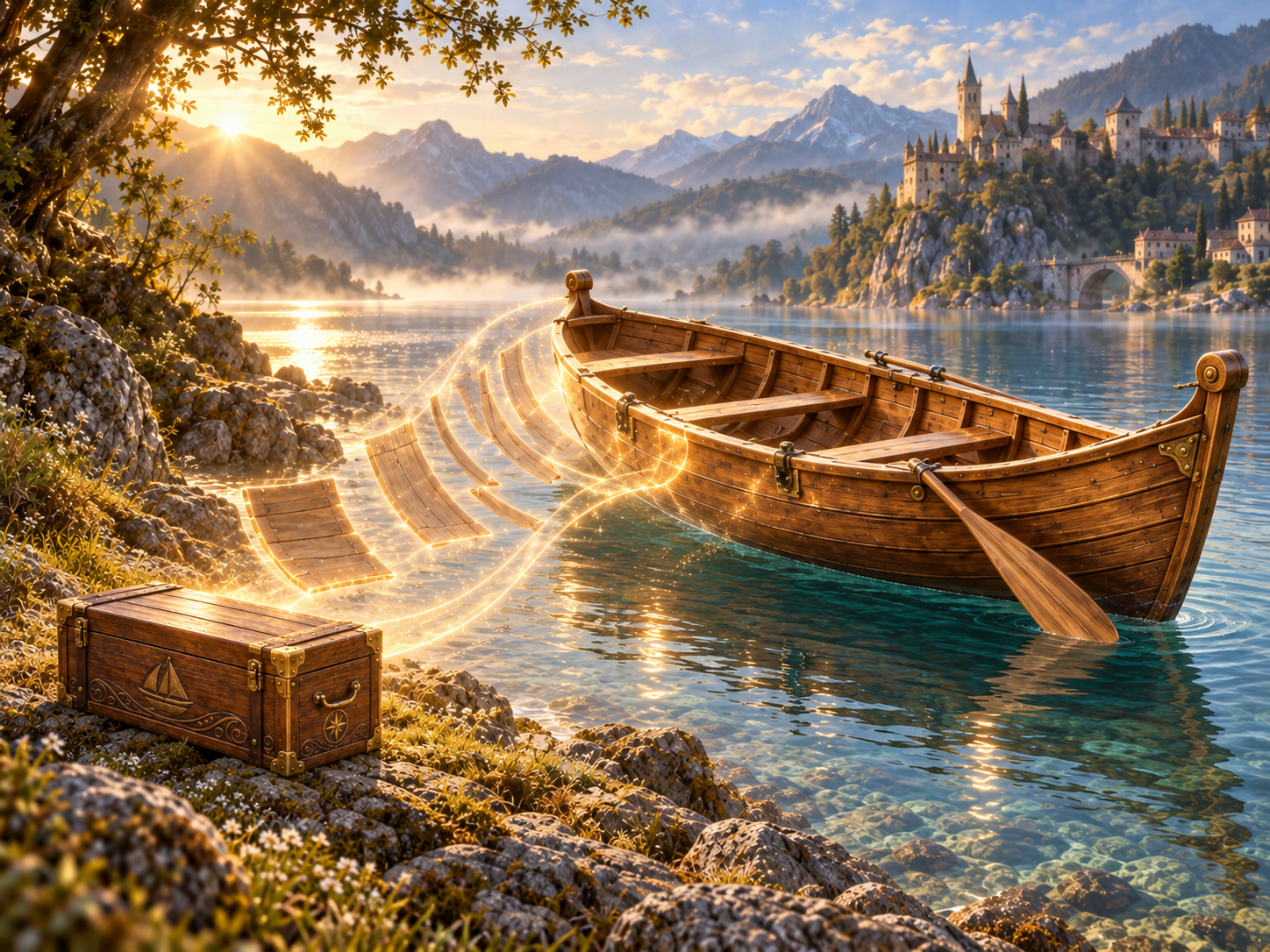
A small wooden box that unfolds into a working vessel, turning rivers, lakes, flooded ruins and hostile coastlines into usable routes.
A folding boat appears to be a small wooden box. It can be used as an ordinary container, but its true value lies in its command words. When activated, the object unfolds into a functioning vessel and later returns to its compact form.
This is a practical magic item with major consequences. A folding boat can turn a blocked road into a river route, a flooded ruin into a navigable passage, a guarded harbour into an infiltration point, or a desperate shoreline into an escape.
Its magic is not spectacular. Its value is that it places a vessel where no vessel should be. That makes it useful to explorers, spies, smugglers, riverfolk, coastal raiders, pilgrims, treasure hunters and anyone who cannot rely on bridges, ferries or friendly ports.
Physical Description
In its folded form, a folding boat looks like a finely made wooden box. It is usually reinforced with brass, bronze, iron or darkened ship-nails. Some examples are plain and workmanlike; others are carved with waves, dolphins, river reeds, sea serpents, harbour towers, anchors or the maker’s shipwright mark.
The box is light enough to carry, but it feels denser and more carefully balanced than an ordinary chest. Its grain may seem too regular for natural timber. When opened, it may smell faintly of pitch, salt, rope, wet reeds, river mud or sun-warmed sailcloth.
When the boat unfolds, it does not appear as a ghostly conjuration. It opens like an impossible piece of shipwright’s work. Panels slide, ribs lock, planks lengthen, rope coils tighten, sailcloth spills free and hidden fittings snap into place with the sound of wood remembering its true shape.
Why This Item Matters
A folding boat gives adventurers control over access, not control over the sea itself. That distinction matters.
The item does not cancel rivers, storms, reefs, patrols, monsters, currents, tides, harbour chains or poor judgement. What it does is give the party a choice where none existed before. They can carry a boat through wilderness, hide it among their equipment, smuggle it through a gate, unfold it inside a cavern, or cross water without bargaining with ferrymen or exposing themselves at a public dock.
That makes the folding boat useful because it creates decisions. Do the characters risk unfolding it in sight of guards? Do they overload the vessel with treasure? Do they trust it in rough water? Do they keep the command words secret? Do they sell it, guard it, or build plans around it?
Folding Boat Rules
Folding Boat — 5.5e / 2024
Wondrous Item, Rare
Weight: 4 lb.
Activation: Three command words; each requires a Magic action.
The inactive item is a wooden box measuring about 12 inches long, 6 inches wide and 6 inches deep. It weighs 4 pounds, floats and can be opened to store objects.
First Command Word. The box transforms into a Rowboat.
Second Command Word. The box transforms into a Keelboat.
Third Command Word. If no creatures are aboard, the vessel returns to box form. Objects small enough to fit inside the box remain within it. Objects too large to fit remain outside as the vessel folds.
When the box becomes a vessel, it has the normal weight of that vessel and anything previously stored in the box remains aboard.
Use the normal Rowboat or Keelboat statistics from the 2024 rules for the chosen form.
If either transformed vessel is reduced to 0 Hit Points, the Folding Boat is destroyed.
Rules note: The 2024 Folding Boat does not retain the older edition’s fixed 10-foot and 24-foot vessel descriptions. Its forms use the current Rowboat and Keelboat statistics.
Folding Boat — Pathfinder 1e
Aura: Moderate transmutation
Caster Level: 6th
Slot: None
Price: 7,200 gp
Weight: 4 lb.
A folding boat looks like a small wooden box about 12 inches long, 6 inches wide and 6 inches deep while inactive. It can be used to store objects as an ordinary box.
When the proper command word is spoken, the box rapidly unfolds over the course of a round into a boat 10 feet long, 4 feet wide and 2 feet deep.
A second command word expands it into a ship 24 feet long, 8 feet wide and 6 feet deep. Anything stored in the box rests inside the resulting boat or ship.
The folding boat cannot unfold unless enough open space exists for the completed vessel.
Small Boat Form
The smaller vessel has one pair of oars, an anchor, a mast and a lateen sail. It carries four people comfortably.
Large Ship Form
The larger vessel has a deck, individual rowing seats, five sets of oars, a rudder, an anchor, a deck cabin and a mast with a square sail. It carries fifteen people with ease.
Returning to Box Form
A third command word returns the vessel to its box form, but it can do so only while unoccupied.
Construction
Requirements:
Craft Wondrous Item
,
fabricate
,
and the creator must have 2 ranks in
Craft
(ships).
Cost: 3,600 gp.
Folding Boat — D&D 3.5e
Aura: Faint transmutation
Caster Level: 6th
Price: 7,200 gp
Weight: 4 lb.
A folding boat resembles a small wooden box about 12 inches long, 6 inches wide and 6 inches deep. It can hold objects like an ordinary box.
One command word unfolds the box into a boat 10 feet long, 4 feet wide and 2 feet deep. A second command word transforms it into a ship 24 feet long, 8 feet wide and 6 feet deep. Objects previously stored inside the box appear inside the vessel.
Small Boat Form
The smaller form has one pair of oars, an anchor, a mast and a lateen sail. Four people can travel in it comfortably.
Large Ship Form
The larger form has a deck, single rowing seats, five sets of oars, a steering oar, an anchor, a deck cabin and a mast with a square sail. It carries fifteen people with ease.
Returning to Box Form
A third command word folds the boat or ship back into its compact box form.
Construction
Requirements: Craft Wondrous Item , fabricate , and 2 ranks in the Craft (shipmaking) skill.
Running the Folding Boat at the Table
A folding boat should make water travel playable, not automatic. Treat it as a strong tool that still has to deal with weather, weight, current, visibility, crew skill, damage and attention.
When the folding boat appears in play, answer three questions quickly.
Where is it opening? The Pathfinder rules explicitly require enough room for the vessel to unfold. In editions that do not state what happens in a confined space, the simplest ruling is that the transformation cannot complete unless the full vessel can fit.
Is the water safe enough? The item creates a vessel, not a guarantee of safe passage. Current, tide, weather, reefs, ice, waterfalls, monsters and enemy ships still matter.
Who sees it happen? A boat appearing from a small wooden box is not subtle if anyone is watching. Witnesses may report it, covet it, fear it, tax it or try to steal it.
Do not overcomplicate normal use. If the party unfolds the boat beside a calm river and crosses with a reasonable load, it works. Save heavier consequences for bad timing, dangerous water, pursuit, stealth, overcrowding and damaged vessels.
Space and Obstruction
Do not treat unfolding as a free attack or a method of automatically destroying doors, walls, gates, creatures or fortifications.
In Pathfinder 1e the answer is explicit: if there is not enough open space for the completed boat or ship, it cannot unfold. For 5.5e / 2024 and 3.5e, where the item’s description does not provide a complete obstruction procedure, the same conservative ruling keeps the item useful without turning it into a siege exploit.
If a more dramatic scene would be useful, a Game Master can describe planks pressing against cargo, beams or stone before the transformation stops, but that description need not create automatic damage.
Difficult Water
Calm water usually needs no check. Call for a check only when the water itself creates meaningful pressure: rapids, reefs, strong current, night travel, fog, ice, heavy rain, surf, pursuit, combat or an overloaded vessel.
In 5.5e / 2024, use an appropriate ability check and apply relevant water-vehicle proficiency where the rules allow it. In Pathfinder 1e or 3.5e, Profession (sailor), Survival, Knowledge, Craft or another appropriate vehicle-handling check may apply according to the situation.
| Situation | Suggested Difficulty |
|---|---|
| Calm river, lake, canal or harbour | No check |
| Strong current, poor visibility, crowded harbour or night landing | Easy to moderate |
| Rough water, narrow channel, sharp turn, pursuit or excessive load | Moderate |
| Rapids, heavy surf, reef approach, storm wind or hostile boarding | Hard |
| Violent storm, waterfall approach, attack from beneath the hull or wreck-strewn water | Very hard or exceptional |
Failure should usually change the situation rather than simply stop travel. The vessel may lose ground, turn broadside, strike debris, take on water, expose the party to missile fire, split the crew’s attention, or force someone to abandon cargo.
Collisions and Ramming
A folding boat is not automatically a siege weapon. Once unfolded it interacts with rocks, pilings, hulls, ice, harbour chains and other obstacles as a vessel of its type.
Light collisions may mean noise, lost speed, damaged fittings or shifted cargo. A serious collision can damage the vessel, throw unsecured creatures off balance, break equipment or leave the boat taking on water.
A deliberate ram should place the vessel at risk as well as the target. Use the vehicle, object and damage rules of the edition being played rather than granting extra damage merely because the boat is magical.
Swamping and Taking on Water
The folding boat should not sink because of one routine failed check unless the danger was already clear and severe. Swamping works better as an escalating problem.
First the vessel begins taking on water. Then cargo becomes wet or unstable. Passengers may have to bail, shift weight, cut loose heavy cargo, repair damage or make for shore. Capsizing or sinking should follow genuinely dangerous conditions, severe damage, serious overloading or repeated failure.
This keeps the item useful while preserving danger. A folding boat can save a party from being stranded, but it cannot make a storm harmless.
Boarding and Combat
In combat, a small vessel is dangerous because space is limited. A strong enemy can block movement. Fire becomes frightening. A missed leap may put someone in the water. A damaged oar, rudder, sail or other piece of steering equipment can matter as much as direct injury.
Use boarding scenes to create choices: hold the deck, cut a grappling rope, protect the person steering, bail water, keep the mast standing, rescue a fallen ally, or decide whether valuable cargo must be abandoned.
Damage and Repairs
Use the damage and object rules belonging to the edition being played. The fact that the vessel originates as a magic item does not make it immune to fire, reefs, rocks, monsters, weapons or severe weather.
For 5.5e / 2024, the destruction rule is decisive: if the Rowboat or Keelboat form reaches 0 Hit Points, the Folding Boat itself is destroyed. Do not replace that rule with the older page’s cracked-box repair mechanic.
In Pathfinder 1e and 3.5e, use the normal rules for damaged objects, magic items and repairs. A competent shipwright, suitable tools, materials or appropriate magic may matter when a damaged vessel remains repairable under those rules.
How It Is Used
A folding boat is most useful when the party needs to cross water without relying on local infrastructure. It can be carried through a dungeon and unfolded beside a black underground lake. It can be concealed before a prison break. It can bypass a destroyed bridge, reach an island shrine, escape along a canal, or move secretly through marshland.
The item rewards planning. Characters who learn the shoreline, current, tide, harbour patrols, chain defences, bridges and landing points before using the boat gain far more from it than characters who unfold it in panic.
At the table, the folding boat should make water travel more possible, not meaningless. Rivers still run fast. Reefs still tear hulls. Guards still watch harbours. Monsters still hunt beneath the surface.
Failure, Risk and Misuse
The best complications for a folding boat are practical. The item should not fail randomly merely to punish the players, but careless use can create pressure.
| Problem | Result in Play |
|---|---|
| Cramped space | In Pathfinder 1e the vessel cannot unfold without enough open space. In other editions, preventing the full transformation is the simplest non-exploitative ruling. |
| Creature occupying the required space | Do not use the transformation as an automatic crushing or killing effect. Resolve the obstruction according to the edition’s normal movement, space and object rules. |
| Rough water | Cargo may shift, the vessel may lose position and the crew may need to control the boat before continuing. |
| Excessive load | The vessel may sit low in the water and become harder or more dangerous to handle. Use the carrying capacity and vehicle rules of the chosen edition. |
| Command word overheard | An enemy, thief, sailor, servant or prisoner may now know how to activate the item. |
| Folding attempted with creatures aboard | In 5.5e / 2024 and Pathfinder 1e the vessel does not return to box form while occupied. The 3.5e item does not add the same explicit restriction, so use that edition’s text rather than importing a later rule automatically. |
| Damaged vessel | Apply the edition’s normal damage rules. In 5.5e / 2024, reaching 0 Hit Points destroys the Folding Boat. |
| Fire aboard | Wood, rope, sailcloth, pitch and cargo can make a small fire become a serious problem if ignored. |
| Hidden current | The vessel may remain intact while being carried away from the intended landing point. |
| Public activation | Witnesses realise that the party possesses a rare portable vessel and may report, tax, confiscate or try to steal it. |
Value in the World
A folding boat is valuable because it breaks the normal relationship between travel, water and authority. Ferries, bridges, customs houses, river gates, harbour chains and naval patrols all depend on controlling where vessels can enter or leave the water. A portable magical vessel can bypass much of that control.
This makes the item desirable and politically sensitive. Explorers prize it. Smugglers covet it. Rulers may regulate it. Harbour officials may seize it. Military commanders may reserve one for scouts, raiders and messengers. Temples may use one for sacred crossings to islands, river shrines or flooded sanctuaries.
In a campaign, ownership of a folding boat can become a minor story in itself. Who made it? Who knows the command words? Was it bought, inherited, stolen, issued, salvaged or recovered from a wreck?
Folding Boats in 1454
In 1454, the ability to carry a vessel overland in the form of a small box has consequences far beyond adventuring. Rivers are commercial roads, frontiers, sources of toll revenue and lines of defence. Ferries, fortified bridges, quays, customs posts, warehouses and harbour chains exist because controlling access to water also means controlling people, cargo and information.
A folding boat allows a small group to put into the water above or below a guarded crossing, leave a road before reaching a toll point, cross a moat or backwater, approach an island unnoticed, or abandon a vessel and carry it through country where no conventional boat could follow.
That does not make river law irrelevant. It makes possession of the item suspicious. Customs officers, river authorities, guilds, military patrols and rulers have good reasons to ask where such a vessel came from and why its owners are avoiding recognised landing places.
Around Strasbourg , for example, movement through the Ill and Rhine waterways is tied to trade, quays, tolls and civic authority. A folding boat is therefore as useful to a merchant agent, smuggler or spy as it is to an explorer.
Trade, Craft and Common Variants
Most folding boats are made by magical shipwrights rather than general enchanters. The best examples feel like true vessels in miniature. Every plank knows where it belongs. Every fitting settles into its proper place. Rope, oars, sail and timber appear as parts of one coherent craft rather than as a heap of conjured equipment.
Good variants should alter use, history or social meaning. They do not need minor numerical bonuses merely to be distinctive.
| Variant | Use and Identity |
|---|---|
| River Folding Boat | Shallow-drafted, quiet and practical; associated with marshes, canals, reed beds and inland waterways. |
| Harbour Folding Boat | Tarred, plain and workmanlike; easily mistaken for dockside storage while folded. |
| Pilgrim Folding Boat | Carved with river gods, sea spirits, island guardians or local protective marks and used for sacred crossings. |
| Smuggler’s Folding Boat | Deliberately dull in appearance and sometimes built with concealed spaces in its box form. |
| War-Captain’s Folding Boat | Marked by a noble house, mercenary company or naval arsenal and reserved for scouts, raids and landing parties. |
These are campaign identities rather than replacements for the mechanical Folding Boat entry. Unless a variant explicitly receives separate rules, it uses the normal statistics for its edition.
Adventure and Worldbuilding Hooks
The Harbour Chain
The party must enter a fortified harbour without passing through the recognised entrance. The folding boat can put them inside the defensive chain, but only if they can reach the water and activate it unseen among pilings, warehouses, patrol lamps and watch boats.
The Wrong Command Word
A stolen folding boat can be opened, but the thief does not know how to return it to its compact form. The vessel is stranded in plain sight and several factions want possession of it before the harbour authorities understand what has happened.
The Boat Remembers the Wreck
Each time the item unfolds, its planks show stains, cracks, salt marks or drowned handprints from a shipwreck that has not yet happened.
Historical Nautical Context
The folding boat works best when its magic feels grounded in actual nautical craft rather than treating the unfolded object as a generic magical platform.
The Pathfinder 1e and D&D 3.5e descriptions are especially specific. The smaller form has oars, an anchor, a mast and a lateen sail. The larger form adds rowing positions, steering equipment, an anchor, a cabin and a square sail.
Those details give the item a strongly maritime identity. A lateen-rigged small vessel evokes river, coastal and Mediterranean sailing, while the larger square-rigged form evokes a heavier working craft whose movement depends much more visibly on crew, wind, open water and room to manoeuvre.
The anchor, oars, mast, cabin, steering equipment and sails matter because they make the magic behave like shipwright’s work. The item belongs to sailors, harbour law, river trade, coastal raiding, pilgrimage routes and smuggling networks as naturally as it belongs in an adventurer’s pack.
Skíðblaðnir and the Myth of the Folding Ship
The idea of an impossibly portable vessel has a much older mythic parallel in Skíðblaðnir (often written Skidbladnir), the extraordinary ship associated with Freyr .
In the Norse tradition recorded in the Prose Edda, the Sons of Ivaldi make Skíðblaðnir. The vessel is large enough to carry the gods with their equipment, receives favourable wind when its sail is raised, and can be folded down like cloth when it is not needed.
That does not mean every RPG folding boat is literally copied from Skíðblaðnir or shares its powers. The parallel is valuable because it shows that the central fantasy is much older than modern roleplaying games: an enormous, fully functional ship concealed inside something a traveller can carry.
In SpiralWorlds, Skíðblaðnir remains Freyr’s divine ship. Ordinary folding boats are lesser magic items and should not automatically inherit Skíðblaðnir’s supernatural wind, immense capacity or divine status.
Related Magic and Vehicles
Sources and Licensing
5.5e / 2024
The 5.5e / 2024 mechanics on this page use material made available in System Reference Document 5.2.1.
This work includes material from the System Reference Document 5.2.1 (“SRD 5.2.1”) by Wizards of the Coast LLC, available at https://www.dndbeyond.com/srd . The SRD 5.2.1 is licensed under the Creative Commons Attribution 4.0 International License .
Pathfinder 1e and D&D 3.5e
The rules text within the Pathfinder 1e and D&D 3.5e sections is Open Game Content derived from open rules references and is used under the Open Game License Version 1.0a.
SpiralWorlds presentation, navigation, original campaign commentary, 1454 material, historical and mythological discussion, CSS, artwork, adventure material and other site-specific content are not designated Open Game Content by this notice.
Material derived from SRD 5.2.1 is used separately under Creative Commons Attribution 4.0 International.
Open Game License v1.0a & Section 15 Copyright Notices
Open Game Content designation. The Pathfinder First Edition and Revised D&D 3.5 mechanical material on this page is designated Open Game Content only to the extent that it derives from material already released as Open Game Content under the Open Game License v1.0a.
Original SpiralWorlds setting material, the 1454 campaign material, historical framing, mythological framing, original explanatory prose, adventure hooks, variants, page design, artwork selection and editorial presentation are not designated Open Game Content.
Material derived from SRD 5.2.1 is used separately under Creative Commons Attribution 4.0 International.
OPEN GAME LICENSE Version 1.0a
The following text is the property of Wizards of the Coast, Inc. and is Copyright 2000 Wizards of the Coast, Inc (“Wizards”). All Rights Reserved.
1. Definitions: (a) “Contributors” means the copyright and/or trademark owners who have contributed Open Game Content; (b) “Derivative Material” means copyrighted material including derivative works and translations (including into other computer languages), potation, modification, correction, addition, extension, upgrade, improvement, compilation, abridgment or other form in which an existing work may be recast, transformed or adapted; (c) “Distribute” means to reproduce, license, rent, lease, sell, broadcast, publicly display, transmit or otherwise distribute; (d) “Open Game Content” means the game mechanic and includes the methods, procedures, processes and routines to the extent such content does not embody the Product Identity and is an enhancement over the prior art and any additional content clearly identified as Open Game Content by the Contributor, and means any work covered by this License, including translations and derivative works under copyright law, but specifically excludes Product Identity; (e) “Product Identity” means product and product line names, logos and identifying marks including trade dress; artifacts; creatures; characters; stories, storylines, plots, thematic elements, dialogue, incidents, language, artwork, symbols, designs, depictions, likenesses, formats, poses, concepts, themes and graphic, photographic and other visual or audio representations; names and descriptions of characters, spells, enchantments, personalities, teams, personas, likenesses and special abilities; places, locations, environments, creatures, equipment, magical or supernatural abilities or effects, logos, symbols, or graphic designs; and any other trademark or registered trademark clearly identified as Product Identity by the owner of the Product Identity, and which specifically excludes the Open Game Content; (f) “Trademark” means the logos, names, mark, sign, motto, designs that are used by a Contributor to identify itself or its products or the associated products contributed to the Open Game License; (g) “Use”, “Used” or “Using” means to use, Distribute, copy, edit, format, modify, translate and otherwise create Derivative Material of Open Game Content; (h) “You” or “Your” means the licensee in terms of this agreement.
2. The License: This License applies to any Open Game Content that contains a notice indicating that the Open Game Content may only be Used under and in terms of this License. You must affix such a notice to any Open Game Content that You Use. No terms may be added to or subtracted from this License except as described by the License itself. No other terms or conditions may be applied to any Open Game Content distributed using this License.
3. Offer and Acceptance: By Using the Open Game Content You indicate Your acceptance of the terms of this License.
4. Grant and Consideration: In consideration for agreeing to use this License, the Contributors grant You a perpetual, worldwide, royalty-free, non-exclusive license with the exact terms of this License to Use the Open Game Content.
5. Representation of Authority to Contribute: If You are contributing original material as Open Game Content, You represent that Your Contributions are Your original creation and/or You have sufficient rights to grant the rights conveyed by this License.
6. Notice of License Copyright: You must update the COPYRIGHT NOTICE portion of this License to include the exact text of the COPYRIGHT NOTICE of any Open Game Content You are copying, modifying or distributing, and You must add the title, the copyright date, and the copyright holder’s name to the COPYRIGHT NOTICE of any original Open Game Content You Distribute.
7. Use of Product Identity: You agree not to Use any Product Identity, including as an indication as to compatibility, except as expressly licensed in another, independent Agreement with the owner of each element of that Product Identity. You agree not to indicate compatibility or co-adaptability with any Trademark or Registered Trademark in conjunction with a work containing Open Game Content except as expressly licensed in another, independent Agreement with the owner of such Trademark or Registered Trademark. The use of any Product Identity in Open Game Content does not constitute a challenge to the ownership of that Product Identity. The owner of any Product Identity used in Open Game Content shall retain all rights, title and interest in and to that Product Identity.
8. Identification: If you distribute Open Game Content You must clearly indicate which portions of the work that you are distributing are Open Game Content.
9. Updating the License: Wizards or its designated Agents may publish updated versions of this License. You may use any authorized version of this License to copy, modify and distribute any Open Game Content originally distributed under any version of this License.
10. Copy of this License: You MUST include a copy of this License with every copy of the Open Game Content You Distribute.
11. Use of Contributor Credits: You may not market or advertise the Open Game Content using the name of any Contributor unless You have written permission from the Contributor to do so.
12. Inability to Comply: If it is impossible for You to comply with any of the terms of this License with respect to some or all of the Open Game Content due to statute, judicial order, or governmental regulation then You may not Use any Open Game Material so affected.
13. Termination: This License will terminate automatically if You fail to comply with all terms herein and fail to cure such breach within 30 days of becoming aware of the breach. All sublicenses shall survive the termination of this License.
14. Reformation: If any provision of this License is held to be unenforceable, such provision shall be reformed only to the extent necessary to make it enforceable.
15. COPYRIGHT NOTICE
Open Game License v 1.0a Copyright 2000, Wizards of the Coast, Inc.
System Reference Document Copyright 2000–2003, Wizards of the Coast, Inc.; Authors Jonathan Tweet, Monte Cook, Skip Williams, Rich Baker, Andy Collins, David Noonan, Rich Redman, Bruce R. Cordell, John D. Rateliff, Thomas Reid, James Wyatt, based on original material by E. Gary Gygax and Dave Arneson.
Pathfinder Roleplaying Game Core Rulebook © 2009, Paizo Publishing, LLC; Author: Jason Bulmahn, based on material by Jonathan Tweet, Monte Cook and Skip Williams.
Pathfinder Roleplaying Game Reference Document © 2011, Paizo Publishing, LLC.
Original Folding Boat setting material, 1454 campaign material, historical and mythological framing, variants, adventure hooks and editorial content Copyright © 2026 SpiralWorlds. All rights reserved except material separately identified as Open Game Content or licensed under Creative Commons Attribution 4.0 International.
Keep this reference growing
If this page helped with your reading or game, you can support its upkeep or explore the curated books.
Explore the Bookshop — epics, classics and stories behind imagined worlds.