
Drag Anchor
Drag Anchor
Drag Anchor: 5.5e and Pathfinder Rules for a Ship Braking Device
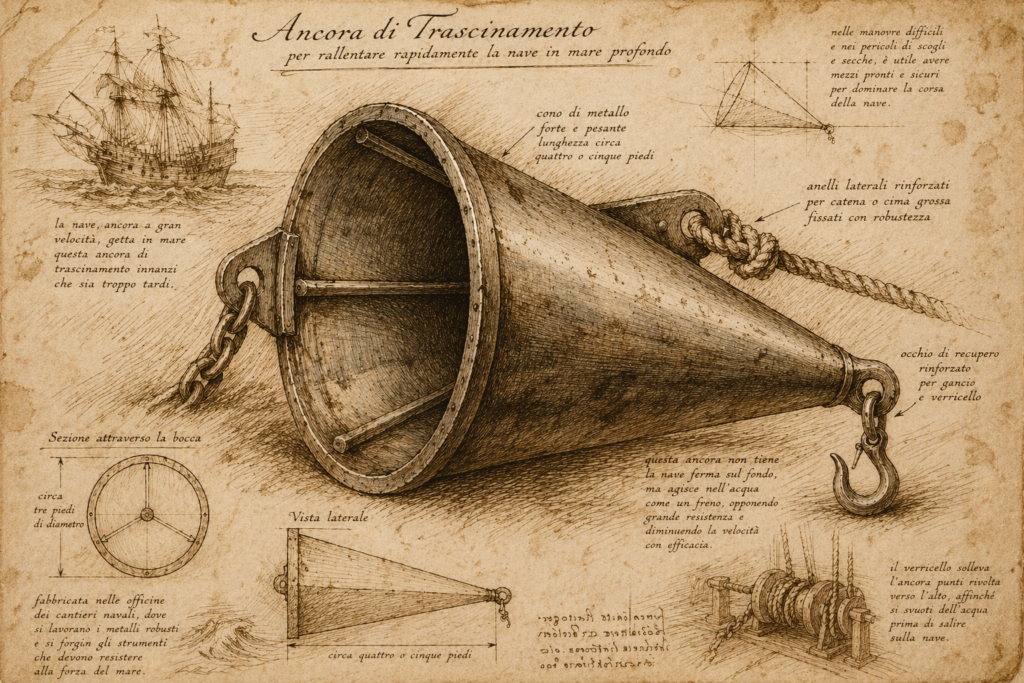
A drag anchor is not a true anchor in the ordinary sense, but a braking device used to slow a ship quickly in deep water. Where a normal anchor is meant to bite the bottom and hold a vessel in place, a drag anchor is cast overboard to resist the ship’s motion through the water and bleed speed before collision, grounding, or a dangerous overshoot.
The device is usually a large metal cone, roughly four to five feet long, with a broad mouth and reinforced frame. Heavy rope or chain is run through strong side loops and secured to the ship. Once thrown overboard, the cone fills and drags hard against the vessel’s forward motion, acting like a submerged brake. Skilled crews use drag anchors when a ship is running too fast into harbour, closing dangerously on reefs or shoals, or trying to check speed during heavy weather and difficult manoeuvres.
When the vessel has slowed enough, the drag anchor is hauled back in. The pointed end bears a reinforced eye so that a hook can catch it and a windlass can raise it point-first, spilling water cleanly as it leaves the sea. Without that recovery feature, the device would be far more dangerous to bring aboard, since a water-filled drag anchor becomes a massive swinging weight.
A drag anchor is most useful on larger seagoing vessels rather than on ordinary river craft or small fishing boats. Warships, merchants, patrol vessels, pilot craft, and ships that regularly work hazardous coasts are the likeliest users. In such places it is a mark of preparation and professional seamanship rather than an exotic curiosity.
Why This Item Matters
A drag anchor gives a crew a way to master speed when sail-handling or oars are no longer enough. In play, it matters because it creates hard nautical choices: whether to risk damage by deploying it too late, whether the crew can recover it under pressure, and whether the ship survives the approach at all.
Failure and Risk
A drag anchor is powerful, but it is not gentle. Poorly secured lines can snap, fittings can tear free, and sudden deceleration can throw crewmen off balance or damage deck gear. In a storm or panic, a badly handled drag anchor can turn one danger into another.
Value in the World
This is specialist maritime gear, most common in major ports, naval yards, and among captains who expect dangerous approaches or fast stops under pressure. It is not universal, but it is well known across serious seafaring cultures. Wealthy merchant captains, war fleets, and pilots working treacherous coasts are the most likely buyers.
Trade, Craft, and Common Variants
Most drag anchors are forged in naval foundries, dockyards, or major port workshops where heavy fittings and stress points can be properly reinforced. Better examples use stronger side loops, cleaner shaping, and more reliable recovery eyes. Cheaper versions are feared for twisting, cracking, or fouling under strain.
Using a Drag Anchor in Your Game
A drag anchor is ideal for sea chases, storm approaches, pirate pursuits, desperate harbour entries, and moments when a captain must choose between controlled violence and disaster. It adds tension and decision-making rather than mere background flavour.
Drag Anchor 5.5
Drag Anchor, Pathfinder
Drag Anchor 3.5
Drag Anchor
Adventuring Gear
Cost: 65 gp
Weight: 450 lb.
A drag anchor is a heavy conical sea brake used by ships in deep water.
When a properly rigged ship deploys a drag anchor, the time needed to bring the vessel under control or to come to a full stop is halved. Deploying or recovering a drag anchor requires a crew, heavy rope or chain, and suitable hauling gear such as a windlass or capstan.
A failed or badly timed deployment can snap lines, damage fittings, or injure crew, as determined by the DM.
DM Guidance: A drag anchor is ship-scale equipment. It is most useful during naval chases, dangerous approaches, storm landings, and other high-pressure manoeuvres.
Drag Anchor
Price 65 gp; Weight 450 lbs.
A drag anchor is a heavy conical braking device used to slow a ship quickly in deep water. It is attached to the vessel with heavy rope or chain and cast overboard, where it fills and drags against the ship’s motion.
A ship that deploys a drag anchor halves the time required to come to a stop or to reduce speed enough for a controlled approach, provided it has proper rigging and enough crew to manage the device. Recovering the drag anchor usually requires a windlass, capstan, or similar hauling gear.
Improper use can damage rigging, snap lines, or injure crew members, at the GM’s discretion. Small craft without the strength or equipment to handle the anchor cannot use it effectively.
Drag Anchor
Ultimate Equipment Guide II
Author Greg Lynch, J. C. Alvarez
Publisher Mongoose Publishing
Publish date 2005
To quickly slow a ship travelling at high speed in deep water, the drag anchor is vastly superior to a normal anchor. It is a large metal cone, four to five feet long with an opening about three feet across. On either side of the opening is a pivoting loop, through which chain or thick rope is run to connect the drag anchor to its ship.
The drag anchor is thrown overboard, where it acts as a water parachute to quickly slow the ship. Once the ship has been brought to a stop, the drag anchor is winched back to the ship. The point of the cone has a thick metal eye on it, designed to accept a hook. When the drag anchors eye has been hooked, it can be raised up out of the water point-first with a windlass, dumping its contents as it leaves the water. A ship with a drag anchor can come to a stop in half the regular time.
Drag Anchor: 110 gp; 450 lb.
Keep this reference growing
If this page helped with your reading or game, you can support its upkeep or explore the curated books.
Explore the Bookshop — epics, classics and stories behind imagined worlds.