
Bard Magic • Spell Reference
Zone of Truth Spell
Circle of True Speech
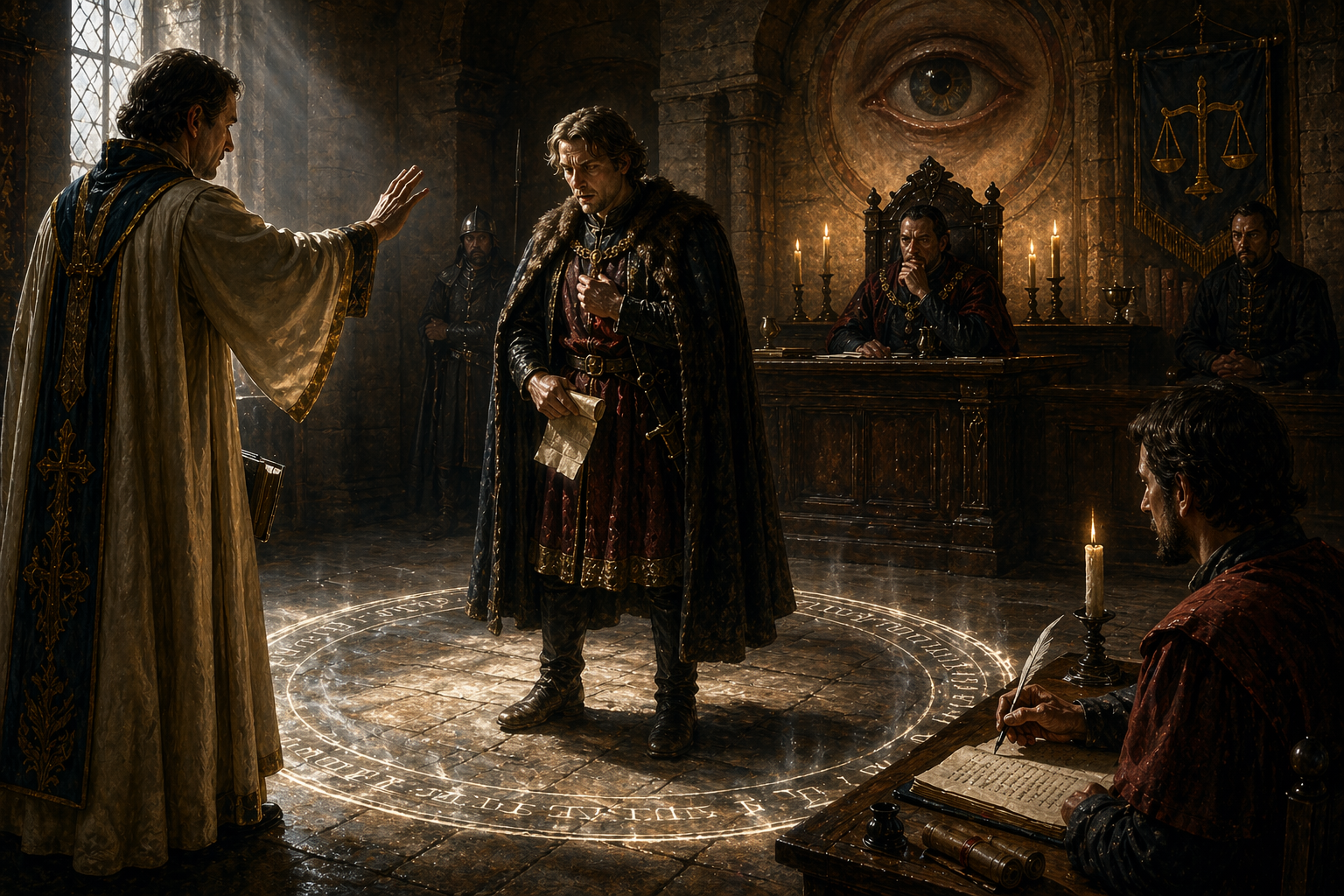
Within a consecrated circle, deliberate lies wither before they can be spoken, leaving silence, evasion, and hard truth as the remaining refuges.
Truth magic changes the moral weather of a room. It does not open the mind, reveal every secret, or force confession from unwilling lips; instead, falsehood loses one of its oldest protections.
Zone of Truth at a Glance
| 5.5e / 2024 | Bard 2, Cleric 2, Paladin 2 • 15-foot-radius Sphere • 10 minutes • No Concentration |
|---|---|
| 5e / 2014 | Bard 2, Cleric 2, Paladin 2 • 15-foot-radius sphere • 10 minutes • No Concentration |
| Pathfinder 1e | Base list includes Cleric 2 and Paladin 2; no Bard • 20-foot-radius emanation • 1 minute/level |
| D&D 3.5e | Cleric 2, Paladin 2; no Bard • 20-foot-radius emanation • 1 minute/level |
Spell Rules by Edition
Zone of Truth — 5.5e / 2024
Rules source: System Reference Document 5.2.1.
| Spell | Level 2 Enchantment (Bard, Cleric, Paladin) |
|---|---|
| Casting Time | Action |
| Range | 60 feet |
| Components | V, S |
| Duration | 10 minutes |
You create a magical zone that guards against deception in a 15-foot-radius Sphere centered on a point within range. Until the spell ends, a creature that enters the spell’s area for the first time on a turn or starts its turn there makes a Charisma saving throw. On a failed save, a creature can’t speak a deliberate lie while in the radius. You know whether a creature succeeds or fails on this save. An affected creature is aware of the spell and can avoid answering questions to which it would normally respond with a lie. Such a creature can be evasive yet must be truthful.
Zone of Truth — 5e / 2014
Rules source: System Reference Document 5.1.
| Spell | 2nd-level enchantment (Bard, Cleric, Paladin) |
|---|---|
| Casting Time | 1 action |
| Range | 60 feet |
| Components | V, S |
| Duration | 10 minutes |
You create a magical zone that guards against deception in a 15-foot-radius sphere centered on a point of your choice within range. Until the spell ends, a creature that enters the spell’s area for the first time on a turn or starts its turn there must make a Charisma saving throw. On a failed save, a creature can’t speak a deliberate lie while in the radius. You know whether each creature succeeds or fails on its saving throw. An affected creature is aware of the spell and can thus avoid answering questions to which it would normally respond with a lie. Such a creature can be evasive in its answers as long as it remains within the boundaries of the truth.
Zone of Truth — Pathfinder 1e
Rules source: Archives of Nethys — Zone of Truth.
| School | enchantment (compulsion) [mind-affecting] |
|---|---|
| Level | Cleric 2, Inquisitor 2, Medium 2, Oracle 2, Paladin 2, Psychic 2, Warpriest 2, Witch 2 |
| Casting Time | 1 standard action |
| Components | V, S, DF |
| Range | close (25 ft. + 5 ft./2 levels) |
| Area | 20-ft.-radius emanation |
| Duration | 1 min./level |
| Saving Throw | Will negates |
| Spell Resistance | yes |
Creatures within the emanation area (or those who enter it) can’t speak any deliberate and intentional lies. Each potentially affected creature is allowed a save to avoid the effects when the spell is cast or when the creature first enters the emanation area. Affected creatures are aware of this enchantment. Therefore, they may avoid answering questions to which they would normally respond with a lie, or they may be evasive as long as they remain within the boundaries of the truth. Creatures who leave the area are free to speak as they choose.
Zone of Truth — D&D 3.5e
Rules source: D&D 3.5 SRD — Zone of Truth.
| School | Enchantment (Compulsion) [Mind-Affecting] |
|---|---|
| Level | Cleric 2, Paladin 2 |
| Components | V, S, DF |
| Casting Time | 1 standard action |
| Range | Close (25 ft. + 5 ft./2 levels) |
| Area | 20-ft.-radius emanation |
| Duration | 1 min./level |
| Saving Throw | Will negates |
| Spell Resistance | Yes |
Creatures within the emanation area (or those who enter it) can’t speak any deliberate and intentional lies. Each potentially affected creature is allowed a save to avoid the effects when the spell is cast or when the creature first enters the emanation area. Affected creatures are aware of this enchantment. Therefore, they may avoid answering questions to which they would normally respond with a lie, or they may be evasive as long as they remain within the boundaries of the truth. Creatures who leave the area are free to speak as they choose.
What Changed Between Editions
| Modern Bard access | The 2024 and 2014 spell is available to Bards at level 2, alongside Clerics and Paladins. In Pathfinder and D&D 3.5, Bard is absent from the base class list; special class features or campaign rules may grant separate access. |
|---|---|
| 2024 and 2014 | Both use a 15-foot-radius sphere, 60-foot range, 10-minute duration, and Charisma saves. The caster knows each save’s result. A creature saves on its first entry on a turn or when it starts its turn in the area; a successful save does not erase later required saves. |
| Pathfinder and 3.5 | Both use a 20-foot-radius emanation at close range, last 1 minute per caster level, and allow a Will save and Spell Resistance. A creature saves when the spell is cast or when it first enters the area. Their spell text does not grant the modern caster’s knowledge of who resisted. |
| Truth and silence | All four versions constrain deliberate spoken falsehood by affected creatures while inside the area. None forces answers, removes sincerely mistaken beliefs, or makes an incomplete answer complete. |
Overview
The Zone of Truth spell is one of the most useful truth-magic spells in fantasy roleplaying because it is powerful without being absolute. It does not compel a creature to answer. It does not reveal thoughts, uncover memories, expose every secret, or prove that a statement is complete. Instead, it creates a bounded space where deliberate spoken lies cannot pass the lips of those who fail to resist the magic.
That limitation is what makes the spell valuable at the table. A prisoner may fall silent. A corrupt magistrate may answer with legalistic precision. A spy may speak only half-truths. A guilty noble may refuse to reply at all. The spell does not remove social play from the scene; it sharpens it.
In the world, Zone of Truth is used in courts, temple halls, oaths of office, guild trials, hostage exchanges, marriage contracts, military inquiries, sacred reconciliations, and royal investigations. Its presence changes the mood of any chamber. Even those who resist the spell must live with what their silence implies.
Effect
You create a magical zone that suppresses deliberate falsehood. Apply the saving-throw timing in your chosen edition: modern versions check the first entry on a turn or the start of a turn, while the legacy versions check when cast or on first entry. On a failed save, a creature cannot knowingly speak a deliberate lie while it remains within the zone.
An affected creature is aware of the enchantment. It may choose not to speak, refuse to answer, answer evasively, or state truths in a misleading way, provided it does not knowingly speak a deliberate falsehood.
The spell does not force speech. It does not compel confession. It does not reveal thoughts, memories, motives, alignments, disguises, guilt, or withheld information. It also does not prevent a creature from saying something false that it sincerely believes to be true.
By strict wording, Zone of Truth governs deliberate spoken lies. A DM should decide how the spell interacts with written answers, gestures, illusions, coded signals, or magical communication, but the safest ruling is that the spell prevents intentional false speech rather than every possible form of deception.
Creatures that leave the area are no longer constrained by the spell.
At Higher Levels
The Zone of Truth spell does not normally gain additional effects when cast using a higher-level spell slot. Greater ritual versions for temple courts, divine inquisitions, royal oath chambers, or ancient places of judgment would be optional campaign rules devised by the DM. Its strength lies in pressure, not certainty.
Why This Spell Is Dangerous in the World
Zone of Truth is dangerous because it threatens authority, reputation, and legal certainty. A single casting can unsettle a court case, expose the weakness of a treaty, ruin a false accusation, or force a powerful person to choose between silence and implication.
Yet the spell is also dangerous because it can create false confidence. People may assume that anything spoken inside the zone is the whole truth. It is not. A clever speaker can omit, redirect, answer literally, or rely on sincere misunderstanding. In corrupt courts, the spell can become theatre: a sacred circle used not to discover truth, but to make a chosen verdict appear inevitable.
Best Uses
Use Zone of Truth when the party needs pressure rather than proof. It is excellent for interrogations, sacred oaths, prisoner exchanges, witness testimony, noble negotiations, suspected possession cases, guild trials, treaty talks, and tense social encounters where silence matters as much as speech. It cannot itself identify possession or establish what the speaker does not know.
The spell works best when the questions are narrow and specific. “Did you open the western gate?” is stronger than “Are you loyal?” “Did you see Lord Alaric alive after sunset?” is stronger than “What happened?” The spell rewards careful questioning and punishes vague accusations.
Tactics
The caster should prepare questions before casting. Broad questions invite evasive answers. Specific questions force meaningful silence.
The spell is most effective when paired with witnesses, written records, social leverage, or other investigative magic. A failed saving throw does not make the target cooperative, so the party still needs negotiation, intimidation, law, trust, or consequence.
DMs should remember that the target knows the spell is affecting them. This awareness is not a weakness; it is the source of the drama. A guilty creature’s silence may be as revealing as a confession, but it is not the same as proof.
DM Notes
The key to running Zone of Truth well is to distinguish truth from completeness. A creature may say something technically accurate while concealing the most important part of the matter. It may answer a different question. It may say, “I did not kill him,” if it ordered the killing but did not strike the blow. It may say, “I do not know where the relic is,” if the relic has since been moved without its knowledge.
The caster knowing whether a creature failed or succeeded on its save is important in 5e-style play. It prevents the spell from becoming useless, but it still does not make the creature talk.
Do not let the spell become automatic mind-reading. It controls deliberate false speech. It does not reveal motive, memory, alignment, loyalty, disguise, guilt, or hidden intent by itself.
Good Combinations
- Detect Thoughts: Use Zone of Truth to constrain spoken lies while Detect Thoughts provides the mental information allowed by its own edition, such as surface thoughts or deeper information after the required resistance.
- Command: A carefully timed command may create a brief opening if it is valid under that edition’s Command rules. “Answer” is a DM-adjudicated example, rather than a guarantee of speech or a full confession.
- Calm Emotions: Useful when a truthful exchange is likely to collapse into panic, rage, or grief.
- Dispel Magic: Helpful if a dispellable spell is affecting what the target believes to be true. Dispel Magic does not automatically remove every curse or non-spell effect.
- Augury: Use after a tense questioning scene to ask about the outcome of a specific course of action within Augury’s own time limit and rules.
Using This Spell in Your Game
The best Zone of Truth scenes are not simple interrogations. They are social traps, moral tests, public reckonings, or tense negotiations where every word matters.
Place the spell in a visible ritual context. A chalk circle on a stone floor. A silver reliquary placed between rivals. A temple mosaic marked by old verdicts. A magistrate’s hall where every witness stands beneath the same painted eye. The more formal the setting, the more pressure the spell creates.
For adventures, the strongest use is often not “make the villain confess.” It is “make everyone discover that the official story cannot be spoken truthfully.”
Spellcasting Culture and Worldbuilding Hooks
Temples may maintain truth circles for oath-taking, legal testimony, and reconciliation between feuding houses. Some rulers forbid unauthorised casting of the Zone of Truth spell in court, claiming that only appointed priests may judge truth. Merchant guilds may require it before sealing dangerous contracts. Knightly orders may use it before admitting new members.
Criminals learn to fear the spell, but politicians learn to survive it. Professional witnesses, court advocates, spies, and diplomats train in careful truthful evasion. In lands where the spell is common, the phrase “he answered under the circle” may mean less than common folk believe.
A tyrant may use Zone of Truth to force public loyalty rituals. A just ruler may use it to protect the innocent. A corrupt temple may decide which truths are allowed to matter.
Adventure Hooks
- The Silent Witness: A murdered duke’s servant fails the spell’s saving throw but refuses to answer the one question that matters.
- The Honest Traitor: A captured scout truthfully claims loyalty to the crown, revealing that the crown itself has secretly ordered treason.
- The Broken Trial: Every witness in a sacred court speaks truthfully, yet their truths contradict one another.
- The Oath Market: A guild sells magically witnessed contracts, but someone has learned how to exploit literal wording inside the truth circle.
Rules Sources and Licensing
This work includes material taken from the System Reference Document 5.1 (“SRD 5.1”) by Wizards of the Coast LLC and available at https://dnd.wizards.com/resources/systems-reference-document. The SRD 5.1 is licensed under the Creative Commons Attribution 4.0 International License available at https://creativecommons.org/licenses/by/4.0/legalcode.
This work includes material from the System Reference Document 5.2.1 (“SRD 5.2.1”) by Wizards of the Coast LLC, available at https://www.dndbeyond.com/srd. The SRD 5.2.1 is licensed under the Creative Commons Attribution 4.0 International License, available at https://creativecommons.org/licenses/by/4.0/legalcode.
The Pathfinder and 3.5 spell mechanics and their tables are Open Game Content under the Open Game License v1.0a. Artwork and original setting prose are excluded from that designation.
Open Game License v1.0a and copyright notices
Permission to copy, modify and distribute the files collectively known as the System Reference Document (“SRD”) is granted solely through the use of the Open Gaming License, Version 1.0a.
This material is being released using the Open Gaming License Version 1.0a and you should read and understand the terms of that license before using this material.
The text of the Open Gaming License itself is not Open Game Content. Instructions on using the License are provided within the License itself.
The following items are designated Product Identity, as defined in Section 1(e) of the Open Game License Version 1.0a, and are subject to the conditions set forth in Section 7 of the OGL, and are not Open Content: Dungeons & Dragons, D&D, Player’s Handbook, Dungeon Master, Monster Manual, d20 System, Wizards of the Coast, d20 (when used as a trademark), Forgotten Realms, Faerûn, proper names (including those used in the names of spells or items), places, Red Wizard of Thay, the City of Union, Heroic Domains of Ysgard, Ever-Changing Chaos of Limbo, Windswept Depths of Pandemonium, Infinite Layers of the Abyss, Tarterian Depths of Carceri, Gray Waste of Hades, Bleak Eternity of Gehenna, Nine Hells of Baator, Infernal Battlefield of Acheron, Clockwork Nirvana of Mechanus, Peaceable Kingdoms of Arcadia, Seven Mounting Heavens of Celestia, Twin Paradises of Bytopia, Blessed Fields of Elysium, Wilderness of the Beastlands, Olympian Glades of Arborea, Concordant Domain of the Outlands, Sigil, Lady of Pain, Book of Exalted Deeds, Book of Vile Darkness, beholder, gauth, carrion crawler, tanar’ri, baatezu, displacer beast, githyanki, githzerai, mind flayer, illithid, umber hulk, yuan-ti.
All of the rest of the SRD is Open Game Content as described in Section 1(d) of the License.
More information on the Open Game License can be found at www.wizards.com/d20.
The terms of the Open Gaming License Version 1.0a are as follows:
OPEN GAME LICENSE Version 1.0a
The following text is the property of Wizards of the Coast, Inc. and is Copyright 2000 Wizards of the Coast, Inc (“Wizards”). All Rights Reserved.
1. Definitions: (a)”Contributors” means the copyright and/or trademark owners who have contributed Open Game Content; (b)”Derivative Material” means copyrighted material including derivative works and translations (including into other computer languages), potation, modification, correction, addition, extension, upgrade, improvement, compilation, abridgment or other form in which an existing work may be recast, transformed or adapted; (c) “Distribute” means to reproduce, license, rent, lease, sell, broadcast, publicly display, transmit or otherwise distribute; (d)”Open Game Content” means the game mechanic and includes the methods, procedures, processes and routines to the extent such content does not embody the Product Identity and is an enhancement over the prior art and any additional content clearly identified as Open Game Content by the Contributor, and means any work covered by this License, including translations and derivative works under copyright law, but specifically excludes Product Identity. (e) “Product Identity” means product and product line names, logos and identifying marks including trade dress; artifacts; creatures characters; stories, storylines, plots, thematic elements, dialogue, incidents, language, artwork, symbols, designs, depictions, likenesses, formats, poses, concepts, themes and graphic, photographic and other visual or audio representations; names and descriptions of characters, spells, enchantments, personalities, teams, personas, likenesses and special abilities; places, locations, environments, creatures, equipment, magical or supernatural abilities or effects, logos, symbols, or graphic designs; and any other trademark or registered trademark clearly identified as Product identity by the owner of the Product Identity, and which specifically excludes the Open Game Content; (f) “Trademark” means the logos, names, mark, sign, motto, designs that are used by a Contributor to identify itself or its products or the associated products contributed to the Open Game License by the Contributor (g) “Use”, “Used” or “Using” means to use, Distribute, copy, edit, format, modify, translate and otherwise create Derivative Material of Open Game Content. (h) “You” or “Your” means the licensee in terms of this agreement.
2. The License: This License applies to any Open Game Content that contains a notice indicating that the Open Game Content may only be Used under and in terms of this License. You must affix such a notice to any Open Game Content that you Use. No terms may be added to or subtracted from this License except as described by the License itself. No other terms or conditions may be applied to any Open Game Content distributed using this License.
3.Offer and Acceptance: By Using the Open Game Content You indicate Your acceptance of the terms of this License.
4. Grant and Consideration: In consideration for agreeing to use this License, the Contributors grant You a perpetual, worldwide, royalty-free, non-exclusive license with the exact terms of this License to Use, the Open Game Content.
5.Representation of Authority to Contribute: If You are contributing original material as Open Game Content, You represent that Your Contributions are Your original creation and/or You have sufficient rights to grant the rights conveyed by this License.
6.Notice of License Copyright: You must update the COPYRIGHT NOTICE portion of this License to include the exact text of the COPYRIGHT NOTICE of any Open Game Content You are copying, modifying or distributing, and You must add the title, the copyright date, and the copyright holder’s name to the COPYRIGHT NOTICE of any original Open Game Content you Distribute.
7. Use of Product Identity: You agree not to Use any Product Identity, including as an indication as to compatibility, except as expressly licensed in another, independent Agreement with the owner of each element of that Product Identity. You agree not to indicate compatibility or co-adaptability with any Trademark or Registered Trademark in conjunction with a work containing Open Game Content except as expressly licensed in another, independent Agreement with the owner of such Trademark or Registered Trademark. The use of any Product Identity in Open Game Content does not constitute a challenge to the ownership of that Product Identity. The owner of any Product Identity used in Open Game Content shall retain all rights, title and interest in and to that Product Identity.
8. Identification: If you distribute Open Game Content You must clearly indicate which portions of the work that you are distributing are Open Game Content.
9. Updating the License: Wizards or its designated Agents may publish updated versions of this License. You may use any authorized version of this License to copy, modify and distribute any Open Game Content originally distributed under any version of this License.
10. Copy of this License: You MUST include a copy of this License with every copy of the Open Game Content You Distribute.
11. Use of Contributor Credits: You may not market or advertise the Open Game Content using the name of any Contributor unless You have written permission from the Contributor to do so.
12. Inability to Comply: If it is impossible for You to comply with any of the terms of this License with respect to some or all of the Open Game Content due to statute, judicial order, or governmental regulation then You may not Use any Open Game Material so affected.
13. Termination: This License will terminate automatically if You fail to comply with all terms herein and fail to cure such breach within 30 days of becoming aware of the breach. All sublicenses shall survive the termination of this License.
14. Reformation: If any provision of this License is held to be unenforceable, such provision shall be reformed only to the extent necessary to make it enforceable.
15. COPYRIGHT NOTICE
Open Game License v 1.0a Copyright 2000, Wizards of the Coast, Inc.
System Reference Document Copyright 2000-2003, Wizards of the Coast, Inc.; Authors Jonathan Tweet, Monte Cook, Skip Williams, Rich Baker, Andy Collins, David Noonan, Rich Redman, Bruce R. Cordell, John D. Rateliff, Thomas Reid, James Wyatt, based on original material by E. Gary Gygax and Dave Arneson.
Pathfinder Roleplaying Game Core Rulebook. © 2009, Paizo Publishing, LLC; Author: Jason Bulmahn, based on material by Jonathan Tweet, Monte Cook, and Skip Williams. END OF LICENSE
Keep this reference growing
If this page helped with your reading or game, you can support its upkeep or explore the curated books.
Explore the Bookshop — epics, classics and stories behind imagined worlds.