
Rerir — Avenger-King of Hunaland and Father of Völsung
A vengeance-born king of the old Hunnic-Danubian marches, whose greatest victory was not a battle, but the divine conception of a son he would never live to see.
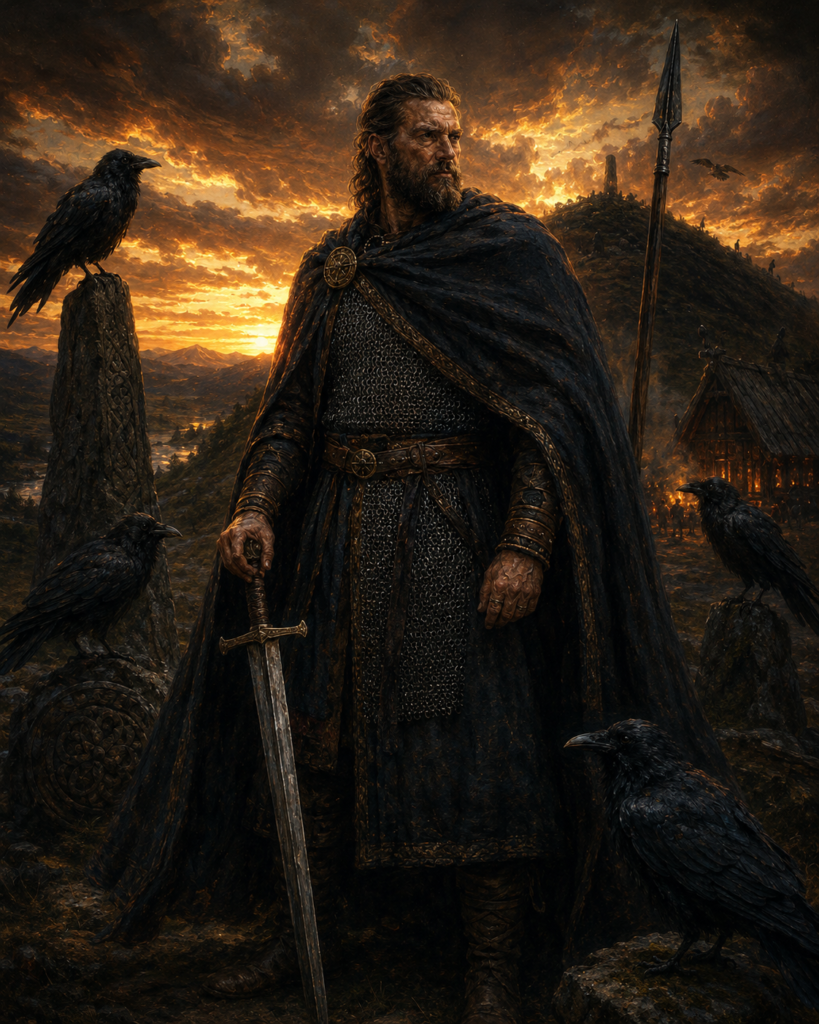
- Name: Rerir
- House: Völsung line
- Father: Sigi, son of Odin
- Son: Völsung
- Homeland: Hunaland, the saga-name for the old Hunnic-Danubian borderlands
- Late Medieval Placement: The Kingdom of Hungary, Pannonia, and the Carpathian marches
- Culture: Heroic Germanic-Norse saga tradition layered over older Hunnic, Gothic, Frankish, and Danubian memory
- Religion: Asgardian Pantheon, especially Odin as ancestral power and Freyja as divine helper in the fertility-apple episode
- Role: Avenger, king, dynastic restorer, doomed father
- Alignment: Lawful Neutral
- Primary Themes: Blood vengeance, sacred kingship, divine fertility, dynastic anxiety, inheritance bought at a cost
Rerir stands near the beginning of the Völsung story, before the greater names of Völsung, Sigmund, Signy, Sinfjötli, and Sigurd. He is not remembered because he slays a dragon, draws a sword from a sacred tree, or dies in a famous last battle. He is remembered because he restores a murdered royal house, takes back a broken inheritance, and becomes the father of the bloodline from which the great Völsung tragedies descend.
His father, Sigi, is murdered by hostile kinsmen. Rerir answers in the old heroic manner: he gathers strength, recovers his father’s lands, avenges the killing, and restores the throne. Yet the victory is incomplete. A kingdom can be reclaimed by the sword, but a bloodline cannot be secured by vengeance alone.
Rerir and his wife have rule, honour, wealth, and enemies, but no child. That absence becomes the secret wound inside the restored kingdom. Every feast, treaty, oath, tribute, and marriage negotiation carries the same unspoken question: who inherits?
The gods answer. A supernatural maiden comes in crow-form and brings Rerir a fertility apple. He understands the sign, returns to his wife, and the child who will become Völsung is conceived. The gift saves the line, but not the parents. Rerir dies before the child is born, and his wife carries the unborn Völsung for six winters before commanding that he be cut from her body.
Rerir is therefore not merely an early name in the genealogy. He is the hinge between murder and dynasty. He restores the throne, receives divine aid, and leaves behind a son whose life will make the family name legendary. His tragedy is that he wins the future without living to see it.
For a late medieval campaign, Hunaland should not be treated as a neat modern country. It is a saga-name, a heroic geography attached to Huns, old European war-memory, and the shadowed borderlands of legendary kingship. The strongest placement is the Middle Danube: Hungary, Pannonia, and the Carpathian marches. In play, Rerir’s hall may be gone, his mound half-forgotten, and his kingdom buried beneath later borders, but the old oaths remain.
Why Rerir Matters in Play
Rerir is not useful because he is “another warrior king.” He is useful because he turns succession into danger. Around him, a missing heir becomes a political crisis, a fertility rite becomes a divine bargain, a murdered father becomes a legal problem, and a future child becomes a weapon before he is even born.
Use Rerir when the campaign needs royal pressure that cannot be solved by winning a single battle. The players may protect his queen, judge the limits of vengeance, carry a god-sent apple, expose a false heir, break an old blood-feud, or discover that a dynasty’s survival is the beginning of a greater doom.
Appearance
Rerir looks like a king made by feud rather than ceremony. He is broad-shouldered, hard-eyed, and weathered, with the stillness of a man who survived long enough to punish his father’s killers. His beard and hair are kept with royal discipline, but not softness. His authority is not decorative.
He wears dark wool over mail, a heavy sword-belt, arm-rings, and a cloak fastened with a severe brooch. He does not need a glittering crown. Men recognise his rule by the weapons at his side, the witnesses in his hall, and the silence that falls when he names a debt.
Crows gather where he passes. They perch on roof-beams, boundary stones, gallows trees, battlefield poles, and burial mounds. They are not ornament. They are witnesses.
Character and Voice
Rerir is controlled, blunt, and difficult to move once he has judged a matter. He listens more than he speaks. When he does speak, he does not plead, flatter, or decorate. He names what is owed.
He is not cruel for pleasure. That would make him smaller. Rerir believes vengeance is a royal duty. If a king’s father can be murdered without answer, every oath becomes weaker. Every hostage becomes negotiable. Every border invites testing. To him, revenge is not rage; it is political repair.
His deepest fear is not death. It is ending.
Motives
Rerir wants his father’s murder to become the beginning of renewed rule, not the last wound of a dying house. He has recovered the throne, but without an heir the restoration is hollow.
He may seek to:
- Secure an heir through divine, political, or dangerous ritual means.
- Punish surviving allies of Sigi’s killers.
- Bind neighbouring lords before succession fails.
- Protect his wife from rivals who understand that the dynasty depends on her.
- Determine whether the gods have blessed his line or marked it for sacrifice.
Fears
Rerir fears that vengeance restored the throne but not the future. He fears that Odin’s favour is never free. He fears that a child gained through divine intervention may belong more to the gods than to his parents. He fears that his line will become famous only because it is doomed.
Using Rerir in a Campaign
Rerir works best during the dangerous period between restored kingship and secured succession. The party may meet him as a reigning king whose court appears strong but is inwardly unstable. His enemies have been punished, but not all of them are dead. His throne is restored, but his line is still fragile.
He can also appear as a legendary ancestor in a campaign set centuries after his death. In that form, Rerir’s power survives through burial mounds, crow omens, oath-curses, inherited weapons, noble claims, and blood-feuds that later generations barely understand.
Use him as:
A Royal Patron: Rerir hires the party to recover a relic of Sigi, escort a divine messenger, guard his queen, expose a rival claimant, or retrieve a stolen token needed for a fertility rite.
A Vengeance-King: The party must decide whether to aid, restrain, or survive his campaign against those tied to his father’s murder.
A Dynastic Pressure Point: Rerir’s lack of an heir makes every faction dangerous. His queen’s body, the royal bed, the gods’ favour, and the future of the kingdom all become political weapons.
A Legendary Ancestor: In a later campaign, a noble house invokes Rerir’s name to justify war, succession, revenge, or ownership of a sacred mound.
Adventure Hooks
The Apple on the Mound
A crow drops a red-gold apple into Rerir’s lap while he sits on an ancestral mound. By nightfall, three factions want it: the queen’s household, a rival claimant, and an Odin-priest who insists the king must not touch a gift meant for the womb. The party must guard, steal, interpret, or destroy the apple before the court turns violent.
Sigi’s Last Debt
A surviving witness claims Rerir’s vengeance was incomplete. One of Sigi’s true killers now lives under guest-right in a neighbouring hall. Rerir demands justice, but killing a protected guest could ignite war across the Danubian marches.
Six Winters Unborn
Rerir is dead. The queen still carries the child. Six winters have passed, and the kingdom is beginning to fracture. The party is summoned to protect the queen, silence false heirs, and decide whether the unborn Völsung is miracle, curse, or both.
Allies and Enemies
Odin: Rerir’s ancestral line descends from Odin through Sigi. Odin’s involvement makes the dynasty glorious, violent, and dangerous to everyone near it. His favour is real, but never harmless.
Freyja: In the fertility-apple episode, Freyja hears the childless royal couple’s need and sends the supernatural maiden. Her role should feel sacred, dangerous, and intimate: the goddess does not merely grant a baby; she opens the way for a bloodline whose glory will shake kingdoms.
Hljóð / Ljod: The giant-maiden who brings the apple in crow-form later becomes bound to the Völsung line herself. She is ideal as a recurring supernatural figure: messenger, witness, bride, and fate-bearer.
The Queen: Rerir’s wife should not be treated as a passive vessel. She is the co-bearer of the dynasty’s terrible continuation. After Rerir’s death, she becomes the person through whom the line survives.
The Murdering Kinsmen: The men who killed Sigi may already be dead, but their sons, widows, oath-friends, fosterlings, and hired blades remain. Rerir’s vengeance may have ended one feud while planting another.
Secrets
- Rerir does not fully trust the apple, but refusing a divine answer may be worse than accepting it.
- One man killed in Rerir’s vengeance campaign was guilty by kinship, not deed.
- The queen has dreamed of her son already grown, already blood-marked, already looking past her.
- A rival house believes the apple proves the Völsung line is giant-touched, not god-blessed.
- Odin’s priests know a darker prophecy: the line Rerir saves will become greater than kings and more ruinous than invaders.
Rerir, 5.5e / 2024-Compatible Stat Block
Rerir, Pathfinder 1e-Compatible Stat Block
Rerir, Avenger-King of Hunaland
Medium Humanoid, Lawful Neutral
Armor Class: 18
Initiative: +2
Hit Points: 153 (18d8 + 72)
Speed: 30 ft.
Proficiency Bonus: +4
Saving Throws: Str +9, Con +8, Wis +6, Cha +7
Skills: Athletics +9, History +6, Insight +6, Intimidation +7, Perception +6, Persuasion +7
Senses: passive Perception 16
Languages: Old Norse heroic speech, courtly Germanic dialects, Danubian war-signs
Challenge: 9
| STR | DEX | CON | INT | WIS | CHA |
|---|---|---|---|---|---|
| 20 (+5) | 14 (+2) | 18 (+4) | 14 (+2) | 15 (+2) | 17 (+3) |
Traits
Avenger’s Authority. Rerir has Advantage on Charisma checks made to command warriors, enforce oaths, accuse a blood-guilty enemy, or demand tribute from those who recognise his kingship.
Odin-Marked Line. When Rerir fails a saving throw, he can choose to succeed instead. When he does so, crows or ravens become briefly audible nearby, even indoors or underground. Once he uses this trait, he cannot use it again until he finishes a Long Rest.
King Under Crows. Crows, ravens, and similar omen-birds do not attack Rerir unless magically compelled. Rerir has Advantage on Wisdom (Perception) checks made near burial mounds, battlefields, gallows trees, abandoned halls, or sites of sworn vengeance.
The Line Must Continue. If Rerir is reduced to 0 Hit Points while defending his queen, heir, sworn household, or royal hall, he can make one weapon attack before falling Unconscious. On a hit, the attack deals an extra 18 (4d8) damage.
Unsettling Oath-King. A creature Frightened by Rerir cannot willingly move closer to his queen, heir, royal standard, or an ally protected by Stand Before the Line.
Actions
Multiattack. Rerir makes three Longsword attacks, or two Spear attacks and one Shield-Breaker attack.
Longsword of the Restored Throne. Melee Weapon Attack: +9 to hit, reach 5 ft., one target. Hit: 14 (2d8 + 5) slashing damage, or 16 (2d10 + 5) slashing damage if used with two hands. If the target has damaged Rerir’s queen, heir, or sworn ally since the start of Rerir’s last turn, the attack deals an extra 7 (2d6) slashing damage.
Spear. Melee or Ranged Weapon Attack: +9 to hit, reach 5 ft. or range 20/60 ft., one target. Hit: 12 (2d6 + 5) piercing damage, or 14 (2d8 + 5) piercing damage if used with two hands in melee.
Shield-Breaker. Melee Weapon Attack: +9 to hit, reach 5 ft., one target. Hit: 10 (2d4 + 5) bludgeoning damage. If the target is wielding a shield or wearing heavy armour, it must succeed on a DC 17 Strength saving throw or be knocked Prone.
Name the Blood-Debt. Rerir chooses one creature he can see within 60 feet that has damaged him, his household, his queen, or his allies. The target must succeed on a DC 15 Wisdom saving throw or be Frightened of Rerir until the end of Rerir’s next turn. If the target belongs to a house with a known blood-feud against Rerir, it has Disadvantage on the save.
Summon the Witness-Birds. Rerir calls omen-crows to a point he can see within 60 feet. Until the start of his next turn, the area in a 10-foot-radius sphere is lightly obscured by beating wings and harsh cries. Enemies in the area have Disadvantage on Wisdom (Perception) checks and cannot take Reactions unless they succeed on a DC 15 Wisdom saving throw. Once Rerir uses this action, he cannot use it again until he rolls Initiative again or finishes a Short or Long Rest.
Bonus Actions
Command the Hall. One allied creature within 60 feet that can hear Rerir can move up to half its Speed and make one weapon attack. If the attack hits, it deals an extra 4 (1d8) damage.
Reactions
Answer Blood with Blood. When a creature within 5 feet of Rerir hits him with a melee attack, Rerir makes one Longsword attack against that creature.
Stand Before the Line. When a creature Rerir can see attacks his queen, heir, sworn companion, or household warrior within 5 feet of him, Rerir imposes Disadvantage on the attack roll.
Legendary Actions
Rerir can take 2 Legendary Actions, choosing from the options below. Only one Legendary Action can be used at a time and only at the end of another creature’s turn.
Move. Rerir moves up to half his Speed without provoking Opportunity Attacks.
Weapon Attack. Rerir makes one Longsword or Spear attack.
Royal Command Costs 2 Actions. Rerir uses Command the Hall.
Rerir, Avenger-King of Hunaland
Male human fighter 6 / aristocrat 4
LN Medium humanoid
Init +2; Senses Perception +12
Defense
AC 22, touch 12, flat-footed 20; +8 armour, +2 Dex, +2 shield
hp 112 (10 HD; 6d10+4d8+50)
Fort +12, Ref +6, Will +8
Defensive Abilities bravery +2, royal resolve 1/day
Offense
Speed 30 ft.
Melee +1 longsword +16/+11 (1d8+8/19–20)
Melee spear +15/+10 (1d8+7/x3)
Ranged spear +12 (1d8+7/x3)
Special Attacks weapon training +1, vengeance challenge 3/day, witness-birds 1/day
Statistics
Str 20, Dex 14, Con 18, Int 14, Wis 15, Cha 17
Base Atk +9; CMB +14; CMD 26
Feats Cleave, Combat Reflexes, Furious Focus, Improved Initiative, Iron Will, Leadership, Power Attack, Shield Focus, Weapon Focus (longsword), Weapon Specialization (longsword)
Skills Diplomacy +16, Handle Animal +12, Intimidate +18, Knowledge (history) +12, Knowledge (nobility) +15, Perception +12, Ride +12, Sense Motive +15, Survival +10
Languages Old Norse heroic speech, neighbouring court tongues, Danubian war-signs
SQ armour training 1, noble authority, oath-bound household
Gear +1 longsword, masterwork spear, mail, heavy shield, cloak of office, arm-rings worth 500 gp, royal seal-ring
Special Abilities
Noble Authority (Ex): Rerir gains a +4 competence bonus on Diplomacy and Intimidate checks made against warriors, nobles, oath-bound retainers, and subjects of his kingdom.
Royal Resolve (Su): Once per day, when Rerir fails a saving throw, he may reroll it and take the better result. If the reroll succeeds, nearby crows, ravens, or unseen omen-birds cry out. This is not simple luck; it is the pressure of Odin-marked destiny.
Vengeance Challenge (Ex): Three times per day as a swift action, Rerir may name one visible enemy who has harmed him, his kin, his queen, or his household. Against that target, he gains a +2 morale bonus on attack rolls and weapon damage rolls for 1 minute. If the target drops to 0 hit points before the duration ends, Rerir may immediately attempt an Intimidate check to demoralise all enemies within 30 feet.
Oath-Bound Household (Ex): Allied warriors within 30 feet who can hear Rerir gain a +1 morale bonus on Will saves and weapon damage rolls.
Stand Before the Line (Ex): Once per round, when an adjacent ally is attacked, Rerir may use an attack of opportunity to impose a -2 penalty on the attack roll. He must be aware of the attack and able to threaten the attacker.
Witness-Birds (Su): Once per day as a standard action, Rerir calls a sudden rush of crow-spirits, omen-birds, or living battlefield crows to a point within 60 feet. The birds fill a 10-foot-radius spread for 1 round per 2 Hit Dice. The area is treated as light obscurement. Enemies in the area take a -2 penalty on Perception checks and must succeed at a DC 18 Will save or be unable to make attacks of opportunity while they remain in the area. The save DC is Charisma-based.
Treasure
Rerir’s treasure should feel royal but severe: arm-rings, oath-gifts, war-taken weapons, tribute from restored lands, and sacred objects tied to fertility, burial mounds, and kingship.
Suggested treasure for a CR 9 encounter:
- +1 longsword or named ancestral blade
- Masterwork spear with carved shaft
- Heavy shield marked with his house-sign
- Arm-rings and royal gifts worth 1,500 gp
- Burial-mound torc worth 750 gp
- Sealed oath-tablets or carved witness-staves worth more politically than financially
- The Apple-Gift, if used as an artifact-level plot object rather than ordinary treasure
The Apple-Gift
The Apple-Gift should not be treated as a casual magic item. It is divine intervention made physical. It does not simply grant pregnancy; it places a bloodline under supernatural attention.
Suggested 5.5e Effect: A willing creature who shares and consumes the apple as part of a fertility rite may conceive a child if conception is physically and spiritually possible within the campaign’s cosmology. The child is marked by supernatural destiny. Before the rite is completed, the DM should define one blessing and one cost.
Possible Blessings:
- The child is born with extraordinary strength, charisma, or fate-marked endurance.
- The child carries divine favour recognised by omen-birds, seers, and oath-priests.
- The child may found or restore a royal bloodline.
- The child is unusually resistant to mundane sickness, fear, or despair.
Possible Costs:
- One parent will not live to raise the child.
- The pregnancy lasts unnaturally long and destabilises the realm.
- The child draws divine, giantish, or ancestral attention from birth.
- The bloodline gains glory, but every generation inherits a doom.
Adventure and Worldbuilding Uses
Bloodline Claims
A late medieval noble house in Hungary or the Danubian marches claims descent from Rerir. The claim may be political theatre, genuine bloodline memory, or a dangerous half-truth. If proven, it could grant legitimacy over a contested fortress, sacred mound, or ancestral sword. If disproven, it could expose generations of fraudulent kingship.
The Mound Still Watches
Rerir’s burial mound is not quiet. Crows gather there in unnatural numbers, oaths sworn nearby become binding in dangerous ways, and blood shed on the mound sometimes calls up memories of old murders. The site can serve as a trial-ground, oracle, cursed battlefield, or royal inheritance test.
The Queen’s Line
The queen’s role in the story gives the entry a second campaign route. Her descendants, attendants, or priestesses may preserve a parallel tradition: not Rerir the avenger, but the unnamed queen who endured six winters of impossible pregnancy so that the dynasty could continue. This can turn the Völsung inheritance from a simple warrior bloodline into a contested sacred legacy.
Source and Literary Context
Rerir appears in the early dynastic sequence of the Völsunga saga. He is the son of Sigi, who is himself presented as a son of Odin. After Sigi is murdered, Rerir gathers support, recovers his father’s kingdom, and avenges him. The saga then turns to the problem of succession: Rerir and his wife have no child, pray to the gods, and receive a fertility apple delivered by a supernatural maiden in crow-form. In William Morris and Eiríkr Magnússon’s public-domain translation, the divine helper is Freyja. For the primary text, see Project Gutenberg’s edition of The Story of the Volsungs.
The child conceived from the apple is Völsung. Rerir dies before the birth, and the queen carries the child for six winters before commanding that he be cut from her body. Völsung is born already great in growth, kisses his mother before she dies, and becomes king over Hunaland in his father’s place. This makes Rerir important not as the saga’s greatest warrior, but as the restored king whose divine-aided heir gives the Völsung line its name.
Rerir is also a transitional figure. He stands between Sigi’s outlaw, Odin-descended ancestry and the named Völsung royal line. His story turns private vengeance into dynastic history. Without Rerir, Sigi’s murder remains a feud; through Rerir, it becomes the root of a heroic house.
Hunaland should be handled carefully in a late medieval campaign. It is not a fixed modern country. Old Norse sources use it as a shifting heroic geography connected with Huns, Franks, Germanic lands, and other parts of Europe. For a real-world 1453 campaign, the most useful placement is the old Hunnic-Danubian memory-world beneath the Kingdom of Hungary, Pannonia, and the Carpathian marches.
Keep this reference growing
If this page helped with your reading or game, you can support its upkeep or explore the curated books.
Explore the Bookshop — epics, classics and stories behind imagined worlds.