
Daedalus — Labyrinth-Maker, Inventor, and Father of Icarus
Daedalus — Labyrinth-Maker, Inventor, and Father of Icarus
A peerless artificer whose inventions can rescue kingdoms, conceal crimes, and make escape possible only after someone else has paid the price.
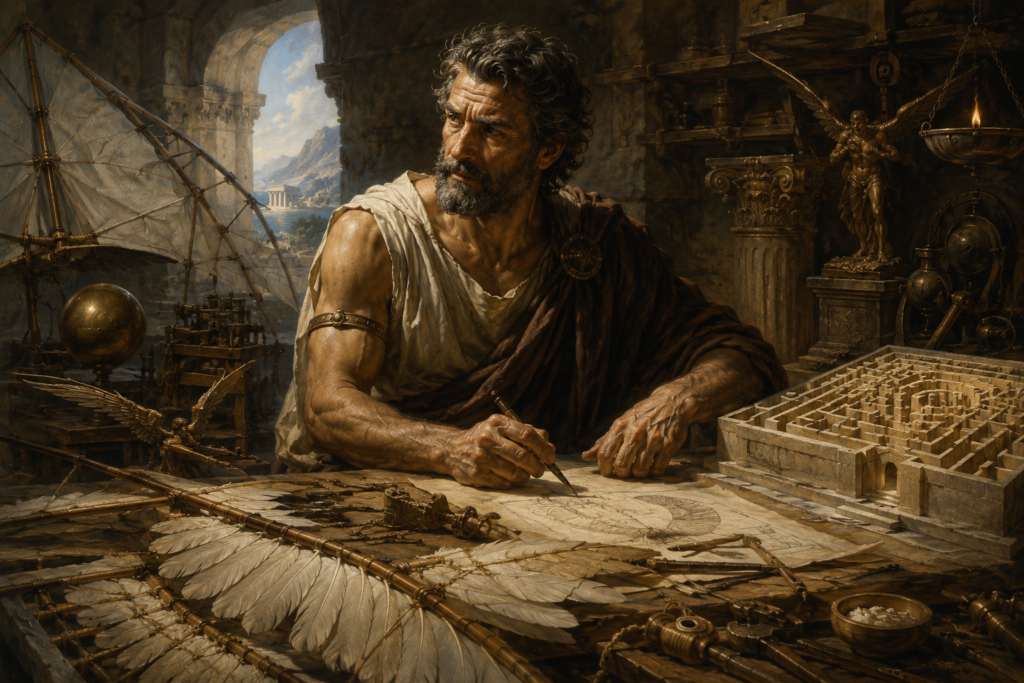
- Full Name: Daedalus
- Common Name: Daedalus
- Aliases: The Labyrinth-Maker, the Cunning Hand, the Exile of Athens, the Prisoner of Crete, the Wing-Maker, the Architect of Minos
- Gender: Male
- Race: Human
- Occupation: Master artificer, architect, sculptor, engineer, inventor, exile, sacred craftsman
- Nationality: Athenian by most later traditions
- Region: Athens, Knossos, Crete, Sicily, sacred workshops, royal courts, hidden foundries, labyrinthine ruins
- Base of Operations: Wherever he is protected, employed, watched, or imprisoned
- Languages: Greek, Cretan court dialect, artisan’s notation, builder’s marks, mathematical diagrams, ritual formulae used in sacred construction
- Religion: Hellenic Pantheon, especially Athena as patron of craft and cunning, Hephaestus as divine smith and maker, and Apollo where purification, exile, and temple-building matter
- Alignment: Neutral
- Affiliations: Royal courts, temple workshops, palace engineers, exiled craftsmen, hidden apprentices, Cretan authorities under King Minos, later Sicilian patrons
- Allies: Icarus, Ariadne in some versions, Pasiphae when he aids her, King Cocalus of Sicily, desperate nobles, forbidden engineers, craftsmen who owe him their livelihood
- Rivals and Enemies: King Minos, betrayed patrons, jealous apprentices, priests who fear his devices, families harmed by his inventions, those who know what he built and why
- Creature Type: Humanoid
- Suggested Role: Major NPC, patron, prisoner, unwilling consultant, morally compromised genius, dungeon architect, inventor of campaign-defining devices
- Challenge Role: Non-frontline mastermind; dangerous through preparation, terrain, traps, constructs, secrets, and engineered consequences
Daedalus is the man rulers summon when ordinary craft, law, and violence fail. He can design a palace that hides its own shame, a prison whose corridors defeat memory, a machine that turns desire into catastrophe, and wings that make tyranny briefly smaller than the sky.
That genius is the danger.
Daedalus is not a harmless old inventor. He is brilliant, useful, grieving, vain, frightened, and morally evasive. He can solve the impossible problem in front of the party, but he may have helped create it. He may hate tyrants, but he has served them. He may love Icarus, but his craft has already cost him too much.
His greatest work is the Labyrinth: not merely a maze, but royal secrecy made stone. It hides the consequence of Pasiphae’s curse, the shame of King Minos, and the living horror of Asterius, the Minotaur of Crete. Daedalus built what power asked him to build, then suffered when power remembered that the maker knew too much.
His wings are his most famous invention because they make escape beautiful. They are also his most painful failure. Daedalus can calculate feather, wax, lift, wind, angle, and descent. He cannot make Icarus obey wonder, youth, terror, and the intoxication of open air.
In play, Daedalus should never feel like a generic wise mentor. He is the architect of impossible spaces and compromised survival. If the party finds him, they have not found safety. They have found the one man who knows how the prison was made, why the wings failed, where the hidden door is, and which innocent person was built into the original bargain.
Daedalus 5.5e / 2024-Compatible Stat Block
Daedalus 5.0e Compatible Stat Block
Daedalus, Pathfinder 1e Stat Block
Daedalus 5.5e / 2024-Compatible Stat Block
Medium Humanoid, Neutral
Armor Class 15, or 18 in a prepared workshop, palace, prison, shipyard, or labyrinth
Initiative +3
Hit Points 91 (14d8 + 28)
Speed 30 ft.
Proficiency Bonus +4
| STR | DEX | CON | INT | WIS | CHA |
|---|---|---|---|---|---|
| 10 (+0) | 16 (+3) | 14 (+2) | 22 (+6) | 16 (+3) | 14 (+2) |
Saving Throws Dex +7, Int +10, Wis +7
Skills Arcana +10, History +10, Investigation +14, Perception +7, Persuasion +6, Sleight of Hand +7, Stealth +7
Tool Proficiencies Carpenter’s Tools, Mason’s Tools, Smith’s Tools, Tinker’s Tools, Thieves’ Tools, Navigator’s Tools, Architect’s Instruments
Senses passive Perception 17
Languages Greek, Cretan court dialect, artisan ciphers, one additional technical or court language
Challenge 8, or 11 inside a prepared Daedalian site
Traits
Master Artificer. Daedalus has Advantage on ability checks made to design, disable, understand, repair, sabotage, or repurpose constructed objects, mechanisms, locks, automata, siege devices, traps, hidden doors, and architectural hazards.
Labyrinthine Mind. Daedalus has Advantage on saving throws against being Charmed, Confused, magically lost, trapped in illusory spaces, or affected by magic that distorts memory, direction, or spatial awareness.
Prepared Site. If Daedalus has spent at least 1 hour in a workshop, ruin, prison, palace, shipyard, construction site, or labyrinth, he may prepare up to five defensive features there. Examples include falling gates, concealed darts, collapsing flooring, hidden lifts, rotating walls, pressure doors, smoke vents, deadfalls, counterweight traps, and emergency exits. A creature attempting to detect or disable one of these features must succeed on a DC 18 Intelligence (Investigation) check or Dexterity check using Thieves’ Tools.
The Maker Knows the Fault. When Daedalus studies a construct, machine, trap, siege device, magical item with moving parts, or engineered structure for 1 minute, he identifies one weakness. The next successful attack, tool check, or spell directed at that weakness gains Advantage, or the target has Disadvantage on the relevant saving throw.
Actions
Multiattack. Daedalus makes two attacks with his Workshop Blade or Tool-Hurled Strike.
Workshop Blade. Melee Weapon Attack: +7 to hit, reach 5 ft., one target. Hit: 7 (1d8 + 3) slashing damage. Daedalus may then move 5 feet without provoking Opportunity Attacks if he is adjacent to a wall, doorway, table, machine, scaffold, statue, or other constructed feature.
Tool-Hurled Strike. Ranged Weapon Attack: +7 to hit, range 20/60 ft., one target. Hit: 7 (1d8 + 3) piercing or bludgeoning damage. If the target is within 5 feet of a machine, door, lever, suspended load, trap, or unstable structure, it must succeed on a DC 16 Dexterity saving throw or take 10 (3d6) bludgeoning damage from the triggered hazard.
Release the Mechanism. Daedalus activates one prepared device within 60 feet that he can see or has previously marked. Choose one of the following effects.
Falling Gate. One creature must succeed on a DC 16 Dexterity saving throw or take 14 (4d6) bludgeoning damage and be Restrained. A Restrained creature can use an action to make a DC 16 Strength check, ending the effect on a success.
Dart Wall. Up to three creatures in a 15-foot line must each make a DC 16 Dexterity saving throw, taking 18 (4d8) piercing damage on a failed save, or half as much damage on a successful one.
Rotating Passage. A 10-foot section of floor or wall shifts. One creature must succeed on a DC 16 Dexterity saving throw or be moved up to 20 feet into a space Daedalus chooses.
Smoke and Counterweight. A 15-foot-radius area becomes Lightly Obscured until the end of Daedalus’s next turn, and Daedalus immediately moves up to half his speed.
Bonus Actions
Hidden Catch. Daedalus opens, locks, jams, or alters a door, hatch, panel, latch, valve, or hidden mechanism within 30 feet.
Engineer’s Step. Daedalus moves up to 15 feet without provoking Opportunity Attacks, provided he moves along or through a constructed feature.
Reactions
I Built This Passage. When Daedalus would be hit by an attack while inside a structure, ruin, palace, ship, workshop, labyrinth, or engineered space, he imposes Disadvantage on the attack roll by using a hidden panel, shifting screen, counterweight, false pillar, or moving wall.
Turn the Force Aside. When a creature Daedalus can see within 30 feet triggers a trap or constructed hazard, he alters its effect. One creature has Disadvantage on its saving throw, or one creature of Daedalus’s choice has Advantage on its saving throw.
Daedalus, Pathfinder 1e Stat Block
Male human expert 8 / rogue 4 / wizard 3
N Medium humanoid
Init +6; Senses Perception +18
AC 21, touch 14, flat-footed 17; +4 armour, +3 Dex, +1 dodge, +3 protective devices
hp 96
Fort +7, Ref +13, Will +13
Defensive Abilities evasion, trap sense +1, uncanny dodge
Speed 30 ft.
Melee masterwork short sword +13/+8 (1d6+1/19–20)
Ranged thrown tool +15 (1d4+1 plus prepared mechanism)
Special Attacks sneak attack +2d6, trap master, prepared mechanism
Wizard Spells Prepared CL 3rd; concentration +10
2nd—arcane lock, locate object
1st—alarm, comprehend languages, floating disk, unseen servant
0—detect magic, mage hand, mending, message
| STR | DEX | CON | INT | WIS | CHA |
|---|---|---|---|---|---|
| 10 | 17 | 12 | 24 | 16 | 14 |
Base Atk +11; CMB +11; CMD 25
Feats Craft Construct, Deceitful, Dodge, Improved Initiative, Master Craftsman, Skill Focus (Craft [architecture]), Skill Focus (Disable Device), Skill Focus (Knowledge [engineering]), Skill Focus (Profession [architect])
Skills Appraise +20, Craft (architecture) +30, Craft (carpentry) +26, Craft (mechanical) +30, Disable Device +27, Escape Artist +18, Knowledge (arcana) +20, Knowledge (engineering) +30, Knowledge (history) +19, Perception +18, Profession (architect) +27, Sense Motive +16, Sleight of Hand +18, Spellcraft +20, Use Magic Device +18
Languages Greek, Cretan, artisan ciphers, Draconic or another technical magical language
SQ rogue talents, trapfinding +2, brilliant design, maker’s flaw
Special Abilities
Brilliant Design. Daedalus gains a +4 insight bonus on checks to design, identify, repair, disable, or sabotage traps, locks, siege engines, moving architecture, automata, hidden chambers, and complex mechanisms.
Maker’s Flaw. After studying a construct, trap, machine, or architectural feature for 1 minute, Daedalus may identify a structural weakness. The next attack roll, Disable Device check, caster level check, or sunder attempt against that target gains a +4 bonus.
Prepared Mechanism. In any location where Daedalus has had at least 1 hour to work, he may prepare up to five mechanical hazards. Each functions as a CR 5–8 trap, usually involving darts, gates, deadfalls, smoke, rotating walls, weighted doors, counterweights, or hidden exits. Detecting or disabling one usually requires a DC 25 Perception or Disable Device check.
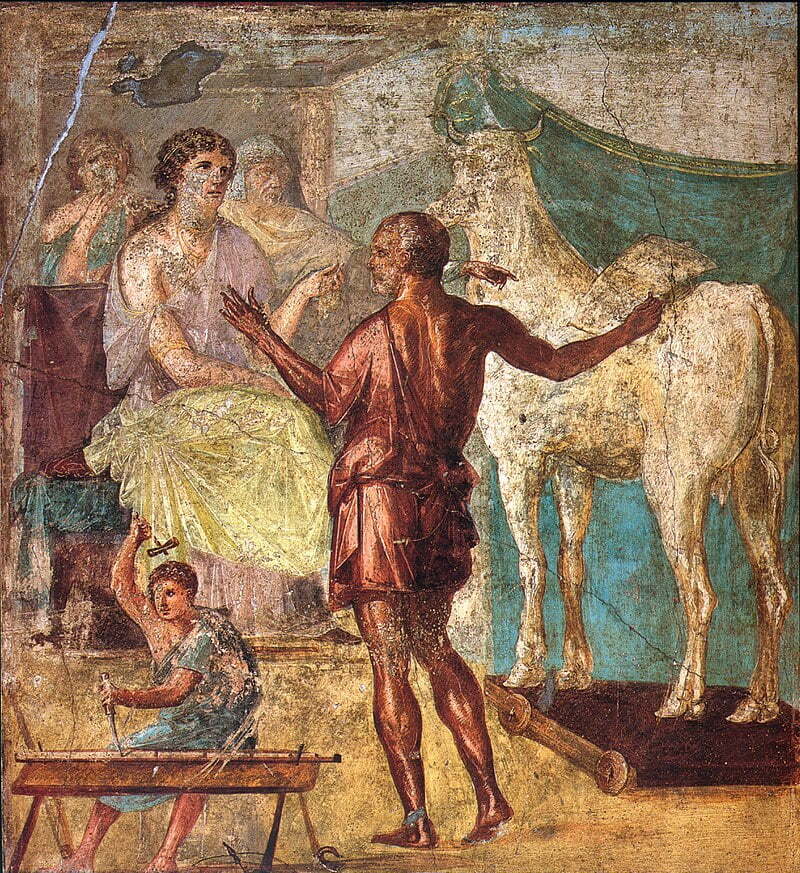
Mythological Figures: Daedalus (5E)
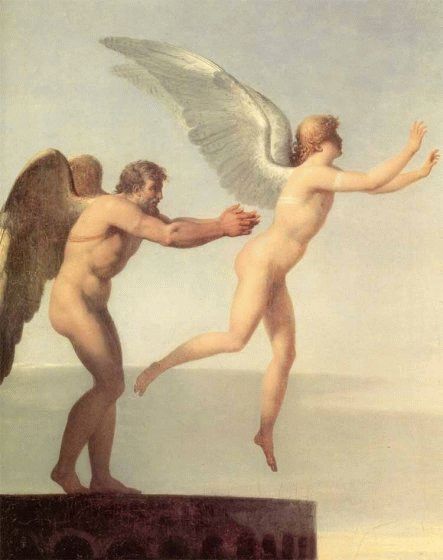
(Musée des Beaux-Arts et de la Dentelle, Alençon)
Mythological Figures: Daedalus (5E) | EN World | Dungeons & Dragons | Tabletop Roleplaying Games
Daedalus
Medium humanoid (human), neutral good rogue (genius) 9
Armor Class 14 (studded leather)
Hit Points 36 (8d8)
Speed 30 ft.
| STR | DEX | CON | INT | WIS | CHA |
| 14 (+2) | 15 (+2) | 10 (+0) | 20 (+5) | 14 (+2) | 8 (-1) |
Saving Throws Dex +6, Int +9
Skills History +9, Insight +10, Investigation +13, Perception +6, Religion +9, Stealth +6
Tools carpenter’s tools +8, disguise kit +4, forgery kit +4, dice set +4, mason’s tools +8
Senses passive Perception 16
Languages Common and two others
Challenge 3 (700 XP)
Background: Advisor – Master. Daedalus is frequently made to take on apprentices, training them in the ways of the mechanical arts. His subordinates obey his commands and believe what he tells them (within reason).
Cunning Action (1/turn). Daedalus can take a bonus action to take the Dash, Disengage, Help, or Hide action.
Evasion. When Daedalus is subjected to an effect that allows him to make a Dexterity saving throw to take only half damage, he instead takes no damage if he succeeds on the saving throw, and only half damage if he fails.
Fast Learner. After Daedalus has heard a creature speak for 1 minute or longer, he can mimic its manner of speaking as long as he knows the same language as the creature (allowing him to seem like he is local to a given region).
Sneak Attack (1/turn). Daedalus deals an extra 17 (5d6) damage when he hits a target with a weapon attack and has advantage on the attack roll, or when the target is within 5 feet of an ally of Daedalus that isn’t incapacitated and Daedalus doesn’t have disadvantage on the attack roll.
Tactician. Daedalus is able to use the Help action to aid an ally attack a creature as long as the target of the attack is able to see and hear Daedalus and is within 30 feet of him.
Tactician’s Insight. After Daedalus has observed or interacted with a creature for 1 minute, he learns whether or not it has higher or lower Intelligence, Wisdom, or Charisma scores than him. In addition, he learns if the target has more or fewer class levels than him. Daedalus also knows when he and the target have equal scores in one of these categories.
ACTIONS
Dagger.Melee or Ranged Weapon Attack: +6 to hit, reach 5 ft. or thrown 20/60 ft., one target. Hit: 4 (1d4+2) piercing damage.
Light Crossbow.Ranged Weapon Attack: +6 to hit, range 80/320 ft., one target. Hit: 6 (1d8+2) piercing damage.
REACTIONS
Uncanny Dodge. When an attacker Daedalus can see hits him with an attack, Daedalus can use his reaction to halve the attack’s damage against him.
Character and Lore
Daedalus belongs among the great Hellenic NPCs: not because he conquers cities, slays monsters, or wins divine favour through purity, but because his work changes what rulers can hide.
He believes skill should outrank birth, command, and brute force. A ruler may hold the throne, but the maker decides where the walls stand, where the air moves, where the hidden stair descends, and which door cannot be opened from the inside.
That belief makes him useful. It also makes him proud.
Later traditions connect Daedalus not only with invention and architecture, but also with jealousy toward a gifted young apprentice, often named Perdix, Talos, or Calos. This matters in play because it prevents him from becoming too clean. Before he is trapped by Minos, Daedalus has already shown that fear of being surpassed can become violence.
The Labyrinth is his greatest triumph and his greatest public crime. It is not just a maze. It is a political structure: a palace’s shame, a king’s secrecy, a queen’s punishment, and a monster’s prison fused into one work of stone.
His escape by wings is the opposite kind of invention: fragile, intimate, and desperate. The Labyrinth hides a royal crime. The wings expose a father’s failure. Together, they define him.
Personality
Daedalus speaks like a man already measuring the room. He notices hinges, sightlines, airflow, loose stones, fear, and pride before he notices hospitality. He rarely says a thing is impossible. He says it is expensive, unstable, immoral, unfinished, or likely to kill the wrong person.
He is not cruel for pleasure, but he has made peace with harm when harm arrives through craft. That is his central flaw. A sword kills openly. A labyrinth lets its maker pretend he only designed corridors.
He loves Icarus, but grief has not made him soft. It has made him exacting. He is hardest on young geniuses, apprentices, reckless heirs, and anyone who reminds him of the boy who flew too high.
Motives
Survival: Daedalus has lived under tyrants and knows that genius attracts cages.
Control: A hidden machine, prison, automaton, or passage may still be operating after years of misuse.
Reputation: He wants his craft remembered as more than the Labyrinth and the fall of Icarus.
Secrecy: Some designs should never be copied.
Defiance: He hates being owned, even though he has served power more often than he admits.
Atonement without confession: Daedalus may repair damage caused by his inventions while refusing to admit the full depth of his guilt.
Fears
Daedalus fears being trapped by his own work. He fears apprentices surpassing him. He fears that Icarus died not because youth ignored wisdom, but because Daedalus’s wisdom was incomplete.
Most of all, he fears that every invention is a door, and every door eventually opens for someone worse.
Using Daedalus in Your Campaign
Use Daedalus when you want a problem to feel engineered rather than accidental.
He can be a patron who commissions the party to recover stolen designs, rescue an apprentice, or destroy a corrupted machine. He can be a prisoner hidden beneath a palace, forced to maintain the very structure that holds him. He can be a fugitive pursued by Minos, temple authorities, rival inventors, or the families harmed by his devices.
He also works as a dungeon architect whose old works form the campaign’s most memorable ruins, a guilty witness who knows how a monster was hidden, or a dangerous teacher for an artificer, rogue, wizard, engineer, or craftsman PC.
Daedalus should be useful enough that the party wants his help, and compromised enough that accepting it creates consequences.
Table Use
A Daedalus scenario should include at least one of these pressures:
- A structure with moral meaning, not just tactical complexity.
- A device that solves one problem while creating another.
- A patron who wants the invention but not the responsibility.
- A younger craftsman, child, apprentice, or heir endangered by ambition.
- A secret passage that changes the political truth of a place.
- A monster, prisoner, or victim hidden because someone powerful could not bear public shame.
Magic and Craft Notes
Daedalus does not need to be a powerful battle-mage. His magic should support craft, containment, secrecy, repair, and escape. Spells such as alarm, arcane lock, comprehend languages, detect magic, floating disk, locate object, mage hand, mending, message, and unseen servant suit him because they serve the workshop, the prison, the hidden door, the guarded chest, the sacred blueprint, and the controlled site.
At the table, his spells should rarely feel like spectacle. They should feel like the last unseen part of a mechanism: a lock that closes by itself, a message scratched into bronze, a tool moving without a hand, a damaged hinge repairing just enough to seal the wrong person inside.
Adventure Hooks
The Second Labyrinth
A king has secretly commissioned Daedalus to build a new prison beneath a palace, claiming it will hold a monster. Daedalus privately asks the party to investigate before construction is complete. The “monster” may be a rightful heir, a cursed child, a political witness, or something genuinely dangerous that the king created.
The Wings That Did Not Fail
A set of wax-and-feather wings appears in the hands of a young noble who should not know Daedalus’s designs. The wings work too well. Someone has improved the original pattern, and Daedalus is terrified because the new design removes the one limit that kept fools and tyrants close to the earth.
The Apprentice’s Fall
A gifted young craftswoman claims Daedalus murdered or ruined her predecessor out of jealousy. Daedalus insists the story has been twisted. The party must uncover whether the old master is guilty, whether Athena intervened, and whether the supposedly dead apprentice has returned in another form.
Minos Comes Searching
King Minos travels from court to court with an impossible riddle, using it to find Daedalus. Any ruler who solves the riddle is suspected of hiding him. The party must decide whether to protect Daedalus, surrender him, fake his death, or turn the riddle back against Minos.
The Moving Statues
Old cult images attributed to Daedalus begin walking at night. They do not attack at first. They open doors, move offerings, block roads, and stand outside the houses of people whose ancestors benefited from hidden crimes. Daedalus says he never made them to move. He is lying, but not about everything.
The Minotaur’s Door
A sealed passage in the original Labyrinth opens for the first time in generations. Inside are bones, traps, Daedalus’s maintenance marks, Ariadne’s thread-signs, and evidence that someone else entered after Theseus and came out changed.
Secrets Daedalus May Know
The Labyrinth has more than one centre. Asterius, the Minotaur of Crete, was not the only thing hidden there.
Ariadne’s thread was not simple string. It may have been a ritual path-marker, a charm, a map encoded in touch, or a device Daedalus designed.
The wings were not meant for Icarus. The first pair may have been built for a different prisoner, sacrifice, or royal escape.
Minos was not Daedalus’s worst patron. Another ruler, temple, or immortal power may have commissioned something worse.
The apprentice did not die cleanly. Perdix, Talos, or Calos may survive as a transformed creature, rival inventor, divine servant, or bitter spirit.
Daedalus as Patron
Daedalus pays in knowledge, devices, safe routes, secret doors, and impossible repairs. He does not hand out wonders casually. He knows too well what happens when powerful tools reach vain hands.
Possible rewards include a map through an unmappable structure, a one-use escape device, a construct-disabling key, a hidden compartment built into armour or a wagon, a repaired relic with one dangerous limitation, or training in engineering, trapcraft, craft magic, or architectural investigation.
Daedalus as Enemy
Daedalus should not fight like a duelist. He fights like a man who arranged the room yesterday.
An encounter against him should involve doors, machinery, misdirection, elevation, smoke, collapsing platforms, constructs, false exits, and moral pressure. The party should win by understanding the design, not merely by damaging him.
If Daedalus becomes a true antagonist, his danger is not malice but rationalisation. He can justify almost anything as containment, experiment, necessity, secrecy, or correction.
Treasure and Equipment
Daedalus should carry little ordinary treasure. His wealth is in tools, plans, rare materials, and unfinished prototypes.
Suggested treasure includes masterwork architect’s instruments worth 500 gp, a portable artificer’s tool chest worth 1,000 gp, hidden design tablets worth 2,500 gp to the right patron, a sealed plan for a flying harness or moving statue, and a sacred offering once dedicated after Icarus’s death.
He may also possess one of the following signature devices.
Daedalian Key
A folded bronze-and-ivory key that changes its teeth when turned in a lock. It can open one nonmagical lock per day without a check, provided the lock was made by mortal hands. Against magical locks, it grants Advantage or a +4 bonus on the relevant check.
Wax-and-Feather Wings
These wings allow limited flight but are vulnerable to heat, storm, sea spray, and reckless ascent. They should feel miraculous and dangerous, not like ordinary magic gear.
In D&D terms, they grant a fly speed of 40 feet for up to 10 minutes. When the wearer climbs recklessly, flies into dangerous heat, ignores storm wind, or treats the wings as ordinary equipment, they must succeed on a DC 15 Wisdom saving throw. On a failure, the wings begin to fail. The wearer has 1 round to descend, grab support, or be rescued before falling.
The Labyrinth Thread
A thread, cord, or marked line prepared by Daedalus that remembers turns. A creature holding it gains Advantage on checks to retrace a path through a maze, dungeon, palace, fog bank, dream-space, or magically confusing structure. If cut, stolen, or knotted by an enemy, it may lead the bearer to the wrong centre.
Roleplaying Daedalus
“Every prison begins as someone’s solution.”
“No, the door is not hidden. The room is lying about which wall is important.”
“A king never asks for a monster’s cage until he has already made the monster.”
“I warned the boy. That is not the same as saving him.”
“Do not praise the invention until you have named who will suffer when it works.”
Keep this reference growing
If this page helped with your reading or game, you can support its upkeep or explore the curated books.
Explore the Bookshop — epics, classics and stories behind imagined worlds.