
Niklaus Stuller — The Black Banger Road-Murderer
Niklaus Stuller — The Black Banger Road-Murderer
A murderer remembered not for greatness, but because his crimes make even an executioner’s book feel like a warning.
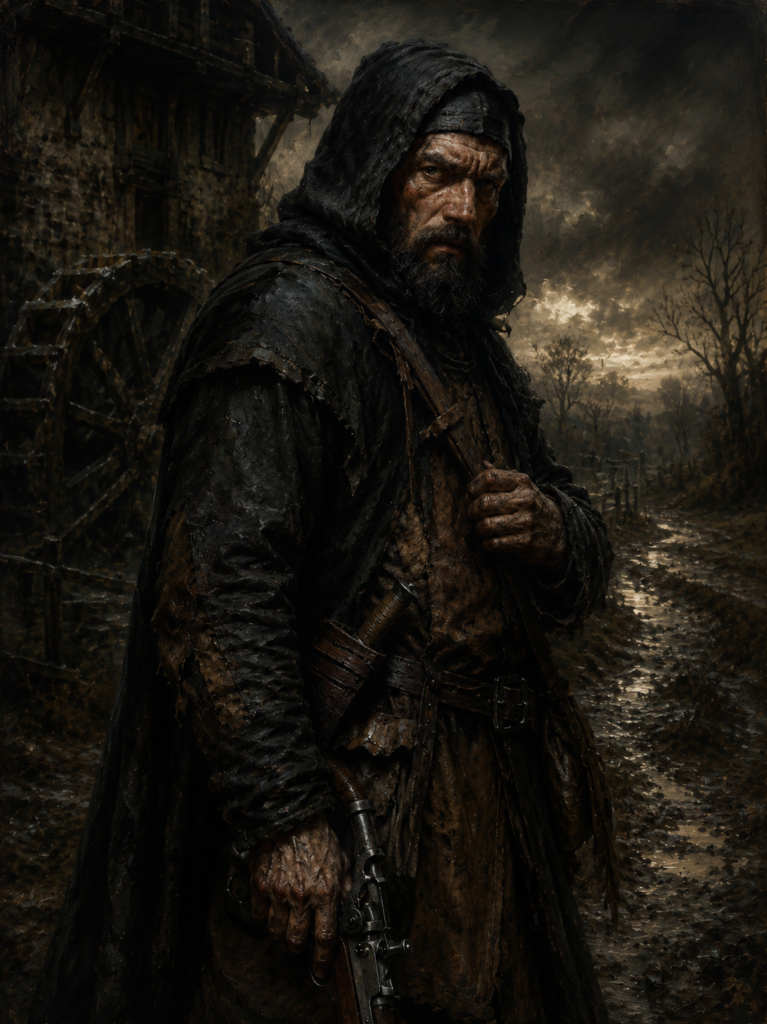
- Full Name: Niklaus Stuller
- Likely Historical Form: Niklaus Stüller
- Common Name: Niklaus Stuller
- Alias: The Black Banger
- Gender: Male
- Race: Human
- Occupation: Murderer, road predator, outlaw, accomplice in violent crime
- Nationality / Region: German-speaking lands of the Holy Roman Empire; associated with Eisfeld, Sonneberg, Coburg, and Bamberg
- Base of Operations: Roads, mills, woodland tracks, river crossings, lonely farms, and the margins between jurisdictions
- Languages: German, thieves’ cant, enough market speech to deceive travellers
- Religion: Functionally impious; in campaign terms, he severs himself from oath, household, birth, burial, and mercy
- Alignment: Chaotic Evil
- Affiliations: Criminal companions; frightened informants; receivers of stolen goods; violent men hiding between towns
- Allies: Desperate fugitives, corpse-strippers, corrupt fences, and accomplices who know too much to leave him alive
- Enemies: Town guards, local magistrates, road wardens, surviving witnesses, betrayed accomplices, bereaved families, and communities that have begun to recognise the pattern of his crimes.
- NPC Role: Horror villain, hunted murderer, execution-record mystery, haunted-road threat, or grim legal case
Niklaus Stuller is not a grand villain. That is what makes him dangerous.
He is not a prince, warlock, cult master, or demon’s chosen butcher. He is a man from the road: violent, predatory, mobile, and remembered through the cold language of execution records. In the surviving journal of Meister Frantz Schmidt, Stuller appears as Niklaus Stüller from Eisfeld, called Black Banger, a murderer who, with companions from Sonneberg, commits eight murders. Schmidt’s record says Stuller is punished at Bamberg by being drawn on a sled, torn with red-hot tongs, and executed with the wheel.
That is enough for a campaign.
Stuller works best when he makes ordinary travel feel unsafe again. He is the reason a mill bars its doors before sunset, why a pregnant woman does not walk between villages alone, why a cart-driver keeps a loaded pistol under the seat, and why an executioner writes one name with no need for ornament. His crimes are not interesting because they are spectacular. They are interesting because they attack the fragile structures that make settlement possible: birth, baptism, hospitality, roads, kinship, and the belief that even a stranger has limits.
Do not make him glamorous. Stuller is strongest as a human horror: a man whose evil depends on opportunity, accomplices, weak law, bad roads, and the failure of decent people to act soon enough.
Personality
Stuller is not charismatic in a courtly sense, but he understands fear. He knows when to stay silent, when to let another man speak, when to pretend dullness, and when to make his companions believe there is no way back except through more blood.
He rarely rages in public. His danger lies in calculation without conscience. He can eat beside a corpse, laugh at an oath, ask for ale after violence, and sleep if he thinks the hiding place is good.
When cornered, he becomes practical. He bargains, lies, names accomplices, invents patrons, pleads drunkenness, claims another man leads him, or insists he can reveal where bodies, goods, or coins are hidden. His confession is not repentance. It is another attempt to control the room.
Motives
Stuller does not need a grand cause. He kills because violence gives him money, silence, movement, and control.
His strongest motives are practical and predatory:
- Profit: He robs travellers, strips bodies, and sells stolen goods through fences or frightened accomplices.
- Elimination of Witnesses: He kills people who can identify him, trace his movements, or expose his companions.
- Control: He uses fear to dominate victims, accomplices, and small communities that lack the strength to resist him openly.
- Opportunity: He chooses isolated roads, bad weather, weak law, and moments when no one expects help to arrive.
- Self-Preservation: When threatened, he lies, bargains, names others, invents patrons, hides evidence, or kills again to stay free.
Stuller is most convincing when his evil remains human and immediate. He is not trying to reshape the world. He is trying to pass through it without consequence, leaving bodies, fear, and broken households behind him.
Fears
Stuller does not fear guilt. He fears helplessness.
He fears being bound, displayed, judged, and made small. He fears crowds because a crowd turns private violence into public memory. He fears executioners because they understand bodies without flinching. He fears midwives, priests, and old women more than soldiers, because they name the kind of wrong he does.
Most of all, he fears truth surviving him. He wants fear to remain, not justice.
A strong scenario turns this against him: the party’s task is not merely to kill or capture Niklaus Stuller, but to make sure his lies do not outlive his victims.
Niklaus Stuller 5.5e / 2024-Compatible Stat Block
Niklaus Stuller, the Black Banger, Pathfinder 1e Stat Block
Niklaus Stuller 5.5e / 2024-Compatible Stat Block
Medium Humanoid, Chaotic Evil
Armor Class: 15
Initiative: +3
Hit Points: 91 (14d8 + 28)
Speed: 30 ft.
Proficiency Bonus: +3
| STR | DEX | CON | INT | WIS | CHA |
|---|---|---|---|---|---|
| 14 (+2) | 16 (+3) | 14 (+2) | 12 (+1) | 13 (+1) | 11 (+0) |
Saving Throws: Dex +6, Con +5, Wis +4
Skills: Athletics +5, Deception +3, Intimidation +6, Perception +4, Stealth +6, Survival +4
Senses: passive Perception 14
Languages: German, thieves’ cant
Challenge: 5 (1,800 XP)
Traits
Ambusher. Stuller has Advantage on Initiative rolls while hidden, travelling with prepared accomplices, or attacking from concealment.
Brutal Opportunist. Once per turn, when Stuller hits a creature that has the Frightened, Grappled, Prone, Restrained, or Surprised condition, or when he hits a creature within 5 feet of one of his allies, the target takes an extra 10 (3d6) damage.
Hard to Bring to Trial. Stuller has Advantage on ability checks and saving throws made to escape grapples, slip bonds, resist forced movement, or flee through crowds, woods, mud, smoke, or darkness.
Road Predator. Stuller has Advantage on Wisdom (Survival) checks made to track travellers, choose ambush ground, identify isolated shelters, or avoid patrol routes.
Actions
Multiattack. Stuller makes two attacks, using Knife, Heavy Club, or Pistol.
Knife. Melee Weapon Attack: +6 to hit, reach 5 ft., one target. Hit: 8 (2d4 + 3) piercing damage.
Heavy Club. Melee Weapon Attack: +5 to hit, reach 5 ft., one target. Hit: 7 (1d8 + 2) bludgeoning damage. If Stuller has Advantage on the attack roll and the target is Medium or smaller, the target must succeed on a DC 14 Strength saving throw or have the Prone condition.
Pistol. Ranged Weapon Attack: +6 to hit, range 30/90 ft., one target. Hit: 13 (2d8 + 4) piercing damage. The pistol must be reloaded after firing. In campaigns without firearms, replace this with a heavy crossbow: +6 to hit, range 100/400 ft., one target. Hit: 8 (1d10 + 3) piercing damage.
Dirty Throw. Stuller throws ash, mud, blood, lime, or road grit at one creature within 10 feet. The target must succeed on a DC 14 Dexterity saving throw or have the Blinded condition until the end of its next turn.
Bonus Actions
Vanish into Disorder. Stuller takes the Hide or Disengage action if he is in dim light, smoke, woodland, a crowd, a cluttered building, or adjacent to a Frightened creature.
Kick the Wounded. Stuller targets one Prone creature within 5 feet. The target must succeed on a DC 14 Constitution saving throw or take 5 (1d6 + 2) bludgeoning damage and be unable to take Reactions until the start of Stuller’s next turn.
Reactions
Use the Witness. When a creature Stuller can see hits him with an attack while another creature is within 5 feet of him, Stuller forces the attacker to reroll the attack unless the attacker succeeds on a DC 14 Wisdom saving throw. On a failed save, the attacker must use the lower roll. This trait requires a plausible obstruction, hostage, animal, fallen body, or panicked bystander.
Encounter Guidance
Stuller alone is dangerous but beatable. He becomes frightening with terrain, hostages, darkness, locked doors, one or two lesser accomplices, and time pressure. He should not stand in an open road trading blows with heroes unless cornered.
Niklaus Stuller, the Black Banger, Pathfinder 1e Stat Block
CR 5
XP 1,600
Male human rogue 5 / fighter 1
CE Medium humanoid
Init +7; Senses Perception +10
Defense
AC 18, touch 13, flat-footed 15 (+4 armour, +3 Dex, +1 natural or hardened leathers)
hp 52 (6 HD; 5d8+1d10+18)
Fort +6, Ref +8, Will +3
Defensive Abilities evasion, trap sense +1, uncanny dodge
Offense
Speed 30 ft.
Melee masterwork dagger +9 (1d4+3/19–20) or sap +8 (1d6+2 nonlethal)
Ranged pistol +9 touch (1d8/×4) or heavy crossbow +8 (1d10/19–20)
Special Attacks sneak attack +3d6
Tactics
Before Combat Stuller chooses ground with poor sightlines, mud, doors, livestock, carts, frightened witnesses, or a clear escape route.
During Combat He attacks isolated or injured targets, blinds enemies with thrown filth, threatens hostages, and flees when the fight becomes orderly.
Morale Stuller begs, bargains, lies, names accomplices, or runs when reduced below 15 hp. If he believes capture means execution, he becomes reckless.
Statistics
Str 14, Dex 17, Con 14, Int 12, Wis 13, Cha 10
Base Atk +4; CMB +6; CMD 19
Feats Improved Initiative, Point-Blank Shot, Precise Shot, Quick Draw, Skill Focus (Stealth), Weapon Finesse
Skills Acrobatics +11, Bluff +9, Climb +10, Disable Device +11, Disguise +7, Escape Artist +11, Intimidate +10, Knowledge (local) +9, Perception +10, Sense Motive +7, Stealth +14, Survival +9
Languages German, thieves’ cant
Combat Gear pistol or heavy crossbow, powder and shot if firearms are used, masterwork dagger, sap, smoke pot, caltrops, manacles
Other Gear studded leather, dark cloak, false travel tokens, stolen purse, cheap protective charm carried as disguise rather than devotion, blood-stiffened gloves, small knife for cutting bonds
How to Use Niklaus Stuller in a Campaign
Use Niklaus Stuller when you want the campaign to become morally cold for a session or arc. He belongs in stories about unsafe roads, corrupted justice, execution records, haunted punishment sites, and the ugly border between law and vengeance.
He works especially well in four roles.
The Hunted Man: Stuller is alive and moving between jurisdictions. Each town thinks the murders happen elsewhere until the pattern becomes undeniable.
The Prisoner Who Knows Too Much: Stuller is captured, but his accomplices, victims, and hidden evidence still matter. The party must escort him, interrogate him, or keep him alive long enough for trial.
The Dead Man’s Stain: Stuller has already been executed, but something remains: a cursed sled-route, a wheel-post, a bloodied millstone, or a restless spirit tied to crimes no one properly answers.
The Name in the Executioner’s Book: The party finds his case in an executioner’s journal and realises one detail does not match. Someone else escapes punishment.
Adventure Hooks
The Executioner’s Omission
An executioner’s journal records Stuller’s punishment, but one line has been scraped away and rewritten. The missing line names a protected receiver, a surviving accomplice, or the hiding place of stolen goods. The party must recover the truth before a town official destroys the record to protect his family name.
The Road Where Women Vanish
Pregnant women travelling between two towns begin disappearing. Locals blame wolves, soldiers, or spirits of the wood, but an old execution broadside names the same road and the same pattern from decades earlier. Either Stuller lives under an impossible curse, someone imitates him, or one of his old accomplices is never punished.
The Sled from Bamberg
A punishment sled once used to drag condemned criminals to execution reappears outside a chapel, though it was burned years ago. Anyone who touches it dreams of a black-bearded man laughing beneath iron tongs. The sled is not asking for pity. It is calling for completion.
The Baptism That Does Not Happen
A priest asks the party to investigate a rural haunting where infants’ cries sound beneath frozen earth. The locals refuse to speak of Stuller’s companions and the crime that makes even murderers accuse one another. The party must decide whether justice lies in exposing the dead, punishing the living, or performing rites long denied.
The Accomplice in the Walls
A respectable old house in Coburg begins bleeding through its plaster. Hidden behind the wall are stolen goods, a weapon, and a written confession naming the men who ride with Stuller. Their descendants now hold office and will kill to keep the family clean.
Secrets and Clues
Common Knowledge: Stuller is a murderer whose name becomes a warning on the road.
Known to Guards and Executioners: He does not act alone. His crimes tie him to companions from Sonneberg.
Known to Priests and Midwives: His crimes are remembered not only for killing, but for offences against birth, baptism, and household continuity.
Hidden Truth: A local official delays pursuit because Stuller’s violence keeps certain roads, witnesses, or debts conveniently silent.
Supernatural Truth: The law finishes the man, but the land remembers what mercy never heals.
Table Behaviour
Stuller should create pressure before he appears. Let the table hear about him through missing travellers, empty carts, dogs that refuse to cross a ditch, a miller who keeps a loaded weapon by the door, and an executioner who refuses to exaggerate.
When he appears, keep him grounded. He should not monologue. He should notice exits. He should use hostages, darkness, mud, smoke, weather, frightened witnesses, and rough terrain. He should run if running is wise. He should kill a witness if the table gives him time.
Do not make him impressive in the wrong way. He is not a dark genius. He is a human horror made dangerous by opportunity, accomplices, weak law, and the failure of ordinary protections.
Evidence, Treasure, and Aftermath
Stuller’s treasure should be ugly rather than glamorous.
On His Person: 3d10 gp, 2d6 sp, a stolen ring, a woman’s corded belt, a cheap local protective charm, a knife, a pistol or crossbow, and a blood-marked token from a victim.
Hidden Cache: 120 gp in mixed coin, trade goods worth 80 gp, two purses from murdered travellers, a rusted strongbox, letters from an accomplice, and one object that identifies a protected patron or corrupt receiver.
Moral Treasure: The real reward is proof: a confession, a named accomplice, a recovered account, burial knowledge, or evidence that lets a family reclaim the truth.
Aftermath: Capturing or killing Stuller should not end the matter. His companions, protectors, imitators, victims, and execution record all create further play.
Source and Literary Context
Niklaus Stuller, more accurately given in the cited execution record as Niklaus Stüller, is an obscure 16th-century murderer associated with the journal of Meister Frantz Schmidt, the executioner later known for his long service at Nuremberg. Schmidt’s record for 1577 identifies “Niklaus Stüller from Eisfeld,” also called “Black Banger,” and states that he and companions from Sonneberg committed eight murders. The same entry records that Stüller was punished at Bamberg by being drawn on a sled, torn with red-hot tongs, and executed with the wheel. A modern edition is available as The Executioner’s Journal: Meister Frantz Schmidt of the Imperial City of Nuremberg.
The campaign version above treats Stuller as a historically rooted but sparsely documented criminal figure. The surviving material is severe but brief, so the adaptation avoids presenting him as a fully recoverable biography. He is best used as a grim road-murderer, execution-record villain, or haunted-crime figure whose crimes expose the breakdown of safe travel, household protection, childbirth rites, and public justice.
Keep this reference growing
If this page helped with your reading or game, you can support its upkeep or explore the curated books.
Explore the Bookshop — epics, classics and stories behind imagined worlds.