
Arthur’s foster-brother keeps Camelot fed, guarded, judged, insulted, and alive.

- Name: Sir Kay the Tall
- Other Names: Kay, Cai, Cei, Kei, Sir Kay the Seneschal
- Kind: Human knight with old heroic gifts
- Role: Seneschal of Camelot, Knight of the Round Table, Arthur’s foster-brother
- Household: Son of Sir Ector
- Alignment: Lawful Neutral
- Languages: English, Welsh, French, Latin
- Challenge Role: Court commander, household enforcer, social obstacle, mounted opener
- Usual Company: Household knights, squires, clerks, servants, men-at-arms, grooms, messengers, and gate-guards
- Primary Use in Play: The difficult man between the characters and Arthur
Overview
Sir Kay is the man who makes Camelot function when the songs stop.
Other knights chase marvels, break enchantments, win impossible duels, and return with names fit for poems. Kay counts horses, assigns chambers, posts guards, questions strangers, watches prisoners, disciplines servants, controls access to Arthur, and turns royal intention into household law.
He is Arthur’s foster-brother, not merely an officer. That gives him a freedom no ordinary courtier has. Kay can contradict Arthur, insult a prince, block a famous knight from the hall, or send a proud youth to the kitchens and survive the consequences.
His loyalty is real. It is also hard, jealous, proud, and often unpleasant.
Kay is not Camelot’s greatest knight, and he knows it. That knowledge has made him sharp. He mocks the untested, distrusts easy glory, and treats courtesy as something earned rather than owed. Many hate him. Many more rely on him.
In the campaign, Kay should not be a secret villain, a comic fool, or a bland loyal knight. He is Camelot’s necessary hard man: Arthur’s brother in all but blood, the keeper of doors, the breaker of boasts, and the old fire of Cei reduced to human scale.
Appearance
Kay is tall, narrow, and hard-faced, with the look of a man who has spent too many years listening for excuses. His hair is dark with iron-grey at the temples. His eyes are pale, cold, and watchful.
He dresses better than a frontier knight but less richly than a court peacock: polished plate, a severe surcoat, a seneschal’s chain, a heavy belt of keys, and a sword worn for use rather than display.
At feast or council, he often stands rather than sits. He keeps one hand near his belt, where a key-ring, knife, seal, or folded writ is more likely to decide a moment than a sword.
In battle he carries shield and longsword. On campaign he may open a fight with a lance from horseback, but once the first shock is done he fights as a shielded household knight, closing ranks around Arthur, prisoners, banners, or the court’s vulnerable people.
When the old heroic gift rises in him, Kay seems taller than he is. Rain steams from his gauntlets. Frost melts on his shield. Men who stand too close feel as if they have come near banked coals under ash.
Personality and Manner
Kay is loyal, resentful, dutiful, suspicious, and brutally practical.
He does not welcome strangers because he knows strangers bring prophecy, debts, assassins, feuds, and hungry mouths. He does not flatter knights because knights already flatter themselves. He does not trust marvels because marvels rarely stable horses, feed servants, repair doors, pay ransom, or bury the dead.
His tongue is infamous. Kay insults the untested, needles the proud, and exposes weakness in public. Sometimes this is useful. A boastful knight learns discipline. A false pilgrim breaks under pressure. A hidden traitor reveals anger too quickly. Sometimes it is merely cruelty wearing the mask of office.
Kay’s best self is the man who protects Arthur’s household. His worst self is the man who cannot bear being second in a story that began in his own father’s house.
Court Office and Authority
Kay is seneschal, which makes him one of the most powerful practical officers in Camelot.
He controls access, lodging, feasts, guard rotations, household stores, prisoner custody, stable priority, messenger routes, court discipline, and much of the machinery that turns Arthur’s ideals into daily rule. A knight may outrank Kay in glory. Few outrank him in the corridors, kitchens, armouries, storerooms, gatehouses, and guarded passages where a royal court actually lives.
Kay is a social encounter before he is a combat encounter.
Kay at Court
Kay is often the first real test characters face in Camelot.
If they arrive with proof, discipline, humility, useful news, or proper witnesses, Kay may move them quickly through the court. He can provide lodging, safe stabling, armour repairs, a guarded audience, a quiet warning, or a place near someone important.
If they arrive boasting, armed without permission, lying about rank, insulting servants, mistreating prisoners, or demanding Arthur’s attention, Kay makes the court itself resist them. Doors close. Meals arrive late. Weapons are politely removed. Grooms misplace saddles. Guards ask the same questions twice. A clerk discovers a missing seal. A lesser knight is sent to “receive” them instead of Arthur.
Kay does not need to draw steel to become an obstacle.
What Kay Wants
Kay wants Arthur safe, Camelot orderly, fools humbled, liars exposed, and the household respected.
He also wants something he will not say aloud: to matter in a court increasingly defined by knights whose glory outshines his office. Kay’s tragedy is not that he lacks honour. It is that he fears honour has passed him by.
Relationships
- King Arthur: Arthur is Kay’s foster-brother and king. Kay loves him, resents him, obeys him, contradicts him, and protects him with the ferocity of a man who knew him before the crown.
- Sir Ector: Ector’s household made both Arthur and Kay. Kay’s office is bound to that old fosterage debt.
- Sir Bedivere: Bedivere is one of the few old companions who can answer Kay’s sharpness without turning it into a feud. Kay respects him because Bedivere remembers the earlier, harder world.
- Sir Gawain: Gawain’s courtesy exposes Kay’s failures. Kay knows it and dislikes being measured by it.
- Sir Lancelot: Kay resents Lancelot’s effortless superiority but cannot deny his greatness. Lancelot’s rescues humiliate Kay and save him at the same time.
- Young Knights: Kay is often their first wall. He mocks them, tests them, and may accidentally forge them into legends.
- Hostile Courts: Enemies of Camelot know Kay’s pride can be baited. They also learn that baiting him near Arthur’s household is dangerous.
Currently in the World
Kay is usually found in Camelot’s working heart: the gate court, the armoury, the kitchens before a feast, the guard-room, the stable-yard, the prisoner hall, or the passage outside Arthur’s council chamber.
He rides when duty demands it, not because he enjoys wandering after marvels. If encountered on the road, he is rarely alone. He travels with squires, grooms, household guards, led horses, sealed orders, or prisoners under escort. He may be carrying ransom terms, investigating a failed garrison, summoning a knight home, escorting a royal guest, or recovering someone who has embarrassed the court.
Kay’s presence means Camelot is watching.
Mechanics Tabs
The rules below are mechanics compatible for different game editions.
Sir Kay the Tall 5.5e
Sir Kay the Tall Pathfinder 1e / 3.5e
Sir Kay the Tall 5.5e-Compatible Rules

Sir Kay the Tall
Medium Humanoid, Lawful Neutral
Armor Class 20
Initiative +2
Hit Points 153
Speed 30 ft.
Proficiency Bonus +4
| STR | DEX | CON | INT | WIS | CHA |
|---|---|---|---|---|---|
| 18 (+4) | 14 (+2) | 18 (+4) | 13 (+1) | 15 (+2) | 12 (+1) |
Saving Throws Str +8, Con +8, Wis +6
Skills Athletics +8, History +5, Insight +6, Intimidation +5, Perception +6, Persuasion +5
Damage Resistances cold, fire
Condition Resistances Kay has advantage on saving throws against exhaustion caused by cold, forced marching, drowning, smoke, or suffocation.
Senses passive Perception 16
Languages English, Welsh, French, Latin
Challenge 9
Traits
Seneschal of Camelot. In a royal court, military household, fortress, camp, or Arthurian-controlled hall, Kay has advantage on Charisma checks made to command guards, servants, squires, grooms, clerks, household knights, and other retainers. Non-hostile household personnel obey lawful orders from him unless doing so would clearly betray Arthur.
Nine-Night Endurance. Kay can hold his breath for nine days and nine nights. He ignores the first level of exhaustion he would gain from forced marching, cold exposure, sleep loss, or swimming.
Cei’s Heat. Kay cannot be made numb or helpless by ordinary cold. Rain, frost, and snow steam from objects he grips for more than a moment. Allies who begin their turn within 5 feet of Kay have advantage on saving throws against nonmagical cold.
Hard Wound. Once per turn, when Kay hits a creature with his Court-Forged Longsword, the target cannot regain hit points until the end of Kay’s next turn.
Tall as the Forest. As a Bonus Action, Kay can draw on the old heroic gift of Cei. For 1 minute, he becomes Large if there is room, his reach with melee weapons increases by 5 feet, and his weapon attacks deal an extra 1d8 damage. Once Kay uses this trait, he cannot use it again until he finishes a Long Rest.
Hard to Like, Harder to Move. Kay has advantage on saving throws against being Charmed or Frightened while he can see an ally, banner, royal seal, prisoner, gate, or doorway he has sworn to defend.
Actions
Multiattack. Kay makes two Court-Forged Longsword attacks. He may replace one Court-Forged Longsword attack with Shield Bash.
Court-Forged Longsword. Melee Weapon Attack: +8 to hit, reach 5 ft., one target. Hit: 13 (2d8 + 4) slashing damage, or 15 (2d10 + 4) slashing damage if used with two hands. While Tall as the Forest is active, this attack deals an extra 1d8 slashing damage and has reach 10 ft.
Shield Bash. Melee Weapon Attack: +8 to hit, reach 5 ft., one target. Hit: 11 (2d6 + 4) bludgeoning damage. If the target is Large or smaller, it must succeed on a DC 16 Strength saving throw or be knocked Prone.
Mounted Lance Charge. Kay must be mounted and must move at least 20 feet straight toward the target before making this attack. Melee Weapon Attack: +8 to hit, reach 10 ft., one target. Hit: 27 (3d12 + 8) piercing damage. If the target is Large or smaller, it must succeed on a DC 16 Strength saving throw or be knocked Prone. Kay cannot use Mounted Lance Charge as part of Multiattack. After the charge, he normally draws sword and shield.
Seneschal’s Command. Kay chooses up to three allied creatures within 60 feet that can hear him. Each chosen ally may use its Reaction to move up to half its speed without provoking Opportunity Attacks, make one weapon attack, or gain 10 temporary hit points. Once Kay uses this action, he cannot use it again until he rolls Initiative again or finishes a Short Rest.
Bonus Actions
Cutting Reproof. Kay targets one creature within 60 feet that can hear and understand him. The target must make a DC 16 Wisdom saving throw. On a failure, it subtracts 1d4 from the next attack roll, ability check, or saving throw it makes before the start of Kay’s next turn. If the target is an untested knight, proud noble, boastful warrior, or guest who has broken court custom, it has disadvantage on the save.
Reactions
Parry. Kay adds 3 to his AC against one melee attack that would hit him. To do so, he must see the attacker and be wielding a melee weapon or shield.
Hold the Door. When a creature Kay can see moves within 5 feet of an ally, prisoner, doorway, banner, or royal officer Kay is protecting, Kay may move up to 10 feet and make one Court-Forged Longsword attack against that creature.
Equipment
Plate armour, heavy shield, court-forged longsword, lance, dagger, seneschal’s chain, royal keys, wax seals, folded writs, household purse, and a hard-used cloak suitable for riding between halls.
Sir Kay the Tall Pathfinder 1e / 3.5e-Compatible Rules

Sir Kay the Tall
CR 9
XP 6,400
Male human unique knight
LN Medium humanoid
Init +2; Senses Perception +14
Defense
AC 24, touch 11, flat-footed 23
hp 115
Fort +13, Ref +7, Will +8
Defensive Abilities hard to move, nine-night endurance
Resist cold 10, fire 10
Offense
Speed 20 ft. in armour, 30 ft. unarmoured
Melee court longsword +17/+12 (1d8+5/19–20) or court longsword +14/+9 (1d8+11/19–20 with Power Attack)
Melee shield bash +15 (1d6+5)
Special Attacks bitter reproof, hard wound, mounted opening lance, seneschal’s command, tall as the forest
Ability Scores
| STR | DEX | CON | INT | WIS | CHA |
|---|---|---|---|---|---|
| 20 (+5) | 14 (+2) | 18 (+4) | 13 (+1) | 15 (+2) | 12 (+1) |
Base Atk +10; CMB +15; CMD 28
Feats Combat Reflexes, Improved Shield Bash, Iron Will, Mounted Combat, Power Attack, Ride-By Attack, Spirited Charge, Step Up, Weapon Focus longsword
Skills Diplomacy +14, Intimidate +17, Knowledge nobility +14, Perception +14, Ride +15, Sense Motive +15, Swim +12
Languages English, Welsh, French, Latin
Gear +1 full plate, +1 heavy steel shield, masterwork longsword, lance, dagger, seneschal’s chain, signet, royal keys, seals, writs
Special Abilities
Bitter Reproof (Ex). As a standard action, Kay may verbally cut down one creature within 60 feet that can hear and understand him. The target must succeed on a DC 16 Will save or become shaken for 1 round. A proud warrior, untested knight, boastful noble, or guest who has broken court custom takes a –2 penalty on this save. This is a language-dependent mind-affecting fear effect.
Cei’s Heat (Su). Kay is never made helpless by ordinary cold. Snow, rain, and frost steam from objects he grips for more than a moment. Allies within 5 feet of Kay gain a +2 circumstance bonus on saving throws against nonmagical cold and exposure.
Hard Wound (Su). A creature damaged by Kay’s longsword cannot benefit from magical healing, fast healing, or regeneration until the start of Kay’s next turn. This does not prevent ordinary stabilisation, binding wounds, or later healing once the effect ends.
Hard to Move (Ex). Kay gains a +4 bonus on saving throws against charm and fear effects while he can see an ally, banner, royal seal, prisoner, gate, or doorway he has sworn to defend.
Mounted Opening Lance (Ex). When mounted and charging with a lance, Kay deals an additional 2d6 points of piercing damage. This is an opening shock tactic, not his normal repeated attack routine.
Nine-Night Endurance (Su). Kay can hold his breath for nine days and nine nights, gains a +4 bonus on saving throws against exhaustion, drowning, suffocation, smoke, and cold exposure, and treats severe cold as one category less dangerous.
Seneschal’s Command (Ex). As a standard action, Kay may grant all allies within 30 feet who can hear him a +2 morale bonus on attack rolls, weapon damage rolls, and saving throws against fear until the start of his next turn. Alternatively, one affected ally may immediately move up to half its speed as an immediate action.
Tall as the Forest (Su). Once per day as a swift action, Kay may grow to Large size for 5 rounds, as if affected by enlarge person except that the effect is supernatural and cannot be dispelled by ordinary counterspelling. While enlarged, his reach increases to 10 feet and his longsword damage increases appropriately.
Combat Tactics
Kay does not fight like a wandering champion trying to win applause. He fights like a household officer trying to keep something important from collapsing.
In court, he begins with command, positioning, and words. He orders doors barred, prisoners moved, shields raised, lamps lit, servants cleared, and messengers sent. He uses Cutting Reproof or Bitter Reproof to break a boastful enemy’s rhythm, then lets guards and household knights close the space.
Mounted, Kay opens with one hard lance charge if the ground allows it. He does not make repeated lance attacks as a routine Multiattack. After impact, he draws sword and shield, presses the target, and uses Shield Bash to knock enemies down for allies.
On foot, Kay protects thresholds. He is at his best beside a doorway, banner, prisoner, wounded ally, or royal person. He wants enemies to come through him one at a time. If Tall as the Forest is active, he controls reach and space rather than chasing kills.
Kay retreats only if Arthur, a royal prisoner, a treaty, or the household records are in greater danger elsewhere. He is proud, but he is not stupid enough to die for vanity when the court still needs defending.
Playing Kay at the Table
Kay should make the players feel watched before they feel threatened.
Speak through him in short, cutting sentences. He notices mud on boots, false heraldry, a trembling squire, a borrowed sword, a missing seal, or a knight who lets servants carry too much. He does not explain himself unless forced.
His insults should usually have a point. If Kay is cruel, make him cruel about something true: cowardice, vanity, carelessness, broken custom, bad discipline, or a danger the characters have not yet noticed.
The best Kay scenes leave the players unsure whether they want to punch him, prove him wrong, or thank him later.
Using Sir Kay in Your Game
Use Kay when the party needs to feel the weight of Camelot as an institution.
He is not the king. He is not the shining knight. He is the man who decides whether the party reaches those people cleanly, late, armed, insulted, watched, or already in trouble.
Kay works best when he is right about something and wrong about how he says it. A suspicious stranger really is dangerous. A young knight really is arrogant. A prisoner really might escape. A feast really does require rules. The party should be able to dislike him without dismissing him.
Make him useful, necessary, and difficult.
Adventure Hooks
The Wrong Seat at the Feast
Kay humiliates a young knight, foreign envoy, or player character by seating them below their expected rank. The insult is deliberate. Kay believes they have lied about lineage, broken guest custom, or arrived under suspicious protection.
Before the feast ends, the insult becomes a legal problem. A duel, hostage claim, inheritance dispute, or old oath surfaces. Kay may have prevented a worse breach — or he may have turned a minor mistake into a court crisis.
Nine Nights Under Water
A sealed chest, drowned witness, cursed sword, or royal token lies beneath a black lake where ordinary divers die. Kay can survive the descent, but Arthur cannot spare him from court without exposing a political weakness.
The characters must escort him, bargain with him, or go in his place. Beneath the water, Kay’s old gift draws the attention of something that remembers Cei, not Sir Kay.
The Seneschal’s Prisoner
Kay is transporting a prisoner who has every reason to be hated: a traitor, killer, oath-breaker, enemy knight, or faerie spy. Along the road, several factions try to seize or murder the captive.
Kay refuses to explain everything because the truth is sealed under Arthur’s authority. The characters must decide whether to trust the harsh seneschal, the desperate prisoner, or the charming rescuers who claim Kay is carrying an innocent person to a false judgement.
Mythic and Historic Context
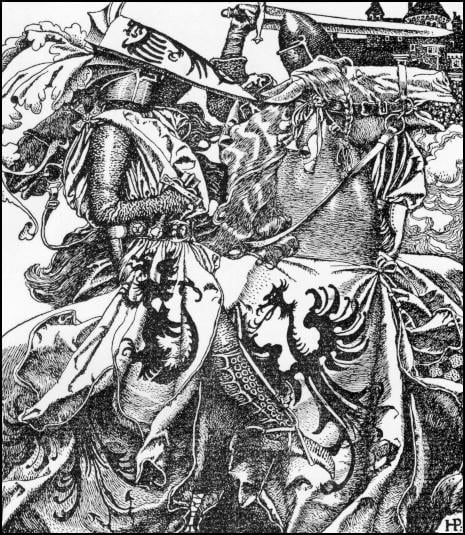
Sir Kay is one of the oldest and most persistent figures in Arthurian tradition. He appears under several names, including Kay, Cai, Cei, Kei, and Caius. In later romance he is usually Arthur’s foster-brother and seneschal, the sharp-tongued officer of the court whose loyalty to Arthur is rarely simple but usually remains secure. The Camelot Project gives a useful overview of this long development.
In early Welsh material, especially Culhwch and Olwen, Cai is far stranger and more powerful than the later courtly Kay. He is stubborn, supernaturally enduring, resistant to ordinary hardship, and associated with feats that feel closer to heroic myth than ordinary knighthood. This page keeps that older force alive in reduced form, making Kay more than a rude court official without turning him into a demigod.
In Sir Thomas Malory’s Le Morte Darthur, Kay is bound tightly to the Sword in the Stone episode and to Arthur’s fosterage. Kay first attempts to claim the sword after Arthur draws it, but the truth is soon revealed. Sir Ector then asks Arthur to make Kay seneschal, and Arthur grants the office for life. This makes Kay’s authority both political and deeply personal: he holds office because Arthur remembers the household that raised him.
For the campaign, Sir Kay is treated as a living Arthurian NPC: Arthur’s foster-brother, Camelot’s seneschal, and a difficult but loyal guardian of the court. His harshness should create playable pressure rather than simple villainy. He is the man who bars the gate, insults the unproven, protects the household, and reminds the table that Camelot is not only a dream of chivalry but also a working court full of food, keys, prisoners, pride, debt, and law.
Video
Keep this reference growing
If this page helped with your reading or game, you can support its upkeep or explore the curated books.
Explore the Bookshop — epics, classics and stories behind imagined worlds.