
Mount Parnassus — Delphi, Muses and Sacred Trails
Sacred Mountain of Central Greece · Delphi and the High Roads
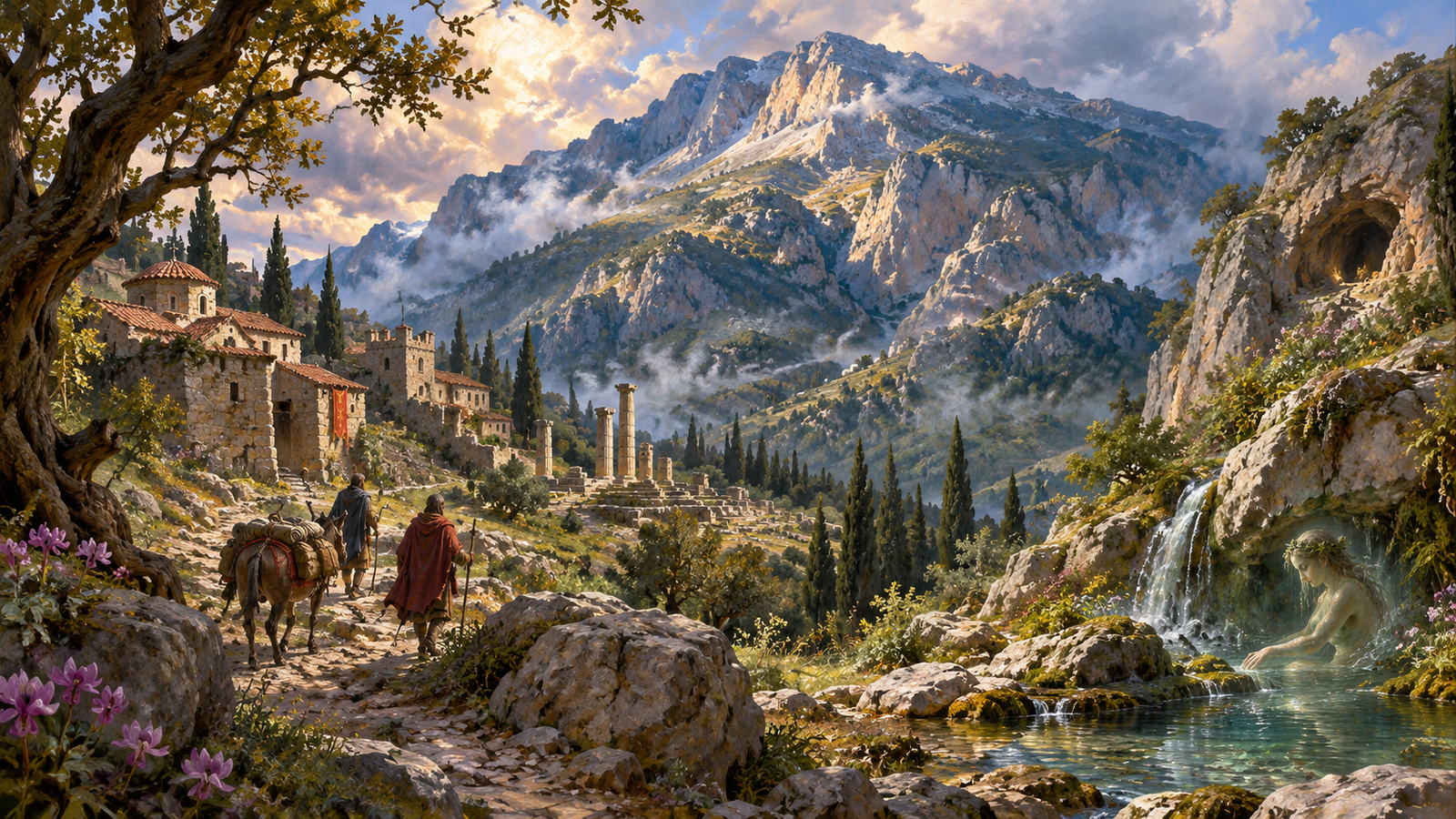
At a Glance
| Region | Central Greece; chiefly Phocis, also reaching towards Boeotia and Phthiotis |
|---|---|
| Landscape | Steep limestone slopes, wooded foothills, ravines, mountain paths, caves and high ridges |
| Great sanctuary | Delphi, on the south-western slopes of the mountain, historically sacred to Apollo |
| Ancient associations | Apollo, Pan, Dionysus, the Muses and the legend of Pegasus |
| People | Herders, mountain guides, travellers, village households and guardians of old sacred places |
| Adventure character | Oracle mysteries, difficult climbs, hidden shrines, family disputes and dangerous bargains |
At a shepherd’s shelter above Delphi, a stranger offers a gold coin for someone willing to carry a sealed tablet to the Corycian Cave. Two travellers claim the tablet was stolen from a dead prophet. The shepherd asks only that his daughter be allowed to return from the mountain before the weather breaks. Whoever is telling the truth, the storm will close the high pass by nightfall.
What Is Happening Right Now?
In Kastri, the village that has grown among Delphi’s ancient stones, herders bring sheep down from the high pastures and travellers hire guides before attempting the cave paths. The upper spring has begun to fail. Leontios knows the water belongs to the nymphs, but the shepherd households blame the dry weather and demand he open the route to its source. Chrysanthe the healer is caring for sick animals, and a broken bowl carried into the village may be the key to restoring the water. No distant lord can settle that quarrel by decree.
The celebrated ancient sanctuary at Delphi is not a civic institution unchanged from its Classical height. Its ruins and traditions survive amid later settlements, paths and rival powers. The gods and local guardians may still act in this fantasy world, but their presence must be discovered through particular people, places and signs.
On the slopes of Mount Parnassus stands Delphi, the great oracle of Apollo. The Castalian spring was sacred to pilgrims approaching the sanctuary. Greek tradition also associates the mountain with the Muses, giving it a lasting connection to poetry, music and learning.
Myths Remembered on the Mountain
Stories of fugitives, poets and gods give the mountain its many names. These belong to different heroic and ancient ages. Their sites may still preserve old promises and strange powers, but the people of the living mountain are not automatically participants in every story.
- Orestes is remembered as a fugitive in the tales of his family.
- Dionysus has a strong sacred association with the mountain, alongside Apollo.
- The Corycian Cave is associated with Pan and the nymphs; the Muses are also linked to the mountain’s poetry and music.
A pale pegasus drinks from a secluded pool near the north-facing ridge at daybreak. Its hoofprints end at bare rock, and more than one shepherd has watched it leap into the clouds. It does not carry every stranger who calls to it: the creature has become wary since hunters set snares near the pool. A ranger who frees its injured companion earns a safe approach; a hunter who tries to seize one of the horses will find the whole ridge hostile.
Places Adventurers Can Visit
Delphi and the Castalian Spring
The ancient oracle of Apollo stands amid the remains of Delphi, beneath the Phaidriades cliffs. The Castalian spring and the approaches to the sanctuary hold generations of stories. A person seeking a prophecy must distinguish a genuine omen from an inscription, a dream, a frightened witness or someone exploiting the sanctuary’s reputation.
The Corycian Cave
The Corycian Cave opens high above Delphi, with cold passages, slippery rock and chambers sacred to Pan and the Corycian nymphs. One of them, Koryke, guards a spring beneath the oldest votive stones. A careless visitor broke a bowl that held the first water drawn each season. The spring has retreated into a crack, and the shepherds’ animals now suffer on the high grazing ground.
Koryke speaks to those who come without torches or axes. She wants the broken dedication repaired, not a human sacrifice or a payment in gold. Leontios the guide knows which carved fragment was carried down to a house below Delphi; Chrysanthe the healer can find its present keeper. Restore the bowl and she releases the spring, with a safe way through the cave revealed in the wet stone. Rob the offerings and she will mislead the intruders in passages where daylight cannot reach them.
Shepherd Routes and High Ridges
Flocks, mule trains and travellers follow the lower paths while snow and bad weather may close the upper routes. A mountain pass can be held by an impoverished family, frightened guards or a genuinely supernatural guardian. Taking the wrong path costs food, daylight and trust.
Shelter, Supplies and Guides
The Pine Roof — Kastri’s Lower Lane
Near the lower lane of Kastri, a small house known as the Pine Roof offers barley soup, bread, wash water and space on woollen mattresses. Sofia, its widowed keeper, charges little to herdsmen and somewhat more to well-equipped travellers; there is room to tether mules outside but no guarded stable. She remembers who passed through the village and will lend blankets to anyone who helps a missing shepherd get home. Most nights her guests exchange songs, weather reports and arguments about the old sanctuary.
The Guide and the Healer
Leontios can guide a small party from Kastri to the Corycian Cave when the route is clear, but will not lead armed treasure hunters into the nymphs’ precinct. He asks for food and a fair day’s payment, not promises of imaginary treasure. Chrysanthe treats wounds, fever and sick animals with herbs and clean water at her house beside the lower spring. She has no store of rare magical remedies, but can point an herbalist or druid toward the plants that still grow below the snow line.
Stories, Study and the Road Out
Thalia, a singer and teacher, knows old hymns of Apollo and Dionysus and keeps copies of a few damaged inscriptions. She will trade knowledge for a reliable transcription or a performance, but not for an offer to strip the ruins. Common rope, food, oil and mule fodder can be bought or bartered in Kastri; metal repairs and specialised books are limited. Travellers who need the road to the plain should ask Leontios about the season and recent landslides before leaving.
People, Services and Dangers
Thalia has recognised the name of Koryke in an old dedication, but she refuses to guide strangers into the cave. Leontios helped the shepherds who took the sacred bowl down the mountain and is ashamed to admit it; his loyalty to those families may cost him Koryke’s trust. Chrysanthe needs the water restored before her remaining animals weaken. All three will remember whether visitors treat the villagers as frightened neighbours or convenient suspects.
Falls, sudden storms, lost trails and exhausted animals remain dangerous even after the spring is restored. Near the Corycian Cave, Koryke’s anger makes the rocks unnaturally slippery for armed intruders who have harmed the precinct. Those who leave tools outside and approach in peace can hear running water beneath the stone. A traveller who knows Pan’s rites may find another path to the cave; one who brings witnesses from Kastri can settle the quarrel without a fight.
Rumours and Adventure Openings
- The Twice-Spoken Prophecy. Two witnesses quote incompatible answers from the same ruined sanctuary. One has lied to protect a child; the other is hiding a lucrative betrayal.
- The Cave’s Last Lamp. An injured guide returns without his companions. He says a light remains burning deep within the Corycian Cave, and the families of the missing blame his broken promise.
- Song on the Ridge. A voice is heard before each storm. The villagers disagree whether it is a Muse, a mortal musician or a signal used by raiders. Finding the singer is only the beginning.
The Next Visit
Return to Kastri after the bowl has been repaired and the spring runs freely again: Sofia sets a place for the travellers at the Pine Roof, Leontios offers to guide them through a safer high passage, and Chrysanthe’s animals are recovering. If the fragments remain stolen, the well below the village has to be rationed, and strangers are blamed for the trouble. Koryke remembers anyone who harmed the offerings; her warning follows the offender to the next spring on the ridge.
Travel and Deeper History
From Kastri the path climbs past Delphi toward the Corycian Cave and the grazing grounds of Parnassus. To reach the coastal country a traveller descends toward Krissa and the Corinthian Gulf; to cross east into Boeotia, the road leads through the country of Arachova. The high cave path is unsuitable for a heavily laden cart and may close in bad weather, so a pack animal and a trusted guide matter more than a promised shortcut. The mountain lies chiefly in Phocis, with slopes reaching towards Boeotia and Phthiotis; Delphi occupies its southern flank, not the summit.
Those heading farther toward Athens must make the longer journey through central Greece, while people seeking other sacred mountains can consult Greece and the Balkans. The cults of Apollo and Dionysus lead into the mountain’s earlier ages.
Historical sources: Delphi Archaeological Site — Parnassus and the Corycian Cave and UNESCO — Archaeological Site of Delphi.
Delphi in Historical Art


Keep this reference growing
If this page helped with your reading or game, you can support its upkeep or explore the curated books.
Explore the Bookshop — epics, classics and stories behind imagined worlds.