
Megara of Thebes — Wife of Heracles, Tragic Princess
Megara of Thebes — Wife of Heracles, Tragic Princess
The Theban princess whose household was broken by divine hatred, Megara knows the true cost of Heracles’ glory and refuses to let kings, priests, or poets make the dead convenient.
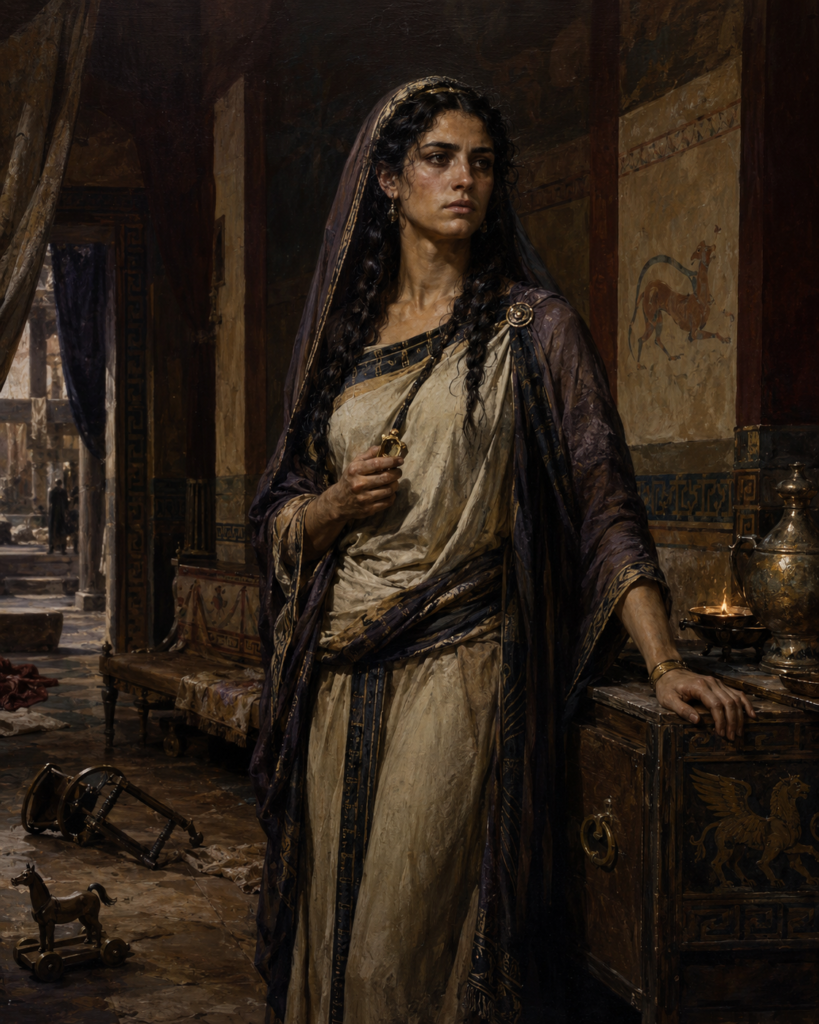
- Full Name: Megara of Thebes
- Common Name: Megara
- Gender: Female
- Race: Human
- Nationality: Theban
- Culture: Theban Greek / Boeotian royal house
- Occupation: Princess of Thebes, royal widow or estranged wife of Heracles, political witness, court negotiator
- Religion: The Olympian gods; she honours divine power but no longer mistakes it for justice
- Father: Creon, king of Thebes
- Spouse: Heracles, in the primary heroic tradition
- Later Association: Iolaus in some surviving traditions
- Languages: Greek; Theban court speech and formal diplomatic usage
- Alignment: Lawful Good
- Affiliations: House of Creon, Thebes, the household of Heracles
- Enemies: Hera’s agents, Theban opportunists, priests who profit from silence, enemies who use Heracles’ crime for factional gain
- Base of Operations: Thebes, especially Creon’s palace, the royal precinct, temple courts, and sealed family chambers
Overview
Megara of Thebes is the daughter of King Creon and the first wife of Heracles. She enters heroic tradition as a royal bride given to a victorious champion, but her story is not a reward-tale. It is one of the sharpest mortal tragedies in Greek myth: a household destroyed because divine hatred chooses to punish a hero through those closest to him.
In the common tradition, Hera drives Heracles into madness, and he kills Megara and their children. That atrocity becomes one of the great stains that sends him toward purification and the Twelve Labours. Other traditions allow Megara to live beyond the catastrophe, sometimes later associating her with Iolaus. For campaign use, the surviving Megara is the stronger NPC: a woman left alive after the ruin, forced to watch others turn her murdered household into a chapter of Heracles’ legend.
Megara should not be played as a passive victim or decorative tragic wife. She is a princess, a witness, a survivor of royal violence, and one of the few people who can speak of Heracles without flattery. Her power is not martial strength. It is memory, legitimacy, public sympathy, sealed evidence, and the terrible authority of someone who knows what happened before the song was cleaned.
She works best as a major social NPC: someone the party must protect, persuade, fear disappointing, or answer before. Her presence turns heroic reputation into a moral problem.
Appearance
Megara has the controlled elegance of a woman raised to be watched by enemies. She wears Theban court clothing: layered linen and wool, bronze or gold clasps, dark-bordered garments, and jewellery chosen for lineage rather than display.
After the catastrophe, her dress becomes simpler. One surviving brooch, wedding clasp, child’s charm, or signet of Creon’s house carries more meaning than ornament. Her beauty is severe rather than soft: composed eyes, formal posture, restrained grief, and a stillness that makes loud men seem foolish.
When Megara is angry, she does not rage. She becomes precise.
Character
Megara is courteous, intelligent, and difficult to manipulate. She understands kings, warriors, priests, servants, reputation, and the way public stories are altered before they are repeated. She does not despise courage, but she distrusts anyone who assumes a hero’s suffering excuses the suffering of others.
She is especially protective of wives, children, servants, hostages, and minor witnesses — the people heroic tradition usually steps over. Her compassion is real, but not sentimental. She has learned that pity can be used as a leash.
Her deepest fear is not death. It is erasure. She fears that her children will become unnamed sacrifices to Heracles’ greatness, that her own life will become a footnote, and that Thebes will praise itself for surviving a crime it helped conceal.
Motives
Megara’s motives depend on when she appears in the campaign.
Before the catastrophe: she wants Thebes stable, Heracles politically accepted, and her household shielded from Hera’s hostility.
During crisis in Thebes: she wants to protect her children, expose factional treachery, and keep frightened courtiers from sacrificing her household to preserve their own positions.
After the catastrophe, if she survives: she wants the dead named correctly, Hera’s agents exposed, and Thebes prevented from turning murder into patriotic theatre.
As a spirit or revenant: she wants testimony, burial truth, and a reckoning that forces Heracles’ legend to carry its shadow.
What Megara Knows
Megara knows too much for comfort.
- Which Theban nobles truly supported Heracles and which merely exploited his victories.
- Which priests sensed Hera’s hostility before the catastrophe and stayed silent.
- What Heracles was like when no bard was watching.
- Which servants, nurses, guards, and children died unnamed.
- Which temple records were altered after the massacre.
- Whether Creon’s house still holds letters, seals, bloodied objects, or witness tablets that contradict the official story.
- Who benefits if Megara is remembered only as “Heracles’ wife.”
Megara and Heracles
Megara should not be written as simply anti-Heracles. That weakens the tragedy.
She may love him, fear him, pity him, resent him, and still recognise that Hera’s malice was the greater force behind the ruin. She may believe Heracles’ remorse is real while also knowing remorse cannot restore the dead. This tension is what makes her powerful in play.
If Heracles enters the same scene, Megara should change the air. His strength cannot answer her questions. His labours cannot purchase her forgiveness. His fame becomes smaller in the presence of the woman who remembers the household before it became a legend.
Using Megara of Thebes in Your Campaign
Megara creates pressure through truth, not combat. Use her when the campaign needs a heroic myth challenged by someone with the right to speak.
She can ask the party to guard testimony before a tribunal. She can demand they recover burial tokens before a false memorial is dedicated. She can refuse to bless Heracles’ atonement unless the dead are named. She can expose a priestly faction that hid behind Hera’s will after the crime was done.
Megara is also useful as a test of the party’s morality. Do they protect the vulnerable witness, or the useful hero? Do they want justice, or a cleaner story? Do they believe divine punishment makes human choices irrelevant?
Variant: If Megara Is Dead
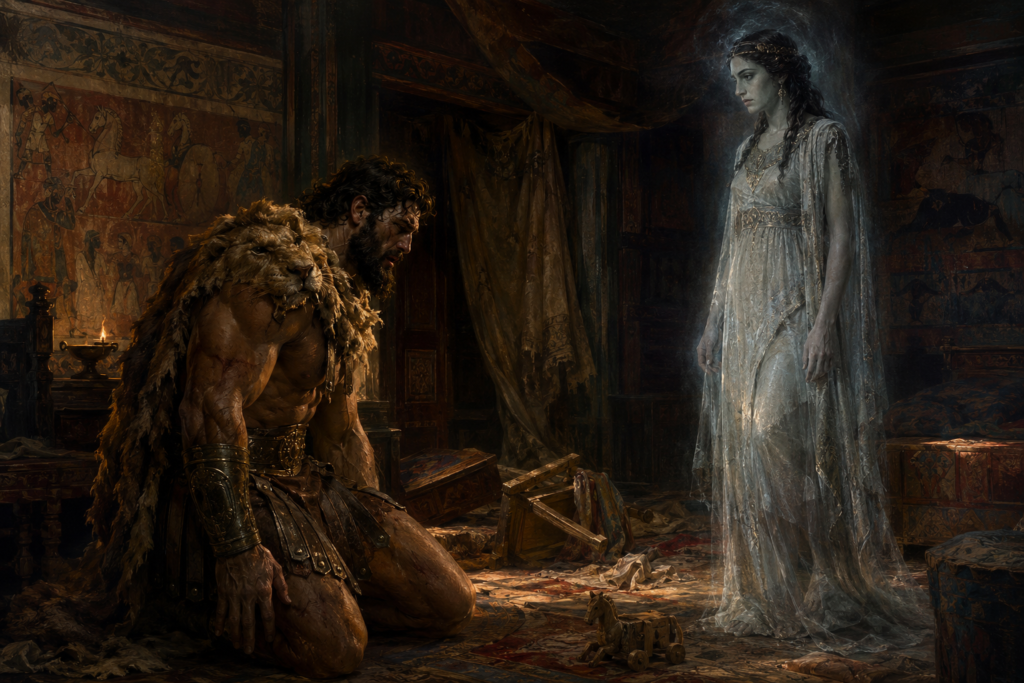
If the campaign follows the harsher tradition in which Megara dies with her children, she can still appear as a shade, dream-witness, or household revenant. This version should not be a generic ghost encounter. She is the voice of a crime that official Thebes has tried to arrange into ceremony.
A dead Megara may haunt Creon’s sealed chambers, appear in Heracles’ dreams, refuse false offerings, or speak only when the children’s true names are restored. Her purpose is not random vengeance. It is testimony. She wants the living to stop making a clean legend out of an unclean wound.
Edition Tabs
Megara of Thebes D&D 5.5e / 2024
Megara of Thebes, Pathfinder 1e
Megara of Thebes D&D 5.5e / 2024
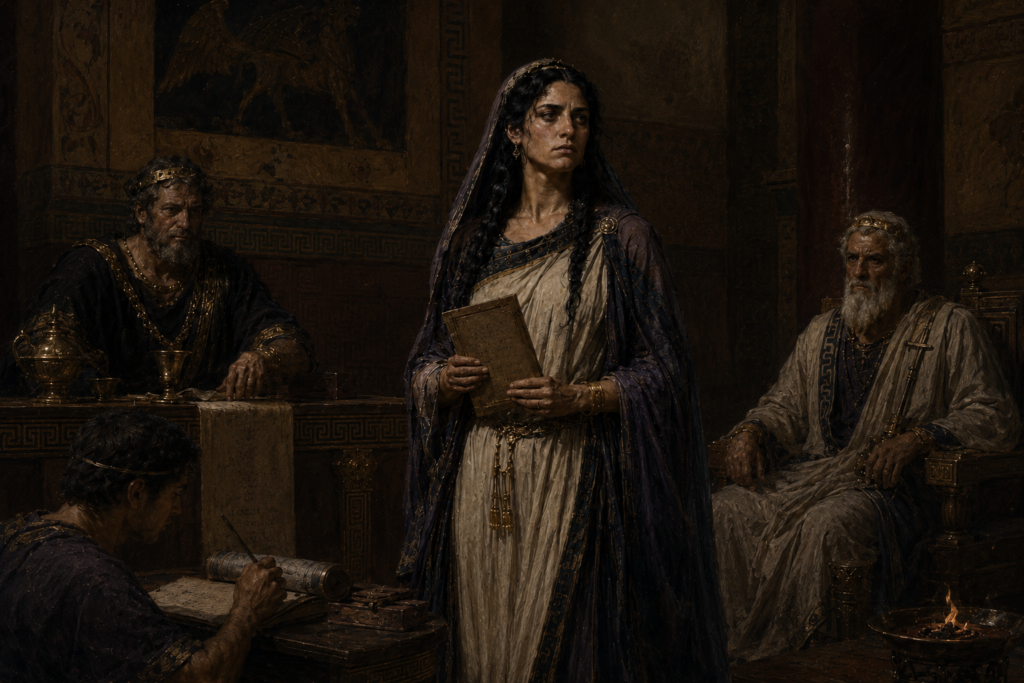
Medium Humanoid, Lawful Good
Armor Class 14
Initiative +2
Hit Points 55
Speed 30 ft.
Proficiency Bonus +2
| STR | DEX | CON | INT | WIS | CHA |
|---|---|---|---|---|---|
| 10 (+0) | 14 (+2) | 12 (+1) | 15 (+2) | 16 (+3) | 18 (+4) |
Saving Throws Wis +5, Cha +6
Skills Deception +6, History +4, Insight +5, Persuasion +6, Religion +4
Senses Passive Perception 13
Languages Greek; Theban court speech and formal diplomatic usage
Challenge 3 (700 XP)
Traits
Royal Bearing. Megara has Advantage on Charisma checks made to influence Thebans, courtiers, royal servants, and those who recognise the authority of Creon’s house.
Witness to Divine Ruin. Megara has Advantage on saving throws against being Charmed or Frightened by celestials, fiends, fey, divine agents, and servants of Hera.
Actions
Dagger. Melee Weapon Attack: +4 to hit, reach 5 ft., one target. Hit: 4 (1d4 + 2) Piercing damage.
Commanding Rebuke. Megara targets one creature within 60 feet that can hear and understand her. The target must make a DC 14 Wisdom saving throw. On a failure, it takes 10 (3d6) Psychic damage and cannot make Opportunity Attacks until the start of Megara’s next turn. On a success, it takes half damage and suffers no further effect.
Reaction
Not That Story. When a creature within 60 feet makes a Charisma check to glorify, excuse, conceal, or politically exploit an act of violence Megara witnessed or understands, and Megara can hear and understand the creature, Megara can force the creature to reroll the check and use the lower result.
Megara of Thebes, Pathfinder 1e
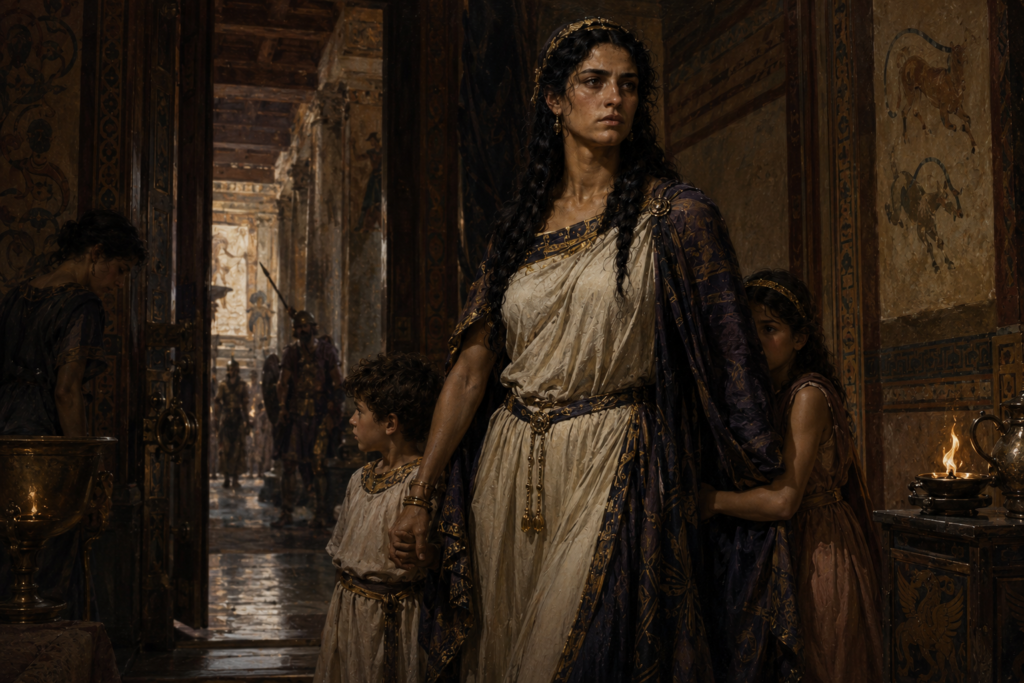
CR 3
XP 800
Female human aristocrat 3 / expert 3
LG Medium humanoid
Init +2; Senses Perception +8
Defence
AC 14, touch 12, flat-footed 12 (+2 Dex, +2 armour)
hp 38 (6 HD)
Fort +3, Ref +4, Will +8
Defensive Abilities witness to divine ruin
Offence
Speed 30 ft.
Melee dagger +5 (1d4/19–20)
Special Attacks commanding rebuke 3/day
Statistics
Str 10, Dex 14, Con 12, Int 15, Wis 16, Cha 18
Base Atk +4; CMB +4; CMD 16
Feats Iron Will, Noble Scion, Persuasive, Skill Focus (Sense Motive)
Skills Bluff +13, Diplomacy +15, Knowledge (history) +11, Knowledge (nobility) +12, Knowledge (religion) +11, Perception +8, Sense Motive +15
Languages Greek; Theban court speech and formal diplomatic usage
SQ royal bearing
Gear court dagger, fine royal clothing, bronze clasp of Creon’s house, signet token, mourning veil, sealed household testimony, 35 gp in jewellery and coin
Special Abilities
Royal Bearing (Ex). Megara gains a +2 bonus on Diplomacy and Sense Motive checks involving Thebans, courtiers, royal servants, and anyone who recognises her lawful standing.
Witness to Divine Ruin (Ex). Megara gains a +2 bonus on saving throws against charm, compulsion, and fear effects created by divine casters, outsiders, priests, or servants of Hera.
Commanding Rebuke (Ex). Three times per day as a standard action, Megara may denounce a creature within 60 feet that can hear and understand her. The target must succeed at a DC 17 Will save or be shaken for 1d4 rounds. If the creature is already shaken, it is instead staggered for 1 round. This is a language-dependent fear effect. The save DC is Charisma-based.
Treasure and Possessions
Megara’s possessions are not dungeon loot. They are evidence, leverage, and memory.
- Signet of Creon’s House: Grants lawful access to Theban records, sealed chambers, and servants still loyal to the old royal household.
- Wedding Clasp: A bronze or gold clasp from her marriage to Heracles; valuable as jewellery, dangerous as a symbol.
- Mourning Veil: Worn during formal accusations, funerary rites, and tribunal appearances.
- Sealed Testimony: Names witnesses, dead children, servants, priests, and nobles connected to the catastrophe.
- Household Key: Opens a sealed chamber in Creon’s palace containing children’s toys, altered records, divine signs, or blood-marked relics.
Adventure Hooks
The Witness Thebes Cannot Silence
A faction in Thebes plans to destroy Megara’s testimony before a tribunal. They claim to be protecting Heracles’ honour, but the records also implicate priests and nobles who knew Hera’s curse was moving before the massacre began.
The Children’s Names
Megara hires the party to recover burial tokens, nursemaid records, and household tablets naming the dead correctly. A public memorial is being prepared, but its official version changes the children’s names to make the tragedy easier to fold into heroic propaganda.
Hera’s Second Cruelty
A priestess of Hera offers Megara a bargain: silence herself, and the goddess will allow her one dream-vision of her dead children each year. Megara refuses. The party must protect her from divine pressure that comes through dreams, omens, servants, legal threats, and sacred law rather than open battle.
Source and Literary Context
Megara is a Greek mythological figure best known as the daughter of Creon of Thebes and the first wife of Heracles. In the common tradition, Hera drives Heracles into a madness in which he kills Megara and their children; this catastrophe becomes central to Heracles’ need for purification and atonement. Encyclopaedia Britannica summarises this tradition in its entry on Megara and its wider article on Heracles.
Euripides’ tragedy Heracles gives one of the most powerful surviving dramatic treatments of the story, placing Megara, her children, and Amphitryon under threat before Heracles returns and the divine madness falls. Seneca’s later Roman tragedy Hercules Furens also preserves Megara as a major figure in the household catastrophe; a public-domain translation is available through Theoi’s text of Seneca, Hercules Furens.
Ancient traditions do not treat Megara in only one way. Some accounts preserve the harsher version in which she dies during Heracles’ madness, while others allow her to survive and later be given to Iolaus. This entry uses the surviving Megara as the primary campaign version because it gives her direct agency as a political witness, while the darker tradition remains available as a shade, revenant, or sacred haunting. In either form, Megara matters because she forces the legend of Heracles to remember the household it destroyed.
Keep this reference growing
If this page helped with your reading or game, you can support its upkeep or explore the curated books.
Explore the Bookshop — epics, classics and stories behind imagined worlds.