
Spell, Zeus’s Fury spell, “Skyfather’s Judgment”
Zeus’s Fury spell, “Skyfather’s Judgment”
A divine storm-call that lets the caster mark the battlefield round after round with punishing vertical bolts of heavenly lightning.
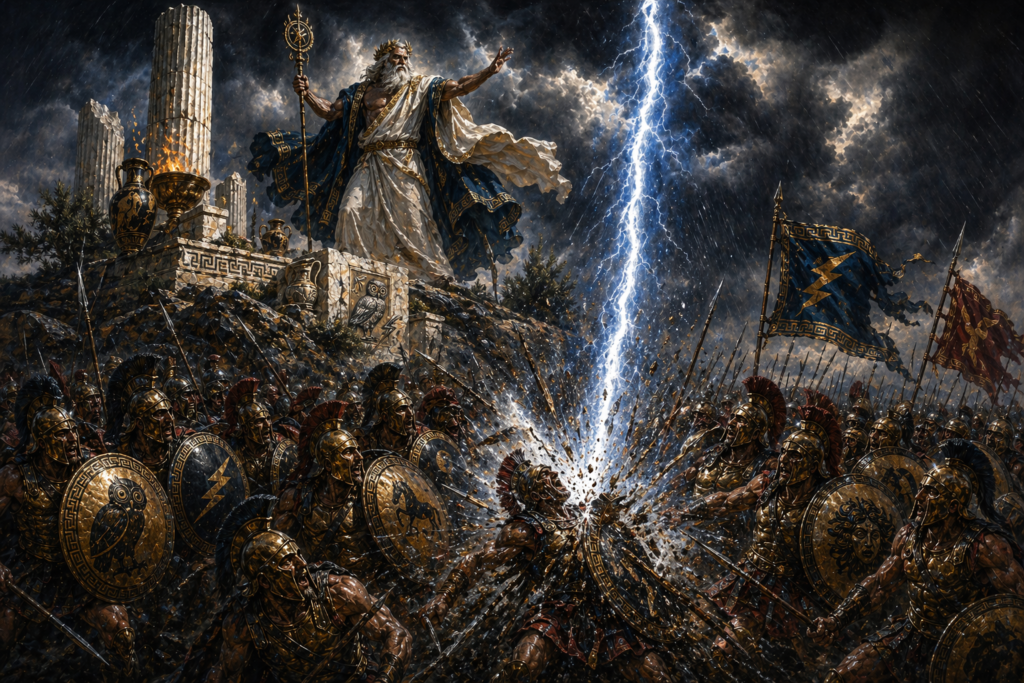
Some storm spells summon weather. Others declare that the sky itself has found a guilty target.
Overview
Zeus’s Fury is a spell of open-sky judgment, calling down repeated strokes of divine lightning upon those who stand exposed beneath the wrath of the heavens. It is not a single flash of destructive magic, but a sustained sentence: the first bolt strikes, the thunder answers, and the battlefield understands that the storm has only begun.
Where lesser lightning spells spend their force in one instant, Zeus’s Fury creates continuing dread. Soldiers break formation. Siege crews abandon their engines. Commanders stop standing where they can be seen. Each round, the caster may choose another point within range and bring the sky crashing down again.
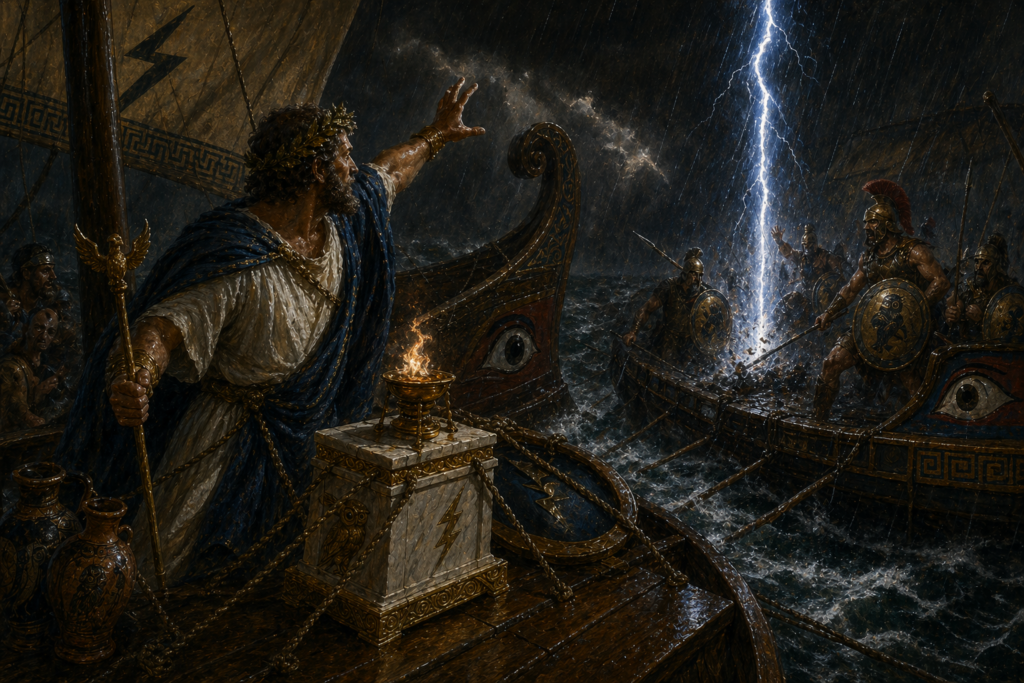
The spell is most feared in storm country, on mountain passes, sacred hills, ship decks, open courtyards, and battlefields where there is no roof between the guilty and the clouds. In the hands of a druid or storm-priest, Zeus’s Fury is more than battlefield magic. It is a sign that the heavens have taken sides.
Zeus’s Fury Spell Effect
You call down a narrow vertical bolt of lightning from above, striking a point within range. Creatures caught in the bolt’s path are blasted by divine electricity. After the spell is cast, you may continue calling down additional bolts on later turns while the spell lasts.
The spell becomes more powerful outdoors in storm conditions, where the caster draws upon the living force of the sky rather than conjuring lightning from nothing.
Zeus’s Fury spell, 5.5e / 2024
Zeus’s Fury spell, Pathfinder 1e
Zeus’s Fury spell 3.5
Zeus’s Fury spell
9th-Level Evocation
Casting Time: 1 action
Range: 150 feet
Components: V, S
Duration: Concentration, up to 1 minute
Available To: Druid, Cleric (Tempest, Storm, Sky, Thunder, or Zeus/Olympian domain only)
Alternative Spell Name: Skyfather’s Judgment
Choose a point you can see within range. A vertical bolt of lightning crashes down from above in a 5-foot-wide, 30-foot-high line. Each creature in the bolt’s area must make a Dexterity saving throw. A creature takes 9d10 lightning damage on a failed save, or half as much damage on a successful one.
Until the spell ends, you can use an action on each of your later turns to call down another bolt, choosing a new point within range each time.
If you cast this spell outdoors in stormy conditions, such as heavy rain, thunderclouds, powerful winds, supernatural storm winds, or the edge of a tornado or whirlwind, each bolt deals 11d10 lightning damage instead of 9d10.
This spell can function indoors or underground only if there is enough open vertical space for the bolt to descend. It cannot be cast underwater.
Zeus’s Fury spell
Level: druid 9, cleric 9; Domain: Air 9, Storm 9, Weather 9, Zeus/Olympian 9
Casting Time: 1 round
Components: V, S
Range: Medium 100 ft. + 10 ft./level
Effect: One or more 30-ft.-long vertical bolts of lightning
Duration: 1 minute/level
Saving Throw: Reflex half
Spell Resistance: Yes
When you cast Zeus’s Fury, you gain the ability to call down vertical strokes of lightning. Each bolt is 5 feet wide and 30 feet long, striking downward at a point you choose within range. Any creature in the target square or in the path of the descending bolt takes 7d6 points of electricity damage + 1 point per caster level. A successful Reflex save halves the damage.
You do not have to call a bolt on the round the spell is completed. Once the spell is active, you can call one bolt as a standard action on any later round while the duration remains. You can take other actions between bolts, including casting other spells, but calling a bolt requires concentration. You can call a total number of bolts equal to your caster level.
If you are outdoors in stormy conditions, including rain, thunderclouds, strong winds, hot and heavy cloud cover, tornado conditions, or a magical whirlwind created by a Large or larger air elemental or similar creature, each bolt instead deals 7d10 points of electricity damage + 1 point per caster level.
Zeus’s Fury functions indoors and underground only where there is enough space for the bolt to descend, but it does not function underwater.
Zeus’s Fury spell

Immediately upon completion of the spell, and once per round there after, you may call down a 5-foot-wide, 30-foot-long, vertical bolt of lightning that deals 7d6 of electricity damage, +1 point per caster level.
Relics & Rituals: Olympus
© 2004 White Wolf Publishing, Inc. Distributed for Sword and Sorcery Studios by White Wolf Publishing, Inc.
By W. Jason Peck, Aaron Rosenberg, Christina Stiles and Relics & Rituals: Olympus team
Evocation [Electricity]
Level: Druid 9
Components: V, S
Casting Time: 1 round
Range: Medium (100 ft. + 10 ft./level)
Effect: One or more 30-ft.-long vertical lines of lightning
Duration: 1 min./level
Saving Throw: Reflex half
Spell Resistance: Yes
The bolt of lightning flashes down in a vertical stroke at whatever target point you choose within the spell’s range (measured from your position at the time). Any creature in the target square or in the path of the bolt is affected. You need not call a bolt of lightning immediately; other actions, even spellcasting, can be performed. However, each round after the first you may use a standard action (concentrating on the spell) to call a bolt. You may call a total number of bolts equal to your caster level.
If you are outdoors and in a stormy area a rain shower, clouds and wind, hot and cloudy conditions, or even a tornado (including a whirlwind formed by a djinni or an air elemental of at least Large size) each bolt deals 7d10 +1 point per caster level instead of 7d6+1 point per caster level.
This spell functions indoors or underground but not underwater.
Why Zeus’s Fury spell Is Dangerous in the World
The Zeus’s Fury spell is dangerous because it changes the meaning of open ground. A single lightning bolt kills the unlucky. Repeated divine lightning reshapes the whole battle. It makes courtyards, bridges, hilltops, siege lines, exposed roads, and ship decks feel suddenly cursed.
The spell also gives religious and political force to weather. A druid who casts Zeus’s Fury beneath a blackening sky does not look like a spellcaster using an element. They look like the chosen voice of the storm. Villages remember where the bolts fell. Armies remember the road they could not cross. Rulers remember which sacred hill became impossible to take.
Used carelessly, the spell leaves more than corpses behind. It can split old trees, blacken shrines, blast masonry, destroy siege engines, terrify horses, and mark a battlefield for generations.
Best Uses
Breaking enemy formations: The Zeus’s Fury spell is ideal against troops who rely on holding position, guarding a gate, manning a siege engine, protecting a commander, or standing in close formation.
Punishing exposed targets: The Zeus’s Fury spell is especially strong against enemies crossing bridges, causeways, open courtyards, hill roads, ship decks, beaches, and mountain passes.
Forcing movement: Even when a creature survives the damage, the threat of the next bolt may force it to abandon cover, break concentration, leave a ritual circle, or move away from allies.
Defending sacred ground: The Zeus’s Fury spell works beautifully as a guardian spell for storm temples, mountain sanctuaries, sacred groves, sky-altars, and battlefields where divine wrath should feel visible.
Tactics
Use Zeus’s Fury when the enemy cannot easily spread out. A narrow pass, drawbridge, stairway, courtyard, ship deck, or broken city street makes every bolt more frightening. The spell is not only about striking enemies where they stand; it is about striking where they need to stand.
The best targets are commanders, spellcasters maintaining concentration, siege crews, monsters blocking a route, and enemies trying to protect weaker allies. The spell rewards patience. Each bolt should make the battlefield less comfortable for the enemy.
In 5.5e play, Zeus’s Fury competes with other powerful concentration spells, so it should feel like a deliberate battlefield-defining choice. In Pathfinder 1e play, its longer duration and high number of possible bolts reward preparation, open terrain, and stormy conditions.
DM Notes
Zeus’s Fury should feel vertical. The threat comes from above, and the scene should show it. Describe clouds opening, wind lifting cloaks, hair rising with static, birds scattering, bronze fittings ringing, rain flashing white, and the ground bursting with steam where the bolt strikes.
For balance, do not let the spell become a flexible lightning beam. It does not travel horizontally, bend around corners, snake through tunnels, or function underwater. Indoors, it requires a space that can plausibly receive a descending bolt, such as a great hall, cavern, temple nave, ruined tower, or open-roofed chamber.
Storm enhancement should be meaningful, not automatic. A pale sky with a few clouds is not enough. Heavy rain, thunderheads, violent wind, supernatural storm conditions, or oppressive heat beneath black clouds are suitable. When the stronger damage applies, make the weather part of the encounter before the spell is cast.
Good Combinations
- Control Weather: Creates or strengthens the storm conditions that make Zeus’s Fury more destructive and more dramatic.
- Wall of Stone: Shapes enemy movement, forcing foes into lanes where repeated vertical bolts become much harder to avoid.
- Entangle: Slows enemies in exposed ground, making it easier to punish them with repeated lightning strikes.
- Earthquake: Breaks formations, damages structures, and turns the battlefield into chaos before Zeus’s Fury begins selecting survivors.
- Wind Walk: Allows the caster and allies to approach storm-wrapped battlefields from unexpected directions before divine lightning begins to fall.
Using This Spell in Your Game
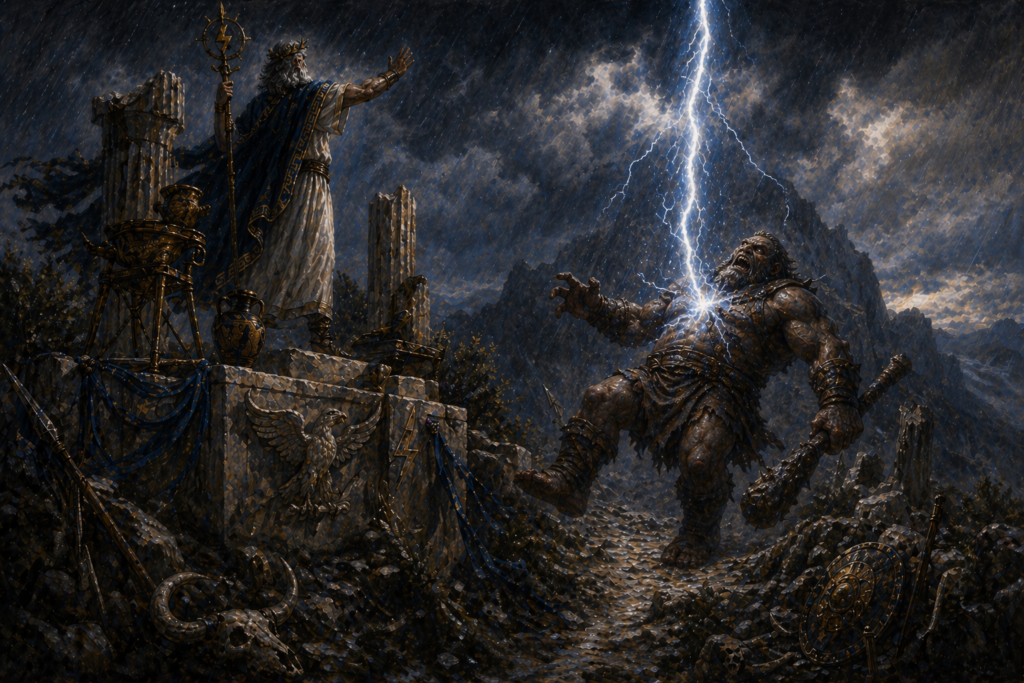
Zeus’s Fury belongs in moments of open judgment. It is the spell for a blasphemous army marching across a sacred field, giants descending from a thunder pass, raiders crossing a storm-lashed bridge, or a tyrant standing exposed in the courtyard of a stolen temple.
For player characters, the spell offers power with commitment. The caster must hold concentration, spend actions, and choose targets carefully. For villains, it creates immediate urgency. The party must scatter, break line of sight, reach shelter, disrupt the caster, or find a way to make the storm itself unreliable.
The strongest encounters using Zeus’s Fury are not just about surviving damage. They are about decision-making beneath a hostile sky.
Spellcasting Culture and Worldbuilding Hooks
Among storm-priests, Zeus’s Fury may be taught only after an ordeal beneath thunderclouds. A candidate might be required to stand alone on a mountain altar, hold a bronze rod, and speak the names of old sky powers while lightning breaks the peaks around them.
In some realms, the spell is treated as a weapon of kings and temple courts. Casting it near royal roads, granaries, fleets, sacred precincts, or mustering fields may be forbidden without permission from a ruler or priesthood.
Old battlefields marked by Zeus’s Fury rarely lose their reputation. Glassy scars in stone, blackened hill shrines, split oaks, and fields where no horse will willingly graze may all mark places where the sky once judged the earth.
Keep this reference growing
If this page helped with your reading or game, you can support its upkeep or explore the curated books.
Explore the Bookshop — epics, classics and stories behind imagined worlds.