
Silent Image
At a Glance
| 5.5e / 2024 | Level 1 · 60 feet · 15-foot cube · concentration, up to 10 minutes · Study to examine |
|---|---|
| 5e / 2014 | Level 1 · 60 feet · 15-foot cube · concentration, up to 10 minutes · action to examine |
| Pathfinder 1e | Level 1 · Long range · caster-level-scaled figment · concentration · Will disbelief |
| D&D 3.5e | Bard/Sorcerer/Wizard 1 · Long range · caster-level-scaled figment · concentration · Will disbelief |
A thought takes visible form, and for a few dangerous moments the world begins to obey what was never there.
Illusion becomes truly powerful when it leaves the mind and enters shared space. Silent Image is one of the clearest examples of that transition: a spell that does not merely confuse, but places a convincing falsehood directly into the world where others must move around it, fear it, obey it, or waste precious time testing it.
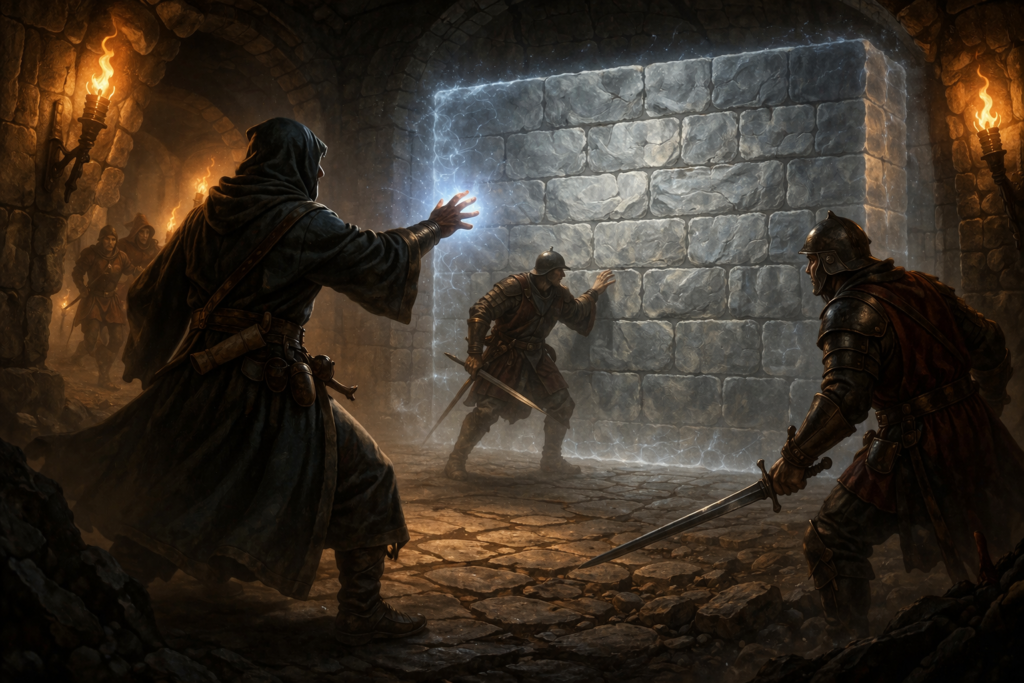
This is the spell of ambushers, fugitives, scouts, infiltrators, battle mages, shrine tricksters, and cunning survivors. A wall that never existed can halt pursuit. A guardian no one wants to challenge can hold a corridor. A false idol, sealed gate, lurking beast, or open path can reshape choice before anyone has time to think clearly. Silent Image does not need weight, sound, or substance to matter. It only needs to arrive in the right place, in the right shape, at the exact moment belief becomes action.
Spell Rules
Silent Image — 5.5e / 2024
You set a false fact into the world, shaping a visible illusion so convincing that others react to it before they ever think to doubt it.
| Spell | 1st-Level Illusion |
|---|---|
| Casting Time | 1 Action |
| Range | 60 feet |
| Components | V, S, M (a bit of fleece) |
| Duration | Concentration, up to 10 Minutes |
Available To: Bard, Sorcerer, Wizard
Alternative Name: Phantom Scene
Alternative Bard Name: Stage of Lies
Effect
You create the image of an object, a creature, or some other visible phenomenon no larger than a 15-foot Cube within range. The image appears at a spot and lasts for the duration. The image is purely visual and is not accompanied by sound, smell, or other sensory effects.
As a Magic action, you can move the image to any spot within range and alter its appearance so its movement seems natural. For example, if you create the image of a creature and move it, you can make it appear to walk.
Physical interaction reveals the image to be an illusion, since things pass through it. A creature that takes a Study action to examine the image can determine that it is an illusion with a successful Intelligence (Investigation) check against your spell save DC.
A creature that recognises the illusion can see through it. There is no higher-slot scaling.
Silent Image — 5e / 2014
| Spell | 1st-level Illusion · Bard, Sorcerer, Wizard |
|---|---|
| Casting Time | 1 action |
| Range | 60 feet |
| Maximum Image | 15-foot cube |
| Components | V, S, M (a bit of fleece) |
| Duration | Concentration, up to 10 minutes |
Create a visual image of a creature, object or other phenomenon at a point within range. It supplies no sound, smell or physical sensation. Spend your action to relocate it within range, changing its appearance to make that movement plausible.
Physical contact exposes its lack of substance. A creature can also spend an action examining it and roll Intelligence (Investigation) against your spell save DC. A creature that identifies the illusion can see through it. Higher slots give no additional effect.
Silent Image — Pathfinder 1e
| School / Level | Illusion (figment) · Bard 1, Sorcerer/Wizard 1; also Arcanist, Magus, Medium, Mesmerist, Occultist, Psychic, Red Mantis Assassin and Skald 1 |
|---|---|
| Casting Time | 1 standard action |
| Components | V, S, F (a bit of fleece) |
| Range | Long (400 feet + 40 feet/level) |
| Effect | Four 10-foot cubes + one 10-foot cube/level; shapeable |
| Duration | Concentration |
| Saving Throw / SR | Will disbelief if interacted with · Spell Resistance no |
Shape a movable visual figment of an object, creature or force. It creates no sound, scent, texture or temperature. Movement must remain within the permitted effect size.
Mythic version
The figment occupies eight 10-foot cubes plus one per caster level and persists for one round per level after concentration. At mythic tier 6 or higher, spending two uses of mythic power instead allows a stationary 50-foot emanation lasting concentration plus one minute per level.
Silent Image — D&D 3.5e
This material is Open Game Content, and is licensed for public use under the terms of the Open Game License v1.0a
Illusion (Figment)
Level: Bard 1, Sorcerer/Wizard 1
Components: V, S, F
Casting Time: 1 standard action
Range: Long (400 ft. + 40 ft./level)
Effect: Visual figment that cannot extend beyond four 10-ft. cubes + one 10-ft. cube/level (S)
Duration: Concentration
Saving Throw: Will disbelief (if interacted with)
Spell Resistance: No
This spell creates the visual illusion of an object, creature, or force, as visualized by you. The illusion does not create sound, smell, texture, or temperature. You can move the image within the limits of the size of the effect.
Focus: A bit of fleece.
What Changed
- 2024 names the Magic and Study actions; 2014 uses an action for moving or examining the image. Both use Investigation to examine it.
- The modern image fits a 15-foot cube. PF1e and 3.5e scale the volume and range with caster level and use Will disbelief.
- PF1e has expanded class lists and an optional mythic version. Every version is visual only.
Overview
Silent Image is one of the most versatile low-level illusion spells because it creates temporary visual reality where none exists. It does not charm minds directly or alter the physical world. Instead, it inserts a lie into the environment and lets expectation, fear, caution, and urgency do the rest.
That makes it far more than a decorative trick. The spell can redirect movement, stall aggression, disguise routes, support ambushes, reinforce disguises, create false authority, and fracture enemy decision-making. Even when the illusion lasts only seconds before scrutiny exposes it, those seconds can be enough to win initiative, split a formation, cover a retreat, or make an enemy choose wrongly.
Its limits define its best uses. Because the image has no sound, texture, scent, or substance, the spell is strongest in conditions where creatures are unlikely to test it immediately: distance, darkness, clutter, confusion, urgency, ritual solemnity, and fear. Used intelligently, it becomes a spell not of raw falsehood, but of tactical timing.
Uses
False Barriers: Create a wall, cave-in, barricade, closed gate, fallen beam, or sanctified obstruction to slow pursuit or redirect movement.
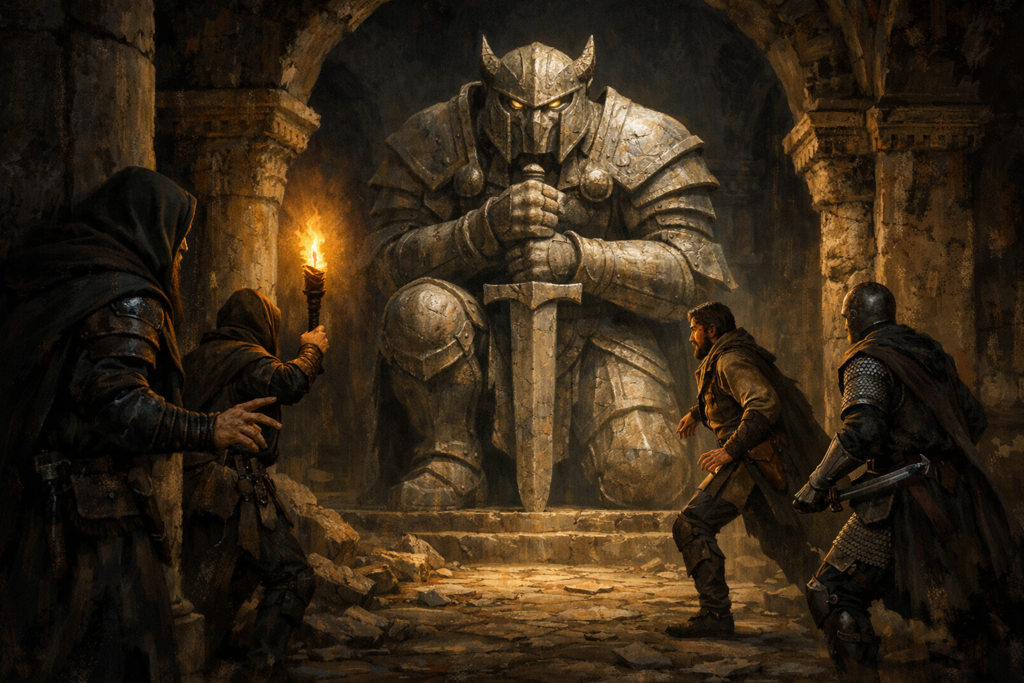
Phantom Guardians: Place a beast, statue, spirit, executioner, watchman, or looming figure where hesitation alone is enough to change behaviour.
Fake Cover and Concealment: Produce the appearance of rubble, crates, drapery, tomb slabs, market stalls, or shrine furnishings to hide allies or disguise vulnerable positions.
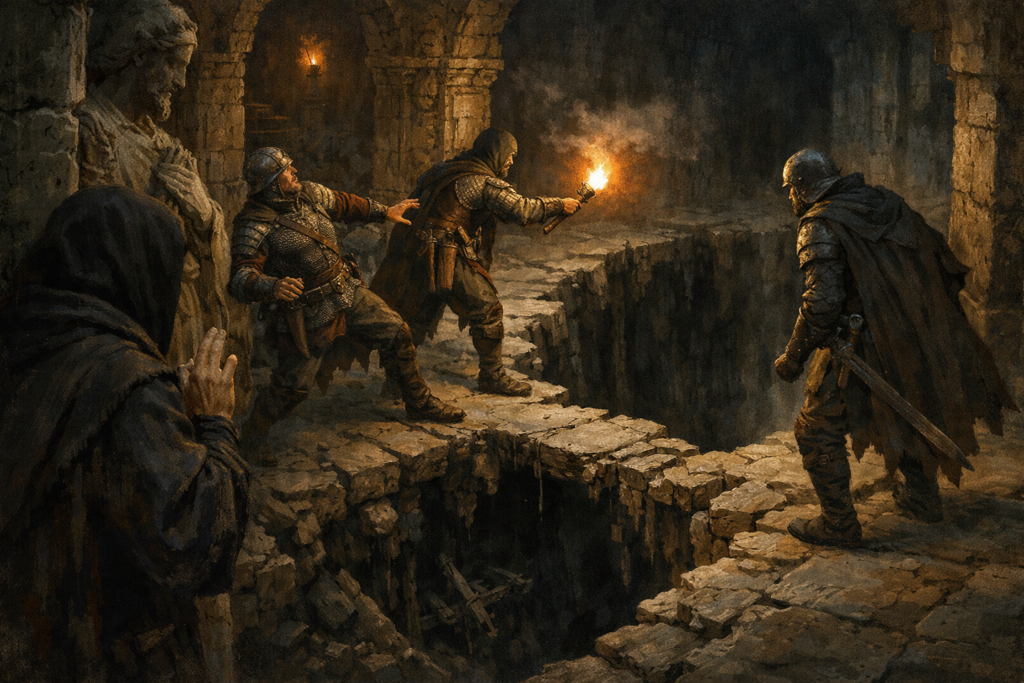
Trap Support: Conceal a danger, make a safe route appear blocked, or encourage enemies to step where they should not.
Social and Ritual Deception: Display false relics, sacred signs, ceremonial visions, omens, warnings, or signs of rank to manipulate belief in tense or symbolic spaces.
Escape and Withdrawal: Make an exit appear sealed, a corridor appear occupied, or a route appear unsafe while the real retreat happens elsewhere.
Tactics
The best illusion is usually the one people are already prepared to believe. A wall in a ruin, a sentry in a fortress, a holy figure in a shrine, or a beast in a dark forest path will often work better than anything spectacular. Make the falsehood belong to the scene.
Use the spell to force decisions under pressure. Creatures rarely stop to conduct careful inquiry when danger may be immediate. They halt, flinch, circle, shout warnings, change formation, or waste actions probing what should not be there. Silent Image is strongest when the cost of hesitation is already high.
Movement makes the illusion more persuasive. A beast that prowls, cloth that stirs, a figure that shifts slightly, or smoke that drifts feels more convincing than a perfectly static falsehood placed in an otherwise living world.
Respect contact. The spell weakens dramatically once creatures touch it, pass through it, or gain time for deliberate inspection. Use it at range, across obstacles, in poor visibility, or in moments where no one wants to be first to test what might be deadly.
Most importantly, think in terms of outcomes rather than visuals. The real question is never “what image looks impressive?” but “what false sight will make them do the wrong thing?”
Good Combinations
Disguise Self: Pair a false identity with a false environment for stronger infiltration and social manipulation.
Minor Illusion: Add a second smaller false detail to reinforce the larger deception.
Fog Cloud: Reduced visibility makes visual uncertainty more dangerous and gives illusions more time to work.
Charm Person: Helps sustain the false narrative once the illusion has already shaped the encounter.
Invisibility: Lets you reposition or escape while enemies focus on the false scene.
Magic Mouth: Turns the image into part of a staged omen, warning, ritual event, or calculated trap.
DM Notes
Silent Image is most rewarding when it changes decisions rather than being dismissed automatically. If a false hazard, guardian, or obstacle would plausibly delay, alarm, or redirect a creature, let it do so. The spell’s value lies in shaping the flow of the scene.
At the same time, its limits should remain real. The image does not make noise, cast force, create smell, bear weight, or survive touch. A clever illusion should matter, but an implausible one or one exposed to direct testing should begin to fail naturally.
Adjudication should follow temperament and circumstance. A frightened cultist, cornered bandit, tired sentry, suspicious noble, war-trained captain, and veteran wizard should not all respond in the same way. Fear, discipline, urgency, intelligence, and context all shape how quickly a creature questions what it sees.
The spell becomes memorable when it creates hesitation, divided attention, false confidence, or dramatic misreading. It is rarely most interesting as a simple yes-or-no trick. It shines when it changes the shape of the encounter.
Related Magic
Minor Illusion · Major Image · Disguise Self · Magic Mouth · Bard Spells
Illusion in Play
Critical Role Animated: Silent Image illustrates a scene using the spell.
Further Illustrations
Sources and Licensing
- Silent Image — 2024 rules
- Silent Image — 2014 rules
- Silent Image — Pathfinder 1e
- Silent Image — D&D 3.5e
This work includes material from the System Reference Document 5.2.1 and System Reference Document 5.1 by Wizards of the Coast LLC, available through the D&D SRD page. Both are licensed under Creative Commons Attribution 4.0 International. Rules summaries are adapted; tactical and setting commentary is separate.
Open Game License v1.0a & Copyright Notices
The Pathfinder 1e and D&D 3.5e rules material on this page is derived from Open Game Content and is used under the Open Game License Version 1.0a. Presentation, navigation, original commentary and setting material are not designated Open Game Content by this notice.
OPEN GAME LICENSE Version 1.0a
The following text is the property of Wizards of the Coast, Inc. and is Copyright 2000 Wizards of the Coast, Inc (“Wizards”). All Rights Reserved.
- Definitions: (a)”Contributors” means the copyright and/or trademark owners who have contributed Open Game Content; (b)”Derivative Material” means copyrighted material including derivative works and translations (including into other computer languages), potation, modification, correction, addition, extension, upgrade, improvement, compilation, abridgment or other form in which an existing work may be recast, transformed or adapted; (c)”Distribute” means to reproduce, license, rent, lease, sell, broadcast, publicly display, transmit or otherwise distribute; (d)”Open Game Content” means the game mechanic and includes the methods, procedures, processes and routines to the extent such content does not embody the Product Identity and is an enhancement over the prior art and any additional content clearly identified as Open Game Content by the Contributor, and means any work covered by this License, including translations and derivative works under copyright law, but specifically excludes Product Identity. (e)”Product Identity” means product and product line names, logos and identifying marks including trade dress; artifacts; creatures characters; stories, storylines, plots, thematic elements, dialogue, incidents, language, artwork, symbols, designs, depictions, likenesses, formats, poses, concepts, themes and graphic, photographic and other visual or audio representations; names and descriptions of characters, spells, enchantments, personalities, teams, personas, likenesses and special abilities; places, locations, environments, creatures, equipment, magical or supernatural abilities or effects, logos, symbols, or graphic designs; and any other trademark or registered trademark clearly identified as Product identity by the owner of the Product Identity, and which specifically excludes the Open Game Content; (f)”Trademark” means the logos, names, mark, sign, motto, designs that are used by a Contributor to identify itself or its products or the associated products contributed to the Open Game License (g)”Use”, “Used” or “Using” means to use, Distribute, copy, edit, format, modify, translate and otherwise create Derivative Material of Open Game Content. (h)”You” or “Your” means the licensee in terms of this agreement.
- The License: This License applies to any Open Game Content that contains a notice indicating that the Open Game Content may only be Used under and in terms of this License. You must affix such a notice to any Open Game Content that you Use. No terms may be added to or subtracted from this License except as described by the License itself. No other terms or conditions may be applied to any Open Game Content distributed using this License.
- Offer and Acceptance: By Using the Open Game Content You indicate Your acceptance of the terms of this License.
- Grant and Consideration: In consideration for agreeing to use this License, the Contributors grant You a perpetual, worldwide, royalty-free, non-exclusive license with the exact terms of this License to Use, the Open Game Content.
- Representation of Authority to Contribute: If You are contributing original material as Open Game Content, You represent that Your Contributions are Your original creation and/or You have sufficient rights to grant the rights conveyed by this License.
- Notice of License Copyright: You must update the COPYRIGHT NOTICE portion of this License to include the exact text of the COPYRIGHT NOTICE of any Open Game Content You are copying, modifying or distributing, and You must add the title, the copyright date, and the copyright holder’s name to the COPYRIGHT NOTICE of any original Open Game Content you Distribute.
- Use of Product Identity: You agree not to Use any Product Identity, including as an indication as to compatibility, except as expressly licensed in another, independent Agreement with the owner of each element of that Product Identity. You agree not to indicate compatibility or co-adaptability with any Trademark or Registered Trademark in conjunction with a work containing Open Game Content except as expressly licensed in another, independent Agreement with the owner of such Trademark or Registered Trademark. The use of any Product Identity in Open Game Content does not constitute a challenge to the ownership of that Product Identity. The owner of any Product Identity used in Open Game Content shall retain all rights, title and interest in and to that Product Identity.
- Identification: If you distribute Open Game Content You must clearly indicate which portions of the work that you are distributing are Open Game Content.
- Updating the License: Wizards or its designated Agents may publish updated versions of this License. You may use any authorized version of this License to copy, modify and distribute any Open Game Content originally distributed under any version of this License.
- Copy of this License: You MUST include a copy of this License with every copy of the Open Game Content You Distribute.
- Use of Contributor Credits: You may not market or advertise the Open Game Content using the name of any Contributor unless You have written permission from the Contributor to do so.
- Inability to Comply: If it is impossible for You to comply with any of the terms of this License with respect to some or all of the Open Game Content due to statute, judicial order, or governmental regulation then You may not Use any Open Game Material so affected.
- Termination: This License will terminate automatically if You fail to comply with all terms herein and fail to cure such breach within 30 days of becoming aware of the breach. All sublicenses shall survive the termination of this License.
- Reformation: If any provision of this License is held to be unenforceable, such provision shall be reformed only to the extent necessary to make it enforceable.
- COPYRIGHT NOTICE
Open Game License v 1.0a Copyright 2000, Wizards of the Coast, Inc.
System Reference Document Copyright 2000-2003, Wizards of the Coast, Inc.; Authors Jonathan Tweet, Monte Cook, Skip Williams, Rich Baker, Andy Collins, David Noonan, Rich Redman, Bruce R. Cordell, John D. Rateliff, Thomas Reid, James Wyatt, based on original material by E. Gary Gygax and Dave Arneson.
Pathfinder Roleplaying Game Core Rulebook © 2009, Paizo Publishing, LLC; Author: Jason Bulmahn, based on material by Jonathan Tweet, Monte Cook, and Skip Williams.
END OF LICENSE
Keep this reference growing
If this page helped with your reading or game, you can support its upkeep or explore the curated books.
Explore the Bookshop — epics, classics and stories behind imagined worlds.