
Fantastic Machine Spell: Conjure the Clattering Engine of Arcane Craft
Fantastic Machine Spell: Conjure the Clattering Engine of Arcane Craft
A many-armed magical engine lurches into being, grinding, hauling, digging, lifting, and smashing its way through one simple command.
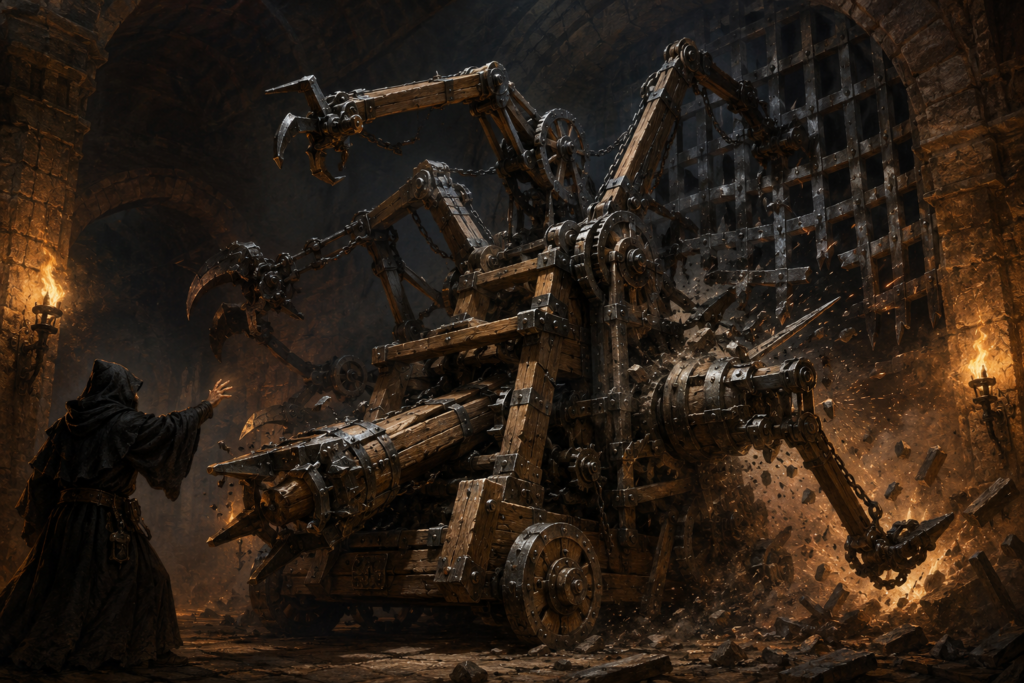
Fantastic Machine creates a temporary magical engine: a huge, noisy, many-armed construct of gears, levers, chains, claws, wheels, bellows, hammering limbs, and grinding joints. The original spell describes the machine as “illusory” in appearance, but its rules make it a real conjured creation. It has weight, hit points, hardness, strength, attacks, lifting power, and the ability to excavate stone and soil. It is visually fantastic, not merely unreal.
This is craft magic at its most practical and dangerous. The spell does not summon a warrior or spirit. It creates labour. A single caster can bring the force of a work gang, quarry crew, siege engine, crane, digger, and battering machine into a battlefield, mine, temple, ruin, or collapsing tunnel.
The machine is obedient but not clever. When the spell is cast, the caster gives it one simple physical task. That task cannot be changed. If the command is precise, the spell can save lives, open sealed ways, move impossible burdens, or tear apart stonework. If the command is careless, the machine becomes a literal-minded magical brute, repeating the wrong labour until dismissed or destroyed.
Quick Rules Reference
- Creates one temporary 10-foot magical machine.
- The machine performs one simple physical task chosen when the spell is cast.
- The task must be brief, clear, and physical.
- The chosen task cannot be changed after casting.
- The machine acts on the caster’s turn.
- It can move, lift, drag, excavate, smash, and attack.
- It is especially effective against stone and metal.
- It is noisy, obvious, and not intelligent.
- It is a real conjured machine, not a harmless illusion.
Effect
You create a Large, many-armed magical machine in an unoccupied space within range. When you cast the spell, you give the machine one simple physical task, such as “clear this passage,” “drag that wagon uphill,” “smash the gate,” “lift that stone slab,” “carry these crates to the bridge,” or “dig straight forward through the loose earth.”
The machine continues or repeats that task for the spell’s duration. You cannot change the task after the spell is cast, though you may dismiss the spell early. The machine acts on your turn, including the turn on which you cast the spell.
The machine can move over the ground, swim awkwardly, fly clumsily when lightly loaded, lift heavy objects, push or drag great weights, excavate loose material, batter stone or metal, slam nearby creatures, and hurl small rocks if suitable stones are available.
It has no independent judgement beyond the task assigned to it. It can follow simple physical instructions, but it cannot solve puzzles, interpret changing battlefield priorities, identify hidden dangers, make moral choices, select new targets intelligently, or understand complex conditional orders.
Mechanics Tabs
The rules below are mechanics compatible for different game editions.
Fantastic Machine 5.5e / 2024
Fantastic Machine, Pathfinder 1e / 3.5e
Fantastic Machine 3.0e
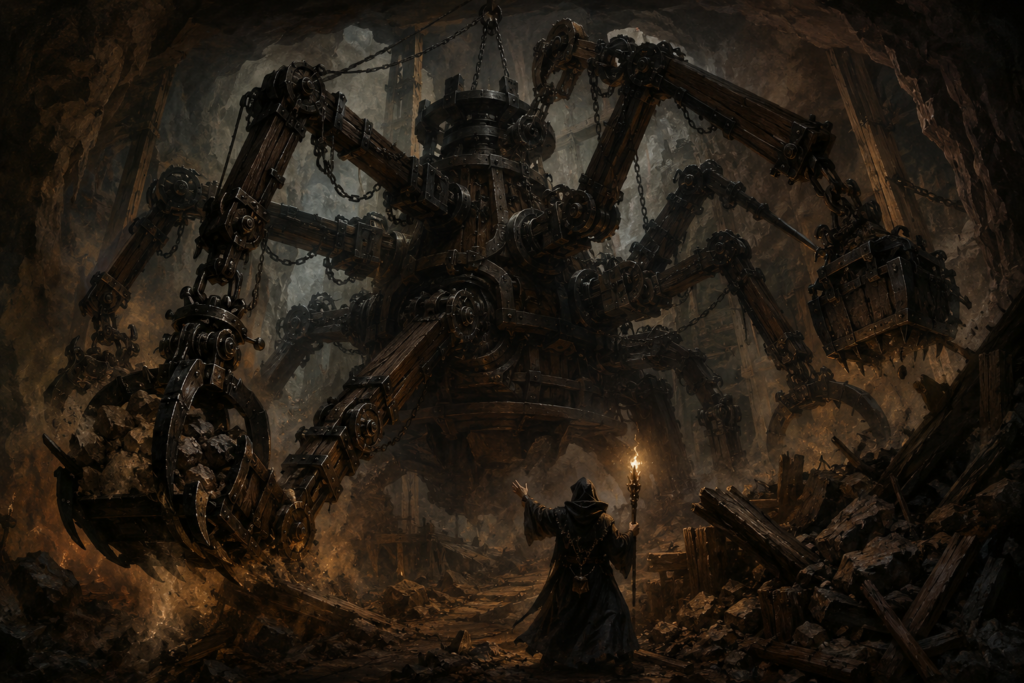
Fantastic Machine 5.5e / 2024-Compatible Version
6th-level conjuration
Casting Time: Action
Range: 120 feet
Components: V, S, M
Material Component: A small brass gear, carved wooden lever, or iron rivet worth at least 25 gp
Duration: 10 minutes
Spell Lists: Artificer, Wizard; Cleric if the cleric belongs to a craft, forge, creation, architecture, or sacred engineering tradition
Alternative Spell Name: Engine of the Arcane Smith
You conjure a Large magical machine in an unoccupied space you can see within range. The machine lasts for the duration, until reduced to 0 hit points, or until you dismiss it. When you cast the spell, choose one simple physical task for the machine to perform. The instruction must be brief, physical, and fixed. It cannot be changed after the spell is cast.
The machine acts immediately after you on your turn. It obeys the task you gave it as directly as possible. It is a magical construct, not a true creature summon, and it does not accept new tactical orders each round.
Fantastic Machine Stat Block
Large Construct, Unaligned
Armor Class: 14
Hit Points: 45
Speed: 40 ft., swim 10 ft., fly 10 ft. while lightly loaded
| STR | DEX | CON | INT | WIS | CHA |
|---|---|---|---|---|---|
| 16 (+3) | 8 (-1) | 14 (+2) | 3 (-4) | 6 (-2) | 1 (-5) |
Saving Throws: Str +6, Con +5
Damage Resistances: Bludgeoning, Piercing, and Slashing from nonmagical attacks
Damage Immunities: Poison, Psychic
Condition Immunities: Charmed, Exhaustion, Frightened, Paralyzed, Petrified, Poisoned
Senses: Passive Perception 8
Languages: Understands the caster’s task command but cannot speak
Challenge: —
Proficiency Bonus: Equals your Proficiency Bonus
Traits
Constructed Labourer. The machine can lift up to 1,000 pounds, push or drag up to 2,500 pounds, and carry up to 500 pounds. It can fly or swim only while carrying 175 pounds or less.
Excavating Engine. The machine can clear loose earth, sand, gravel, broken stone, or collapsed rubble. As an action, it can excavate a 5-foot cube of loose earth, sand, gravel, or broken rubble. Dense natural stone, worked masonry, iron-bound barriers, and magically reinforced structures usually require attacks instead.
Fixed Instruction. The machine follows only the task chosen when the spell is cast. If the task becomes impossible, the machine repeats the nearest part of the task it can still perform until the spell ends or is dismissed.
Siege Force. The machine deals double damage to objects and structures made of stone or metal. This replaces the older edition’s triple-damage rule with a simpler 5.5e-compatible structure-damage rule.
Actions
Slam. Melee Spell Attack: Your spell attack modifier to hit, reach 10 ft., one target.
Hit: 13 (2d8 + 4) bludgeoning damage. If the target is an object or structure made of stone or metal, apply Siege Force.
Hurl Stone. Ranged Spell Attack: Your spell attack modifier to hit, range 150/600 ft., one target. The machine must have a suitable stone or similar object within reach.
Hit: 11 (2d6 + 4) bludgeoning damage.
Notes
This version keeps the spell’s identity as a magical labour engine rather than turning it into a normal combat summon. It can fight, but its strongest uses are excavation, siegework, hauling, lifting, clearing rubble, breaking barriers, and moving heavy objects under pressure.
The machine does not replace skilled engineering. It can dig, lift, smash, drag, and hold, but it cannot design a bridge, judge structural stability, safely undermine a fortress, select the best mining route, or understand a complex work sequence without a clear command.
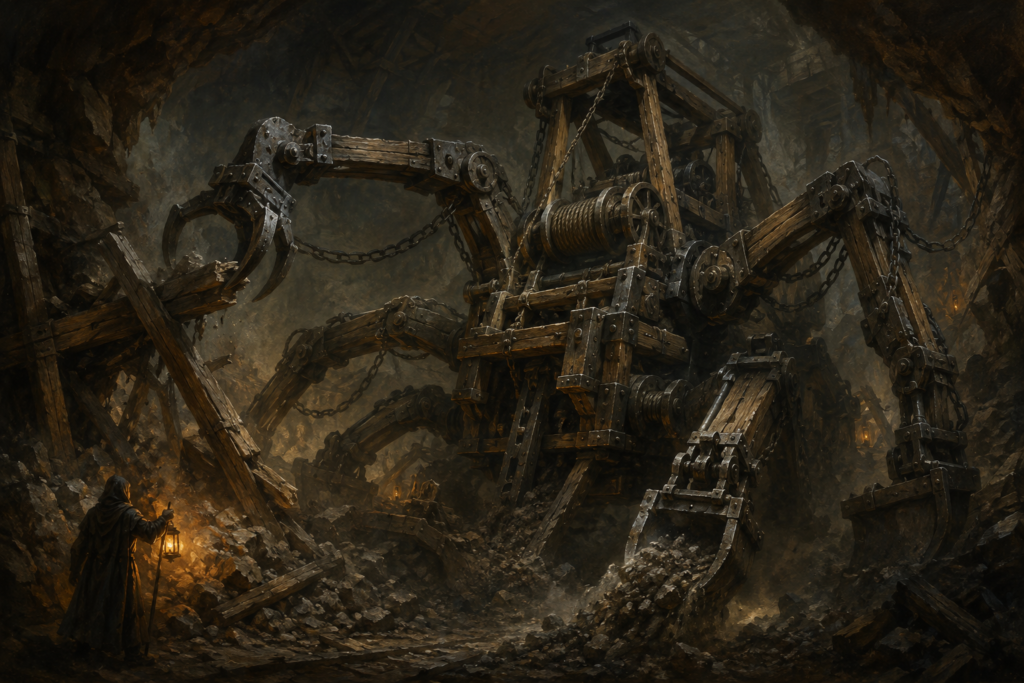
Fantastic Machine, Pathfinder 1e / 3.5e-Compatible Version
Conjuration (Creation)
Level: Craft 6
Components: V, S, DF
Casting Time: 1 standard action
Range: Medium
Effect: One 10-foot magical machine
Duration: 1 minute/level (D)
Saving Throw: None
Spell Resistance: No
You create a bizarre but functional magical machine. When the spell is cast, you assign the machine one simple physical task that can be described in twenty-five words or fewer. The machine can repeat the same task, but the task cannot be changed after casting.
The machine acts on your turn in the initiative order and can act on the turn you cast the spell.
Fantastic Machine Statistics
Treat the machine as a Large animated object with the following special statistics:
- Speed: 40 ft.; swim 10 ft.; fly 10 ft. clumsy
- Hit Points: 22
- Armor Class: 14
- Hardness: 10
- Saves: Fort +1, Ref +1, Will -4
- Strength: 16
- Attack: Slam +5 melee
- Slam Damage: 1d8 + 4
- Stone or Metal Damage: Triple slam damage, 3d8 + 12
- Rock Throwing: +3 ranged attack
- Range Increment: 150 ft.
- Maximum Range: 10 range increments
- Thrown Rock Damage: 2d6 + 4
Load and Labour
- Light Load: Up to 172 lb.
- Medium Load: 173–346 lb.
- Heavy Load: 347–520 lb.
- The machine can fly or swim only while lightly loaded.
- It can lift up to 1,040 lb. to a height of 15 feet.
- It can push or drag up to 2,600 lb.
- It can excavate 7,000 lb. of loose rock per minute.
- It can clear a 5-foot-by-5-foot space of loose rock in 3 rounds.
- It can excavate sand or loose soil at twice that rate.
Notes
The machine’s instruction must be simple, physical, and fixed at the moment of casting. Good commands include “break this stone wall,” “drag this statue outside,” “dig straight down here,” “carry these crates to the gate,” or “clear this collapsed passage.” Poor commands include anything requiring judgement, negotiation, investigation, stealth, moral choice, or changing priorities.
Despite its impressive appearance, the machine is not a true intelligent construct. It is temporary magical labour given shape.
Fantastic Machine 3.0e
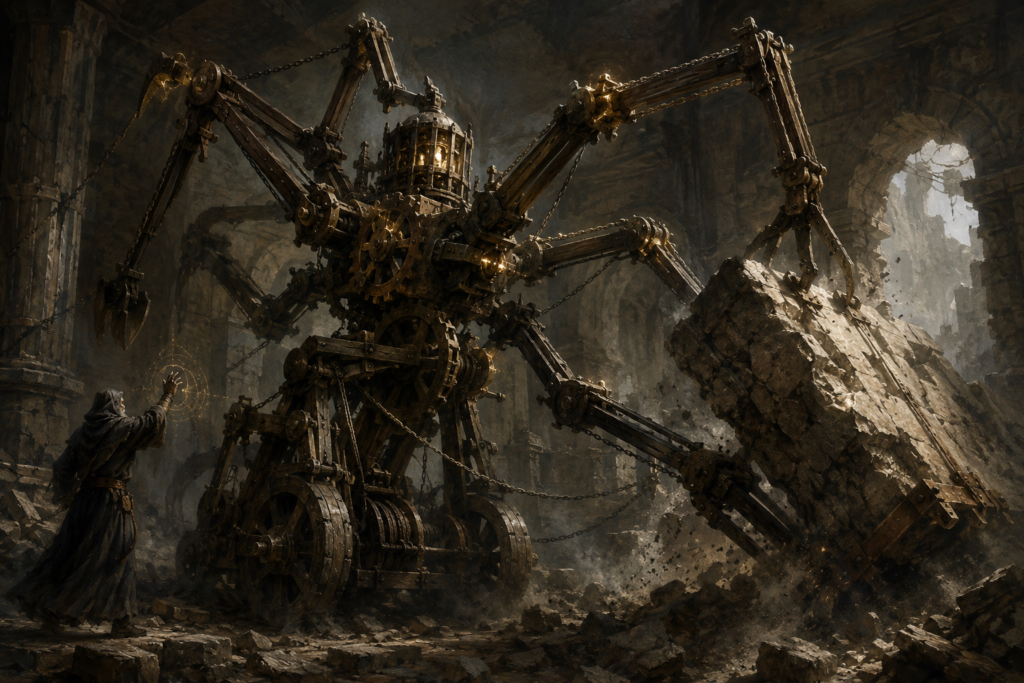
Your spell generates an illusory, many-armed noisy, massive mechanical construct of impressive appearance.
(Spell Compendium, p. 88)
Originally posted on D&D tools
Conjuration (Creation)
Level: Craft 6,
Components: V, S, DF,
Casting Time: 1 standard action
Range: Medium (100 ft. + 10 ft./level)
Effect: A 10-ft. machine
Duration: 1 minute/level (D)
Saving Throw: None
Spell Resistance: No
This spell creates a bizarre, but useful, machine that you can command to perform any simple, physical task that can be described in twenty-five words or less. You can order the machine to perform the same task over and over, but you can’t change the task. You must specify the task when yo cast the spell. The machine always acts on your turn in the initiative order. (It can act during the turn you cast the spell.)
The machine functions as a Large animated object. It trundles over the ground at a speed of 40 feet. It can swim or fly at a speed of 10 feet (clumsy). It has 22 hit points, AC 14 (-1 size, +5 natural), and hardness 10. Its saving throw modifiers are Fortitude +1, Reflex +1, Will -4.
The machine has a Strength of 16. A light load for the machine is up to 172 pounds; a medium load is 173-346 pounds; and a heavy load is 347-520 pounds. The machine can fly or swim only when lightly loaded. The machine can lift a weight of up to 1,040 pounds to a height of 15 feet. It can push or drag 2,600 pounds. It can excavate 7,000 pounds of loose rock each minute (which is sufficient to clear a 5-by-5 foot space in 3 rounds). It can excavate sand or loose soil at twice that rate.
The machine has an attack bonus of +5 and can make one slam attack each round that deals 1d8 +4 points of damage. It deals triple slam damage (3d8+12) against stone or metal. The machine can hurl Small rocks (if any are at hand) with an attack bonus of +3. Its range increment is 150 feet, and it can throw a rock up to 10 range increments. A thrown rock deals 2d6+4 points of damage.
Why This Spell Is Dangerous in the World
Fantastic Machine makes high-level labour portable. A temple engineer, dwarven guild-priest, siege-wizard, or ruin-breaker can bring the force of a crew and engine into places where no crew could safely work.
That changes how rulers think about doors, walls, collapsed tunnels, treasure vaults, prison blocks, floodgates, mine galleries, and battlefield obstacles. A locked gate is not merely tested by thieves. A stone bridge is not merely defended by soldiers. A buried shrine is not safe because tons of rock lie above it.
Any place that depends on weight, labour, or obstruction can be threatened by this spell.
Its limitation keeps it from becoming absolute. The machine is loud, obvious, temporary, and literal-minded. It does not replace planning. It rewards exact commands and punishes careless ones.
Rules Clarifications and Edge Cases
- Can the caster change the task later? No. The chosen task is fixed when the spell is cast.
- Can the task include conditions? Only very simple ones. “Dig until you reach open air” is reasonable. “Dig unless the tunnel becomes unsafe, then reinforce the ceiling and turn left” is too complex.
- Can it fight? Yes, but it is not primarily a combat summon. It can slam, hurl rocks, and break objects.
- Can it carry creatures? Yes, if the task and load allow it, but it is noisy, awkward, and not a safe vehicle unless the situation is stable.
- Can it fly with cargo? Only when lightly loaded.
- Can it build complicated structures? No. It can move, lift, dig, hammer, drag, and smash. Skilled design still requires intelligence, tools, and planning.
- Is it an illusion? No in mechanical terms. Its appearance may be bizarre and fantastic, but the spell creates a real temporary machine.
Best Command Wording
The strongest commands are short, physical, and measurable.
Good examples include:
- “Clear this passage of loose rubble.”
- “Drag that wagon to the gate.”
- “Break that iron portcullis.”
- “Lift that stone slab and hold it raised.”
- “Dig straight ahead through loose earth.”
- “Carry these crates to the bridge.”
- “Push this fallen statue away from the doorway.”
- “Throw rocks at enemies crossing the causeway.”
Weak commands include:
- “Help us escape.”
- “Defend us intelligently.”
- “Find the safest route.”
- “Build a proper bridge.”
- “Do whatever I would want you to do.”
- “Fight the most dangerous enemy.”
The machine obeys action, not intention.
Good Combinations
- Wall of Stone: Use Fantastic Machine to batter, reshape, or clear stone barriers while Wall of Stone creates controlled fortifications, plugs, ramps, and battlefield walls.
- Stone Shape: Stone Shape handles precision alteration, while Fantastic Machine supplies brute force, lifting, hauling, and repeated labour.
- Move Earth: Move Earth reshapes larger areas over time, while Fantastic Machine handles local excavation, rubble clearing, and heavy object movement.
- Fabricate: Fabricate turns raw material into finished work, while Fantastic Machine gathers, lifts, positions, or breaks the materials needed for the craft.
- Animate Objects: Animate Objects creates multiple mobile combatants, while Fantastic Machine creates one focused engine of labour, siege pressure, or construction.
Adventure Hooks
The Engine Beneath the Shrine. A craft-priest reopens a sealed underground shrine with Fantastic Machine, but the command is badly worded. The machine keeps digging after the first chamber is breached, threatening to expose something buried below the temple for a reason.
The Siege That Should Have Failed. A small army crosses a broken pass after a conjured machine clears rubble faster than defenders believed possible. The characters must destroy the caster, sabotage the engine, or turn the machine against the invaders’ own siegeworks.
The Machine in the Mine. Miners vanish after hiring a spellcaster to clear a collapsed gallery. The machine obeyed its command perfectly, but it opened a lower passage into a sealed older world.
Historical and Mythic Context
Fantastic Machine belongs to the old dream of the self-working engine: the crafted thing that moves without muscle, the tool that obeys command, and the artificial servant that turns thought into labour. In mythic terms, it stands near the legendary automata of the divine smith, where craft becomes almost alive without becoming truly living.
Ancient stories of divine craftsmanship often imagine metal servants, animated statues, self-moving tripods, bronze guardians, and impossible engines shaped by gods or master smiths. The spell also echoes the practical world of mills, cranes, treadwheels, siege engines, water-driven machinery, and mine works, where human craft multiplies strength beyond the body. A useful historical reference point is the long development of machines as devices that transmit and transform force.
In a fantasy campaign, the spell gives that idea a more dangerous sacred form. The machine is not merely a tool. It is temporary magical engineering: a clattering engine called into the world to dig, lift, drag, break, and build. It shows that conjuration is not only about monsters and mist. It can also create labour, pressure, leverage, and industry.
This makes Fantastic Machine especially appropriate for craft temples, dwarven guild-priests, siege colleges, magical universities, mining orders, ruin-breakers, and ambitious rulers who understand that moving stone can change history as surely as moving armies.
Keep this reference growing
If this page helped with your reading or game, you can support its upkeep or explore the curated books.
Explore the Bookshop — epics, classics and stories behind imagined worlds.