
Call Nightmare Spell
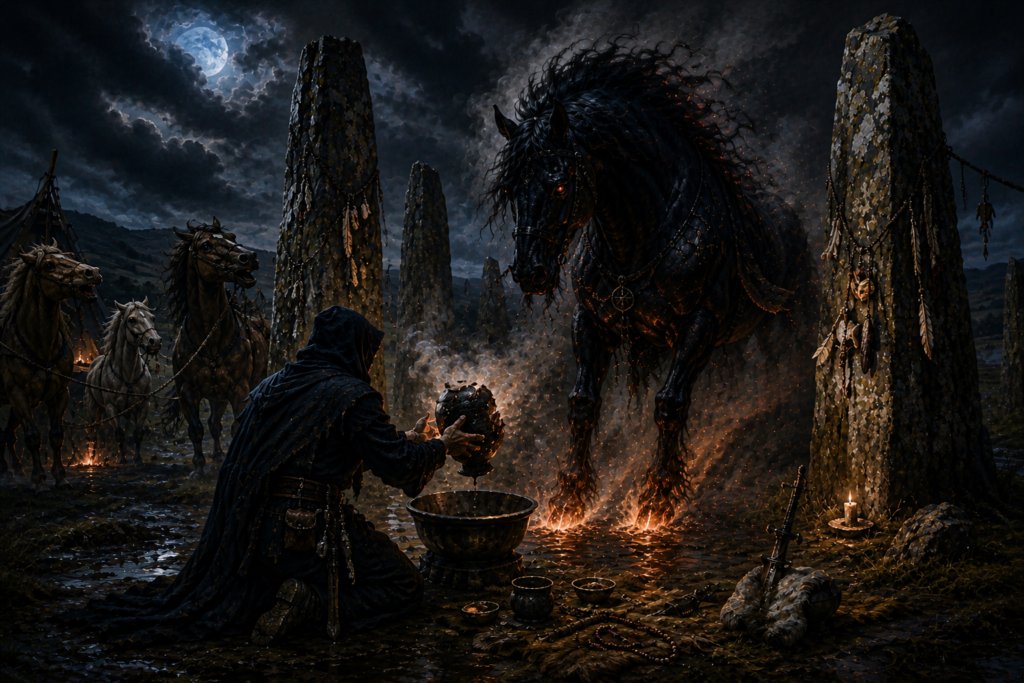
A prepared soul buys one week of service from a nightmare—but the printed spell is older and much narrower than the modern conversion once shown here.
Call Nightmare comes from the 3.0 Book of Vile Darkness. There is no direct official D&D 5e / 2014, D&D 5.5e / 2024, or Pathfinder 1e printing, and no revised official 3.5e version is presented here as though it were native to that edition.
The original spell is brutally simple: the caster offers a prepared soul, calls one nightmare from the Lower Planes, and receives its service for one week as a mount or guard. If the nightmare moves more than 150 feet away, it immediately returns whence it came. Casting the spell again replaces the previous nightmare.
Quick Rules Reference
- 5.5e / 2024: no direct official Call Nightmare spell.
- 5e / 2014: no direct official Call Nightmare spell.
- Pathfinder 1e: no native core Call Nightmare entry.
- D&D 3.5e: no revised official printing is used here; the known source is the 3.0 Book of Vile Darkness.
- 3.0 source: Conjuration (Calling) [Evil], Demonologist 4, Sorcerer 5, Wizard 5.
- Service: one nightmare for one week as a mount or guard.
- Tether: more than 150 feet from the caster sends it back immediately.
- Cost: a Soul component—the prepared soul offered to the nightmare.
Rules
Call Nightmare by Edition
5.5e / 2024 — No Direct Official Call Nightmare
The 2024 rules do not contain this spell. The previous 5th-level modern version on this page was a conversion and has been removed.
Do not treat its invented command action, 120-foot casting range, sacred-site restriction, death/dismissal procedure or soul-vessel examples as published 2024 mechanics.
5e / 2014 — No Direct Official Call Nightmare
The 2014 spell list likewise has no direct Call Nightmare spell. Any adaptation of the old soul-price calling spell is a house rule rather than an official 5e printing.
Pathfinder 1e — No Native Core Entry
Pathfinder 1e has no native core Call Nightmare entry. A table importing the spell should label it as imported 3.0 material and decide how its Soul component interacts with that campaign’s soul-binding rules.
D&D 3.5e — Legacy Import, Not a Revised Printing
The known printed source is the 3.0 Book of Vile Darkness. It is commonly usable at 3.5e tables with adjudication, but that does not make it a revised 3.5e spell.
Do not silently add rules: the source says the nightmare serves as a mount or guard for one week, uses the 150-foot tether, and is replaced by another casting. Extra command structures or sacred-threshold restrictions are campaign rulings.
What Changed?
- The invented 5.5e/2024 conversion has been removed.
- Pathfinder 1e and 3.5e are no longer presented as native published versions.
- The original class list is restored: Demonologist 4, Sorcerer 5, Wizard 5.
- The printed rules are kept narrow: one nightmare, one week, mount or guard, 150-foot tether, later casting replaces the earlier one.
- Sacred-site refusal, detailed command behaviour, automatic dismissal/death return and soul-vessel examples are no longer presented as spell mechanics.
Legacy 3.0 Call Nightmare — Book of Vile Darkness
Conjuration (Calling) [Evil]
Level: Demonologist 4, Sorcerer 5, Wizard 5
Components: V, S, Soul
Casting Time: 1 minute
Range: Medium (100 ft. + 10 ft./level)
Effect: One nightmare
Duration: One week
Saving Throw: None
Spell Resistance: No
The caster calls a nightmare from the Lower Planes and offers it a prepared soul. In exchange, it serves for one week as a mount or guard. If it moves more than 150 feet from the caster, it immediately returns whence it came. A later casting replaces the previous nightmare.
Why This Spell Is Dangerous in the World
Call Nightmare is visible damnation.
A caster who rides a nightmare cannot pretend to be merely eccentric, learned, or politically misunderstood. The creature’s presence announces dealings with the Lower Planes. Horses panic. Dogs hide. Stablehands refuse service. Priests bar doors. Travellers remember scorched hoofprints long after the rider has passed.
The danger is not only combat power. It is proof. Anyone who sees the nightmare knows that a soul has been offered and accepted.
That makes the spell politically poisonous, religiously damning, and socially unforgettable.
Sacred Reactions
Sacred places do not ignore a nightmare.
Shrines, holy wells, sacred groves, ancestral tombs, divine precincts, and old ritual boundaries may react before any priest speaks. Candles gutter blue-black and go out. Horses scream in nearby stables. Hounds refuse to cross the yard. Votive chains tremble without wind. Water in a holy basin clouds with ash. Standing stones sweat cold moisture.
These signs do not need to deal damage or create extra mechanics. Their purpose is to show that the world recognises the creature.
Some sacred sites may bar a nightmare through their own wards, guardians, divine protections, or local laws of magic. That is a property of the site or another effect, not an intrinsic rule of Call Nightmare.
Infernal Consequences
The nightmare came from somewhere.
Repeated use of Call Nightmare may attract the attention of infernal powers, rival fiends, cults, priests, and occult scholars. A nightmare’s brands, tack, smoke, wounds, or manner may suggest which Lower Planar power answered the bargain.
Possible consequences include:
Infernal Recognition: Cultists or devil-bound agents recognise the caster as someone who has made a serious transaction.
Spiritual Tracking: Priests, witches, or psychopomps follow the stain left by the consumed soul.
Rival Claims: Another infernal power objects to the bargain and sends agents to investigate.
Reputation Damage: Nobles, temples, guilds, and villages remember the rider and treat the summoning as public evidence of corruption.
The spell should not punish the player randomly. It should make the choice matter.
Best Uses
Infernal Mount
The nightmare gives the caster a terrifying steed for travel, pursuit, escape, and battlefield movement.
Guard Creature
Within its tether, the nightmare makes a dangerous guardian for ritual chambers, gates, prison yards, and infernal sanctuaries.
Intimidation
The spell is devastating in social scenes where fear, reputation, or religious horror matters.
Villain Signature
This is an excellent spell for corrupt nobles, infernal warlocks, black-robed wizards, death cult leaders, and tyrants who rule by dread.
Tactics
Keep the nightmare close. The 150-foot limit is the spell’s main tactical boundary.
The caster should ride it, command it from nearby, or use it to guard a tight area. It is less useful as a scout or independent hunter.
The nightmare works best in darkness, smoke, panic, firelit courtyards, narrow roads, and enclosed spaces where its presence can break morale. It should not fight like a normal horse. It should trample, menace, isolate, and exploit fear.
Against a genuinely warded sacred site, the nightmare may become a siege symbol rather than an infiltrator if the site’s own protections bar it. The spell itself does not grant sacred thresholds a special defence.
DM Notes
Do not make the nightmare randomly betray the caster. The bargain is real.
But do not make it cuddly either.
The nightmare remains an intelligent evil outsider. The printed spell guarantees service as a mount or guard, but does not provide a detailed command system or rewrite the creature’s personality.
The nightmare also judges the caster. It notices weakness, hypocrisy, cowardice, broken bargains, and hesitation. It respects strength, certainty, cruelty, tyranny, and ambition. This should shape its manner, not override the spell.
Strong table rule: the spell gives service, not friendship.
Good Combinations
- Darkness: Lets the nightmare appear out of smoke, hoofbeats, and panic.
- Fear: Reinforces the creature’s natural terror and infernal symbolism.
- Unhallow: Makes the nightmare feel like part of a larger corrupted site.
- Dimension Door: Helps the caster reposition while keeping the nightmare within tether range.
- Wall of Fire: Fits the nightmare’s infernal presence and can shape the battlefield around it.
Using This Spell in Your Game
Call Nightmare works best when the world reacts to it.
A nightmare should not be treated as just another mount. Its arrival should create consequences: rumours, religious suspicion, terrified witnesses, panicked animals, and enemies who now understand the caster has crossed a line.
A village may bar its gates. A ruler may refuse audience. A temple priest may demand cleansing. A stablemaster may burn the straw after the nightmare leaves. A rival may spread the story deliberately because the truth is damaging enough.
This spell is especially good for villains because it externalises corruption. The nightmare is not hidden sin. It is sin with hooves.
Spellcasting Culture and Worldbuilding Hooks
Infernal cults may treat the ability to call a nightmare as proof of rank.
Some tyrants ride nightmares during executions, making fear part of state ceremony.
Certain roads are believed cursed because nightmares once carried warlords across them.
A soul used for this spell may not be gone quietly. It may leave traces: dreams, hauntings, accusations, or relatives who know something was stolen.
An old shrine may keep a blackened horseshoe nailed inside its gate as a warning that a nightmare once tried to enter and failed.
An infernal court may consider every casting a recorded transaction, even if the mortal caster thinks the matter ended when the spell expired.
Historical Context
Call Nightmare belongs to the older fantasy tradition of dangerous otherworldly mounts, soul-price bargains, and servants whose obedience has been purchased rather than earned. The nightmare is the visible proof of the transaction: a fiendish steed present because a mortal offered something far more valuable than coin.
Keep this reference growing
If this page helped with your reading or game, you can support its upkeep or explore the curated books.
Explore the Bookshop — epics, classics and stories behind imagined worlds.