
Blade Barrier Spell: Whirling Blades of Sacred Force and Divine Judgement
Blade Barrier Spell: Whirling Blades of Sacred Force and Divine Judgement
A divine wall of spinning force-blades cuts the battlefield in two, turning passage itself into punishment.

Blade Barrier is a spell of judgement, defence, and battlefield command. It does not simply fill an area with damage. It draws a lethal sacred line and asks every creature nearby a brutal question: stay where you are, retreat, or cross the blades.
The spell is strongest when used to divide enemy forces, defend a gate, seal a corridor, protect wounded allies, or trap a dangerous foe on the wrong side of the fight. It is not a subtle spell, but it is a precise one. A clever caster does not merely place the barrier where enemies stand. They place it where enemies must decide whether advancing is worth the blood.
Quick Rules Reference
- Spell Type: High-level force barrier and battlefield-control spell.
- Primary Role: Area denial, movement punishment, formation splitting, and defensive cover.
- Damage Role: Severe force or slashing-force damage to creatures that pass through the barrier.
- Shape: A straight vertical wall or a ring of whirling blades, depending on the edition.
- Core Table Question: Did the creature pass through the barrier, get caught when it appeared, or merely stand beside it?
Effect
You summon an immobile vertical curtain of whirling magical blades shaped from pure force. The barrier may appear as a long straight wall or as a ring, depending on the rules version being used. Once created, it remains fixed in place for the duration.
A creature that passes through the barrier is cut by the blades. If the spell appears directly where creatures are standing, those creatures must react at once, either suffering the blades or avoiding the wall if their save allows it.
The barrier also acts as a defensive screen. Attacks made through the blades are hindered by the flashing force edges, allowing the spell to serve as both weapon and shield.
Mechanics Tabs
The rules below are mechanics tabs for different game editions.
Blade Barrier 5.5e / 2024
Blade Barrier, Pathfinder 1e / 3.5e
Blade Barrier 3.0e
Blade Barrier 5.5e / 2024-Compatible Version
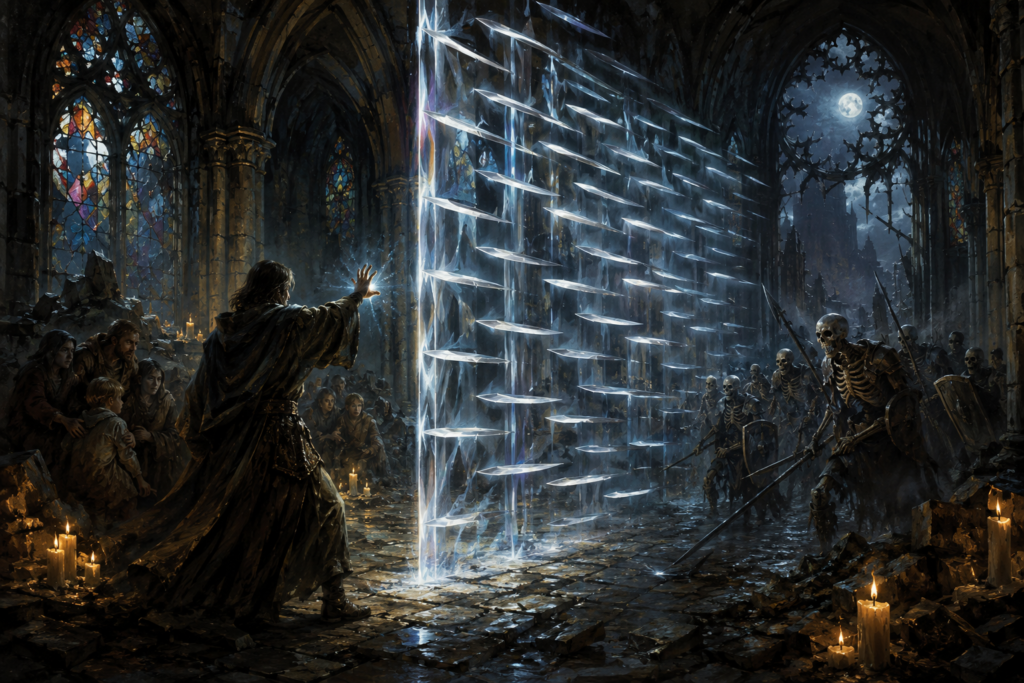
6th-Level Evocation
Casting Time: Action
Range: 120 feet
Components: V, S
Duration: Concentration, up to 10 minutes
Available To: Cleric
Alternative Spell Name: Wall of Judgement
You create an immobile vertical wall of whirling spectral blades made from magical force. The wall appears within range on a solid surface. You may form it as either a straight wall up to 100 feet long, 20 feet high, and 5 feet thick, or as a ringed wall up to 60 feet in diameter, 20 feet high, and 5 feet thick.
When the wall appears, each creature in its area must make a Dexterity saving throw. On a failed save, a creature takes 6d10 force damage. On a successful save, it takes no damage and moves to the nearest unoccupied space of its choice on one side of the wall.
A creature also makes this saving throw when it passes through the wall for the first time on a turn. On a failed save, the creature takes 6d10 force damage. On a successful save, it takes half as much damage. A creature can take this damage only once per turn.
The wall provides three-quarters cover against attacks and effects that pass through it. The wall does not block sight, but its whirling blades make attacks through it difficult.
At Higher Levels: When you cast this spell using a spell slot of 7th level or higher, the damage increases by 1d10 for each slot level above 6th.
Notes
- Caught When Cast: A creature in the wall’s area when it appears gets one Dexterity save to avoid the wall entirely.
- Crossing Later: A creature that later passes through the wall risks damage, even if it is pushed, pulled, dragged, or thrown through it.
- Once Per Turn: This prevents repeated forced-movement loops from dealing the spell’s damage several times in a single turn.
- Cover: Three-quarters cover reflects the barrier’s defensive value without making it a solid wall.
- Damage Type: Force damage keeps the spell aligned with its original magical-force identity.
Blade Barrier, Pathfinder 1e / 3.5e-Compatible Version
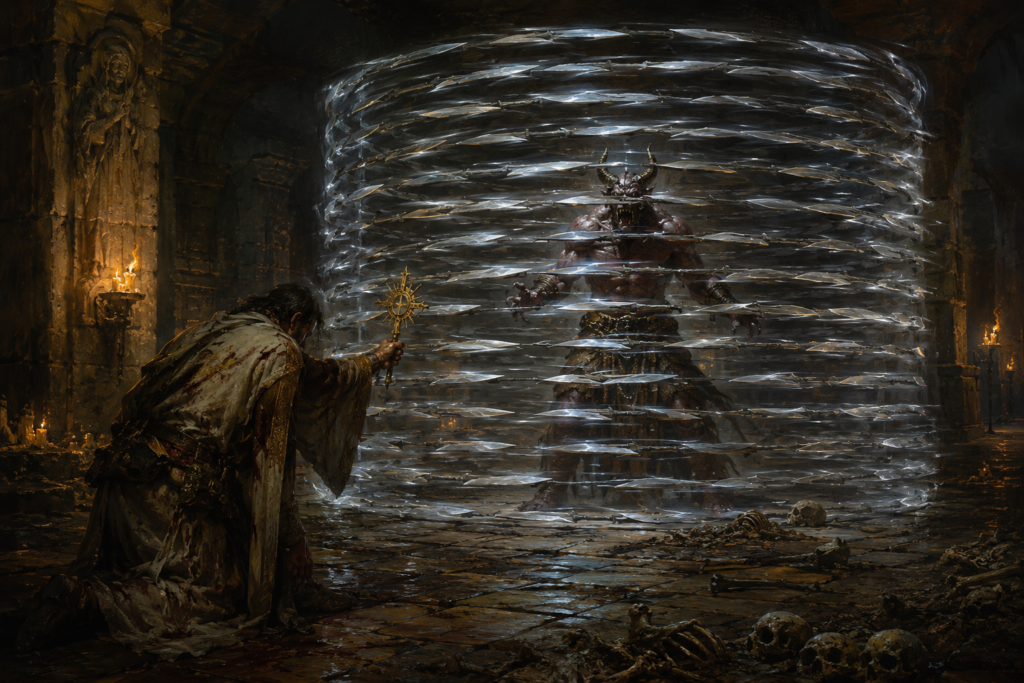
Evocation [Force]
Level: Cleric 6, Good 6, War 6
Components: V, S
Casting Time: 1 standard action
Range: Medium, 100 ft. + 10 ft./level
Effect: Wall of whirling blades up to 20 ft. long/level, or a ringed wall of whirling blades with a radius of up to 5 ft. per two caster levels; either form 20 ft. high
Duration: 1 min./level (D)
Saving Throw: Reflex half or Reflex negates; see text
Spell Resistance: Yes
An immobile, vertical curtain of whirling blades shaped from pure force springs into existence. Any creature passing through the wall takes 1d6 points of damage per caster level, to a maximum of 15d6. A successful Reflex save halves this damage.
If you evoke the barrier so that it appears where creatures are, each affected creature is treated as passing through the wall. However, each such creature may avoid the wall entirely by making a successful Reflex save. A creature that succeeds ends up on the side of its choice and takes no damage.
The barrier provides cover against attacks made through it, granting a +4 bonus to AC and a +2 bonus on Reflex saves against such attacks.
Pathfinder / 3.5e Notes
- Appearing on Creatures: If the spell appears directly through occupied squares, creatures get the Reflex save to avoid the wall entirely.
- Crossing Later: A creature that later chooses or is forced to pass through the barrier takes damage, with Reflex half.
- Cover, Not Total Cover: The barrier hinders attacks through it but does not fully block sight.
- Fixed Position: Once created, the barrier is immobile. The caster cannot move it down a corridor or sweep it across enemies.
Blade Barrier 3.0e
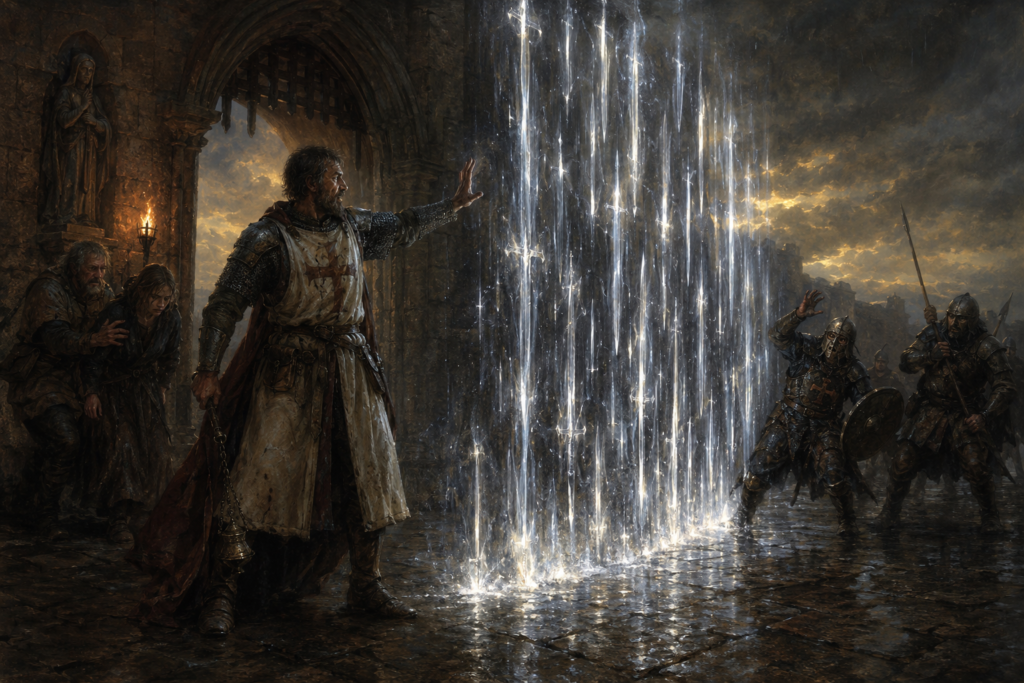
Evocation [Force]
Level Cleric 6, Good 6, War 6
Components V, S
Casting Time 1 standard action
Range Medium (100 ft. + 10 ft./level)
Effect Wall of whirling blades up to 20 ft. long/ level, or a ringed wall of whirling blades with a radius of up to 5 ft. per two levels; either form 20 ft. high
Duration 1 min./level (D)
Saving Throw Reflex half or Reflex negates; see text
Spell Resistance Yes
An immobile, vertical curtain of whirling blades shaped of pure force springs into existence. Any creature passing through the wall takes 1d6 points of damage per caster level (maximum 15d6), with a Reflex save for half damage.
If you evoke the barrier so that it appears where creatures are, each creature takes damage as if passing through the wall. Each such creature can avoid the wall (ending up on the side of its choice) and thus take no damage by making a successful Reflex save.
A blade barrier provides cover (+4 bonus to AC, +2 bonus on Reflex saves) against attacks made through it.
Why This Spell Is Dangerous in the World
Blade Barrier is feared because it turns divine authority into geography. A war-priest can divide cavalry from infantry. A temple guardian can make a sanctuary door impossible to storm. A battlefield cleric can cut a retreating army away from its commanders or seal a plague-choked street long enough for healers to escape.
The spell’s danger is not only its damage. It creates a public boundary with lethal force behind it. In a siege, that may save a city. In a crowded hall, it may become a massacre. In a sacred court, it may be remembered as either miracle or atrocity, depending on who stood on the wrong side when the blades appeared.
Rules Clarifications and Edge Cases
- Standing Beside the Wall: A creature beside the barrier is not damaged unless it enters, passes through, or is caught in the wall when it appears.
- Forced Movement: A creature pushed, pulled, thrown, or dragged through the barrier takes damage as normal for passing through it.
- Teleportation: A creature that teleports from one side to the other without passing through the barrier does not take crossing damage.
- Flying Creatures: The classic barrier is vertical and 20 feet high. Flying creatures can pass over it if they have enough space and movement.
- Missiles and Rays: The barrier hinders attacks through cover. It does not automatically destroy every arrow, bolt, ray, or thrown weapon unless a specific edition rule says otherwise.
Good Combinations
- Wall of Stone: Seal alternate routes so enemies must either retreat, remain trapped, or cross the blades.
- Spirit Guardians: Control the safe side of the barrier and punish enemies who push past it into the caster’s guarded space.
- Command: Force a creature to halt, flee, approach, or drop at exactly the wrong side of the barrier.
- Hold Person: Lock a humanoid threat near the wall while allies control the surrounding battlefield.
- Telekinesis: Move a dangerous enemy into a position where crossing the barrier becomes the least terrible option.
Adventure Hooks
- The Bladed Door: A shrine gate remains sealed by a lingering Blade Barrier that should have faded years ago. Something inside is still praying, feeding, or holding the spell in place.
- The Wrong Side of Mercy: A celebrated war-priest used the spell to stop raiders, but trapped villagers on the far side with them. The survivors now demand judgement.
- The Saint’s Corridor: A ruined battlefield contains a narrow road where invisible blades still manifest whenever oathbreakers try to pass.
Historical and Mythic Context
Blade Barrier belongs to the old sacred image of the forbidden threshold. Many mythic places are guarded not by locks, but by consequences: a gate watched by spirits, a bridge that tests the unworthy, a sanctuary line that the impure may not cross. This spell makes that idea visible. It does not merely block passage. It declares that crossing has a price.
The spell also draws power from the symbolic weight of the sword. Across many traditions, the blade is more than a weapon. It is a sign of judgement, kingship, office, oath, punishment, and sacred defence. A wall of blades therefore feels different from a wall of fire or stone. Fire consumes. Stone denies. Blades judge.
For historical background on swords as weapons and symbols of authority, see Britannica’s overview of the sword. For mythic comparison, the spell also belongs beside older stories of threshold guardians, bridge tests, sanctuary boundaries, and forbidden gates where passage itself proves worth, authority, or doom.