
 Buy me a coffee
Protesilaus — First Fallen of Troy, Greek Hero
A living Thessalian prince marked by prophecy: the first Achaean to set foot on Trojan soil is fated to die.
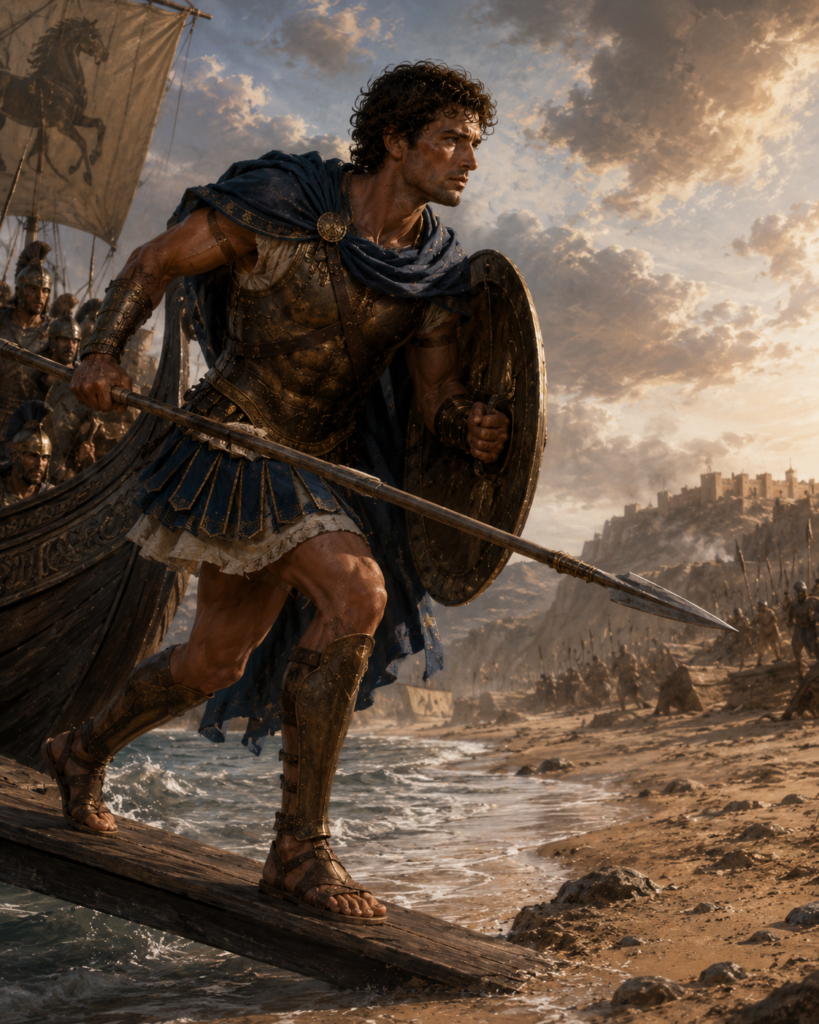
- Full Name: Protesilaus
- Greek Form: Protesilaos
- Earlier Name: Iolaus, in some traditions
- Common Name: Protesilaus
- Title: First Fallen of Troy
- Gender: Male
- Race: Human
- Occupation: Thessalian prince, Achaean war-leader, spear-fighter, ship commander
- People: Achaean Greek; Thessalian
- Homeland: Phylace in Thessaly
- Region: Thessaly, the Achaean fleet, the coast before Troy
- Base of Operations: Phylace; his ships; the Achaean war-camp; any council where a first landing, first assault, or first sacrifice is being debated
- Languages: Greek; battlefield command language; courtly and household speech of Thessaly
- Religion: Hellenic divine tradition, bound by oath, household duty, guest-right, war honour, and the gods who govern fate
- Alignment: Lawful Neutral
- Affiliations: The Achaean host; Thessalian warriors of Phylace; Laodamia; the house of Iphiclus; Greek kings bound by the war against Troy
- Allies: Laodamia, Podarces, loyal Thessalian captains, household retainers, oath-bound warriors, sailors, scouts, and soldiers who understand the cost of being first
- Rivals and Enemies: Trojan defenders, reckless glory-seekers, commanders who hide behind prophecy, men who send others forward to test doom, and anyone who dresses cowardice as command
Protesilaus is a living Hellenic hero standing at the edge of one of myth’s most dangerous thresholds.
Across the Achaean fleet, the prophecy is known: the first Greek to set foot on Trojan soil will die. Kings hear it, sailors whisper it, and warriors waiting in the ships understand that the war may demand its first corpse before it grants its first victory.
Protesilaus is the prince who steps forward anyway.
He is not reckless. He is not empty of fear. He is newly married, bound to Laodamia, lord of an unfinished house, and commander of men who trust him. That is what makes the prophecy bite. Protesilaus has everything to lose.
His courage is not noise. It is decision. He understands that a commander who survives by sending a prisoner, servant, slave, or ignorant soldier into foretold death has already lost the right to speak of honour.
In a campaign, Protesilaus is best used as a living prince under fate-pressure. His famous death at Troy is a threat, omen, prophecy, possible future, and moral test. He belongs wherever the party must decide who goes first when the first step may be fatal.
Character
Protesilaus is formal, restrained, and severe. He speaks like a man who expects words to become obligations.
He respects courage, but not performance. A quiet scout who admits fear and advances anyway earns more from him than a boasting noble who shouts of glory from the second rank.
He distrusts clever evasions of responsibility. Landing on another man’s body, forcing a captive forward, or twisting an oracle so that someone weaker pays the price does not impress him. It disgusts him.
His flaw is not lack of feeling. His flaw is that he may value the right act so highly that he cannot turn away from it, even when love, prudence, and the unfinished life behind him beg him to live.
Protesilaus and Laodamia
Protesilaus and Laodamia should be treated as the emotional centre of the story, not as a side note to the prophecy. Their marriage is what makes the prophecy hurt. Without Laodamia, Protesilaus can become only “the brave man who goes first.” With her, he becomes a living husband, householder, and prince whose future is still unfinished.
Laodamia gives the story its private cost. The Achaean kings may speak of honour, fate, landing rights, and military necessity, but she sees what those words actually threaten: a marriage barely begun, a household not yet completed, a woman being asked to surrender her husband to a prophecy that others find useful. She does not weaken Protesilaus’ heroism. She makes it more serious, because he is not choosing danger from emptiness, vanity, or despair. He has a life worth returning to.
In play, Laodamia should be more than “the grieving wife.” She is the person most able to challenge the heroic language surrounding Protesilaus. She may ask the party to recover the original wording of the prophecy, expose a false oracle, delay the landing, confront the Achaean kings, or prove that honour does not require her husband’s death. Her question is not simply “Can he be saved?” It is “Who decided that his death was necessary, and why?”
Used well, Laodamia prevents Protesilaus from becoming a flat martyr. She forces the campaign to treat his courage as a costly decision rather than a glorious pose. Protesilaus is brave because he has fear, love, duty, and a future pressing against him. Laodamia is the voice of that future. She makes clear that the first step onto Trojan soil is not just a military act; it is a choice that may break a household, a marriage, and a life that had every reason to continue.
The Prophecy of the First Step
The prophecy is the engine of the NPC:
The first Achaean to touch Trojan soil will die.
The prophecy may be literal, divine, corrupt, mistranslated, politically useful, or magically engineered by Troy. It may be avoidable only by dishonour. It may be a test of command rather than a fixed sentence.
Protesilaus does not ask whether men can trick fate. He asks what kind of men they become while trying.
Motives
Protesilaus wants to protect his men, honour his house, keep faith with Laodamia, fulfil his obligations, and avoid becoming the kind of commander who lives by spending lesser lives.
He may ask the party to investigate the prophecy, expose a false oracle, judge a proposed evasion, protect Laodamia from political pressure, or uncover which king benefits most if he dies first.
He is not against survival. He is against survival purchased by cowardice.
Fears
Protesilaus fears leaving Laodamia with an unfinished marriage and an unfinished house.
He fears his men will call his death glorious because calling it wasteful would wound them more deeply.
He fears the Achaean kings will learn that whenever leaders hesitate, a brave man can be found to pay for them.
He fears discovering that fate can be escaped only by becoming unworthy of escape.
Secrets
He does not want to die. That is why his courage matters.
He suspects the prophecy may be useful to someone. A seer, king, god, or Trojan agent may be shaping events so that his death becomes convenient.
He has considered the tricks. Shield, plank, captive, animal hide, delayed landing, technical wording. Most of them leave a stain he cannot accept.
Laodamia knows the fear beneath the discipline. The army sees the prince who may go first. She sees the husband trying not to tremble.
Using Protesilaus in Your Campaign
Use Protesilaus when the party faces a threshold where tactics, honour, and sacrifice collide.
He fits naturally into a Trojan War campaign, a Hellenic heroic campaign, a living myth-history setting, a cursed landing, a siege, a war council, or any story where leaders must decide whether the first cost will be chosen, volunteered, hidden, or imposed.
He should not be naïve. He knows the prophecy. He knows the tricks. He knows the kings are frightened. His tragedy is that understanding the trap does not free him from the choice.
Scene Uses
The War Council: The Achaean kings argue around the prophecy without naming the victim. Protesilaus forces them to speak plainly.
The Wife’s Plea: Laodamia asks the party to find a way through the doom that does not dishonour her husband or sacrifice another innocent person.
The Shield Trick: A clever captain proposes landing on a shield, plank, or carried platform so the prophecy technically falls elsewhere.
The First Through the Breach: A gate, bridge, sacred threshold, or fortress breach repeats the same problem away from Troy.
The False Oracle: The prophecy may have been altered, exaggerated, or mistranslated. Protesilaus needs proof before he decides whether to trust it.
The Unfinished House: Beams crack, doors refuse to hang straight, and household omens worsen as the fleet prepares to sail.
Adventure Hooks
The First Foot on the Black Shore
The fleet refuses to land because the oracle declares that the first Achaean ashore will die before sunset. A commander quietly plans to send a prisoner first. Protesilaus learns of it and asks the party to stop the scheme before the war begins with hidden cowardice.
Laodamia’s Bargain
Laodamia hires the party to recover the original wording of the prophecy. She does not want comfort. She wants truth, even if truth proves that her husband is walking toward death with open eyes.
The Shield on the Sand
A captain proposes a technical evasion: land on a shield instead of soil. The plan might save Protesilaus, or it might transfer the doom to the next man. The party must decide whether this is cunning, blasphemy, or murder by interpretation.
The King Who Would Not Step
One Achaean leader publicly praises Protesilaus while privately arranging for him to be the doomed first man. Protesilaus suspects the insult but cannot accuse without proof.
The House That Will Not Stand
Every beam placed in Protesilaus’ house cracks overnight. Laodamia believes the house is warning them. The priests call it grief. The omen may be older than either.
The First Dead Was Chosen
A captured Trojan spy claims the prophecy is not divine at all, but part of a ritual defence meant to bind the first invader’s blood to the land. If true, Protesilaus’ death would not be fate. It would be enemy magic.
Roleplaying Protesilaus
Protesilaus speaks directly, with controlled intensity. He dislikes flattery and evasive moral language.
Useful lines:
“Say it plainly. Who is meant to die first?”
“Do not call a man brave after arranging his death.”
“If there is a way through this that does not stain my house, find it.”
“I am not eager for death. That is why the choice matters.”
“Laodamia is not a footnote to my honour.”
“No army should begin with a lie buried in the sand.”
Protesilaus, 5.5e / 2024-Compatible Stat Block
Laodamia, Wife of Protesilaus, 5.5e / 2024-Compatible Stat Block
Protesilaus, First Fallen of Troy, Pathfinder 1e Stat Block
Protesilaus, First Fallen of Troy 5.5e / 2024
Medium Humanoid, Lawful Neutral
Armor Class 18
Initiative +3
Hit Points 136 (16d8 + 64)
Speed 30 ft.
Proficiency Bonus +4
| STR | DEX | CON | INT | WIS | CHA |
|---|---|---|---|---|---|
| 20 (+5) | 16 (+3) | 18 (+4) | 13 (+1) | 16 (+3) | 18 (+4) |
Saving Throws Str +9, Con +8, Wis +7, Cha +8
Skills Athletics +9, History +5, Insight +7, Intimidation +8, Perception +7, Persuasion +8
Senses passive Perception 17
Languages Greek
Challenge 9 (5,000 XP)
Traits
First Ashore. During the first round of combat, Protesilaus has Advantage on attack rolls against creatures that have not yet taken a turn. If he moves at least 20 feet straight toward a hostile creature before attacking it, his first hit that turn deals an extra 13 (3d8) Piercing damage.
Prince of Phylace. Allied creatures within 30 feet that can see or hear Protesilaus have Advantage on saving throws against being Frightened while he is not Incapacitated.
Threshold Commander. While Protesilaus stands in a doorway, breach, gangplank, ford, gate, shoreline, bridge, or similar threshold, allied creatures within 30 feet gain a +2 bonus to Initiative rolls and saving throws against being Frightened.
No Expendable First Man. Protesilaus has Advantage on Wisdom (Insight) checks made to determine whether a creature is being sent into danger without informed consent.
Actions
Multiattack. Protesilaus makes two Spear of the First Landing attacks.
Spear of the First Landing. Melee or Ranged Attack Roll: +9, reach 5 ft. or range 20/60 ft. Hit: 14 (2d8 + 5) Piercing damage, or 16 (2d10 + 5) Piercing damage if used with two hands to make a melee attack. If the target is standing on a threshold, ship, bridge, shore, gate, breach, or battlefield boundary, it takes an extra 9 (2d8) Piercing damage.
Shield-Breaking Advance. Protesilaus moves up to his Speed in a straight line without provoking Opportunity Attacks. He may move through the space of one Large or smaller hostile creature. That creature must succeed on a DC 17 Strength saving throw or take 18 (4d8) Bludgeoning damage and have the Prone condition.
Command the Landing. Protesilaus chooses up to three allied creatures within 60 feet that can hear him. Each target may move up to half its Speed without provoking Opportunity Attacks, provided this movement brings it closer to a shore, gate, breach, bridge, enemy line, or other contested threshold.
Reactions
I Will Be First. When an allied creature within 30 feet would trigger a trap, curse, readied attack, or hostile effect by being the first to enter an area, Protesilaus may move up to his Speed toward that area. If this movement places him in the triggering position, he becomes the target instead.
Bronze Answer. When a creature misses Protesilaus with a melee attack, Protesilaus makes one Spear of the First Landing attack against that creature.
Protesilaus, First Fallen of Troy, Pathfinder 1e Stat Block
CR 9
XP 6,400
Male human fighter 10
LN Medium humanoid human
Init +7; Senses Perception +15
Defense
AC 25, touch 14, flat-footed 22; +8 armor, +3 Dex, +3 shield, +1 dodge
hp 105 (10d10+50)
Fort +12, Ref +8, Will +8
Defensive Abilities bravery +3, threshold commander
Offense
Speed 30 ft.
Melee +2 spear +18/+13 (1d8+9/×3)
Ranged +2 spear +15 (1d8+7/×3)
Special Attacks first ashore, weapon training spears +2
Statistics
Str 20, Dex 16, Con 18, Int 13, Wis 16, Cha 18
Base Atk +10; CMB +15; CMD 29
Feats Combat Reflexes, Dodge, Improved Initiative, Iron Will, Lunge, Mobility, Power Attack, Step Up, Vital Strike, Weapon Focus (spear), Weapon Specialization (spear)
Skills Acrobatics +11, Intimidate +17, Knowledge (history) +11, Perception +15, Perform (oratory) +10, Sense Motive +16, Swim +13
Languages Greek
Gear +2 spear, bronze cuirass equivalent to +2 breastplate, heavy shield, sea-stained cloak, signet of Phylace, wedding token from Laodamia
Special Abilities
First Ashore (Ex). During the first round of combat, Protesilaus gains a +2 bonus on attack and damage rolls against creatures that have not yet acted. If he charges during that round, his first successful spear attack deals an additional 2d8 points of damage.
Threshold Commander (Ex). While occupying a doorway, breach, gangplank, ford, gate, bridge, shoreline, or similar threshold, Protesilaus grants allies within 30 feet a +2 morale bonus on saving throws against fear and a +1 morale bonus on attack rolls made as part of a charge or advance through that threshold.
I Will Be First (Ex). Once per round as an immediate action, when an ally within 30 feet would trigger a trap, readied attack, ambush, or harmful effect by being the first to enter an area, Protesilaus may move up to his speed. If he can reach the triggering space, he becomes the target of the effect instead.
Name the Cost (Ex). As a standard action, Protesilaus may challenge one enemy commander, priest, seer, or officer within 60 feet who can hear him. The target must succeed at a DC 19 Will save or take a –2 penalty on attack rolls, Bluff checks, Intimidate checks, and saving throws against fear for 1 minute whenever it uses unwilling subordinates, prisoners, servants, or hirelings to trigger danger in its place. This is a mind-affecting fear effect. The save DC is Charisma-based.
Laodamia, Wife of Protesilaus

Medium Humanoid, Neutral Good
Armor Class 13
Initiative +2
Hit Points 60 (11d8 + 11)
Speed 30 ft.
Proficiency Bonus +3
| STR | DEX | CON | INT | WIS | CHA |
|---|---|---|---|---|---|
| 10 (+0) | 14 (+2) | 12 (+1) | 15 (+2) | 18 (+4) | 20 (+5) |
Saving Throws Wis +7, Cha +8
Skills History +5, Insight +10, Medicine +7, Persuasion +8, Religion +5
Senses passive Perception 14
Languages Greek
Challenge 3 (700 XP)
Traits
Household Authority. Allied creatures within 30 feet of Laodamia that can hear her have Advantage on saving throws against being Charmed or Frightened while defending a home, spouse, oath, family member, guest, or sworn companion.
Clear-Eyed Love. Laodamia has Advantage on Wisdom (Insight) checks made to detect concealed fear, false courage, political manipulation, coerced consent, or a plan that treats a person’s death as useful before it treats that person as human.
Unfinished House. While Laodamia is in a household, war-camp, harbour, shrine, or ship prepared for departure, she can sense whether an oath, marriage, farewell, funeral duty, or promised return connected to that place has been broken or left dangerously incomplete. This sense gives emotional impressions and symbolic signs, not exact facts.
Laodamia and Protesilaus. While Protesilaus is within 60 feet of Laodamia and can see or hear her, he has Advantage on saving throws against being Charmed or Frightened. Once per day, when Protesilaus fails a saving throw, Laodamia can use her Reaction to let him reroll the save if he can hear her.
Actions
Dagger. Melee or Ranged Attack Roll: +5, reach 5 ft. or range 20/60 ft. Hit: 5 (1d4 + 2) Piercing damage.
Name the True Cost. Laodamia chooses one creature within 60 feet that can hear and understand her. The target must succeed on a DC 16 Wisdom saving throw or be unable to willingly order, coerce, deceive, or pressure another creature into entering obvious deadly danger until the end of Laodamia’s next turn. A creature that succeeds on the save is immune to this effect for 24 hours.
Plea Against Fate. Laodamia chooses up to three allied creatures within 60 feet that can hear her. Each target gains 7 (2d6) Temporary Hit Points and may immediately end the Frightened condition on itself. Once a creature benefits from this action, it cannot benefit from it again until it finishes a Long Rest.
Household Rebuke. Laodamia targets one creature within 60 feet that can hear her and has broken an oath, betrayed a spouse, sacrificed an unwilling subordinate, or knowingly profited from a false prophecy. The target must make a DC 16 Charisma saving throw. On a failed save, it takes 13 (3d8) Psychic damage and has Disadvantage on the next Charisma check it makes before the end of Laodamia’s next turn. On a successful save, it takes half as much damage and suffers no Disadvantage.
Promise of Return. Laodamia chooses one allied creature within 30 feet that can hear her and is about to leave a defended home, ship, camp, gate, harbour, or household threshold. For 1 hour, the creature gains a +1d4 bonus to saving throws against being Charmed or Frightened. The effect ends early if the creature knowingly breaks an oath, abandons a sworn companion, or sends another creature into danger in its place.
Bonus Actions
Steady the Beloved. Laodamia chooses one allied creature within 30 feet that can hear her. Until the start of Laodamia’s next turn, that creature gains a +1d4 bonus to one saving throw, ability check, or attack roll it makes while defending an oath, home, spouse, guest, or companion.
Reactions
Do Not Spend His Life Cheaply. When a creature Laodamia can see within 60 feet orders, coerces, or manipulates another creature into entering danger first, Laodamia forces that creature to make a DC 16 Wisdom saving throw. On a failed save, the triggering command falters; the intended subordinate may refuse without suffering magical compulsion, fear-based Disadvantage, or immediate morale penalty from that order.
Unfinished Return. When Protesilaus or another allied creature within 30 feet is reduced to 0 Hit Points but not killed outright after defending an oath, home, spouse, guest, companion, or promised return, Laodamia moves up to half her Speed toward that creature if she is able to move. The creature drops to 1 Hit Point instead. Laodamia can use this Reaction once per Long Rest.
Equipment and Treasure
Protesilaus carries the equipment of a prince who expects to fight at the front, not rule from the rear.
Personal Gear: Bronze cuirass, heavy shield, long spear, sea cloak, Thessalian horse-hair crest, signet of Phylace, command tokens for his ships, and a wedding token from Laodamia.
Appropriate Treasure: A gold-inlaid spearhead, a fine bronze shield, 800–1,500 gp in campaign wealth, gifts from Thessalian retainers, sealed letters from Laodamia, and costly materials intended for the unfinished house.
Major Item: Spear of the First Landing
This +2 spear is made for a warrior who expects to fight at the front of a landing, breach, or gate assault. It deals an extra 1d8 damage against a creature occupying a shore, gate, bridge, gangplank, breach, or battlefield boundary.
Once per long rest, when an adjacent ally would trigger a trap, ambush, or readied attack by being the first to enter a dangerous area, the bearer may use a reaction to move into the triggering position and become the target instead.
Campaign Consequences
If Protesilaus trusts the party, they gain more than a strong spear. They gain a commander who understands honour, fear, and the cost of leadership. He may bring ships, Thessalian soldiers, battlefield legitimacy, and the loyalty of men who know he will not spend them cheaply.
If they betray him, the damage should be political and personal. Laodamia may curse their names. Thessalian captains may withdraw support. The Achaean war council may fracture. Soldiers may begin asking whether their leaders intend to spend them in the same way.
If they save him from the prophecy without dishonouring him, they change more than one man’s fate. They change the moral beginning of the war.
Related SpiralWorlds Links
Source and Literary Context
Protesilaus, also called Protesilaos, is a Greek hero of the Trojan War cycle. He is remembered as a Thessalian prince and leader of the force from Phylace and neighbouring places. His defining tradition is that he was the first Achaean warrior to leap ashore at Troy and the first to fall there. For a concise summary, see Encyclopaedia Britannica’s Protesilaus entry.
Homer’s Iliad remembers Protesilaus as a fallen leader whose wife mourns him and whose house remains unfinished. For campaign adaptation, those details are essential because they make his courage personal rather than abstract: he is not a man with nothing to lose, but a prince, husband, and householder drawn toward a fatal first step. A public-domain translation of the Iliad is available through Project Gutenberg: Homer, The Iliad.
Later mythic traditions expand the connection between Protesilaus and Laodamia, especially her grief and the famous motif of his brief return after death. In this campaign version, that material is treated primarily as prophecy pressure, marital stakes, and possible consequence rather than as the baseline state of the NPC. For a classical source note on the three-hour return tradition, see Theoi’s Hermes page quoting Hyginus: Theoi, Hermes Myths 3.